How many Swiss jobs actually require German? I counted.
Every second person who moves here gets told the same thing: without German, forget it. I have heard it in bars, in RAV waiting rooms, and from recruiters who should know better. So this morning I stopped guessing and counted.
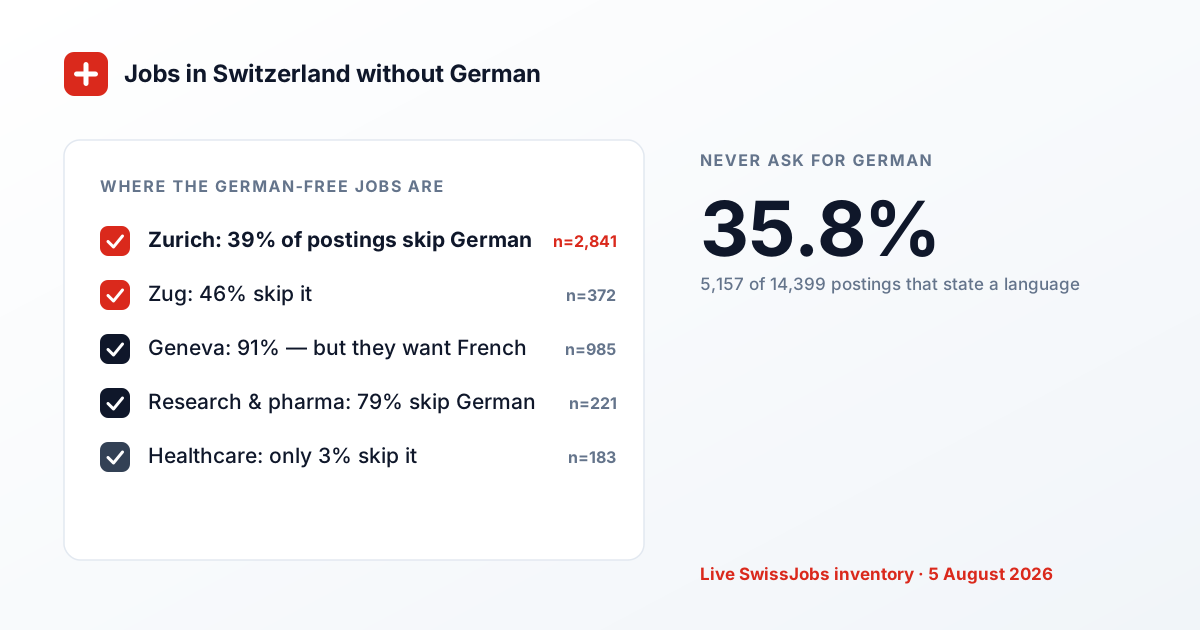
Our inventory held 18,715 live Swiss postings when I pulled it at 07:44. Of those, 14,399 actually name a language they want. German turns up in 9,242 of them — 64%. Which leaves 5,157 postings that state a language requirement, right now, today, and it is not German. That is not a rounding error. That is a third of the market.
Short version
- Can you get a job in Switzerland without German?
- Yes, and not only in some niche. Of the 14,399 live postings on our platform that state a language requirement this morning, 5,157 — 35.8% — never mention German at all, and 3,329 of those name English and nothing else. The catch is that they cluster: research, pharma, finance, IT, and the international employers around Zurich, Zug, Basel and Geneva.
- Which Swiss jobs are most likely to be English-only?
- Research and pharma lead by a distance — 79% of those postings never mention German and 91% name English. Finance and accounting sits at 57%, software and IT at 56% across 1,611 postings, which makes tech the biggest English-friendly pool in absolute terms. Care work is the opposite: of the healthcare postings that state a language, 97% want German.
- Where in Switzerland do jobs need German the least?
- Geneva (9% of its language-stating postings name German), Vaud (20%), Ticino (22%) and Valais (33%). But read the small print: in Geneva half those postings want French instead, in Vaud two thirds do. If you speak neither German nor French, Zurich and Zug are the better bet — 38.6% and 45.7% of their postings skip German, mostly in favour of English.
- How good does my German have to be if a job asks for it?
- Professional working level, not native. Across the 9,244 German requirements in the live inventory, 8,426 ask for professional level, 570 are happy with conversational, 55 with basic — and only 202 want a native speaker. In CEFR terms, B2 gets you into the conversation and C1 ends the argument.
- What should my CV say about languages?
- Levels, in the top third of page one, in the CEFR notation Swiss recruiters read daily: German B2 · English C1 · French A2. Not 'good language skills'. That one line decides whether a screener puts you on the yes pile or the maybe pile, and the maybe pile rarely gets opened again.
Working on your CV right now? ATS CV checker: free, against a real Swiss job ad
See what a Swiss recruiter checks first
Upload your CV and get a score against a specific job ad in about 30 seconds — language levels, work permit, photo, how your achievements are phrased.
ATS CV checker, freeSo how many Swiss jobs actually require German?
Of the 14,399 live postings that name a language at all, 9,242 ask for German — 64% — which leaves 5,157 that do not.
First the honest version of the number, including the part most articles skip. We had 18,715 published jobs live this morning, and 4,316 of them state no language requirement whatsoever — the advert simply does not say. I refuse to count those as German-free, because silence in a Swiss advert usually means the employer assumed rather than that they do not mind. So my base is the 14,399 postings that actually commit to something.
Inside that base: German 9,242 times, English 6,384, French 2,833, Italian 503. The shares add up to more than 100% because some adverts name two languages — though fewer than you would expect. 10,556 of them, 73%, name exactly one.
So no, German is not a myth, and anyone selling you the idea that Switzerland is basically English-speaking now has not looked at a job board lately. It is still the single biggest gate in this market. But a third of the door stands open, and 5,157 jobs is a big enough third that treating German as a hard prerequisite costs you months you did not need to spend.
Live SwissJobs inventory, 5 August 2026. Base: the 14,399 of 18,715 published postings that state at least one language requirement. An advert can name several languages, so the shares exceed 100%.
Write a custom CV for every job you apply to
Most people send the same CV everywhere. The AI editor rewrites yours per application — Swiss format, the right language, in about a minute.
CV maker & resume builder: tailor it to this jobWhich jobs do not ask for German?
Research, pharma, finance and IT — in research and pharma 79% of postings never mention German — while care work and sales are effectively closed without it.
This is where the market splits, and it splits hard. Take every posting that states a language and sort it by what the job actually is. Research and pharma skip German 79% of the time, and 91% of those adverts name English. Finance and accounting: 57%. Software and IT: 56% across 1,611 postings, which makes tech the largest English-friendly pool in absolute numbers, by a distance.
Now the other end of the same chart. Healthcare and care: 97% want German. Sales: 85%. Trades and construction: 74%, and a startling 3% name English at all. The logic is not snobbery, it is who you talk to all day. A Pflegefachfrau talks to an 84-year-old from the Emmental. A research scientist talks to a Slack channel spanning four countries.
Which makes the useful question not 'can I work in Switzerland without German' but 'is my profession one where the customer is Swiss'. If the answer is yes, learn the language, because no CV trick substitutes for it. If your work already happens in English, you are competing on skills, and there are considerably more of those roles than the folklore admits.
Live SwissJobs inventory, 5 August 2026. Language-stating postings grouped by job-title keywords; between 175 and 1,611 postings per group.
See what a Swiss recruiter checks first
Upload your CV and get a score against a specific job ad in about 30 seconds — language levels, work permit, photo, how your achievements are phrased.
ATS CV checker, freeWhere in Switzerland can I work without German?
Geneva and Vaud barely ask for it — 9% and 20% — but they want French instead, so for an English-only applicant Zurich and Zug are the real targets.
The map is not the one people expect. German requirements do collapse in the west: Geneva 9%, Vaud 20%, Neuchâtel lower still. But that is the Röstigraben, not an opening for internationals. Half of Geneva's language-stating postings name French, and in Vaud it is two thirds. Swapping one language wall for another is not progress if you speak neither.
The genuinely English-friendly cantons are the ones with international head offices in them. In Zurich, 38.6% of language-stating postings never mention German, and 37.8% name English and no continental language at all — out of 2,841 postings, so the absolute numbers are serious. Zug is proportionally even better at 45.7%. Basel-Stadt sits in the middle at 25.6%, carried almost entirely by pharma.
And then the deep end: Thurgau 94% German, St. Gallen 93%, Graubünden 93%, Lucerne 91%, Aargau 90%. If you are hunting from abroad with English only and your search radius sits over the Ostschweiz, the numbers say move the radius, not the CV.
Live SwissJobs inventory, 5 August 2026. Share of each canton's language-stating postings that name German; between 429 and 2,841 postings per canton.
How good does my German actually have to be?
Professional working level — 8,426 of the 9,244 German requirements say exactly that, and only 202 ask for a native speaker.
This one surprised me a little. When a Swiss advert names German, it almost never demands perfection: 8,426 of the requirements land at professional working level, 570 at conversational, 55 at basic, and 202 — two hundred and two, out of more than nine thousand — want a native speaker. Native German is a rounding error in this market.
In CEFR terms that is B2 to C1. B2 means you can sit in a meeting held in German and contribute to it. C1 means nobody slows down for you. Neither means flawless written Hochdeutsch, and none of it means understanding Schweizerdeutsch on day one — people switch to Hochdeutsch in the meeting and back to dialect at the coffee machine, and that gap catches out everyone who moves here, Germans included.
The practical read: if you are at B1 and climbing, apply to the professional-level jobs anyway and say where you are. 'German B1, currently in a B2 course, English C1' is a candidate with a trajectory. 'Basic German' is a shrug. And if you want the certificate Swiss employers and migration offices actually recognise, that is fide, linked below.
What does all this mean for my CV?
Put your language levels in the top third of page one in CEFR notation, with your permit in the same block, because the screener will not go hunting for either.
Every number above describes a filter that gets applied in roughly thirty seconds. Permit, language, location. If a recruiter has to dig into page two to find out whether you speak the language their own advert named, you are no longer being evaluated — you are being deferred. And nobody comes back to the deferred pile.
So: three lines, directly under your name. Languages with levels. Permit or citizenship — an EU/EFTA passport is an administrative formality here, a non-EU one is a genuine hurdle, and vagueness always gets read as the worse case. Then where you live, or where you are moving to and when. That block answers the entire first screen before anyone reaches your work history.
Then aim properly. If your field sits on the English-friendly side of the chart above, target the cantons where those employers actually are, and stop apologising for your German in the cover letter. If it does not, the honest answer is that the language is the job requirement and no amount of dossier polish gets around it. Either way, run the finished CV against one real posting before you send it. That is what the CV check below does, and it is a lot cheaper than twenty silences.
What I would actually use
Three links, one of them not ours:
- SwissJobsour tool
Ours. All 18,715 live Swiss postings in one place, filterable by canton and language — which is where every number in this article came from. Useful for seeing the English-friendly slice for your own job title rather than for the market as a whole.
SwissJobs SwissJobs CV Check our tool
Ours, free. Run your CV against one specific posting and it flags what a Swiss screener stumbles over in the first pass: no permit line, language levels buried on page two, duties written where results belong.
Try it free- fide
Neutral and official. The Swiss language-certificate system for German, French and Italian — the one that carries weight with employers and with the migration authorities, unlike a self-declared level.
Visit site
I do not want to oversell this. German is still the largest single requirement in the Swiss market, and learning it will change your options more than any application tactic ever will. Start anyway.
But 'you cannot work here without German' is the kind of thing everyone repeats and nobody counts. I counted. It is 5,157 jobs, this morning, and not one of them cares whether you believed the folklore.
The tools compared
We checked 16 Swiss and international application tools on their own pages — prices, free tiers, and what is actually included.