RAV applications per month: how many are realistic in your field?
Register with the RAV and you are given a number early on: this many job-search efforts per month, documented and evidenced. Depending on canton, occupation and adviser, it usually sits somewhere between eight and twelve.
That number is much the same for almost everyone. The job market behind it is not remotely the same.
We analysed roughly twenty thousand published Swiss adverts by where they are and which occupational field they belong to. The result explains something rarely said out loud in an RAV meeting: for some job seekers the quota is two afternoons' work, and for others it forces applications that everyone involved knows are not a fit.
Both produce frustration, for opposite reasons — and neither case is a motivation problem.
Short version
- How many applications does the RAV require per month?
- There is no nationally fixed figure. Your adviser sets it based on occupation, region and labour-market conditions; in practice it usually falls somewhere between eight and twelve per month.
- What if my field genuinely does not have that many suitable openings?
- That is a legitimate thing to raise, not an admission. The requirement is meant to be appropriate to the market — document how many suitable adverts actually existed in your field and region, and bring that to the conversation.
- In which fields is the quota hardest?
- The narrow ones. IT and software make up around 31% of the adverts we could assign to a field; logistics and transport around 2.8% — a ratio of roughly eleven to one. In a small field in a small canton the number of suitable adverts is quickly in single digits.
- Do speculative applications count?
- Usually yes, and in narrow fields they are often the only route to the quota. Two thirds of Swiss adverts run through company careers pages anyway, so the line between an advert and a speculative approach is thinner than it looks.
Working on your CV right now? ATS CV checker: free, against a real Swiss job ad
See what a Swiss recruiter checks first
Upload your CV and get a score against a specific job ad in about 30 seconds — language levels, work permit, photo, how your achievements are phrased.
ATS CV checker, freeHow unevenly is the Swiss job market spread?
Zurich alone accounts for roughly a quarter of adverts whose canton we know — the three largest cantons together for more than four in ten.
The first inequality is geographic, and it is larger than population figures would suggest. Zurich accounts for 23.9% of the adverts where we know the canton. Bern, Geneva and Vaud follow between 8.5% and 9.1%. At the other end, several cantons sit in the two-to-three percent range.
For the RAV quota this means the same number of applications requires selecting from a broad field in Zurich and exhausting the field in a small canton. Anyone who cannot or will not move — which is most people — has a structurally smaller market without behaving any differently.
It is also why commuting comes up so often in advisory meetings. The recommendation is not arbitrary: in Switzerland the radius around your home decides the number of reachable jobs more sharply than in larger countries, because distances are short and cantonal boundaries are economically real.
The order of the argument matters. Not "you should be more mobile", but: if the quota does not add up inside your radius, then either the radius or the quota needs adjusting — and both are negotiable.
Share of published Swiss adverts with a known canton, August 2026.
Write a custom CV for every job you apply to
Most people send the same CV everywhere. The AI editor rewrites yours per application — Swiss format, the right language, in about a minute.
CV maker & resume builder: tailor it to this jobHow big is the gap between occupational fields?
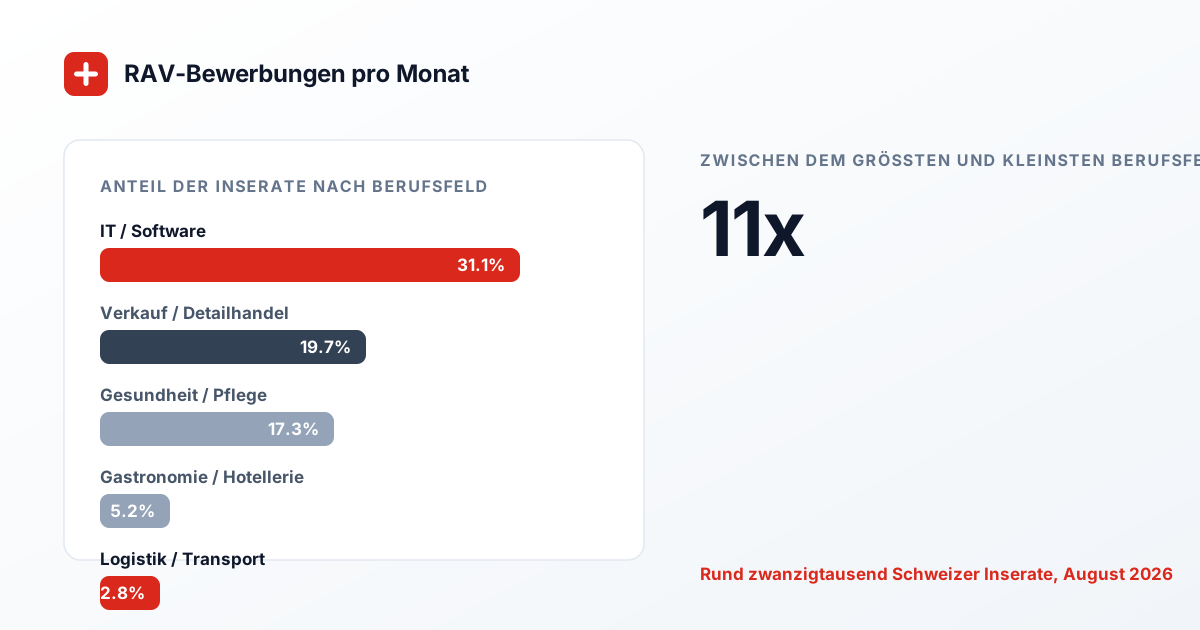
Between the largest and smallest of the eight fields analysed there is roughly a factor of eleven.
The second inequality is occupational and it is sharper still. IT and software account for 31.1% of the adverts we could assign to a field. Sales and retail follow at 19.7%, health and care at 17.3%.
At the bottom sit logistics and transport at 2.8% and hospitality at 5.2%. Between the top and bottom fields there is therefore roughly an elevenfold difference.
That number is the actual point of this article. A quota of ten applications a month is a formality in software development in the German-speaking cantons — there are more suitable adverts than anyone can sensibly work through. The same quota in a narrow field in a small canton can mean there simply are not ten suitable openings.
What happens then is familiar and appears in no leaflet: you apply for jobs you do not want, are overqualified for, or are plainly wrong for, in order to reach a number. It costs time, generates rejections that land on your own tally, and over months erodes the willingness to apply carefully to the ones that do fit.
Share of assigned published Swiss adverts by field, August 2026.
See what a Swiss recruiter checks first
Upload your CV and get a score against a specific job ad in about 30 seconds — language levels, work permit, photo, how your achievements are phrased.
ATS CV checker, freeWhy does concentration hit some people twice?
Searching in a narrow field outside the large centres multiplies two constraints rather than adding them.
The two inequalities do not add up, they multiply. The three largest cantons together account for 41.9% of all adverts with a known canton. Anyone living in one of the twenty others and searching in a field worth a few percent of the market is operating in a fraction of a fraction.
These are precisely the people who sit in an advisory meeting facing a requirement that does not match their market, and who rarely have numbers to hand to show it. The conversation then ends up about motivation when it was about availability.
The same holds in reverse. If you are in Zurich in a broad field and meet the quota effortlessly, do not measure yourself by it. Ten quickly dispatched applications are not a better result than four careful ones — the quota measures effort, not prospects.
So the useful way to hold the number is identical in both cases: it is an administrative requirement, not a strategy. The strategy has to exist alongside it.
Share of published Swiss adverts with a known canton, August 2026.
How do you raise this in the advisory meeting?
With a count rather than an impression — the requirement is meant to be appropriate, and appropriateness can be evidenced.
The job-search-effort requirement is meant to be appropriate to the labour market. What counts as appropriate is your adviser's judgement — and judgement responds to evidence far more readily than to impressions.
The scale is easy to state. If your field is around 3% of the assigned market and an acquaintance's is 31%, then roughly eleven times as many adverts sit behind the same monthly requirement. That the same number feels entirely different to the two of you is not a matter of attitude.
In practice: keep a simple list for one month. Date, role, company, source, and a column marked suitable / borderline / unsuitable. If the month ends with six entries under suitable and the requirement is ten, that is a conversation with substance rather than a complaint.
The list helps in the other direction too. If thirty suitable adverts accumulate and still produce no invitation, the problem is not the number but the dossier — and then the time is better spent on the documents than on further applications.
Take speculative applications seriously as well. Two thirds of Swiss adverts lead to company careers pages, many roles appear there before they reach the portals, and in narrow fields direct approaches are often the only way to reach a double-digit figure at all.
The same monthly requirement meets very differently sized sub-markets. Published Swiss adverts, August 2026.
What should you actually do?
Count what genuinely exists in your field and radius, then set both quota and effort against it.
Four things, in this order.
Count for a month. Without the list, every conversation about the quota is a conversation about feelings.
Decide your realistic radius before someone else decides it for you. If half an hour more commuting materially enlarges your reachable market, that is a decision you want to make deliberately rather than meet as a reproach.
Separate quota from quality cleanly. Meet the requirement, but measure your progress by the applications you actually want. Five careful dossiers and five obligatory applications is a better month than ten half ones.
Check the dossier when the number is right and the replies are missing. Our <a href="https://swissjobs.app/cv-check">CV check</a> compares your CV against a specific advert and shows which requirements have no counterpart; if you are rebuilding from scratch, the <a href="https://swissjobs.app/cv-builder">CV template</a> for Switzerland produces a document with the expected dossier parts. Both are free.
And keep in view what the number is and is not. It evidences that you are searching. It does not decide whether you are found.
Tools mentioned in this article
Both are free and both are ours, which is labelled.
The short version: the RAV quota is much the same for everyone, and the market behind it is not. Between the largest and smallest occupational field there is roughly a factor of eleven, and the three largest cantons together account for more than four adverts in ten.
If the requirement feels impossible, there is a fair chance it genuinely is impossible in your slice of the market. That is not a reproach to you and not one to your adviser — it is a number you can put on the table, once you have it.
The tools compared
We checked 16 Swiss and international application tools on their own pages — prices, free tiers, and what is actually included.