Remote jobs Switzerland: the word to search for, and how to tell a real one from a relocation ad
Type Homeoffice into a Swiss job search and you get a handful of results. Type Remote and the list is about twenty times longer. Same jobs, same week, one word apart. We see it every day in what people search for on our own site, and it is the cheapest fix in any remote job hunt.
So here is the practical version: the word to type, how to tell a Swiss remote job from a call-centre ad that says remote and means Athens, what hybrid actually promises, whether you need German, and how many days a week a Grenzgänger or frontalier may legally work from home across the border. All of it from the adverts we read this month and the rules in force right now.
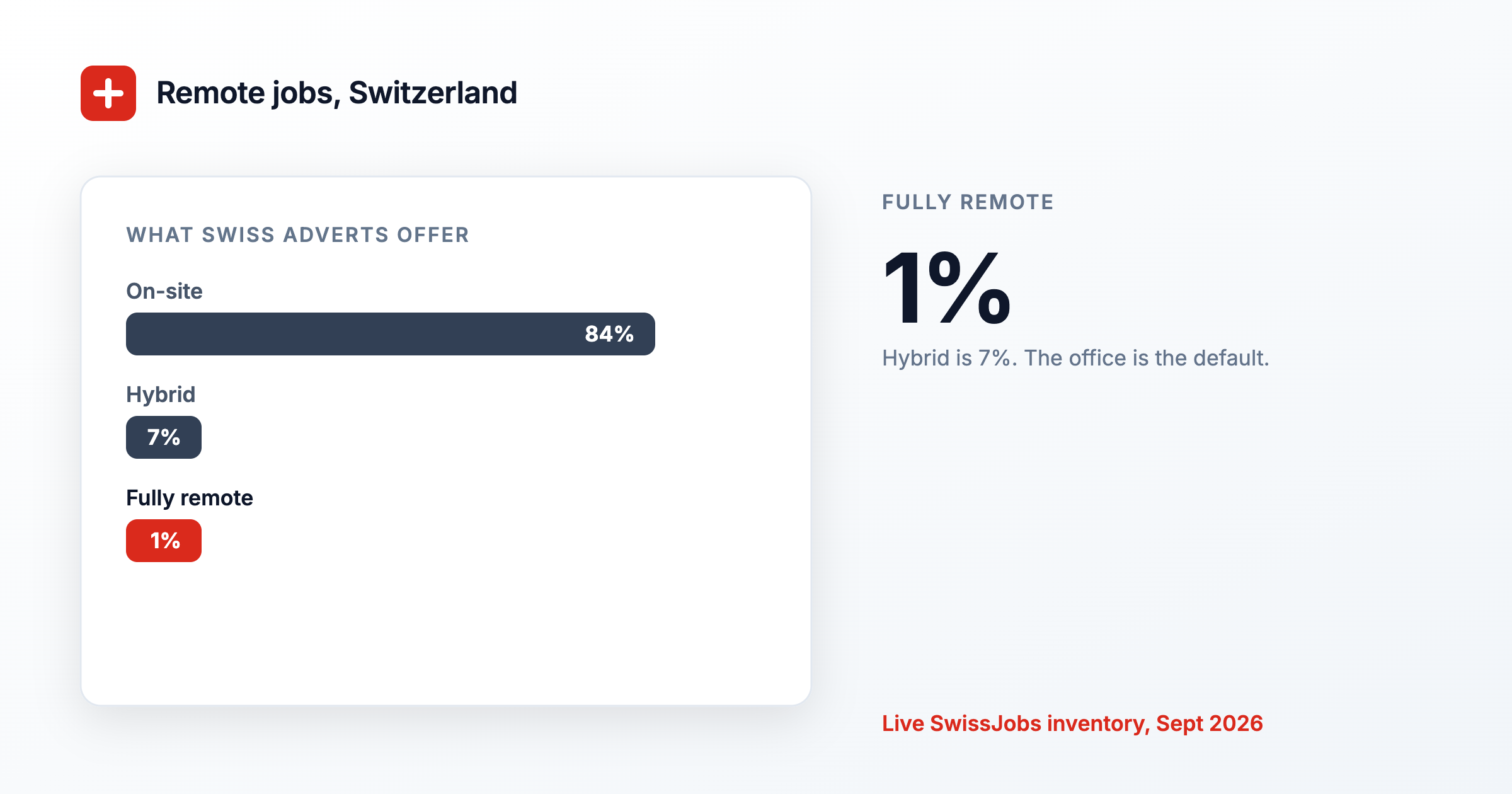
One caution up front. Remote work is a thin slice of the Swiss market: across every published advert, about 84% are on-site, about 7% hybrid and roughly 1% fully remote. The office is the default and home is the exception. Anyone promising you a fully remote Swiss salary from a beach is selling something.
Short version
- What word should I search for remote jobs in Switzerland?
- Here you no longer need the right word: filter by work mode, on-site, hybrid or fully remote, because every advert is tagged from its own text. On other sites, type remote first and hybrid second. Of the titles that name one of these words, about seven in ten say Remote and a quarter say Hybrid; Homeoffice is about 4%, so searching for it hides almost the whole pile.
- Are there fully remote jobs in Switzerland?
- Few. Among Swiss adverts that mention working from home at all, roughly one in nine says fully or 100% remote. The rest are hybrid, with the office as the default and the home days agreed after the offer, not in the advert.
- How many days can a frontalier or Grenzgänger work from home?
- Up to 49.9% of working time keeps you in Swiss social insurance (since July 2023; January 2024 for Italy). The tax caps are lower: 40% from France, 25% from Italy. The lower cap applies, so plan on two days a week from France and one from Italy.
- Do remote jobs in Switzerland require German?
- Less often than office jobs. Roughly one in four remote-flagged adverts asks for German, against four in ten across the whole market, and half of them name no language at all. English is named more often than German in that group.
- Can I work remotely from abroad for a Swiss company?
- Not on a normal Swiss employment contract. A B permit requires you to live in Switzerland, and cross-border home office is capped at 49.9% of your hours. Fully remote from abroad is a different contract, usually through an employer of record, with local tax and social insurance.
- How do I distinguish a genuine Swiss remote opportunity from a relocation advertisement?
- Check the location and the currency. A Swiss remote role names Switzerland or a Swiss city, pays in CHF and quotes a Pensum. An advert that mentions relocation, a relocation bonus or another country is a job abroad advertised on Swiss boards.
Working on your CV right now? ATS CV checker: free, against a real Swiss job ad
See what a Swiss recruiter checks first
Upload your CV and get a score against a specific job ad in about 30 seconds — language levels, work permit, photo, how your achievements are phrased.
ATS CV checker, freeWhich word do I type: Homeoffice, Remote or Hybrid?
Not here, filter by work mode instead. On any other site, type remote first and hybrid second; Homeoffice, the word most people search for, is about 4% of the titles that name one at all.
We counted the word Swiss employers put in the job title when the role can be done from home. Remote wins by a mile: roughly two thirds of those titles carry it. Hybrid takes most of the rest. Homeoffice, Home Office and Télétravail together are a rounding error. So a search box on jobs.ch, LinkedIn, Indeed or our own site (which matches on titles) never shows a Homeoffice searcher the Remote roles. Different word, empty page.
The fix used to be two saved searches. Now it is one filter: we read each advert's own words and tag it on-site, hybrid or fully remote, so you can ask for the thing instead of the word. Where that filter does not exist, run two searches, remote and hybrid, and save both as alerts. Add homeoffice only for German-speaking cantons and télétravail only for Romandie. Skip home-based, distance and flexible: nobody in Switzerland titles a job that way.
Hybrid represents a quarter of job listings, and within this subset, positions designated as hybrid remain visible when a city filter is applied, due to the employer's readiness to accommodate you on-site. Conversely, roles classified as Remote often fail to specify a location, thereby posing a distinct type of challenge for applicants.
Read from each advert's own wording across all published adverts on SwissJobs.app, September 2026.
Write a custom CV for every job you apply to
Most people send the same CV everywhere. The AI editor rewrites yours per application — Swiss format, the right language, in about a minute.
CV maker & resume builder: tailor it to this jobHow can I distinguish between a genuine Swiss job posting for a remote position and a relocation advertisement?
Read the location line and the currency before the job description: a third of remote adverts name no city at all, and some that say remote mean a desk in Athens.
Three checks, in order. First, the location. Roughly a third of the adverts that flag remote work list only Switzerland, no city. Good because the employer does not care where in the country you sit, bad because the moment you filter by Zurich or Geneva those adverts vanish. So when you hunt remote, clear the location filter and sort by date instead.
Second, the country. A recurring shape in our list is the title Customer Support, German-speaking, Remote, Greece, relocation included. That is a call centre in Athens hiring German speakers on Swiss boards because the language matters and the address does not. If the advert mentions relocation, a relocation bonus or any country other than Switzerland, it is not a Swiss remote job, and the salary is local to wherever the desk is.
Third, the money. A Swiss remote role pays in CHF, quotes a Pensum (80-100% is the usual range) and names a Swiss entity as the employer. A remote role priced in EUR or USD with no Swiss entity is usually a contractor arrangement, and that changes your tax, your pension and your permit situation entirely.
See what a Swiss recruiter checks first
Upload your CV and get a score against a specific job ad in about 30 seconds — language levels, work permit, photo, how your achievements are phrased.
ATS CV checker, freeHybrid or fully remote: what does the advert actually promise?
Hybrid means the office is the default and home is negotiated; only about one advert in nine that mentions remote work says fully or 100% remote.
Among the adverts that mention working from home at all, about one in nine uses the words fully remote or 100% remote. Everything else is hybrid, remote possible, or home office by arrangement. Read those three as the same sentence: you will have a desk, and how often you sit at it is decided after the offer, not in the advert.
At the initial meeting, you should specifically inquire about the following: will you be working on-site a fixed number of days per week, or does the schedule vary by team? Are these work-from-home days specified in your employment contract or outlined in a company policy that can be modified at will? Swiss employers rarely include work-from-home arrangements in the employment contract; instead, they are typically outlined in a Reglement, which can be revised within a quarter. If having two days to work from home is a crucial factor in your decision to take the job, ensure that the number of such days is explicitly documented so you can easily reference it.
Do I need German for a remote job in Switzerland?
Among the adverts that flag remote, half display no language, and English is cited more frequently than German.
Across the Swiss market as a whole, about four adverts in ten ask for German. Among the adverts that flag remote or hybrid work it is closer to one in four, and half of them name no language requirement at all. Where a language is named, it is more often English than German.
The reason for this is straightforward. Remote positions are typically held by teams from companies that serve clients beyond the local market, such as software, data, and sales operations in the DACH region, as well as finance back offices. These teams predominantly function in English. Conversely, a remote role that insists on proficiency in German indicates that the work involves interaction with Swiss clients or regulatory bodies, where the language is not merely a requirement, but a fundamental aspect of the job.
So if your German is weak, the remote pile is your best odds anywhere in the Swiss market, and the advert's own language is the tell. Written in German with German required: apply only if you can hold a phone call in it. Written in English with no language named: apply, and put your English level where a Swiss recruiter looks first, right under your name.
How many days can a cross-border worker work from home?
Up to 49.9% of your hours for social insurance, and a lower tax cap depending on the country: 40% from France, 25% from Italy.
If you live in France, Germany, Italy, Austria or Liechtenstein and work for a Swiss employer, two separate rules cap your home-office days, and the lower one wins. The first is social insurance. Since 1 July 2023 (1 January 2024 for Italy), a multilateral agreement lets you work up to 49.9% of your time from home in your country of residence and stay insured in Switzerland: AHV, pension fund, accident cover. Cross the 50% line and you fall into your home country's system, and your employer has to register there. Almost no Swiss employer will do that for one person.
The second is tax. France and Switzerland agreed that up to 40% of working time from home leaves your taxation unchanged; that rule became permanent this year. Italy allows 25% since 1 January 2024. For Germany, a day worked at home counts as a day you returned home, so the social-insurance cap is the one that binds. Austria and Liechtenstein have their own arrangements; ask HR before you promise anything. Your employer applies for the A1 certificate; your only job is to tell them the true split.
In practice: a five-day week from France allows two days at home, from Italy one, from Germany two. Fully remote from across the border is not a thing under these rules, whatever the advert says. Put the number you can actually offer in the application. I live in Annemasse and can be on site three days a week gets you an interview. I would like to work remotely gets you a polite no.
What do I write in the application for a remote or hybrid role?
The four critical pieces of information that the recruiter scrutinizes before proceeding with your application are: your town, the specifics of your permit, the designated days for on-site presence, and your corresponding time zone - all of which are prominently displayed in the top section of the first page.
Swiss recruiters screen the top of page one for permit, location and languages before they read a single bullet. For a remote or hybrid role that check gets stricter, not looser, because the employer is about to trust you with a setup they cannot see. Give the four answers unasked: where you live (town, not just country), your permit status, how many days you can be on site, and your working hours if you sit in another time zone.
The permit is the silent killer of applications. To qualify for it, EU and EFTA citizens must already have a Swiss address; the permit is tied to the contract and requires them to use it as a de facto residence. However, non-EU citizens face a more complex hurdle, as their employer must persuade the canton that they need to hire this individual, and the remote role is notoriously the most difficult to justify, as the canton's first question will inevitably be: why does this person need to be in Switzerland in the first place? The permit does not apply to working remotely from abroad on a Swiss contract; instead, a separate arrangement, typically with an employer of record, is required.
Then the CV itself. A hybrid advert still lists a stack of requirements and is screened like any other. Before sending, run the CV against the advert and look at what the screen would flag: a missing language level, a tool named in the advert and absent from the CV, no location line. Fix those, then send. A remote role draws more applicants than a local one, from further away, so first-screen mistakes cost more, not less.
Three links, one of them not ours
The above-mentioned searches and checks are accompanied by the official cross-border home office webpage.
- SwissJobsour tool
Ours. Search remote and hybrid across Swiss boards, career pages and LinkedIn in one place, with the city filter cleared.
SwissJobs CV check our tool
Ours, free. Reads your CV against one specific advert and lists what a Swiss first screen would flag, in about half a minute.
Try it free- BSV: cross-border telework rules
The Federal Social Insurance Office's page on the 49.9% rule, the A1 certificate and which countries have signed (German page; the agreement itself is linked there in English).
Visit site
Ensure you're searching for remote and hybrid positions, not Homeoffice. Deactivate the city-specific filter to broaden your results. Exclude any job postings referencing relocation or international assignments. Confirm the on-site workdays in writing. Be aware of your cross-border cap before attending the interview. Prioritize highlighting town, permit, and workdays at the top of your CV, especially for the first thirty seconds of the reader's attention.
You can accomplish these steps without a tool. For the sake of convenience, our CV check software automatically compares a CV against a job posting and highlights any potential red flags that a Swiss screen would flag. Whether you choose to use it or not, the six-step process is clearly outlined in the article.
The tools compared
We checked 16 Swiss and international application tools on their own pages — prices, free tiers, and what is actually included.