Which Swiss canton has the most jobs? I counted all 20,777
Someone asked me last week which canton pays best. Reasonable question to ask a person who has 20,777 live Swiss job postings sitting in a storage bucket. I said I'd look it up. Twenty minutes later I had an answer, and the answer was: I can't tell you. Not from job ads, anyway.
This is the thing nobody warns you about before you move here. Swiss employers do not put salaries in job adverts. Not "rarely" — of the 20,777 postings live on our platform at 08:12 this morning, exactly zero carry a salary field, and twelve mention a franc figure anywhere in the text. Twelve. So I stopped chasing the number that isn't there and measured the four that are: where the openings sit, what language they're written in, how senior they are, and how many of them are part-time. That map answers the real question better than a salary column would have.
Short version
- Which Swiss canton has the most job openings right now?
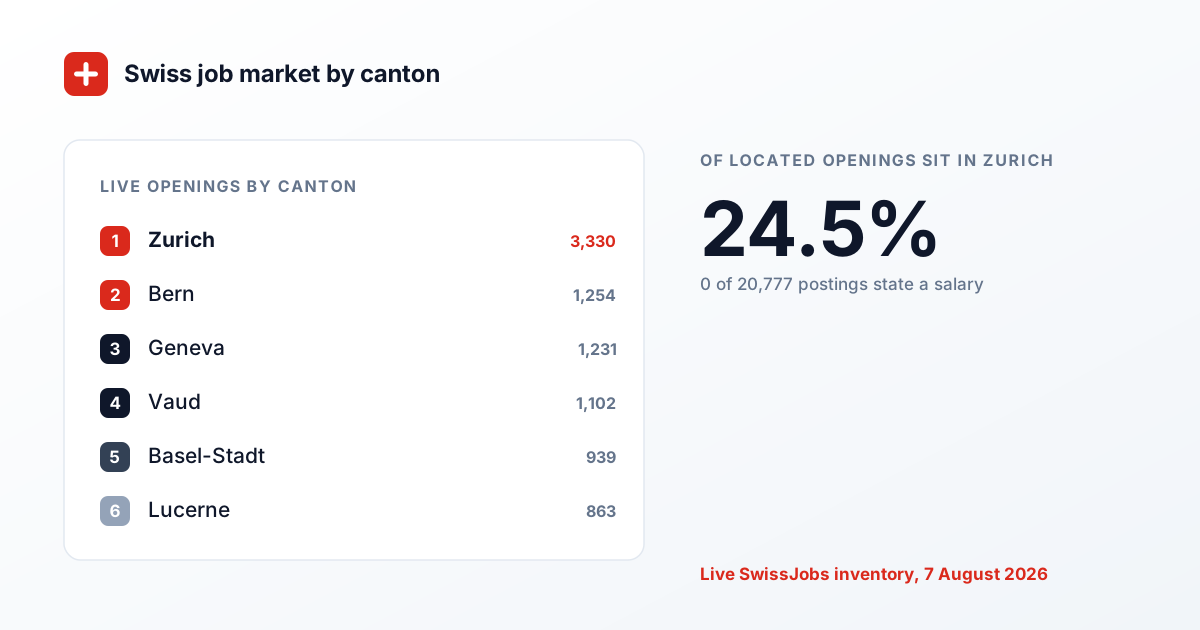
- Zurich, and it isn't close. 3,330 of the 13,580 live postings with a resolved canton sit in Zurich — 24.5%, more than Bern (1,254) and Geneva (1,231) put together. Then Vaud 1,102, Basel-Stadt 939, Lucerne 863, Aargau 780. The five biggest cantons hold 57.8% of the located market between them, which is roughly the concentration you'd guess from the map and then underestimate anyway.
- Which Swiss canton pays the best?
- Job adverts cannot answer this and neither can I from this dataset. Zero of 20,777 live postings carry a structured salary, and 12 of the 16,149 with a text summary put a CHF figure in it — 0.07%. For actual pay figures use the federal wage statistics through the SECO national salary calculator. What the ads do show is where the internationally-paying employers cluster: Zug, Geneva and Zurich, on both the English-language and the seniority measure.
- Where in Switzerland can I work without German?
- Zug (57.7% of language-detected ads in English), Geneva (57.4%) and Zurich (53.1%). In Zurich, English is named as a required language more often than German is — 1,727 of the canton's 3,330 postings versus 1,607. Move east or into central Switzerland and it collapses: Lucerne 10.4%, Graubünden 8.1%, Thurgau 6.3%.
- Where are the senior roles concentrated?
- Zug and Zurich. 27.1% of Zug's openings and 24.6% of Zurich's carry a senior, lead, head, director or Leiter-type title, against a 14.3% national average. Geneva 20.7%, Basel-Stadt 19.0%, Vaud 18.1%. At the other end: Lucerne 6.8%, Graubünden 6.0%, Schwyz 3.7% — plenty of work, much flatter title structure.
- Which canton is realistic for part-time work?
- Solothurn (15.6% of its openings), Schaffhausen (12.7%), Schwyz (12.6%), Bern (12.2%), Graubünden (12.0%), Aargau and St. Gallen (both 11.5%). The national figure is 6.4%. Geneva (2.9%) and Fribourg (2.3%) are the hardest places to find an advertised part-time role — the Pensum culture is genuinely regional.
Working on your CV right now? ATS CV checker: free, against a real Swiss job ad
See what a Swiss recruiter checks first
Upload your CV and get a score against a specific job ad in about 30 seconds — language levels, work permit, photo, how your achievements are phrased.
ATS CV checker, freeWhich canton actually has the jobs?
Zurich holds 3,330 of the 13,580 located openings — 24.5%, more than Bern and Geneva combined — and the five biggest cantons hold 57.8% of everything.
Start with the raw count, because everything else in this article is a slice of it. Zurich 3,330. Bern 1,254. Geneva 1,231. Vaud 1,102. Basel-Stadt 939. Lucerne 863. Aargau 780. Fribourg 617. Valais 503. St. Gallen 489. Zug 435. Solothurn 365. Graubünden 334. Ticino 267. Neuchâtel 255. Thurgau 250. All 26 cantons appear, right down to Uri with two.
One in four openings is in a single canton. I knew Zurich was big; I did not expect it to outweigh the entire Romandie's two largest cantons put together. And Zug is the number that should stop you — 435 postings out of a canton of roughly 130,000 people, more than Ticino manages with nearly three times the population.
Now the caveat, because you should know what you're looking at. Of the 20,777 published postings, 13,580 carry a resolved canton. That's not a random two-thirds: the geocoding pass runs a few days behind the scraper, so 88.7% of postings older than a week have a canton and only 0.9% of this week's 5,521 arrivals do. The canton picture is drawn on the settled part of the index. When I look at the raw location strings on the unresolved rows, the most common ones are Zürich (810), Bern (505), "Switzerland" (448), Basel (297) and Genève (225) — the same centres, in roughly the same order. So the shape holds, but treat the absolute counts as a floor, not a census.
Second caveat, smaller: Basel-Landschaft shows 35 postings, which is nonsense as a description of Baselland's economy. Almost everything in that agglomeration advertises with a Basel address and lands in Basel-Stadt. Read the Basel bar as "the Basel region" and don't draw conclusions about Liestal.
Live SwissJobs inventory, 7 August 2026. Base: the 13,580 of 20,777 published postings with a resolved canton; percentages are of that base.
Write a custom CV for every job you apply to
Most people send the same CV everywhere. The AI editor rewrites yours per application — Swiss format, the right language, in about a minute.
CV maker & resume builder: tailor it to this jobSo which canton pays best?
I can't tell you from job ads, and that's not a limitation of my dataset — it's a fact about the Swiss market: zero of 20,777 live postings carry a salary field and twelve put a franc figure anywhere in the text.
I want to be exact about this, because it's the part people don't believe. Structured salary data on 20,777 live postings: none. Not a low share. Zero. Then I went looking in the free text — 16,149 of the postings have a summary of the advert, and 309 of those mention pay in words at all (1.9%). Of those, 12 attach an actual number.
Here's the entire visible evidence, more or less: one advert quoting a Lohnband of CHF 84'000–100'000, one at CHF 183,800–309,700 a year, one at CHF 25–30 an hour, a couple more in the same shape. Twelve data points out of twenty thousand. You could not build a canton ranking out of that if your job depended on it, and I'm not going to pretend otherwise by dressing up a guess.
So what do you do instead? Use the federal numbers. The Lohnstrukturerhebung is a proper survey of actual paid wages, it's free, and SECO wraps it in a calculator where you enter branch, region, age, education and Pensum and get a range for your exact profile. That's a far better answer than anything scraped off job boards, and it's the one I give people who ask me at parties.
One thing the silence itself tells you, though. In a market where no advert states pay, the salary conversation happens entirely in the interview, and the number is set by what you ask for. If you come from a country with published salary bands, this is the single most expensive habit to bring with you: waiting to be told. Look the range up beforehand, then name it.
See what a Swiss recruiter checks first
Upload your CV and get a score against a specific job ad in about 30 seconds — language levels, work permit, photo, how your achievements are phrased.
ATS CV checker, freeWhere are the senior openings?
Zug 27.1% and Zurich 24.6% of postings carry a senior, lead, head or director title, against a national average of 14.3% — while Lucerne sits at 6.8%.
Second proxy, same logic. I can't see salaries, but I can see titles, and a canton whose adverts are one-quarter senior-and-above is a canton full of head-office layers. I counted every posting whose title contains senior, lead, head, principal, chief, director, managing, Leiter/Leiterin, chef or responsable — crude, but consistent across all 26 cantons, so the comparison holds even where the absolute level is rough.
Zug 27.1%. Zurich 24.6%. Geneva 20.7%. Basel-Stadt 19.0%. Vaud 18.1%. National 14.3%. Then Bern 11.0%, Ticino 9.4%, Aargau 8.1%, St. Gallen 8.0%, Lucerne 6.8%, Graubünden 6.0%, Schwyz 3.7%.
Notice that Zug tops both this and the English list, off a base of only 435 postings. That's what a canton of holding companies and regional headquarters looks like in job-advert data: few openings, disproportionately senior, disproportionately in English. If you're a mid-career specialist, 435 postings in Zug are worth more of your attention than the raw count suggests. If you're two years out of university, they're worth much less.
Which is the honest inversion of the whole "where's the money" question. The cantons with the highest share of senior work are the hardest ones to enter at the bottom. Lucerne's 6.8% isn't a weakness — it's a market advertising a lot of ordinary jobs that ordinary applicants can actually get.
Live SwissJobs inventory, 7 August 2026. Job titles matched against senior/lead/head/principal/chief/director/Leiter/chef/responsable; base is each canton's located postings. National average 14.3%.
And where is part-time actually normal?
The map turns upside down: Solothurn 15.6%, Schaffhausen 12.7% and Bern 12.2% of openings are advertised part-time, against 2.9% in Geneva and 2.3% in Fribourg.
Every chart so far has had the same four cantons on top. This one doesn't, and that's why I like it. Solothurn 15.6%. Schaffhausen 12.7%. Schwyz 12.6%. Bern 12.2%. Graubünden 12.0%. Thurgau 11.6%. Aargau and St. Gallen 11.5%. National average across the whole inventory: 6.4%.
Then the bottom: Zurich 5.3%, Lucerne 5.3%, Vaud 4.8%, Zug 3.4%, Geneva 2.9%, Fribourg 2.3%. So the cantons with the most international, most senior, best-paying-by-proxy work are also the ones least likely to advertise anything under 100%.
There's a language split hiding in here too. Part-time shares run visibly higher across German-speaking cantons than French-speaking ones, which matches something anyone who has worked on both sides of the Röstigraben will tell you: an 80% Pensum is an unremarkable career choice in Bern or Aarau and still a slightly awkward conversation in Geneva.
If a reduced Pensum is non-negotiable for you, that changes the search order, not just the filter. Fewer than one in thirty Geneva adverts offers it. One in six in Solothurn does.
Live SwissJobs inventory, 7 August 2026. Base: each canton's located postings, employment type as stated in the advert. National average 6.4%.
What does any of this change about my application?
Two lines on page one: which canton you can actually work in, and what permit you hold — because in a market with no published salaries, the screening happens on logistics first and money never.
The practical read of these four charts is a search order. If you want senior and international, you're looking at Zug, Zurich, Geneva and Basel and you'll be competing with everyone else who ran the same numbers. If you want volume and a realistic shot, Bern, Aargau, Lucerne and St. Gallen advertise thousands of jobs that never appear in an English-language newsletter. If you need 80%, start in the German-speaking mid-sized cantons and stop wasting evenings on Geneva.
Then the part that actually decides whether anyone reads you. Your CV has to say where you can work and under what status, in the top third of page one. "Zurich, B permit" or "EU citizen, no permit required, relocating to Basel in October". I've watched this go wrong more times than any other single thing: strong candidate, no location line, screener can't tell in five seconds whether hiring them means a work-permit process, moves on. Nobody writes back to tell you that's what happened.
Languages, same paragraph, with levels: "German B2 · English C1 · French A2". Given the numbers above, if you're applying into Zurich or Zug, put English first and don't apologise for B1 German. If you're applying into Lucerne or Thurgau, the reverse, and be honest about the level — 89.6% of Lucerne's detectable adverts are in something other than English.
That top-third check is mechanical, which is why we automated it. Paste the posting, upload your CV, and our CV check tells you which of those lines a Swiss screener won't find. It has no opinion about which canton you should live in.
What I'd actually use
Three links, one of them not ours:
- SwissJobsour tool
Ours. All 20,777 live Swiss postings, filterable by canton — every figure in this article came out of it. Useful here because you can set the canton filter and see the volume difference for yourself rather than taking my word for the ranking.
SwissJobs SwissJobs CV Check our tool
Ours, free. Run your CV against one specific posting: it flags the things a Swiss screener looks for in the first pass and usually can't find — location and permit line, language levels in CEFR notation, results instead of duties.
Try it free- SECO national salary calculator
Not ours, and the right tool for the question this article can't answer. The federal calculator is built on the official wage survey — enter branch, region, age, education and Pensum, get a realistic range for your profile before you walk into the salary conversation.
Visit site
So: Zurich has the jobs, Zug has the seniority, Solothurn has the Pensum flexibility, and nobody at all has the salary printed on the tin. That last one isn't going to change soon, so treat it as a rule of the game rather than an annoyance — look the range up yourself, and turn up to the interview with a number in your head.
I'll re-run this in a few months. The interesting thing won't be Zurich's lead, which is structural, but whether the English share keeps climbing in cantons where it currently doesn't. That's the number I'd bet on moving.
The tools compared
We checked 16 Swiss and international application tools on their own pages — prices, free tiers, and what is actually included.