Sachbearbeiter, Fachspezialist, Mitarbeiter: I counted 16,807 Swiss job titles so you don't have to
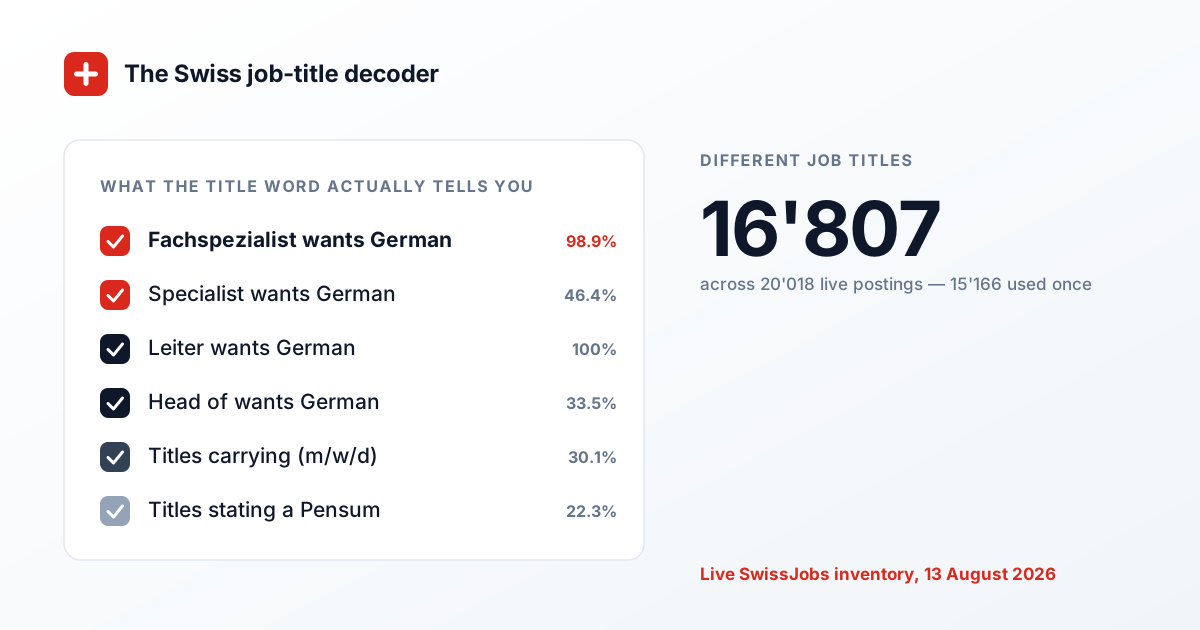
I pulled the inventory at 08:20 this morning: 20,018 live Swiss postings. Then I did something a bit stupid and counted the titles. Not the words in them — the whole titles, exactly as written.
16,807 different ones. And 15,166 of those appear exactly once in the entire Swiss market as we see it. One posting, one title, never used again by anybody.
That killed the article I was planning to write. I wanted a clean ladder — Mitarbeiter at the bottom, Sachbearbeiter above it, Fachspezialist above that, Leiter on top, here's your salary band. There is no ladder. Swiss employers don't share a job-title system, they improvise one per opening. But while I was failing to find the ladder I found something more useful, and it's the thing this article is actually about: the word in the title barely predicts the level, and it predicts the language of the job almost perfectly.
Short version
- What does Sachbearbeiter mean in English?
- There's no clean equivalent, which is why you keep googling it. The closest honest translation is "case handler" or "administrative specialist" — someone who owns a defined process end to end (invoicing, claims, withholding tax, debt collection) without managing people. It is not a manager and not an assistant. In our inventory it's 233 of 20,018 live postings (1.2%), and only 2.1% of those titles also carry a leadership word, which is the data version of "this is an individual contributor role".
- What's the difference between Fachspezialist and Specialist?
- In practice, the language of the workplace. Of the 93 Fachspezialist postings whose text we could parse, 92 (98.9%) require German. Of the 599 Specialist postings, 278 (46.4%) do. Same seniority, same kind of work, two very different doors. If you don't speak German, the English word in the title is doing more for you than any line on your CV.
- Does Senior mean management in Switzerland?
- No, and this trips up almost every international candidate I talk to. Of the 1,431 live postings with Senior in the title, only 22.4% also carry a management word (Leiter, Head, Director, Manager, Verantwortlich). Senior here means depth, not headcount — you're expected to be the person who knows the thing, not the person who runs the people. The expert track is a real career here, and it's not a consolation prize.
- What do (m/w/d), 80–100% and EFZ mean in a Swiss job title?
- (m/w/d) or (w/m/d) is the gender tag — männlich/weiblich/divers, legally motivated, carries zero information about the job; 30.1% of live titles have one. A percentage like 80–100% is the Pensum, the workload the employer will hire for, and 22.3% of titles state one. EFZ is the federal vocational certificate (4.7% of titles); HF and FH are tertiary vocational and university-of-applied-sciences degrees. Strip all of that out and the actual job title is usually two words long.
- Should I put the advert's job title on my CV?
- For that one application, yes — in the headline under your name, matching their wording. Not because of some robot keyword myth, but because a Swiss screener spends about thirty seconds deciding whether you're in the right category at all, and "Sachbearbeiter Debitoren" reads as an instant yes where "Finance Operations Associate" makes them work. Keep your real title in the experience section. You're labelling the application, not rewriting your history.
Working on your CV right now? ATS CV checker: free, against a real Swiss job ad
See what a Swiss recruiter checks first
Upload your CV and get a score against a specific job ad in about 30 seconds — language levels, work permit, photo, how your achievements are phrased.
ATS CV checker, freeWhy do 20,018 Swiss job ads need 16,807 different titles?
Because nobody's coordinating: 90.2% of the distinct titles in our inventory are used by exactly one posting, so a Swiss job title is a sentence an HR person wrote once, not a rank in a shared system.
Look at the actual output for a second. "Sachbearbeiter/in Quellensteuer (m/w/d)". "Technischer Sachbearbeiter Ersatzteile (m/w/d) 80-100%". "Stv. Filialleiter / Stv. Filialleiterin (m/w/d) 80-100%". "Fachspezialist/in Inkasso, 80-100%". Every one of those is doing four jobs at once: naming the function, the specialisation, the gender-neutrality compliance and the workload. No wonder they're all different.
The handful of titles that do repeat are almost all retail and apprenticeships, where one big employer posts the same role in eighty towns. "Verkäufer:in Food" appears 109 times. "Verkäufer:in Kassen/Services", 54. "Metzger:in (Fleischfachfrau / Fleischfachmann)", 45. Outside that, repetition basically stops.
Which has one immediate consequence for how you search. Searching a title is searching for one company's phrasing. If "Sachbearbeiter Buchhaltung" gives you a handful of hits, that is not the size of the market — that is the number of employers who happened to phrase it your way this month. Search the function word instead, and search it in more than one language.
And the second consequence is the one I didn't expect. If the title doesn't encode a level, what does it encode? Something, clearly — these words are not random. It just isn't seniority.
Live SwissJobs inventory, 13 August 2026. Titles compared exactly as written, including the (m/w/d) and Pensum suffixes.
Write a custom CV for every job you apply to
Most people send the same CV everywhere. The AI editor rewrites yours per application — Swiss format, the right language, in about a minute.
CV maker & resume builder: tailor it to this jobWhat does Sachbearbeiter actually mean in English?
It means "the person who owns this process" — a case handler or administrative specialist with no direct reports, and the reason it won't translate is that English-speaking companies split that one role across several different titles.
Sache is the matter, the file, the case. Bearbeiter is the one who works on it. A Sachbearbeiter Debitoren owns receivables. A Sachbearbeiter Quellensteuer owns withholding tax for a canton's worth of employees. It's a substantial job with real ownership and it is deliberately not a management job — of the 233 live postings using the word, 2.1% also carry a leadership term.
Here's the honest bit though. Everyone searching "Sachbearbeiter English" assumes it's the backbone of the Swiss market. It's 1.2% of live postings. Mitarbeiter (533, and the most junior-signalling word we have — 0.4% carry a leadership term) is bigger. Fachmann/Fachfrau, the vocational-qualification form, is bigger again at 953. Verkäufer, 454. And apprenticeships — Lehrstelle, Lernende, apprenti, apprendista — 816 postings between them, 4.1% of everything advertised in this country, which still strikes me as the most Swiss statistic I produce all week.
The rest of the decoder, quickly. Fachspezialist: subject-matter expert, deeper than Sachbearbeiter, still no team (1.7% leadership words). Leiter or Leitung: runs something — 1,286 postings, and "Projektleiter" (328) runs projects while "Teamleiter" (227) runs people, which is not the same job. Stv.: Stellvertreter, the deputy, 186 postings — a real rung, usually the one before the Leiter role opens up. dipl.: diplomiert, 371 postings, meaning the qualification is regulated and they will check it.
A word on Chef, because it catches people twice. In a French-language advert it means boss — "chef de projet" is a project manager. In a German-language one it's usually the kitchen. "Sous-Chefin / Sous-Chef oder Köchin / Koch 100%" is a real live title and it is not a management role in the sense you're hoping.
See what a Swiss recruiter checks first
Upload your CV and get a score against a specific job ad in about 30 seconds — language levels, work permit, photo, how your achievements are phrased.
ATS CV checker, freeDoes a Swiss job title tell you the seniority?
Barely — the only reliable seniority signal in a Swiss title is an explicit leadership word, and Senior isn't one of them: just 22.4% of Senior postings also say Leiter, Head, Director or Manager.
I tested this the blunt way: for each title word, what share of those postings also contain a management term? Mitarbeiter, 0.4%. Fachspezialist, 1.7%. Specialist, 1.7%. Sachbearbeiter, 2.1%. Senior, 22.4%.
So the words split into two clean groups — the ones that say management out loud, and everything else. There's no middle. That's the difference from the US market, where Associate → Manager → Senior Manager → Director is a ladder everyone reads the same way. Here, if the title doesn't contain Leiter, Head, Director, Manager or Verantwortliche, you should assume no direct reports and check the advert body for the actual scope.
Which makes the Senior number worth sitting with for a second. Four out of five Senior roles in Switzerland are senior individual contributors. If you've been reading "Senior" as a step towards managing people, you've been misreading the Swiss market — the expert track runs all the way up here, and plenty of people take it on purpose. I think that's healthier than the alternative, honestly. It also means "Senior" on your CV had better be backed by depth, because that's what they'll test.
The title doesn't tell you the level. It tells you the language.
This is the finding: every single one of the 1,050 Leiter postings we could parse requires German, and so do all 174 Sachbearbeiter roles — while only 33.5% of Head of roles and 17.5% of Director roles do.
Put Fachspezialist and Specialist side by side. Nominally the same job. 98.9% of Fachspezialist postings require German; 46.4% of Specialist postings do. Leiter versus Head of: 100% against 33.5%. The German word isn't describing a different job. It's describing a different employer — one whose internal language is German and who therefore wrote the title in German without thinking about it.
Broaden it and the pattern holds. Titles built on a German function word (5,606 postings) require German 99.7% of the time. Titles built on an English one and no German word (5,768 postings) require German 47.8% of the time. Two almost identically sized halves of the market, and one of them is more than twice as open to you if your German is the weak point.
That 47.8% deserves its own warning, though, because it cuts the other way too. Nearly half of the English-titled jobs still want German. "Senior Project Manager" on a Swiss careers page is not a promise of an English-speaking workplace — for 45.1% of Senior roles and 56.8% of Manager roles, German is in the requirements. Engineer is 54.6%. I see people apply to forty English-titled postings, hear nothing, and conclude the market is closed. Half of those forty asked for a language they didn't mention in the CV.
The geography backs it up rather than contradicting it. Of the located Head of roles, 48.3% are in Zurich, against 23.6% for the inventory as a whole — international headquarters, English titles, English requirements. Sachbearbeiter roles spread out across Bern (18.1%), Zurich (17.1%), Aargau (11.4%) and Luzern (10.5%): domestic employers, German titles, German required. The title is a proxy for who's hiring.
So use it. When you're scanning a list of a hundred adverts and deciding which fifteen to spend a real application on, the language of the title is the cheapest filter you have — and it's free, you can read it from the search results page without opening anything.
Live SwissJobs inventory, 13 August 2026. Percentages are of the 16,571 postings (82.8%) whose advert text could be parsed for language requirements — the other 3,447 have no readable requirements and are excluded rather than counted as "no German needed".
What do (m/w/d), 80–100% and EFZ mean in the title?
They're metadata bolted onto the title: 30.1% of live titles carry a gender tag, 22.3% state a Pensum, and 4.7% name a federal vocational certificate — none of it describes the work.
The gender tag first, because it's the biggest and the emptiest. (m/w/d), (w/m/d), (m/w), Verkäufer:in, Mitarbeiter*in, Fachfrau/-mann — it all means the same thing: all genders welcome. 30.1% of titles carry some form of it. Ignore it completely. It tells you nothing about the employer beyond that their HR software has that field switched on.
The Pensum is the one that actually matters, and 22.3% of titles state one — 12.8% as a range like "80-100%". That range is not indecision. It means the employer will hire at 80% and is telling you so upfront, which in Switzerland is a normal and completely non-career-limiting arrangement. (I went into this in more detail in the piece on what the Pensum numbers really say at /blog/part-time-jobs-switzerland, including why the tagged part-time count badly understates how much of the market flexes.)
Then the qualifications. EFZ (937 titles) is the eidgenössisches Fähigkeitszeugnis, the federal certificate at the end of a three- or four-year apprenticeship. EBA is its two-year sibling. HF (273) is a tertiary professional degree, FH (153) a university of applied sciences. When these appear in the title rather than the body, treat them as hard filters — the employer put them in the shop window deliberately, and "equivalent foreign qualification" is a conversation you'll need to have early rather than hope nobody notices.
One more, minor but useful: 4.3% of titles name a city. Given that 9,350 of our 20,018 postings carry no structured location at all, a city in the title is sometimes the only place the location exists. Worth reading before you assume a job is near you.
Share of all 20,018 live titles, SwissJobs inventory, 13 August 2026.
So what goes on your CV?
Their title in your headline for that one application, your real title in your experience section, and your language levels high enough on the page that the screener never has to guess.
If the advert says Sachbearbeiter Debitoren, the line under your name says Sachbearbeiter Debitoren. Not "Finance Operations Associate", even if that's what your last employer called you — put that in the experience block where it belongs, with the dates and the results. The headline is a label for this application, and its only job is to get you past a thirty-second categorisation.
Second, and this follows directly from the chart above: if two thirds of the parsed market states German as a requirement and 90.2% of titles are one-offs, then the screener cannot infer your language level from your job history the way they might in a single-language market. Write it. "German C1, English C2, French B1" in the top third, using the CEFR levels, not "fluent" and definitely not "good". Same for your permit and your notice period. Every one of those is a thing they check before they read a single bullet point about your achievements.
Third — and this is the bit people skip — read ten adverts in your field before you rewrite anything. Not to copy them. To find out which of the two halves of this market you're actually applying into, because "Fachspezialist Rechnungswesen" and "Finance Specialist" want a visibly different dossier even when the work is identical. One wants a Swiss-format two-pager with your Arbeitszeugnisse attached. The other wants a clean one-page achievements CV and has never heard of an Arbeitszeugnis.
If you're not sure which one you just sent, that's what the CV check is for. Paste the advert, paste your CV, and it'll tell you which requirements the posting states and whether your document answers them — including the language line, which is the one that quietly kills more applications than any formatting choice ever will.
What I'd actually use for this
Three of these are ours and I'll say so each time. The fourth is the official Swiss source for what a qualification title means, and there's no version of this article where I don't send you there.
- SwissJobsour tool
Ours. The 20,018 live postings every number in this article came out of. Search the function word rather than the full title — "Sachbearbeiter" and "Specialist" separately, because as the chart shows, they're two different markets wearing the same job.
SwissJobs SwissJobs CV Check our tool
Ours, free. Run your CV against one specific advert. It reads the requirements the posting actually states — languages, permit, availability, qualification — and tells you which ones your document doesn't answer. Most useful on exactly the postings whose title didn't tell you what you were walking into.
Try it free- SwissJobs — low-competition feedour tool
Ours. Postings crawled straight from employers' own applicant tracking systems. Relevant here because that pool skews heavily English-titled and English-speaking, so if the German requirement is your blocker, it's the part of the inventory worth reading first.
SwissJobs — low-competition feed - berufsberatung.ch
Not ours. The official Swiss careers portal. If a title contains EFZ, EBA, HF or a regulated "dipl." qualification and you want to know what it actually certifies — and what a foreign equivalent would need to look like — this is the authoritative source rather than a blog.
Visit site
I came into this morning wanting to build a Swiss job-title hierarchy and I have to report that it doesn't exist. 16,807 titles, 15,166 of them used once, no shared ladder anywhere.
But the thing I found instead is more actionable than the thing I was looking for. The title is a signal — it's just signalling the employer's internal language rather than your future rank. German word, German workplace, 99.7% of the time. English word, and it's a coin flip that lands on German a bit under half the time.
Read the title for that, filter on it, and then go and read the advert properly, because the level was never in the title anyway. It's in the third paragraph, where it always was.
The tools compared
We checked 16 Swiss and international application tools on their own pages — prices, free tiers, and what is actually included.