Switzerland work visa: which permit you need, and what your employer has to do
Switzerland work visa is the phrase everybody searches for, and it is slightly the wrong one. What you need to work here is a permit, issued by a canton. Some nationalities need an entry visa on top, but the visa gets you through the airport — the permit decides whether you can take the job. And you do not apply for it. Your employer does.
That one fact is why so many applications from abroad die without a reply. Before a recruiter reads a word about your experience, they work out whether they could hire you at all: what you may work as, from when, and how much administration it costs them. Leave it blank and somebody has to guess. Below: what the common permits mean, what each asks of an employer, and how to read an advert for signs the company has done it before. Not legal advice — the official rules are linked at the bottom.
Short version
- Do you need a work visa for Switzerland?
- Switzerland issues work permits rather than work visas. The right to work comes from a cantonal permit that the employer applies for; nationals of some countries need an entry visa on top of it, but the permit is the part that decides whether you can start the job.
- Which Swiss work permit do you need?
- L is the short-stay permit, tied to a contract of three to twelve months. B is the residence permit for a contract of a year or more, valid five years for EU and EFTA nationals. C is the settlement permit, granted after five or ten years of residence. G is the cross-border commuter permit for people who live abroad and go home at least once a week.
- What does a Swiss employer have to do to hire someone from abroad?
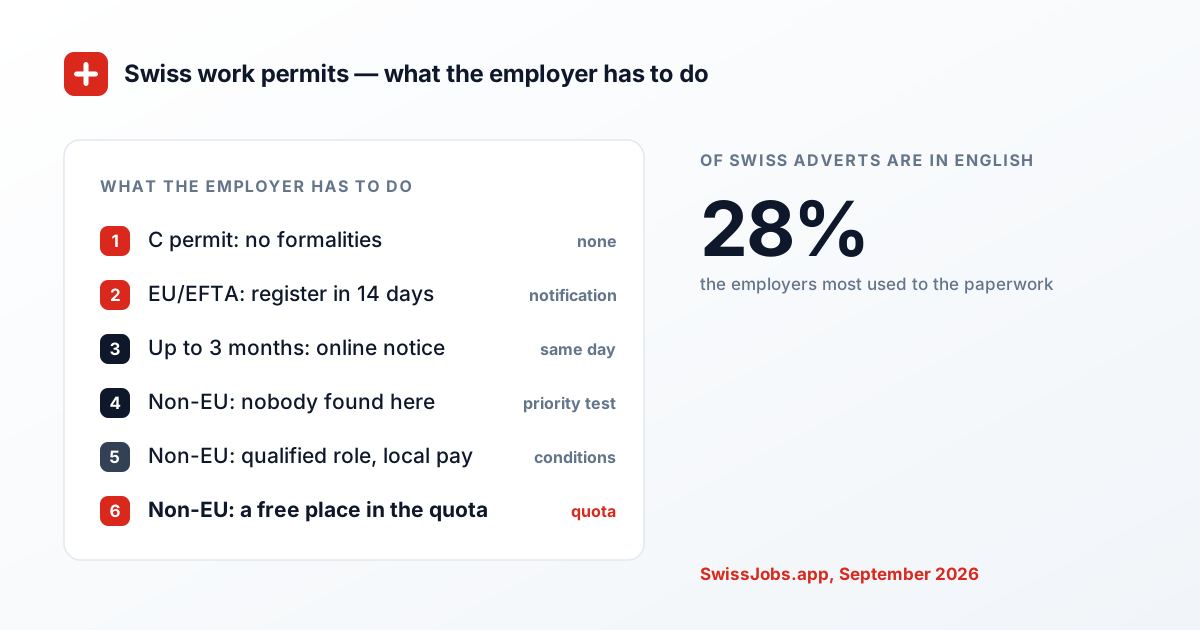
- For an EU or EFTA national, very little: the person registers with their commune within 14 days of arrival and before starting work, and short assignments run through an online notification. For a third-country national the employer must show no suitable candidate was available in Switzerland or the EU/EFTA, that the role is a qualified one, that pay and conditions match the local norm, and that a place in the annual quota is free.
- How can you tell whether an employer hires people from abroad?
- The language of the advert is the most useful free signal. A bit over a quarter of Swiss adverts are written entirely in English, and those tend to be employers with international staff and an HR function that has run the permit process before.
- What should your CV say about your permit?
- One line in the top block, next to your contact details: your nationality or the permit you already hold, the canton that issued it, and the date you could start. It removes the recruiter's biggest unknown before they have to ask about it.
Working on your CV right now? ATS CV checker: free, against a real Swiss job ad
See what a Swiss recruiter checks first
Upload your CV and get a score against a specific job ad in about 30 seconds — language levels, work permit, photo, how your achievements are phrased.
ATS CV checker, freeWhich Swiss work permit do you actually need?
Four letters cover almost everybody: L for a contract under a year, B for a year or more, C once you have been resident long enough, and G if you live across the border.
L goes with a contract of three to twelve months, matches the contract's length and tops out at 364 days. B is the ordinary residence permit, for a contract of at least a year or an open-ended one, issued for five years to EU and EFTA nationals. C is settlement — five continuous years of residence for EU-15 and EFTA nationals, ten for most others — and it ends the question entirely, because it carries free access to the labour market and needs nothing from an employer.
G is the one people forget: the cross-border commuter permit, for someone living in an EU or EFTA state who works here and goes home at least weekly. Geneva, Basel and Ticino run substantially on it.
Then the split that decides everything else. Under the free movement agreement, an EU or EFTA national with a job offer is entitled to the permit — a registration, not a decision. For a third-country national the same offer starts a real application, and the employer carries it.
Write a custom CV for every job you apply to
Most people send the same CV everywhere. The AI editor rewrites yours per application — Swiss format, the right language, in about a minute.
CV maker & resume builder: tailor it to this jobWhat does your employer actually have to do about it?
For an EU or EFTA national, a registration inside 14 days. For a third-country national: a labour-market test, a qualification case, local-standard pay and a free place in the annual quota — all filed by the employer.
The free-movement side is light. The new arrival registers with their commune within 14 days and before starting work. For short jobs there is not even that: work of up to three months in a calendar year runs through an online notification the employer files on day one. Worth saying plainly in an application, because plenty of hiring managers still assume a foreign passport means months of waiting.
The third-country route is a different animal. The employer has to show nobody suitable could be found in Switzerland or the EU/EFTA, that the role is a qualified one — managers, specialists, skilled professionals with a degree and experience — that pay and conditions match what is customary for the region, profession and sector, and that a quota place is free. The canton decides first, the State Secretariat for Migration approves.
That route is built around durable full-time work, which is less of an obstacle than it sounds: where an advert states a contract type, about nine in ten are full-time. The barrier is the priority test, and the only way past it is being the person the employer could not find here.
Contract type where the advert states one. Swiss job adverts on SwissJobs.app, September 2026.
See what a Swiss recruiter checks first
Upload your CV and get a score against a specific job ad in about 30 seconds — language levels, work permit, photo, how your achievements are phrased.
ATS CV checker, freeHow do you tell whether an employer has done this before?
The language the advert is written in is the best free signal there is: a bit over a quarter of Swiss adverts are written entirely in English, and those employers have a process already.
German is the majority language of the market by a wide margin, English second, French a solid third, Italian a small slice. That English quarter is not a translation service for foreigners — it is what a company writes in when its working language is English, which in practice means international staff and an HR function that has filed permit applications before.
Use it as a filter, not as a promise. An English-written advert tells you the permit question will at least be understood when you raise it. A German-written advert from a twelve-person Sanitärfirma in Aargau may be a perfectly good job whose owner has never filed anything. Neither is a verdict on your chances — it is a difference in how much you have to explain.
Language the advert is written in, where identifiable. Swiss job adverts on SwissJobs.app, September 2026.
Does an English-language advert mean you do not need German?
No. About one in four English-written adverts names German anyway, and the ones that name no language at all are silent rather than open.
An advert written in English reads like an invitation. Then the first interview is in English, the second is in English, and the team meeting on day four is in Swiss German. About a quarter of English-written adverts state a German requirement outright; a smaller slice names French; the rest mostly name English and stop.
There is a trap in that last group. An advert that does not mention German is not an advert that does not want German — it is one that did not write it down, and a job description is what somebody had time to type, not a full list of what a team needs.
So put your actual levels on the CV, in the standard European scale, near the top rather than in a skills box at the end. An honest B1 beats an unexplained gap — the recruiter finds out in week one anyway.
Language requirements stated in English-written Swiss adverts. SwissJobs.app, September 2026.
Where in Switzerland are the employers that hire from abroad?
Counted across the postings where the canton is known, Zurich, Zug and Geneva are where the English-written adverts cluster — Bern, Lucerne and Aargau stay overwhelmingly German.
In Zurich nearly six adverts in ten are written in English, with Zug and Geneva just behind. Basel-Stadt is about a third, and by Bern it is closer to one in seven. That is not a ranking of job quality. It is a map of where the internationally staffed employers sit — which is the same as a map of where the permit conversation is routine rather than novel.
The catch is that everybody else has worked this out, and a Zurich advert in English collects applications from across Europe. Cantons further down the list have less competition per advert and a narrower door: worth walking through with the local language, worth skipping without it.
Counted across the postings where the canton is known. SwissJobs.app, September 2026.
What should the application itself say about all this?
One line high on page one — status, canton, start date — and no invented salary expectation, because Swiss adverts do not print a figure to invent one from.
Write it flat, as a fact, in the block with your contact details. “Italian citizen, EU/EFTA — registration procedure, no quota.” “B permit, canton of Zurich.” “G permit, resident in Annemasse.” “Indian citizen, Swiss master’s degree, available from 1 November.” No apologising, no explaining the law back to the reader. A recruiter who sees the answer in two seconds stops thinking about it and starts reading your last job.
If you already hold a permit, check what is written on it before you resign anywhere. B permit holders can generally change job without further authorisation, but a permit granted for one specific role can carry a labour-market condition — and then a change of employer is an application to the cantonal authority rather than a formality.
Last thing, and nobody warns you about it: Swiss adverts do not state salaries. We look for a stated figure in every advert we read and effectively none carries one. Yet for a third-country hire the employer has to prove your pay matches the local, professional and sector norm — so there is a number in the file you never get to see. Do not guess it into a covering letter. Ask when an offer is being shaped, and let the employer name the range first.
The tools for this
Two of ours, both free, and the official source — which beats every summary of it, including this one.
- SwissJobs job searchour tool
The Swiss market in one place, searchable in English and in the local language, filterable by canton — useful for finding the employers who advertise in your language.
SwissJobs job search SwissJobs CV Check our tool
Reads your CV against a specific advert the way a Swiss recruiter does, including whether your status and language levels are visible in the first screen.
Try it free- State Secretariat for Migration
The official conditions for working in Switzerland, permit by permit. If anything here conflicts with that page, that page is right.
Visit site
The permit question is not the hard part of a Swiss job hunt. It is the part that gets left unanswered, and an unanswered question at the top of a CV quietly outweighs a good career underneath it. Say what you are, say which canton, say when you can start.
Then aim at the half of the market that can act on it: search in both languages, look hardest where the internationally staffed employers sit, and take the G permit seriously if you live near a border. And check the official page rather than any blog, including this one.
The tools compared
We checked 16 Swiss and international application tools on their own pages — prices, free tiers, and what is actually included.