Make a Swiss CV — the structure, section by section
Updated:
What belongs in a Swiss CV, in what order, and the lines an international template has no field for — built from the official arbeit.swiss list and from what the live adverts on SwissJobs.app actually ask for.
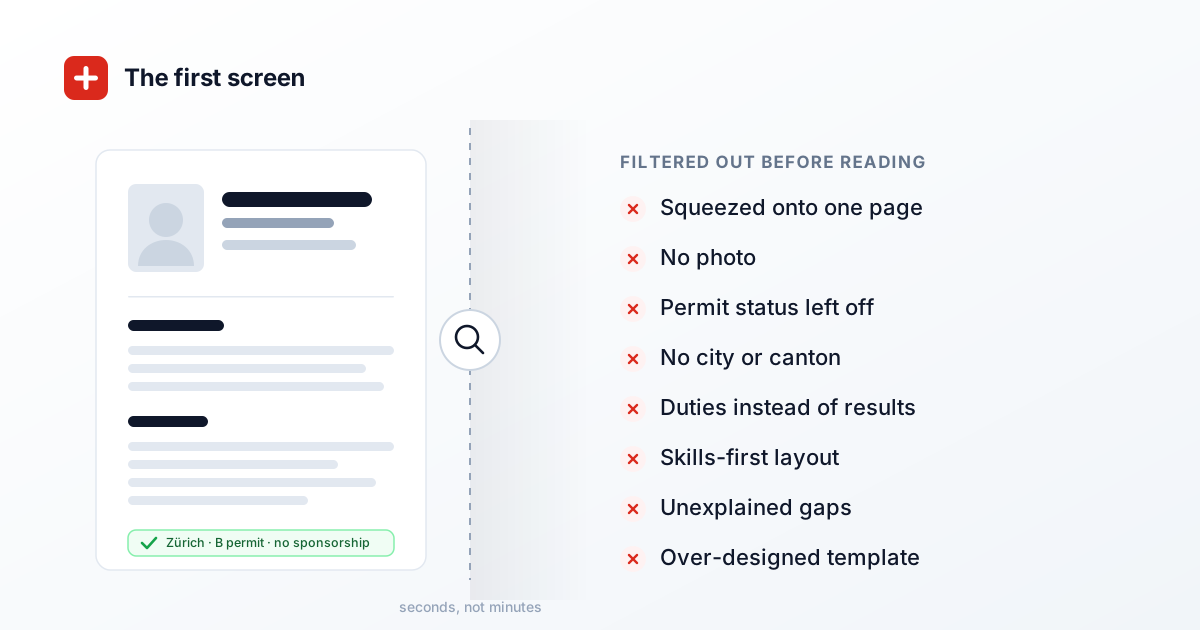
In short
Here is the skeleton to copy. Title «CV», personal details with a photograph, professional experience in reverse chronological order, education and further training, language skills with levels, special knowledge, interests, and a note that references are available on request. That is the official arbeit.swiss list; no more than three pages, sent as PDF. Three lines are specifically Swiss and no international template has a field for them: your town, your permit status, and the workload you can take.
Those three lines are most of the difference. A template from a design tool gives you skill bars, rating dots and a two-column grid, and no slot for the question the Swiss advert puts in its own headline. Roughly one advert in five on SwissJobs.app states a workload percentage in the job title itself, and in about three quarters of those the range starts below 100. The employer has already decided the workload before you apply. If your CV is silent on it, somebody has to ask — and having to ask is the most expensive form of interest there is.
The second difference is which language you write it in, and that one is measurable. Among the adverts whose language we can identify, close to six in ten are in German, just under a quarter in English, one in seven in French and a small remainder in Italian. English is a bigger share than French — which surprises most people arriving here. So the instruction is not «write a CV» but «write the version that matches the advert», and in Zurich, Zug, Basel and Geneva, keep two.
Everything below is either quoted from arbeit.swiss — the only official content list that exists for a Swiss CV — or counted from the live adverts. If you would rather fill the skeleton in than retype it, the CV builder on SwissJobs.app has these sections in this order, is included in the free account, and exports as PDF with no watermark.
Share of the live adverts on SwissJobs.app written in English, out of the adverts in each town whose language we can identify — 97 per cent of the index. Measured 27 September 2026. An English CV is a serious instrument in five towns and a rounding error in the rest.
- Order: title «CV» — personal details — professional experience — education — languages — special knowledge — interests — reference note. That is the arbeit.swiss list, in its order.
- Reverse chronological, «with your most recent job mentioned first». Not skills-first, not grouped by relevance.
- Three pages maximum, per the official page. One page is not a virtue here — it reads as a thin career, not a tight one.
- Three header lines an overseas template omits: town and canton, nationality and permit, the workload you are available for.
- Languages with levels, not adjectives: more than nine in ten adverts that ask for German ask for it at professional or native level.
- Per role: month/year to month/year, job title, employer, town, workload — then two to four lines of scope with actual magnitudes.
- Foreign qualification: one line on recognition. Find the responsible body by occupation at recognition.swiss.
- Sending: one PDF, an unambiguous file name, an email address with your first and last name — all three are named on the official checklist.
The skeleton, line by line
arbeit.swiss — the platform run by SECO and the cantonal labour offices — sets out what a CV contains, and the list is short: title «CV», personal details including photograph, professional experience to date, education and training, language skills, special knowledge or activities, personal interests or hobbies, references. Two rules of form come with it, both verbatim: «Your CV should be structured chronologically, with your most recent job mentioned first» and «A CV should be no longer than three pages». That is the whole of the official specification. Everything else is convention — and convention is precisely what a template bought abroad does not carry.
Typed out, the header is seven lines beside or below the photograph. First and last name. Street, postcode, town. Phone number with the +41 prefix. An email address built from your name. Year or full date of birth. Nationality, and for non-Swiss nationals the permit type. Then one line reading «Available from …, workload …». After that comes the heading «Professional experience» and your most recent role.
A role is written in four blocks: the period as month/year to month/year; job title, employer and town on one line; the workload if it was not full time; then two to four lines underneath. Those lines are not the job description from your old contract. They are whatever was countable: how many people, how many sites, what budget, which systems, what revenue. «Responsible for purchasing» and «purchasing for three branches, around forty suppliers, budget responsibility» are the same job and different documents.
And the interests section, which international advice treats as filler, is its own item on the Swiss official list. Two or three lines, specific rather than generic. «Volleyball club, four years on the committee» says something. «Travel, music, reading» says nothing, and takes up the same space.
The header: town, permit, workload — the three lines with no field
Workload first, because it is the most visible. Roughly a fifth of live adverts carry the percentage in the job title itself — not buried in the body text, but in the line that shows up in a result list. The distribution inside that fifth is the useful part: the single most common statement is not «100 %» but «80–100 %», and in about three quarters of the adverts that name a workload at all, the lower bound sits below 100. Switzerland does not advertise part time as a special case; it advertises a range. A CV that says «full time» quietly removes you from adverts that would have taken you.
One honest caveat. The structured employment-type field in our own data says something different: it marks a little over four in five adverts as full time and only about one in twenty as part time. The two measurements do not contradict each other, they measure different things. The field records what the employer ticked; the title records what the employer wrote. Where the title says 80 to 100 per cent, almost every employer still ticks «full time». For the practical question — is 80 per cent possible here — the title is the better source.
The permit is the mirror image: it matters precisely because the advert does not raise it. Across the advert summaries we can search, a work or residence permit is mentioned in about one in a thousand. That is exactly why no template has a field for it — the text that template makers derive their fields from never discusses it. The person reading your CV has the question anyway, and one line answers it before it is asked: «British national, B permit, no sponsorship required», or «Swiss citizen», or «EU national, permit application on arrival».
Town, finally, is not an administrative detail but the commuting question. Town and canton belong in the header even if you are still abroad — in which case name the town you intend to move to and a date. Zurich and Zug are fifteen minutes apart and a completely different application.
Which language do you write it in?
«Write in the language of the advert» is correct and useless on its own, because it does not tell you what the distribution looks like. Among the live adverts whose language we can identify — 97 per cent of the index — close to six in ten are German, just under a quarter English, one in seven French and a small remainder Italian.
Town by town the picture sharpens, and it is the reason the figure above exists. In Geneva, we can sort half of the ads into English and just under half into French: the biggest French-speaking city in Switzerland uses English in ads just as much as French. In Zug the split is close to six-four for German, in Zurich about six in ten German to four in ten English, in Basel roughly three-quarters to a quarter. Then the other Switzerland: Lucerne and Winterthur are around nine in ten German, and Chur is effectively all German. An English-only CV in Graubünden or central Switzerland speaks to just six percent of the market.
The practical rule: one version in the language of your target canton is mandatory; a second in English pays for itself in Zurich, Zug, Basel and Geneva, and nowhere else. And the second version is not a machine translation of the first. Swiss job titles, qualifications and reference wording have fixed equivalents that a literal translation misses — «Kaufmännische Grundbildung EFZ» is a federal commercial apprenticeship with a specific name, not «commercial basic education».
One small thing that saves time later: name the file after yourself and the role, not the language. «CV_Anna_Meier_Accounts_Receivable.pdf» gets found in a mailbox. «CV_final_v3.pdf» does not.
Languages: levels, not adjectives
In a Swiss CV the language block is a filter, not decoration. Just under three quarters of live adverts name at least one required language. Among those, about two thirds ask for German, a bit over four in ten for English, a fifth for French and a few per cent for Italian — the shares add to more than a hundred because one advert may ask for several.
They also state a level, and the level is high. Among adverts that require German, more than nine in ten want it at professional or native standard; for English it is just under nine in ten, for French just under eight in ten. «Good written and spoken» does not answer that requirement — it evades it, and the evasion is legible.
The number that changes your layout: a bit over a quarter of the adverts stating a language requirement want two or more, and the most common pair is German plus English. A one-line language section is therefore too short in one case out of four. Write each language on its own line, with the level, and with the certificate and year where you have one: «German — C1 (Goethe-Zertifikat, 2024). English — native. French — B1, reading and email.»
If your level in the local language is below what the advert wants, the line is still better than the omission — but add a second clause that shows movement: a course in progress, an exam booked, your level a year ago against your level now. Swiss recruiters read a rising curve very differently from a static claim.
What the adverts actually ask for — and what that puts in the CV
We searched the summaries of the live adverts for requirements that can be translated into a CV section. The result is unglamorous and useful for that reason. The most common thing named is professional experience, in a bit over half of the summaries searched. Second is a completed qualification or degree, in about a quarter. Customer contact appears in roughly a fifth; resilience and flexibility in just under a tenth; working independently at a similar rate; teamwork slightly below. A driving licence is required in about two per cent, shift or weekend work in about one per cent.
Translated into sections: the two blocks that have to carry weight are experience and education, in that order, from your first real job onwards. School leavers invert them and put education first. Everything the adverts mention rarely — driving licence, shift availability, software beyond the obvious — belongs under «special knowledge», not in the header.
The place foreign CVs most often break is the qualification itself. If your degree or apprenticeship is not Swiss, put the Swiss equivalent in the same line, and say whether recognition is required and whether you have it. Which occupations need recognition, and which body handles yours, is answered by the State Secretariat for Education, Research and Innovation through its search at recognition.swiss: you enter the occupation and it names the responsible body. A regulated occupation with that line missing is an open question, and open questions get filtered.
One detail that only appears when you compare the four language versions of the same official page: the French, Italian and English versions require the CV itself to have no gaps — «not contain any gaps» in the English text. The German version applies that wording to the work certificates rather than to the CV. Treat the stricter reading as the real one. An unexplained six-month gap costs more than an explained two-year one.
The advert's job title belongs in your CV — minus the bracket
A bit over a quarter of live job titles carry a gender tag: (m/w/d), (m/f), (h/f). About six per cent carry both a tag and a percentage, and a little over half carry neither. This is not trivia, it is an instruction. The job title in that line is the wording the employer uses internally — the term they search by and file you under.
So take it. Directly under your name, put the role you are targeting in exactly the employer's wording, without the bracketed tag and without the percentage. «Accounts Receivable Specialist (m/w/d) 80–100 %» becomes the line «Accounts Receivable Specialist». It costs five seconds per application and it is the single most effective tailoring move available.
The same applies to the file name and to the subject line of the covering letter. arbeit.swiss lists «clear and correct file names» as an explicit pre-send check — the only item on the whole official list that is about the recipient's filing rather than about your content.
Before you send — and why speed is part of the structure
The official pre-send checklist is short and quotable: spelling and formatting errors, completeness of documents, clear and correct file names. Then: «Save and send your application documents as PDF files» and «Use a reliable email address (ideally containing your first name and surname)». Work references, diplomas and certificates go into a single PDF, chronological, most recent first. On referees: the CV carries the note that references can be provided on request, and a separate sheet of referees can be handed over at interview.
That leaves the question of how long you may take over all this, and the adverts give an uncomfortable answer. A quarter of the live adverts are nine days old or newer; half are older than eighteen days; only about a third went up in the last fortnight. If you only start writing your CV when you see a suitable advert, you are systematically applying to the older half of the market.
Hence the order that works. Build the full skeleton once — three pages, every role, every number, in the language of your target canton. Then per application touch only three places: the role line in the header, the workload, and the two-to-four lines under your most recent job. Ten minutes instead of three evenings, and it is precisely the part that gets read.
The content list, the order, the page limit, the PDF rule, the file-name and email-address checks and the referee note are quoted from the «Tips on applying for jobs» page on arbeit.swiss (SECO), retrieved 22 August 2026; the differences between the four language versions were checked on the de, fr and it versions of that same page. The recognition body for foreign qualifications is named by the State Secretariat for Education, Research and Innovation. All shares for workload, language requirements, job titles and advert age are counted from the live adverts on SwissJobs.app as of 21 August 2026. Two denominators differ and are named in the text where they are used: shares of adverts by written language are out of the adverts whose language can be identified, 97 per cent when recounted on 27 September 2026; requirement shares are out of the adverts with a searchable summary, likewise around three quarters. Workload and job-title shares are out of all live adverts. None of these figures is a survey — each is a count of the adverts themselves.
Write a custom CV for every job you apply to
Most people send the same CV everywhere. The editor rewrites yours against the posting — Swiss format, the right language, in about a minute.
CV maker & resume builder: for a specific advertSources
Related questions
What our job index says about the Swiss market
Computed live from our own index, not quoted from a study. Shares only, as of today.
Language the advert is written in
- Deutsch
- 60%
- English
- 23%
- Français
- 13%
- Italiano
- 3%
Of adverts that state a language requirement, the share asking for
- Deutsch
- 70%
- English
- 43%
- Français
- 21%
- Italiano
- 3%
19% posted in the last 7 days · Largest markets: Zürich 18% · Bern 10% · Genève 5% · Basel 5%