An ATS-safe CV: single column or designed template — and which tool?
Updated:
In short
Either works — the column count is not what decides it. The tool and the file format are. On 4 September 2026 we measured our own export: the reading order comes out perfectly, because the sidebar sits after the main column in the document. But not one of the eleven section headings is recoverable as a word from the PDF, because they are letter-spaced. The same document exported to Word gives back all eleven. Microsoft, Canva and cvswiss.ch all sell "ATS" as a template name, and none of those labels can be checked from outside.
Who to choose
The other tools here are real and good at what they do — the table says what each is for. The reason we lead is one row in it: the job index is our own, so the advert is already there.
Choose lebenslauf.ch if
lebenslauf.ch — 100 per cent free and with no login at all, if a clean CV is enough and no account should be created.
Choose SwissJobs.app if
Pick the job directly — You choose the posting from our own Swiss index, and the CV, letter and check are written against exactly that text — no searching, no copying.
Four tools, not one — CV, motivation letter, CV check and interview prep from one account, on the same data.
The RAV sheet — Job-search efforts from the tracker, printed on the official SECO form. None of the other tools in this list has it.
Start without an account — Open it and write without signing up; the account is asked for to save and from the second document.
CHF 15 a month, seven free days first — Full access during the trial, cancel monthly, billed in francs — no four-week periods, no exchange-rate risk.
The tools’ landing pages compared
All captured on 4 September 2026 at the same window width, so the comparison is fair.
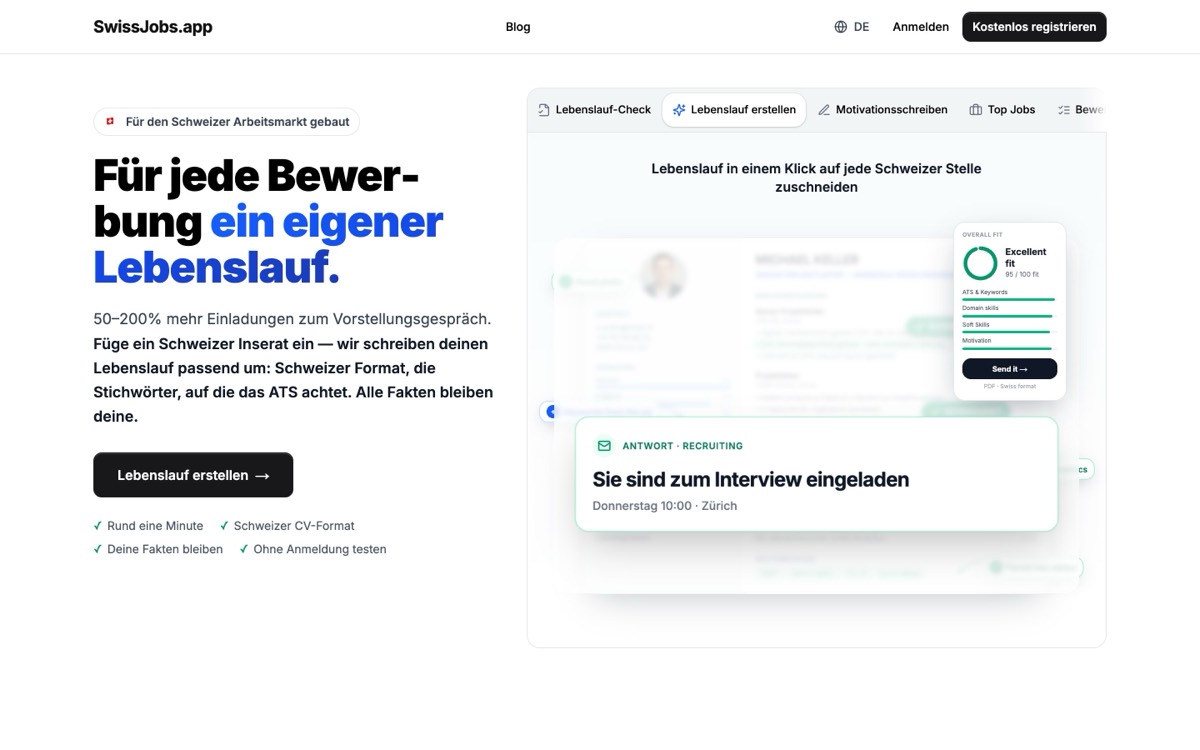
1. SwissJobs.appOur app
Add your current CV and a Swiss advert, AI writes one tailored to it. Free to start, no signup.
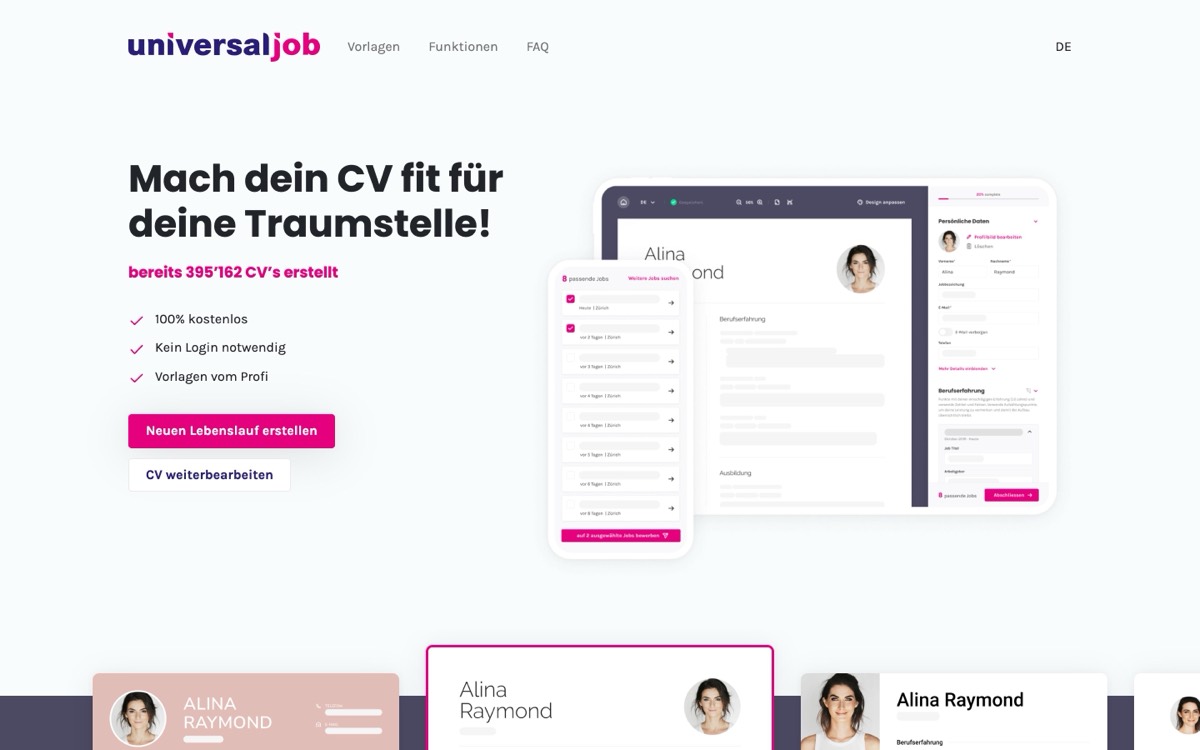
Free, but you write the whole CV yourself in an empty form. Every line from scratch, no AI help.
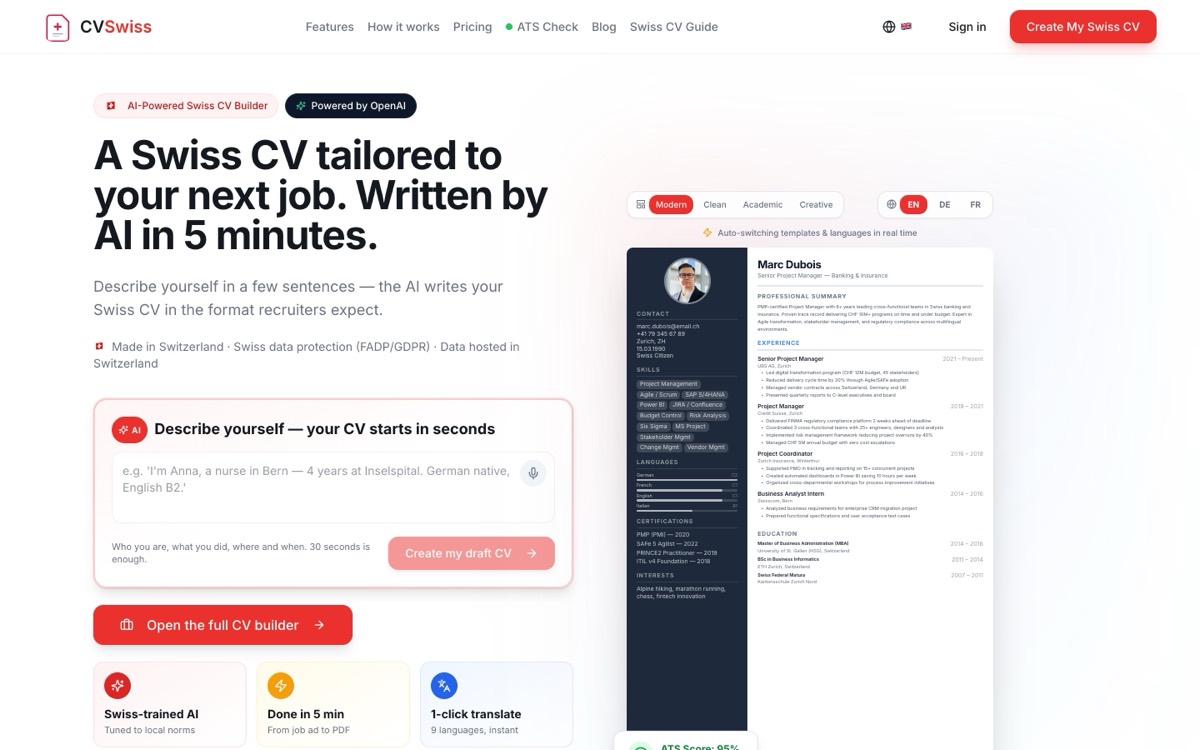
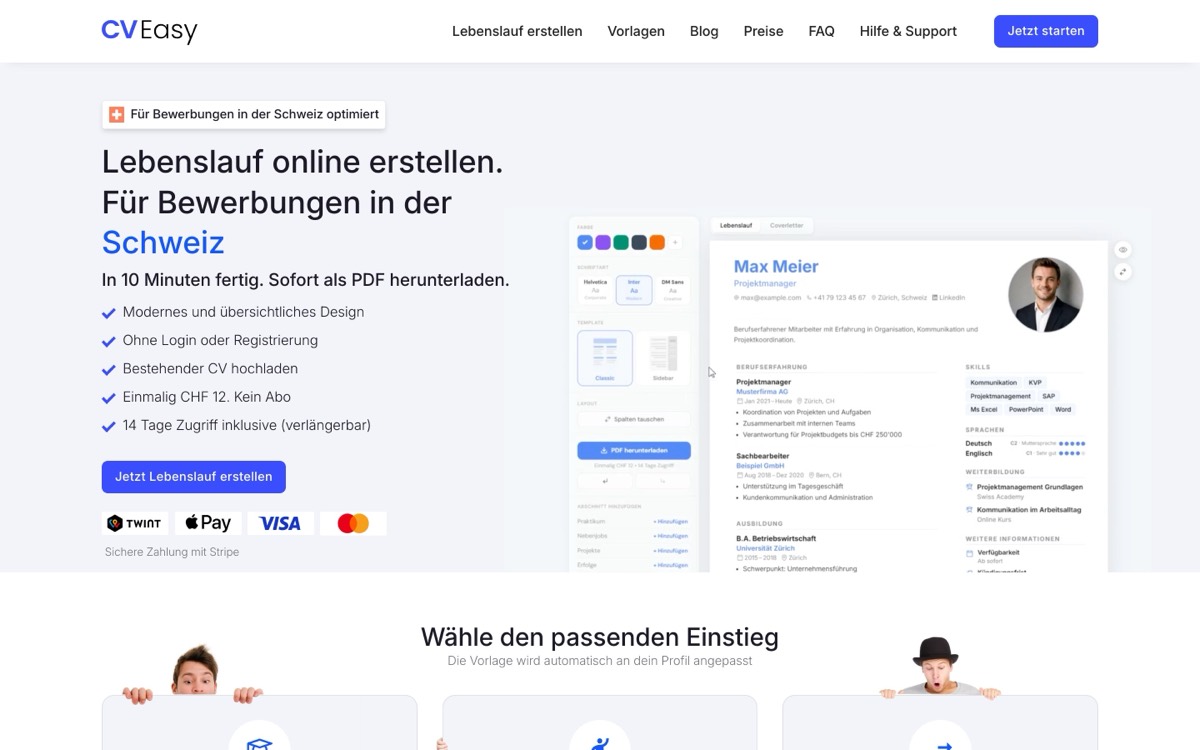
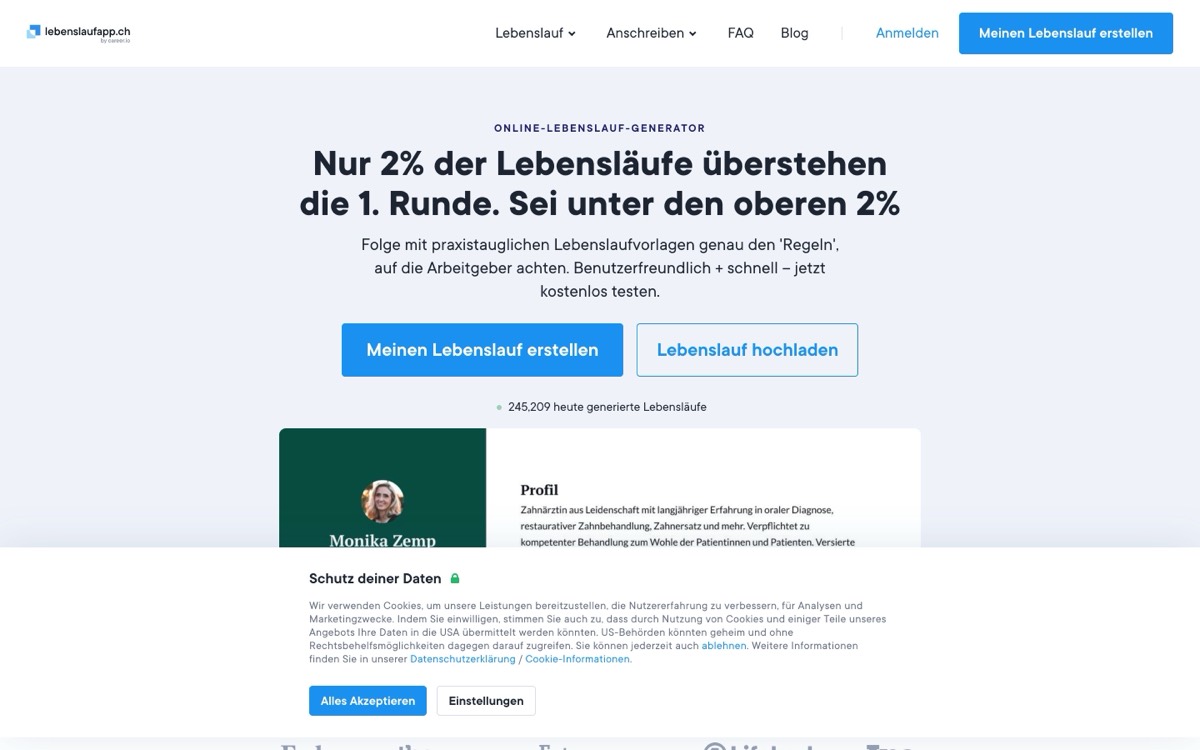
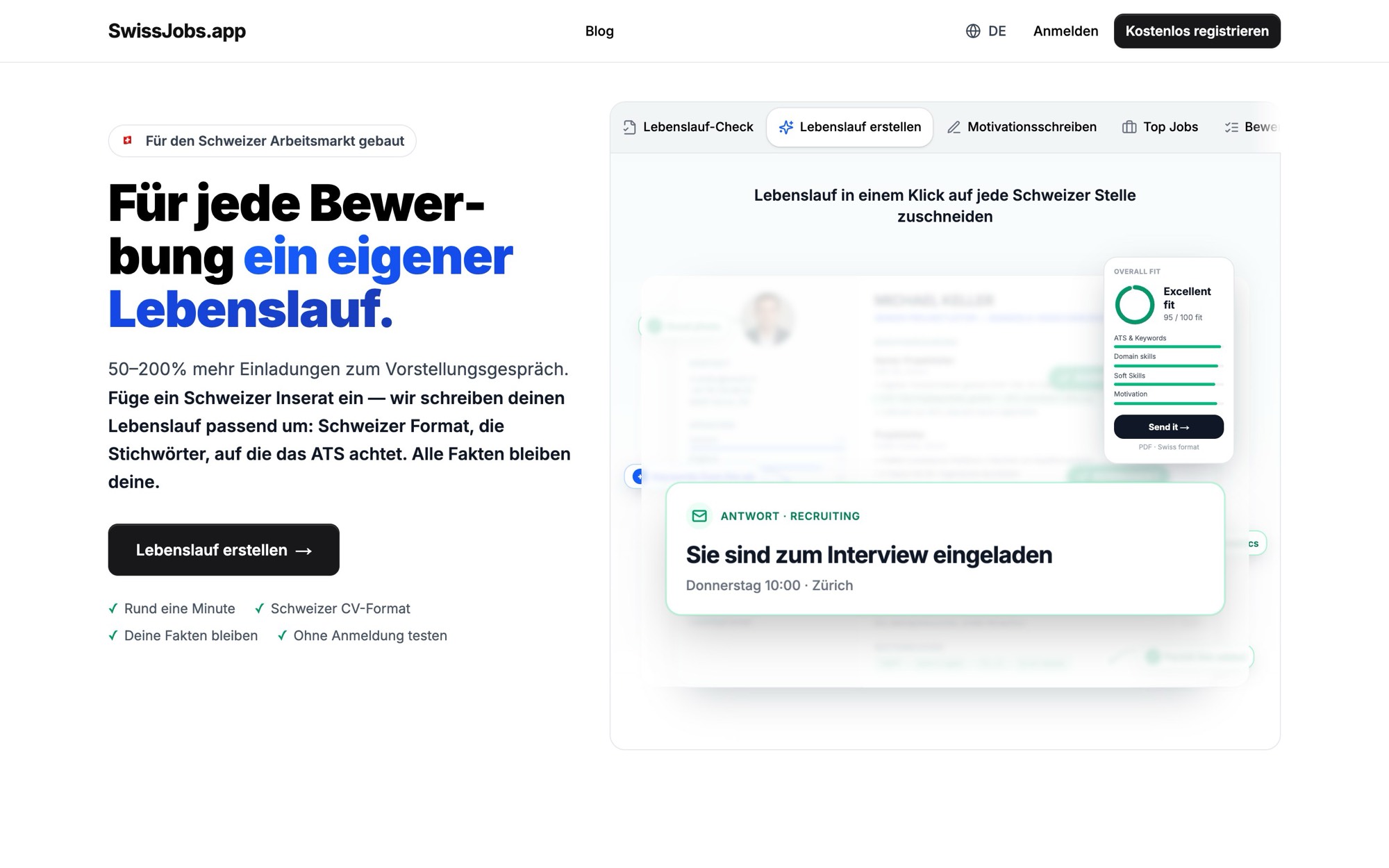
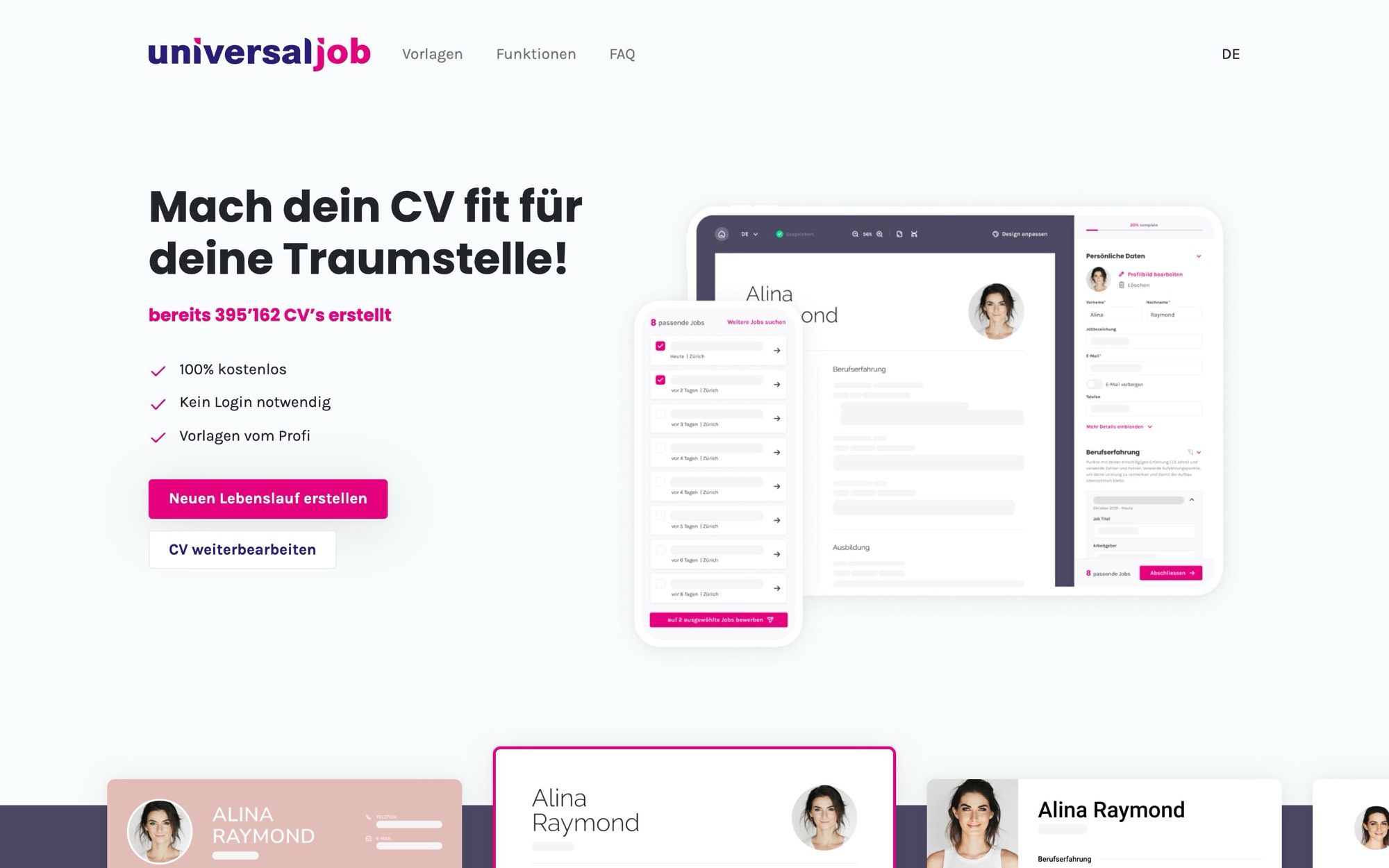
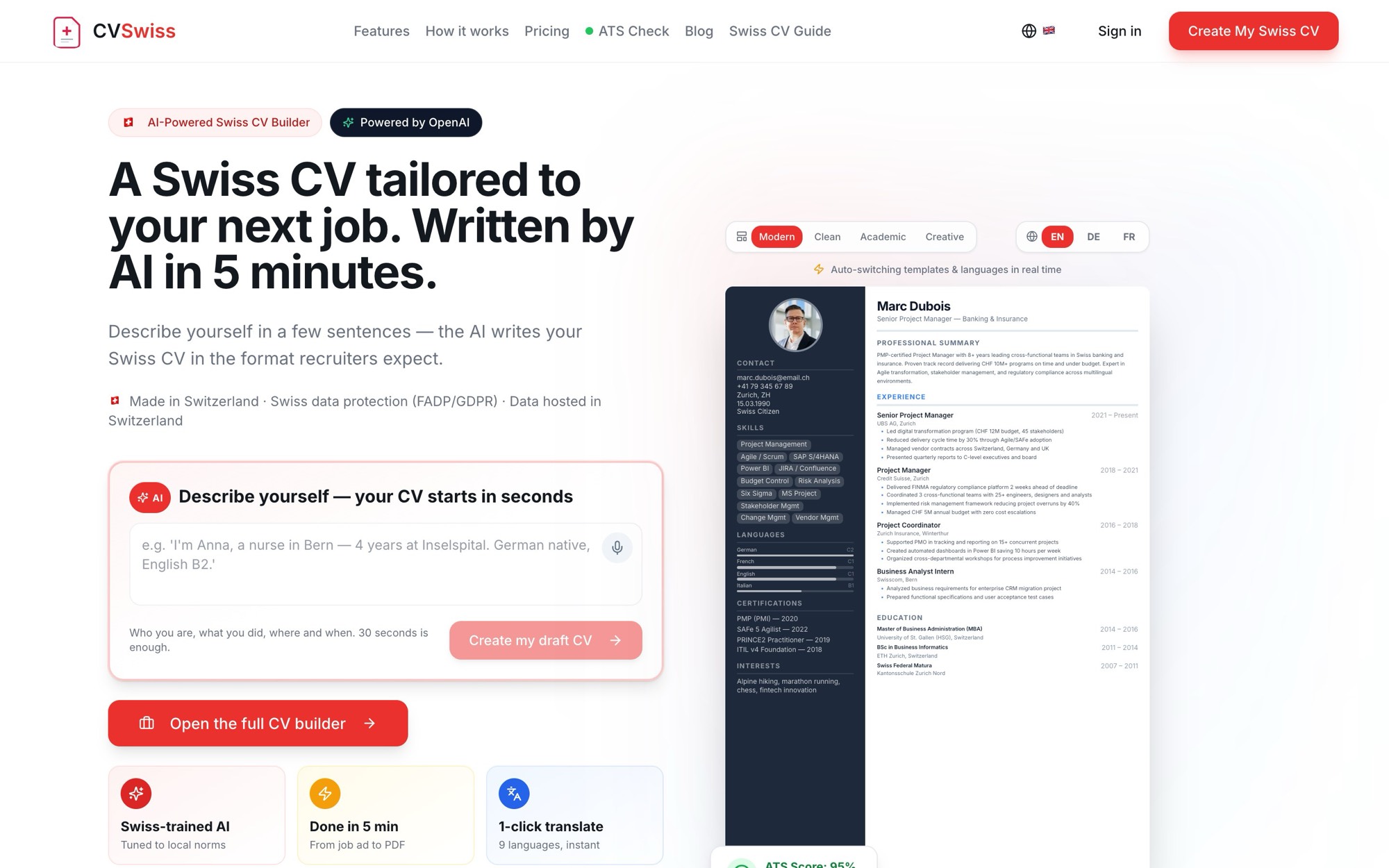
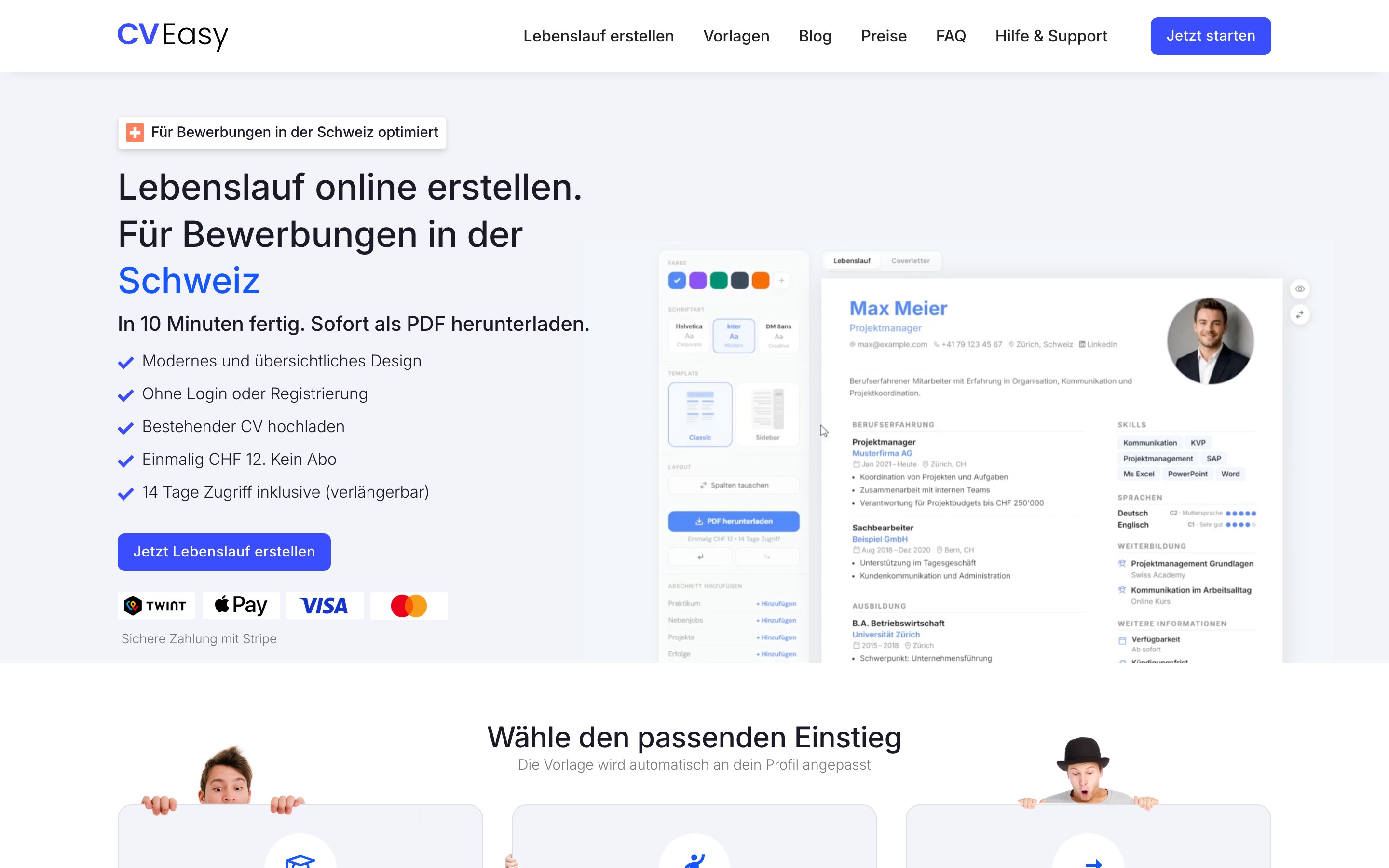
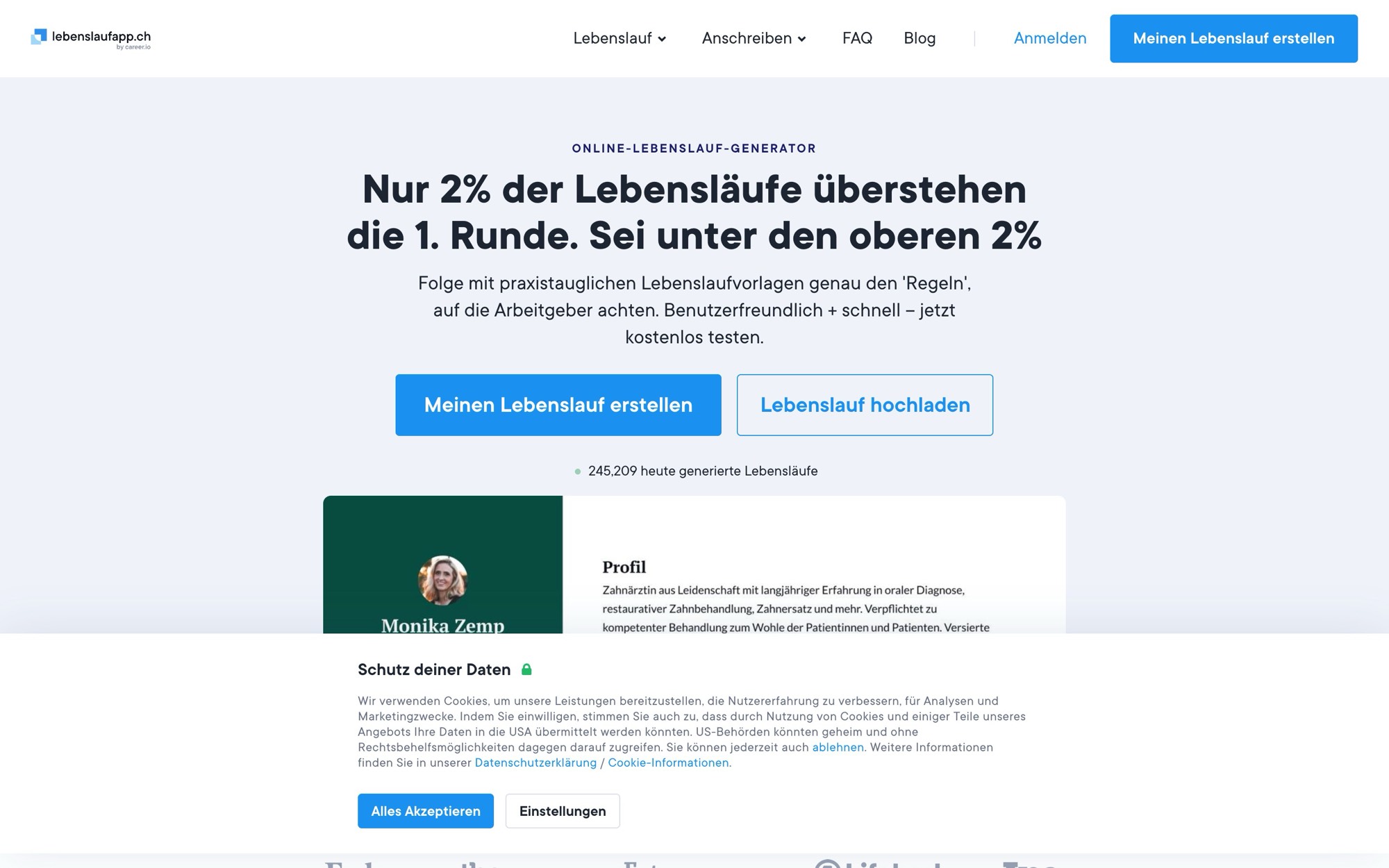
The question is asked as a matter of taste and is a matter of tooling. Almost nobody builds their own layout: you pick a template or a generator, and what ends up inside the file was decided by the vendor. That decision is never disclosed. On the same day we read the public template pages of three vendors and counted: seven of the roughly thirty named templates on Microsoft's resume page carry ATS in the name, cvswiss.ch prints "All templates are ATS-optimized and follow Swiss CV standards" under its fourteen, and in Canva's English gallery one template is called "White and Blue Minimalist Professional Corporate ATS Resume". Three vendors, three different uses of the same abbreviation.
If you are applying from outside Switzerland, one more thing is worth knowing before you pick a template. The Swiss application is a dossier, not a resume: it carries your Arbeitszeugnisse (the written employer references every Swiss job ends with), usually a photo, a line stating your work permit if you do not hold a Swiss or EU passport, language levels written as CEFR grades rather than "fluent", and your Pensum — the workload in per cent. Two pages is the norm. A template designed for a one-page US resume has no place for any of that, and you only find out while filling it in.
Our own measurement, 4 September 2026, on the document the SwissJobs.app CV editor serves to a visitor who is not signed in. PDF printed through a browser's print dialog and read back with two independent extractors that agreed exactly; the Word file produced by the application's own export code and then unpacked and read. The metric is whether an ordinary text search finds the heading as one word in the extracted text.
- SwissJobs.app — Layout: one wide column plus a sidebar of 224 of the page's 794 pixels, about 28 per cent, written after the main column in the document · Single-column option: no · Export: PDF and Word (DOCX), neither watermarked · Price: try it without an account, then a free account with 5 documents a day and 10 per rolling week, a 7-day trial, then CHF 15 a month or CHF 95 a year · Languages: German, French, Italian, English.
- cvswiss.ch — Layout: 14 templates, 12 of them with a sidebar or a two-column body · Single-column option: yes, two ("Academic / LaTeX", "Banner") · Export: watermarked download always free, the paid output is a PDF · Price: remove the watermark from CHF 5 one-off ("No edits after download"), subscription CHF 15 a month · Languages: German, French, Italian, English (their own pages, 4 September 2026).
- Canva — Layout: a free canvas with text boxes placed by hand; in the German CV gallery 7 of the 55 visible template names state a column or sidebar layout · Single-column option: yes, but as a design decision rather than a switch · Export: PDF, PNG, more formats with Pro · Price: Free CHF 0 a year, Pro CHF 128 a year for one person, Business CHF 210 · Languages: the gallery has 23 language editions plus a default, none of them Swiss (4 September 2026).
- Microsoft Word templates — Layout: whatever the template imposes, and many build the second column as a table · Single-column option: yes, several · Export: DOCX and PDF · Price: CHF 0 if you already hold an Office licence; the templates themselves are free · Languages: the software in many, the resume templates overwhelmingly in English.
- Europass — Layout: one single-column form, no gallery · Single-column option: that is all it does · Export: PDF · Price: CHF 0 · Languages: 31 editions including all four of ours — but built for the EU, with no field for a Swiss permit line or a Pensum.
- Shared ground: every one of these tools produces a file whose text can be read back in full. Nothing is lost in any layout — we measured that on 29 August 2026 across eleven constructions of the same CV with two independent extractors. What differs is the order, and whether the headings survive as words.
- Where the others are ahead: cvswiss.ch offers two explicitly single-column templates and we offer none. Canva Free costs CHF 0 a year and carries more than 1.6 million templates — against our 54 design variations that is not a gallery, it is a handful. And a Word template is yours forever, works offline, and lets you move any line yourself, including the order inside the document, which no online tool allows.
The tools compared directly
| Criterion | SwissJobs.app | lebenslauf.ch | cvswiss.ch | cv-easy.ch | careerkit.me | Canva | Europass |
|---|---|---|---|---|---|---|---|
| Price | CHF 15/Mt · CHF 95/J | free | from CHF 15/mo | CHF 12 one-off | USD 2.95/Mt | n/s | free |
| Usable without an account | Yes | Yes | n/s | Yes | n/s | n/s | n/s |
| PDF without watermark | Yes | Yes | Yes | Yes | Yes | n/s | Yes |
| Word / DOCX export | Yes | n/s | n/s | n/s | n/s | n/s | Yes |
| AI tailors to an advert | Yes | No | Yes | No | No | No | No |
| Advert from its own job index | Yes | No | No | No | No | No | No |
| Swiss conventions | Yes | Yes | Yes | Yes | No | No | No |
| CV check against an advert | Yes | No | n/s | No | No | No | No |
| Motivation letter | Yes | No | n/s | Yes | n/s | n/s | No |
| Application tracker | Yes | No | No | No | No | No | No |
| RAV form (SECO) | Yes | No | No | No | No | No | No |
| Own job index | Yes | No | No | No | No | No | No |
| Languages | DE/EN/FR/IT | DE | DE/EN/FR | DE/FR/EN/IT | DE/EN | many | 31 languages |
| Built in Switzerland | Yes | Yes | Yes | Yes | No | No | No |
As of 4 September 2026. Every figure for another tool comes from that tool's own site; "n/s" means it was not readable there — not that the feature is missing. Our row comes from the code and from walking the live flow.
What we measured on our own export — including the part that failed
A comparison that tests other people's products and describes its own is not a comparison. So on 4 September 2026 we put our own CV through the same treatment our 29 August test gave to eleven other constructions: the document the editor serves to a visitor who is not signed in, set with the live site's stylesheet, printed to an A4 PDF through a browser's print dialog, then read back with two independent text extractors. Both agreed, character for character.
The good half first. All eleven blocks came out complete, and the nine whose order matters came out in the intended sequence: name, profile, competences, achievements, professional experience — and only then the contents of the sidebar. That is a build decision rather than luck. In the document the main column is written before the sidebar, even though on paper the sidebar sits alongside it. As a control we set the same page with the two swapped in the document, visually indistinguishable from the first. There, education, skills and certifications came out ahead of the person's name. Two pages that look identical produce two completely different text files.
Now the bad half. Not one of the eleven section headings was recoverable as a word from the PDF. "Profile" comes out as P R O F I L E, "Professional experience" as a spaced-out string of letters. The cause is a single line in our stylesheet: the headings are set at 10 pixels with 1.4 pixels of letter-spacing, which is fourteen hundredths of the font size. Our own August measurement put the point at which headings stop being findable at around twelve hundredths. We are above it. A program that segments a dossier by its headings finds none of ours in our PDF.
The same document as a Word file: eleven out of eleven
Because the editor offers both formats, we sent the same CV through the Word export on the same day — using the application's own export code, run in a real browser — then unpacked the resulting file and read it. All eleven headings are present as whole words: "PROFILE", "PROFESSIONAL EXPERIENCE", "EDUCATION". In a Word file, letter-spacing is a formatting attribute sitting beside the text rather than part of it. In a PDF it becomes actual spaces; in a Word file the word stays a word.
The same file settles the ordering question too. The Word export builds the two columns as a single borderless table row with two cells: the entire main column of both pages on the left, the entire sidebar content on the right. Reading the file gives you one cell in full, then the other. That is exactly the order you want, and it is a different animal from the table that alternates left and right row by row and interleaves the sidebar into your work history. Many Word templates sold as "two-column" are the second kind.
The practical rule that follows holds whichever tool you use. If the apply button leads into an applicant system and the form accepts Word, send the Word file. If a person opens the dossier — and in our index roughly half of open Swiss adverts route to the employer's own site, only a good third into an applicant system — the PDF is the calmer choice, because it looks the same everywhere.
"ATS-optimised" is a template name, not a property
We counted the label on three vendors' public template pages on 4 September 2026. On Microsoft's resume page seven of about thirty named templates carry it — "ATS healthcare resume", "ATS office manager resume", "ATS Bold accounting resume" — and a link invites you to "Explore more ATS-friendly templates". cvswiss.ch shows fourteen templates and prints beneath them: "All templates are ATS-optimized and follow Swiss CV standards." In Canva's German gallery the abbreviation appears in none of the 55 visible template names; in the English gallery exactly once, inside a name.
Three vendors, three incompatible uses of the same three letters: a category covering a quarter of the range, a property claimed for the whole range, and a colour-word sitting next to "Minimalist" and "Corporate". When one label means three different things at three vendors, it is describing an expectation rather than a property. That is not an accusation against any of them — it is the reason the label cannot help you choose.
What is worth reading on cvswiss.ch is the layout wording rather than the ATS wording. Of the fourteen, two are explicitly single-column — "Academic / LaTeX" with "Single-column layout", "Banner" with "No sidebar, clean single column". The other twelve carry a sidebar or a two-column body, and two of those are described as "Education-first layout" and "Education-first order". That is a statement about order, and it is more useful than any ATS badge, because it tells you what comes first. We did not test what comes out of their paid download — that would have meant buying one — so we make no claim about it.
If you are applying from abroad, some of these tools are closed to you
The English-speaking reader of this page is disproportionately applying into Switzerland from outside it, and the tool list narrows for that reader in ways nobody mentions. Canva, Microsoft and Europass work from anywhere. cvswiss.ch runs in English as well as the three national languages. But most of the Swiss-built CV tools are German-only interfaces, and a German-language advert — which is what you will be answering, since German-language postings are the largest single share of the open stock — needs a CV in German whether or not the tool speaks it.
That is also the answer to a question that looks like a layout question and is not: which language should the CV be in? The language of the advert, every time. A designed template does nothing about this and a single-column one does nothing about it either. What matters is whether your tool can produce the document in the language the posting was written in. Ours generates it in the language of the interface you are working in, which is one of four.
And a Swiss-specific contrast worth carrying into whatever template you pick: in the United Kingdom and the United States a photo on a CV is discouraged, in Switzerland it is conventional and its absence is noticed. Almost every "ATS-friendly" template in the English-language galleries is built on the assumption that there is no photo — which is a reasonable assumption in the market those templates were designed for, and the wrong one here.
Who should use which
Use Canva if you work in a design occupation. There the sheet is the work sample, and a designed page is the point rather than a risk. It is a small group, though: in our index roughly 3.5 per cent of open adverts carry a title from design, marketing or media, and 0.4 per cent are actual design occupations (measured 24 August 2026). Everyone else is buying design freedom nobody asked for.
Use a Word template for the single application whose file you want to keep afterwards. It costs nothing on an existing licence, works without an internet connection, and lets you move any line yourself — including the order inside the document, which no online tool exposes. Use Europass when a job or a recognition procedure asks for it by name; the form is single-column and available in 31 language editions, but it is built for the EU and has no field for a work permit line or a workload in per cent.
Use cvswiss.ch if you are writing one application and want a clean PDF for CHF 5 — cheaper than any subscription, and two of their templates are explicitly single-column, which we do not offer at all. And use us if Swiss adverts are what you answer week after week: we rewrite the CV from the text of the advert in about a minute, then let you edit any line by hand or by instruction, export PDF and Word without a watermark, fill the RAV job-search-efforts form at /arbeitsbemuehungen from your tracked applications, and open the editor without an account. What you will not get from us is a single-column version — and, until we change one line in the stylesheet, not a heading a program can find as a word in the PDF either.
The rule in three sentences
First: the column count is not the question. Across eleven measured constructions nothing was ever lost; what shifts is the order, and it follows the position in the document rather than the position on the page. Second: the "ATS-optimised" label carries no information, because it means three different things at three vendors — check the file your tool produces instead. Third: if the apply button leads into an applicant system and the form takes Word, send the Word file; it carries the headings across as words, and the PDF may not.
The check takes half a minute and beats every template description: open your PDF, select all the text, paste it into a plain text editor, and read it. If the name is at the top and the roles follow in the right order, the arrangement is fine however many columns the page has. Then search that text for the word "Experience". If you cannot find it, your headings are letter-spaced, and to a program that segments a dossier by its headings they are not there.
The export measurement was carried out on 4 September 2026 specifically for this answer. Its basis is the document the SwissJobs.app CV editor serves to a visitor who is not signed in, set with the live site's stylesheet. The PDF was produced through a browser's print dialog at A4 and read back with two independent text extractors which agreed on every point; no AI model was involved. The Word file was produced with the application's own export function, then unpacked and read as plain text. What is measured is the text layer of the file — the order and the form in which the characters are stored — not the behaviour of any particular applicant system, which applies rules of its own on top. "Recoverable as a word" means an ordinary text search for the heading finds it in the extracted text. The statements about Microsoft, Canva, cvswiss.ch and Europass come from their public template and pricing pages, retrieved on 4 September 2026; no account was created, nothing was uploaded and no paid download was bought, so nothing is claimed here about the contents of their finished files. The template counts refer to the names visible on one gallery page, not to a complete range. The market figures on design occupations (24 August 2026) and on where the apply button leads (August 2026) come from already-published analyses of the adverts live on SwissJobs.app.
Write a custom CV for every job you apply to
Most people send the same CV everywhere. The editor rewrites yours against the posting — Swiss format, the right language, in about a minute.
CV maker & resume builder: for a specific advertJobs by profession, city or language
Type a profession, a city or a language, the page shows the adverts currently open for it.
By profession
- Consultant
- Project Manager
- Retail Sales
- Nurse
- Nursing & Care
- Administrative Assistant
- Account Manager
- Software Engineer
- Public Administration
- Architect
- Insurance
- Chef
71 more — narrow the search
By work type
Sources
- cvswiss.ch — template gallery, 14 templates with their layouts (4.9.2026)
- cvswiss.ch — pricing, CHF 5 one-off and CHF 15 a month (4.9.2026)
- Canva — English resume template gallery (4.9.2026)
- Canva — Swiss pricing page, Free CHF 0, Pro CHF 128 a year (4.9.2026)
- Microsoft — Word resume templates, seven with ATS in the name (4.9.2026)
- Europass — create a CV, 31 language editions (4.9.2026)
- SwissJobs.app — Do tables and columns break CV parsing? (measurement of 29.8.2026)
- SwissJobs.app — One column or two in a Swiss CV?
- SwissJobs.app — build a CV
- SwissJobs.app — fill the RAV job-search-efforts form
Related questions
What our job index says about the Swiss market
Computed live from our own index, not quoted from a study. Shares only, as of today.
Language the advert is written in
- Deutsch
- 60%
- English
- 23%
- Français
- 13%
- Italiano
- 3%
Of adverts that state a language requirement, the share asking for
- Deutsch
- 70%
- English
- 43%
- Français
- 21%
- Italiano
- 3%
19% posted in the last 7 days · Largest markets: Zürich 18% · Bern 10% · Genève 5% · Basel 5%