How does Job-Room work?
Updated:
In short
Job-Room is the job platform of the Swiss public employment service, at job-room.ch. Anyone can search it without an account. The account is what changes things: if you have signed on with an RAV and then register for Job-Room, you see vacancies covered by the job registration requirement five working days before the employer is allowed to advertise them anywhere else. The same registration opens the eServices — submitting benefit forms, uploading documents, job alerts and watchlists. You register with an AGOV login, your AHV number and the eight-digit personnel number your RAV assigns.
Only your unemployment fund's decision and your RAV's guidance are binding. Whether a specific vacancy is subject to the registration requirement is checked case by case by the responsible RAV. This text is editorial, not legal advice.
The Swiss job portals at a glance
Click an image for the full-size view. What each portal actually is stands beside it.
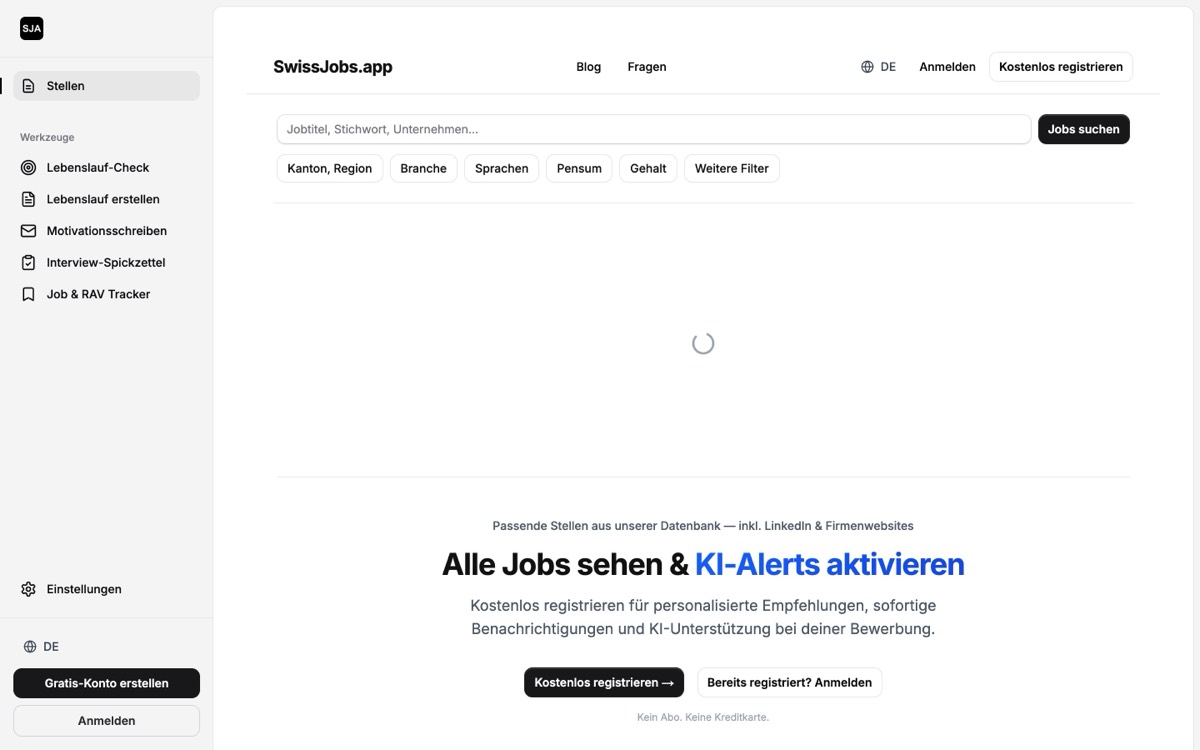
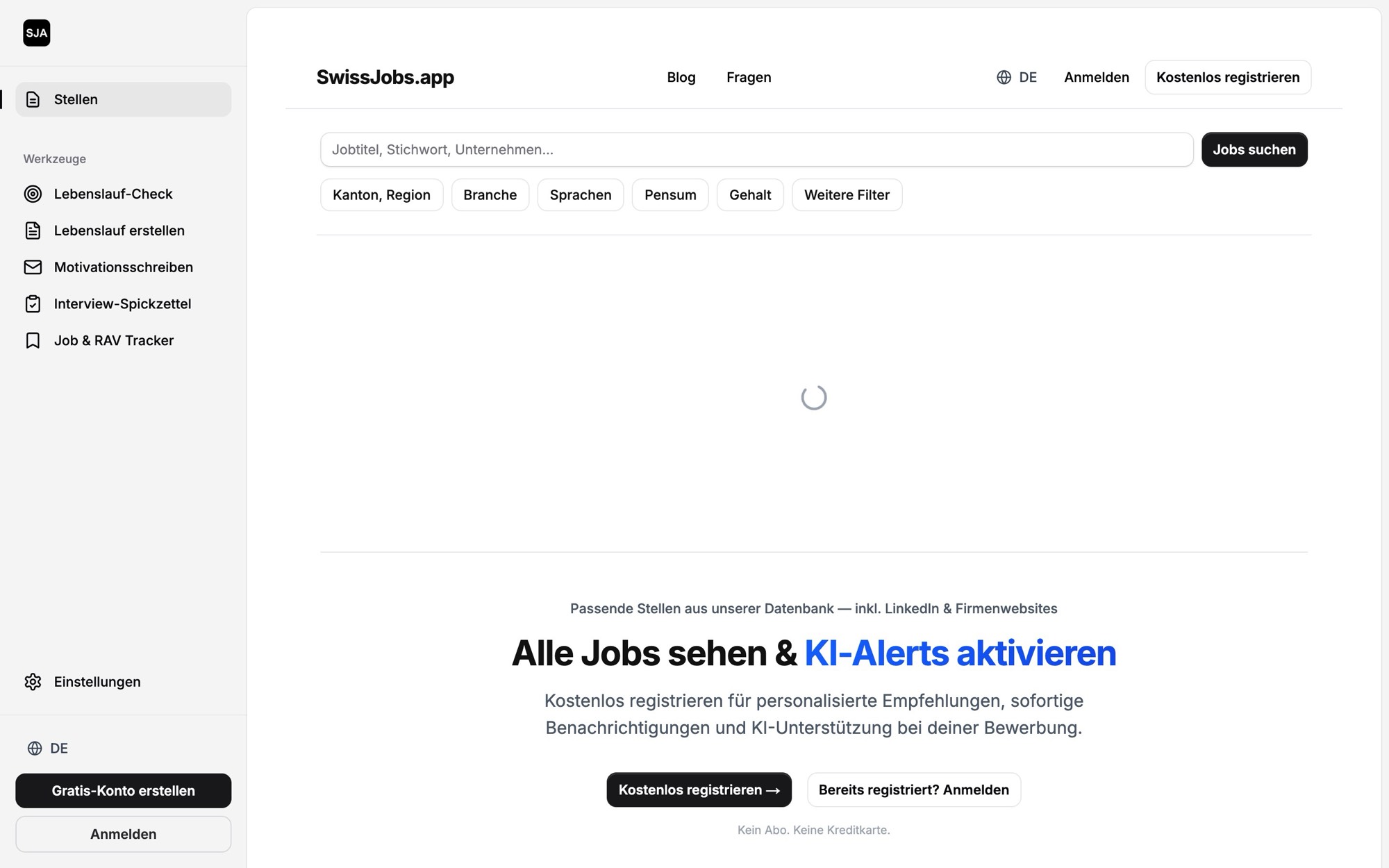
1. SwissJobs.appOur app
Over 21,000 open Swiss roles from ATS systems, company sites and LinkedIn in one place — and from any advert, straight into a CV, a motivation letter, a CV check and interview prep. The RAV job-search-efforts form fills itself from your application tracker. Free to use; the account is asked for at save.
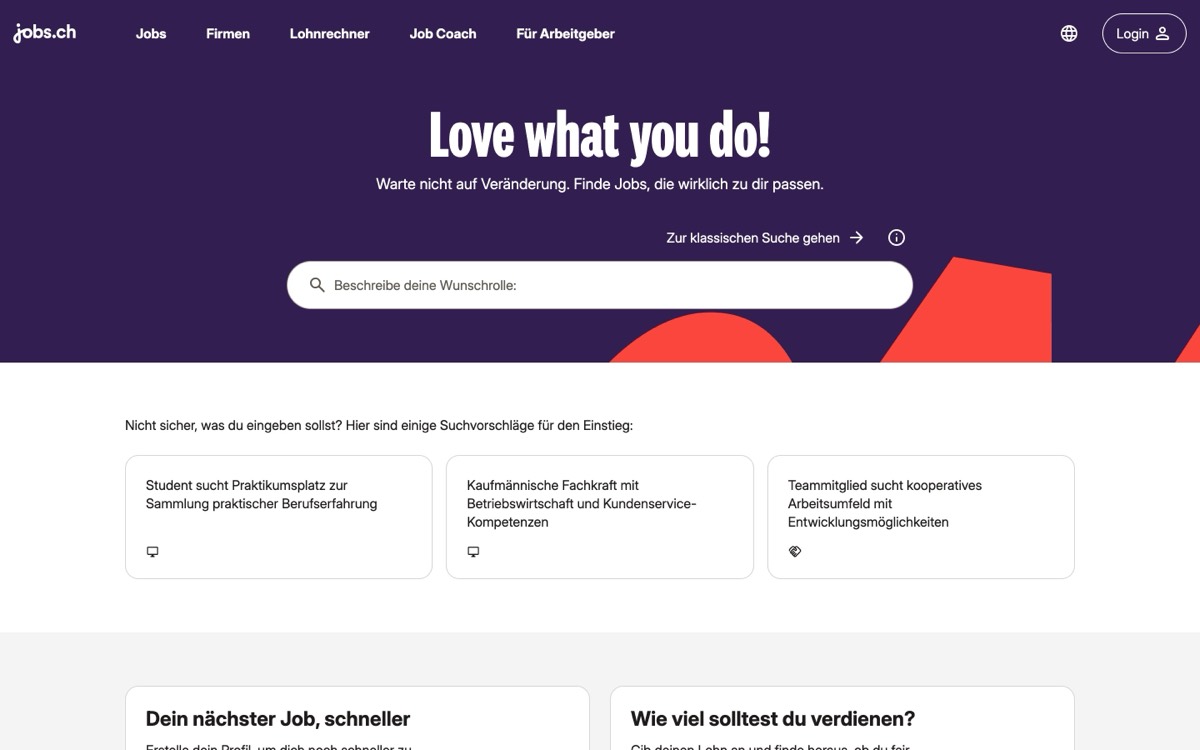
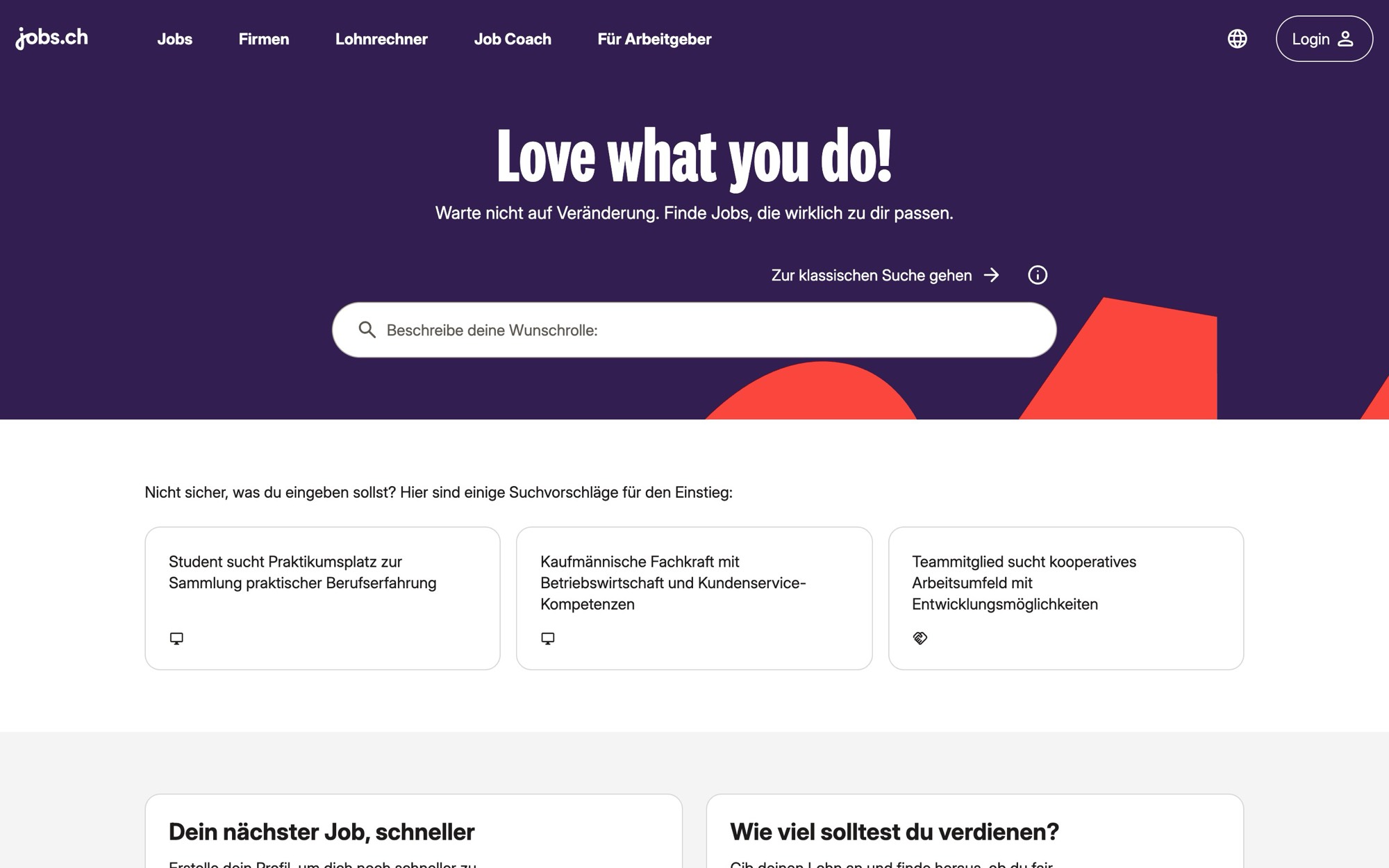
The best-known board in German-speaking Switzerland and the largest index in the country. Owned by JobCloud AG — as are jobup.ch and JobScout24.
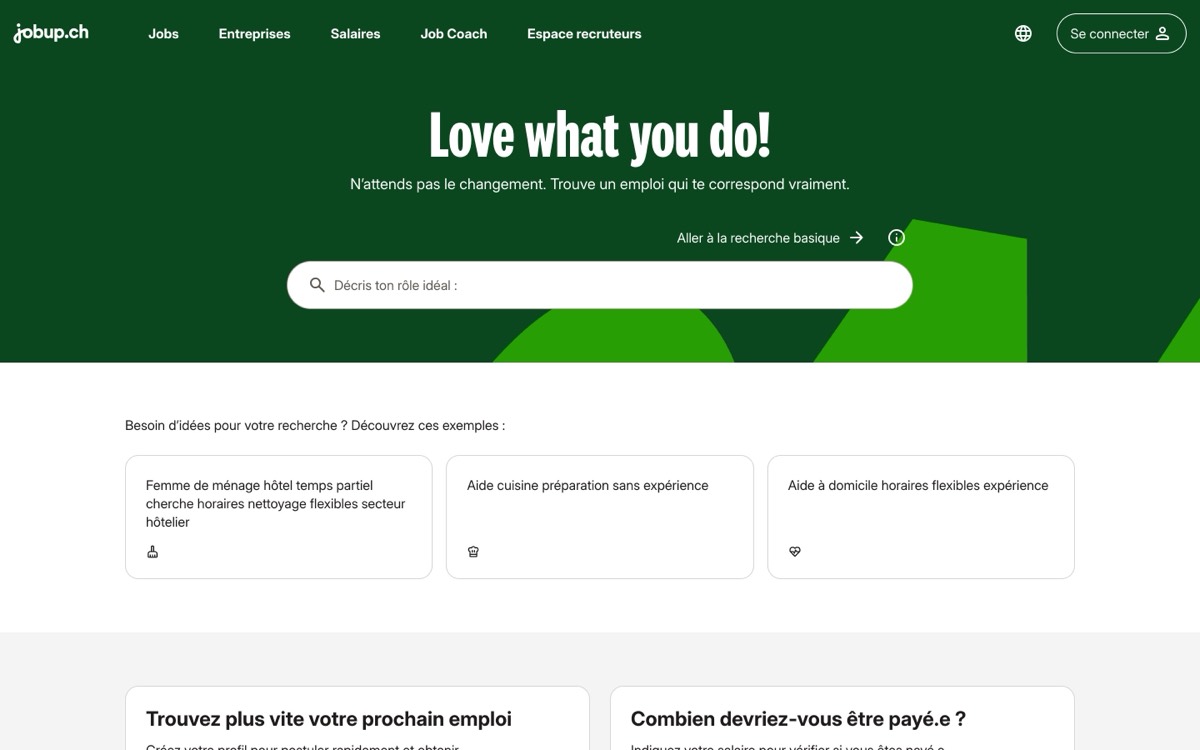
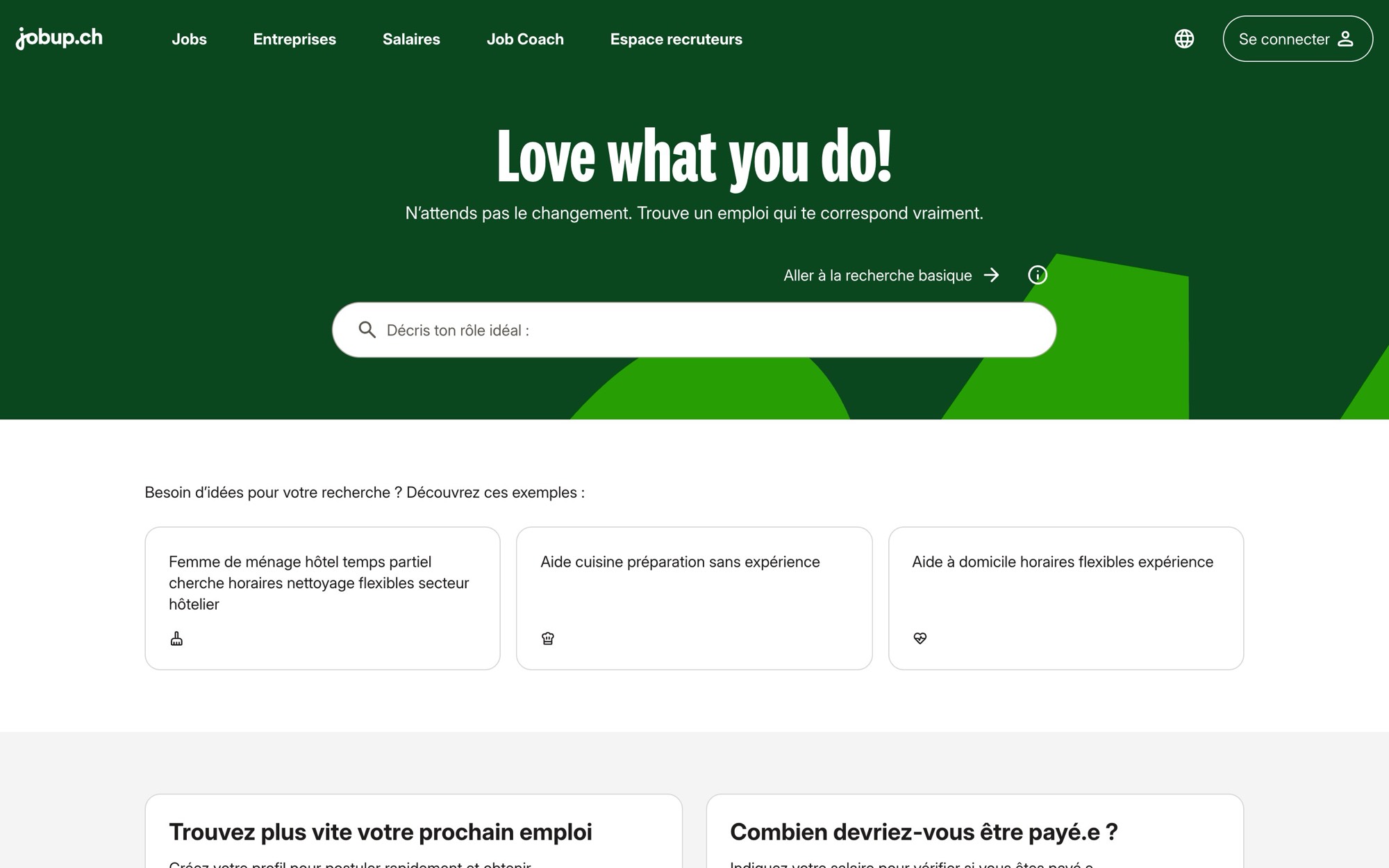
The standard in French-speaking Switzerland and the first place to look for the Romandie — but the same JobCloud AG as jobs.ch.
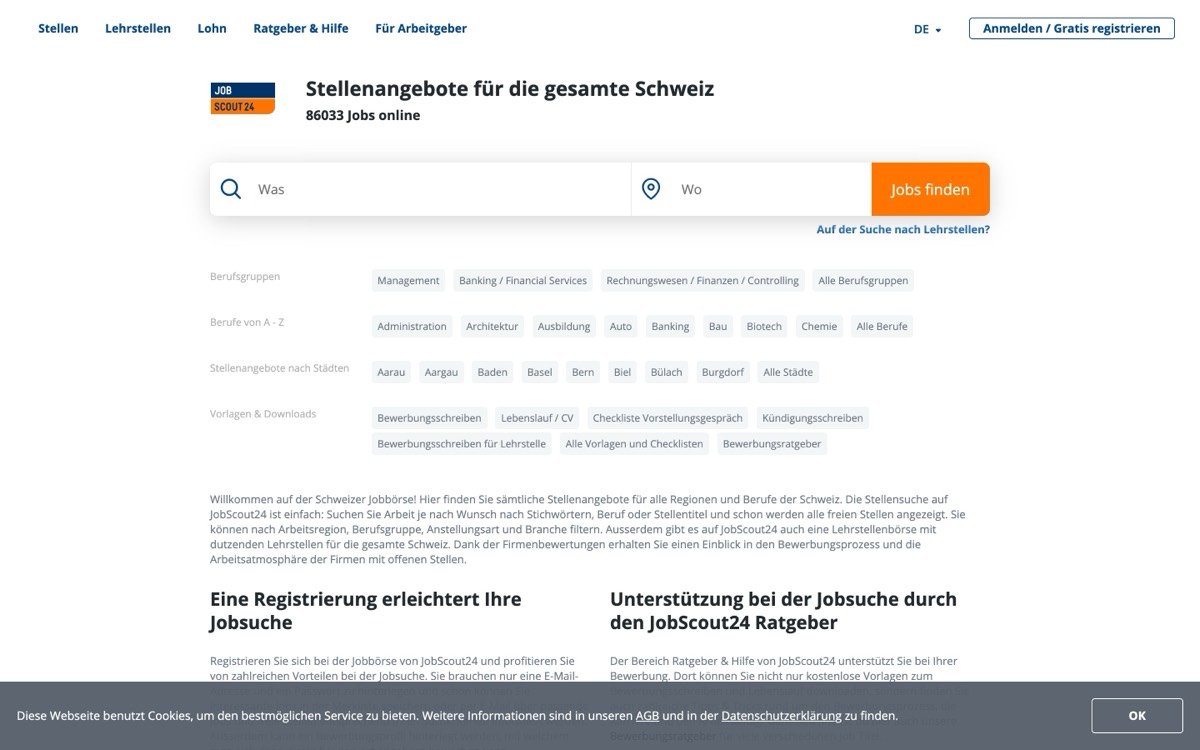
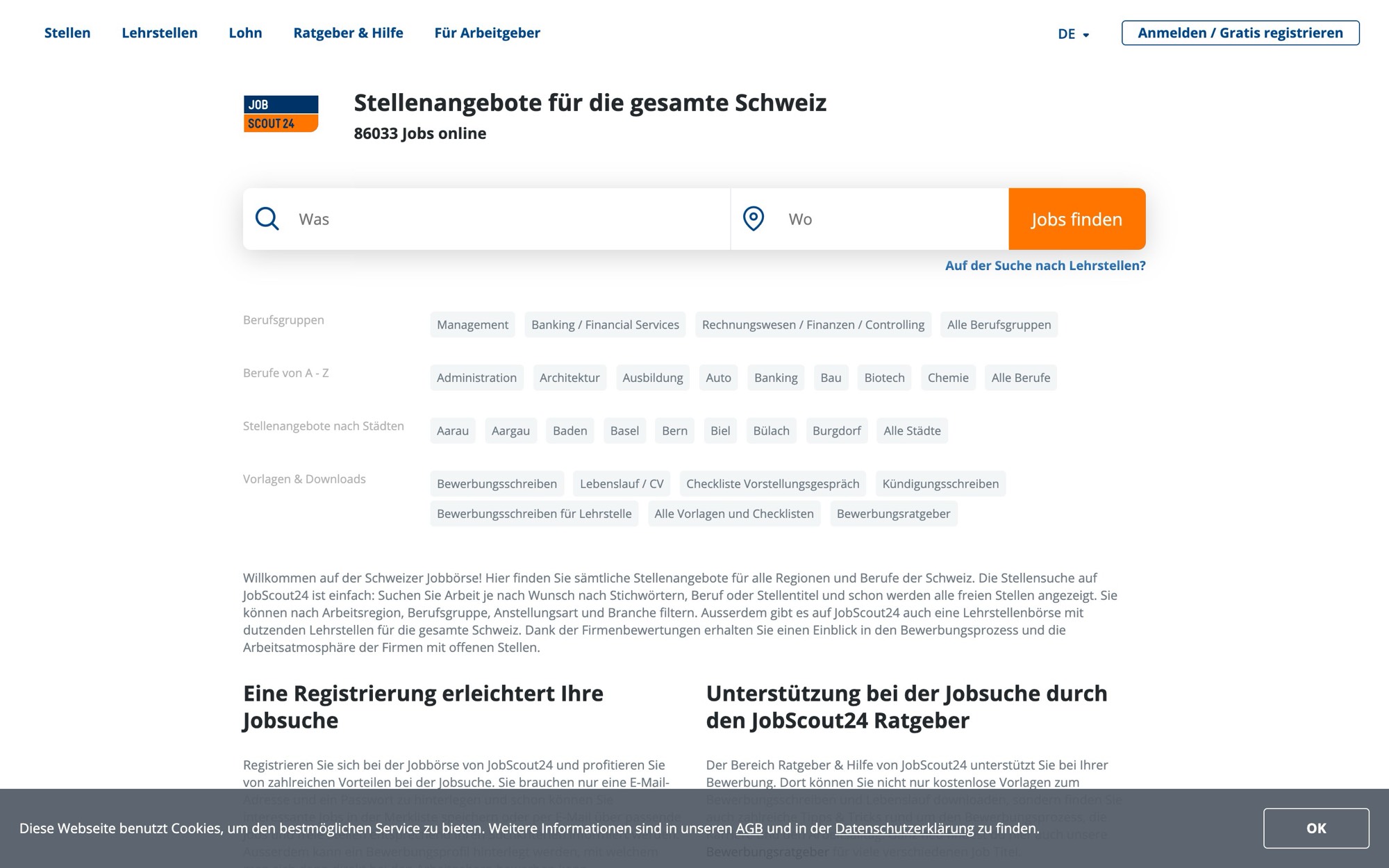
A third brand from the same company. Searching all three to widen your search means searching one provider three times.
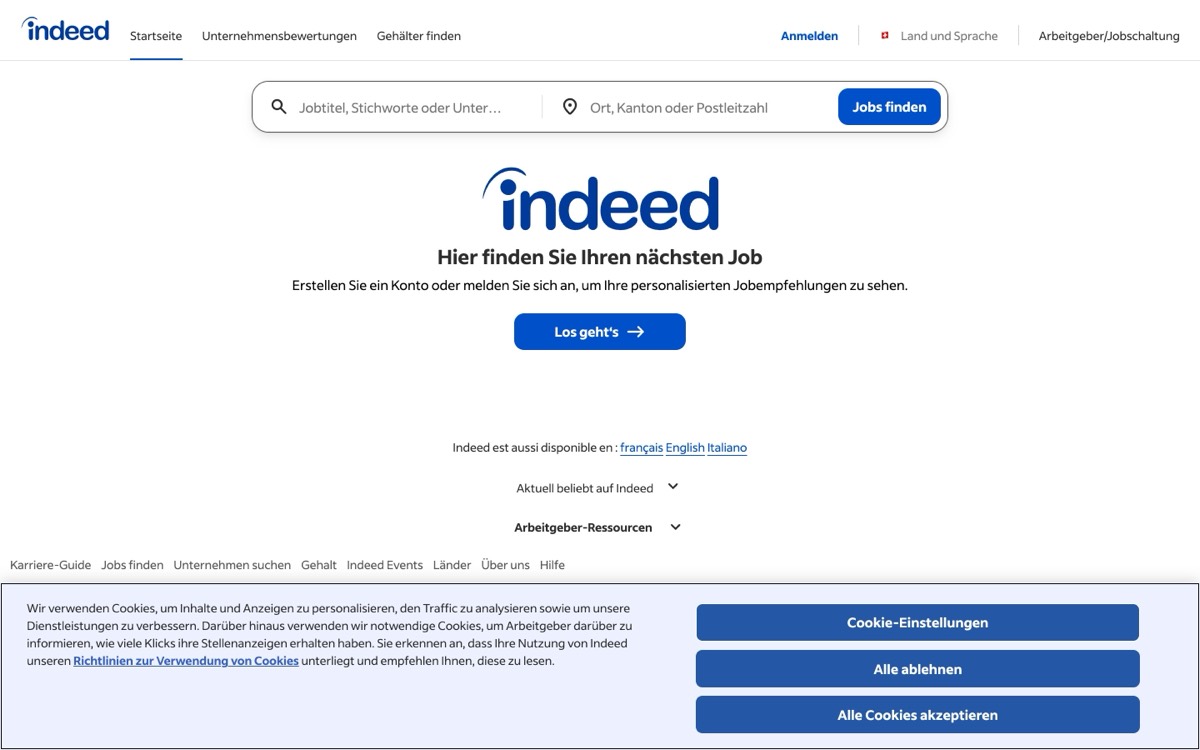
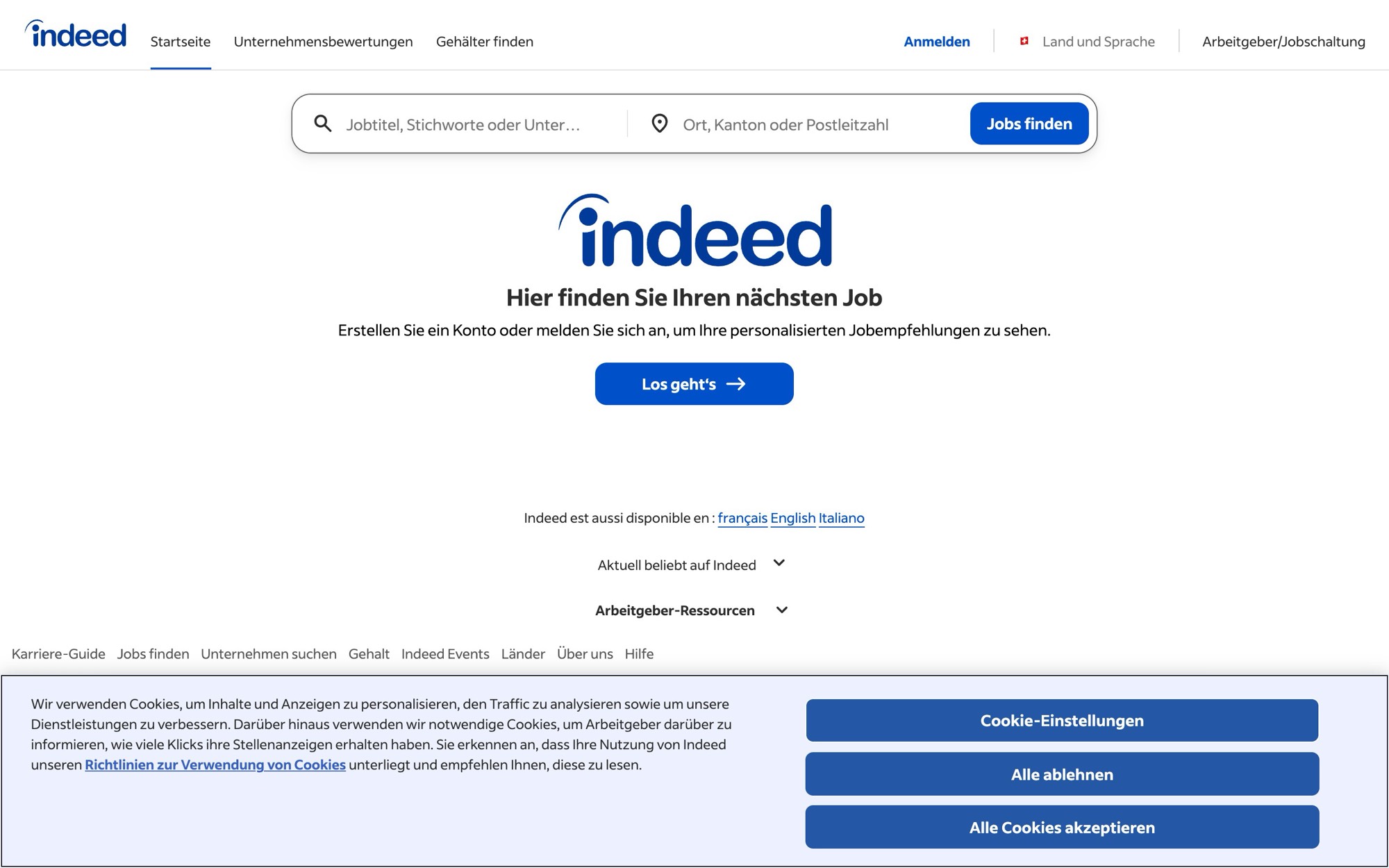
The broadest aggregation, because Indeed also collects from other boards — at the cost of many duplicates of the same advert.
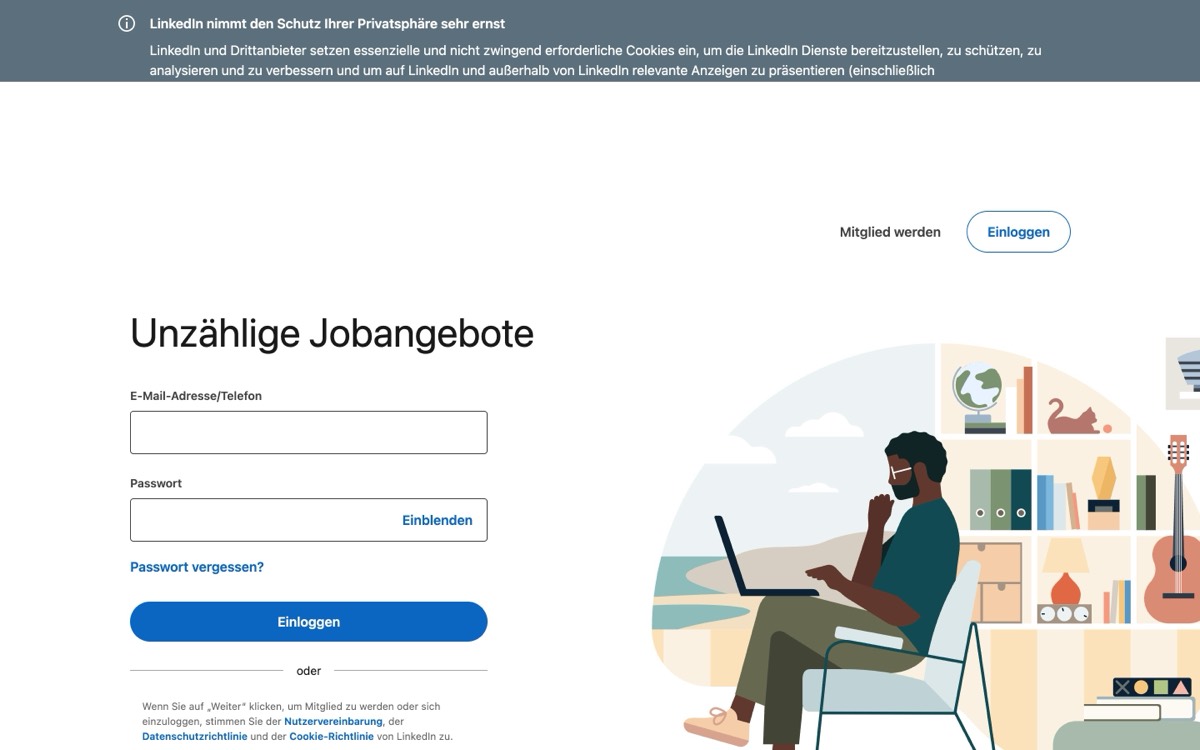
The best reputation for English-speaking and international roles in Switzerland. Considerably thinner for trades, care and commercial roles.
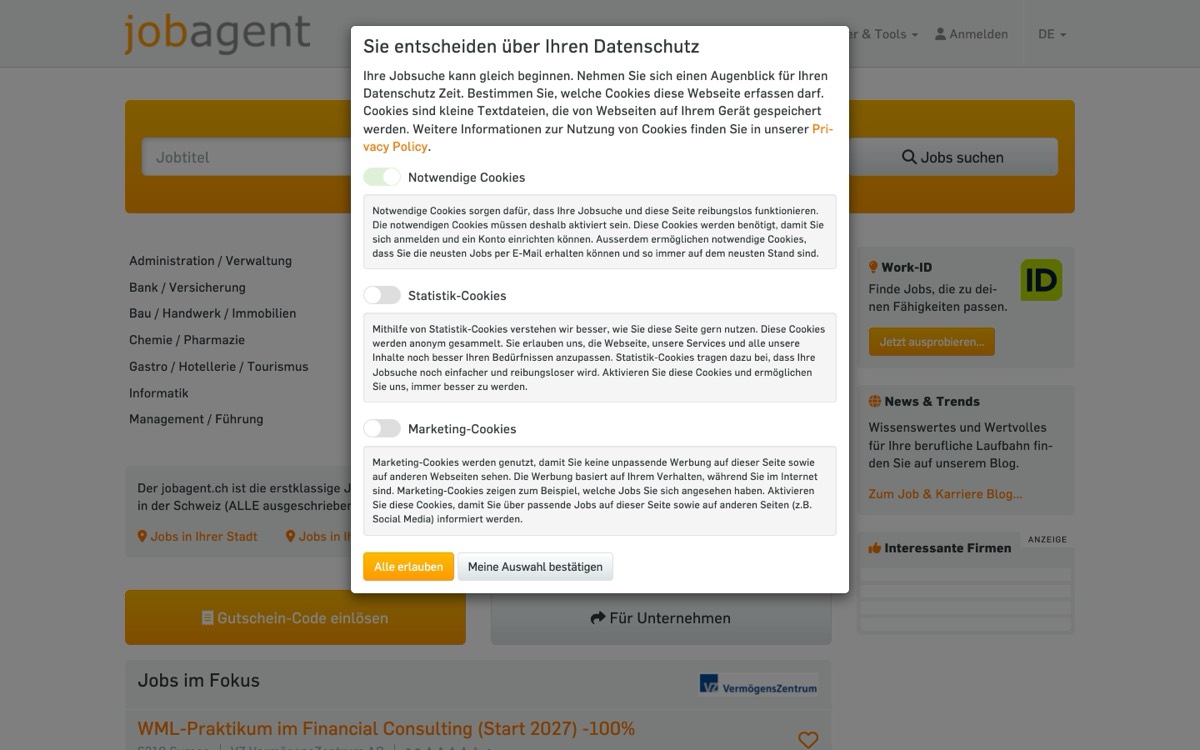
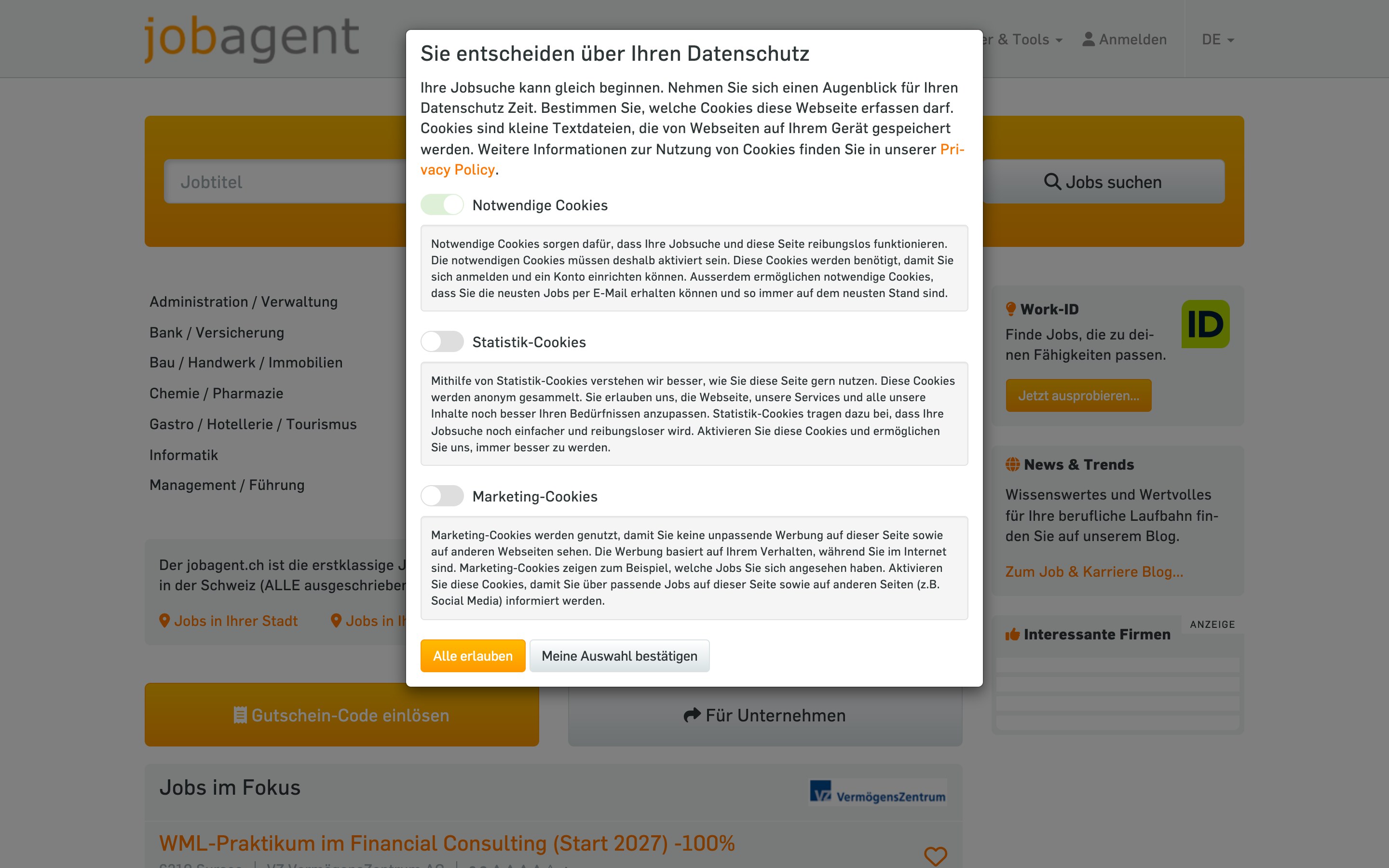
A meta-search across the Swiss job boards, "every job in Switzerland at a glance". Its strength is the Job-Abo: a saved search that mails you new adverts from every portal it covers. Salary calculator and application guides alongside.
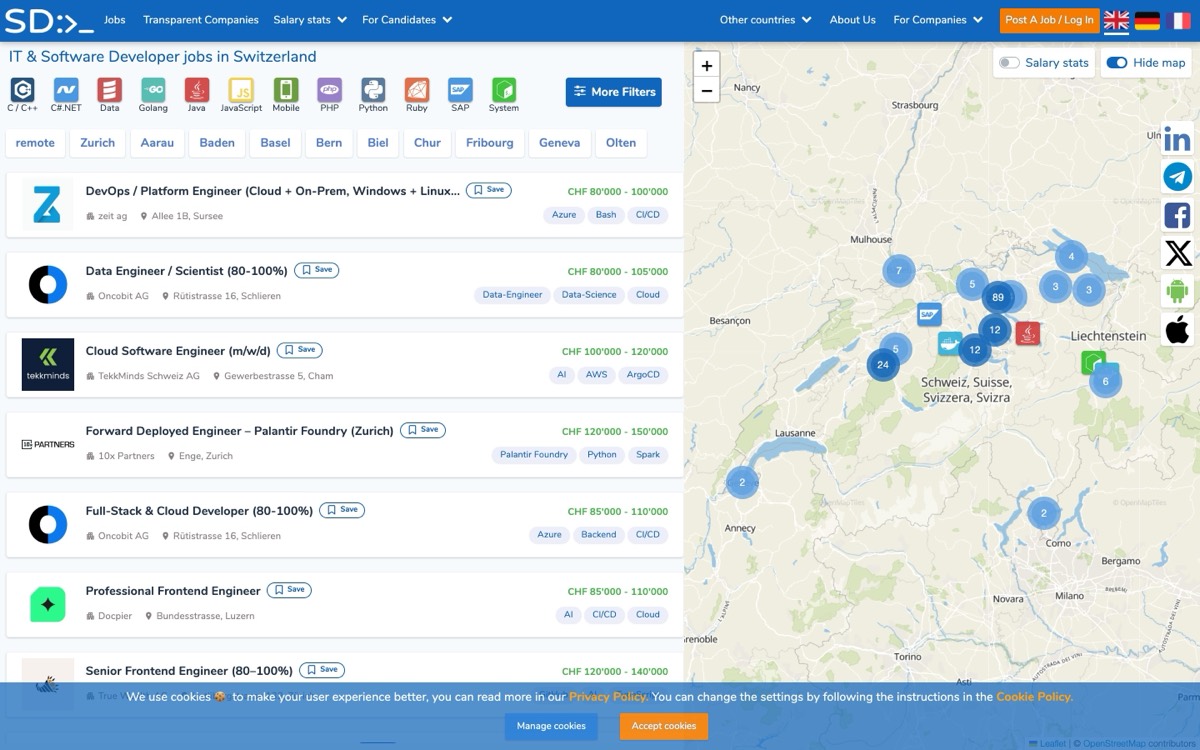
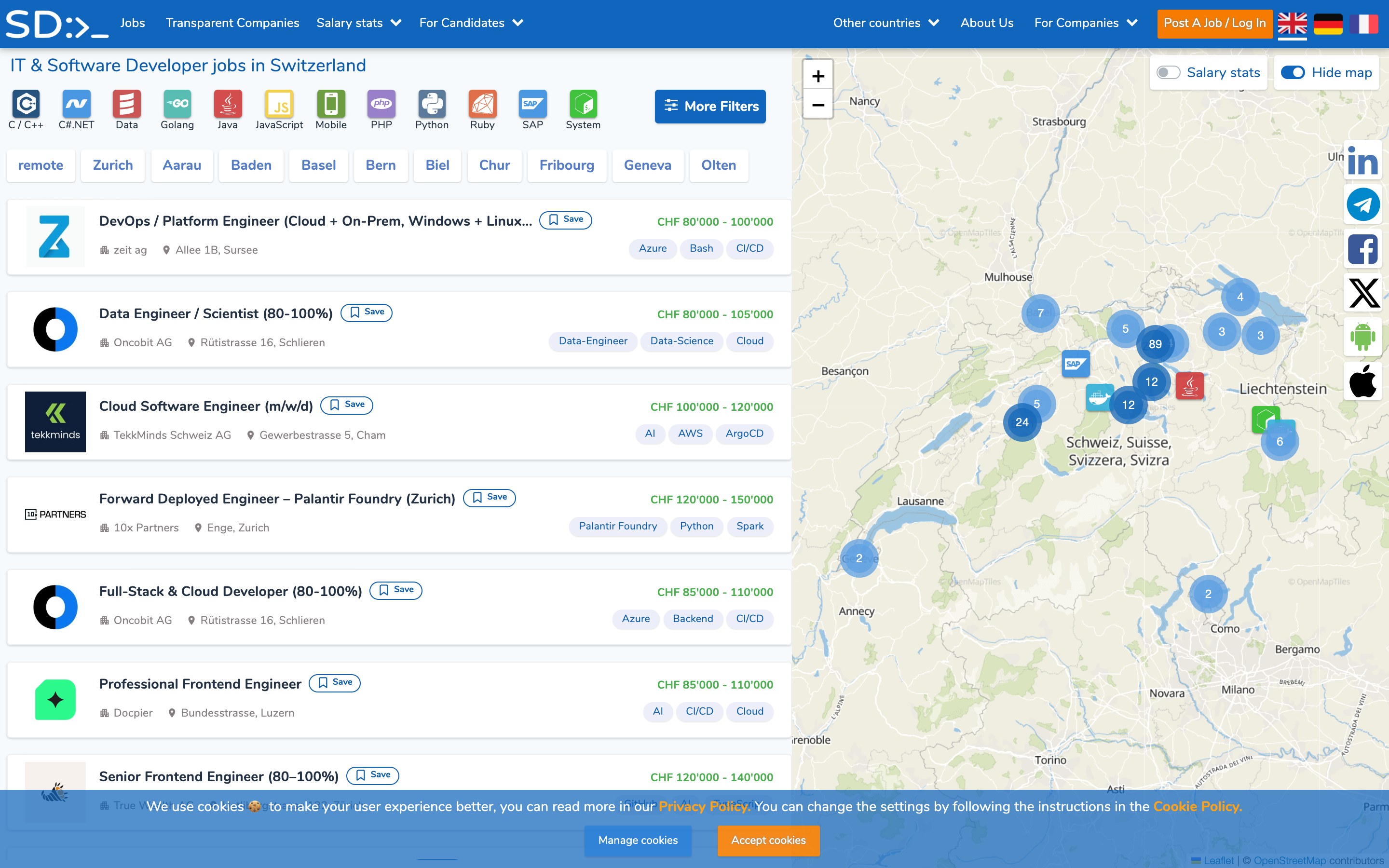
IT and software only, and thorough about it: "183 IT & Software developer jobs in Switzerland", filtered by technology (C#, Java, Python, DevOps, ML) rather than by industry. Publishes salary statistics and lists the companies that disclose their ranges. The site itself is in English.
Jobs by profession, city or language
Type a profession, a city or a language, the page shows the adverts currently open for it.
By profession
- Consultant
- Project Manager
- Retail Sales
- Nurse
- Nursing & Care
- Administrative Assistant
- Account Manager
- Software Engineer
- Public Administration
- Architect
- Insurance
- Chef
71 more — narrow the search
By work type
That five-day window is not a loyalty perk. It is written into federal law, and the wording is deliberately narrow: access to information about reported vacancies is restricted, for a limited period, to people registered with the public employment service in Switzerland.
What follows is the machinery — who may use which half of the platform, what registration actually requires, how the five working days are counted, the single number that decides which occupations end up behind the wall, what the employer owes in return, and what our own live advert stock reveals about all of it.
Selection from the official list of occupation types subject to the job registration requirement for 2026. Threshold: 5 per cent, measured as the average over the fourth quarter of 2024 and the first three quarters of 2025; the list applies from 1 January to 31 December 2026.
- Searching needs no account. The account is for people already signed on as jobseekers with an RAV — sign on first, register second.
- Registration needs an AGOV login (free at agov.admin.ch), your AHV number, and the eight-digit personnel number from the top of your unemployment fund's statements and letters.
- Five working days of exclusivity: reportable vacancies may be advertised elsewhere only after that period, and during it only employment-service staff and registered jobseekers can see them.
- SECO: the blocking period starts on the working day after the vacancy goes live — working days, not calendar days.
- An occupation type is reportable at a national unemployment rate of 5 per cent or more, averaged over the previous year's fourth quarter and the current year's first three quarters.
- Coverage grew from 6.5 per cent of employed persons to 10.8 per cent when cooks and cleaning staff joined the list.
- Employers get matching dossiers within three working days and must report back who they invited, whether they hired, and whether the job is still open.
- No obligation for internal hires with at least six months' service, engagements of up to 14 calendar days, or close relatives of signatories — and the internal-hire exemption does not apply to staff-leasing firms.
- In our open stock, 1.6 per cent of adverts carry an official reportable job title, and none of them apply via job-room.ch.
Two doors, and only one of them needs you to be in the system
arbeit.swiss calls Job-Room Switzerland's biggest jobs platform. The first door is open to everyone: search, filter, read, apply. Nothing about that view requires an account, a Swiss address or a permit, and it is the view a search engine indexes.
The second door is the user account, and it carries a precondition that catches people out. The services tied to registration are for people who have already signed on as jobseekers with a regional employment centre. Signing on with the RAV and registering for Job-Room are two separate acts in a fixed order: the RAV first, the account second.
Signing on can itself be done through a Job-Room eService or in person at the RAV, using your AHV number from your insurance card. arbeit.swiss gives two timing rules that belong together: sign on as soon as possible, and no later than the first day for which you want to claim unemployment benefit. Within two weeks of signing on, the RAV invites you to an initial consultation.
For someone still employed, still on notice, or living abroad and looking into Switzerland, the practical answer is simple: the open search is all you get, and it is not a restricted version of the platform — it is the ordinary one. The head start is reserved for people the insurance is already paying attention to.
What registration actually asks for
Registration runs through the unemployment insurance's Identity Access Management. In front of it sits an AGOV login — the federal administration's shared sign-in, free to create at agov.admin.ch, and reusable across other government services. If you already have one, this step is done.
Then two numbers. Your AHV number, and an eight-digit personnel number issued by your RAV. arbeit.swiss says where to find the second one: at the top of the allowance statements and letters from your unemployment fund. That detail matters more than it sounds — if no statement has arrived yet, the number does not exist yet, and registration will fail on day one for reasons that have nothing to do with you.
What the account then unlocks is a short list: submitting the benefit application, the monthly insured-person declaration and the record of personal job-search efforts online; uploading application documents; setting job alerts; keeping watchlists of vacancies.
One consequence rarely mentioned in the how-to guides: employers use Job-Room in the other direction too. They can search for suitable candidates, see profiles with qualifications and professional experience, and — if they are registered on the platform — obtain contact details to approach someone directly. Registering makes you visible, not just able to see.
The five working days, counted precisely
The rule sits in two layers. The Foreign Nationals and Integration Act sets the principle: in occupation groups with above-average unemployment, employers must report vacancies to the public employment service, and access to the information about reported vacancies is restricted for a limited time to people registered with that service in Switzerland. Article 21a paragraph 3 is the reference; the official text is German, French and Italian, and the English here is our rendering.
The ordinance on employment services sets the clock. Employers may advertise a reportable vacancy elsewhere at the earliest five working days after it is published on the public employment service's platform. The following paragraph says who may look during that time: only staff of the public employment service and people registered with it as jobseekers.
SECO adds the start point: the five-day blocking period begins on the working day after the vacancy goes live on the portal that only RAV-registered jobseekers can reach. The day of publication does not count, and working days are not calendar days — a public holiday stretches the window.
So for those five working days the vacancy is not merely hard to find elsewhere. It is absent. No aggregator has it, no alert from a commercial job board carries it, and no amount of search skill substitutes for the login.
One number decides which occupations are behind the wall
There is no committee and no lobbying here. The ordinance ties everything to a single figure: the reporting obligation applies to those occupation types in the Swiss Standard Classification of Occupations whose national unemployment rate reaches or exceeds a threshold of 5 per cent. The threshold counts as reached when the rate averages at or above it over the fourth quarter of the previous year and the first three quarters of the current year.
The rate itself is defined in the same article: registered unemployed divided by employed persons, based on SECO's labour market statistics. SECO restates it plainly on its employer pages — the sole criterion for the job registration requirement is the unemployment rate.
The list is refreshed in the fourth quarter of each year and then applies for one calendar year, 1 January to 31 December. Two occupation types joined it for the current year: cooks, and cleaning staff and auxiliary workers in offices, hotels and other facilities, both measured at 5.3 per cent.
Because both are very large occupations, the coverage roughly doubled without the rule changing at all. SECO's own figure: 6.5 per cent of employed persons worked in occupations subject to the requirement in 2025, and 10.8 per cent do in 2026. If you cook or clean for a living in Switzerland, the Job-Room account went from irrelevant to material in one list update.
What the employer owes in return
Reporting a vacancy is not a tick-box. The ordinance lists what must be transmitted: the occupation sought, the activity including any special requirements, the place of work, the workload, the start date, whether the contract is fixed-term or permanent, a contact address and the employer's name — and, for staff-leasing firms, the name of the company where the work is actually done. That last item is precisely what a temp agency's ordinary advert leaves out.
The public employment service confirms receipt with an attestation carrying the employer's name and address, an identification number for the advert, and the date from which the advert may be freely published. The deadline is documented before it starts running.
Then the traffic reverses. Within three working days of receiving the complete report, the service sends the employer details of jobseekers with a matching dossier — or tells them explicitly that none are available. The employer must then report back which candidates they considered suitable and invited to an interview or aptitude test, whether they hired one of them, and whether the position is still open.
For a jobseeker that is the part worth understanding. A dossier routed this way lands with an employer who has a legal duty to tell the employment service what happened to it. No speculative application produces that.
Where the obligation stops
The exemptions are broader than most summaries admit. A vacancy need not be reported when it is filled inside a company, company group or corporate group by someone who has worked there for at least six months — explicitly including apprentices taken on after their apprenticeship. Nor when the engagement lasts at most 14 calendar days, nor when the person hired is a close relative of someone with signing authority.
One detail with teeth: the internal-hire exemption does not apply to staff-leasing firms. Temporary assignments in a reportable occupation are therefore more likely to surface in the protected pool than an equivalent permanent role filled internally.
And the statute itself carries the largest exemption of all: if the vacancy is filled by a person already registered with the public employment service, no report is required at all. The protected pool is not a register of every open job in Switzerland. It is a targeted intervention where unemployment is high.
Which is why treating Job-Room as the whole market misreads it in both directions. Inside the five-day window it has no competition. Outside it, it is one portal among many.
What our own advert stock shows
The official list also exists as a table of the job titles belonging to each occupation type, in German, French and Italian, in masculine and feminine forms. We matched those official designations against the titles of every advert open on SwissJobs.app on 22 August 2026. The result: 1.6 per cent of open adverts carry one of the official designations in the title, and 24 of the reportable occupation types appear at all.
Within that slice the distribution is lopsided. Cooks alone account for 41.6 per cent of it; sales managers follow at 15.9 per cent, marketing managers at 8.8 per cent, reception staff at 7.4 per cent and restaurant service supervisors at 5.4 per cent. The construction and general-labour occupations that top the official unemployment table are almost absent from ours — consistent with those roles being filled without a public advert in the first place.
The language pattern is the useful part for an English-speaking reader. Among adverts with a detected language, 13.1 per cent are in French across the whole stock, but 21.1 per cent among adverts carrying a reportable job title. English runs the other way: 27.2 per cent of the whole stock, only 14.3 per cent of the reportable slice. If you search in English, you are searching the part of the market the job registration requirement barely touches — which is worth knowing before deciding whether the account matters to you.
The sharpest finding is a zero. Not one open advert in our stock sends you to apply on job-room.ch or arbeit.swiss. The protected pool does not leak into aggregated listings, ours included, and that is not a gap in our coverage — it is exactly what the ordinance prescribes. The only route in is your own registration.
Two caveats belong with the number. Title matching is a floor: an advert headed 'kitchen help' or 'cleaning staff wanted' does not match an official designation even when the role is plainly reportable. And the title never decides anyway — the responsible RAV checks, on the basis of the actual requirements and activities, whether a given job is subject to the requirement.
Advert figures come from the stock open on SwissJobs.app on 22 August 2026: advert titles matched against the official job designations in the 2026 list of reportable occupation types (German, French and Italian designations, masculine and feminine forms), language shares from the language detected on the advert, destinations from the domain of the apply link. Title matching is a lower bound and does not replace the RAV's case-by-case assessment. Legal position: the Foreign Nationals and Integration Act and the ordinance on employment services as in force on 23 August 2026; registration and blocking-period details from arbeit.swiss and SECO, retrieved 23 August 2026. English renderings of the statutes are ours; the official texts are German, French and Italian.
Sources
- Registration for jobseekers — arbeit.swiss
- Signing on and registration — arbeit.swiss
- Job registration requirement: blocking period, channels, exemptions — SECO
- Job registration requirement and Check-Up for 2026 — arbeit.swiss
- Recruiting staff: searching candidate profiles on Job-Room — arbeit.swiss
- List of reportable occupation types 2026 with unemployment rates (PDF) — arbeit.swiss
- Foreign Nationals and Integration Act (SR 142.20), Art. 21a — fedlex
- Ordinance on employment services (SR 823.111), Art. 53a-53d — fedlex
- Job-Room — jobseekers
Related questions
What our job index says about the Swiss market
Computed live from our own index, not quoted from a study. Shares only, as of today.
Language the advert is written in
- Deutsch
- 60%
- English
- 23%
- Français
- 13%
- Italiano
- 3%
Of adverts that state a language requirement, the share asking for
- Deutsch
- 70%
- English
- 43%
- Français
- 21%
- Italiano
- 3%
19% posted in the last 7 days · Largest markets: Zürich 18% · Bern 10% · Genève 5% · Basel 5%