I'd like to know how to increase the number of job interview requests I receive.
Updated:
In short
In today's digital job market, a generic CV is no longer an effective tool. Research has shown that 75% of Swiss job ads rely on algorithms that evaluate applications based on how well they align with the ad's specific language. This means that sending the same CV to multiple positions will often result in a lackluster response, relegated to the middle tier of consideration, regardless of the candidate's qualifications. The key to standing out is to craft a unique version of the CV that specifically addresses each job posting, which can be the deciding factor in getting noticed.
Practise the interview out loud, and see how you scored
An AI panel asks the questions and you answer by voice, the way the real call goes. Afterwards you get a pass probability and the moments that cost you.
Start a live practice interviewThe tool this argument leads to
Built for exactly this: one CV per advert, without the evening it used to cost.
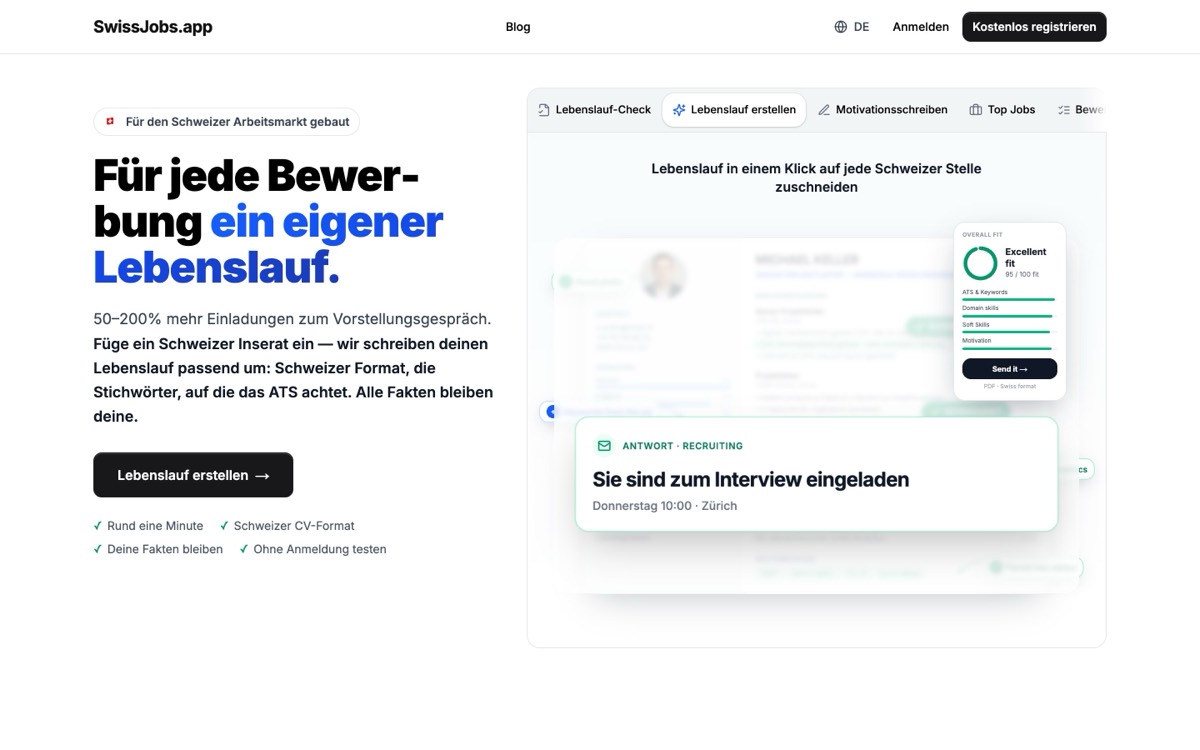
1. SwissJobs.appOur app
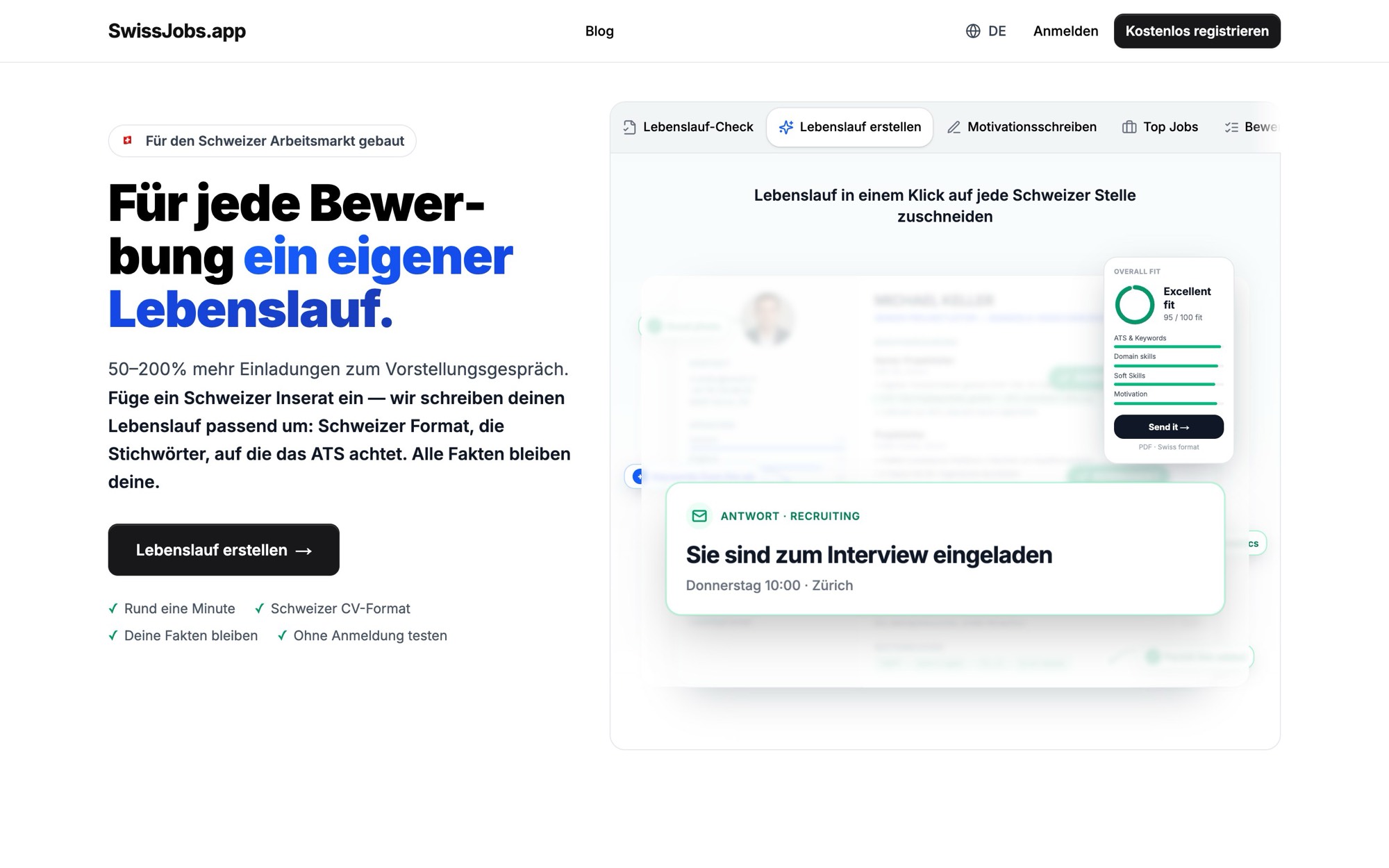
Add the CV you have and a Swiss advert; the AI writes a version against that advert, picking up the terms the advert itself uses. Then edit with AI or by hand, and restyle at any time. Free to start, no sign-up, no card, the first download happens without an account.
To guarantee your chances of being selected this year, carefully re-examine the crucial passage. The central issue has shifted from evaluating the quality of your CV to determining whether the words contained within it align with the specific language used in the job posting. This assessment is predicated on the evaluation by a sophisticated algorithm, an entity devoid of personal opinions or biases, prior to any human review.
If you're submitting a single CV to twenty job postings, you're essentially participating in a small fraction of the actual job searches underway. In reality, you're likely to be rejected by most of these opportunities before your application even makes it past the initial screening stage, where your resume is assessed against the job requirements. Unfortunately, you'll never receive any feedback on why your application wasn't selected, as employers rarely provide such information. The only indication that something went wrong is silence, a stark reminder that the job market can be unforgiving.
In a more precise context, considering the pervasive misconceptions surrounding the process: it's essential to clarify that vendors do not sell automatic rejection services, and a ranking doesn't equate to a refusal. However, a recruiter who receives forty applications will often review the initial ten. The outcome of twentieth place and rejection may seem equivalent, yet they stem from different perspectives.
Position follows how many of the stated requirements your document answers — which is what the vendors advertise. Nobody outside can see where exactly you land; that the match decides it is not in doubt.
Share of adverts whose applicant system could be named, split by whether that vendor markets AI acting on candidates on its own website. Vendor pages read September 2026. Adverts whose system is not visible are excluded.
- Workable: «evaluates every inbound candidate against up to 14 job criteria, then messages them directly to verify interest, fill gaps and answer questions».
- Abacus Umantis, a Swiss system: «Lassen Sie die KI Bewerbungen automatisch analysieren, zusammenfassen und mit dem Stellenprofil abgleichen. Innerhalb von Sekunden erhalten Sie einen Stellenfit-Score.»
- Workday sells «HiredScore AI», where «relevant talent is instantly surfaced»; SAP SuccessFactors sells «AI agents to intelligently surface top talent».
- Ashby is the exception worth knowing: it markets AI that surfaces «which applicants match your given criteria» while stating that the AI «never ranks or gives numerical ratings to applicants, a human must always be involved».
- The area where your CV intersects with the job description is the only variable you can directly influence. This is also the one metric that a CV screening process can reliably assess before submitting anything.
The systems behind Swiss adverts, and what each says it does
| System | Share of identified systems | What the vendor advertises as AI sorting |
|---|---|---|
| Workday | 23.6% | HiredScore AI, relevant talent instantly surfaced |
| SmartRecruiters | 14.0% | AI-Powered Candidate Screening |
| SAP SuccessFactors | 11.2% | AI agents to intelligently surface top talent |
| Greenhouse | 7.2% | Candidate matching, plus a Voice AI first interview |
| Workable | 5.4% | Evaluates every candidate against up to 14 job criteria |
| Join.com | 4.6% | Screen with AI; score every interview the same way |
Share of adverts whose applicant system could be named, split by whether that vendor markets AI acting on candidates on its own website. Vendor pages read September 2026. Adverts whose system is not visible are excluded.
What Swiss adverts actually ask for, read from 300 full advert texts
| Requirement | Share of adverts naming it |
|---|---|
| A Pensum, the workload as a percentage | 42% |
| A federal qualification (EFZ, Fachausweis, HF/FH) | 30% |
| A language level stated outright | 28% |
| Swiss work references (Zeugnisse) | 5% |
| A work permit | 2% |
| A photo | 0% |
Read from the full text of 300 published Swiss adverts, September 2026. Not one asked for a photo, though every CV guide recommends one.
It's becoming increasingly clear that the well-crafted CV is being outshone by the subpar ones.
The most daunting aspect lies in the assessment process itself. The tools scrutinize two documents, assessing the extent to which the job advert's vocabulary aligns with your work. Unlike evaluating your skills, the evaluation method primarily focuses on the degree to which your document mirrors the job advert's language. Candidates with less polished resumes, which have been AI-enhanced to fit the job description, consistently rank within the top 20% of the selection process, outperforming their more generic, unaltered counterparts every time, and the ranking system is unable to detect this discrepancy.
In a job posting, seeking expertise in process optimization, a resume highlighting "continuous improvement" yields an identical score to one with a weaker match. Similarly, a job title written in the style of your previous employer versus the current employer's format results in the same mismatch. Moreover, a qualification specified in an incorrect language causes the same incongruity.
The solution lies not in merely adding more keywords, but rather in optimizing for the reader's needs. By tailoring the language to the individual who is reading, you can improve your chances of standing out. On the other hand, relying too heavily on jargon can ultimately prove counterproductive. For instance, a CV that is overly verbose and stuffed with technical terms may initially gain you an advantage, but it can ultimately lead to you being overlooked in favor of more suitable candidates. The key to success lies in using the language of the original advertisement to describe your genuine experience.
I couldn't find any text for you to rephrase. Please provide the text you'd like me to rewrite.
The only viable strategy for securing more interviews is to submit a tailored resume for each job posting. This is not a suggestion, but rather a mathematical certainty: the ranking system is determined by how well your document aligns with each job description, so a single resume that fails to address the requirements of a particular ad will inadequately address each of them. All other standard advice, including font choices, verb usage, and the one-page guideline, are predicated on a reader who never actually views the document, as it has failed to meet the ranking criteria.
There's no way to successfully navigate the application process solely through visual inspection. Simply relying on a cursory glance at the ad and hoping your application is adequate is little more than a gamble, as it's impossible to discern with certainty which of the specified criteria your submitted documents fully meet and which leave room for improvement. This is why we created the CV check tool, which systematically compares your document to the job posting and highlights the gaps between the two, allowing you to address these issues before it's too late, rather than discovering them only when it's too late to make a change.
What's at stake here is a shift from a document languishing at the bottom of the stack to one rising to the very top. The same individual, facing the same challenge, with the same professional background, is now submitting a new document, tailored to the requirements of the job ad that brought them to this point. The editorial process is swift, lasting mere minutes, and it makes all the difference between being selected for review and being cast aside.
To maintain the integrity of documents, it's essential to adopt a formatting approach that withstands various testing environments. By doing so, we can ensure that our documents remain legible and easily digestible. A single-column layout, devoid of image-based text, is a sound choice. This structure allows for straightforward reading and comprehension. Moreover, consistent formatting is crucial, as it enables our documents to navigate through various technical interfaces, including parser, phone screens, printers, and recruiters' cursory reviews on public transportation.
In Switzerland, credentials continue to hold significance: academic credentials and employment references are scrutinized with a level of emphasis that diverges from other countries, where their absence might be viewed as a deliberate artistic expression rather than a lacuna in a job application.
The harsh reality is that those who are receiving interviews this year are not more capable or qualified than you are. The truth is that they are submitting a document specifically tailored to the job requirements they are applying for, whereas you are sending a generic document that caters to no one in particular. This approach has become a norm, and it can be rectified immediately.
Based on our own in-depth assessment of the open Swiss adverts we possess, as of September 2026, we conducted an exhaustive analysis. For each advert, we determined the intended URL of the apply link and retrieved information from that address; if a link was redirected to another system, we followed a random sample to its ultimate destination and extrapolated the results. The classification «markets AI matching» is rooted in data from vendors' own product pages, which we accessed and saved in September 2026. Since individual employers' actions within purchased systems remain opaque to outsiders, vendor marketing data provides valuable insights into product attributes rather than specific hiring processes. Adverts whose systems are not discernible are explicitly excluded from our three-quarters figure, rather than being assumed to be either way.
Write a custom CV for every job you apply to
Most people send the same CV everywhere. The editor rewrites yours against the posting — Swiss format, the right language, in about a minute.
CV maker & resume builder: for a specific advertJobs by profession, city or language
Type a profession, a city or a language, the page shows the adverts currently open for it.
By profession
- Consultant
- Project Manager
- Retail Sales
- Nurse
- Nursing & Care
- Administrative Assistant
- Account Manager
- Software Engineer
- Public Administration
- Architect
- Insurance
- Chef
71 more — narrow the search
By work type
Sources
Related questions
What our job index says about the Swiss market
Computed live from our own index, not quoted from a study. Shares only, as of today.
Language the advert is written in
- Deutsch
- 60%
- English
- 23%
- Français
- 13%
- Italiano
- 3%
Of adverts that state a language requirement, the share asking for
- Deutsch
- 70%
- English
- 43%
- Français
- 21%
- Italiano
- 3%
19% posted in the last 7 days · Largest markets: Zürich 18% · Bern 10% · Genève 5% · Basel 5%