Why does my application go nowhere despite matching the requirements?
Updated:
In short
Because a requirement list stops deciding anything the moment you satisfy it. Across the open Swiss adverts we hold, three printed requirement profiles cover 68.1 per cent of the market: no language requirement stated at all (33.5 per cent), German at professional level (21.5 per cent), English at professional level (13.1 per cent). Meeting those lines separates you from almost nobody. What decides next is not printed: how old the advert is, whether your availability is settled without a follow-up question, and how legible your career path looks to a Swiss reader.
That is a different diagnosis from "your CV is weak", and it points at different work. If you do not meet the requirements, you have a targeting problem and need different adverts. If you do meet them and still hear nothing, you almost always have a visibility problem: the match exists, but it is not where the first eight seconds of reading go — and it is being weighed against a field in which a great many people bring the same thing.
This page takes apart the four places where a genuinely qualified Swiss application stalls: the sameness of the printed requirements, the permit question that is answered before anyone reads your experience, the advert’s own clock, and the way a Swiss reader reads a career path. It ends with the honest part — the cases where nothing at all was wrong with your application.
Share of open Swiss adverts by the requirement profile they print — the combination of languages and levels recorded on the advert, with "none stated" counted as a profile of its own. Our own count of open adverts on SwissJobs.app excluding apprenticeships and internships, 4 September 2026.
- In short: the requirements in a Swiss advert are an entry threshold, not a ranking. Clearing them puts you in the field; what decides after that is the advert’s age, how settled your availability looks, and how legible your path is.
- Three printed requirement profiles cover 68.1 per cent of open Swiss adverts — none stated (33.5 per cent), German at professional level (21.5 per cent), English at professional level (13.1 per cent). Inside a single occupation the concentration is higher still: in nursing, 87.6 per cent of adverts carry one of that field’s three most common profiles.
- A third of open adverts — 33.5 per cent — state no language requirement at all. One does exist; it simply is not on the list you are ticking.
- If you need a permit, a gate you do not control runs first: for non-EU/EFTA nationals the State Secretariat for Migration requires the employer to prove that no suitable person was available on the Swiss or EU/EFTA labour market, and annual quotas apply on top.
- The advert was already running before you saw it. 21.9 per cent of open adverts are more than 90 days old and only 21.2 per cent are a week old or less; in occupations with high unemployment, a five-working-day blocking period gives RAV-registered jobseekers first sight of the vacancy.
- So the useful question is not whether you meet the requirements — you already know that — but whether a human can see it in eight seconds on the first half page.
The printed requirements separate almost nobody
We counted the open adverts by the requirement profile they print — which languages at which level, with "none stated" treated as a profile in its own right. There are hundreds of possible combinations. Three of them cover 68.1 per cent of the open stock: none stated at 33.5 per cent, German at professional level at 21.5 per cent, English at professional level at 13.1 per cent. Everything else shares the remaining 31.9 per cent.
Inside one occupation it tightens further. In nursing, 87.6 per cent of adverts carry one of that field’s three most common profiles; in construction and the trades 78.9 per cent; in IT 74.6 per cent; in retail and sales 73.0 per cent. Hospitality is the broadest at 62.7 per cent, because it asks for two languages more often and at lower levels.
The consequence is uncomfortable and useful at once. If you meet the printed requirements of a Swiss nursing advert, you meet the same lines as very nearly everyone else who applies to it. The list was never meant as a ranking — it is a threshold. It says who may enter and is silent about who wins. That is exactly why "I meet everything" feels like a claim and does not function as one.
The same count produces a second finding: a third of open adverts state no language requirement at all. That does not mean none exists. It means it is not on the list you are ticking — it lives in the running text, in the daily reality of the team, or in the language the advert itself is written in. Clear the list but miss the unstated expectation, and in the employer’s eyes you did not meet the requirements, while the advert gave you no way to know.
If you need a permit, that question is answered before your experience is read
For anyone applying from outside Switzerland, or living here on a permit that is not yet settled, this is usually the real answer to the question, and it has nothing to do with the quality of the application. The State Secretariat for Migration states that nationals of non-EU/EFTA states are admitted only if they are well qualified — in the first instance people with a university or university-of-applied-sciences degree and several years of professional experience — and that the future employer must prove that no suitable person is available on the domestic labour market or in the labour markets of the EU/EFTA states. Annual maximum quotas apply on top of that.
An employer who does not intend to run that proof for a particular vacancy almost never says so in the advert. They simply do not reply. From the outside, that silence is indistinguishable from "your profile was not good enough", which is why so many well-qualified applications from abroad read the market as hostile when what they met was an administrative gate.
Two practical consequences follow. First, if you already hold a B, C or G permit, or you are an EU/EFTA national, say so explicitly on the first half page — one line, next to your address. The gate then closes in your favour instead of staying open as a question, and an unanswered question costs a follow-up nobody has time for. Second, if you do need sponsorship, the productive move is not more applications but different ones: employers who carry that administrative burden do it visibly and repeatedly, and that is something you can observe before applying.
Two smaller signals sit in the same family and are worth the two lines they cost: a Swiss address with a postcode, and a Swiss phone number. Neither is a rule anywhere. Both remove the relocation question from the first pass.
The advert has a clock, and it started before you saw it
An advert is not a form waiting for you; it is a process already under way. Of the open stock, only 21.2 per cent are a week old or less. 29.3 per cent are eight to thirty days old, 27.7 per cent thirty-one to ninety, and 21.9 per cent are older than ninety days. Roughly one visible advert in five belongs to a vacancy that has been online for more than a quarter of a year.
For a matching application that is the difference between two entirely different situations. On a fresh advert you enter an open process. On a very old one you either enter a process whose shortlist was formed weeks ago, or a standing advert behind which no decision is pending this month at all. Both produce the same silence, and neither is a verdict on your dossier.
There is also a legal delay that most applicants have never heard of. In occupations with high unemployment, Switzerland operates a job vacancy reporting requirement: the employer reports the vacancy to the RAV, and it may be advertised elsewhere only five working days after publication in the protected area of the Job Room portal. arbeit.swiss describes this as an information and application advantage of five working days for jobseekers registered with the RAV. Within three working days of that publication, the RAV also sends the employer details of registered jobseekers whose dossiers fit — or reports back that there are none.
So on the day such an advert becomes visible to you on a public board, the employer may already be holding a set of matching dossiers. That is not a flaw in the system; it is its stated purpose. What it means for you is simply that the advert’s age is information, and it is free. Between two equally well-matched vacancies, the newer one is the better application.
A Swiss application is a dossier, not a resume
This is where applications built in another market lose without ever being compared. A Swiss dossier is expected to carry more than a CV and a letter: the Arbeitszeugnisse (the written employer references for your recent positions), diplomas, and in technical, scientific and financial fields the transcripts and final grades. Arriving with a strong CV and none of that reads as incomplete rather than as a stylistic difference — and incomplete is read as a signal.
The document conventions run the same way, and they are the opposite of the Anglo-Saxon habit in several places. Two pages is the norm and three is fine for senior profiles, where a US one-pager reads as thin. A professional photograph is customary rather than discouraged. Nationality and permit belong on the page. Languages are stated as CEFR levels — German B2, French C1, English native — because "good German" is not a level anyone can act on. Workload is a Pensum given in per cent. Europass, in particular, is a recognisable outsider format in this market.
If you are still employed and cannot supply a current reference, write that in one line rather than leaving the gap. In a first pass, an unexplained gap is filled in with the least favourable assumption available; an explained one stops being a gap. Send one PDF, named properly, in the order CV, letter, references, diplomas. How the dossier arrives is read as a small work sample.
arbeit.swiss sets out what a complete application contains on its tips pages for jobseekers, and recommends in the same place keeping an overview of applications sent and replies outstanding. That overview is the only way to answer the question this page asks: without it you cannot tell whether ten similar rejections came from ten employers or from three.
Switzerland reads the path before the achievements
Switzerland has a recognised training route for almost every occupation — apprenticeship, vocational baccalaureate, university of applied sciences, university. The system works, employers trust it, and the side effect is that a dossier is read first as a path and only afterwards as a record of achievement. Bring the required experience by a route the grid does not recognise, and you are not scored lower — often you are simply never compared.
Two more filters run at the same stage and appear in no advert. Employer size: a move from a small team into a large group is read as a risk, and the reverse move as a different one. And adjacency of subject matter: the same function in another industry counts for less here than the same industry in a slightly different function. "Has done this at our scale, in our field" is a stronger argument in Switzerland than "can do more".
None of that is a reason to give up; it is an instruction about writing. Spell the parallel out instead of leaving it to be inferred — same regulated industry, same team size, same customer type, same procedure — in one line, near the top, not as a conclusion on page two. Put anything certified in Switzerland high on the first page, including the recognition of a foreign diploma if you have obtained one.
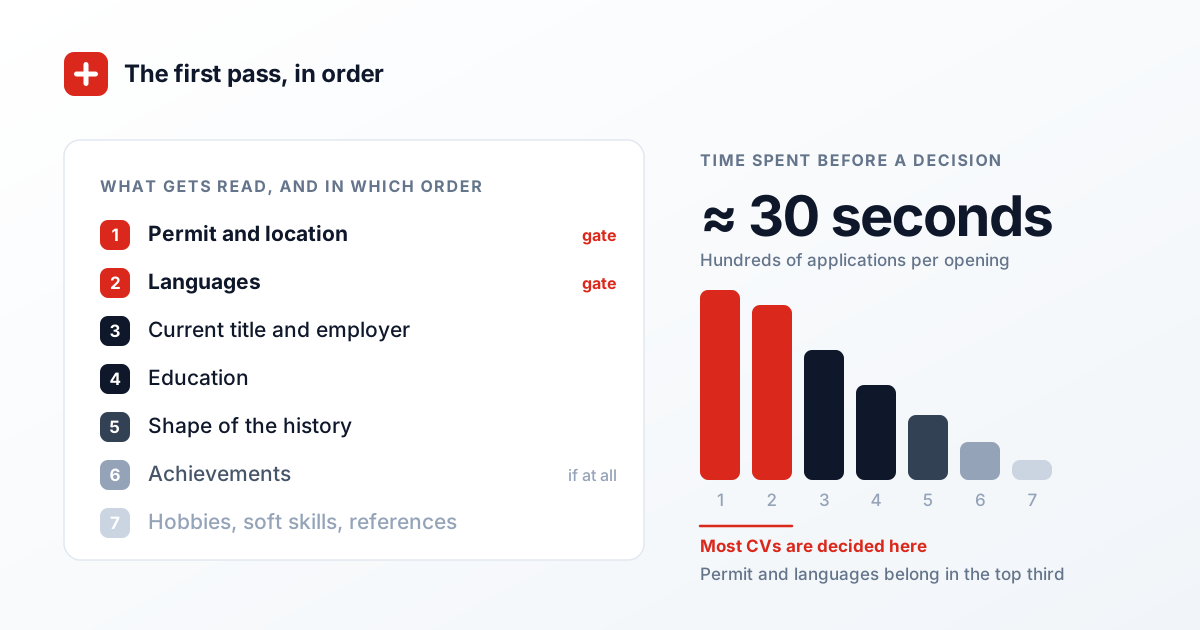
The second half of the same point is the reading order. The first pass takes seconds and starts at the top left. What is not there does not exist in that pass: location, permit, languages with levels, current role and employer. Achievements are read if the dossier survives the first pass, not before. Most of us spend our editing time in exactly the opposite order.
When nothing was wrong with your application
Part of the silence cannot be edited away, and it would be dishonest to leave that out. An internal candidate was already in place because the role had to be advertised internally. A budget was frozen. The role was filled through a referral before the stack was read. The advert was a standing one with no current vacancy behind it. In those cases your application was never in the running, and it had no way of finding out.
The way to handle that is statistical rather than emotional. A single rejection carries almost no information; a series does — but only if you record three things per application, none of which concerns your document. Who received it: the employer itself, an agency, a public administration? How old was the advert on the day you applied? And was every explicitly stated condition evidenced somewhere findable in your dossier?
Those three columns separate the two cases that feel identical from the inside. If old adverts and the same few recipients pile up, it is targeting. If the adverts were fresh, the recipients varied and the conditions evidenced, and still no invitation came, then it is presentation — and presentation is the part you can change.
What to change on the next application
First: the top half of page one carries location, permit, languages with levels, and your current role. Not page two, and not the motivation letter. Second: one line that states the parallel to the advertised role out loud — same industry, same order of magnitude, same subject. Third: two or three results with a number instead of a list of responsibilities. Fourth: between two equally well-matched adverts, take the newer one.
Then the step most people skip, although it is the only measurable one: check your dossier against this specific advert rather than in the abstract. Not "is my CV good", but "is the stated condition present in a form that can be found in seconds". That is the whole difference between a document that meets the requirements and one that visibly does.
That is what our CV check is built for. You give it your CV and the actual advert, and you get back which of the stated requirements are evidenced and findable, which are buried in the text, and which are missing — measured against Swiss criteria rather than an American resume template. You can try it without an account; saving or downloading needs a free one.
What people report
Recruiters working in Switzerland describe rejections of technically qualified candidates consistently as a presentation problem rather than an experience problem. The same items recur: nationality and permit status not stated, no explicit link drawn between the experience and this particular role, language skills given without a level, responsibilities listed instead of results, and one document sent to every vacancy.
Our own review of public posts by recruiters and staffing consultancies active in Switzerland on LinkedIn, November 2025 to June 2026. We publish the recurring pattern, not third-party text, and never the names of private individuals.
The same group describes the first pass as a matter of seconds: a CV that does not immediately show why it fits the role is skipped. What stands out is how much of that is attributed to local conventions — the photograph, the permit line, CEFR language levels, a Swiss address and phone number. In these accounts they are not formalities but the first impression, formed before a single line is read.
The same review. The ordering matches what people who have moved to Zurich describe from the other side of the process.
From the employer side comes the reason those seconds are so severe. A Swiss staffing consultancy describes a substantial share of incoming applications as having no recognisable connection to the advertised role, particularly towards the end of the month when the required number of job-search efforts has to be reached. Screening is therefore built to reject quickly — and a genuinely matching dossier that looks generic is caught by the same reflex.
A public post by a Swiss staffing consultancy on LinkedIn, July 2026, captured in the same review. Note that job-search efforts still have to be recorded with the RAV or in Job Room to count towards benefit; no tool replaces that step.
The market figures are our own count of the adverts open on SwissJobs.app on 4 September 2026; apprenticeships and internships are excluded, because they state the qualification they lead to rather than one they require. We publish shares, never stock counts. A requirement profile is the combination of language requirements and levels recorded on the advert, with "none stated" counted as a profile of its own. Where a language requirement appears only in the running text and not in the recorded fields, the advert counts here as "none stated" — so the 33.5 per cent measures how often the requirement is not set out, not how often none exists. Occupational fields are formed from keywords in the job title and overlap in places; a narrower word list moves the percentages. Advert age is measured from the publication date the advert itself carries, so vacancies left online after they are filled lengthen the upper tail — which is precisely the effect this page describes. The job vacancy reporting requirement and the five-working-day blocking period are taken from the arbeit.swiss FAQ on the reporting requirement, and the admission rules for non-EU/EFTA nationals from the corresponding State Secretariat for Migration page; both read on 5 September 2026.
Check how your CV fits a job — and the Swiss market
Free checker: languages, work permit, skills and more — scored against a specific posting.
ATS CV checker: against a specific advert, freeSources
Related questions
What our job index says about the Swiss market
Computed live from our own index, not quoted from a study. Shares only, as of today.
Language the advert is written in
- Deutsch
- 60%
- English
- 23%
- Français
- 13%
- Italiano
- 3%
Of adverts that state a language requirement, the share asking for
- Deutsch
- 70%
- English
- 43%
- Français
- 21%
- Italiano
- 3%
19% posted in the last 7 days · Largest markets: Zürich 18% · Bern 10% · Genève 5% · Basel 5%