Is my CV ATS-friendly?
Updated:
In short
Test it yourself in two minutes. Open your PDF, select everything, copy it, and paste it into a plain text editor. What lands there is exactly what parsing software sees — there is no better hidden version. If nothing arrives, if the lines come out interleaved, or if your name is glued to a job title, your CV is not machine-readable. If it arrives in reading order, it is. Everything after that is not a formatting question but a wording question.
And the wording advice you have probably read does not transfer to Switzerland. "Mirror the job title exactly" assumes job titles repeat. In our running analysis of the Swiss adverts we index, about three quarters of adverts carry a headline that occurs exactly once across the whole set. There is nothing stable to mirror.
What is stable is narrower and more useful: the language of the advert, the root word of the occupation, the qualification token spelled out both ways, and your location and permit status. Those four survive every title variant, and they are what a Swiss CV is actually filtered on.
Share of the Swiss adverts we index whose headline contains each element. Running analysis, August 2026.
- About three quarters of the adverts we index carry a headline that appears exactly once across the whole set.
- Only around a fifth of headlines are made of words alone, with no bracket, digit or slash.
- Roughly three quarters of adverts carry a language requirement; a good quarter of those ask for two or more languages.
- About a quarter of English-language adverts still require German, and around a fifth of German-language adverts also require English.
- Framework level codes such as B2 or C1 appear far less often in requirement text than levels written out in words.
The two-minute test, in full
Open the PDF you actually send. Select all, copy, and paste into the dumbest text field you can find — TextEdit in plain-text mode, Notepad, an empty box in your browser. Not Word, because Word rescues too much and flatters the file. What appears in that box is the text a parser extracts from your document. There is no second layer and no prettier version underneath.
The first thing to check is whether any text arrives at all. A CV exported as an image, scanned, or photographed produces an empty box or a mess of symbols. If that happens, the keyword question is moot: there is nothing to read. It is more common than people expect, particularly for files that have passed through several tools or been re-saved from a design app.
The second thing is order. A two-column layout can produce perfectly clean text and still deliver it in the wrong sequence. The sidebar holding your languages slides into the middle of a job description, a date lands beside the wrong employer, your name fuses with a list of skills. A human untangles that instantly. Software that is supposed to fill fields does not untangle it.
The third thing is substance. Read the first ten lines of the pasted text and ask whether they say who you are: name, city and canton, permit or nationality, languages with a level, current role. If those live on page two, or only in a header, they are effectively missing. Two minutes of this beats any score, because it tests the same thing every parser does.
Why title mirroring does not work here
The best-known piece of ATS advice is to copy the job title verbatim into your CV. That advice was written for markets where titles repeat, and a repeated title is a target you can hit. Switzerland is not built that way. In our running analysis, more than four in five adverts carry a headline distinct from every other, and about three quarters carry an exact spelling that occurs only once in the whole set.
Nursing shows it most sharply. Almost nine in ten nursing adverts carry their own headline variant, and the single most common spelling covers barely two per cent of them. Copy that most common spelling into your CV and you have picked the market leader — while still failing to match the other ninety-eight per cent word for word.
Project management is starker still. The most frequent single headline is plainly "Project Manager", and it covers under one per cent of the relevant adverts. Everything else carries additions: a specialism, a workload, a gender tag, a department, sometimes two occupations joined by a slash.
The anatomy explains why. Nearly half of all headlines contain a bracket, about a third a gender tag, a good fifth a workload percentage, more than a tenth two roles joined by a slash. Only around a fifth are words alone. Mirroring a Swiss job title mostly means mirroring punctuation.
Language comes before keywords
Before any keyword counts, the language does. Matching between an advert and a CV is literal: a German CV shares almost no character strings with an English advert, however well your career fits. Of the adverts we index, close to six in ten are written in German, just under a quarter in English, roughly one in seven in French, with a smaller Italian share.
The requirement does not follow the advert language. Around three quarters of adverts carry at least one required language. German is named in a good two thirds of those, English in a good four in ten, French in a fifth, Italian in roughly one in twenty-five. A good quarter ask for two or more languages at once.
The crossovers matter most to English speakers. About a quarter of the adverts written in English still require German, and about a fifth of the German-language adverts also require English. An English-only CV therefore fails a large part of the market on a field that has nothing to do with your experience — and one that is cheap to fix by keeping a second language version.
Write levels out. Framework codes such as B2 or C1 appear in requirement text far less often than phrases like "very good German". A CV that says only "B2" does not match the common phrasing at all. Putting both side by side — "German: professional working proficiency (C1)" — costs nothing and satisfies both readings, human and machine.
What Swiss adverts actually name
The second imported instruction is to stuff the CV with software names. That fits markets where tools are the screening criterion. In the condensed requirement text we hold for each advert, the ranking is different: continuing education — Weiterbildung, CAS, MAS — is named considerably more often than any single software product.
Vocational qualifications also outrank tools. Mentions of the Swiss federal apprenticeship certificate, EFZ, or an apprenticeship as such appear more often than mentions of Office, Excel or the large standard business systems. Naming your qualification precisely, and listing continuing education with year and provider, addresses the more frequent requirement rather than the one lifted from another country's advice.
Being honest about the measurement: these shares come from our condensed requirement text per advert, not from the full original wording. A software name buried far down a bullet list in the original may be missing from the condensed version. What holds is the ranking — which kind of requirement is named more often — not the absolute frequency.
The practical consequence is dull and effective. Use the words in the specific advert in front of you, not the words on a generic keyword list. One tailored version per advert, with three to five reworded lines, beats any universal optimisation, because in this market the universal phrasing demonstrably does not exist.
The four things that are machine-stable
The root word of the occupation is the underrated one. Pflegefachperson, Projektleitung, Sachbearbeitung, project manager, software engineer — that stem sits inside nearly every variant of the headline, whatever decoration surrounds it. Write it out in your profile line and in every position title and you match the whole family of spellings instead of one member of it.
Qualification tokens deserve both forms. Around eight per cent of headlines carry a code such as EFZ, HF, FH or "dipl.", and the same codes recur in requirement text, though not always identically. Writing "Federal Diploma of Vocational Education and Training (EFZ)" once costs a line and covers both spellings; the same applies to Höhere Fachschule (HF) and Fachhochschule (FH).
Location and permit are the fields international applicants most often leave off, and the ones screened earliest. They take one line: city, canton, permit type or nationality. Leaving them blank does not buy you the benefit of the doubt; it removes you from the sort. If you are applying from abroad, say so and say what your status would be.
The fourth is the language of the document itself, covered above, and it deserves repeating because it is the only one of the four you cannot fix after the fact. A German advert read by German-speaking colleagues will not be matched by an English CV, no matter how well structured that CV is.
A CV that survives both readers
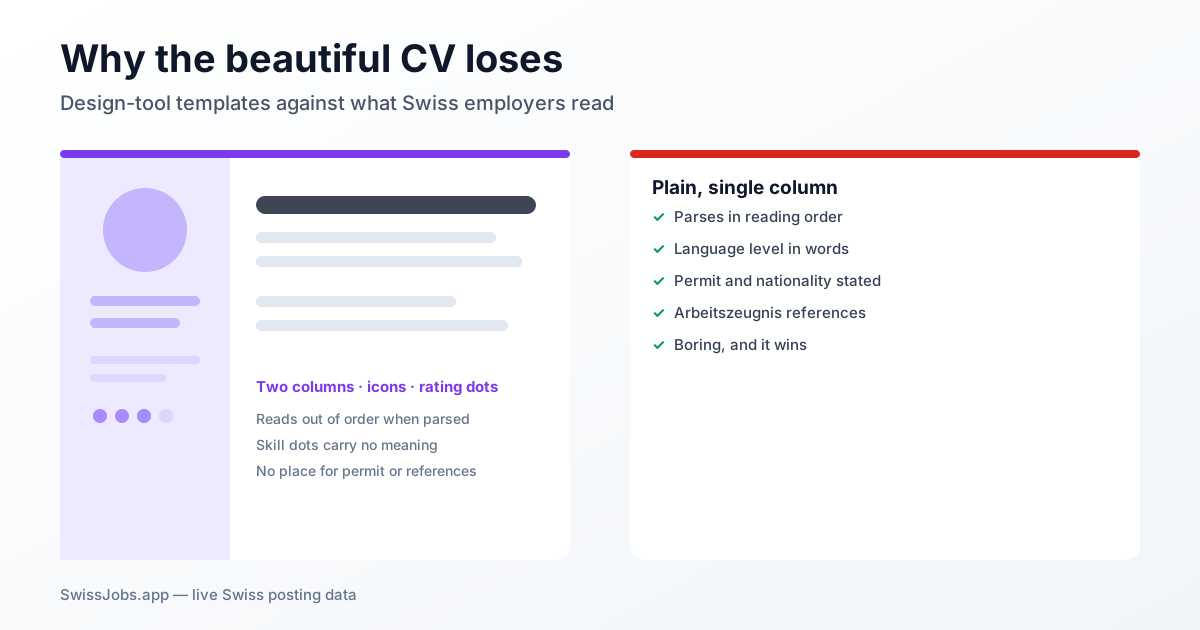
Structure first: one column, real text rather than an image, headings as words rather than icons, and a single date format from the first entry to the last. Nothing may live only in a header or footer, float in a free-standing text box, or exist purely as graphics — rating dots for language skills are the classic example of information that means nothing once parsed.
Content next: the top third carries your name, city and canton, permit or nationality, languages with levels, and your current role including the written-out root word of your occupation. Below that, positions in reverse chronological order, each with period, employer, place and function in the same arrangement every time, so a parser can learn the pattern from the first entry.
Then the match against the individual advert. Read the requirements and adopt the words used there wherever they are factually true of you — the name of the qualification, the name of the specialism, the phrasing of the language requirement. This is not cosmetics; it is the only place in this market where keywords reliably coincide at all.
Finally, run the copy test again on the finished file, under the name you will actually send it as. If the pasted text arrives in reading order and the first ten lines say who you are, where you are, what you can do and in which language, your CV is ATS-friendly — and readable by people, which is the same test done twice.
What people report
Recruiters working the Swiss life sciences market describe a recurring pattern with applicants arriving from abroad: rejections rarely turn on missing experience but on missing fields — permit status not stated, language skills buried, no location given, and very dense Anglo-Saxon layouts. Those are precisely the fields a parser looks for first.
Recurring pattern in English-language LinkedIn posts by recruitment specialists writing about the Swiss labour market, reviewed in August 2026.
All shares come from our running analysis of the Swiss job adverts we index, as at August 2026. The headline figures are measured directly on each advert's unmodified headline. The language figures come from a structured field derived per advert from the advert text; the shares of adverts by written language were recounted on 27 September 2026, when that field was present on 97 per cent of adverts. Statements about which terms occur more often are measured on our condensed requirement text per advert rather than the full original wording; there, the ranking is what holds, not the absolute frequency. We publish shares, never absolute index totals.
Check how your CV fits a job — and the Swiss market
Free checker: languages, work permit, skills and more — scored against a specific posting.
ATS CV checker: against a specific advert, freeSources
Related questions
What our job index says about the Swiss market
Computed live from our own index, not quoted from a study. Shares only, as of today.
Language the advert is written in
- Deutsch
- 60%
- English
- 23%
- Français
- 13%
- Italiano
- 3%
Of adverts that state a language requirement, the share asking for
- Deutsch
- 70%
- English
- 43%
- Français
- 21%
- Italiano
- 3%
19% posted in the last 7 days · Largest markets: Zürich 18% · Bern 10% · Genève 5% · Basel 5%