Is my CV too long?
Updated:
In short
A CV does not become too long at a page count. It becomes too long at the point where it answers questions nobody asked. The test takes five minutes: put the advert beside the document and tick every block that answers a requirement the advert actually names. Across the English-language adverts on SwissJobs.app, only a handful of themes appear at all — personal qualities in 23.1 percent, a number of years of experience in 20.7, a formal qualification in 17.1, a named tool in 13.0. Everything left unticked is your cutting margin.
The official ceiling is probably not your problem. The application guidance from arbeit.swiss, the portal of the State Secretariat for Economic Affairs, states plainly that a CV «should be no longer than three pages», and that it should «be complete, clear and not contain any gaps». Those two sentences pull in opposite directions on purpose: completeness within a hard limit. Most CVs that feel too long are inside the limit and still failing the second half of the sentence.
The reason is measurable. Among the English-language adverts, 93.9 percent name at most two of the seven requirement themes we count, and 45.0 percent name none at all — they simply describe the job. A single advert therefore asks one or two questions. A CV that develops seven themes at equal length across three pages has six answers too many and one that never got deep enough.
Share of the parsed English-language advert descriptions in which the theme appears at all. One advert can name several. Rolling analysis of the open listings on SwissJobs.app, as of 23 August 2026.
- Three pages is a ceiling, not a target — and it is the only length figure any Swiss official source puts in writing. Inside those three pages nothing is prescribed. What decides is the hit rate: how much of what stands there answers something the advert names. Two dense pages read faster than one and a half disordered ones.
- English-language adverts in Switzerland are the ones that count years. A number of years appears in 20.7 percent of them, against 1.3 percent of German-language adverts. If you are applying in English, dates that are readable to the month, and a visible total, are worth more than another paragraph of duties.
- Named tools matter more in English too: 13.0 percent, against 9.1 percent in German. Still, a two-column tool inventory answers a question asked in roughly one advert in eight. Put the three to five products the advert names at the top, and roll the rest into a single line.
- References appear in none of the parsed English-language advert descriptions, and hobbies in none either — yet both sit on the official list of CV components that arbeit.swiss publishes. The resolution is not to delete them but to compress them. «References on request» is one line. Three referees with address and phone number is a third of a page.
- There is no generic advert to justify a generic CV. Of the Swiss adverts we hold, 66.6 percent carry a job title that occurs exactly once across the whole set, and the ten most frequent titles together account for 2.4 percent. Length written to cover every case covers none of them.
- Shortening in Switzerland means condensing, never omitting. The chronology has to hold, because the employer references in the dossier document every position anyway. Two early jobs become two lines — year, function, employer. No gap appears, and half a page comes free.
- If you moved here with a one-page résumé, your problem is probably the opposite one. A Swiss CV is the contents page of a dossier that is then evidenced by employer references and diplomas. After a few years of work, one page cannot do that job, and the missing detail reads as an omission rather than as discipline.
Why «too long» is almost always the wrong diagnosis
Anyone asking this question has usually already counted and knows they are at two or three pages. So the discomfort does not come from the number. It comes from reading it back: you go through your own document and feel it drag. That drag has a cause, and the cause is repetition rather than volume.
A CV that has grown over ten years of work typically says the same thing three times. Once in the profile at the top, once in the duty list of the current role, and once in a skills matrix with bars or stars. To the reader that is not evidence, it is a detour. They are looking for the place where the claim is documented and they find three places where it is asserted.
This is why the length question cannot be settled by page count. Two pages without duplication read faster than one and a half with it. And three pages where every position carries different information are not a problem — they are exactly what the official ceiling permits.
What Swiss adverts put in the foreground
Rather than guessing what a CV should answer, you can count what the adverts ask. We searched the English-language advert descriptions in the open stock for seven requirement themes: personal qualities, a formal qualification, further training and certificates, a named software product, a language requirement, a driving licence, and a stated number of years of experience.
The result is narrow. Personal qualities appear in 23.1 percent of descriptions, a stated number of years in 20.7, a formal qualification in 17.1, a named tool in 13.0. After that it falls away: language requirement 5.5 percent, further training 3.9, driving licence 0.3, hobbies and references zero.
More telling than any single share is how many themes one advert opens at once. 45.0 percent of English-language adverts name none of the seven — they describe the job and stop. 93.9 percent name at most two. Only 6.1 percent reach three or more. The advert your CV is being compared against is asking one or two questions, not seven.
The contrast with the German-language market is worth knowing if you apply in both languages. German-language adverts name further training in 25.7 percent of cases against 3.9 percent in English, and personal qualities in 49.8 percent against 23.1. English-language adverts, in turn, quantify experience roughly sixteen times as often. The same document cannot be optimally weighted for both — but the fix is reordering, not adding pages.
The five-minute test
Print the CV or open it beside the advert. Go through it block by block — every position, every section, every list — and tick when that block answers a requirement stated in the advert. Not «might be interesting», but: does the theme appear in the advert text?
Then count. If fewer than half the blocks carry a tick, the document is not too long, it is badly weighted — and cutting alone will not help, because the remaining half misses the advert too. If two thirds carry a tick and it still fills three pages, it is not too long: it is a complete CV for a demanding role.
Where the advert names nothing at all, which happens in almost half the English-language listings, swap the reference point: use the job title and the company's field instead of the requirement list. The rule stays one tick per block, and the question becomes whether that line helps someone decide you can do this job.
The second step is the last-page test. Cover it and read the document again. If something the advert explicitly asks for is now missing, the page goes back. If only completeness-for-its-own-sake is missing, it was filler — and it condenses into lines further up.
Both tests together cost less time than a single application, which matters because the adverts do not wait. Half the open stock on SwissJobs.app is at most 19 days old, and 13.8 percent is at most a week old. Spending an hour rewriting per application loses you precisely the fresh ones.
The three blocks that cost the most space
First, the duty list copied out of an employer reference. It is the most common cause of an unnecessary third page. The reference travels with the dossier, it is the documented version of the same content, and it describes it at greater length. The CV gains nothing from the repetition and loses half a page.
Second, the skills matrix. Bars, stars or percentages next to a capability cannot be checked and replace no actual statement. For languages there is a checkable alternative: the A1 to C2 levels of the Common European Framework, four or five lines for the whole block. Given that a language requirement is stated outright in 5.5 percent of English-language adverts but in 18.4 percent of German-language ones, that block earns its space the moment you apply in German.
Third, the references block. It sits on the official component list, and yet none of the parsed English-language advert descriptions names references as a requirement. They are asked for at interview, not in the first pass. One line is enough; the sheet with the names goes to the meeting.
When three pages are right
There are cases where length is not a fault. In a regulated profession — nursing, law, construction, financial supervision — registrations, authorisations and certifications have to be named one by one, because they are checked one by one. A history made of many temporary assignments needs lines for the chronology, or gaps appear that then cost an explanation.
Leadership profiles need room as well, because team size, budget scope and reporting line are the information itself. In those cases the third page is earned. The difference from filler is easy to spot: earned length carries one checkable fact per line, filler restates a fact already given.
And the case that runs the other way, common among people arriving from the United States or the United Kingdom: a CV that is too short rather than too long. The habit of ruthless one-page editing removes exactly the detail a Swiss reader expects to see, and the question «is it too long» is then being asked from the wrong end of the problem.
What should survive the cut
By the end, every line should be doing one of three jobs: answering a requirement in the advert, closing the chronology, or evidencing a formal condition. Everything else is a candidate for the summary line. That rule replaces any page-count instruction, because it scales with the length of your career instead of ignoring it.
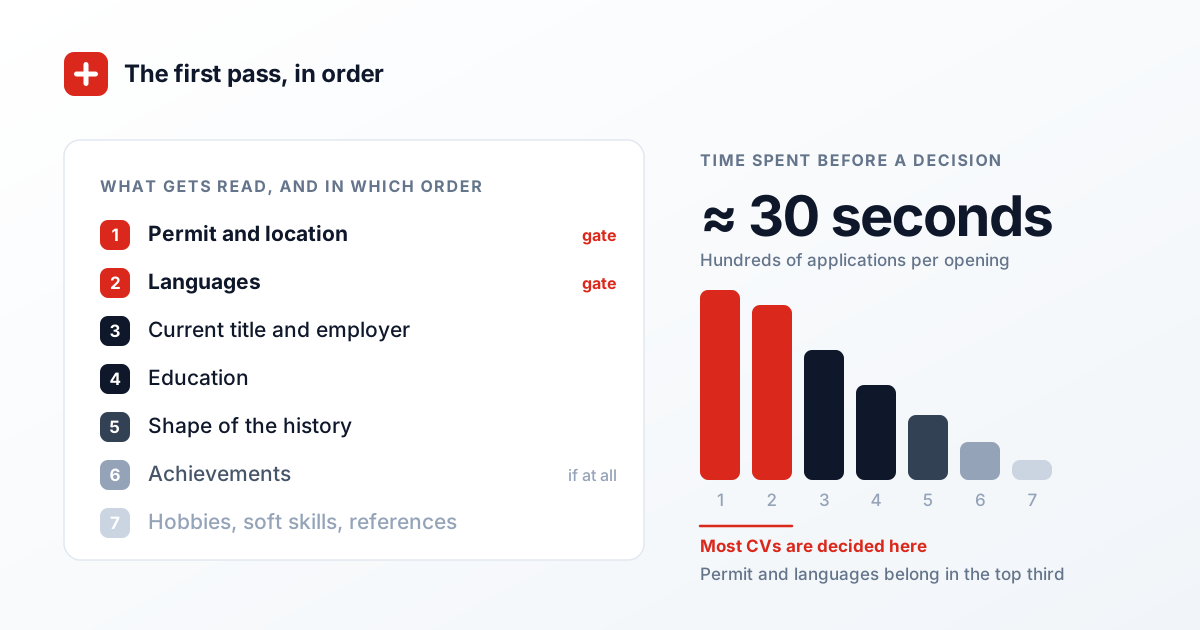
A last point about order, which affects perceived length more than volume does. What gets looked for on the first pass — location, permit status, languages, current title — belongs in the top third of page one. Put it there and a three-page document feels short. Put it on page two and a two-page document feels long.
If you want to know how your document performs against one specific advert rather than against a general rule, that is exactly what the CV check on SwissJobs.app does: it compares your CV with the text of the role you are applying for and shows which of the named requirements the document answers and which it leaves open.
What people report
In the collection of Swiss application posts gathered for the SwissJobs.app CV guide, 36 posts discuss the CV. Not one names an over-long CV as a reason for rejection. Seven, by contrast, name the missing link to the advertised role — too generic, not tailored, no visible connection between the experience and the advert. The complaint from practice is about allocation, not about quantity.
Count of the posts gathered for the SwissJobs.app CV guide; those discussing the CV were read by hand and sorted into length, fit-to-advert and placement.
Nine posts in the same collection state a page count at all, and several describe the opposite problem explicitly: people arriving from a market where the one-page CV is the norm cut exactly the detail that is expected here. Two further posts describe a placement problem — permit status or professional registration sitting too far down and being missed on the first pass.
Same collection; the observation rests on accounts from applicants and recruiters, not on an analysis of actual rejections.
Market figures come from the rolling analysis of the open listings on SwissJobs.app, as of 23 August 2026. The theme shares are based on the advert descriptions we hold rather than on full advert texts; we count whether a theme appears in the description at all. The shares therefore measure what stays in the foreground and are a lower bound rather than an upper one. Only adverts whose text was identified as English feed the English shares; German, French and Italian adverts give noticeably different results, which are given on the corresponding language versions of this page. Counted as themes: personal qualities (wordings such as team player, self-motivated, proactive, flexible, reliable, communication skills), a formal qualification (apprenticeship, diploma, bachelor, master, degree, university), further training and certificates, a named software product, a language requirement, a driving licence, and a stated number of years of experience. Statements about the uniqueness of job titles rest on normalised titles — lower-cased, with bracketed additions, workload percentages and gender markers removed — across the whole set of adverts we hold. Advert age is measured from the posting date recorded on the advert. We publish shares, never absolute stock figures. The CV requirements come from the arbeit.swiss (SECO) application guidance; the language levels from the Common European Framework of Reference.
Check how your CV fits a job — and the Swiss market
Free checker: languages, work permit, skills and more — scored against a specific posting.
ATS CV checker: against a specific advert, freeSources
- arbeit.swiss (SECO) — Tips on applying for jobs: «A CV should be no longer than three pages» and the component list including personal interests and references
- berufsberatung.ch — the application dossier for working people and jobseekers
- Europass — Common European Framework of Reference for Languages (A1 to C2)
Related questions
What our job index says about the Swiss market
Computed live from our own index, not quoted from a study. Shares only, as of today.
Language the advert is written in
- Deutsch
- 60%
- English
- 23%
- Français
- 13%
- Italiano
- 3%
Of adverts that state a language requirement, the share asking for
- Deutsch
- 70%
- English
- 43%
- Français
- 21%
- Italiano
- 3%
19% posted in the last 7 days · Largest markets: Zürich 18% · Bern 10% · Genève 5% · Basel 5%