Jobs in Basel
Updated:
One place name, two job markets. One runs in English and depends on a single industry; the other expects German. Which one you can read decides what Basel looks like.
In short
Basel holds about 6 percent of the Swiss adverts we track but a third of all life-science advertising in the country. That splits the city into two markets that barely overlap. In life sciences — close to one in five Basel adverts — two thirds of the postings ask for no German at all, and two thirds are written in English. In the rest of Basel, nine in ten adverts require German. Which half is open to you is decided almost entirely by language, not by profession.
The Swiss job portals at a glance
Click an image for the full-size view. What each portal actually is stands beside it.
1. SwissJobs.appOur app
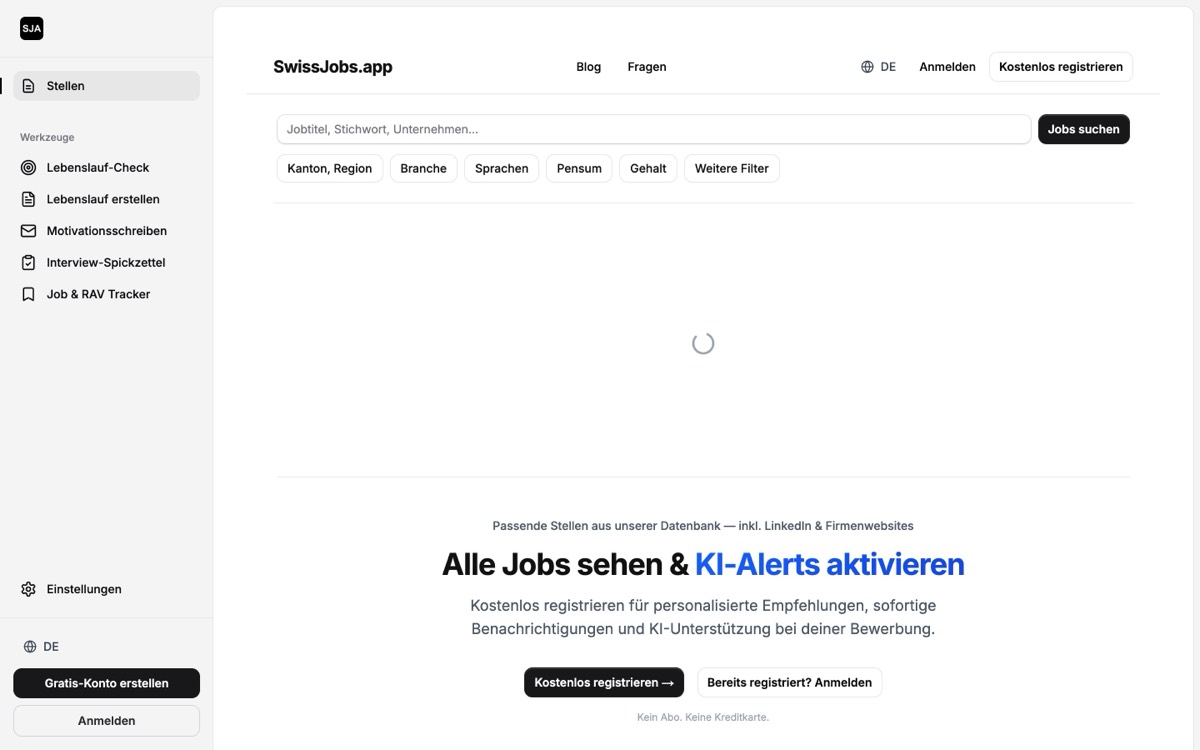
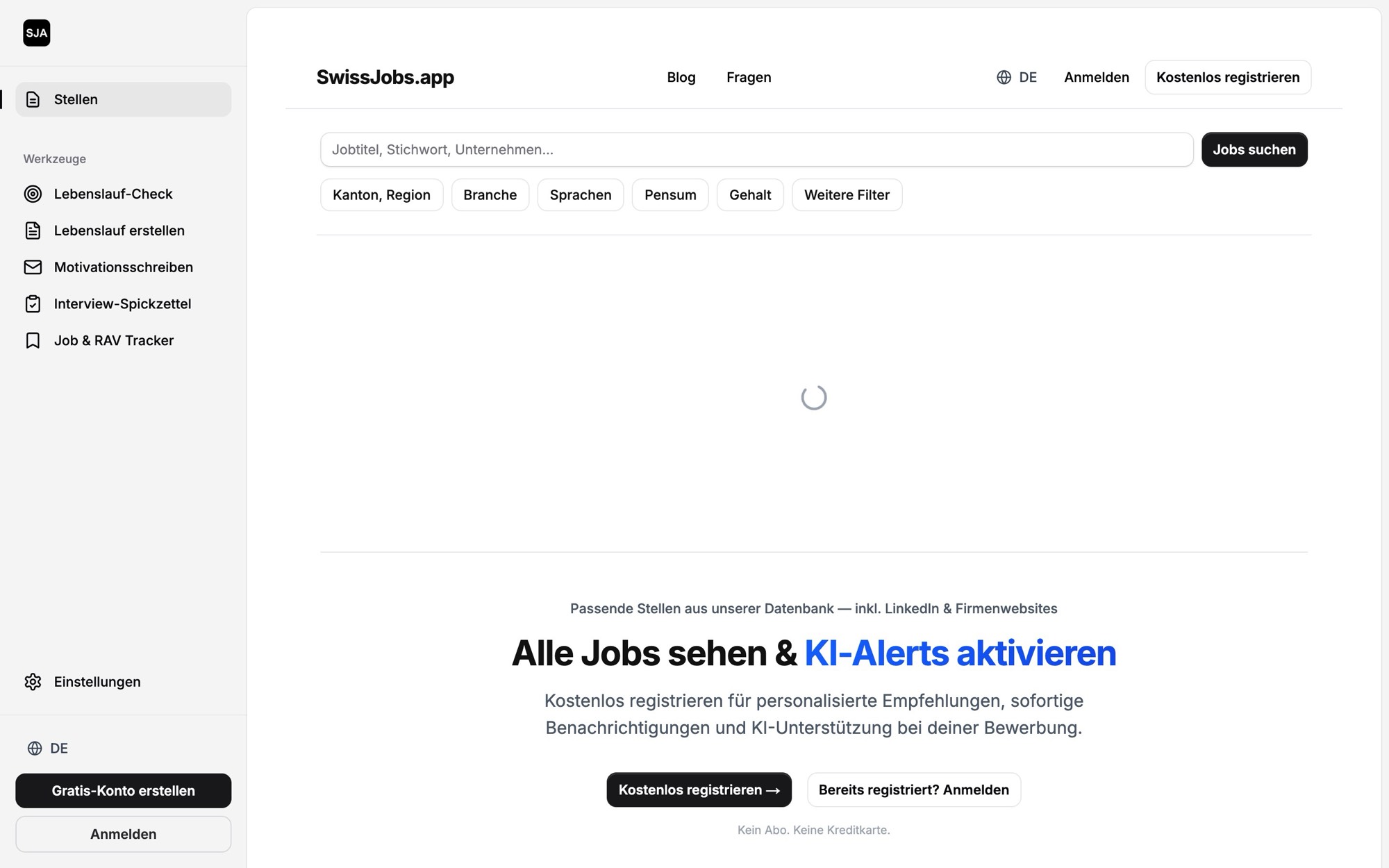
Over 21,000 open Swiss roles from ATS systems, company sites and LinkedIn in one place — and from any advert, straight into a CV, a motivation letter, a CV check and interview prep. The RAV job-search-efforts form fills itself from your application tracker. Free to use; the account is asked for at save.
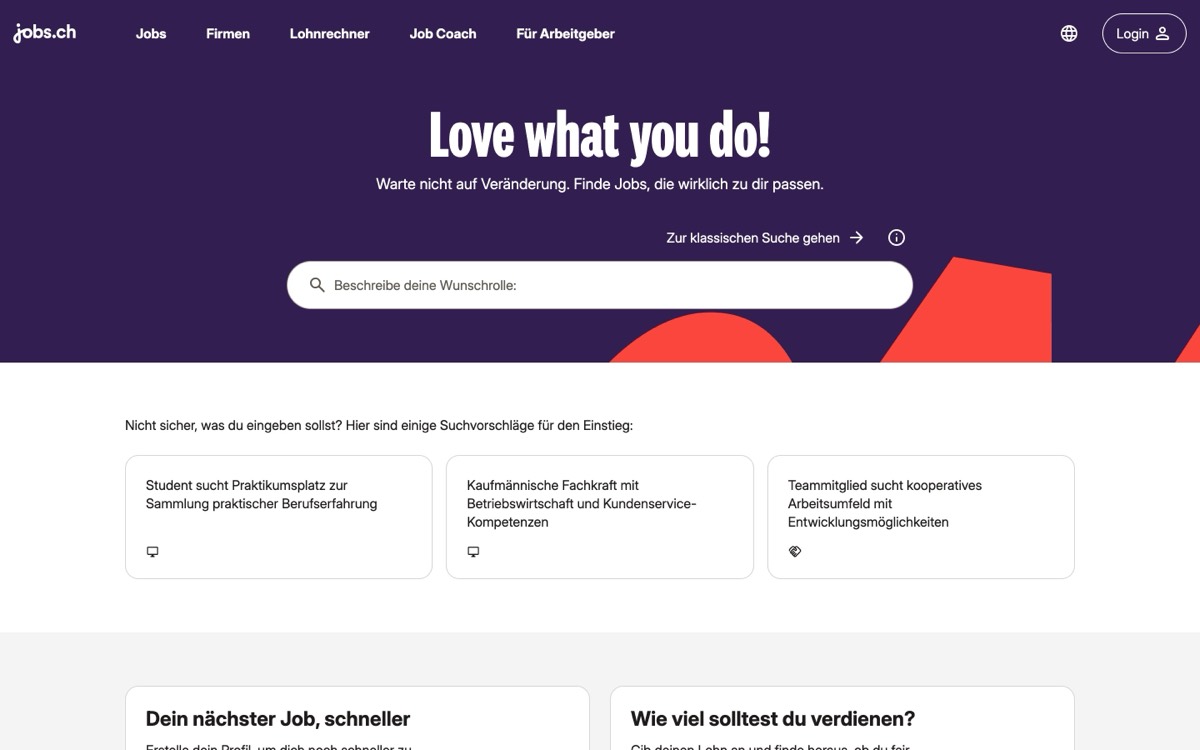
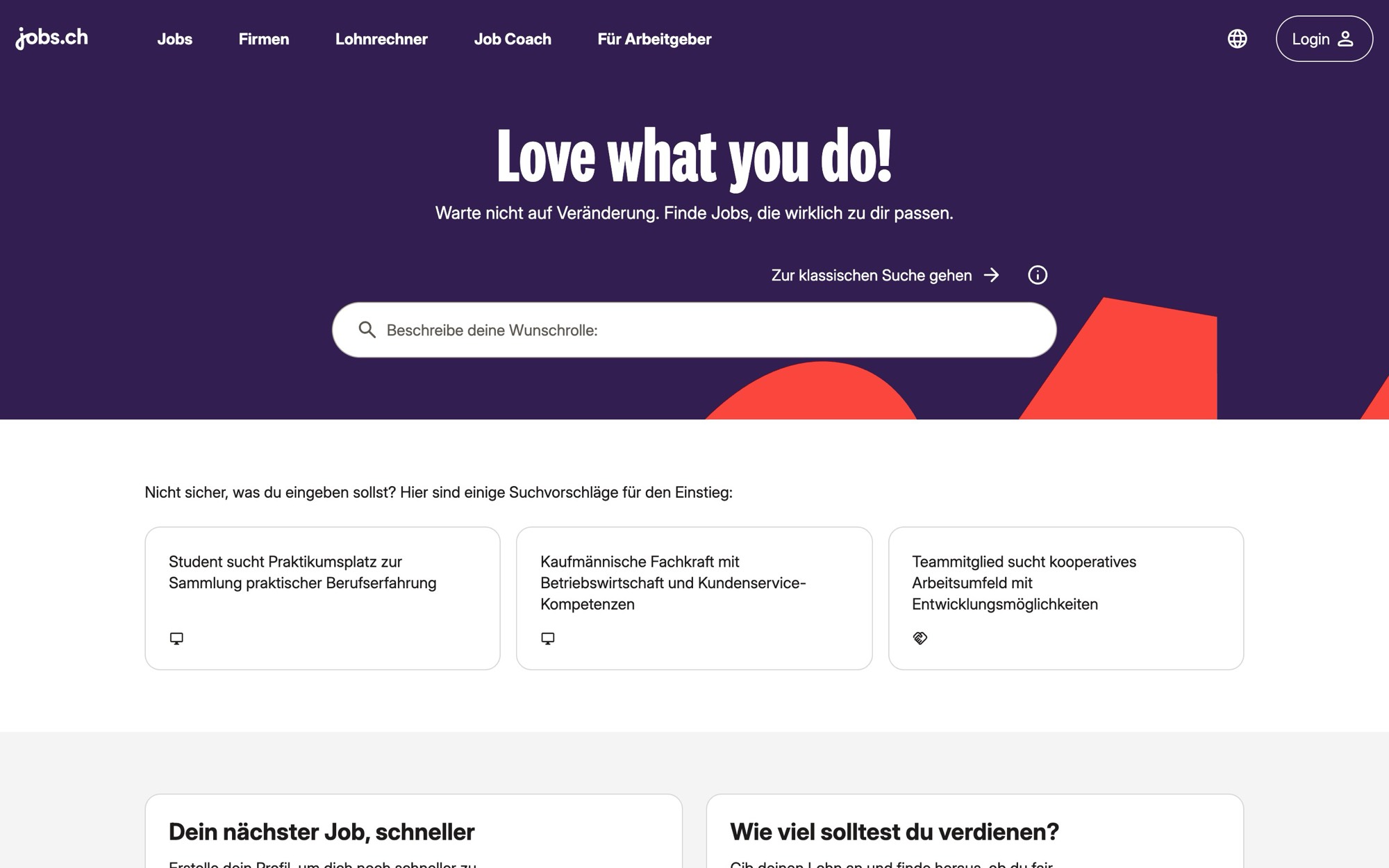
The best-known board in German-speaking Switzerland and the largest index in the country. Owned by JobCloud AG — as are jobup.ch and JobScout24.
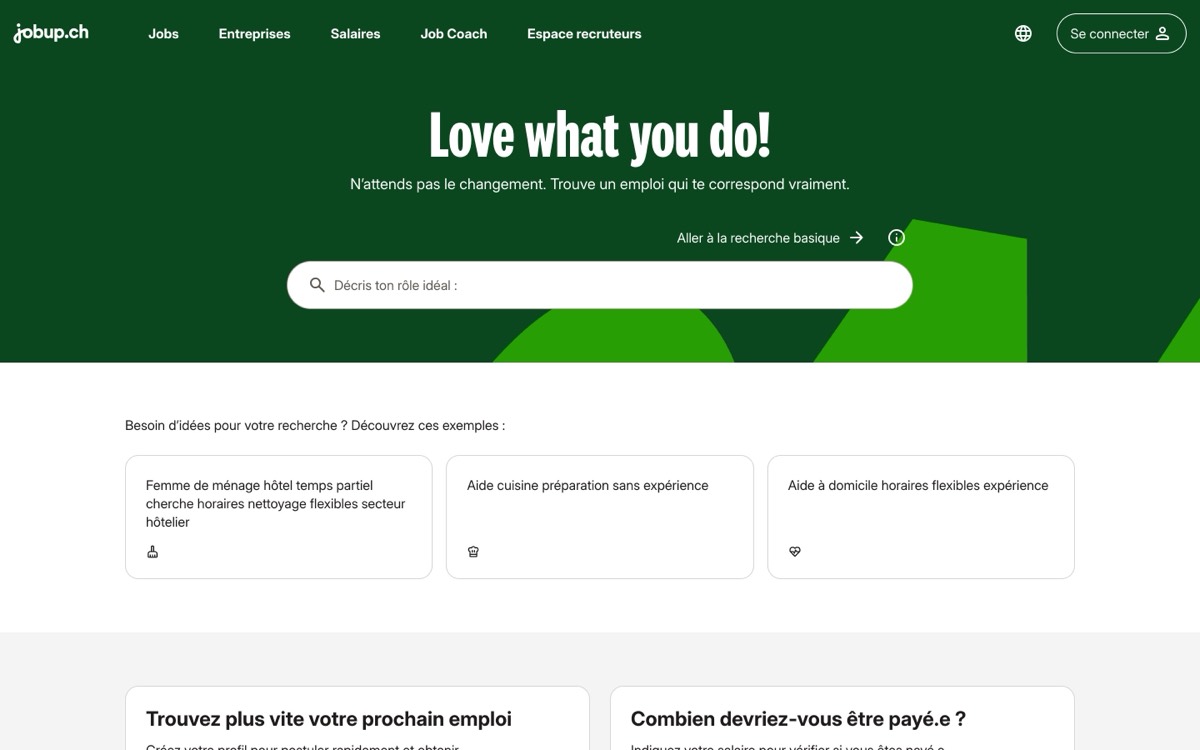
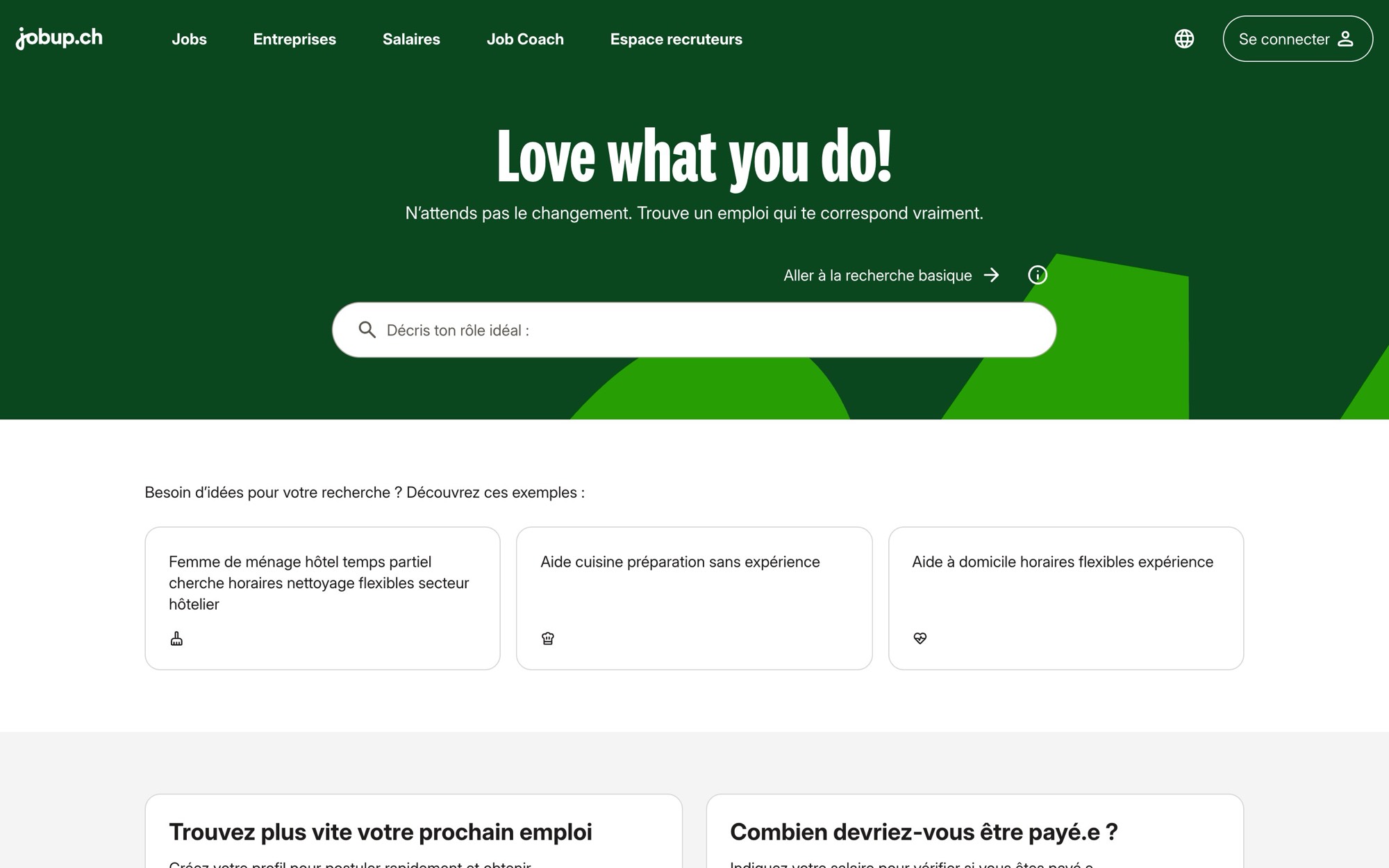
The standard in French-speaking Switzerland and the first place to look for the Romandie — but the same JobCloud AG as jobs.ch.
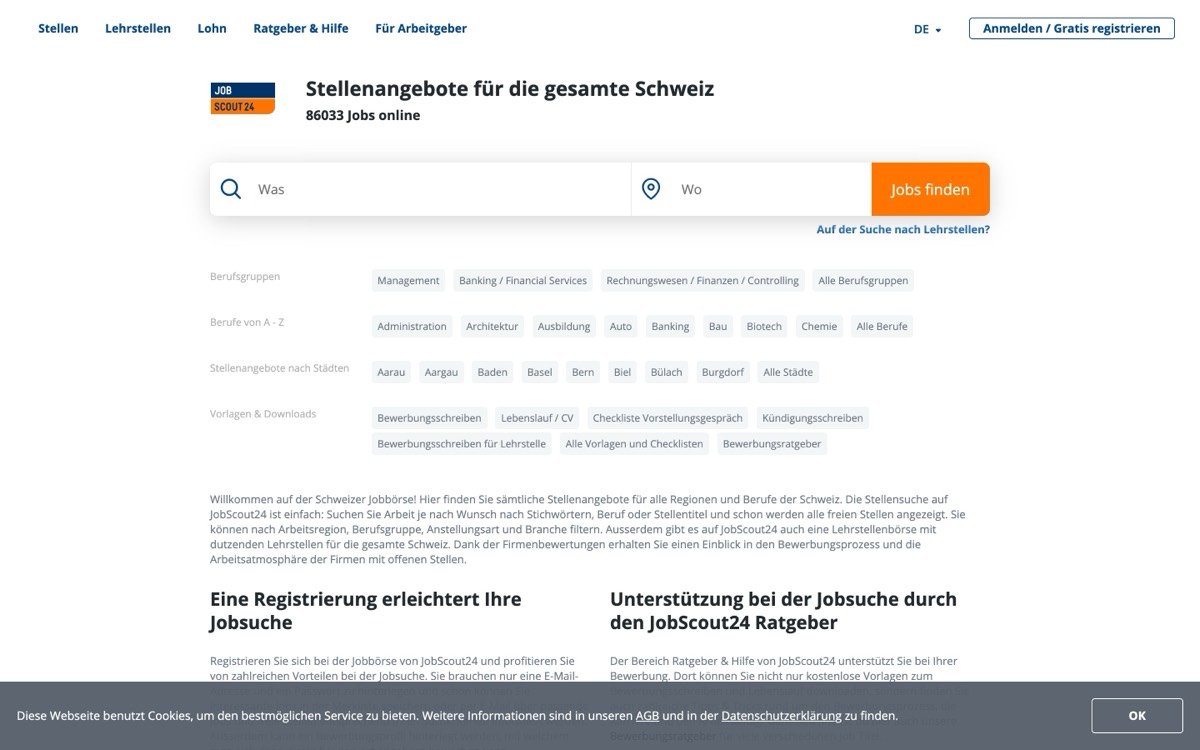
A third brand from the same company. Searching all three to widen your search means searching one provider three times.
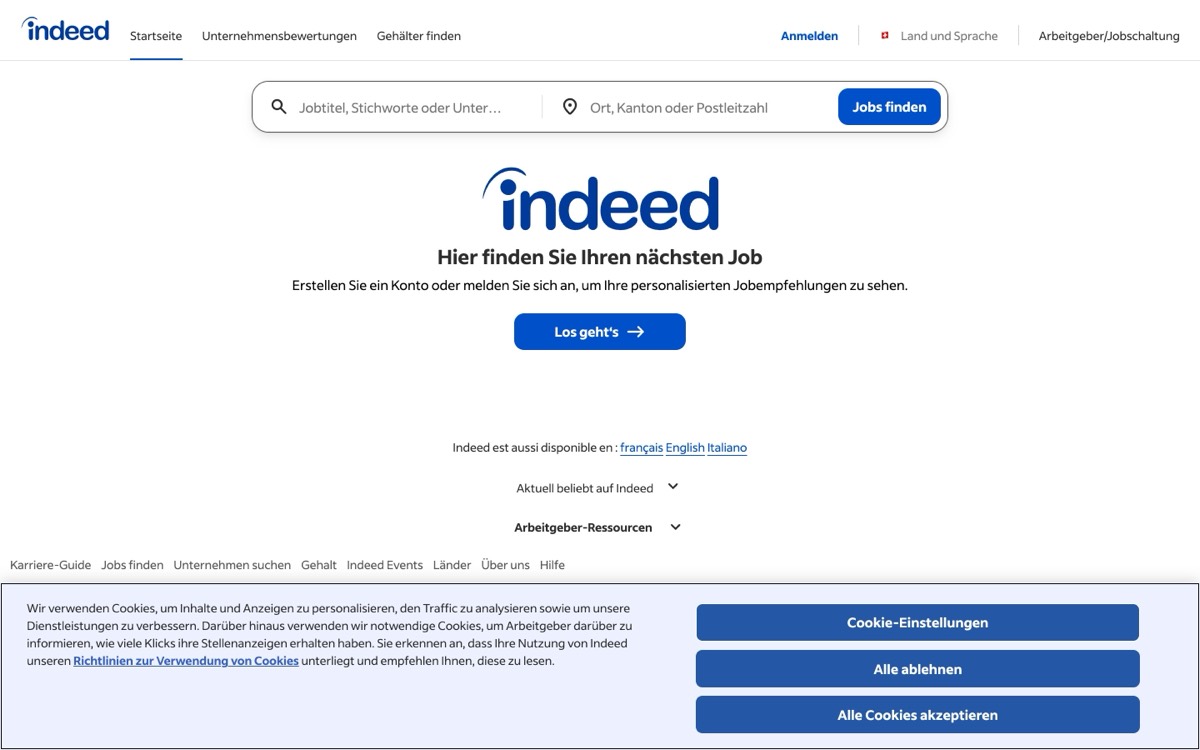
The broadest aggregation, because Indeed also collects from other boards — at the cost of many duplicates of the same advert.
The best reputation for English-speaking and international roles in Switzerland. Considerably thinner for trades, care and commercial roles.
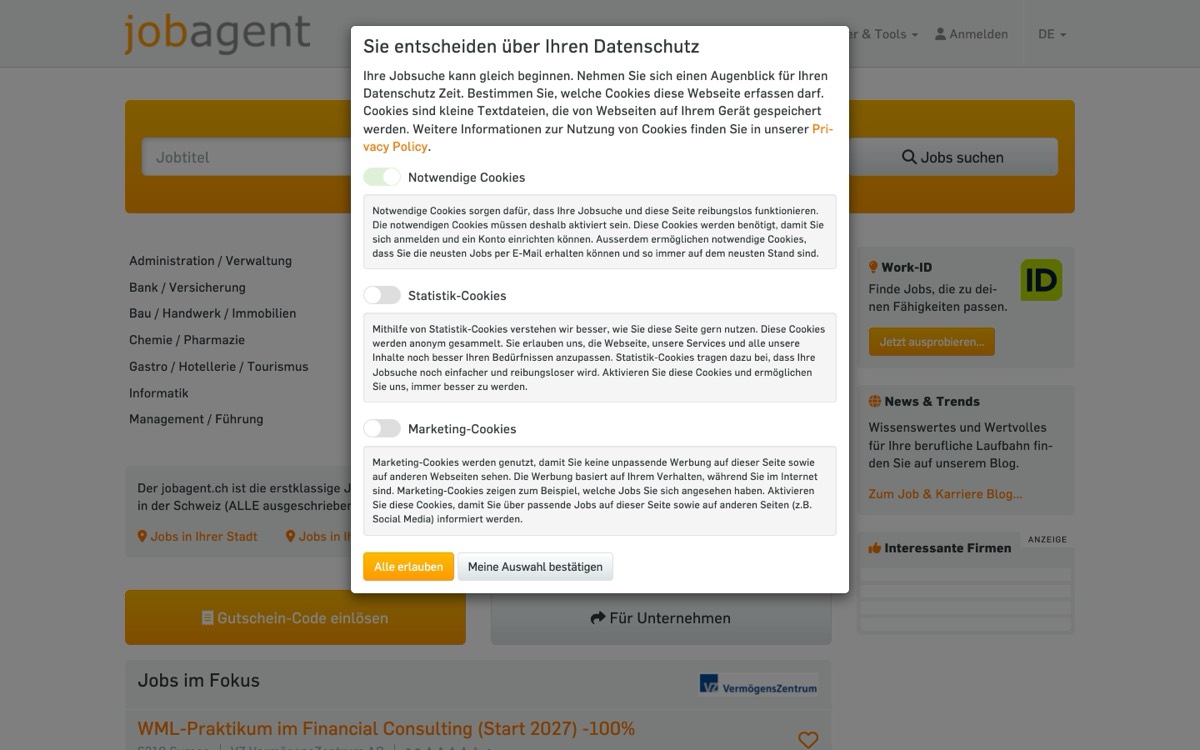
A meta-search across the Swiss job boards, "every job in Switzerland at a glance". Its strength is the Job-Abo: a saved search that mails you new adverts from every portal it covers. Salary calculator and application guides alongside.
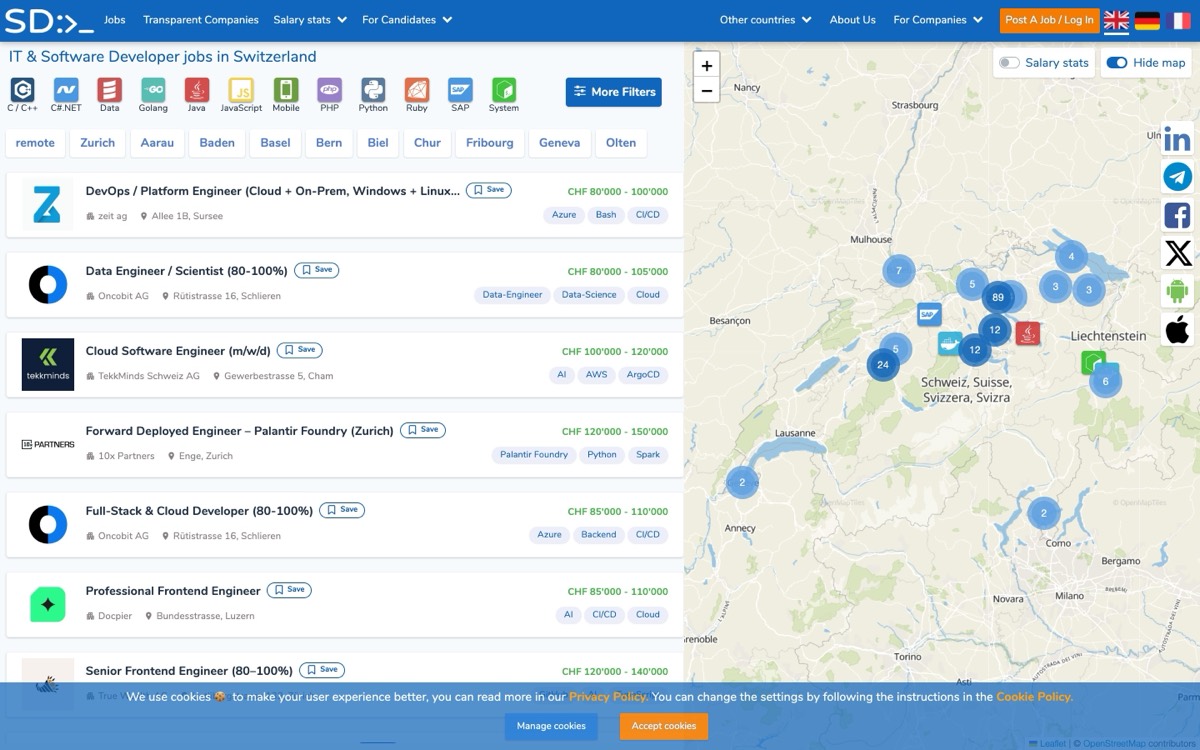
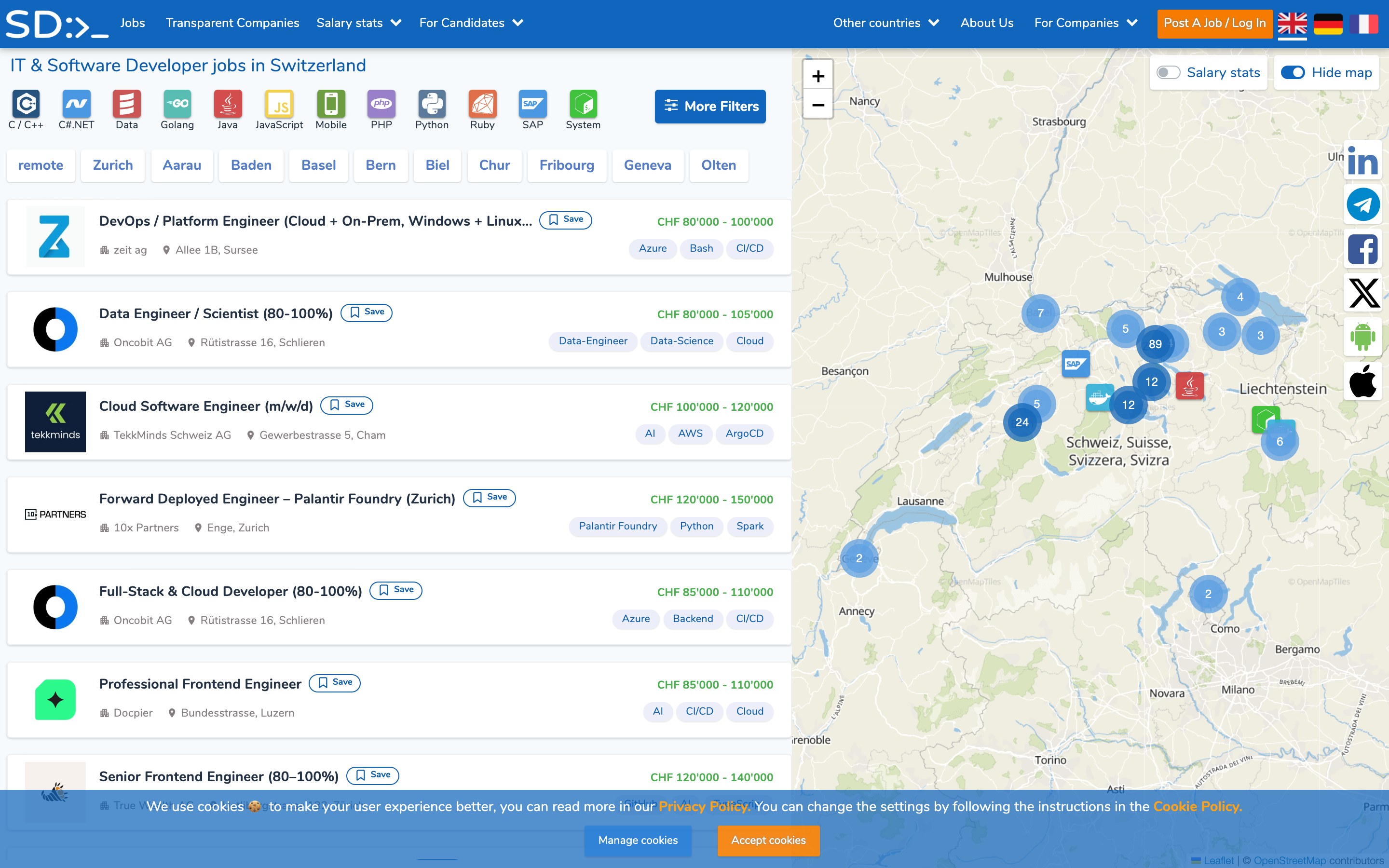
IT and software only, and thorough about it: "183 IT & Software developer jobs in Switzerland", filtered by technology (C#, Java, Python, DevOps, ML) rather than by industry. Publishes salary statistics and lists the companies that disclose their ranges. The site itself is in English.
Jobs by profession, city or language
Type a profession, a city or a language, the page shows the adverts currently open for it.
By profession
- Consultant
- Project Manager
- Retail Sales
- Nurse
- Nursing & Care
- Administrative Assistant
- Account Manager
- Software Engineer
- Public Administration
- Architect
- Insurance
- Chef
71 more — narrow the search
By work type
Nothing about the place name helps you narrow this down. Almost every advert in the region carries the bare word Basel: 94.9 percent of them, with municipalities in the half-canton of Basel-Landschaft almost never appearing on their own. The town filter that rescues a quarter of the market in Zurich or Bern does nothing here. A literal text search is worse than useless in one specific way — 4.6 percent of the postings whose location contains the string basel are North American shop addresses on a Baseline Road.
The border matters more than the spelling. Filter on the two half-cantons and you drop a ring of municipalities that sit inside the daily commute but in a different canton: Kaiseraugst, Rheinfelden, Stein, Frick, Laufenburg and Möhlin in the Aargau Fricktal, Dornach, Breitenbach and Witterswil in Solothurn. That ring adds another 12.8 percent of supply on top of the Basel list, and 35.3 percent of it is life sciences — the same industry, one number plate away.
Share of adverts stating language requirements in which each language is asked for. Rolling analysis of the open Swiss adverts we track, August 2026.
- Basel supplies 6.4 percent of the Swiss adverts we track but 32.9 percent of the country's life-science advertising. The industry is 18.2 percent of the Basel list against 2.6 percent everywhere else.
- 65.6 percent of Basel life-science adverts that state requirements ask for no German whatsoever. Outside that industry the figure is 10.7 percent.
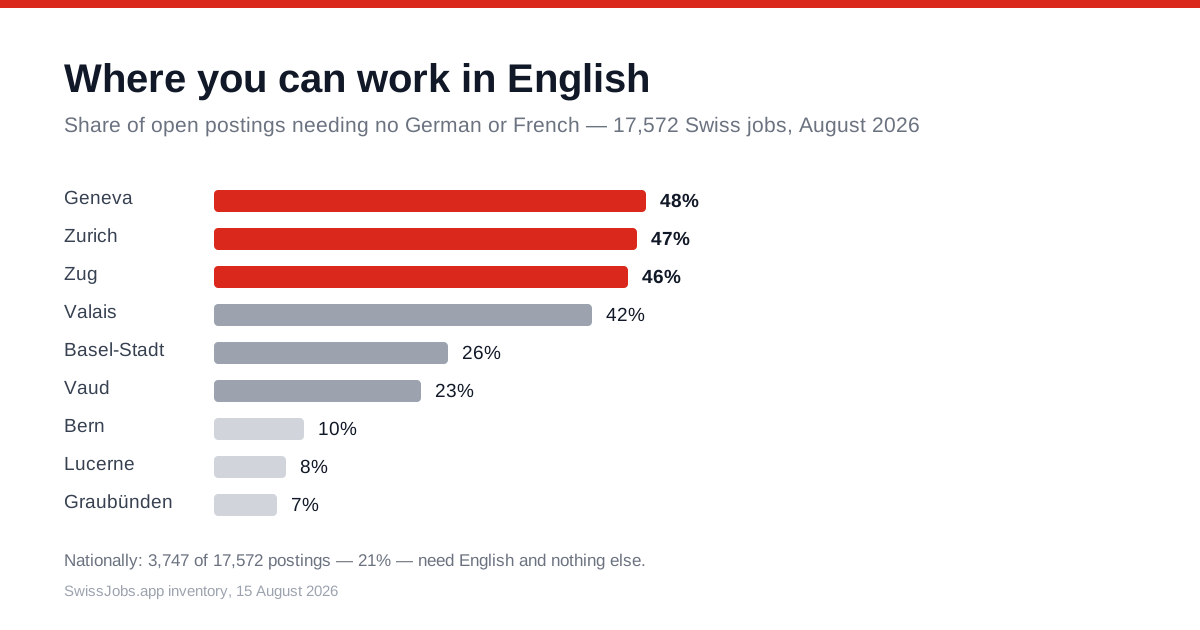
- English alone is enough in 21.1 percent of Basel adverts — less than Zurich (28.3%), Zug (32.4%) or Geneva (42.2%). Basel is not Switzerland's most English-friendly market; it is its most sharply divided one.
- 94.9 percent of the region's adverts are labelled simply Basel, so filtering by municipality removes almost everything and gains almost nothing.
- French is asked for in only 7.1 percent of Basel adverts, exactly as rarely as in the rest of German-speaking Switzerland — the national border leaves no trace in the requirements.
- The largest single advertiser is a staffing firm at 15 percent; the largest direct employer alone accounts for 9.5 percent and the ten largest for 43.3 percent, against 21.4 percent in the rest of the country.
The English half is one industry, and it is not the whole city
Life sciences — pharmaceuticals, biotech, contract research, analytics, medical devices — account for 18.2 percent of Basel adverts against 2.6 percent in the rest of Switzerland. Turned around, a third of every life-science advert in the country sits in a region that supplies only 6.4 percent of the total. No other Swiss industry is concentrated into one place to that degree, and no other large Swiss market leans on a single sector this heavily.
That industry advertises in a different language from its neighbours. 67.9 percent of its Basel postings are written in English, against 14.5 percent for everything else in the region. English is required in 88.5 percent of its adverts that state requirements; German in 34.4 percent; and in 65.6 percent German is not mentioned at all. The rest of Basel is the mirror image — German in 89.3 percent, English in 33.6 percent, German absent in only 10.7 percent.
So the first decision is not which job title to search for but which half of the city you can actually read. If you have no German, Basel is a sector search rather than an occupation search, and that sector is broader than laboratory work: just over half of Basel's English-language adverts come from life sciences, and most of the remainder from the corporate functions clustered around international headquarters — finance, procurement, IT, legal, supply. If you do have German, the other half of the list opens up: retail, healthcare, construction, hospitality, cantonal administration. Do not filter it away because Basel has a reputation as an English-speaking city.
That reputation is only partly earned. Across both halves, English alone is sufficient in 21.1 percent of Basel adverts that state requirements. Zurich reaches 28.3 percent, Zug 32.4 percent and Geneva 42.2 percent. Basel ranks behind all three. And where German is asked for in Basel, it is asked for seriously: 93.2 percent of those mentions specify professional or native level, so conversational German is rarely the ticket in.
Half the jobs in the city are held by people who commute in
Basel draws from a labour pool that crosses two national borders, and the official numbers show it more clearly than any job list. The cantonal office for economy and labour reports that, measured against the number of jobs in Basel-Stadt, cross-border commuters equal roughly 18 percent and commuters from other Swiss cantons roughly 29 percent. Together, close to half of the jobs in the city canton are held by people who live somewhere else.
The same source states that about half of those cross-border commuters live in Germany and the other half in France, while the Swiss commuters come mainly from Basel-Landschaft, Aargau and Solothurn. Roughly speaking, about one job in eleven in Basel-Stadt is held by someone resident in France. For an applicant this cuts both ways: the competition for a Basel role is drawn from a much wider circle than the canton, but a foreign address is also far less unusual here than employers elsewhere in Switzerland treat it.
The market has cooled, though, and that part of the picture is newer than Basel's reputation. The canton's own unemployment rate went from 3.0 percent in 2023 to 3.7 percent in 2024 and 4.3 percent in 2025. Anyone searching today is searching in a tighter market than the city's boom-years image suggests, and the English-language half is the part with the widest catchment and therefore the most competition per advert.
What pulls all those commuters in is in the same statistics: pharmaceuticals lead Basel's sector pay by a clear margin, with a median monthly wage of CHF 11'790 in 2024, the highest of any sector the canton reports. That is the number behind the daily traffic from Alsace and Baden — and behind the volume of applications on every English-language advert in the city.
The cantonal border cuts straight through the commute
Basel is the only large Swiss city whose labour market frays into three countries and four cantons. For a job search, the internal border matters first. Around the two half-cantons sits a ring of municipalities well inside the daily commute but administratively in Aargau or Solothurn: Kaiseraugst, Rheinfelden, Stein, Frick, Laufenburg, Möhlin and Magden in the Fricktal; Dornach, Breitenbach and Witterswil to the south.
That ring is worth another 12.8 percent of supply relative to the Basel list — not a rounding error. And it is not a different kind of work: 35.3 percent of its adverts are life sciences, an even higher share than in Basel proper, because the large production and analytics sites sit out there rather than in the city. Nearly one in five of those adverts is written in English.
Filter on the canton, or search the word Basel, and the whole ring disappears — even though Kaiseraugst is a few minutes by train from Basel's main station and closer than several municipalities in Basel-Landschaft. The fix is a second search pass on the town names themselves: Kaiseraugst, Rheinfelden, Stein, Frick, Laufenburg, Möhlin, Dornach, Breitenbach.
The national border, by contrast, does less than people expect. France starts at the edge of the city, but French is required in only 7.1 percent of Basel adverts and just 0.4 percent of them are written in French. A commuter from Alsace needs German, or English in life sciences. The region is trinational in where people sleep, not in what the job adverts ask for.
A dozen career pages cover a third of the market
Basel is the most concentrated of Switzerland's large markets. Its ten biggest advertisers supply 43.3 percent of the region's adverts, against 21.4 percent in the rest of the country. The single largest is a staffing firm at 15 percent; the largest direct employer alone accounts for 9.5 percent, a share no single company reaches in any other Swiss metropolitan area. Twelve direct employers together cover 32.4 percent of the list.
This makes an unusually cheap strategy work: in Basel, subscribing to a dozen career pages beats scrolling job lists. That dozen includes the two large pharmaceutical groups, a contract research and analytics house, a peptide manufacturer, a measurement and control technology group, the university hospital, the cantonal administration of Basel-Landschaft, a food retailer, an insurer, a physiotherapy staffing service and a business-aviation maintenance operation at the EuroAirport.
The public sector is smaller here than in Bern but not marginal: 2.7 percent administration, 7.4 percent healthcare, 1.2 percent education. Both half-cantons run their own recruitment portals — Basel-Stadt through the cantonal employer site, Basel-Landschaft through its personnel office — and those roles appear there first, usually with a fixed closing date rather than a rolling one.
The counterweight to all that concentration is a long thin tail: 43.1 percent of Basel employers have exactly one open advert, and employers with three or fewer supply 24 percent of the market between them. You only reach that tail by working through the list employer by employer instead of by job title, because the large advertisers otherwise fill the first pages. Staffing agencies account for 16.5 percent of Basel adverts, slightly above the German-speaking average.
How a Basel advert is written, and a search order that works
Three details separate a Basel advert from an average German-speaking Swiss one. The first is the workload. Only 17.9 percent of Basel job titles state a percentage, against 25.1 percent elsewhere in German-speaking Switzerland, because international employers write full-time instead of 80–100%. If you need a reduced workload you cannot rely on the title here — and there is slightly less of it to find: 4.7 percent of Basel adverts are explicitly part-time against 5.5 percent nationally.
The second is fixed-term work. 2.8 percent of Basel titles announce a temporary contract outright, against 1.0 percent in the rest of German-speaking Switzerland — close to three times as often. That is project logic: validations, studies, plant ramp-ups, maternity cover. It comes with an unusually open door for newcomers: 4.4 percent of titles are internships, traineeships or working-student roles, against 2.6 percent elsewhere.
The third is speed, or rather the absence of it. The median Basel advert is about 19 days old, essentially the same as the rest of the country. Basel does not refresh faster than Switzerland does; the belief that you must reply within hours holds for individual corporate postings, not for the market. Sorting by date buys you less here than it does in Bern.
The search order that works for this city: first query the region rather than a municipality, because the place field separates nothing here. Second, run a separate pass over Kaiseraugst, Rheinfelden, Stein, Frick, Laufenburg, Möhlin, Dornach and Breitenbach, where the same industry advertises under a different canton. Third, settle the language question before you filter and pick your half of the market deliberately. Fourth, subscribe to a dozen career pages directly, plus the two cantonal portals. Fifth, on any advert labelled Basel from a large employer, read the body text to find out which site the work is actually at.
Market figures come from our rolling analysis of the open Swiss adverts we track, August 2026. Basel here means Basel-Stadt and Basel-Landschaft together, identified from the advert's location text; the two half-cantons cannot be separated cleanly because nearly every advert in the region is labelled simply Basel. Place names that merely contain the string basel are excluded. Industry is inferred from the employer name and is an approximation. Language requirements refer to the adverts that state any — 77.5 percent of Basel adverts. Canton comparisons use the same method for Zurich, Zug and Geneva. We publish shares, never absolute inventory counts. Figures on jobs, cross-border commuters, in-commuters, unemployment and sector pay come from the office for economy and labour of the canton of Basel-Stadt; the shares of jobs are calculated from its figures for the same reference year.
Sources
Related questions
What our job index says about the Swiss market
Computed live from our own index, not quoted from a study. Shares only, as of today.
Language the advert is written in
- Deutsch
- 60%
- English
- 23%
- Français
- 13%
- Italiano
- 3%
Of adverts that state a language requirement, the share asking for
- Deutsch
- 70%
- English
- 43%
- Français
- 21%
- Italiano
- 3%
19% posted in the last 7 days · Largest markets: Zürich 18% · Bern 10% · Genève 5% · Basel 5%