Jobs in Bern
Updated:
Switzerland's second-largest job market, and the one where the government, two official languages and a single ambiguous place name explain most of what you see.
In short
About one in ten Swiss job adverts we track sits in the canton of Bern, which makes it the country's second-largest market after Zurich. What defines it is not size but who is hiring: one in eight Bern adverts comes from a public authority and another eighth from healthcare, and six of every ten public-administration adverts in the whole country sit here. English is scarcer than anywhere else of comparable size — 5 percent of Bern adverts are written in English, against 22 percent in the rest of Switzerland.
The Swiss job portals at a glance
Click an image for the full-size view. What each portal actually is stands beside it.
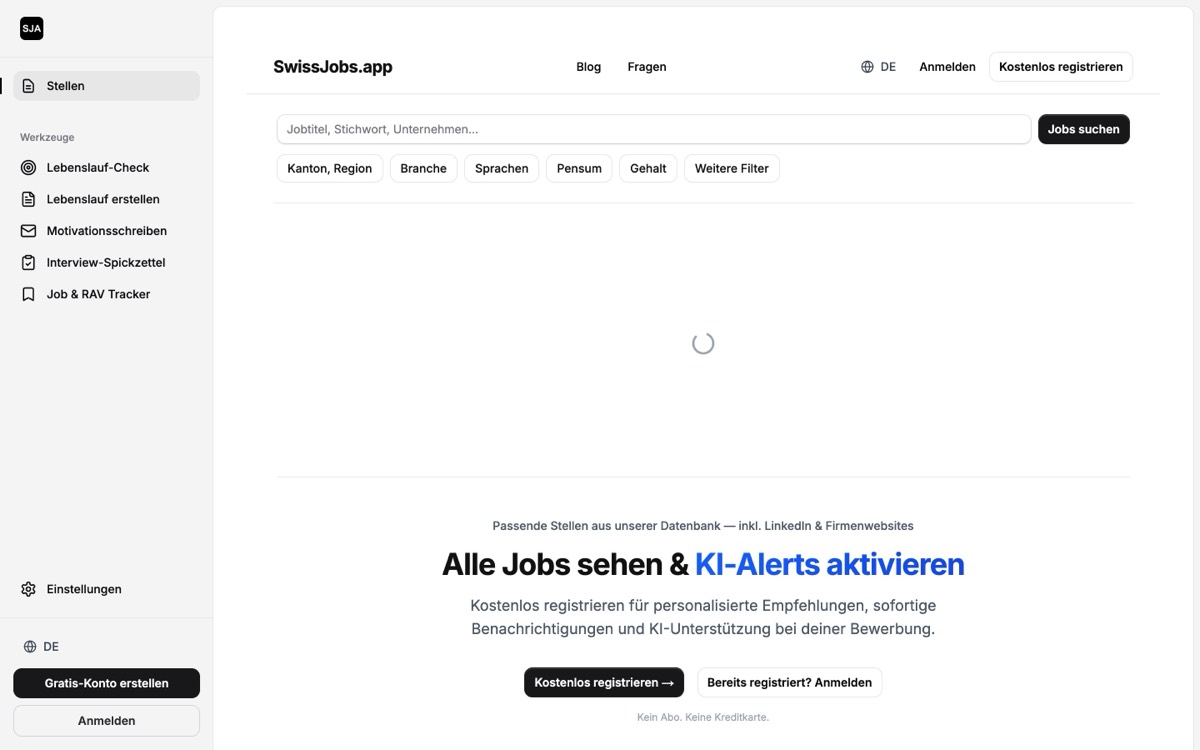
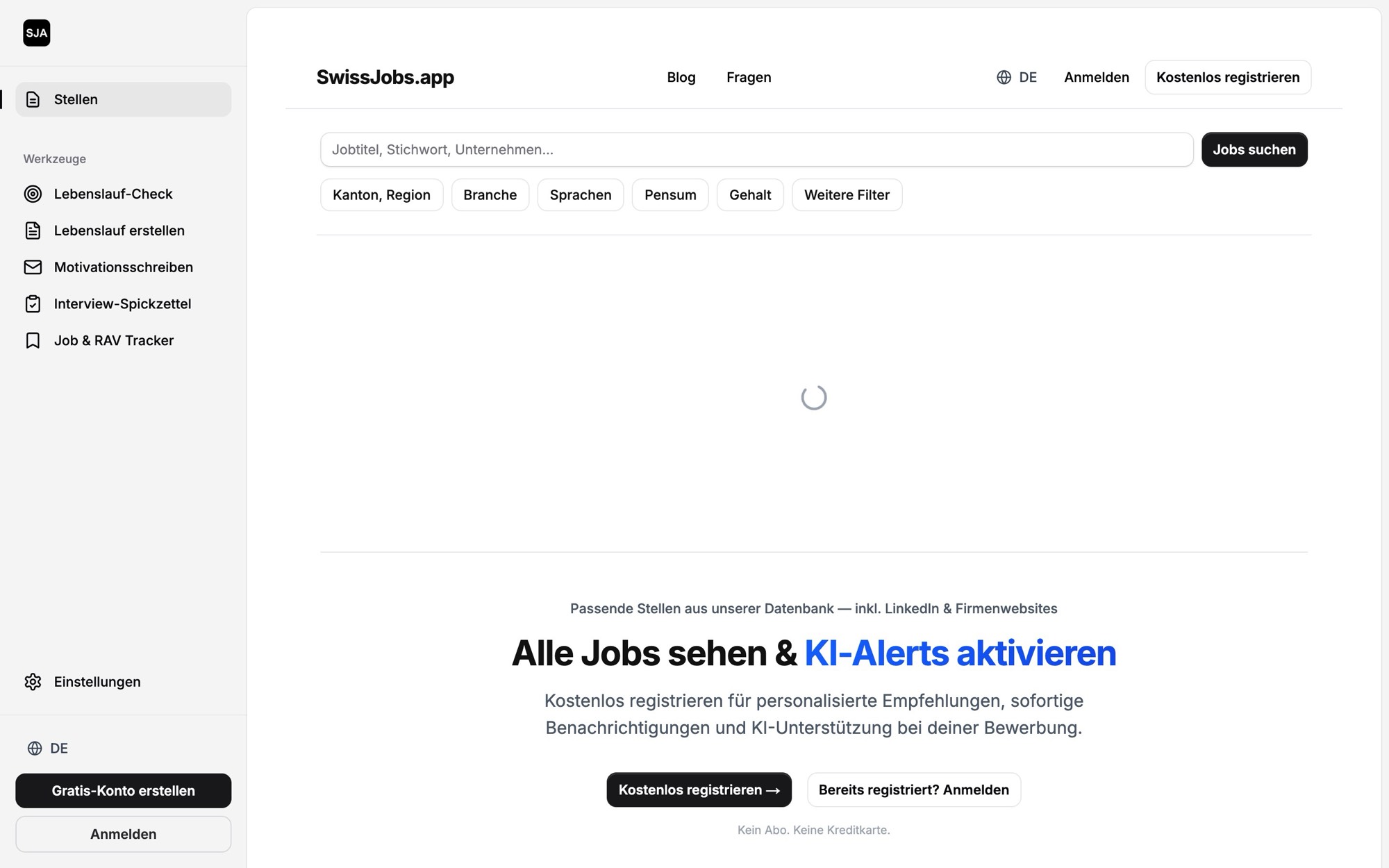
1. SwissJobs.appOur app
Over 21,000 open Swiss roles from ATS systems, company sites and LinkedIn in one place — and from any advert, straight into a CV, a motivation letter, a CV check and interview prep. The RAV job-search-efforts form fills itself from your application tracker. Free to use; the account is asked for at save.
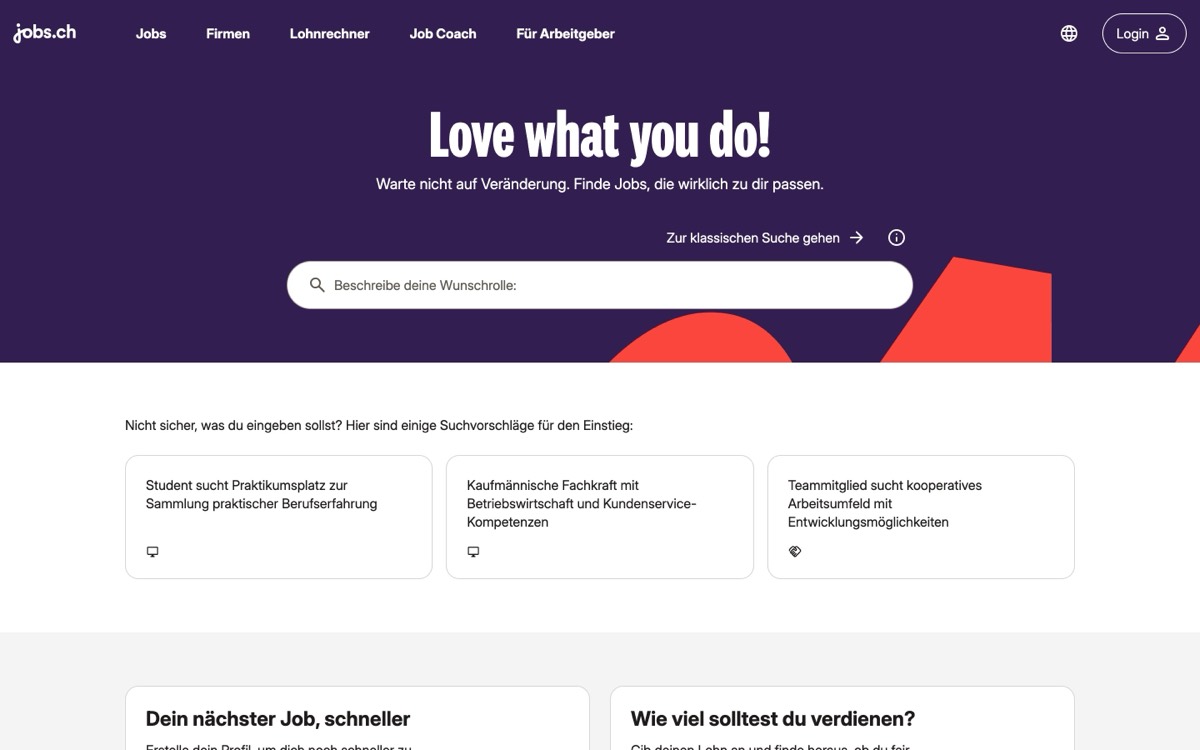
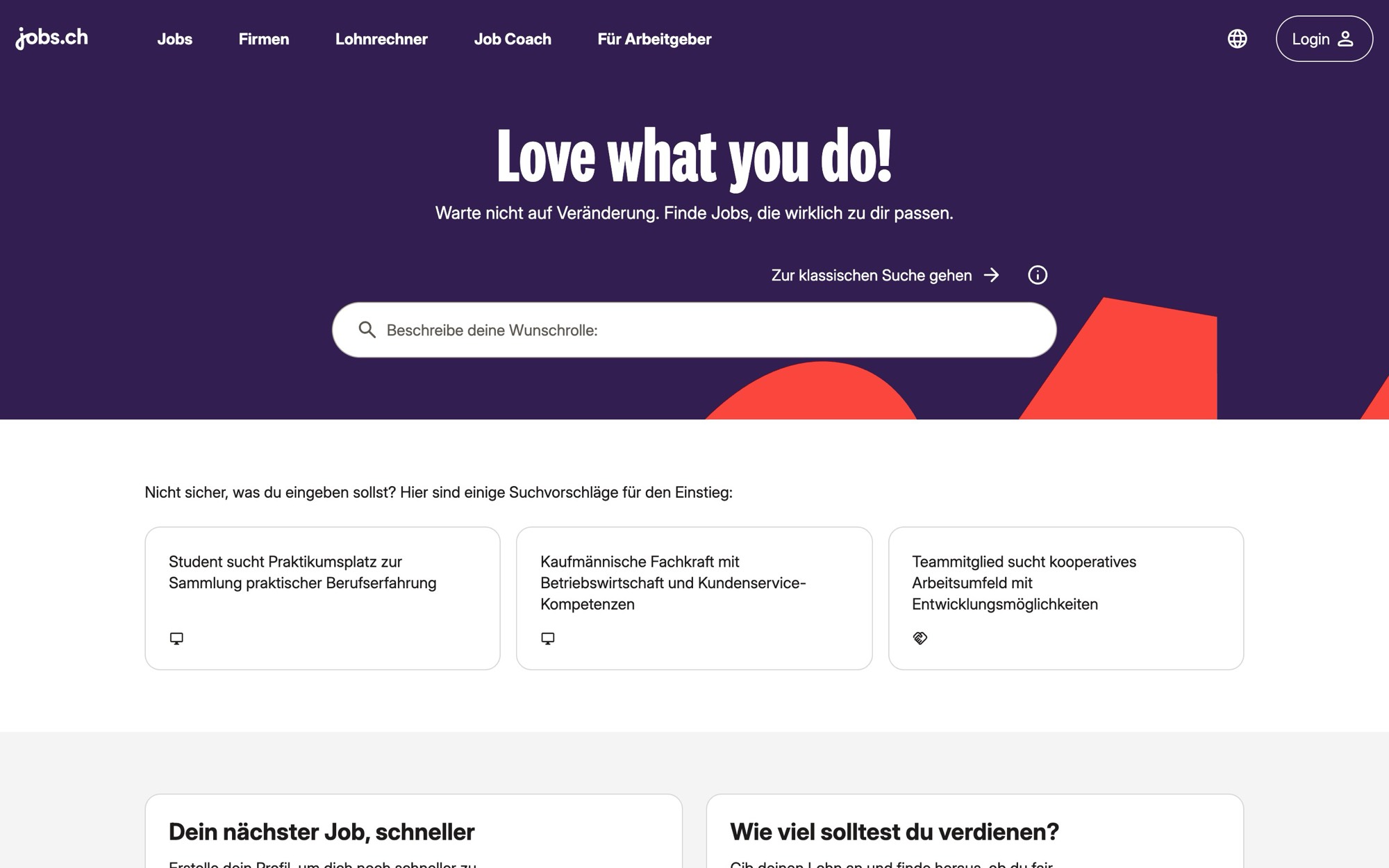
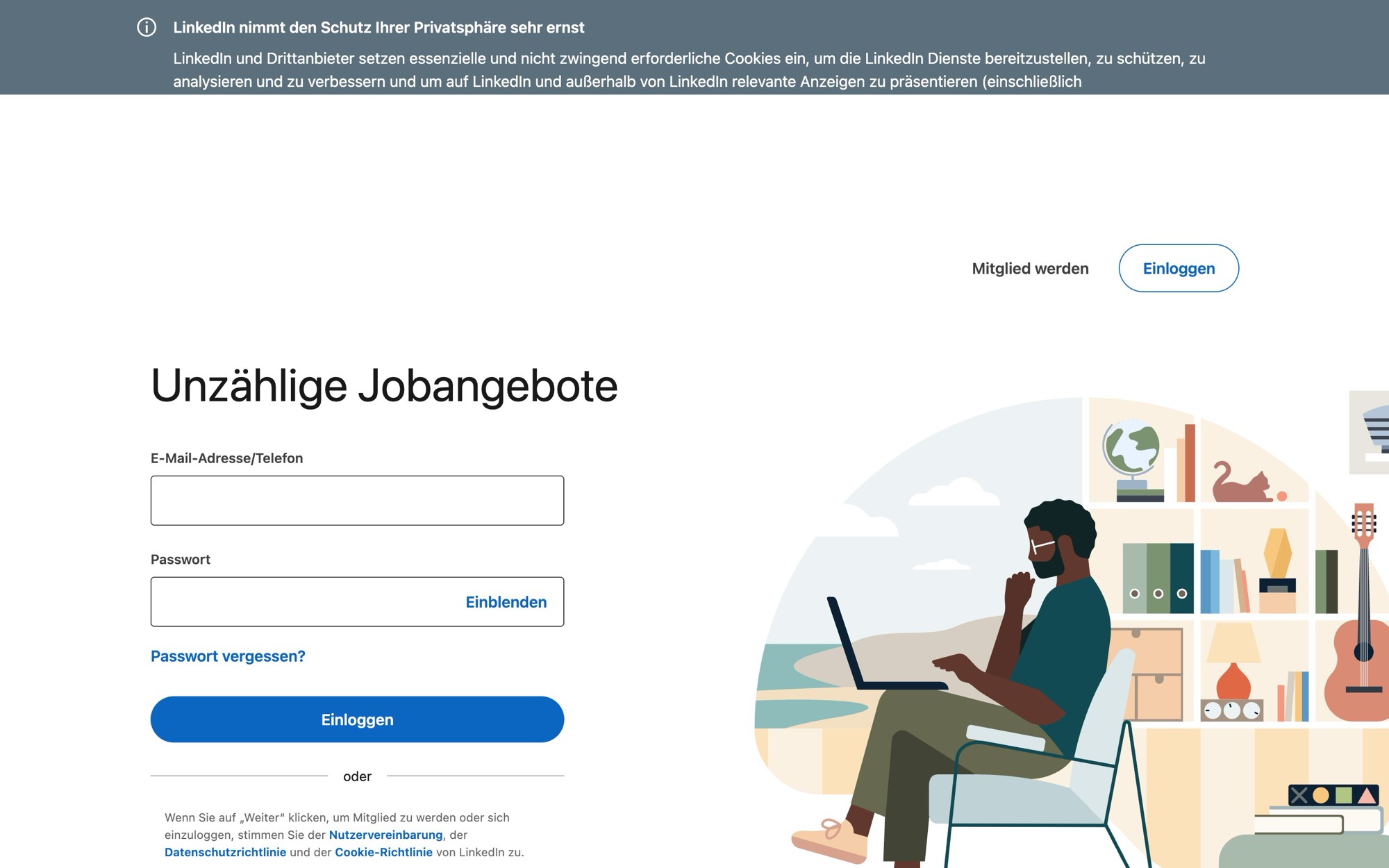
The best-known board in German-speaking Switzerland and the largest index in the country. Owned by JobCloud AG — as are jobup.ch and JobScout24.
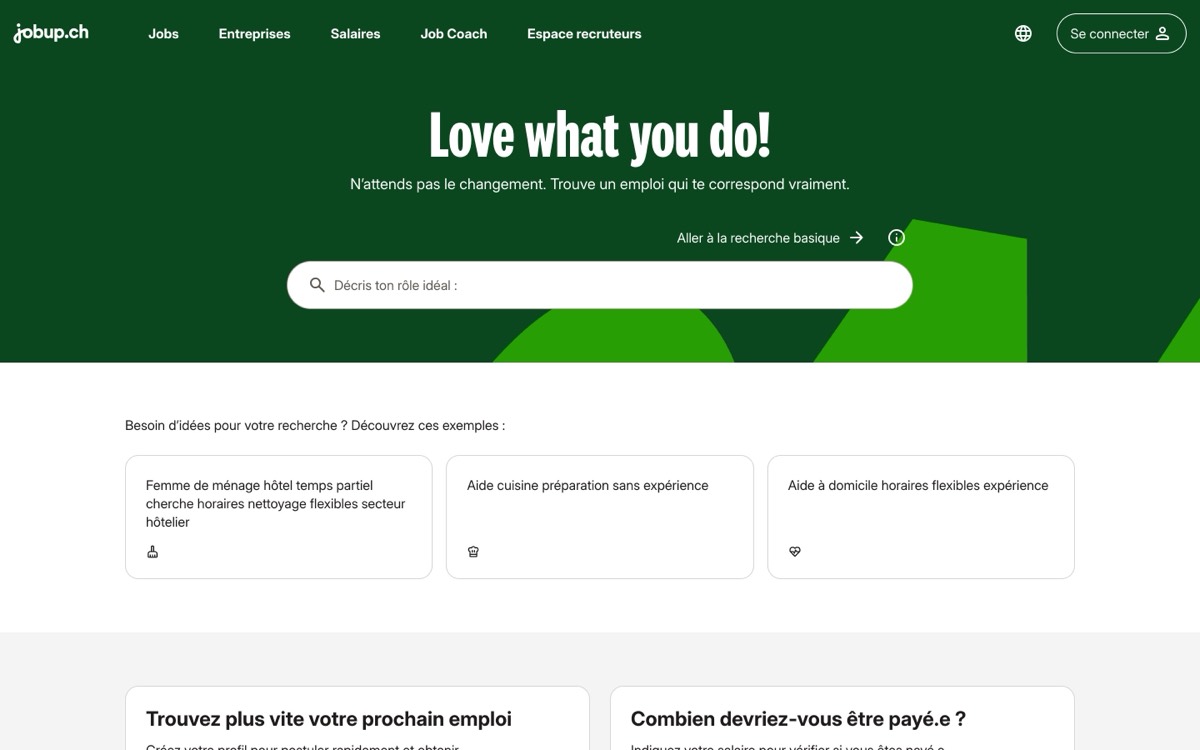
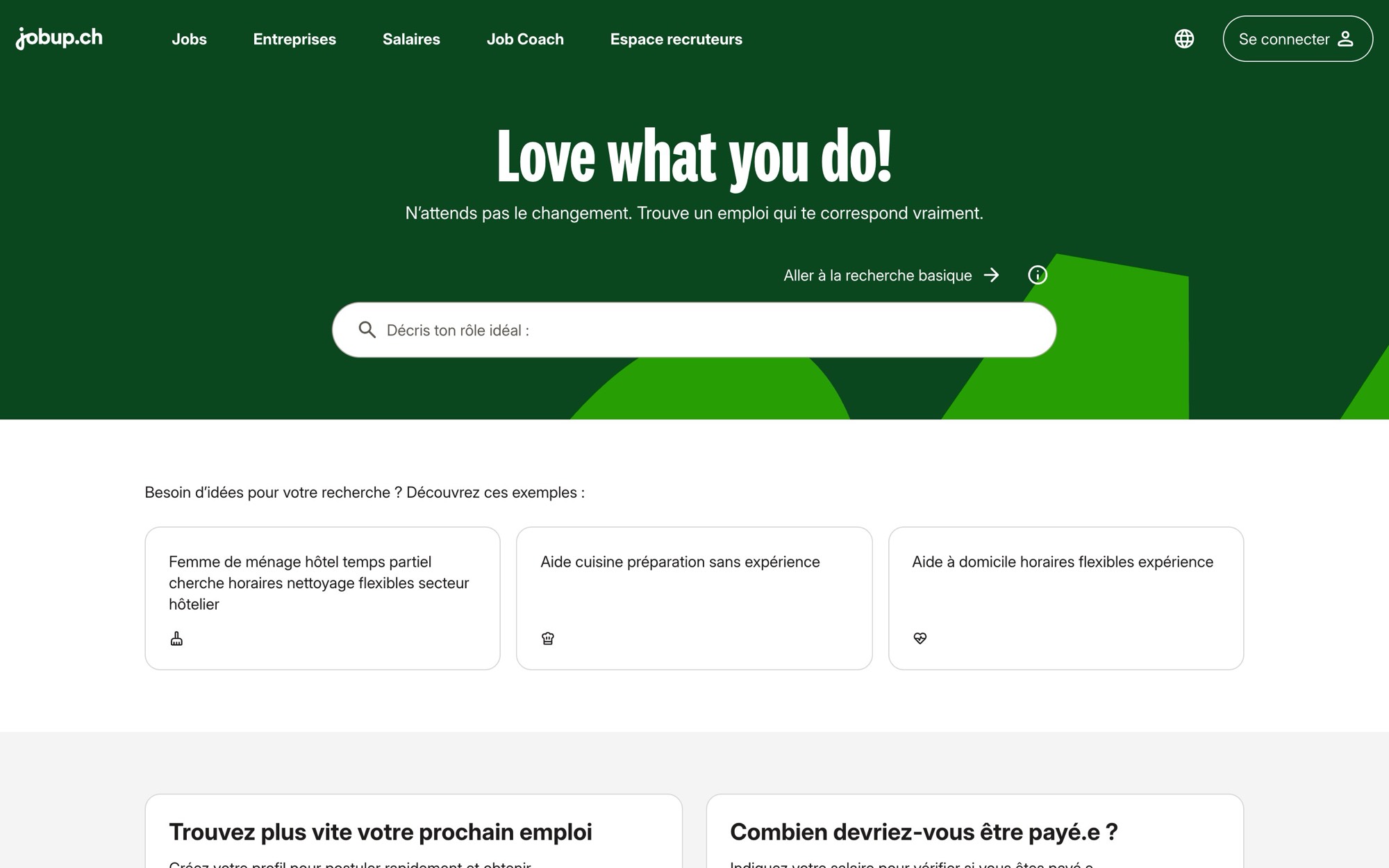
The standard in French-speaking Switzerland and the first place to look for the Romandie — but the same JobCloud AG as jobs.ch.
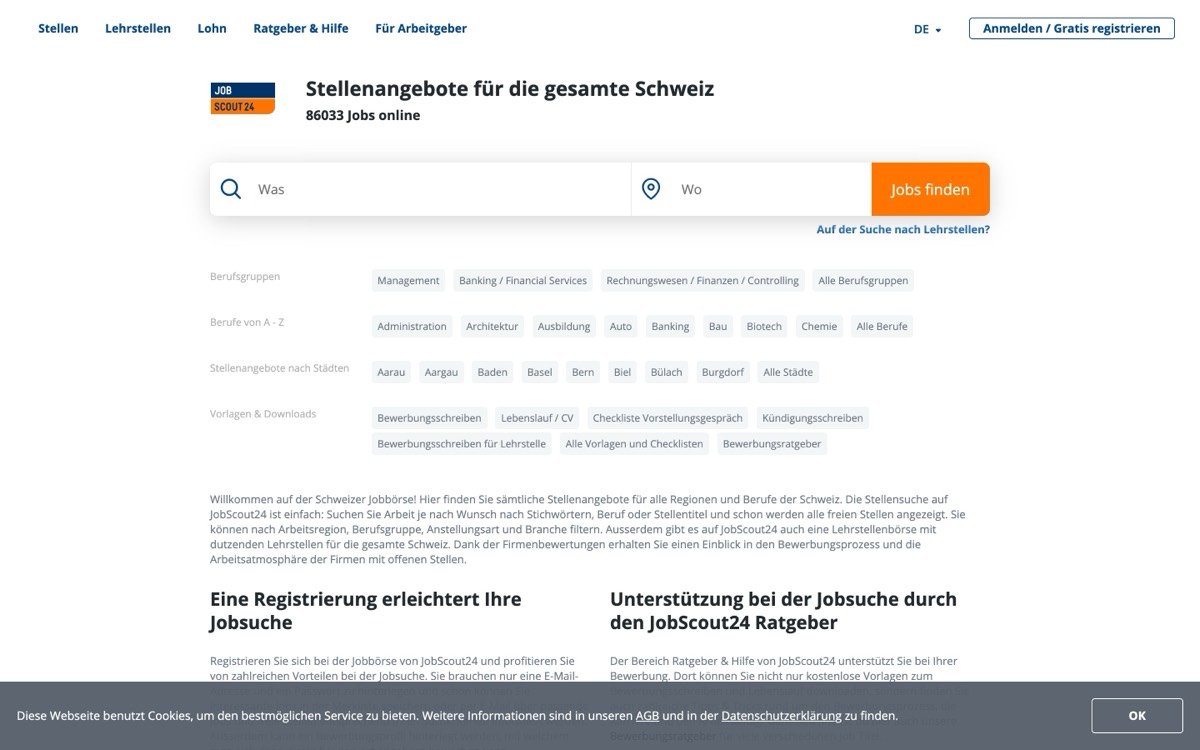
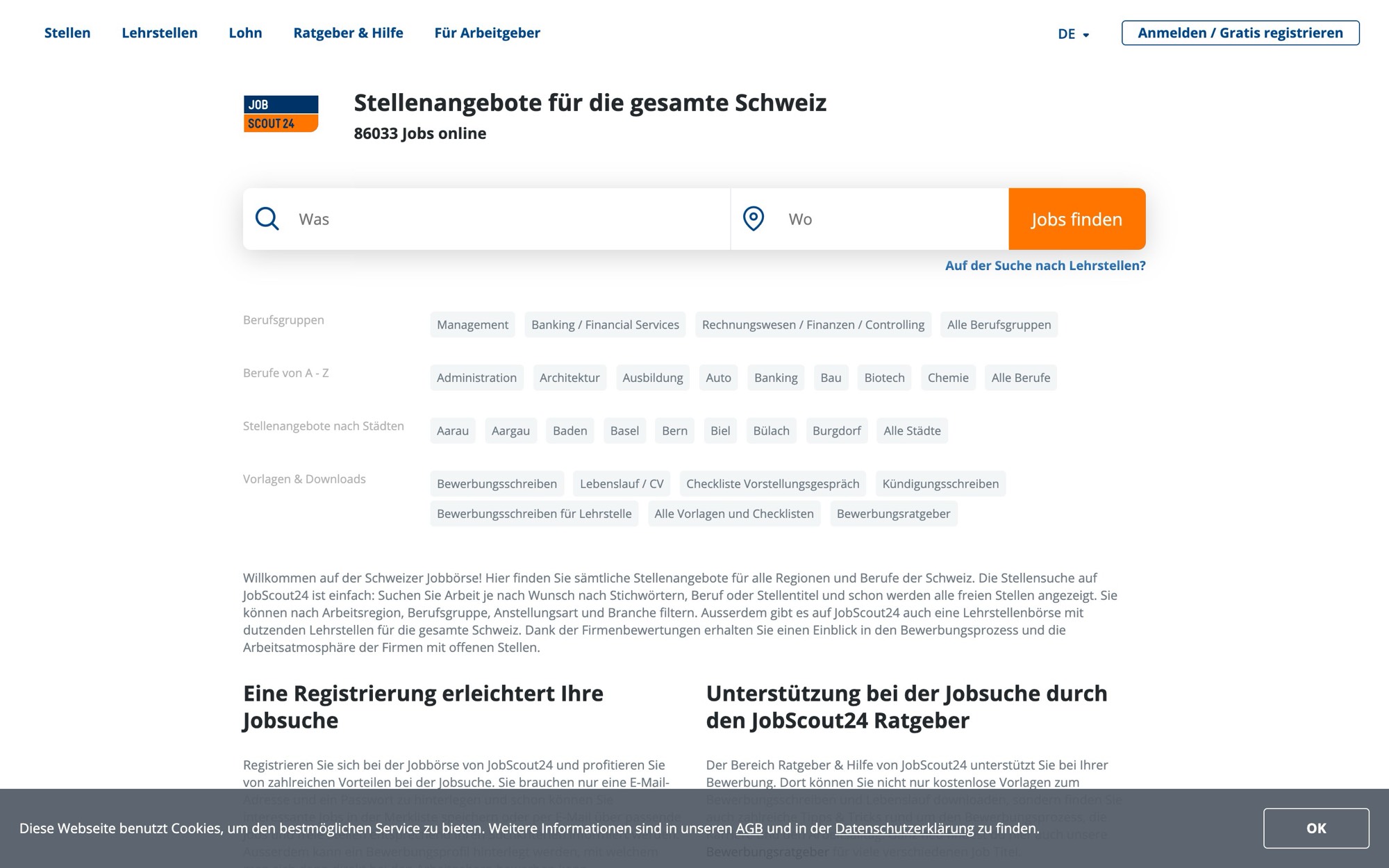
A third brand from the same company. Searching all three to widen your search means searching one provider three times.
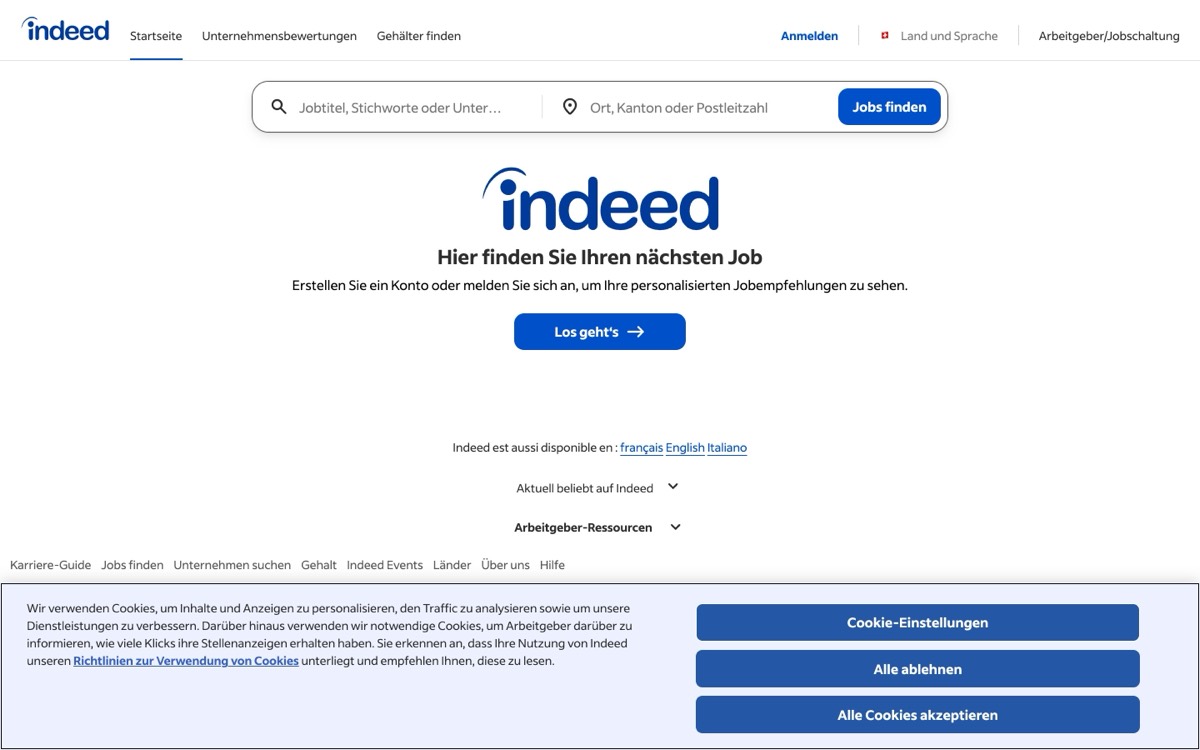
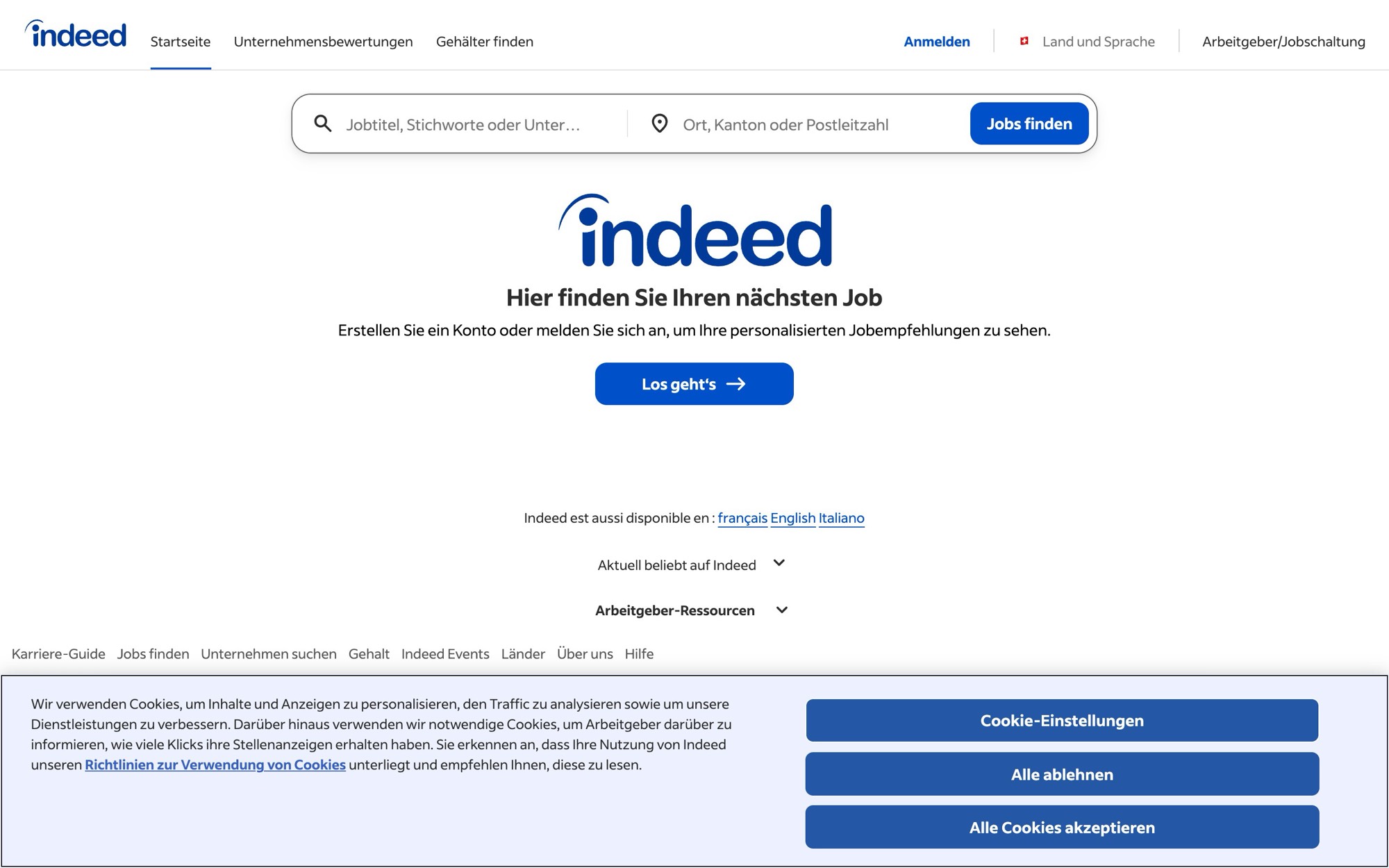
The broadest aggregation, because Indeed also collects from other boards — at the cost of many duplicates of the same advert.
The best reputation for English-speaking and international roles in Switzerland. Considerably thinner for trades, care and commercial roles.
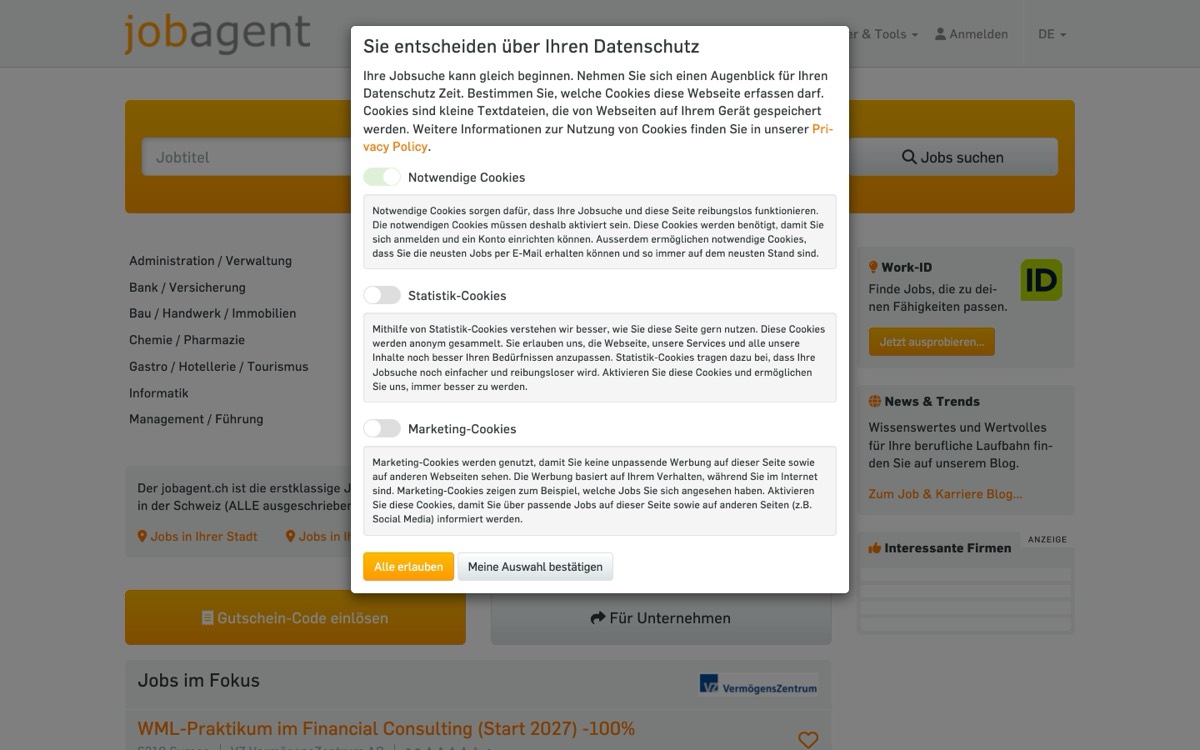
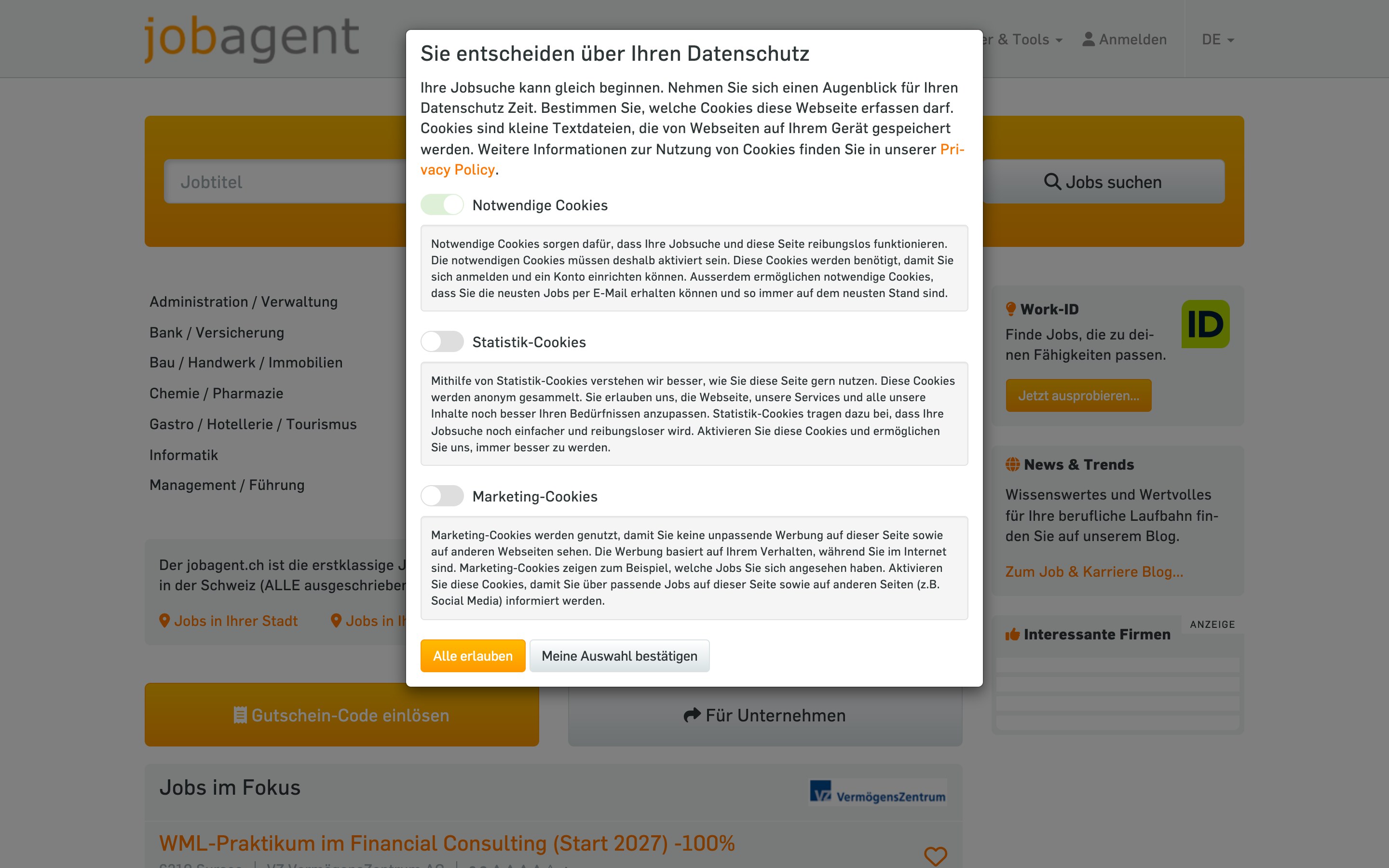
A meta-search across the Swiss job boards, "every job in Switzerland at a glance". Its strength is the Job-Abo: a saved search that mails you new adverts from every portal it covers. Salary calculator and application guides alongside.
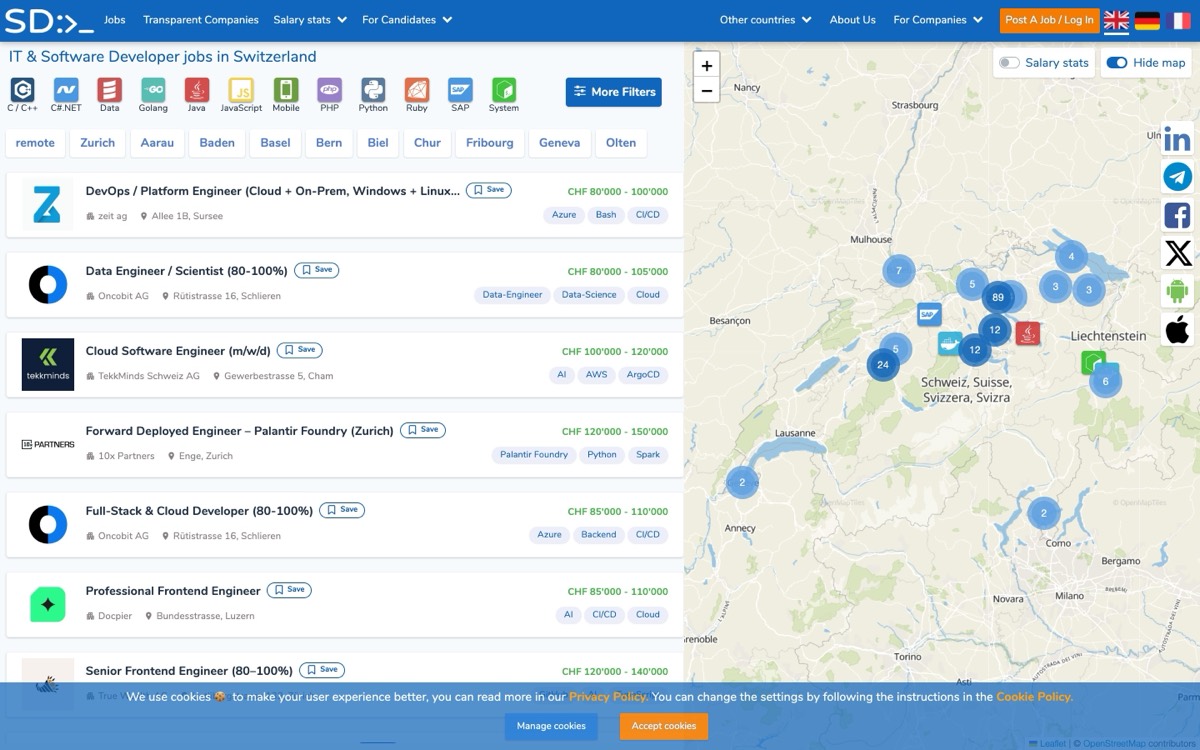
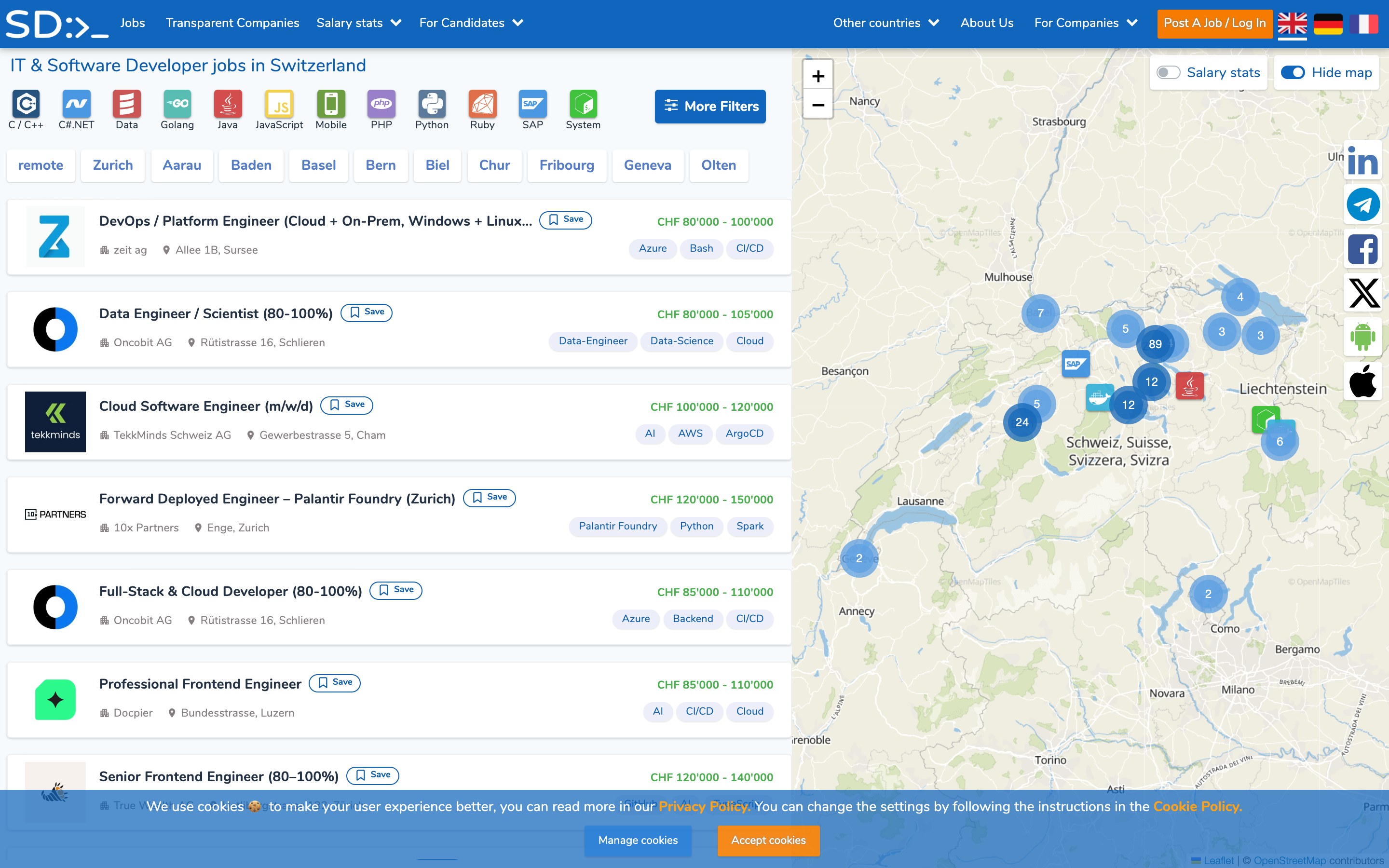
IT and software only, and thorough about it: "183 IT & Software developer jobs in Switzerland", filtered by technology (C#, Java, Python, DevOps, ML) rather than by industry. Publishes salary statistics and lists the companies that disclose their ranges. The site itself is in English.
Jobs by profession, city or language
Type a profession, a city or a language, the page shows the adverts currently open for it.
By profession
- Consultant
- Project Manager
- Retail Sales
- Nurse
- Nursing & Care
- Administrative Assistant
- Account Manager
- Software Engineer
- Public Administration
- Architect
- Insurance
- Chef
71 more — narrow the search
By work type
That last number is the one to plan around if you are moving to Switzerland. Bern carries roughly a tenth of the national advert supply but only 2.6 percent of its English-language adverts, and just 3.1 percent of Bern adverts ask for English alone, against 21.2 percent elsewhere. German is asked for in 92.8 percent of Bern adverts that state a language requirement, and in 93.8 percent of those cases at professional or native level.
The compensation is that Bern rewards a second national language in a way no other German-speaking market does. The canton straddles the language border and is officially bilingual, and 19.2 percent of its adverts with stated requirements ask for German and French together — more than twice the rate in the rest of the country.
Share of canton Bern adverts by type of advertiser, classified from the employer name. Rolling analysis of the open Swiss adverts we track, August 2026.
- Canton Bern holds about 10.6 percent of all the Swiss adverts we track — and 60.8 percent of the country's public-administration adverts.
- 73.4 percent of Bern adverts are labelled simply "Bern"; the remaining quarter name Thun (5.0%), Burgdorf (3.3%), Langenthal (2.8%), Zollikofen (2.3%) and some fifty smaller towns.
- Only 5 percent of Bern adverts are written in English, against 22 percent in the rest of the country; English alone is enough in 3.1 percent of them.
- 19.2 percent of Bern adverts with stated language requirements ask for German and French together, against 8.8 percent elsewhere — and 49.8 percent inside public administration.
- The median Bern advert is about 17 days old, against about 21 elsewhere, and only 19.6 percent are older than two months (28.3 percent elsewhere).
- Part-time is more common here — 8.0 percent of adverts against 5.2 percent nationally — but 26.4 percent of healthcare adverts and only 4.1 percent of administration adverts.
The word "Bern" is doing three jobs at once
In our data, "Bern" is the second most frequent place label in Switzerland, and it is used loosely. It names the city, it names the canton, and very often it just names where the employer's head office and HR department sit. Large public bodies, insurers, associations and hospital groups post centrally under the head office even when the work happens elsewhere. The clearest case is the Spitalzentrum Biel / Centre hospitalier Bienne: more than 98 percent of its adverts carry "Bern" as the location, although the hospital is in Biel and more than four in ten of those adverts are written in French.
The mistake in the other direction is smaller but sharper. A literal text search for "bern" pulls in roughly two percent of hits that have nothing to do with the canton: New Bern in North Carolina, San Bernardino in California, Berneck in canton St Gallen, the Bernina region in Graubünden. Those are the adverts that can sit at the top of a freshly sorted list and waste the first minute of your search.
So the practical rule for this canton is the reverse of the one for Zurich, where spelling is the trap. Here, search the region rather than the word, then filter inside the result; and whenever an advert says "Bern" and comes from a large or public employer, read the body text for the actual place of work. A quarter of the canton's adverts never mention the capital at all — they say Thun, Burgdorf, Langenthal, Zollikofen, Ostermundigen, Lyss, Konolfingen or Köniz, each a small market of its own.
A quarter of the list is public money, and it behaves differently
Bern is the seat of the federal government, and the advert mix shows it. 12.5 percent of Bern adverts come from public administration — the cantonal administration, the federal administration, federal offices such as the Federal Office of Information Technology, swisstopo, the Federal Office of Sport and the Institute of Intellectual Property, plus the armed forces and the cantonal police. In the rest of Switzerland that figure is 1.1 percent. Add healthcare (12.7%), transport and infrastructure (2.7%) and education (1.2%) and close to a third of the Bern list is public or publicly funded.
This changes how you apply, not just where you look. Public adverts run to a fixed closing date, state the workload as an exact percentage, are rarely negotiable on grade or start date, and appear on the employer's own portal first. The canton of Bern publishes all of its vacancies, apprenticeships, internships and teaching posts in its own career portal, and the federal administration runs a separate four-language job portal that also carries university internships and apprenticeships. If you only watch job boards, you see these roles late or not at all.
The second-largest advertiser type is the staffing intermediary, at 16.6 percent of Bern adverts. Their postings are the youngest in the canton — a median of about nine days against about twenty for private employers — but they almost never state language requirements and hardly ever a reduced workload. Sorted by date, they float to the top of every Bern list without representing more actual openings.
Concentration follows from that. The single largest advertiser in the canton is an intermediary and accounts for roughly 15 percent of Bern adverts; the ten largest together for 38 percent, the twenty-five largest for close to half. At the same time nearly half of all Bern employers have exactly one opening, and employers with three adverts or fewer make up 22 percent of the market. That long tail is only reachable by filtering on employer or by running a second pass town by town.
What a non-German speaker should expect
Bern is the least English-friendly of the large Swiss markets, and the gap is not small. 61.1 percent of its adverts are written in German against 39.3 percent elsewhere; 5 percent are in English against 22 percent. Among adverts that state requirements, English is mentioned in 24.5 percent here against 43.5 percent in the rest of the country, and English on its own suffices in 3.1 percent against 21.2 percent. If your plan is to work in Switzerland in English, Bern is the wrong first canton to search — Zurich, Zug, Basel and Geneva all carry a far larger share of the English-language supply.
Where English does appear in Bern, it is concentrated in the parts of the market that deal with the outside world: 48.3 percent of public-administration adverts mention it, because federal offices need English for international files — but they need a national language for the daily work as well. In staffing-intermediary adverts English is mentioned in 1.5 percent, and in private-sector adverts in 27.6 percent.
The mirror image is Italian. 17.9 percent of all Italian-language adverts in our whole index sit in the canton of Bern, essentially all of them from federal offices publishing in the third official language. Outside Ticino, Bern is where Italian-language public jobs actually get advertised.
If you are learning German for the Bern market, the level matters more than the certificate. Where German is required, 89.6 percent of mentions ask for professional working proficiency and another 4.2 percent for native level. Conversational German is enough in only about one advert in seventeen that names the language.
Timing, workload and the canton beyond the capital
Bern's list refreshes faster than the national average. The median advert is about 17 days old against about 21 elsewhere, 17.2 percent are less than a week old against 13.4 percent, and only 19.6 percent are older than two months against 28.3 percent. The reason is structural: intermediary mandates and public adverts with deadlines disappear again quickly, while open-ended private adverts linger. Sorting by date is therefore worth more in Bern than in markets where a third of the list is stale.
Part-time is the other structural difference. 8.0 percent of Bern adverts are part-time against 5.2 percent nationally, and Bern supplies 15.5 percent of the country's part-time adverts while holding 10.6 percent of adverts overall. Almost all of that sits in healthcare, where 26.4 percent of Bern adverts are part-time. If you need a reduced workload, search hospitals, care homes, home-care organisations and practices first — not a part-time filter.
Outside the capital, the canton describes itself as Switzerland's largest industrial canton, with more than six hundred thousand people in work, the watch industry in Biel and the Bernese Jura, precision and medical technology, the Switzerland Innovation Park Biel/Bienne, Empa in Thun and sitem-insel in Bern. Only part of that reaches online job lists: adverts that mention watchmaking at all account for roughly 0.2 percent of the national supply, and almost none of them carry a Bern location. Those roles move through manufacturers' own career pages.
The French-speaking part of the canton — Biel, and the Bernese Jura with Moutier, Tavannes, Reconvilier and La Neuveville — barely appears in the location labels at all, well under one percent of Bern adverts combined. That is not evidence that there is no work there; it is evidence that the work is advertised under "Bern" or through the employer directly. For that region, as for watchmaking, search by employer rather than by place.
A search order that works for this canton
Start from the region rather than the word, and sort by date — in a market whose median advert is seventeen days old, that is the cheapest advantage available. Then work the public portals separately: the canton of Bern's career portal, the federal administration's job portal, and the career pages of Insel Gruppe, Lindenhofgruppe, Spital Emmental, the Spitalzentrum Biel and the regional hospitals. Together those employers are the largest predictable block of the Bern market.
Be honest about language before you filter. Without professional German the Bern list shrinks harder than any other large Swiss market; with German and French together it opens a segment nobody else in German-speaking Switzerland pays for. And whenever an advert says "Bern", check where the work actually happens before you write the application — in this canton that is the single most common source of a wasted afternoon.
Market figures come from our rolling analysis of the open Swiss adverts we track, August 2026. "Bern adverts" means the canton of Bern, identified from the advert's location field (the city, its agglomeration and some fifty further municipalities); place names that merely contain the letters "bern" are excluded. Advertiser type is derived from the employer name and is an approximation. Language figures refer to adverts that state a requirement at all — 73.1 percent of Bern adverts. We publish shares, never absolute stock figures. Statements about bilingualism, the economic structure of the canton and the cantonal career portal come from the canton of Bern; statements about the federal job portal come from the federal administration.
Sources
Related questions
What our job index says about the Swiss market
Computed live from our own index, not quoted from a study. Shares only, as of today.
Language the advert is written in
- Deutsch
- 60%
- English
- 23%
- Français
- 13%
- Italiano
- 3%
Of adverts that state a language requirement, the share asking for
- Deutsch
- 70%
- English
- 43%
- Français
- 21%
- Italiano
- 3%
19% posted in the last 7 days · Largest markets: Zürich 18% · Bern 10% · Genève 5% · Basel 5%