Jobs in Geneva
Updated:
One city name, two job markets that barely overlap: English opens the larger half, French opens the everyday one — and the spelling in the location field tells you which door you are standing at.
- Show me jobs in Geneva — where should I actually look, and what is really in a Geneva listing?
- Can I get an industrial or engineering job in Geneva with B1 French, and should I go through agencies or apply directly?
Show me jobs in Geneva — where should I actually look, and what is really in a Geneva listing?
In short
Geneva is not a bilingual job market. It is two markets sharing a name. Of the listings that state language requirements, 65 percent want English and 54.5 percent want French — but only 21.1 percent want both. Around four in ten need no French at all, and around a third need no English at all. English gets you into the larger half; it does not get you into the city. Which half a listing belongs to is usually visible before you open it.
The Swiss job portals at a glance
Click an image for the full-size view. What each portal actually is stands beside it.
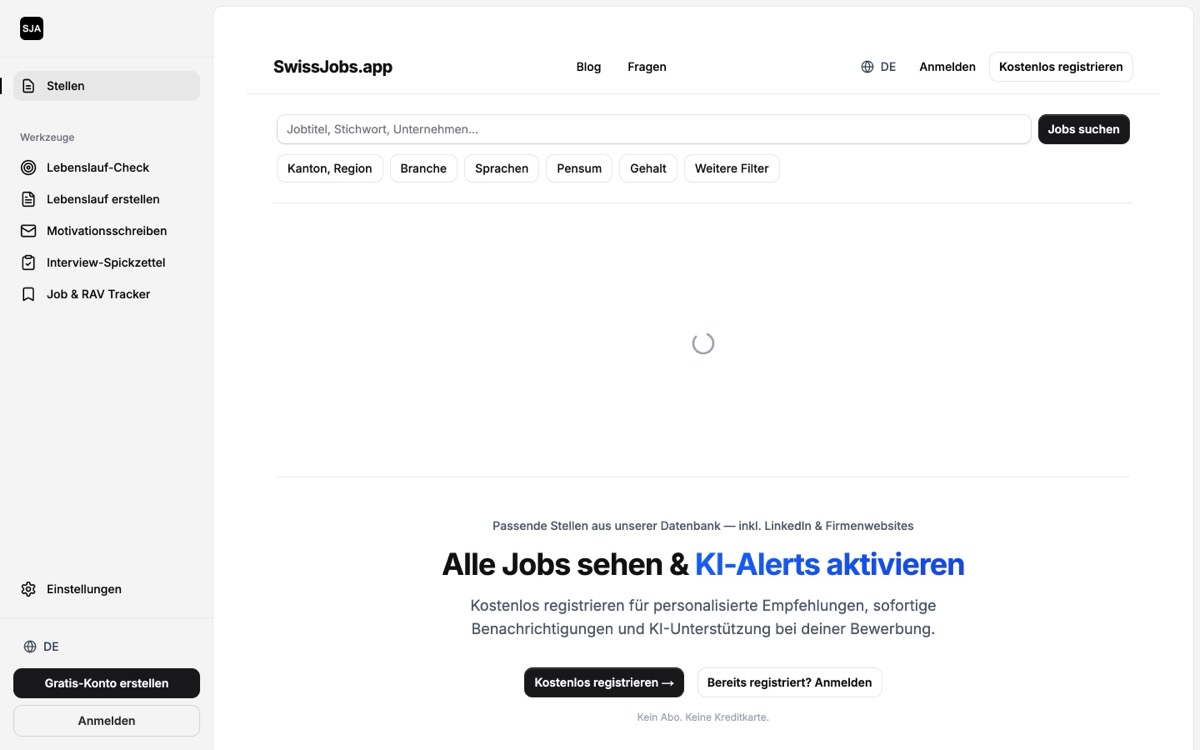
1. SwissJobs.appOur app
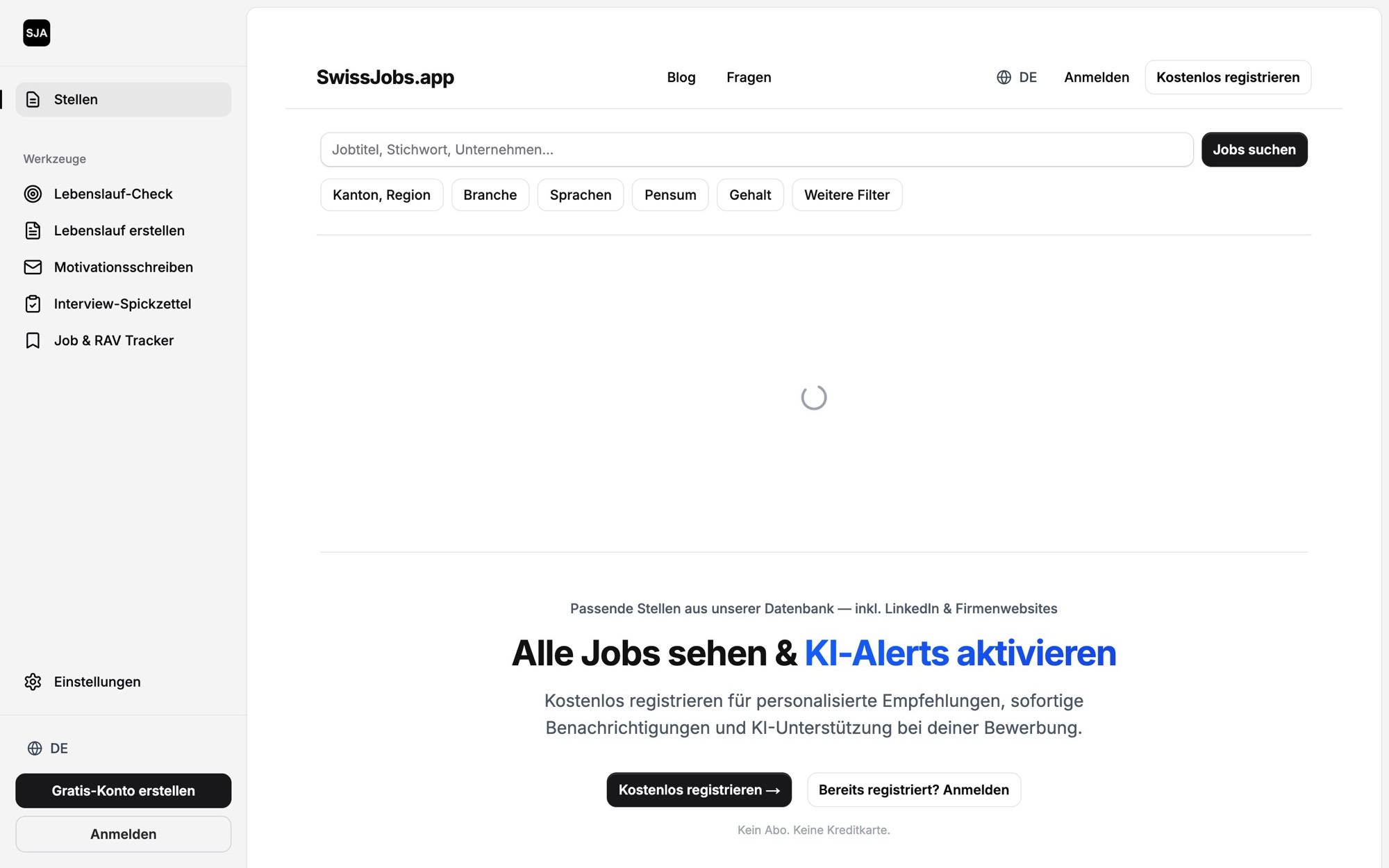
Over 21,000 open Swiss roles from ATS systems, company sites and LinkedIn in one place — and from any advert, straight into a CV, a motivation letter, a CV check and interview prep. The RAV job-search-efforts form fills itself from your application tracker. Free to use; the account is asked for at save.
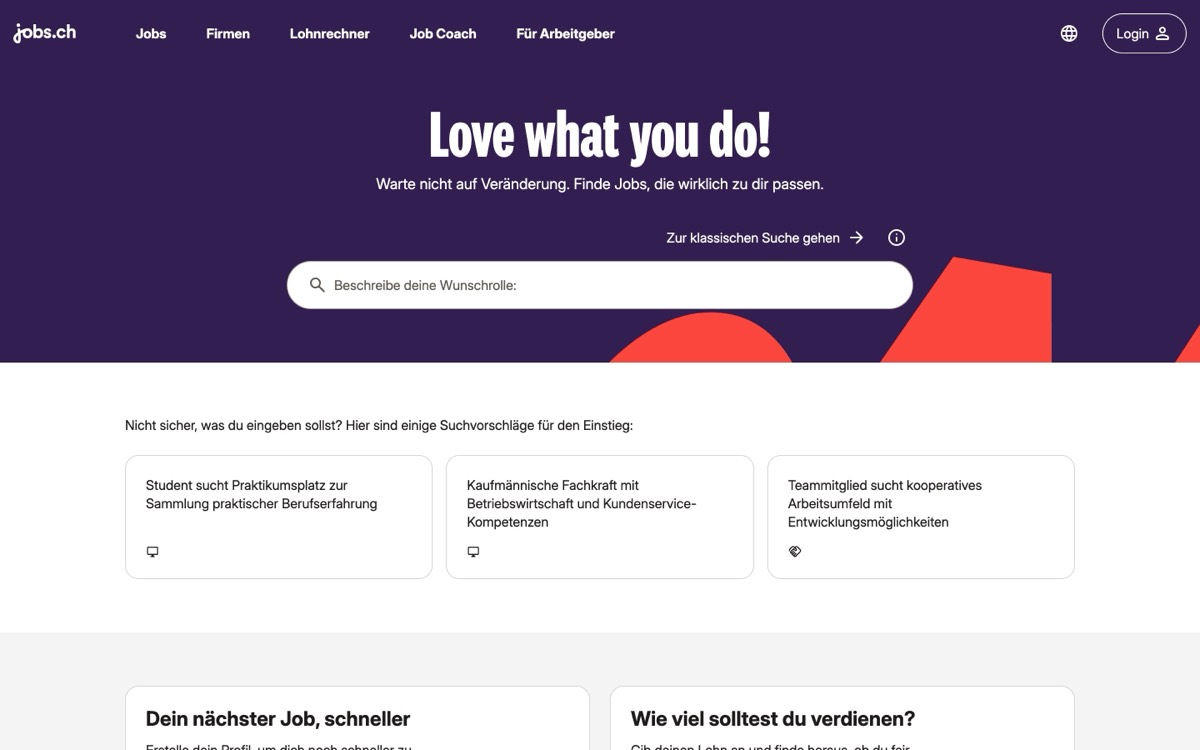
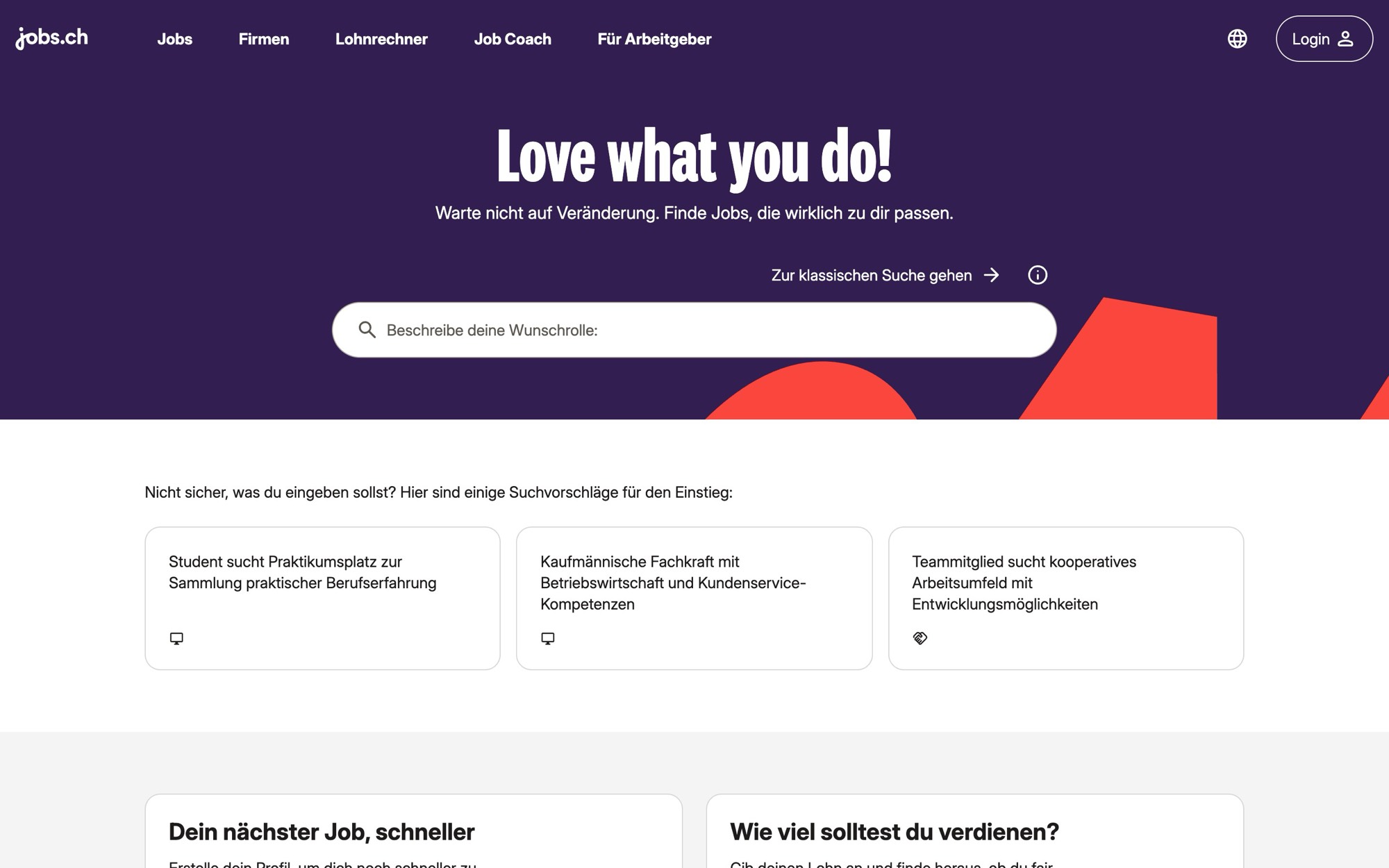
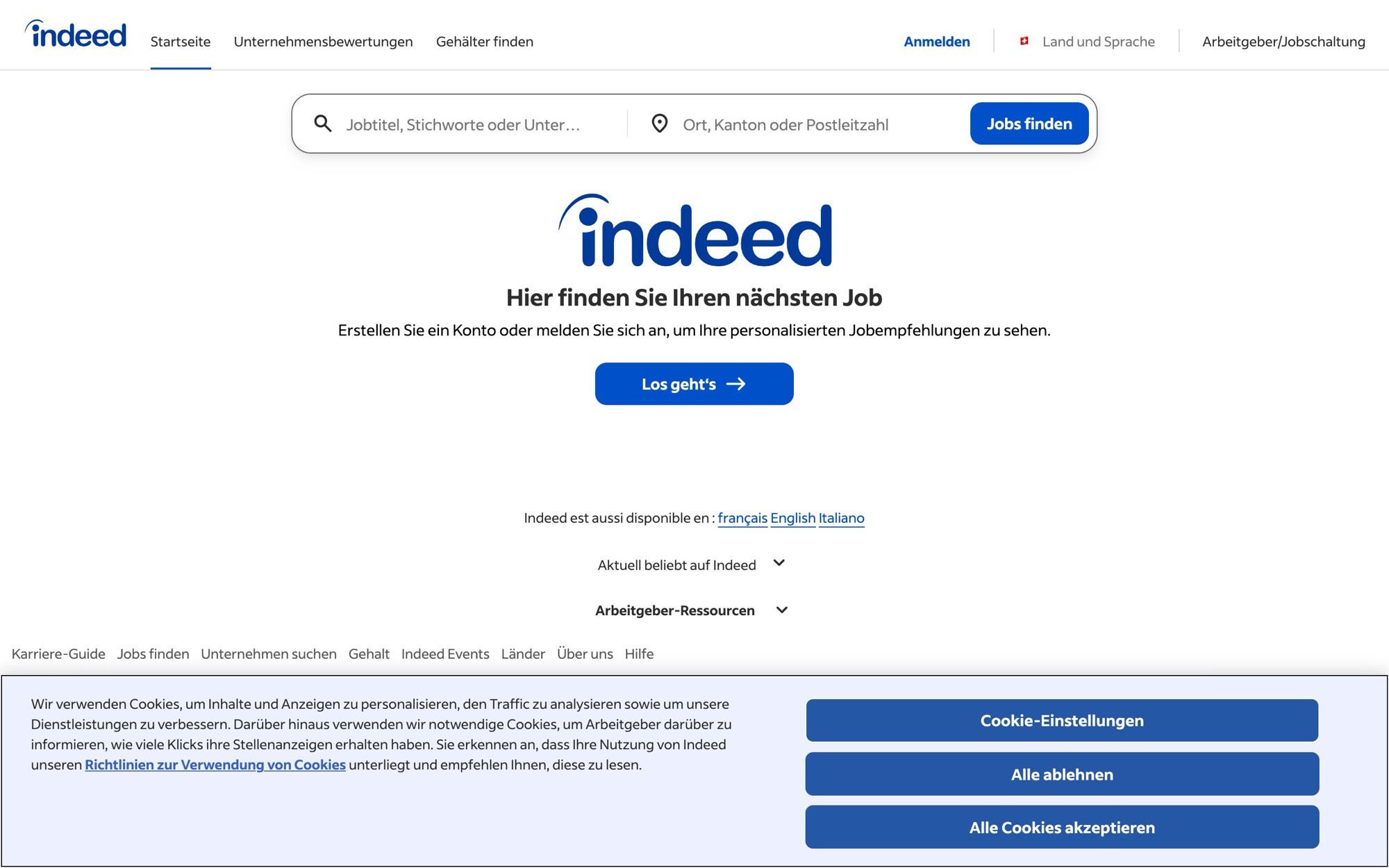
The best-known board in German-speaking Switzerland and the largest index in the country. Owned by JobCloud AG — as are jobup.ch and JobScout24.
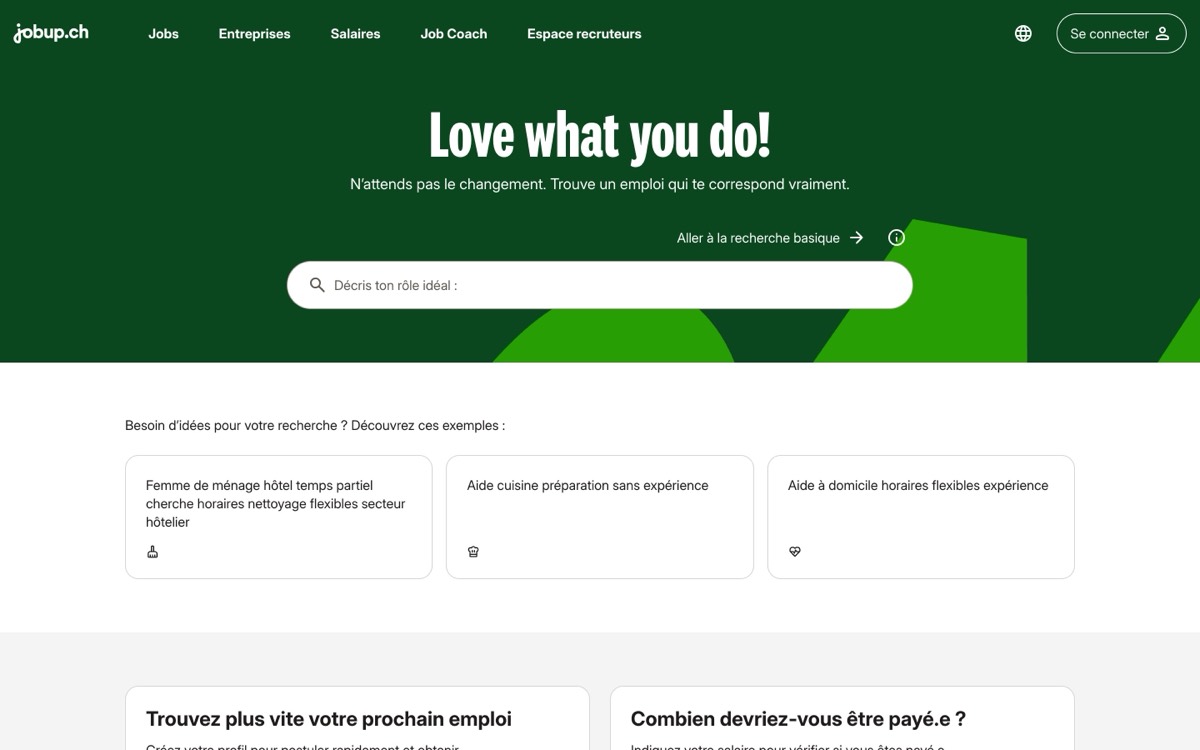
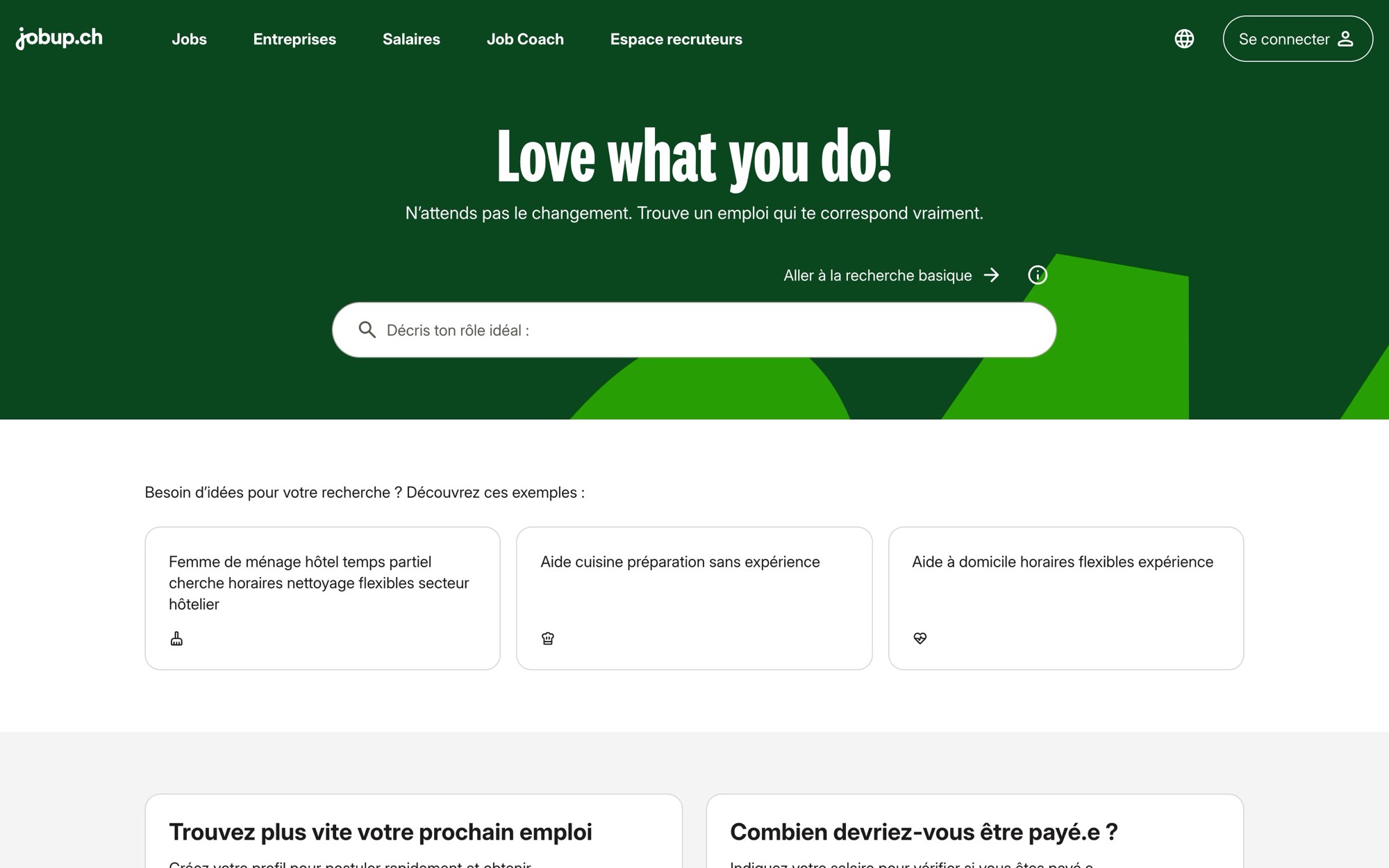
The standard in French-speaking Switzerland and the first place to look for the Romandie — but the same JobCloud AG as jobs.ch.
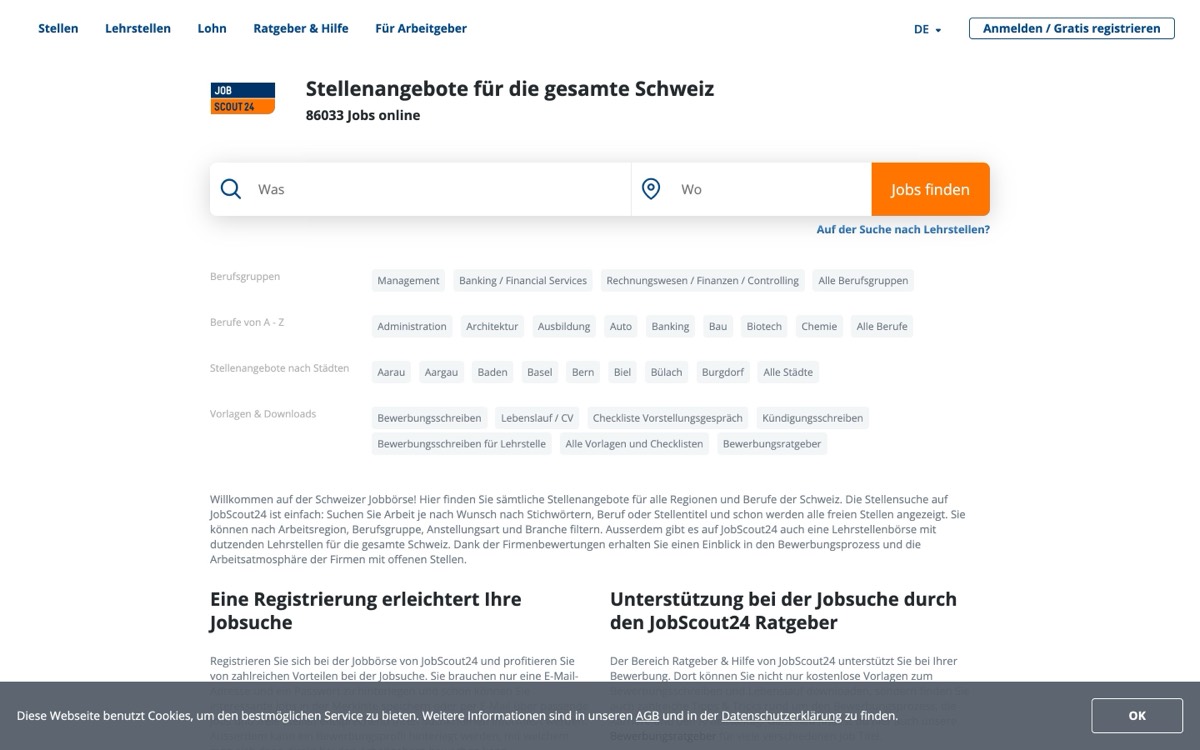
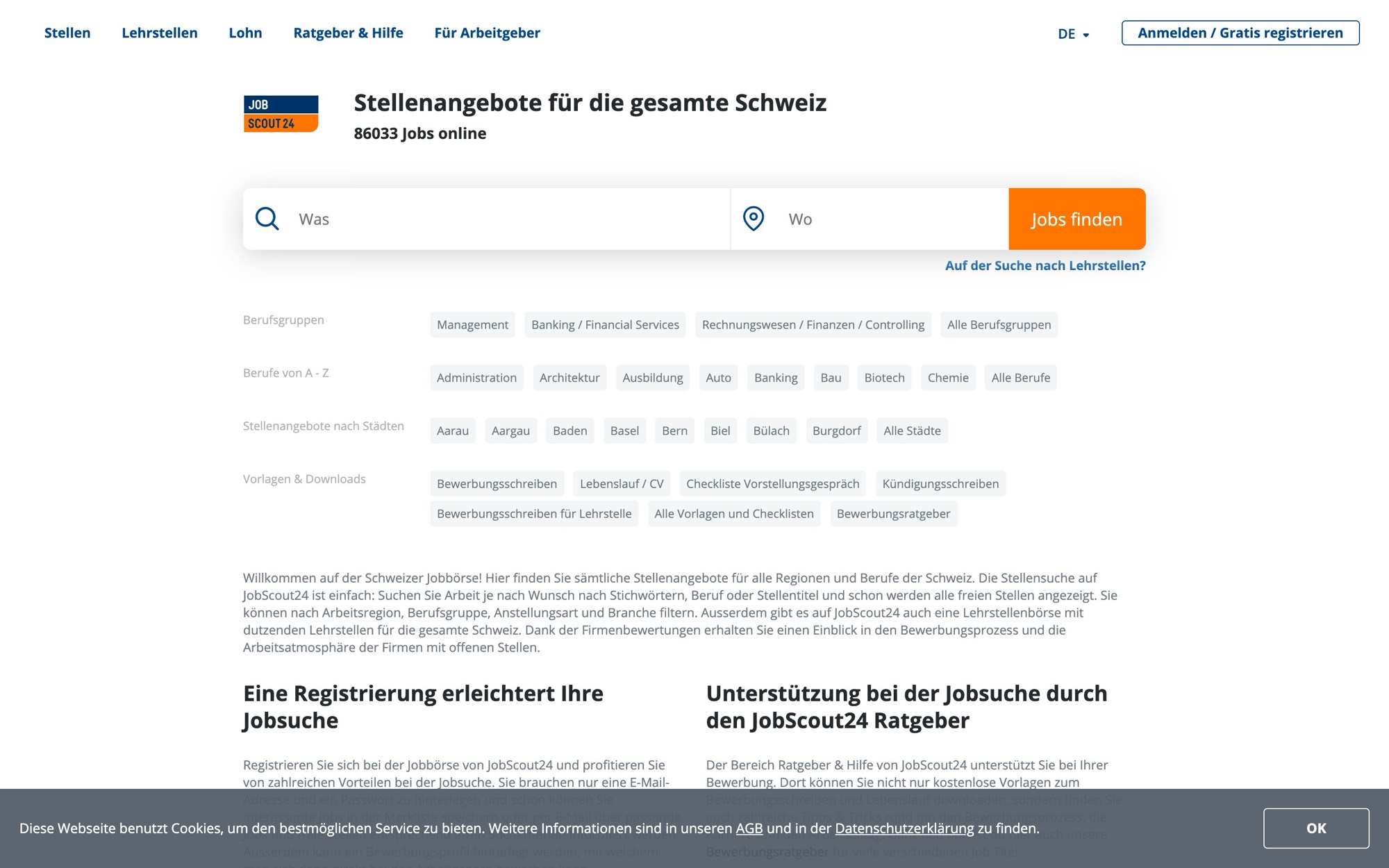
A third brand from the same company. Searching all three to widen your search means searching one provider three times.
The broadest aggregation, because Indeed also collects from other boards — at the cost of many duplicates of the same advert.
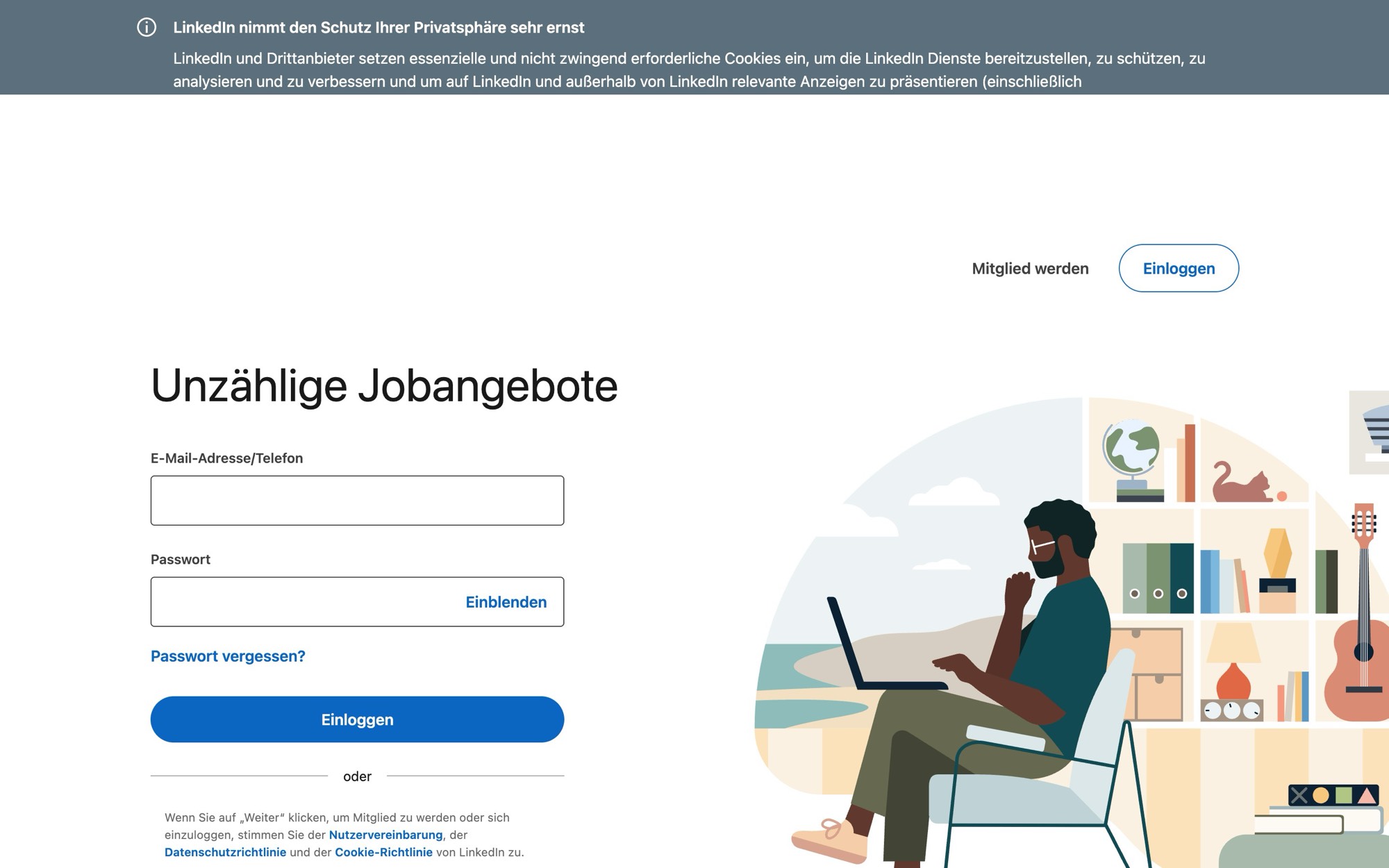
The best reputation for English-speaking and international roles in Switzerland. Considerably thinner for trades, care and commercial roles.
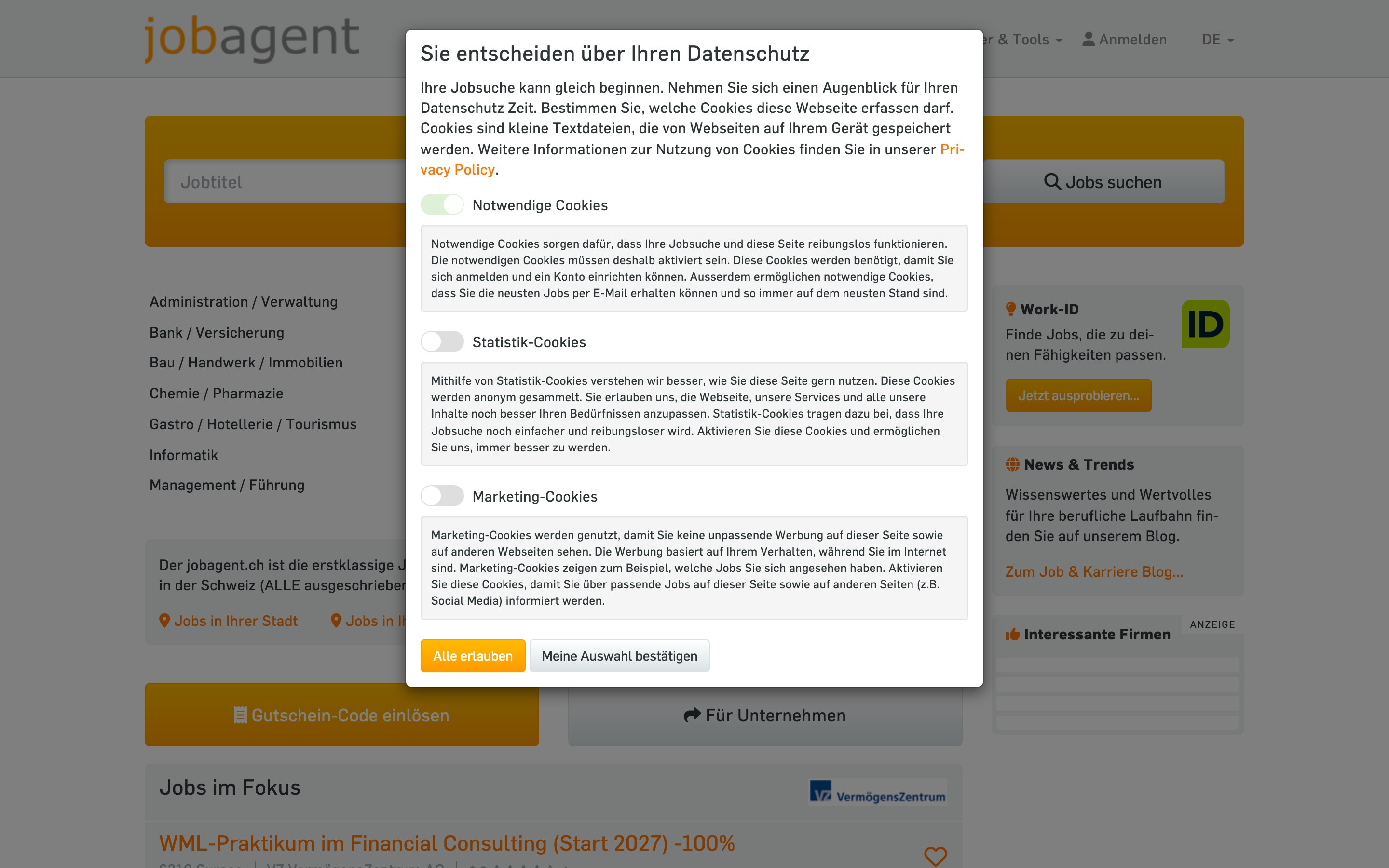
A meta-search across the Swiss job boards, "every job in Switzerland at a glance". Its strength is the Job-Abo: a saved search that mails you new adverts from every portal it covers. Salary calculator and application guides alongside.
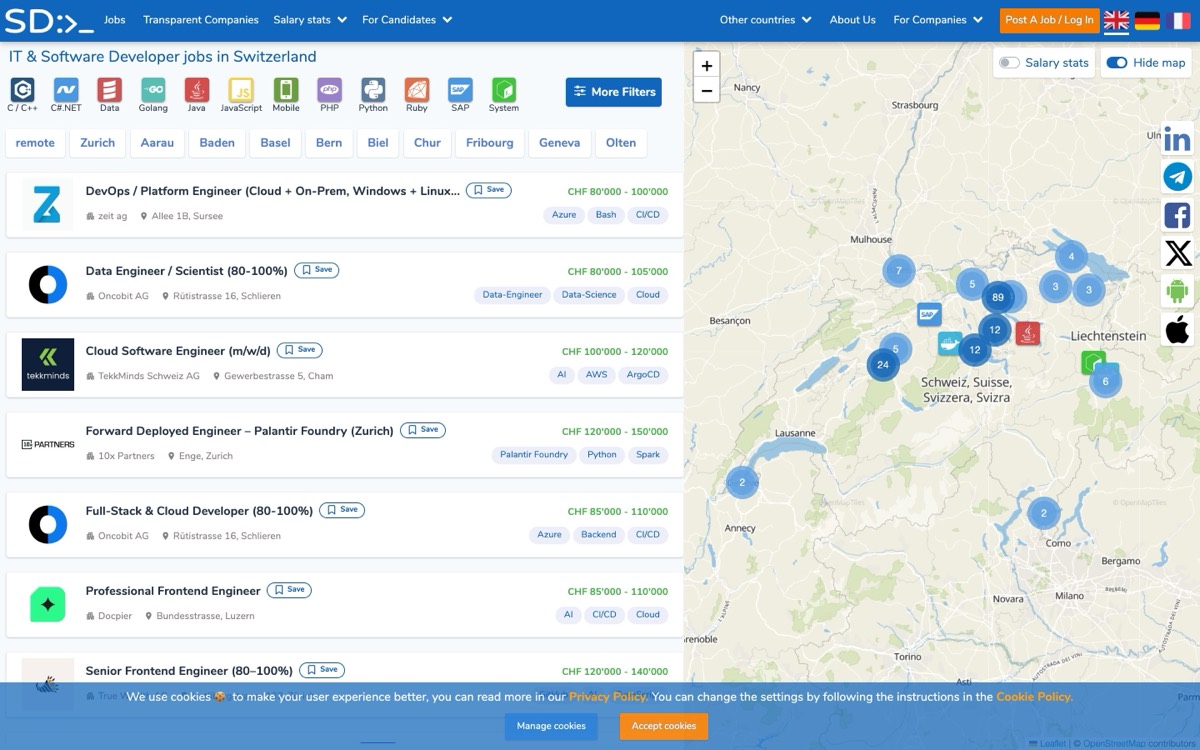
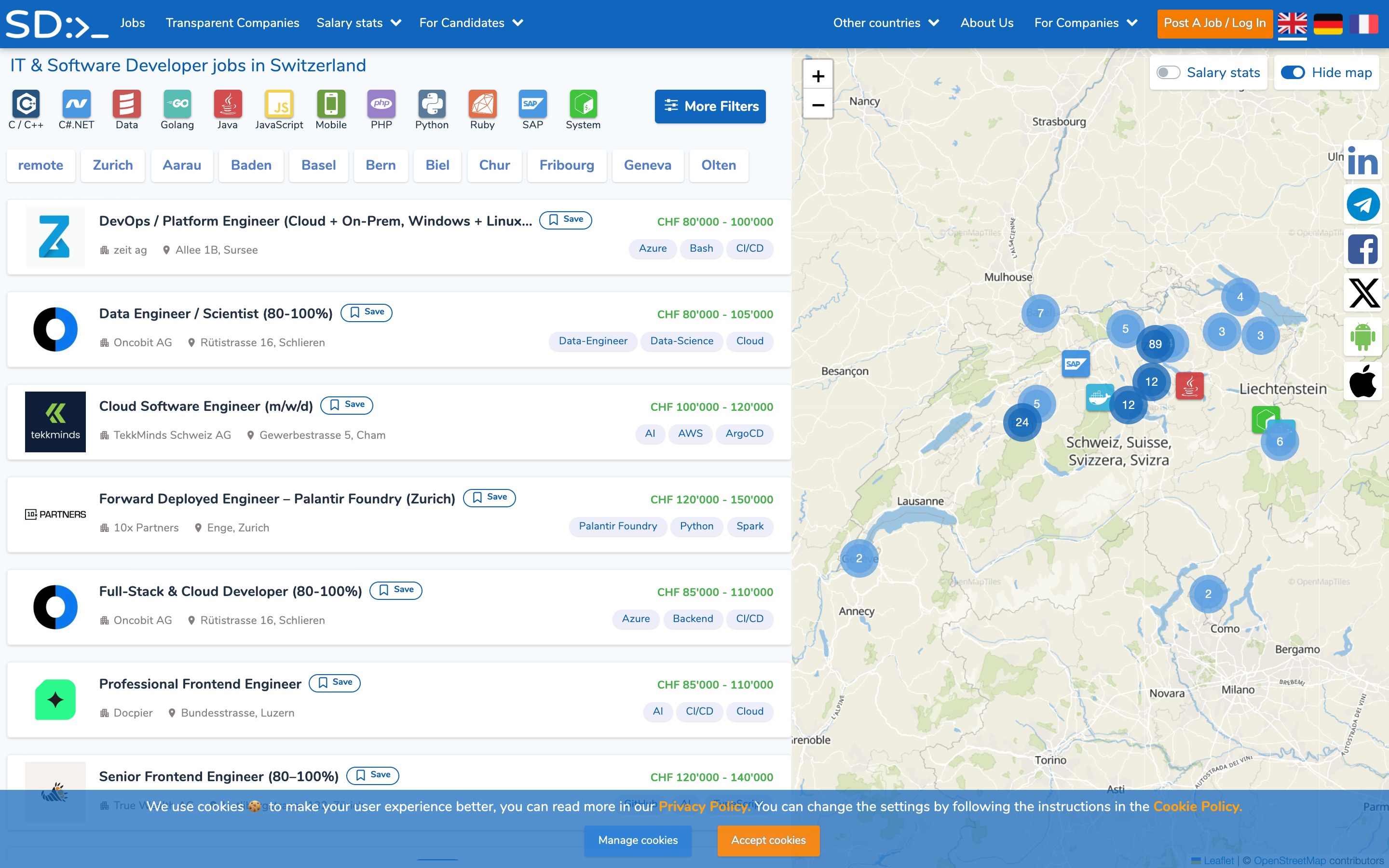
IT and software only, and thorough about it: "183 IT & Software developer jobs in Switzerland", filtered by technology (C#, Java, Python, DevOps, ML) rather than by industry. Publishes salary statistics and lists the companies that disclose their ranges. The site itself is in English.
Jobs by profession, city or language
Type a profession, a city or a language, the page shows the adverts currently open for it.
By profession
- Consultant
- Project Manager
- Retail Sales
- Nurse
- Nursing & Care
- Administrative Assistant
- Account Manager
- Software Engineer
- Public Administration
- Architect
- Insurance
- Chef
71 more — narrow the search
By work type
The tell is the spelling. Listings that write the location in English as «Geneva» ask for French in 12.4 percent of cases. Listings that carry a commune name — Vernier, Meyrin, Lancy, Plan-les-Ouates, Satigny, Versoix, Carouge — ask for French in 88.7 percent. Listings that write «Genève» sit between the two, at 56.4 percent. The word an employer chooses for its own address is a reliable signal of the language it will interview you in.
Searching the English name is also the worst way to find the city. Typing «Geneva» reaches only 11.6 percent of the canton's listings, and close to a quarter of what it does return is not in Switzerland at all — Geneva in Illinois, in Ohio, in Alabama, in New York State, Lake Geneva in Wisconsin and Florida. «Genève» reaches 75.6 percent with essentially no false positives, and a further eighth of the canton carries no form of the city name at all.
Share of listings stating language requirements that ask for French, by the spelling used in the location field. Rolling analysis of the open Swiss listings we hold, August 2026.
- Geneva holds 6.6 percent of the open Swiss listings we track — but 98.1 percent of every international organisation and international NGO advert in the country, 64.6 percent of commodity trading and shipping, and 38.5 percent of watches and luxury.
- English alone is enough in 39.7 percent of Geneva listings that state requirements. That is the highest share in Switzerland, ahead of Zug at 35.5, Zurich at 28.9, Basel at 21.1 and Vaud at 14.2 percent.
- German is asked for in 11.2 percent of Geneva listings. Nationally it is 68.1 percent. Geneva is the one large Swiss market where the default assumption about the country's working language does not hold.
- Where French is required, 91.1 percent of those listings want it at professional level. Conversational French is accepted in 5.1 percent. English is asked at professional level in 94 percent of the listings that name it.
- Fixed-term and contract postings run at 6.6 percent in Geneva against 1.5 percent elsewhere. Inside the canton, international organisations post 22.9 percent of their roles as fixed-term or contract, against 4.7 percent for the rest of the Geneva list.
- The single largest advertiser in the canton is neither a bank nor an organisation: it is a construction-trades staffing agency with 7.3 percent of Geneva listings, advertising entirely in French.
What English actually buys you here
Geneva has the highest share of English-only requirement profiles of any Swiss canton, and that reputation is earned. But the number people carry around — that Geneva is the easiest Swiss city to work in without a local language — is only true of one half of it. The half where it is true is large, well paid and internationally visible. The half where it is false is where most of the everyday jobs are.
Read the two halves by employer type. The English side is international organisations and NGOs, private banks with international clients, a Geneva-founded encryption company, a software vendor, consultancies, commodity traders, the World Economic Forum, global health funds. The French side is the university hospital, the cantonal utility, construction trades, watch manufactures, care providers, hotels, retail, schools and the cantonal administration. Measured on job titles, programme and organisation roles appear three and a half times as often in Geneva as elsewhere in Switzerland, watchmaking crafts five times, construction trades two and a half times.
The practical consequence is that the two halves need different applications, not one application in two languages. A French dossier sent to an international organisation and an English CV sent to a Geneva trades employer are both misaddressed, and you can tell which situation you are in from the location field before you read the advert. Sort your shortlist by that field first and you will stop writing the wrong letter.
If you have both languages, do not treat that as twice the market. Only about one listing in five wants both, so the second language rarely wins you an individual role. What it buys you is access to both lists at once — which in a canton of this size is the difference between a shortlist that runs dry and one that does not.
The city name is a trap in English and only in English
«Geneva» is an ordinary American place name. There is a Geneva in Illinois, one in Ohio, one in Alabama, one in Indiana, one in New York State, and there are Lake Genevas in Wisconsin and Florida. In our holdings almost a quarter of everything a literal «Geneva» search returns sits outside Switzerland, mostly retail and store roles. No other Swiss city has this problem at this scale, and it falls entirely on English-speaking searchers, because the French and Italian names do not collide with anything.
The German name fails differently and more completely. Not a single Geneva listing in our holdings writes the location as «Genf». The only matches on that string anywhere in the country are the addresses of a Zurich bank on Genferstrasse — a street on the other side of Switzerland. If you learned the city's German name first, it will find you nothing.
That leaves the local spelling doing the real work. «Genève» returns 75.6 percent of the canton with essentially no false positives. The remaining eighth is reachable only by commune: Vernier carries four percent of the canton's listings on its own, Plan-les-Ouates and Meyrin roughly two and a half each, then Lancy, Satigny, Versoix, Carouge, Onex, Bernex, Troinex and Bellevue. This is where the airport-edge industry, the watch manufactures, the flavour and fragrance houses and the cantonal utility advertise.
So: query the canton or the region rather than a word. If you must type, type «Genève». Then filter inside the results by commune or employer. The eighth of the canton hiding behind commune names is also its most French-speaking corner, which means the searchers most likely to miss it are exactly the ones who would find it hardest to apply anyway — and knowing that in advance is worth more than another search.
The international sector is Geneva's monopoly, and it comes with a contract type
Nearly every international organisation and international NGO advert in the whole Swiss market sits in this one canton — 98.1 percent of them. The canton's own statistics office reports a category no other canton needs: an international public sector. In March 2025, according to that office, the 38 international organisations based in the canton employed a little under thirty thousand people; counting permanent missions and consulates, the international public sector passes thirty-three thousand.
If you work in that world, Geneva is not one option among several — it is very nearly the only Swiss address for it, and relocating within Switzerland is not a strategy. If you do not work in that world, the canton is smaller than its reputation: forty-two percent of the list is ordinary private-sector work and another fifteen percent runs through staffing agencies.
The contract type is the part people underestimate. Almost one in four international-organisation roles advertised here is explicitly fixed-term or a consultancy contract: 22.9 percent, against 4.7 percent for the rest of the Geneva list and 1.5 percent nationally. Internships are also more common than elsewhere. The cantonal statistics office reports the same shape from the other direction: around a quarter of international-organisation staff were non-permanent in 2025, down from a little under a third at the start of 2020.
Part-time, meanwhile, is rarer in Geneva than in the rest of the country: 3.6 percent of listings against 5.6 percent. Geneva offers more time-limited full-time work and less permanent reduced-hours work. That is a real form of flexibility, but it is not the one most people mean, and it is worth checking the contract length before you fall for the letterhead.
Where the competition has grown
The market has tightened. The cantonal statistics office, working from federal and cantonal employment-office data, puts the share of registered jobseekers in the canton at 7.4 percent in April 2026, up from 5.5 percent in April 2023 — a 34 percent increase in the number of jobseekers over three years. Nationally the increase over the same period was steeper, at 48 percent.
The pressure is concentrated in the middle of a career rather than at the start of one. Among 25 to 49 year olds the rate rose from 6.0 to 8.3 percent, the sharpest move of any age group and above the rate for under-25s, which went from 5.5 to 6.4 percent. In most labour markets the youngest cohort carries the highest rate; in Geneva it is the group with ten to twenty years behind it.
The two branches where the increase was most marked are, awkwardly, the two that make Geneva Geneva. In the branch that includes watchmaking, the number of registered jobseekers more than doubled between April 2023 and April 2026, from 235 to 482 — the statistics office attributes this to weaker international demand and slower orders. And in the branch covering associations and organisations, which includes international NGOs, the office records a marked rise and points to withdrawn funding, American in particular, as a likely cause.
Read together with our own listing data, that is a specific warning rather than a general one. The segments where Geneva holds most of the country's supply are the segments where applicants are currently stacked deepest. If you come from one of them, budget more time than the same search would have taken three years ago, and run a parallel search in the French-speaking private economy, which neither development has touched much.
If you lose a job while living in the canton
The office is the Office cantonal de l'emploi, and it works in French. Two conditions are stated plainly by the canton: you must be domiciled in the canton of Geneva, and you must be looking for work and able to prove it. Registration must happen at the latest on the first day for which you claim unemployment insurance benefits.
The proof requirement is more demanding than newcomers expect. The canton asks for a minimum of eight documented applications per month, recorded on the official form, and it wants them retroactively: if you lose an open-ended job you are expected to start applying from the moment you learn of the termination, for at most three months; on a fixed-term contract, the last three months count. An adviser then reviews those records for quantity and quality.
For the registration itself, have a front-and-back copy of a valid identity document or residence permit ready, plus a copy of your social-insurance or health-insurance card. Once the canton has everything, it confirms registration within five working days. If you cannot register online, the paper forms are available at the office on Rue des Gares in Geneva, whose information desk takes visitors without an appointment.
One point specific to this canton: on a fixed-term international contract, the eight applications a month start while you are still employed, not after the contract expires. Given how much of Geneva's international half is fixed-term, that is the single administrative detail most worth knowing before you need it.
Market figures come from our rolling analysis of the open Swiss listings we hold, August 2026. «Geneva» here means the canton of Geneva, identified from the location field of the listing and the list of Geneva communes; locations that merely contain the string «Geneva» but lie outside Switzerland are excluded, and are reported separately in the text. Sector attribution is derived from the employer name and is an approximation. Language figures refer to the 73.2 percent of Geneva listings that state any requirement at all. Cantonal comparisons apply the same method to Zurich, Zug, Basel, Vaud and Ticino. We publish shares, never absolute totals. Figures on jobseekers, age groups, branches and international organisations come from the Office cantonal de la statistique of the canton of Geneva, which draws on data from the State Secretariat for Economic Affairs and the Office cantonal de l'emploi; the registration rules come from the canton itself. Always check your own situation with your Office cantonal de l'emploi — this page is not advice.
Can I get an industrial or engineering job in Geneva with B1 French, and should I go through agencies or apply directly?
In short
Yes, but mostly through two of the three doors. Industrial and engineering roles are about one Geneva listing in sixteen. Staffing agencies and engineering consultancies post about a third of them, and 95 percent of those are written in French. Employers advertising directly post a little under half, and four in ten of theirs are in English. CERN posts almost a quarter, all in English. Outside CERN, a listing that states a French level nearly always wants professional French, so with B1 the realistic targets are the English-language employer listings and CERN, while the agencies become worth calling once the French improves.
These figures describe the listings open on one day. The Geneva industrial list is short, so a few large recruitment drives can move the shares noticeably from month to month. What counts for a specific role is the advert itself.
The split matters more than the overall share. Taken together, about two thirds of Geneva's industrial listings that state their language needs ask for French, which reads like a closed market for a B1 speaker. Split by who is advertising, it is three markets: agency listings almost entirely in French, employer listings dividing roughly six to four between French and English, and CERN recruiting in English while asking newcomers to commit to learning French.
For someone with strong English and B1 French the order is therefore clear. Start with the employers that advertise directly, and with CERN if the profile fits. Treat the agencies as a door that opens later. And write the French level down per skill in CEFR terms, with what you are doing about it, because an honest B1 survives the first phone call and a vague "good French" does not.
Open industrial and engineering listings located in the canton of Geneva, as of 15 October 2026; apprenticeships, internships and IT roles excluded. Language = the language the listing itself is written in.
- Industrial and engineering roles (quality, supply chain and procurement, logistics, industrialisation and methods, production and maintenance, machining and watch production, mechanical and electrical engineering) are about one Geneva listing in sixteen. Geneva holds about 7 percent of these roles in Switzerland.
- Staffing agencies and engineering consultancies post about a third of Geneva's industrial listings, and 95 percent of their listings are written in French. One staffing firm, Pemsa, accounts for close to a fifth of the canton's industrial listings on its own.
- Employers advertising directly post a little under half: 58 percent written in French, 42 percent in English. About half of those that state their language needs ask for no national language at all.
- CERN posts almost a quarter, every one in English. Its adverts ask for spoken and written English "with a commitment to learn French", or for English or French with a commitment to learn the other.
- Outside CERN, nearly every Geneva industrial listing that states a French level asks for professional French. Across all other Geneva listings that state one, about one in eight accepts conversational French.
- About six in ten direct-employer industrial listings take applications through an applicant-tracking system, the other four in ten on the employer's own careers page. None sends you to a job board to apply.
Three doors into Geneva industry
| Who posts | Share of industrial listings | Written in French | Written in English |
|---|---|---|---|
| Employers advertising directly | 44 % | 58 % | 42 % |
| Staffing agencies and engineering consultancies | 33 % | 95 % | 5 % |
| CERN | 23 % | 0 % | 100 % |
Open industrial and engineering listings in the canton of Geneva, as of 15 October 2026. Shares of listings, rounded.
Three doors, three languages
Geneva's industrial job market is small. Watchmaking, precision engineering, chemicals and electrical equipment are visible in the canton, but measured by listings, industrial and engineering roles make up about one Geneva advert in sixteen. That shapes the search: the list is short enough to read in full every week, and short enough that sending the wrong application through the wrong door is a real loss.
The posters fall into three groups of very different character. A third are intermediaries: staffing agencies placing technicians, machinists and quality staff with client companies, and engineering consultancies that hire engineers and place them on client projects. A little under half are the employers themselves, from watch manufactures to chemical groups. And almost a quarter come from a single organisation, CERN, which sits on the French border at Meyrin and recruits engineers and technicians.
Each group writes in its own language. The intermediaries write in French in 95 percent of cases. The employers write 58 percent of their listings in French and 42 percent in English. CERN writes everything in English. A canton-wide figure such as "two thirds want French" averages three markets that have little in common, and for a B1 speaker that average is the least useful number available.
What B1 covers, and what the listings ask for
B1 is a defined level, not a polite word for some French. The Council of Europe's self-assessment grid, published on Europass, describes a B1 reader as someone who can understand texts that consist mainly of high-frequency everyday or job-related language, and a B1 speaker as someone who can enter unprepared into conversation on familiar topics such as family, hobbies, work and travel. That is enough to follow a briefing on familiar ground. It is not the same as negotiating with a supplier, writing up a non-conformity or chairing a meeting, which is what most quality and supply-chain roles mean when they ask for French.
The listings confirm the gap. Outside CERN, nearly every Geneva industrial listing that states a French level wants professional French; there was a single exception in that group. Across all other Geneva listings that state a French level, about one in eight accepts conversational French, so industrial roles are, if anything, stricter than the rest of the canton. The base is small, because many listings state no level at all, but it points the same way as the agency figure.
CERN is the exception, and it says so in its own words. The adverts we read on 16 October ask for "spoken and written English, with a commitment to learn French", or for English or French with a commitment to learn the other, and a few ask for both. For an engineer with strong English and improving B1 French, that is the one large Geneva employer whose stated rule fits the profile exactly, provided the experience fits a post that belongs to a specific accelerator, detector or infrastructure group.
Agencies: mostly a French-language door
Agencies versus direct applications has an unusually clear answer in Geneva industry, and it is a language answer. Agency listings are almost all in French, and they cluster in the roles where French is spoken all day: technicians, machine setters, maintenance staff, warehouse and quality controllers. An agency recruiter sells you to a client by phone, usually in French, so the first screen is often the language screen.
That does not make agencies useless at B1. It means they become worth calling once the French holds up in a phone interview, and that their listings are useful reading now. They show which companies are hiring, often describing the client without naming it, and the role descriptions show exactly which French vocabulary a quality or methods job runs on.
Two practical points. An agency placing people in Switzerland needs a licence from the cantonal labour office under Art. 2 of the federal placement act (AVG, in French LSE), and one that regularly places people from abroad also needs a licence from SECO, which publishes a directory of licensed agencies. Whether an agency may charge you, and how much, is a separate question, answered on our page about paying a recruitment agency.
Applying directly: where English still opens doors
The employer listings are where strong English carries furthest. About four in ten are written in English, and about half of those that state their language needs ask for no national language at all. These are mostly roles with an international reporting line: R&D engineers, planners in global supply-chain teams, quality staff in companies selling to export markets.
The names are more varied than Geneva's watchmaking reputation suggests. Employers advertising industrial roles directly in the canton on 15 October included Sécheron Hasler Group, whose adverts were for power-electronics and electro-mechanical R&D engineers; the watch manufactures Audemars Piguet, Patek Philippe and Tudor; the luxury houses Louis Vuitton and Chanel; the chemicals and life-science companies Givaudan, Celanese, OM Pharma and Teoxane; the agricultural group Corteva; and the inspection company QIMA. Reading their careers pages is a better use of an evening than searching job boards for the city name.
Employer listings route the application to the employer. About six in ten go through an applicant-tracking system such as Workday, SmartRecruiters or iCIMS, the rest through the company's own careers page, and none sends you to a job board. In practice that means a profile in each system, a CV adjusted to each listing, and an application in the language the listing is written in. If it is in French, apply in French and have the text checked. If it is in English, apply in English and let the French level stand on the CV as a fact rather than an apology.
Writing the application around B1
Put languages near the top of the CV, each with a CEFR level, and split French if it is uneven, for example reading B2 and speaking B1. Add one line on what you are doing about it: daily lessons, a course with an end date, an exam you are registered for. A Geneva recruiter looks at location, permit and languages before the work history, and a precise line answers all three in seconds.
State nationality or permit plainly. An EU or EFTA national can say so in one line, which settles the work-permit question before anyone has to ask it. If you already have a Geneva address, use it: in a market this small and this local, a candidate already in the canton reads as available in a way a candidate abroad does not.
Finally, look a little beyond the canton line. Geneva's industrial list is short, and the canton of Vaud is within commuting distance of most of it. Widening the radius often does more for a B1 speaker than waiting for the next Geneva listing in English.
How these figures were measured
The figures come from the open Swiss job listings SwissJobs.app collects, as of 15 October 2026, with apprenticeships, internships and student posts excluded. A listing counts as Geneva when its location names the city or a Geneva commune; places called Geneva in the United States are removed. A listing counts as industrial when its title names a quality, supply-chain, procurement, logistics, industrialisation, methods, process, production, maintenance, machining, watch-production or mechanical, electrical or process-engineering role. Software, IT and data roles are excluded even when the title says engineer.
Agencies and consultancies were identified from how their own listings describe them: recruiting for a client, or placing engineers on client projects. Language shares rest on the language each listing is written in, which is known for every listing. French levels rest only on the listings that state one, a minority, so they are given in words rather than as precise percentages. The CERN wording was read from its adverts on 16 October 2026.
Listings: analysis of the open Swiss job listings SwissJobs.app collects, as of 15 October 2026; canton of Geneva, industrial and engineering titles, apprenticeships, internships and IT roles excluded; shares only. Language levels: Europass self-assessment grid of the Common European Framework of Reference, read on 16 October 2026. Licensing: Federal Act on Recruitment and the Hiring of Services (AVG), Art. 2, as in force on 1 January 2026. CERN language requirements: CERN job adverts, read on 16 October 2026.
Sources
- Canton of Geneva — conditions for registering with the Office cantonal de l'emploi
- Canton of Geneva — how to register
- Office cantonal de la statistique — jobseekers in the canton of Geneva, May 2026
- Office cantonal de la statistique — international organisations based in Geneva, November 2025
- arbeit.swiss — information for jobseekers
- Europass: Common European Framework of Reference, self-assessment grid (B1 descriptors)
- Federal Act on Recruitment and the Hiring of Services (AVG), Art. 2: licence requirement (Fedlex, German)
- SECO: directory of licensed recruitment and staffing agencies (AVG-Verzeichnis)
- CERN job adverts (language requirements)
Related questions
What our job index says about the Swiss market
Computed live from our own index, not quoted from a study. Shares only, as of today.
Language the advert is written in
- Deutsch
- 60%
- English
- 23%
- Français
- 13%
- Italiano
- 3%
Of adverts that state a language requirement, the share asking for
- Deutsch
- 70%
- English
- 43%
- Français
- 21%
- Italiano
- 3%
19% posted in the last 7 days · Largest markets: Zürich 18% · Bern 10% · Genève 5% · Basel 5%