Jobs in Lausanne
Updated:
The Swiss market with the oldest listings — and a ring of towns around it where the same list turns over twice as fast.
In short
Lausanne carries the oldest job adverts in Switzerland. The median Lausanne listing has been online for 44 days, against 25 in Geneva, 20 in Basel, 19 in Zurich, 17 in Bern and 20 nationally. Four in ten Lausanne adverts are older than two months, and fewer than one in eleven is newer than a week. Recruitment agencies are not the cause: their Lausanne adverts, at a median of 25 days, are the freshest in the city. Direct employers are the slow half. Sort by date before you read page one.
This page is orientation, not legal or social-security advice. Your ORP decides your individual case.
The Swiss job portals at a glance
Click an image for the full-size view. What each portal actually is stands beside it.
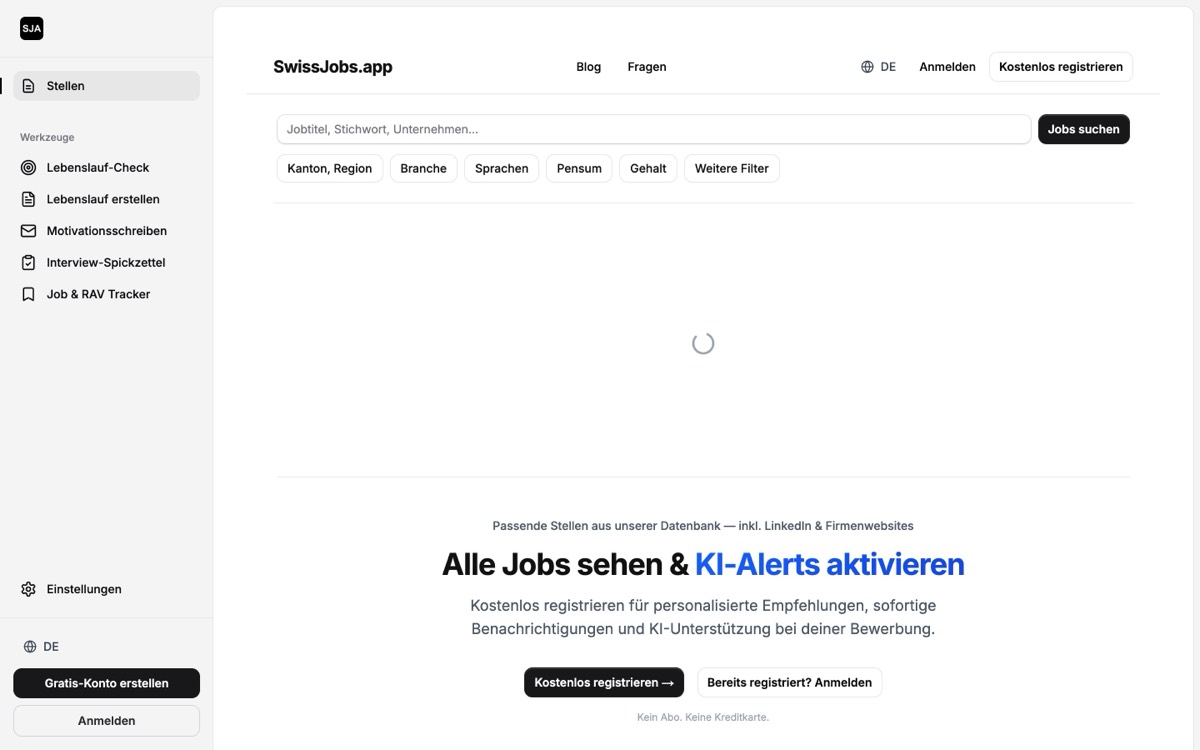
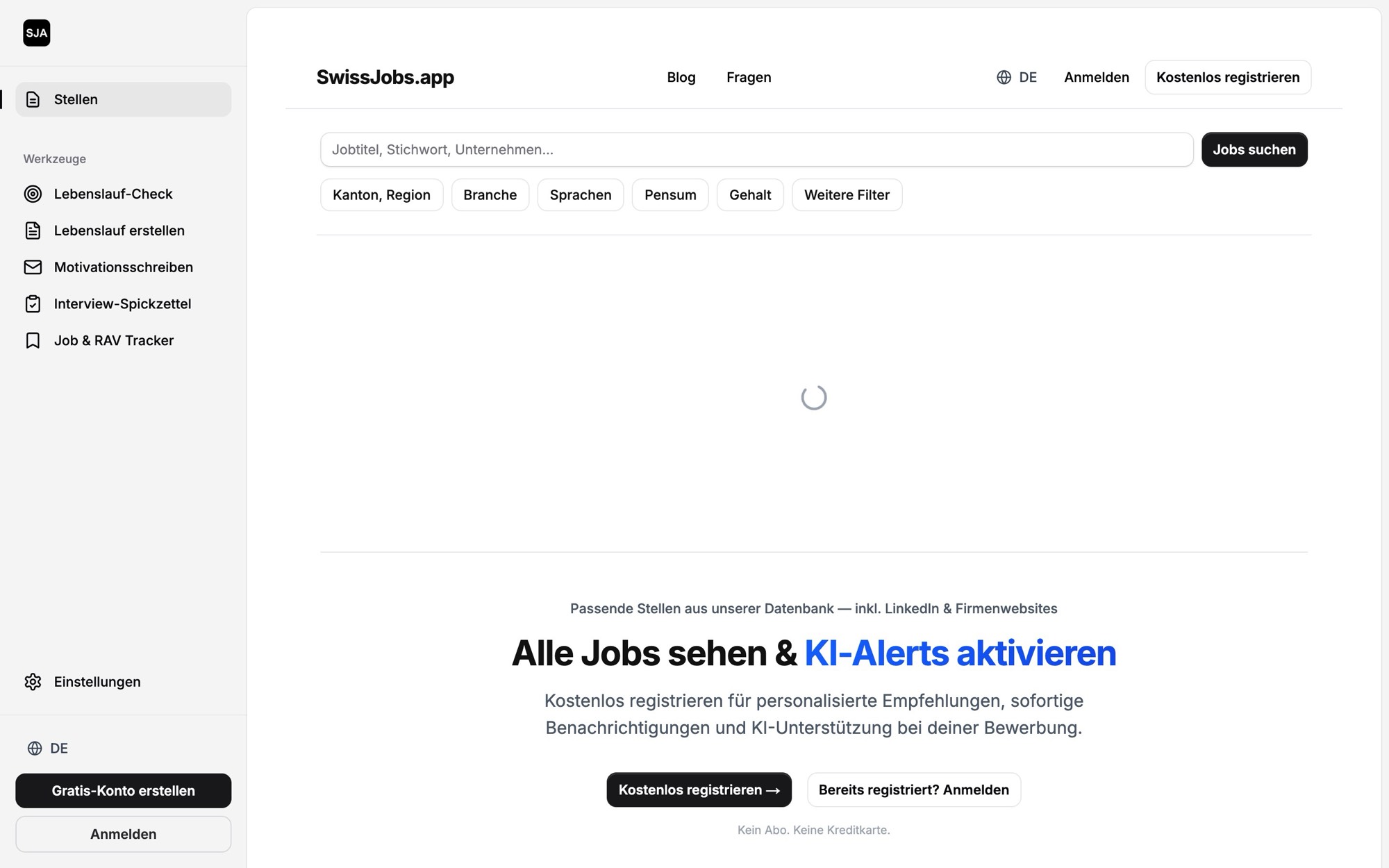
1. SwissJobs.appOur app
Over 21,000 open Swiss roles from ATS systems, company sites and LinkedIn in one place — and from any advert, straight into a CV, a motivation letter, a CV check and interview prep. The RAV job-search-efforts form fills itself from your application tracker. Free to use; the account is asked for at save.
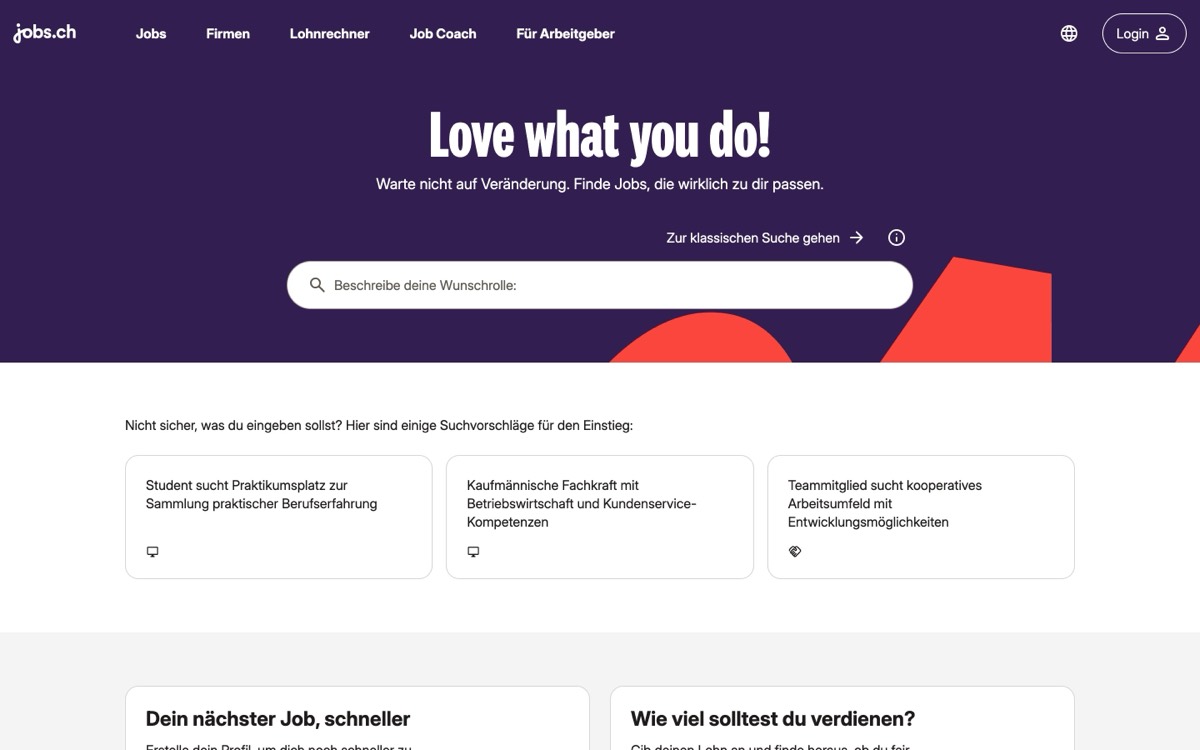
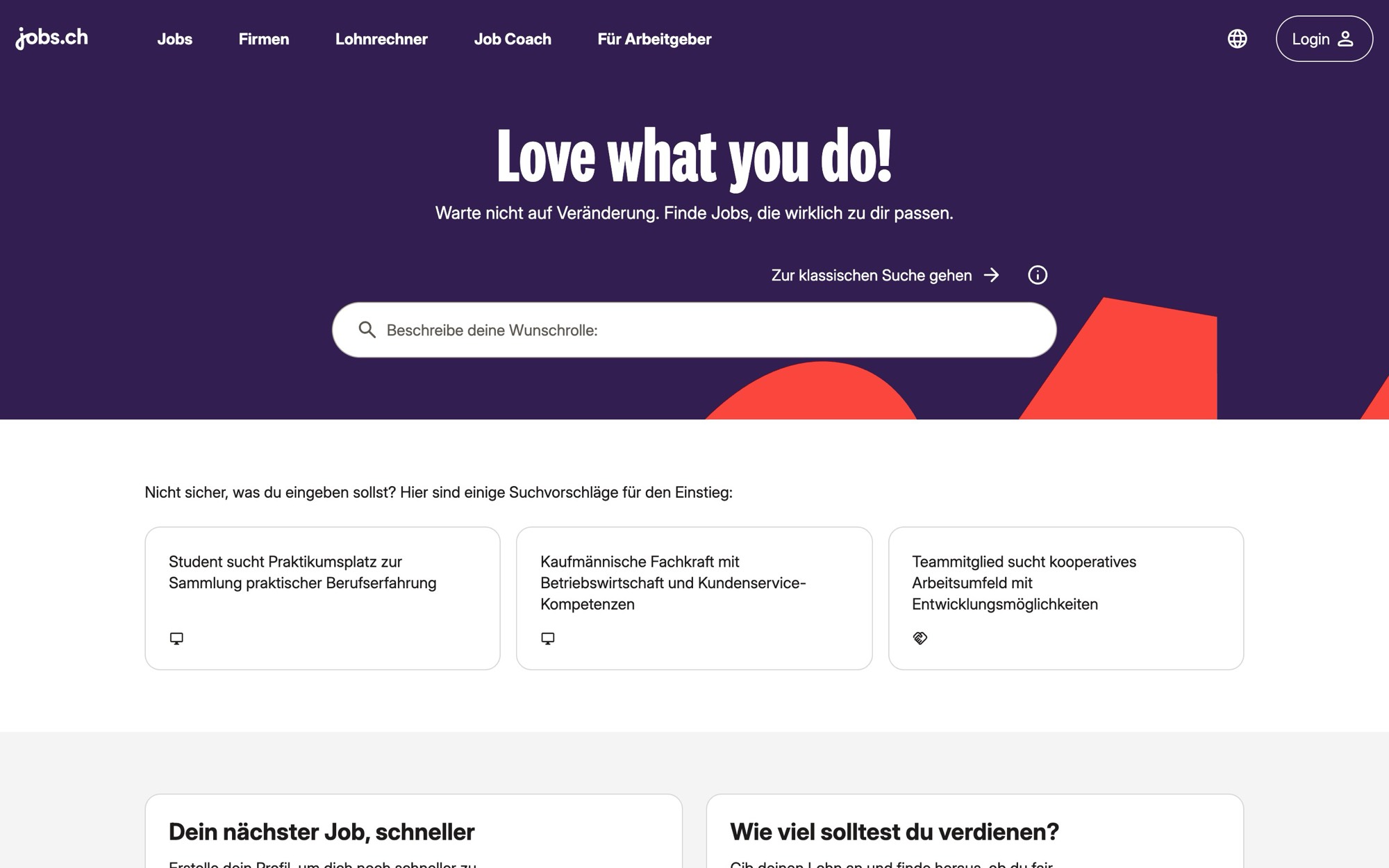
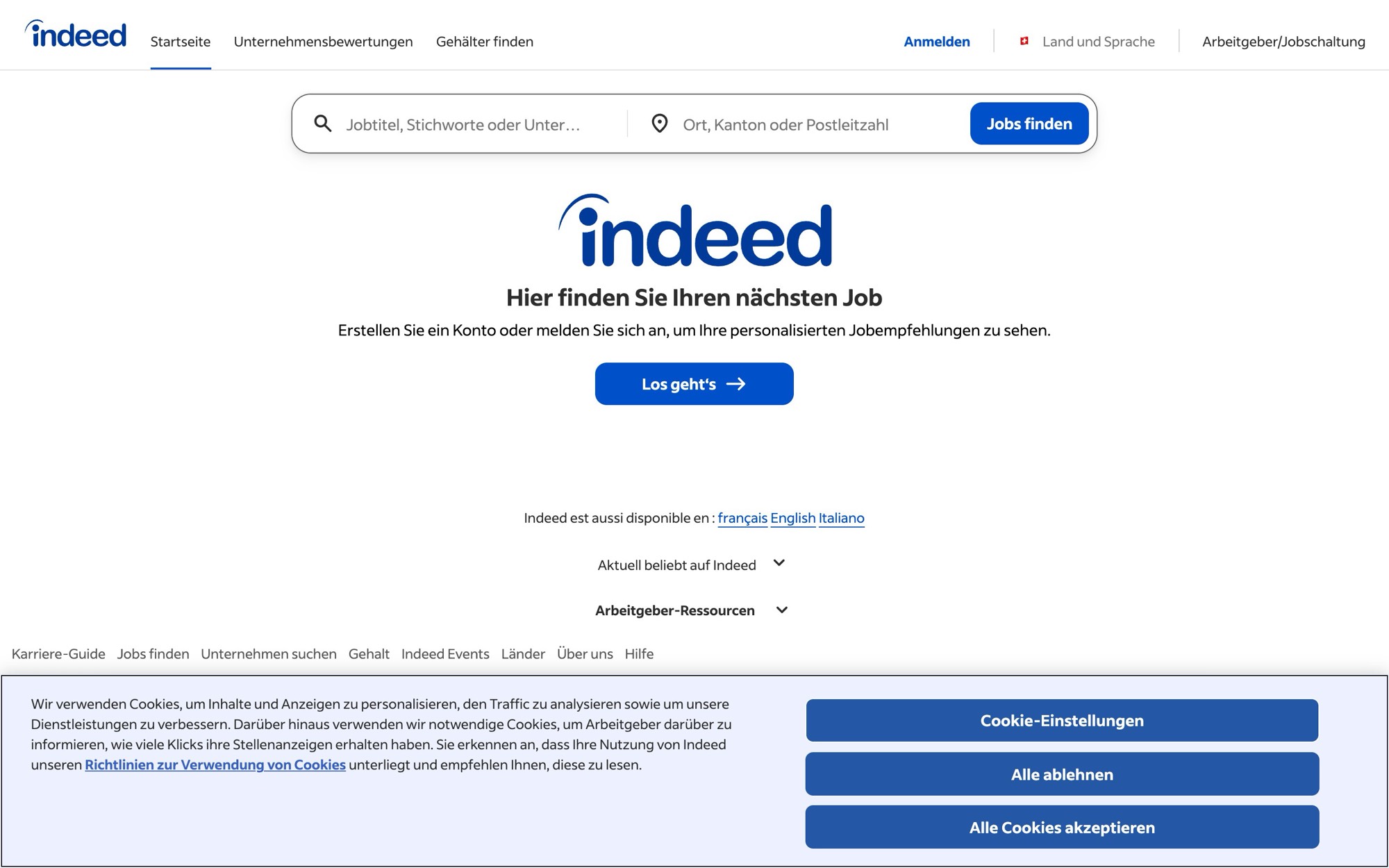
The best-known board in German-speaking Switzerland and the largest index in the country. Owned by JobCloud AG — as are jobup.ch and JobScout24.
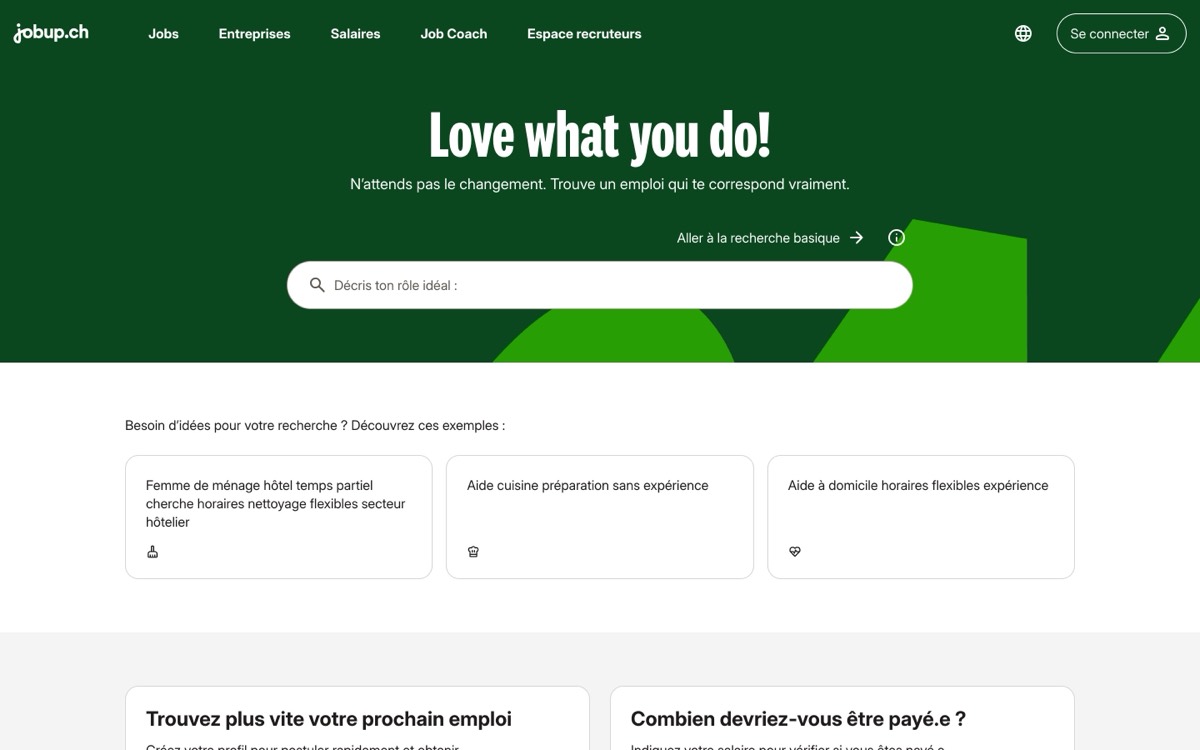
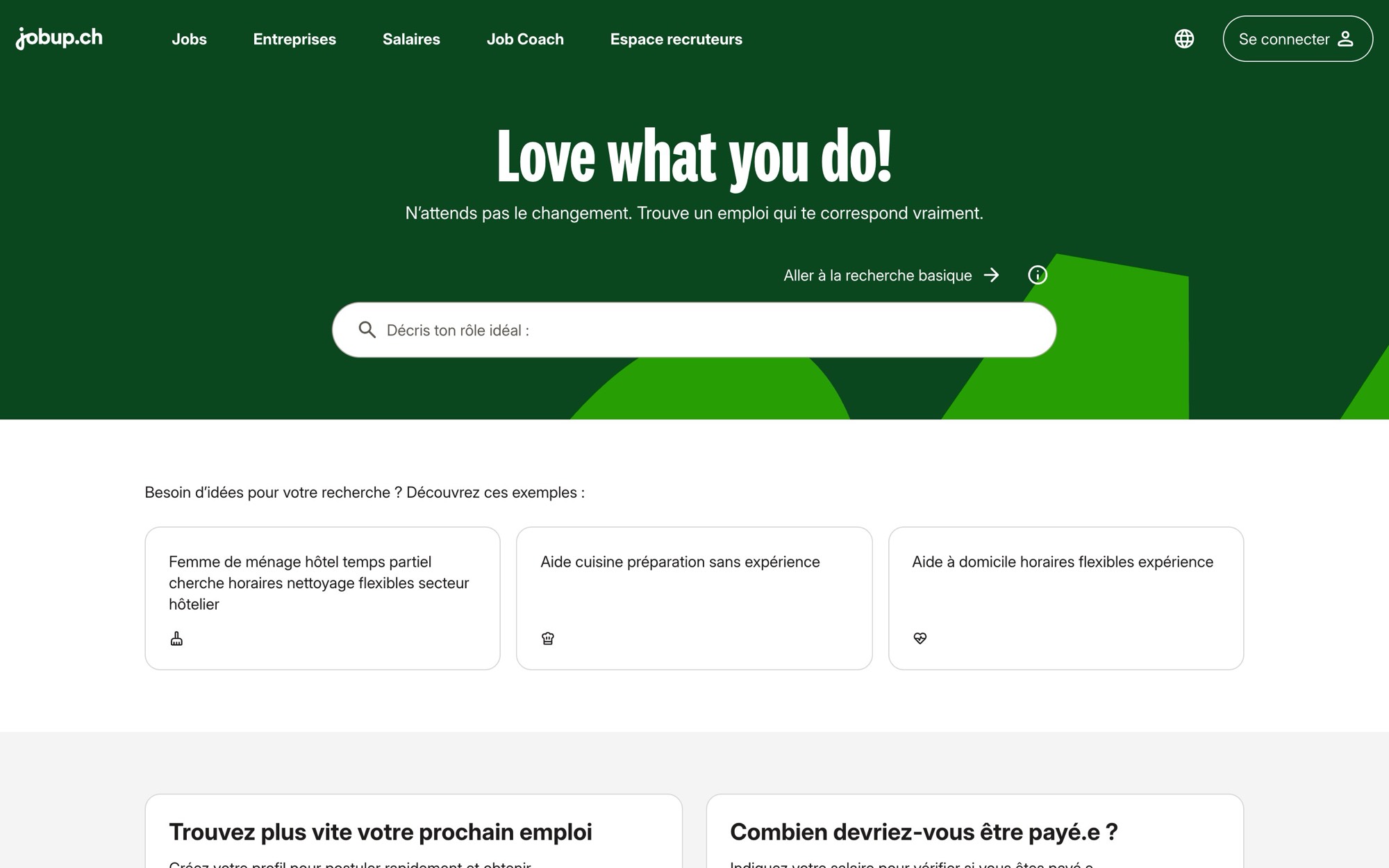
The standard in French-speaking Switzerland and the first place to look for the Romandie — but the same JobCloud AG as jobs.ch.
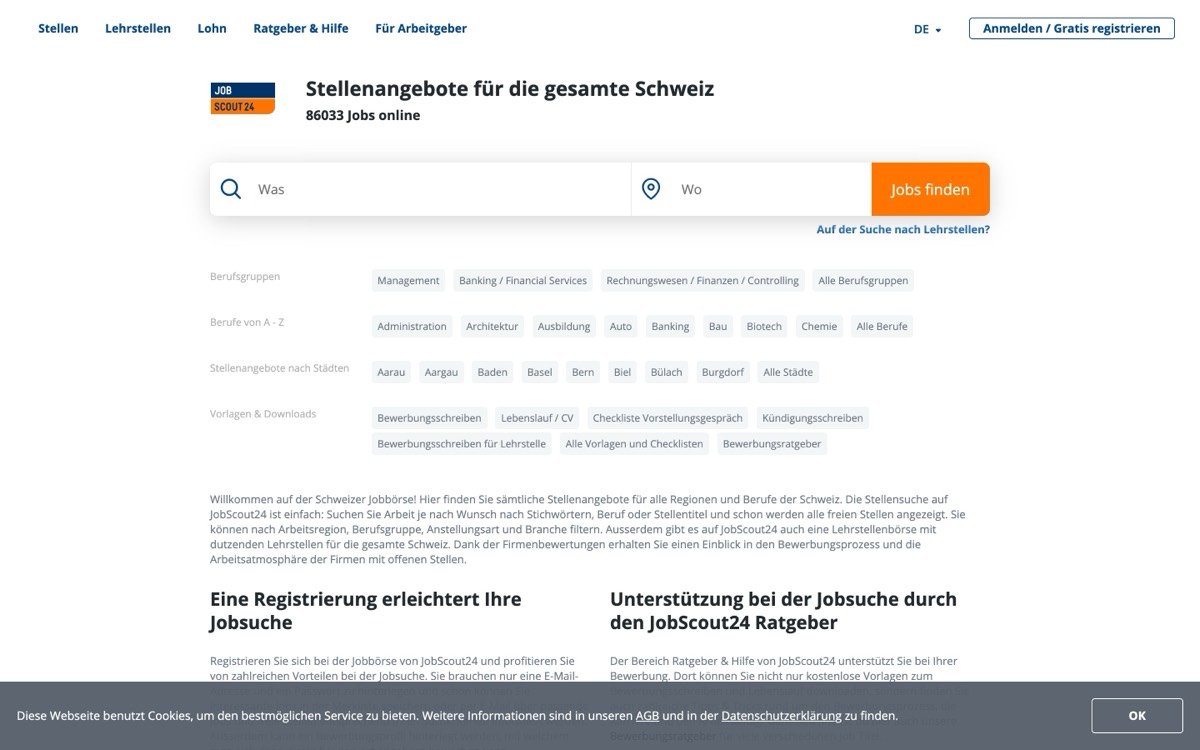
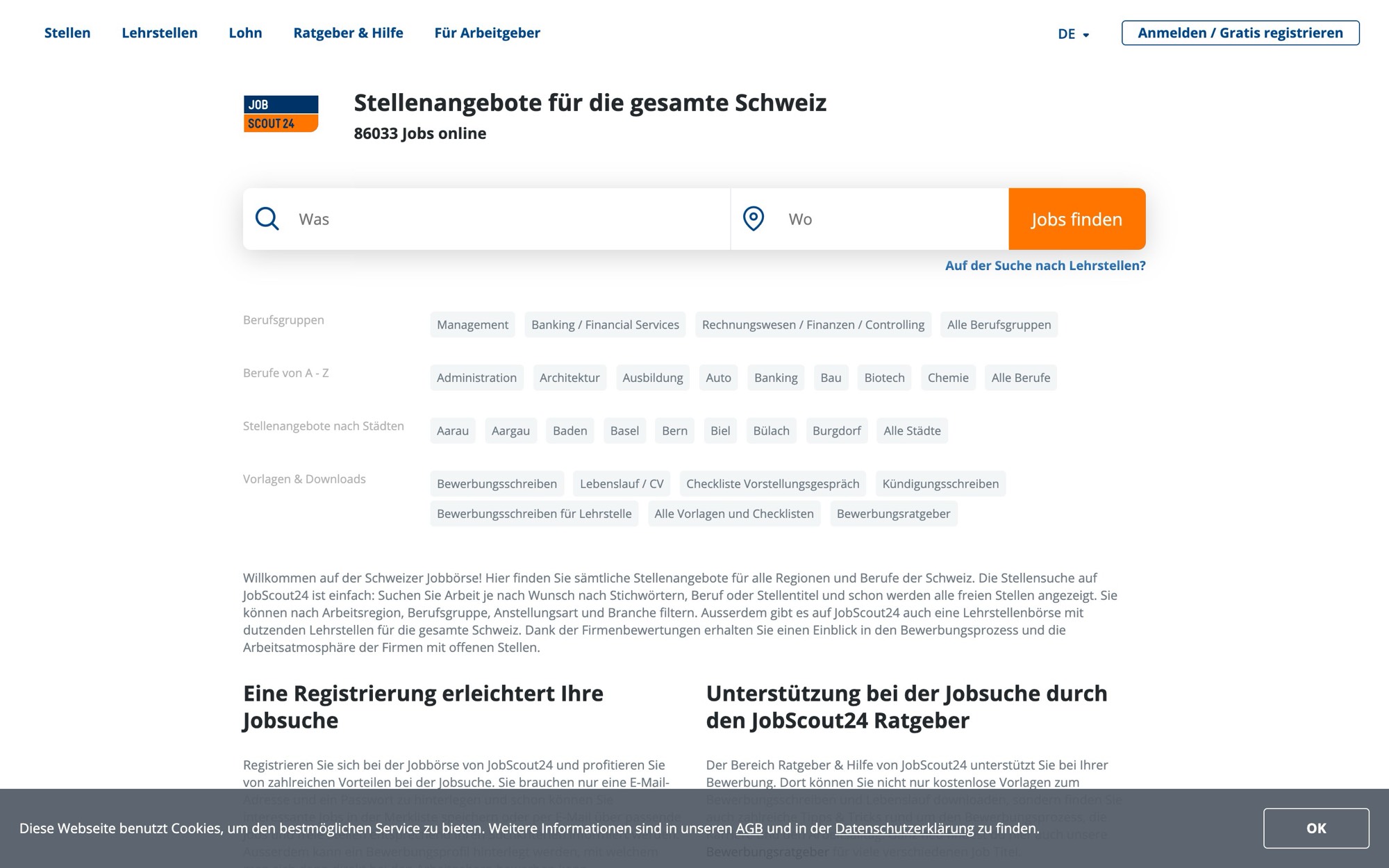
A third brand from the same company. Searching all three to widen your search means searching one provider three times.
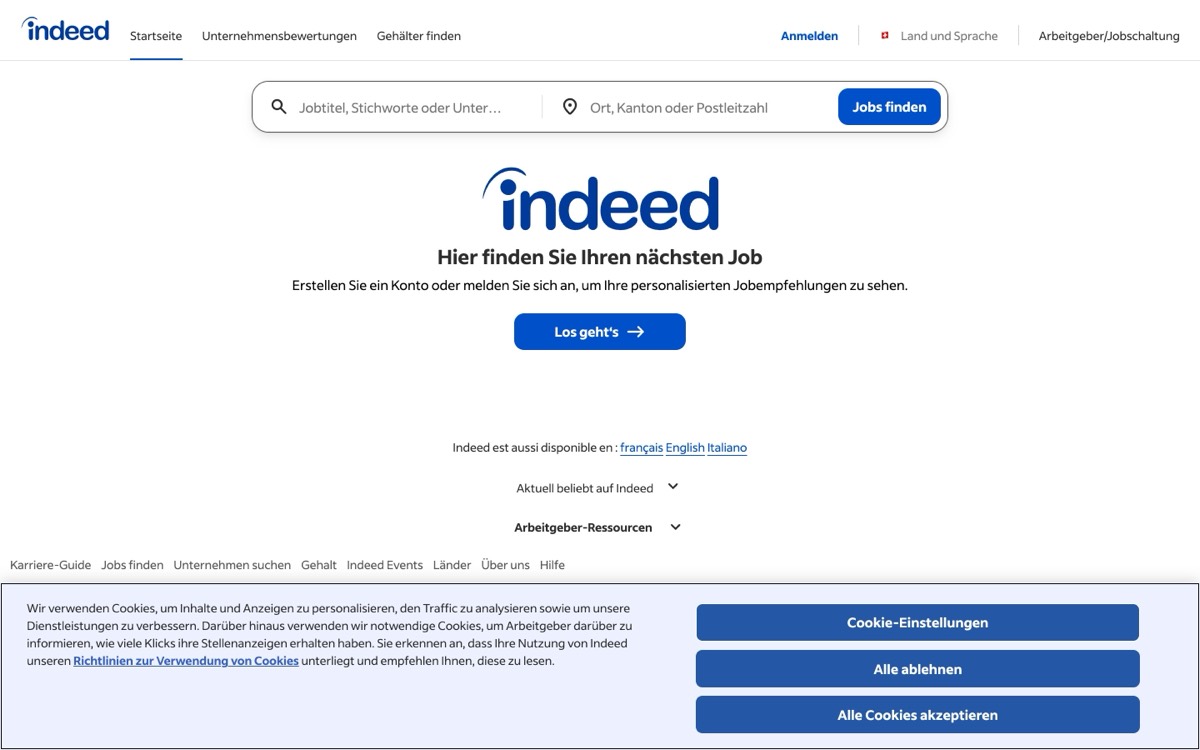
The broadest aggregation, because Indeed also collects from other boards — at the cost of many duplicates of the same advert.
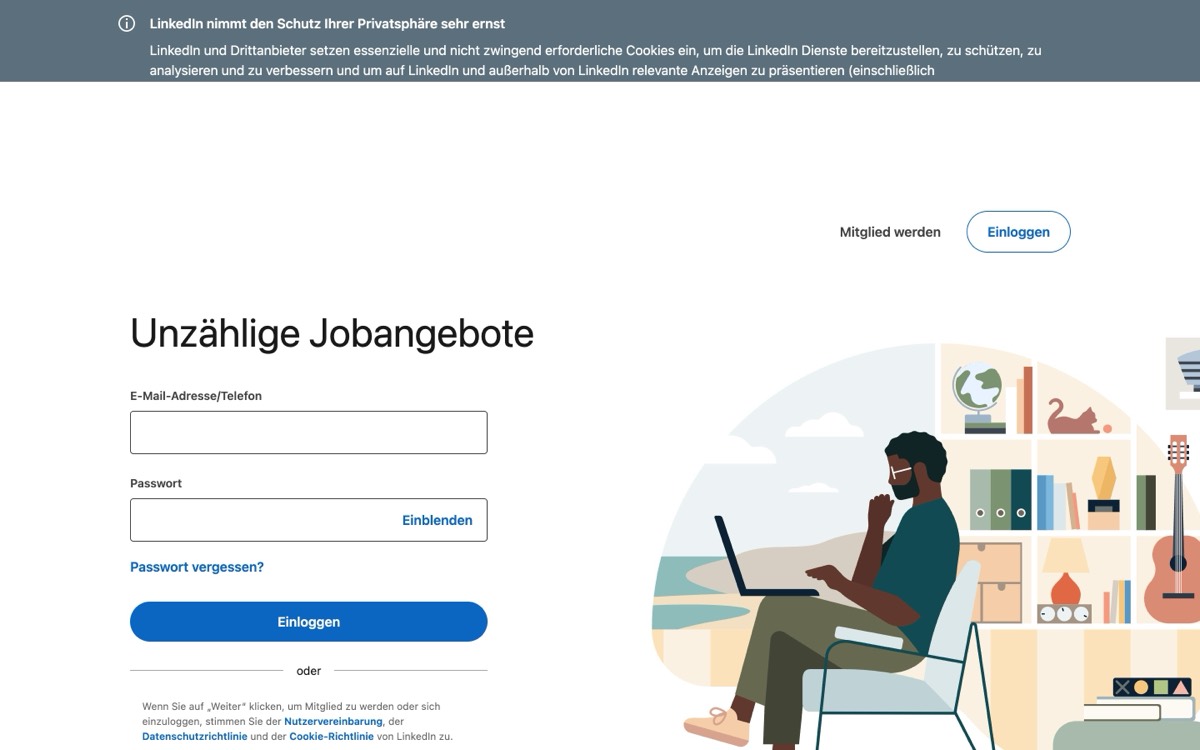
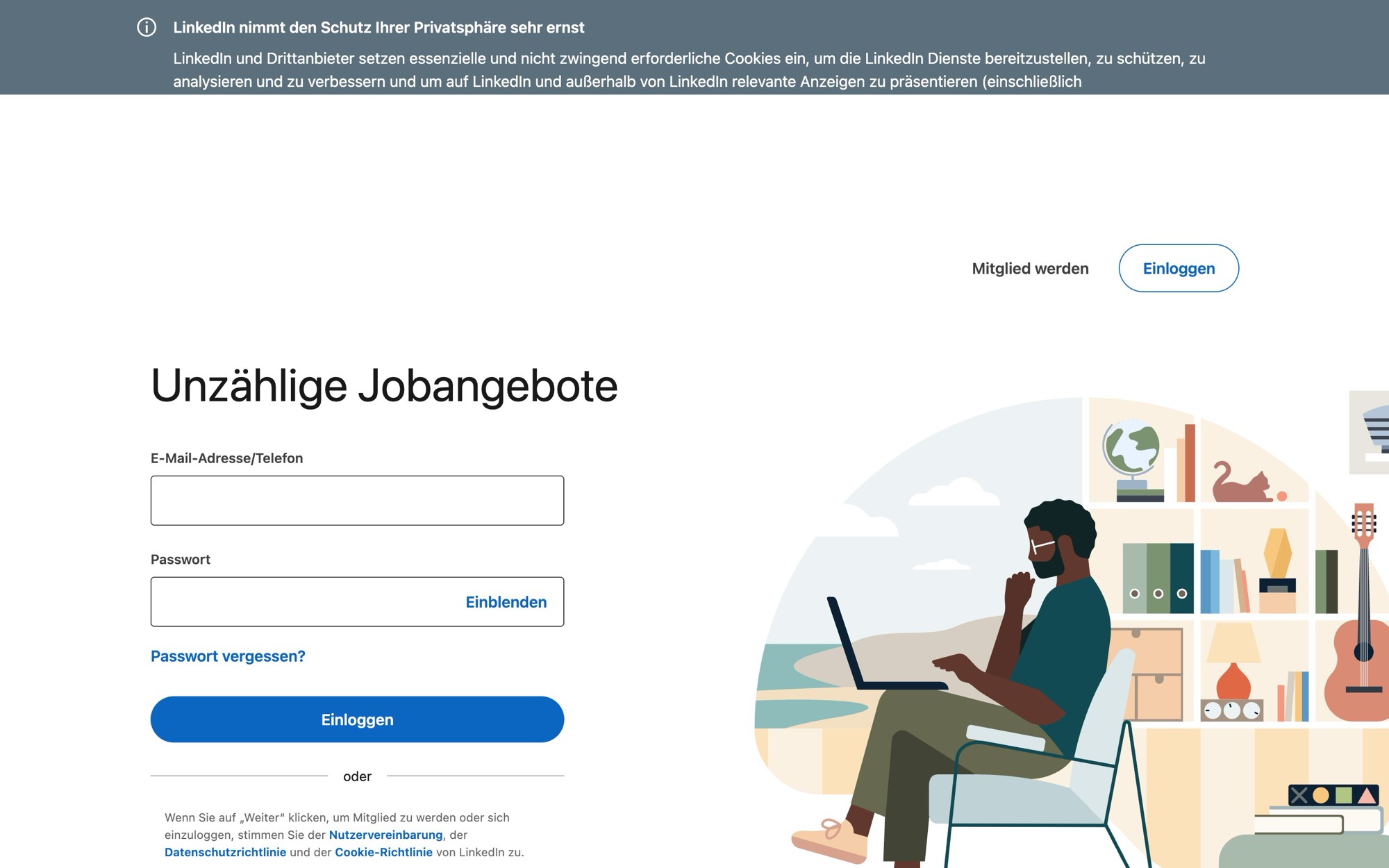
The best reputation for English-speaking and international roles in Switzerland. Considerably thinner for trades, care and commercial roles.
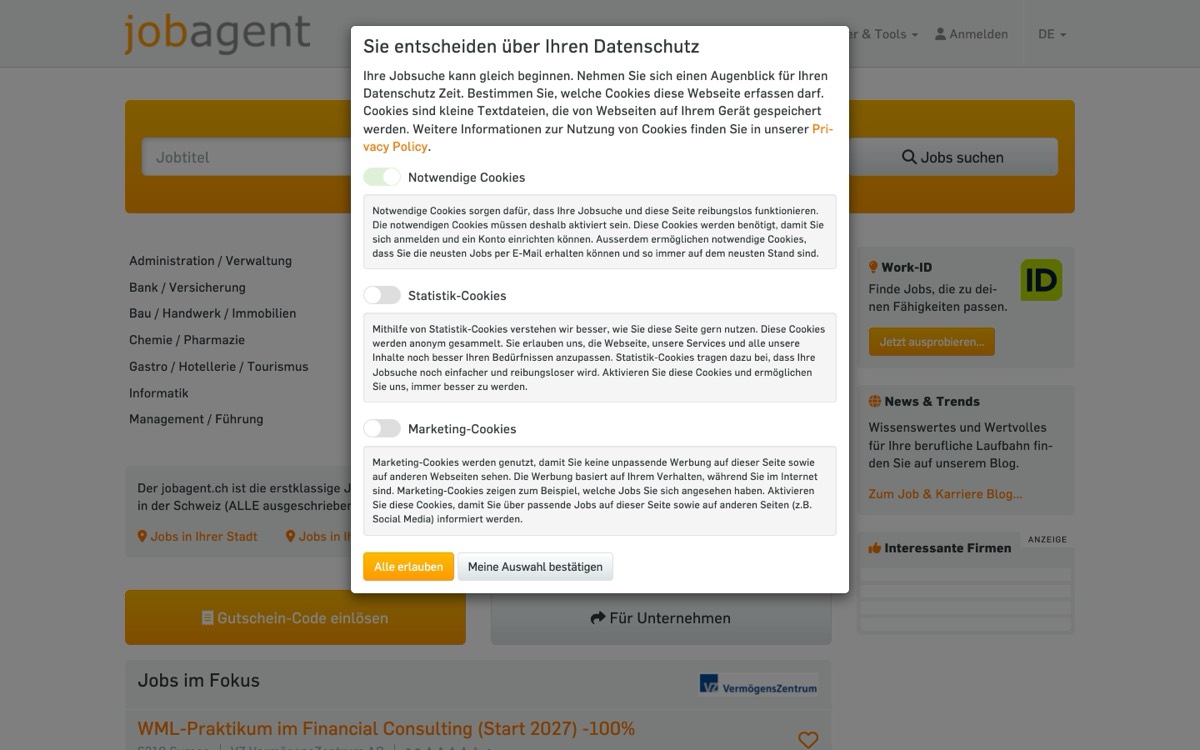
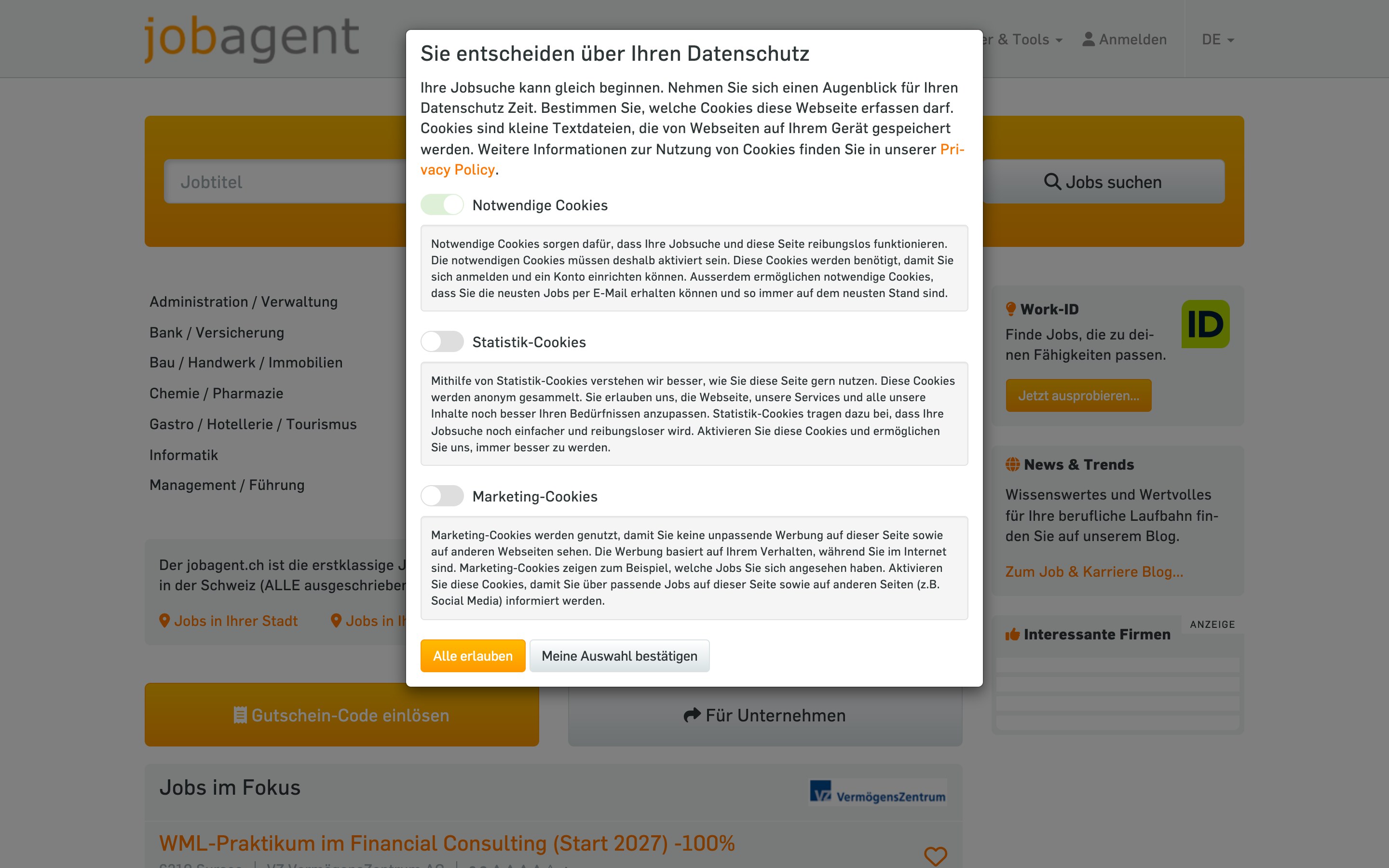
A meta-search across the Swiss job boards, "every job in Switzerland at a glance". Its strength is the Job-Abo: a saved search that mails you new adverts from every portal it covers. Salary calculator and application guides alongside.
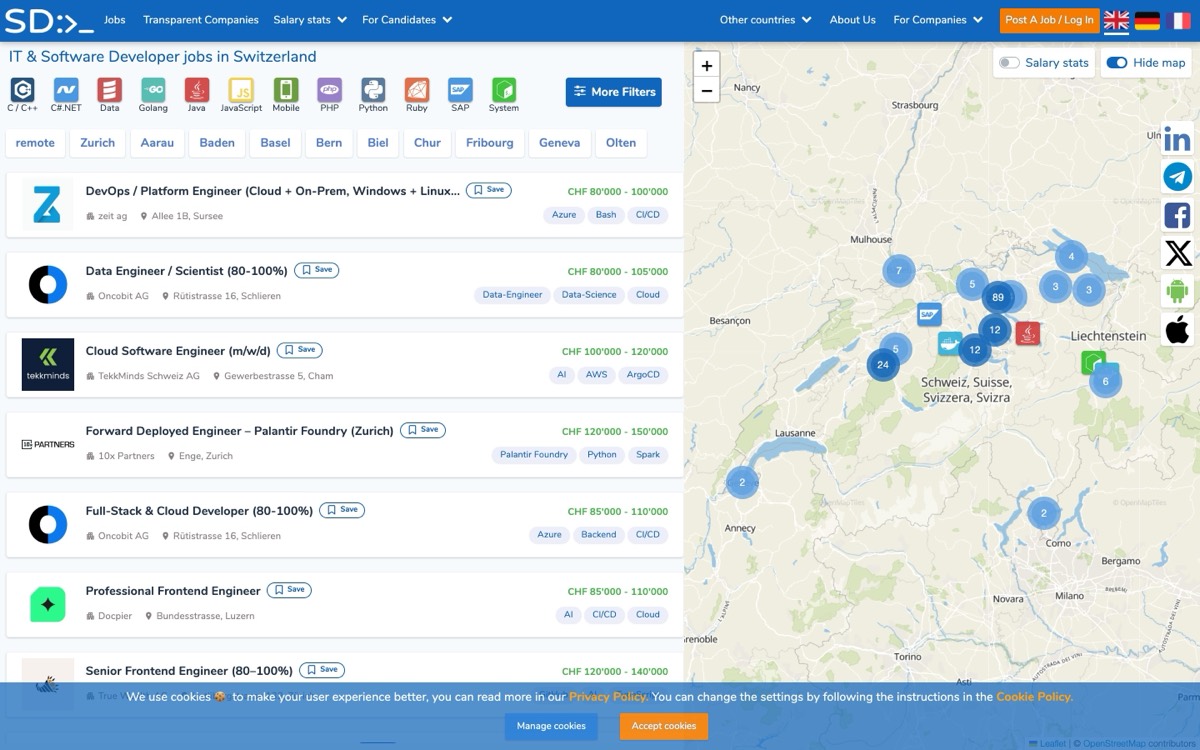
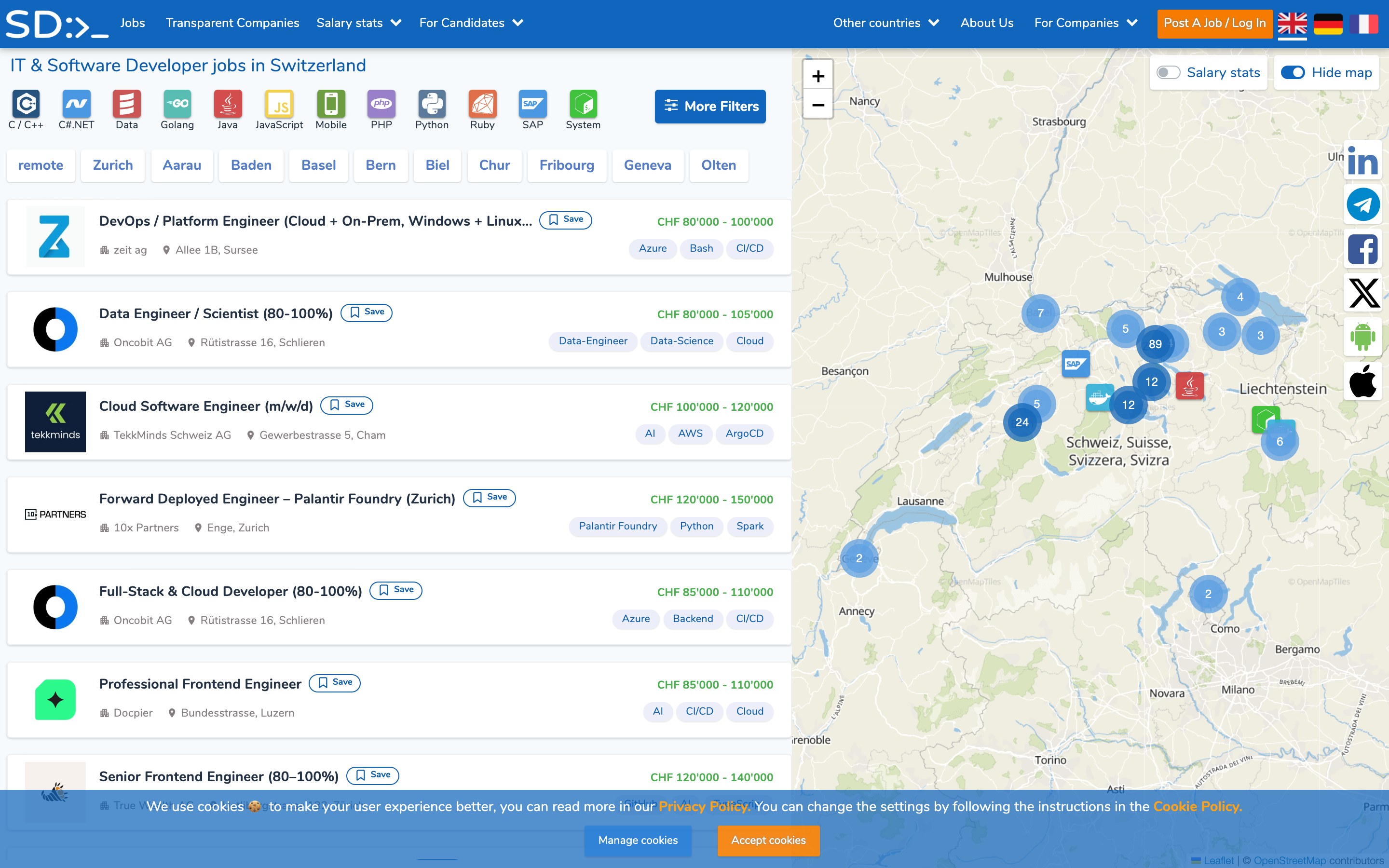
IT and software only, and thorough about it: "183 IT & Software developer jobs in Switzerland", filtered by technology (C#, Java, Python, DevOps, ML) rather than by industry. Publishes salary statistics and lists the companies that disclose their ranges. The site itself is in English.
Jobs by profession, city or language
Type a profession, a city or a language, the page shows the adverts currently open for it.
By profession
- Consultant
- Project Manager
- Retail Sales
- Nurse
- Nursing & Care
- Administrative Assistant
- Account Manager
- Software Engineer
- Public Administration
- Architect
- Insurance
- Chef
71 more — narrow the search
By work type
The second thing to know is coverage. Lausanne has no spelling problem — the name is written the same way in every language, and in our whole set of Swiss adverts not one listing outside Switzerland carries it. The search is clean; it is simply small. The word reaches 48.2 per cent of the canton of Vaud. The other 51.8 per cent name a commune you have to know, or no town at all.
And the half you miss is the faster one. Along La Côte, between Nyon and Rolle, the median advert is 18 days old and 45 per cent were posted within the last fortnight; in the western suburbs the median is 24 days. In the city itself, 28 per cent are that fresh. The ring turns faster than the centre, and it sits inside the same commuting basin.
For an international candidate there is a third layer: Vaud is the easiest large Swiss market to enter without French, and by some distance the easiest to enter at the start of a career — but the English-only openings and the French-only openings sit in different towns, not in different industries.
Median days since publication, by market. Rolling analysis of the open Swiss adverts we collect, August 2026.
- Sort the Lausanne list by date before you read it: four in ten adverts are older than two months.
- Never search on the word "Lausanne" alone — it reaches 48.2 per cent of the canton. Use a canton filter or a list of towns.
- The ring is fresher than the city: along La Côte, 45 per cent of adverts were posted within the last two weeks.
- English alone is enough in a third of La Côte adverts, but in only one in twenty-five in the western suburbs.
- German is required in nearly half of the adverts in the belt immediately around the city, and in under a quarter inside it.
- The canton, the university hospital and the higher-education institutions hire through their own portals — search those separately.
The list is older than it looks — and agencies are not why
Of the large Swiss markets, Lausanne turns over most slowly. 40.7 per cent of its adverts are more than 60 days old, against 27.7 per cent nationally, and only 8.7 per cent are less than a week old, against 13.5 per cent. Open the list unsorted and you are looking, with unusually high probability, at a role that has been filled or quietly frozen.
The obvious suspect would be staffing agencies filling the page with evergreen adverts. It does not hold here. Agencies do account for 23.8 per cent of Lausanne listings, above the 14.4 per cent they hold in the rest of the country, but their adverts are the freshest part of the city at a median of 25 days. Direct employers sit at a median of 46 days, with 43 per cent of their adverts older than two months. The staleness comes from the companies themselves.
A second reason is who does not advertise in Lausanne at all. Public employers account for 1 per cent of Vaud adverts against 1.9 per cent nationally — in a city whose largest employers are precisely public. The canton, the university hospital, the two higher-education institutions and the city administration appear, between them, only a handful of times in our analysis. They hire through their own portals, and those roles are absent from every aggregated list, ours included.
What to do with that: sort by date first; treat anything older than six weeks as unverified and check the employer’s own careers page before you spend an hour on a cover letter; and run the big public institutions as a separate search track rather than expecting a list to surface them.
One word finds only half the canton
Because Lausanne is spelled identically in German, French, English and Italian, and because no advert anywhere else in the world claims the name, a keyword search here is precise. It is also narrow: 48.2 per cent of Vaud’s adverts carry the word in their location field.
Much of the remainder hides behind a single string. 16.9 per cent of Vaud adverts give no town at all, only the canton — the value applicant-tracking systems write when they report a region rather than a municipality. Behind it sit very real employers: the watch manufacture in the Vallée de Joux, European football’s governing body in Nyon, a food retailer, a pharmaceutical group, a hotel operator.
That same string attracts adverts that are not in Switzerland. Roughly one in six listings labelled with the canton name is written in Spanish or Portuguese and belongs to North American retail and banking chains that happen to use the same regional code. We exclude them from Vaud; a keyword search that matches on characters alone will show them to you.
The practical answer is a town list rather than a city name: Renens, Crissier, Prilly, Ecublens, Bussigny, Morges, Nyon, Gland, Rolle, Yverdon-les-Bains, Vevey, Montreux, Aigle, Payerne — or a canton filter, which does the same job in one step.
Which language you need depends on which town, not which job
French is required in 77.4 per cent of Vaud adverts that state a language requirement, against 16.8 per cent in the rest of Switzerland. Where it is asked for, it is rarely asked for lightly: 83.5 per cent of those adverts want professional-level French and a further 8.3 per cent want a native speaker. Conversational French satisfies only 7.6 per cent.
English alone is enough in 19.4 per cent of Vaud adverts with a stated requirement — but that share moves sharply with geography. Along La Côte, between Nyon and Rolle, 32.9 per cent of adverts ask for English and nothing else: an online bank, a medical-device manufacturer, an international school. In the city of Lausanne it is 22.8 per cent. In the western suburbs immediately across the city line it collapses to 4.2 per cent, and in the Chablais, at the far end of the lake, every single advert that names a language asks for French.
German runs the other way and produces the least intuitive number on this page. In the city of Lausanne, 23.2 per cent of adverts require German. In the western suburbs it is 47.9 per cent — nearly double, one commuter stop away. The belt around the city is industrial and German-Swiss-owned: an engineering group, an insurer, a construction firm, a drinks distributor, a lift manufacturer. If you arrive with German and no French, that belt is where your CV is worth most.
Finally, 28.2 per cent of Vaud adverts state no language requirement at all. There, the language of the advert is the signal: half of Vaud’s listings are written in French, a fifth in English, fewer than one in fifty in German.
What Vaud advertises that nowhere else does
The sharpest difference from the rest of the country is at the beginning of a career. 8.3 per cent of Vaud adverts are internships, traineeships or apprenticeships, against 2.5 per cent nationally, and 14.1 per cent of titles carry a junior, assistant or entry-level marker against 4.1 per cent. If you are a recent graduate, this is the most open large market in Switzerland — and the same fact explains why the districts of Lausanne and Ouest lausannois carry the canton’s highest unemployment rates at 5.8 per cent each, against 4.7 per cent for Vaud as a whole.
The second cluster is international sport. 91.7 per cent of every advert we collect from sports federations and sports organisations across Switzerland sits in Vaud — the International Olympic Committee, European football’s governing body, the world swimming federation, a sports-innovation foundation. The canton states that "plus de 60 fédérations et autres organisations sportives internationales" are established on its territory; Lausanne has held the title of Olympic Capital since 1994 and has hosted the IOC since 1915. The practical detail matters more than the count: more than half of those adverts are internships, usually fixed-term and with an international applicant field.
Two other sectors are heavily over-represented relative to the country: construction trades and site roles at 9.1 per cent of Vaud adverts against 2 per cent nationally, and hospitality at 5.1 per cent against 2.2 per cent. Health and social care sits at 14.8 per cent against 10.3 per cent, research and technology-adjacent roles at 7.1 per cent against 4 per cent.
One number cuts against expectation: part-time work is scarcer here, at 3.8 per cent of adverts against 5.6 per cent nationally. And the market is unusually unconcentrated — 51.3 per cent of the employers advertising in Vaud have exactly one opening, and the single largest poster accounts for 7.5 per cent of the canton, where the largest poster in the rest of the country reaches 11.3 per cent. There is no set of ten careers pages that covers this market.
If you lose your job while living in Vaud
Vaud’s equivalent of the RAV is the Office régional de placement, the ORP. The canton names two ways in: online through job-room.ch under "Inscription auprès du service de l’emploi (ORP)", or in person at the counter of your regional ORP without an appointment. If you register online, the canton states plainly that "L’ORP de votre région vous contactera ensuite par téléphone sous 24 heures" — stay reachable in that window, because the registration cannot be completed otherwise.
The canton also states that travail.swiss for information and job-room.ch for online services are the only official sites. Anything that offers to register you for a fee is not one of them.
On the state of the market: at the end of July 2026 Vaud’s unemployment rate held steady at 4.7 per cent while the national and French-speaking regional rates each rose by 0.1 points. A year earlier it stood at 4.3 per cent. Within the canton, the districts of Lausanne and Ouest lausannois are the most affected at 5.8 per cent each, followed by Aigle at 5.2 per cent.
This page is orientation, not advice. Deadlines, eligibility and what counts as a valid application are decided by your ORP, so check your own situation with them.
A search order that works for Lausanne
Start with the canton, not the city, and sort by date. That single change is worth more here than in any other Swiss market, because it separates the 8.7 per cent of adverts posted this week from the 40.7 per cent posted before the summer.
Then split the ring by language. If you work in English, look first at La Côte and at the city centre; if you have German and are learning French, look first at the western suburbs, where nearly every second advert asks for it. If your French is professional-level, the whole canton is open to you, including the Chablais and the Broye, where nothing else is.
Finally, run the institutions directly. The canton as an employer, the university hospital and the federal institute of technology all publish their vacancies on their own sites, and between them they cover a large part of the qualified employment in this city that a list will never show you.
Market figures come from our rolling analysis of the open Swiss adverts we collect, August 2026. "Vaud adverts" means the canton of Vaud, identified from the advert’s location field: the canton’s municipality names as well as the canton name itself. Adverts whose location looks Vaudois but whose text is in Spanish or Portuguese, or whose employer sits outside Switzerland, are excluded and are described separately in the text. The age of an advert is the distance between its publication date and 23 August 2026; a publication date is present for 98.9 per cent of Vaud adverts. Language shares refer to the 71.8 per cent of Vaud adverts that state any requirement at all. Sectors and seniority are inferred from job titles and employer names and are an approximation. We publish shares, never absolute stock figures. Registration with the ORP, the unemployment rate and the figures on international sport come from the canton of Vaud; the Olympic Capital dates come from the city of Lausanne.
Sources
- Canton of Vaud — registering as a jobseeker with the ORP
- Canton of Vaud — July 2026 unemployment rate steady at 4.7 per cent
- Canton of Vaud — international sport in the canton
- City of Lausanne — international sports federations and the Olympic Capital
- Canton of Vaud as an employer — open positions
- CHUV Lausanne — university hospital vacancies
- EPFL — working at the federal institute of technology
- arbeit.swiss — information for jobseekers
Related questions
What our job index says about the Swiss market
Computed live from our own index, not quoted from a study. Shares only, as of today.
Language the advert is written in
- Deutsch
- 60%
- English
- 23%
- Français
- 13%
- Italiano
- 3%
Of adverts that state a language requirement, the share asking for
- Deutsch
- 70%
- English
- 43%
- Français
- 21%
- Italiano
- 3%
19% posted in the last 7 days · Largest markets: Zürich 18% · Bern 10% · Genève 5% · Basel 5%