Jobs in Lucerne
Updated:
The least English-friendly of the large Swiss job markets — and the one where a dozen employer career pages beat any search box.
In short
If you work in English, Lucerne is the hardest of the large Swiss markets. Of the Lucerne adverts that state a language requirement, 96.6 per cent ask for German, and 94.9 per cent of those ask for it at professional level. English on its own is enough for 2.9 per cent, against 20.9 per cent across the rest of the country. The canton of Zug, inside the same commuting area, sits at 36.9 per cent. Same train line, entirely different list.
This page is orientation, not legal or social-security advice. Your RAV decides your individual case.
The Swiss job portals at a glance
Click an image for the full-size view. What each portal actually is stands beside it.
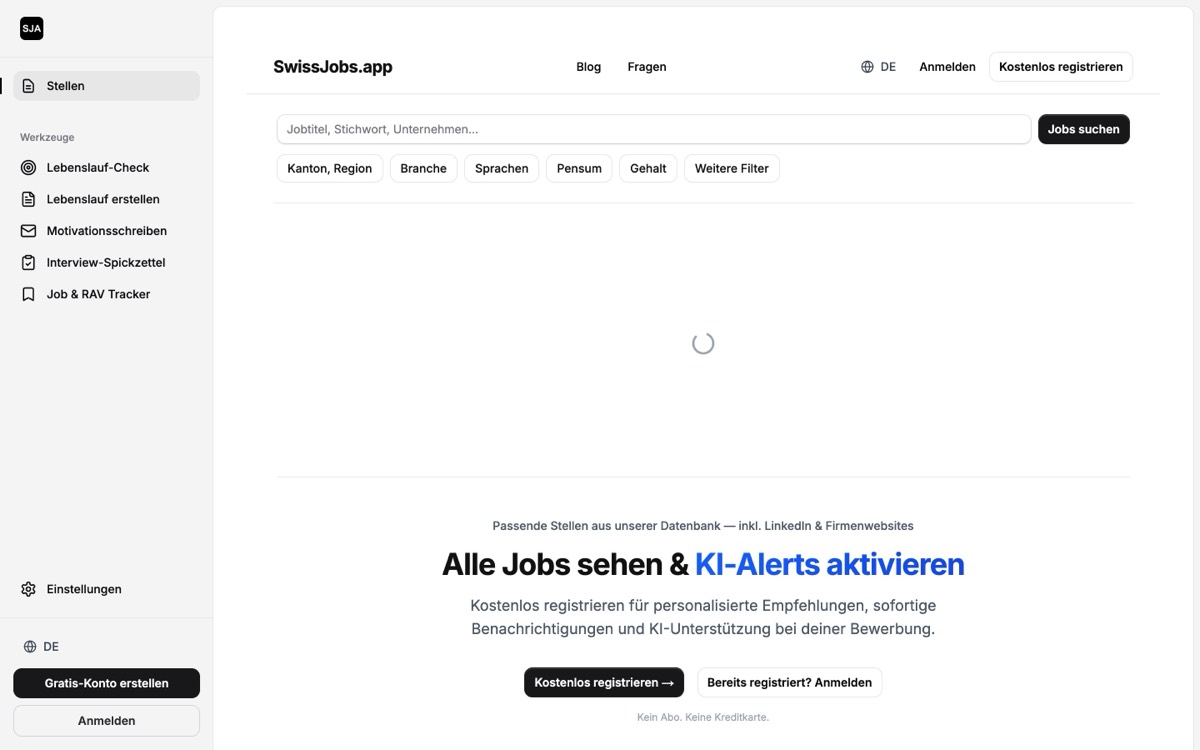
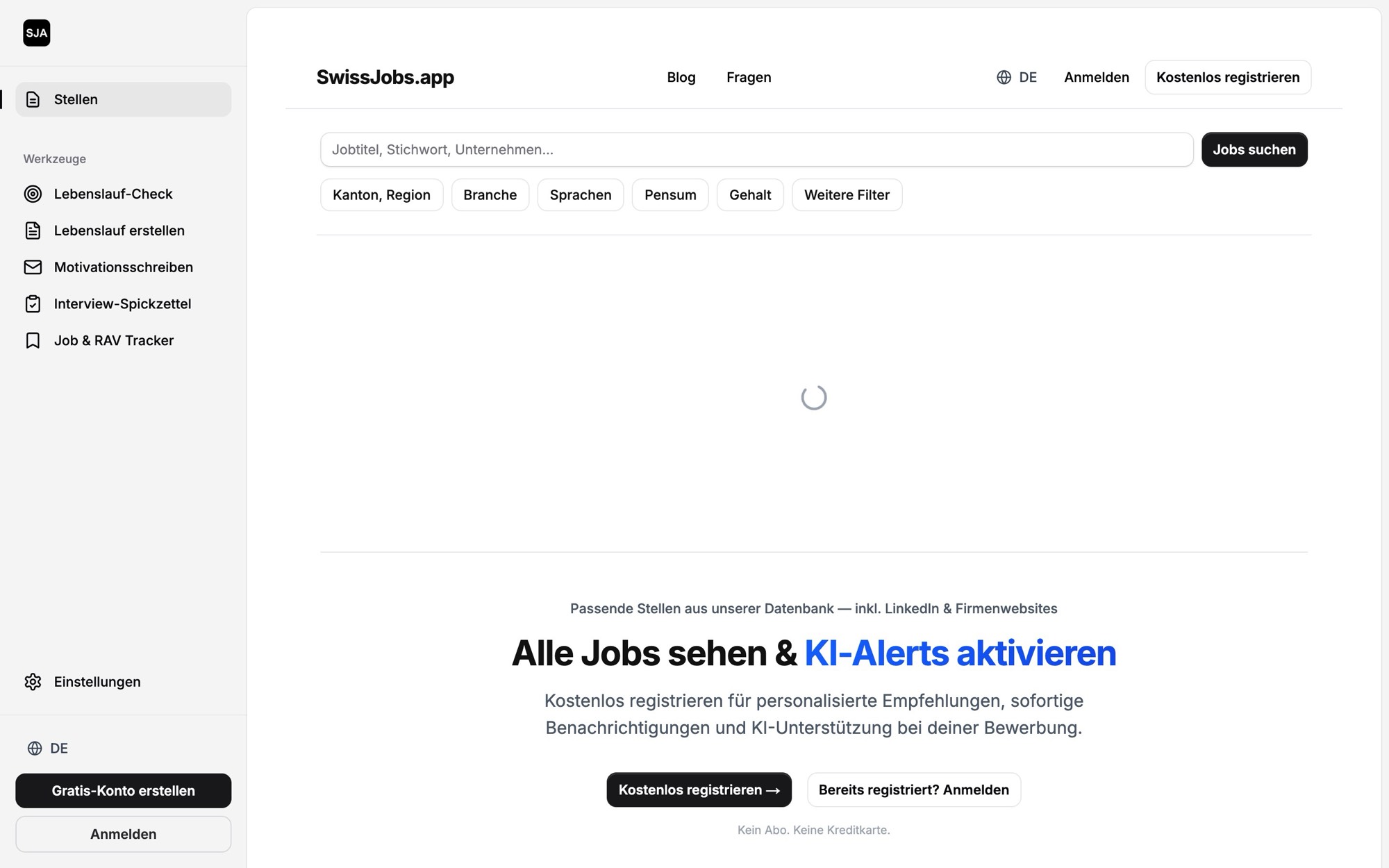
1. SwissJobs.appOur app
Over 21,000 open Swiss roles from ATS systems, company sites and LinkedIn in one place — and from any advert, straight into a CV, a motivation letter, a CV check and interview prep. The RAV job-search-efforts form fills itself from your application tracker. Free to use; the account is asked for at save.
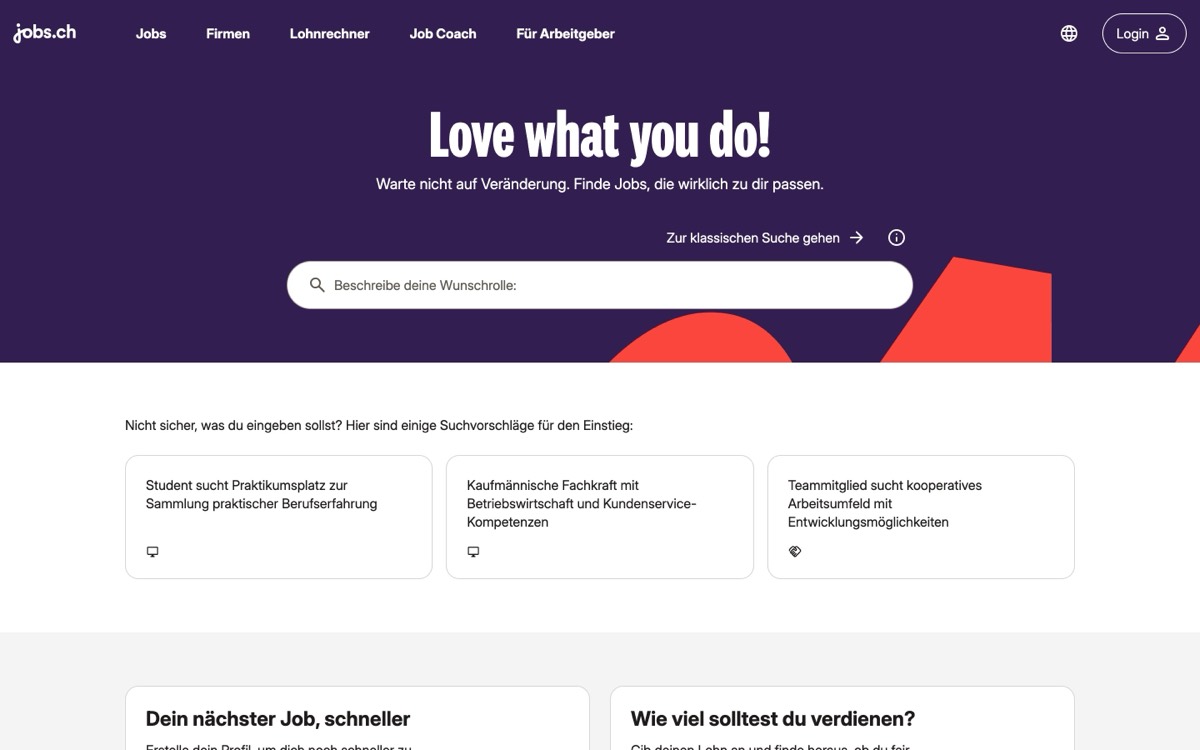
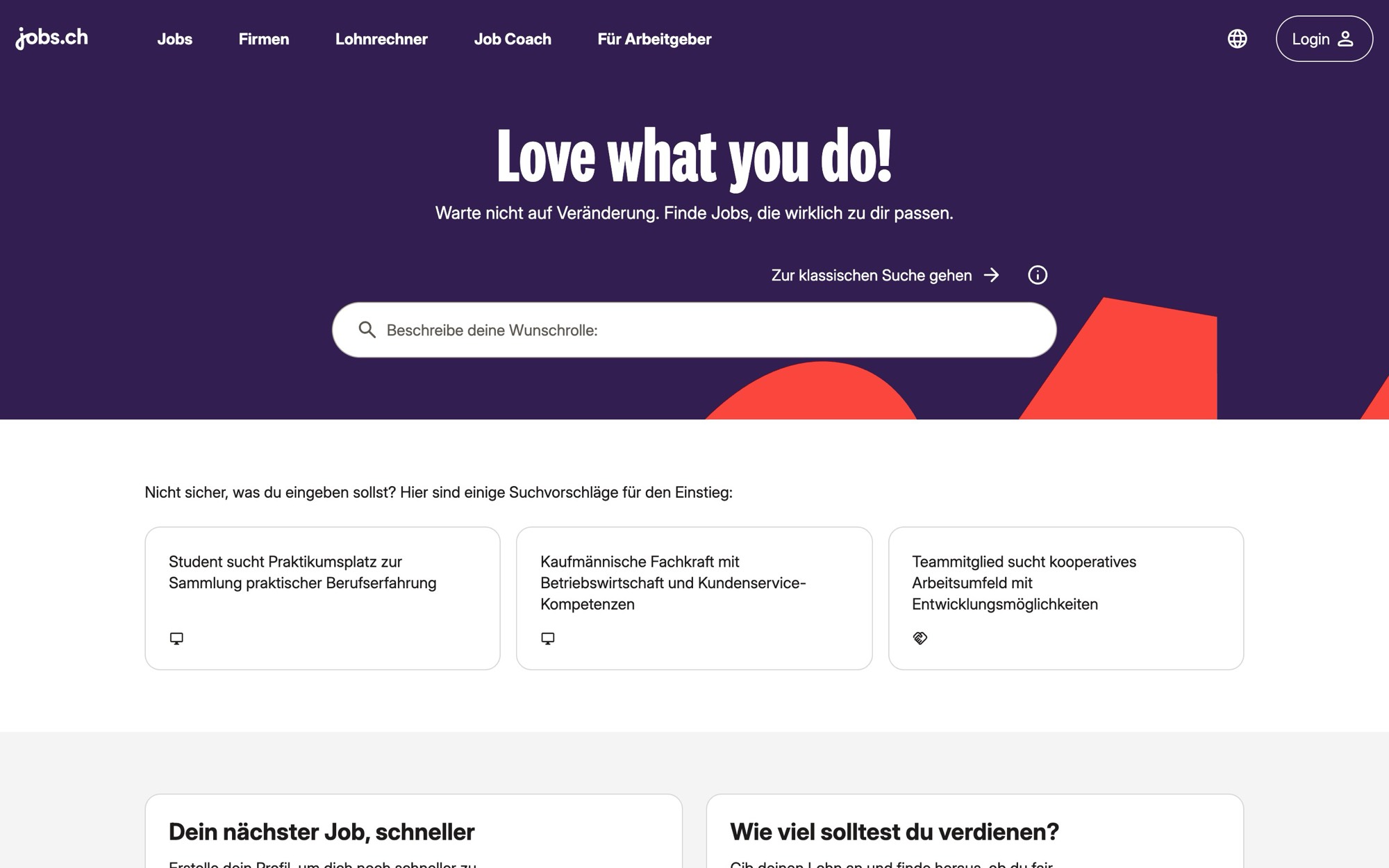
The best-known board in German-speaking Switzerland and the largest index in the country. Owned by JobCloud AG — as are jobup.ch and JobScout24.
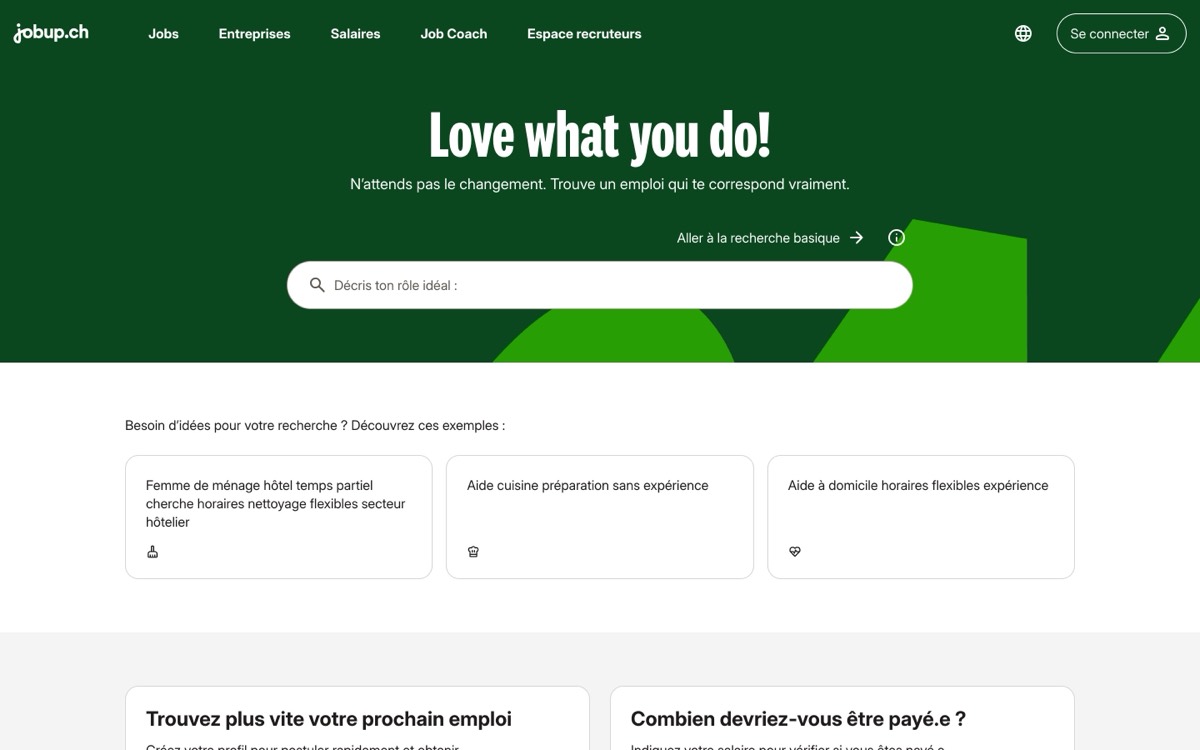
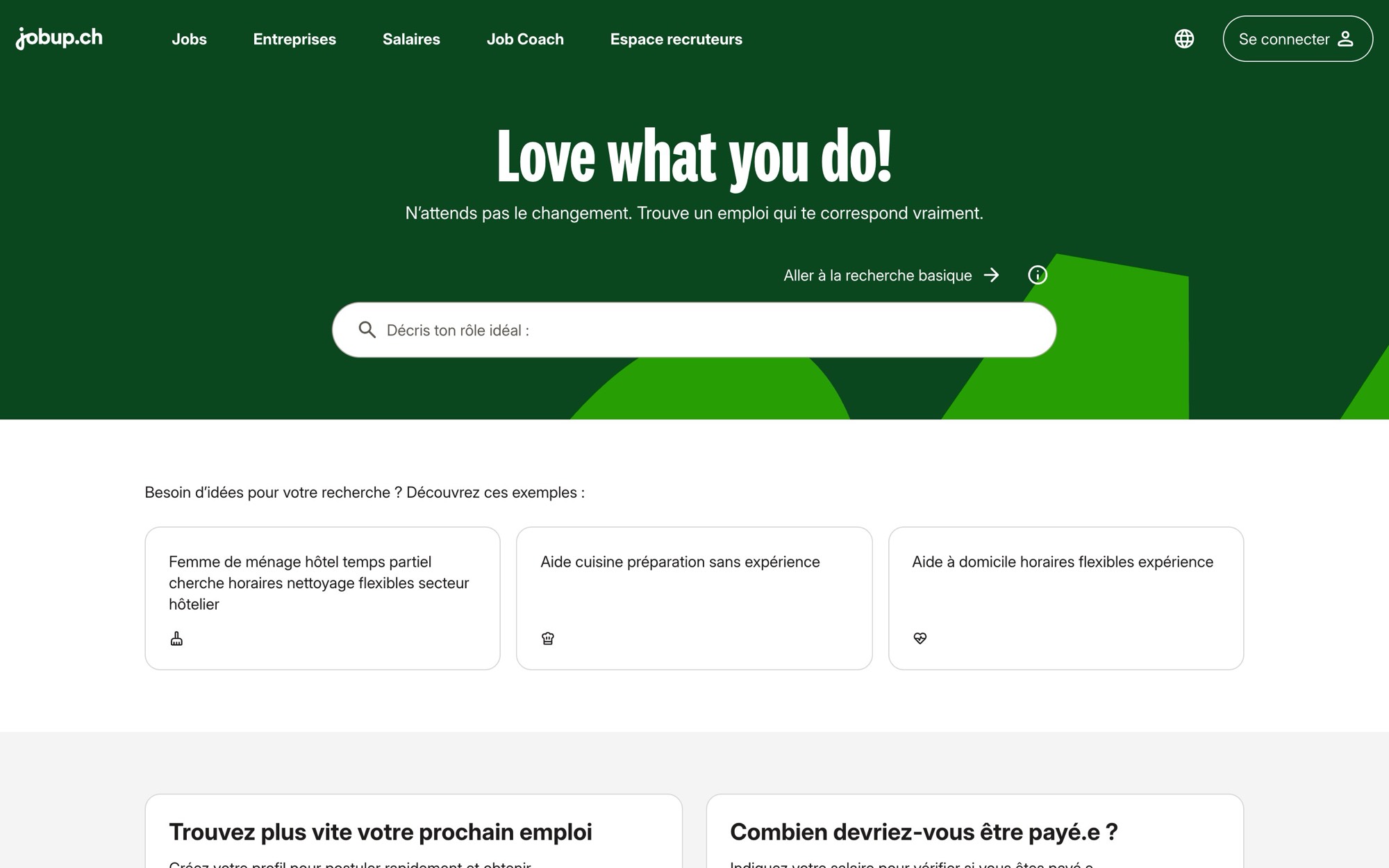
The standard in French-speaking Switzerland and the first place to look for the Romandie — but the same JobCloud AG as jobs.ch.
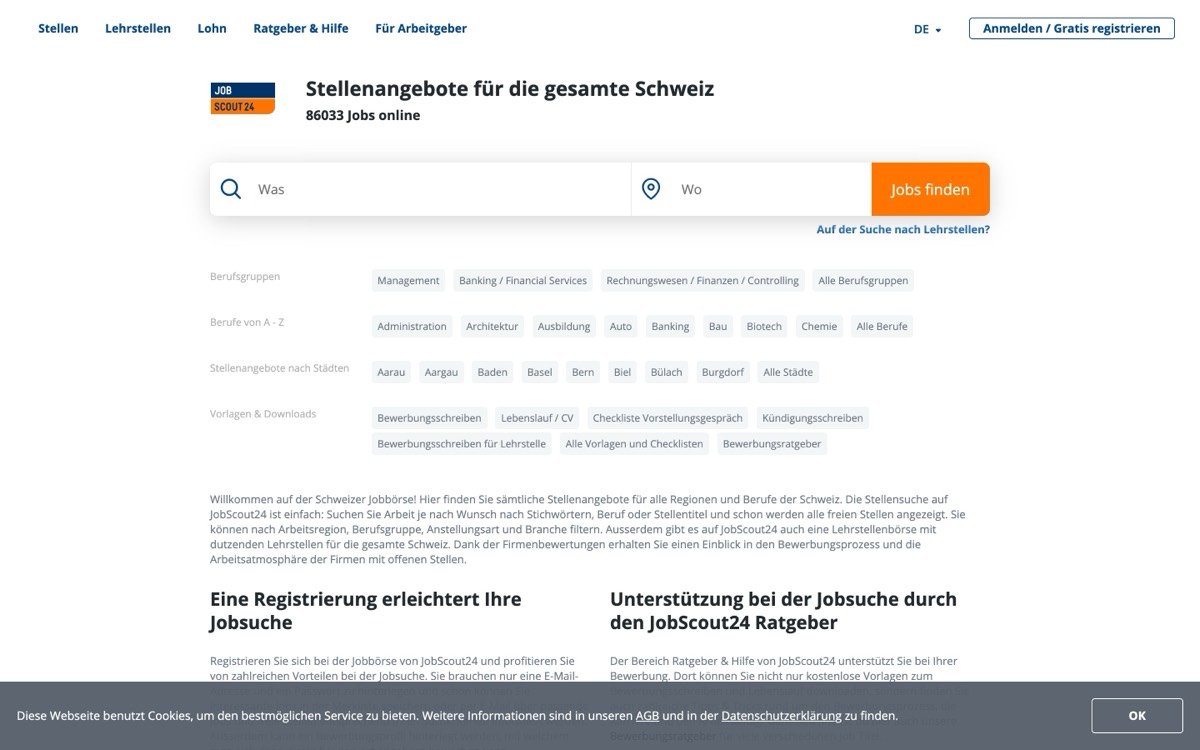
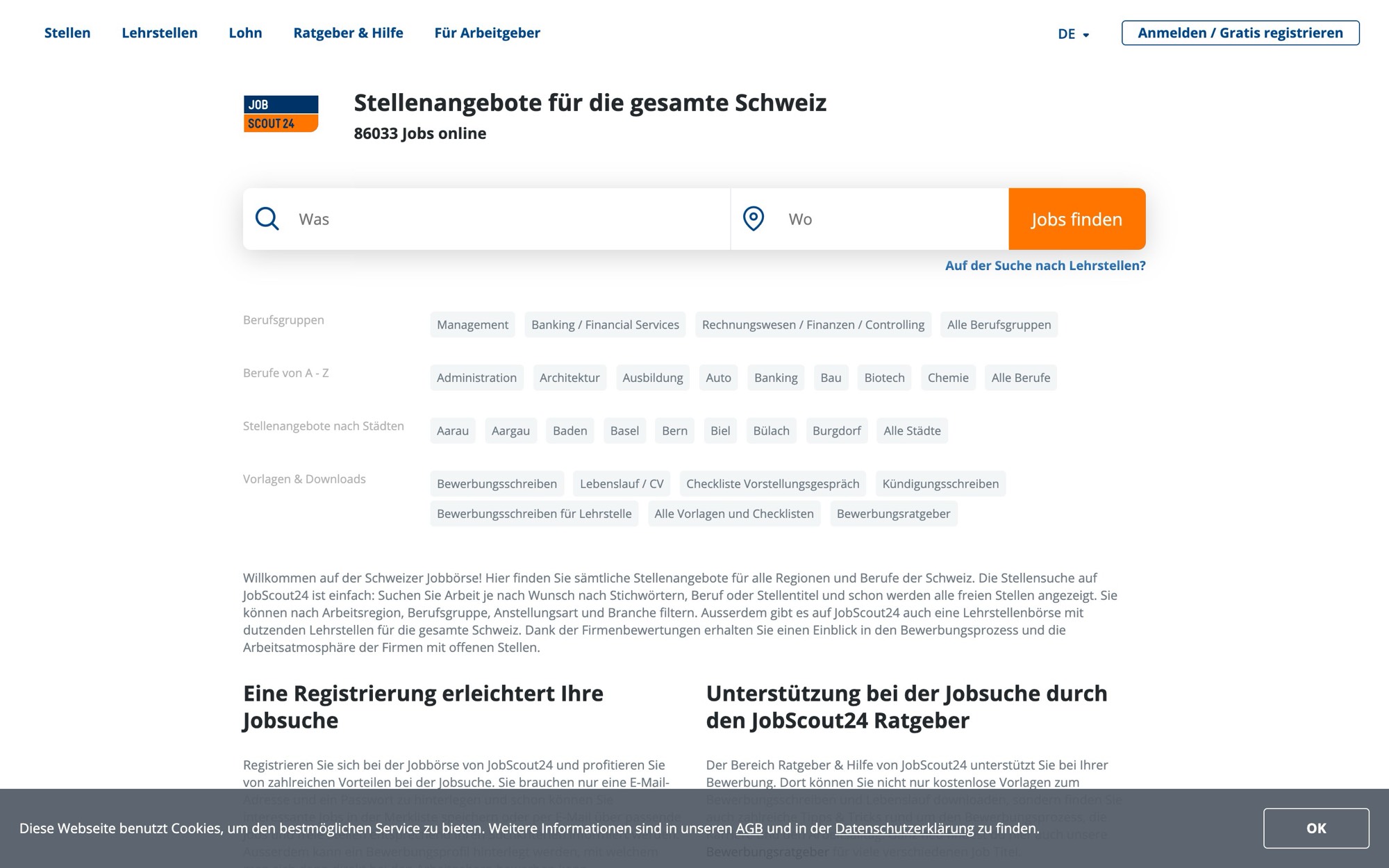
A third brand from the same company. Searching all three to widen your search means searching one provider three times.
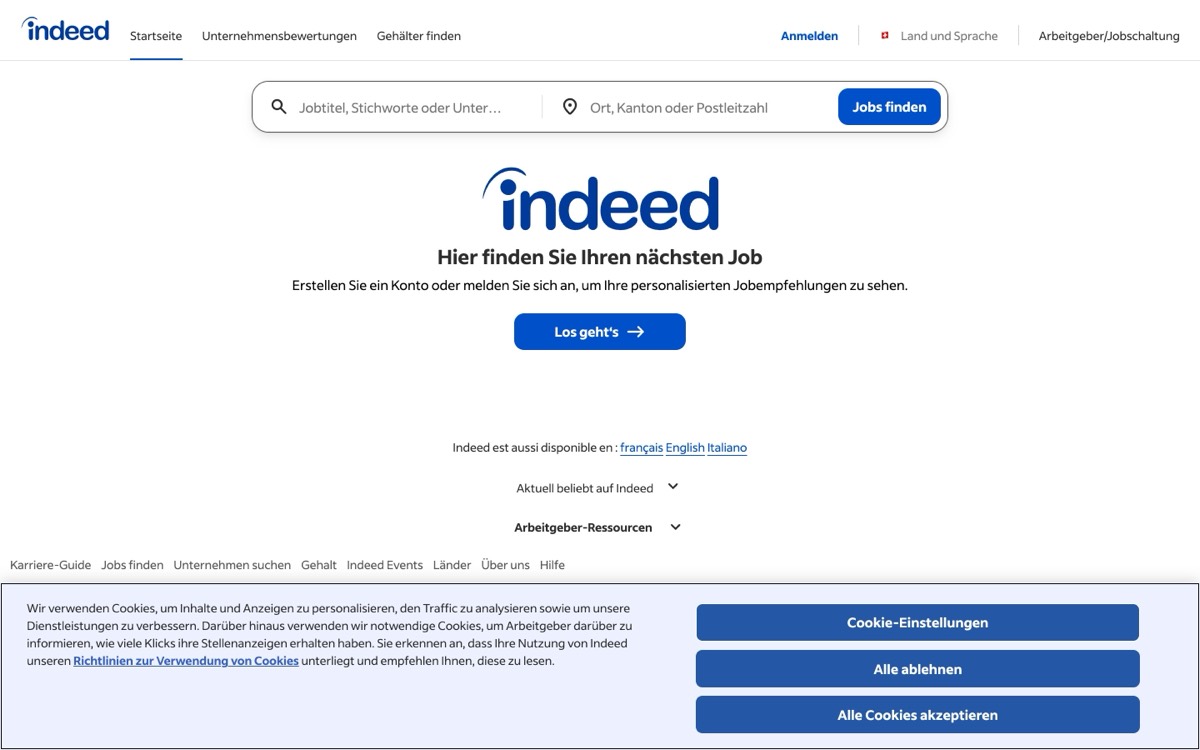
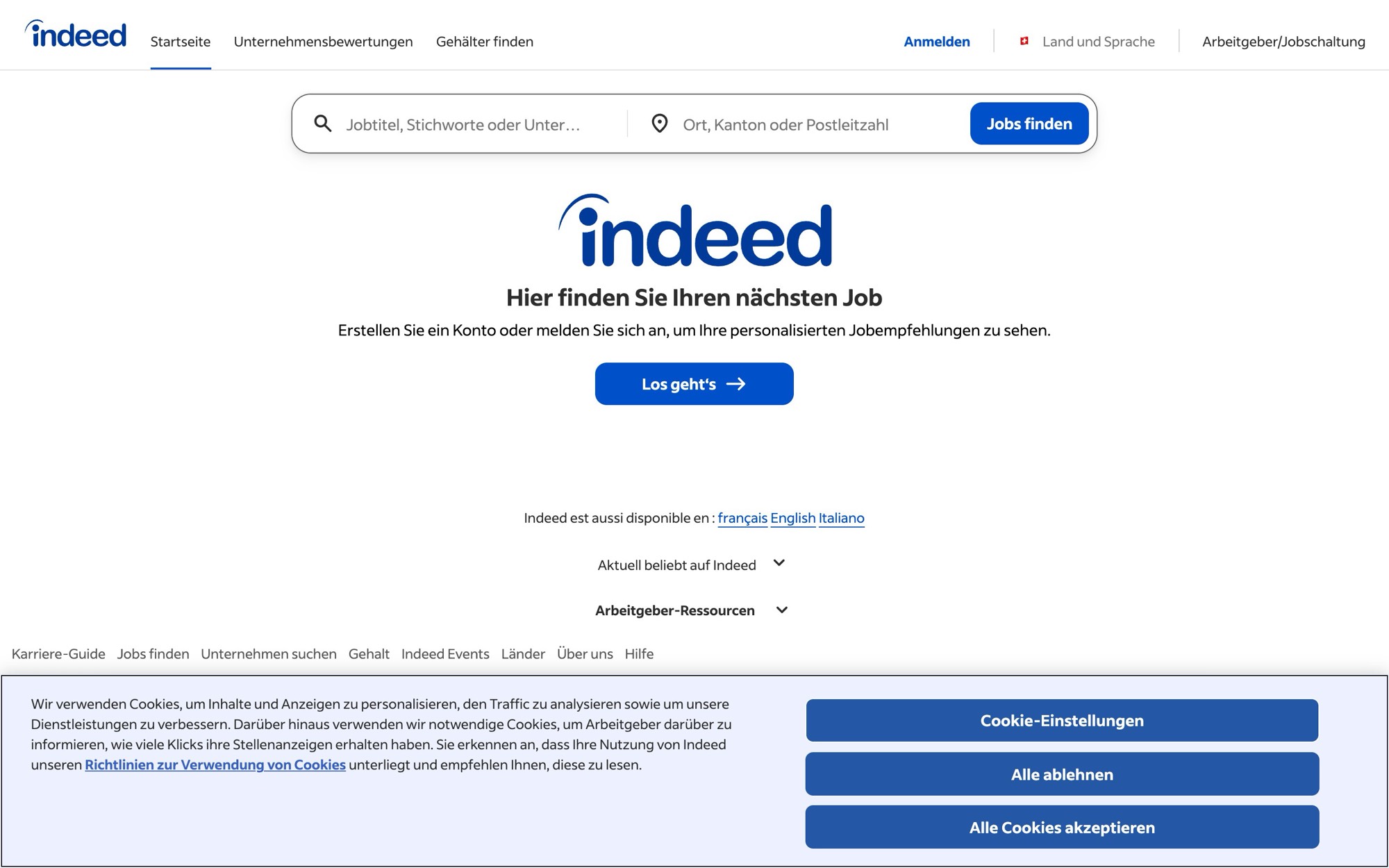
The broadest aggregation, because Indeed also collects from other boards — at the cost of many duplicates of the same advert.
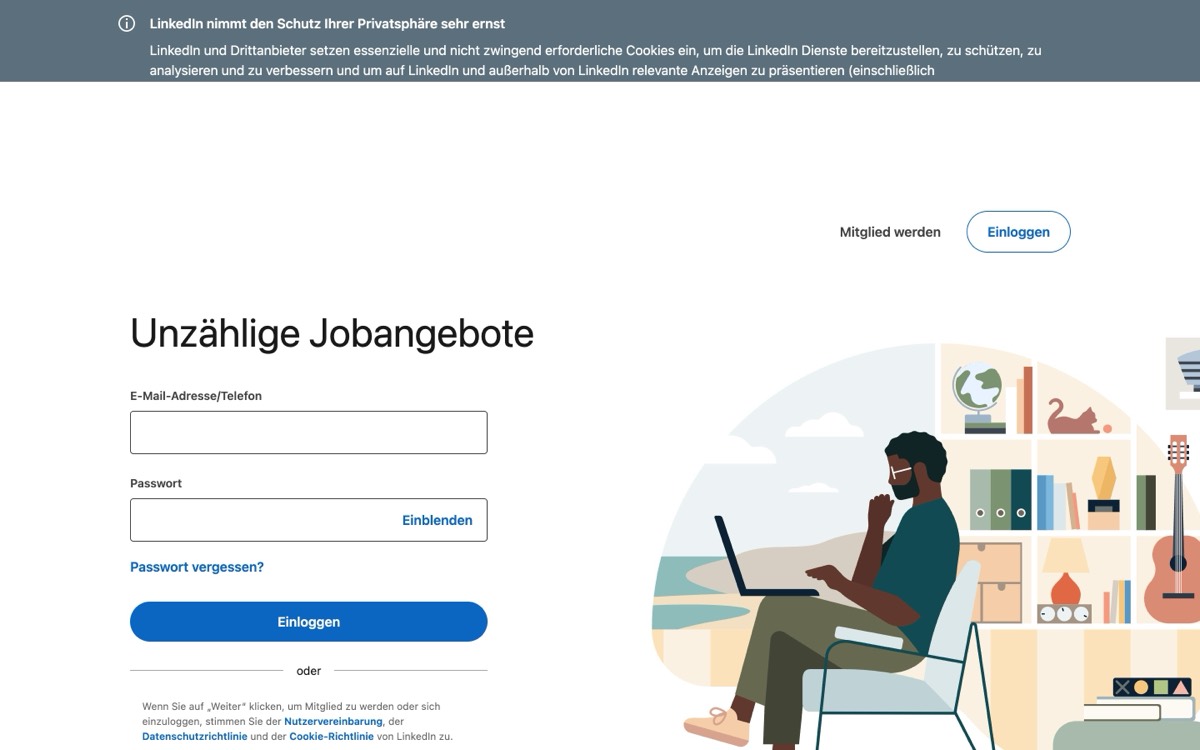
The best reputation for English-speaking and international roles in Switzerland. Considerably thinner for trades, care and commercial roles.
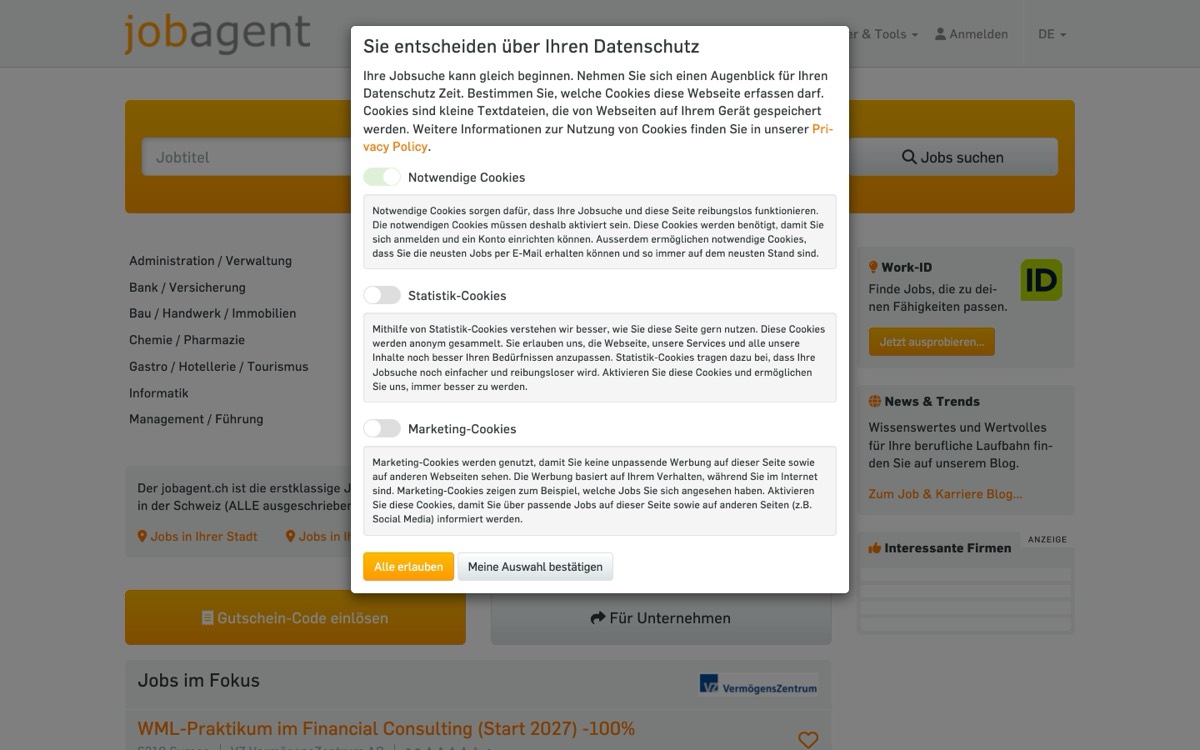
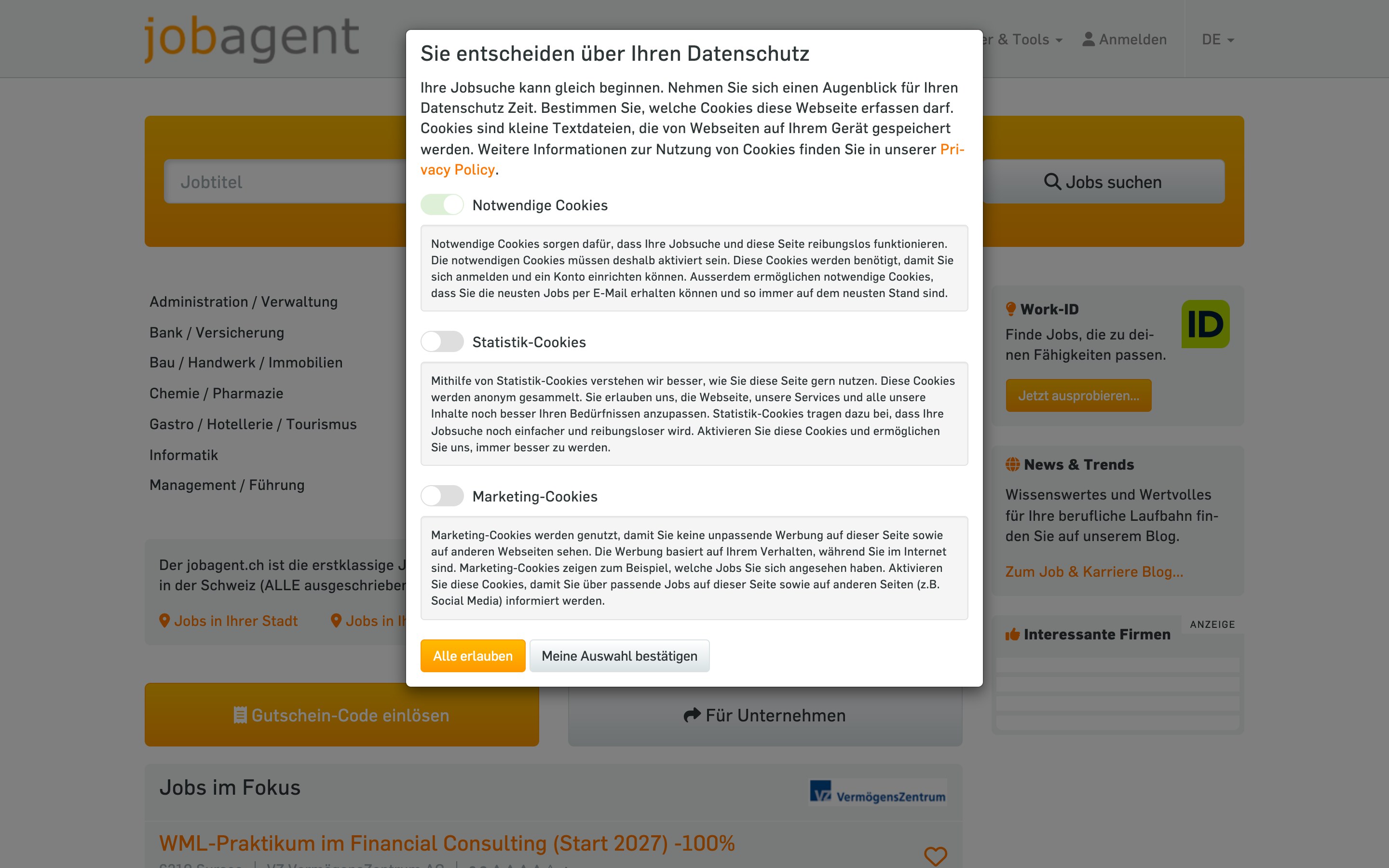
A meta-search across the Swiss job boards, "every job in Switzerland at a glance". Its strength is the Job-Abo: a saved search that mails you new adverts from every portal it covers. Salary calculator and application guides alongside.
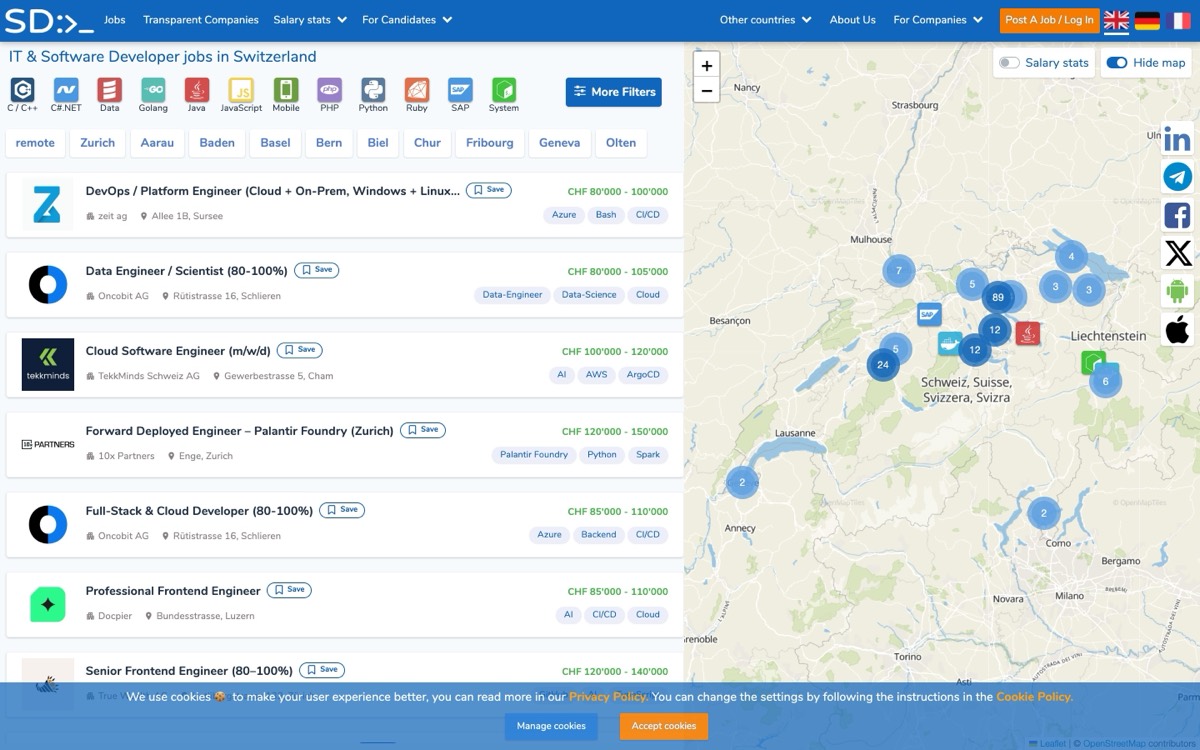
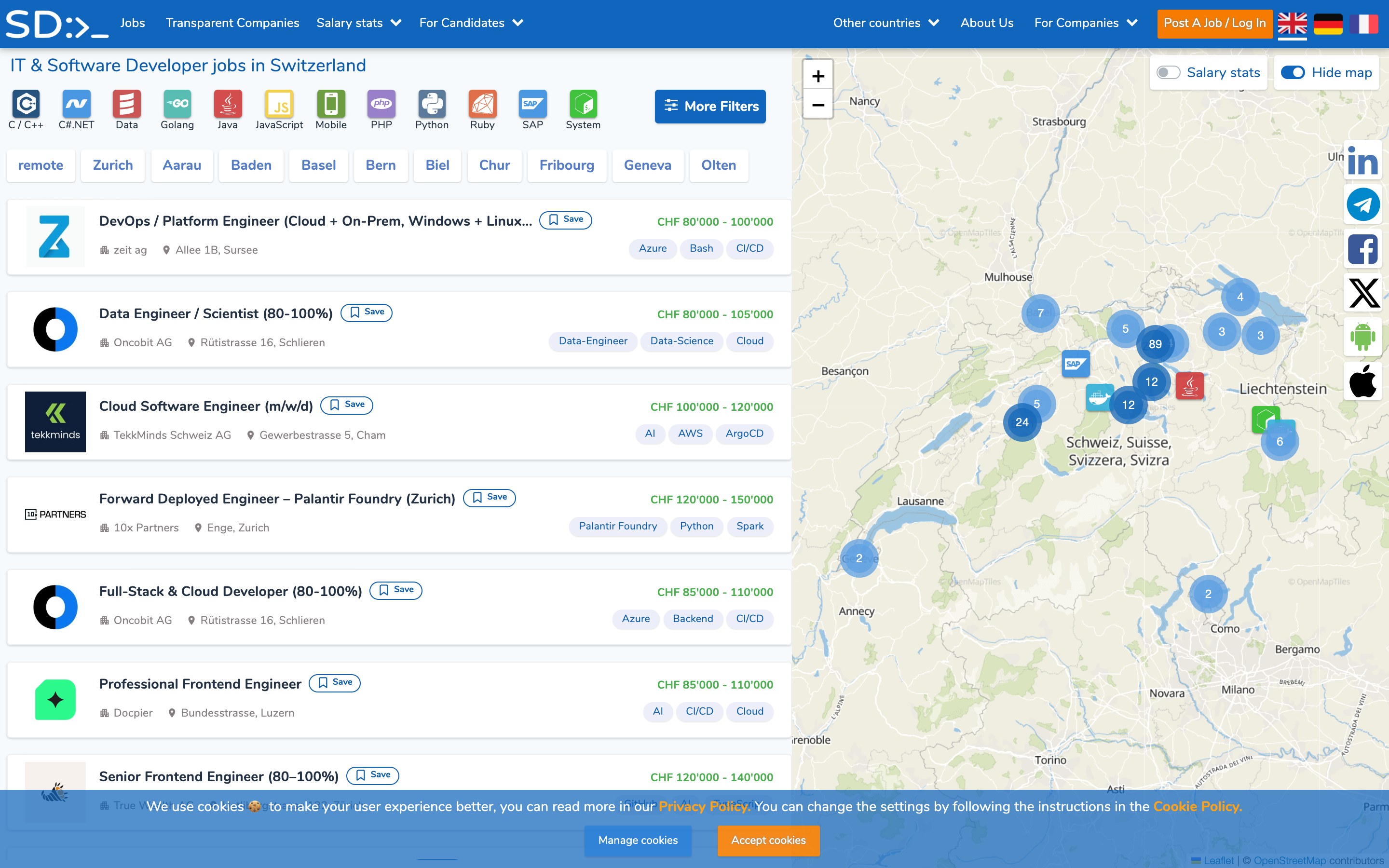
IT and software only, and thorough about it: "183 IT & Software developer jobs in Switzerland", filtered by technology (C#, Java, Python, DevOps, ML) rather than by industry. Publishes salary statistics and lists the companies that disclose their ranges. The site itself is in English.
Jobs by profession, city or language
Type a profession, a city or a language, the page shows the adverts currently open for it.
By profession
- Consultant
- Project Manager
- Retail Sales
- Nurse
- Nursing & Care
- Administrative Assistant
- Account Manager
- Software Engineer
- Public Administration
- Architect
- Insurance
- Chef
71 more — narrow the search
By work type
The second thing to know is that Lucerne is the most concentrated large market in Switzerland. One employer, the cantonal hospital, carries 21.8 per cent of everything we see advertised in the canton, and six employers carry half of it. Zurich needs forty-seven employers to reach half, Geneva thirty, Basel sixteen. Lucerne is also the only large market whose biggest advertiser is not a staffing agency but a place people actually work.
Those two facts point at the same tactic. In a market this concentrated, a search box is worth less than a list of addresses. Roughly a dozen career pages — the cantonal hospital, the city and cantonal administrations, the large care providers, the health insurers headquartered here, the utility, and the handful of manufacturers out in the villages — cover a large share of everything open in the canton. Build that list once and check it weekly.
And do not type the word. "Lucerne" and "Luzern" together find only 57.3 per cent of the canton’s adverts; the rest carry a municipality name you would have to know in advance. Search the region, not the city name.
Number of distinct employers, largest first, needed to account for half of a market’s adverts. Rolling analysis of the open Swiss adverts we collect, August 2026.
- English alone is enough for 2.9 per cent of Lucerne adverts that state a language requirement, against 20.9 per cent across the rest of Switzerland and 36.9 per cent in canton Zug.
- German is asked for in 96.6 per cent of those adverts, and at professional level in 94.9 per cent of them. Conversational German is accepted in 3.2 per cent.
- One employer carries 21.8 per cent of the canton’s adverts and six carry half. Zurich needs forty-seven employers to reach half, Geneva thirty, Basel sixteen.
- The words "Lucerne" and "Luzern" find 57.3 per cent of the canton. The rest is filed under Sursee, Emmen, Kriens, Menznau, Wolhusen, Nottwil, Dagmersellen, Ruswil or Willisau.
- Apprenticeships are 9.1 per cent of the Lucerne list against 2.8 per cent elsewhere; senior and leadership titles are 11 per cent against 19.6 per cent.
- 39.4 per cent of adverts labelled "Emmen" come from the Netherlands, not from canton Lucerne.
What English actually opens in Lucerne
The realistic English-only pool in this canton is not a sector, it is a short list of names: a pharmaceutical site in the city, a sportswear group with an office in Root, plus federal administration and army postings that appear in French. That is most of it. Only 3.4 per cent of Lucerne adverts that state requirements ask for no German at all, and 4 per cent of Lucerne adverts are even written in English — against 21.2 per cent nationally and 38.5 per cent in Zug.
This is worth stating plainly because the usual advice — "apply widely, your English is fine in Switzerland" — is wrong for this particular canton. It is true in Zug, largely true in Geneva and Basel, half true in Zurich, and false in Lucerne. The bar here is not conversational German either: of the adverts that ask for German, 94.9 per cent want it at professional level and only 3.2 per cent accept conversational.
The practical route, if German is your constraint, is to treat Lucerne and Zug as one search area and let the language decide which half of it you read. Zug is a small market — 2.6 per cent of the national list against Lucerne’s 6 per cent — but more than a third of it is workable in English, and it is on the same commuter corridor. Many people who live in Lucerne work in Zug for exactly this reason.
If your German is professional but not native, the good news is that native-level German is rarely demanded: it appears in 1.9 per cent of the Lucerne adverts that name a German requirement. The gate is fluency, not nativeness.
One hospital, three towns, and a lot of non-clinical roles
The single largest advertiser in the canton is the Luzerner Kantonsspital, and it publishes under exactly three place names: Lucerne, Sursee and Wolhusen. If you assume that makes Lucerne a healthcare market, you will misread the list twice over.
First, 41.2 per cent of that hospital’s adverts are not clinical roles at all. In a single sample you find a Linux systems engineer, a cost-accounting controller, a payroll lead, switchboard staff, an optician, gardeners and civilian-service placements. A large Swiss hospital is a mid-sized company with an IT department, a finance function and a facilities operation, and it advertises like one.
Second, take that one employer out and healthcare is 9.7 per cent of the Lucerne list against 7.5 per cent elsewhere — a perfectly ordinary share. Take it out and the canton drops from 6 per cent of the national list to 4.7 per cent, which is roughly its share of the Swiss population. Almost everything that looks unusual about the size and shape of the Lucerne list traces back to one advertiser.
The same employer explains the list’s apparent staleness. The median Lucerne advert is 27 days old against 19 nationally, but the hospital’s median advert is 85 days old and 68.4 per cent of its postings are older than two months. Remove it and the Lucerne median is 17 days — fresher than the country. Judge an advert’s age by who posted it: a three-month-old posting from a large hospital is usually a standing need worth an application, while a three-month-old posting from a small firm usually is not.
Outside the city, one employer per village
More than four in ten of the canton’s adverts carry a municipality name rather than "Lucerne", and in those municipalities the concentration goes further still. Across every place outside the city with a meaningful number of adverts, the largest local employer accounts for 46.3 per cent of that place’s postings on average.
Some individual figures: in Zell, 100 per cent of the adverts come from one food processor. In Nottwil, 78.3 per cent come from the Swiss Paraplegic Centre. In Menznau, 94.9 per cent come from a wood-panel producer; in Ruswil, 76.2 per cent from a building-materials manufacturer; in Wolhusen, 74.2 per cent from the cantonal hospital; in Hitzkirch, 66.7 per cent from an instrumentation maker; in Reiden, 52.9 per cent from a construction-equipment group; in Dagmersellen, 50 per cent from a dairy company.
These are not fringe locations. Sursee, Emmen, Kriens, Menznau and Wolhusen together carry more than one in six of the canton’s adverts, and Sursee’s largest advertiser is the cantonal hospital again. If you search only the city, you lose the whole industrial half of the canton.
The tactic follows directly: in a village where three out of four adverts come from the same firm, that firm’s career page is the local job market. Going there beats any query you could write.
A market built for entering, not for climbing
Lucerne has the most pronounced entry-level profile of any large Swiss market we measure. Apprenticeships and training places make up 9.1 per cent of the canton’s adverts against 2.8 per cent elsewhere, which puts 17 per cent of all Swiss apprenticeship adverts in a canton holding 6 per cent of the overall list. The largest single source is the cantonal utility, followed by a care provider, a car-retail group, a concrete works, a dairy and a wood-panel producer.
At the other end the market is thin. Only 11 per cent of Lucerne job titles carry a senior, lead, head or management word, against 19.6 per cent elsewhere. If you are looking for a leadership role, breadth will not help you here; a direct approach to the six large houses will, and beyond that you should be looking across the cantonal border.
One genuinely useful local habit: 39.5 per cent of Lucerne job titles state the workload percentage in the title itself, against 20.9 per cent nationally — and 27.7 per cent even with the hospital excluded. You can usually see from the results list whether a role is 40, 60 or 100 per cent without opening it, which makes filtering for part-time work much faster here than in most of the country.
Two traps in the location field
The first is Emmen. After the city itself it is the canton’s second-largest place name, and it shares that name with a city in the Dutch province of Drenthe. Across our whole collection, 39.4 per cent of the adverts labelled "Emmen" are Dutch. If you type Emmen and start seeing vacancies for a Kraanmachinist or a Salarisadministrateur, your search is not broken — the place name is.
The second is the English spelling. 2.4 per cent of everything matching "Lucerne" or "Luzern" in a location field is not in Switzerland at all: Lucerne Valley in California, Lucerne in Missouri, Luzerne County in Pennsylvania, a Chemin Lucerne in Quebec. A small share, but exactly the kind of result that can sit at the top of a date-sorted list.
Both traps disappear if you search by region rather than by word. A regional query knows the difference between Emmen in canton Lucerne and Emmen in Drenthe; a text search does not.
If you lose your job in canton Lucerne
The canton runs three regional employment centres — RAV — in Kriens, Sursee and Wolhusen. Which one is yours depends on your municipality of residence rather than on distance; WAS Luzern lets you look this up by commune. It is worth noticing that this map matches the hospital’s: city or agglomeration, Sursee, Wolhusen. The canton is organised institutionally along the same three axes as its largest employer.
For context on the local labour market: in the city of Lucerne, an average of 2.7 per cent of the labour force was registered as unemployed across 2025 — 3.0 per cent among 15- to 24-year-olds, 2.8 per cent among 25- to 49-year-olds and 2.5 per cent among those over 50. That is at the lower end for a large Swiss city, and it is consistent with a market carried by a few stable, large employers.
Register as early as you can, at the latest on your first day without work. Registration, your monthly job-search evidence and any entitlement all run through the RAV, not through a job platform. What you have read here helps with the search itself; your RAV decides your individual case.
Market figures come from our rolling analysis of the open Swiss adverts we collect, August 2026. "Lucerne adverts" means the canton of Lucerne, identified from the advert’s location field: the canton’s municipality names as well as the city itself. Küssnacht am Rigi belongs to canton Schwyz and is not counted. Adverts whose location looks Lucernese but whose application address sits in the Netherlands or Germany are excluded and described separately in the text. The age of an advert is the distance between its publication date and 22 August 2026; a publication date is present for every Lucerne advert. Language shares refer to the 63.6 per cent of Lucerne adverts that state any requirement at all. Sectors, apprenticeships and seniority are inferred from job titles and employer names and are an approximation; postings from the same institution published through different portals or under different legal names are merged into one employer. We publish shares, never absolute stock figures. The information on the regional employment centres comes from WAS Luzern and the city unemployment rates from LUSTAT Statistik Luzern.
Sources
- WAS Luzern — which RAV covers your municipality
- WAS Luzern — job placement through the RAV
- LUSTAT Statistik Luzern — unemployment in the city of Lucerne
- Luzerner Kantonsspital — its own vacancy portal
- Swiss Paraplegic Centre Nottwil — vacancies
- Viva Luzern — vacancies
- City of Lucerne — administration vacancies
- CKW — careers and apprenticeships
- arbeit.swiss — information for jobseekers
Related questions
What our job index says about the Swiss market
Computed live from our own index, not quoted from a study. Shares only, as of today.
Language the advert is written in
- Deutsch
- 60%
- English
- 23%
- Français
- 13%
- Italiano
- 3%
Of adverts that state a language requirement, the share asking for
- Deutsch
- 70%
- English
- 43%
- Français
- 21%
- Italiano
- 3%
19% posted in the last 7 days · Largest markets: Zürich 18% · Bern 10% · Genève 5% · Basel 5%