Jobs in Zurich
Updated:
Switzerland's largest job market — and the quirks worth knowing before you search it.
In short
Almost one in five Swiss adverts we track is in the canton of Zurich; among adverts whose canton is known it is about a quarter, nearly three times the next-largest canton. What matters more is how you query it. Search literally for «Zürich» and you miss roughly a quarter of the canton: about one advert in six spells the city without the umlaut, and others name only Winterthur, Wallisellen or Dübendorf. Search by canton or by a list of places, never by one spelling.
This answer can contain errors and is not official advice. What your RAV or unemployment fund says is binding.
The Swiss job portals at a glance
Click an image for the full-size view. What each portal actually is stands beside it.
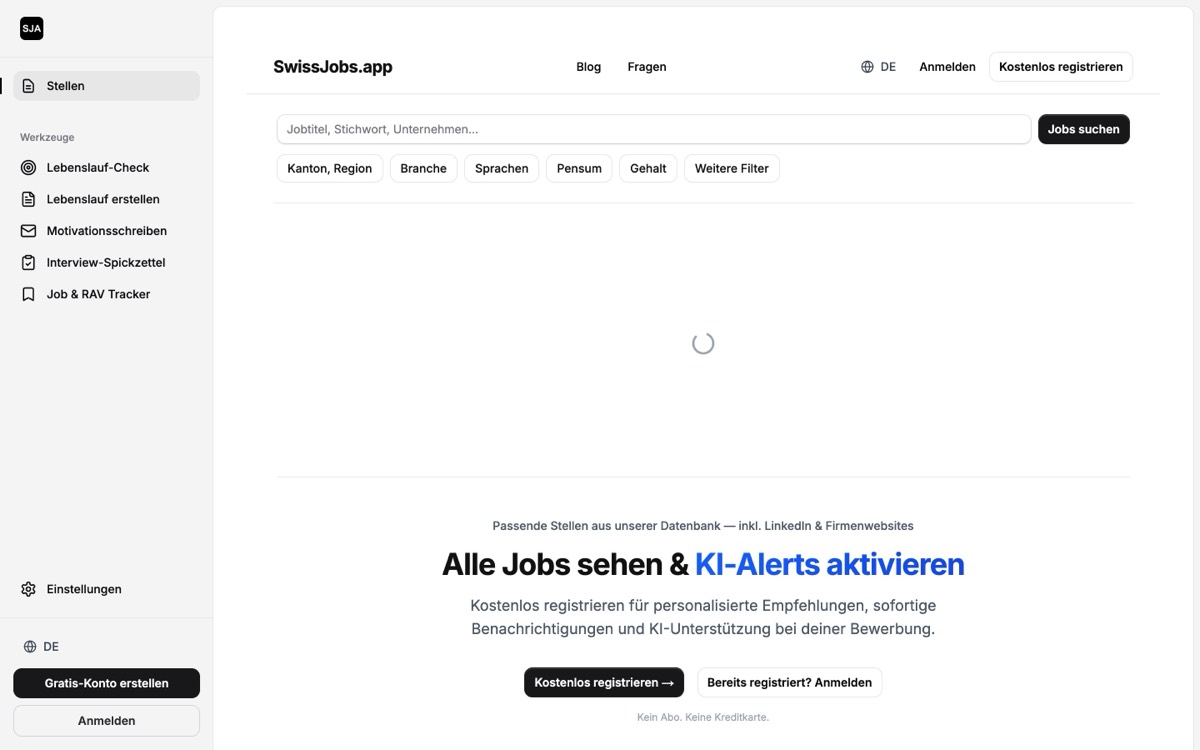
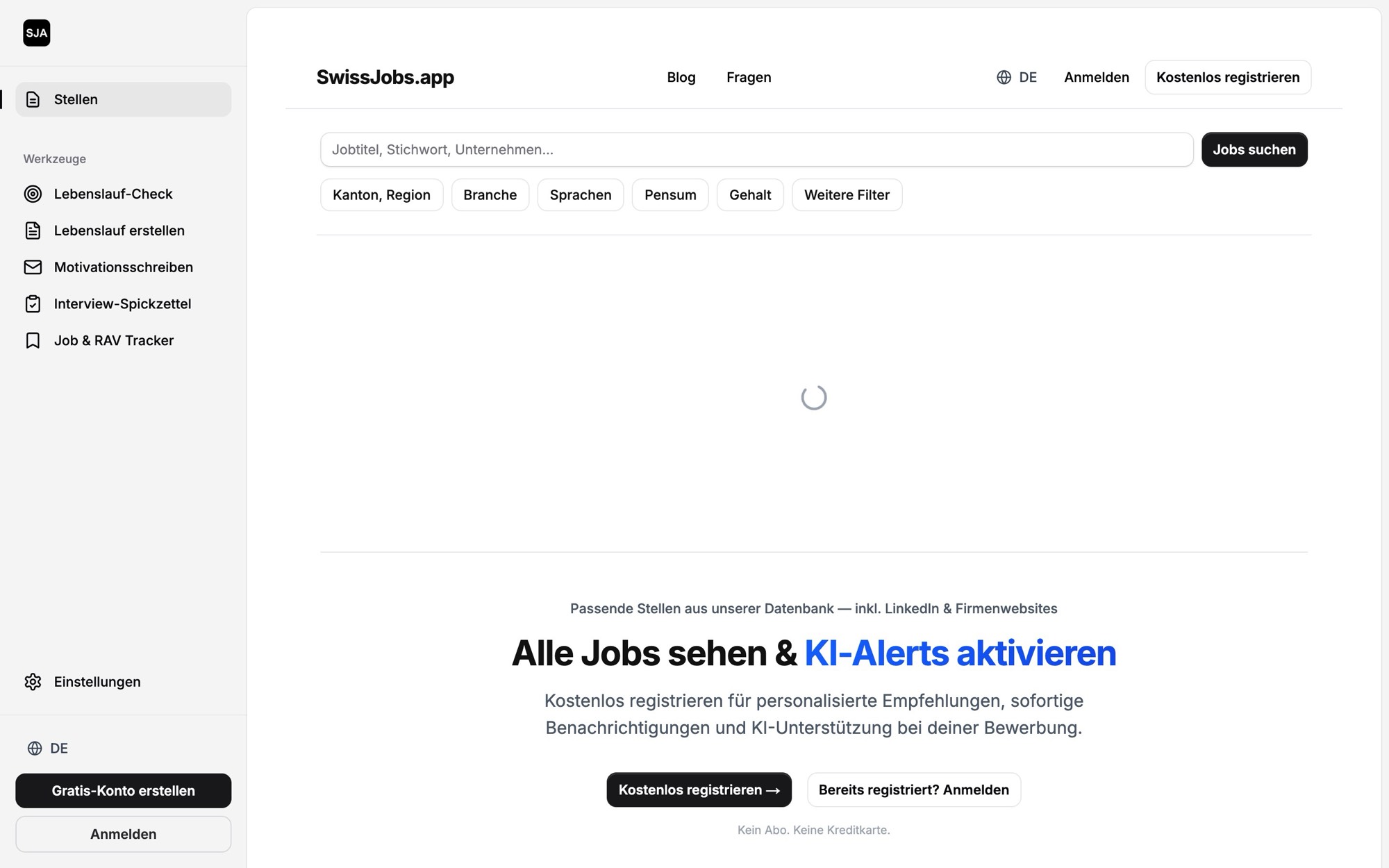
1. SwissJobs.appOur app
Over 21,000 open Swiss roles from ATS systems, company sites and LinkedIn in one place — and from any advert, straight into a CV, a motivation letter, a CV check and interview prep. The RAV job-search-efforts form fills itself from your application tracker. Free to use; the account is asked for at save.
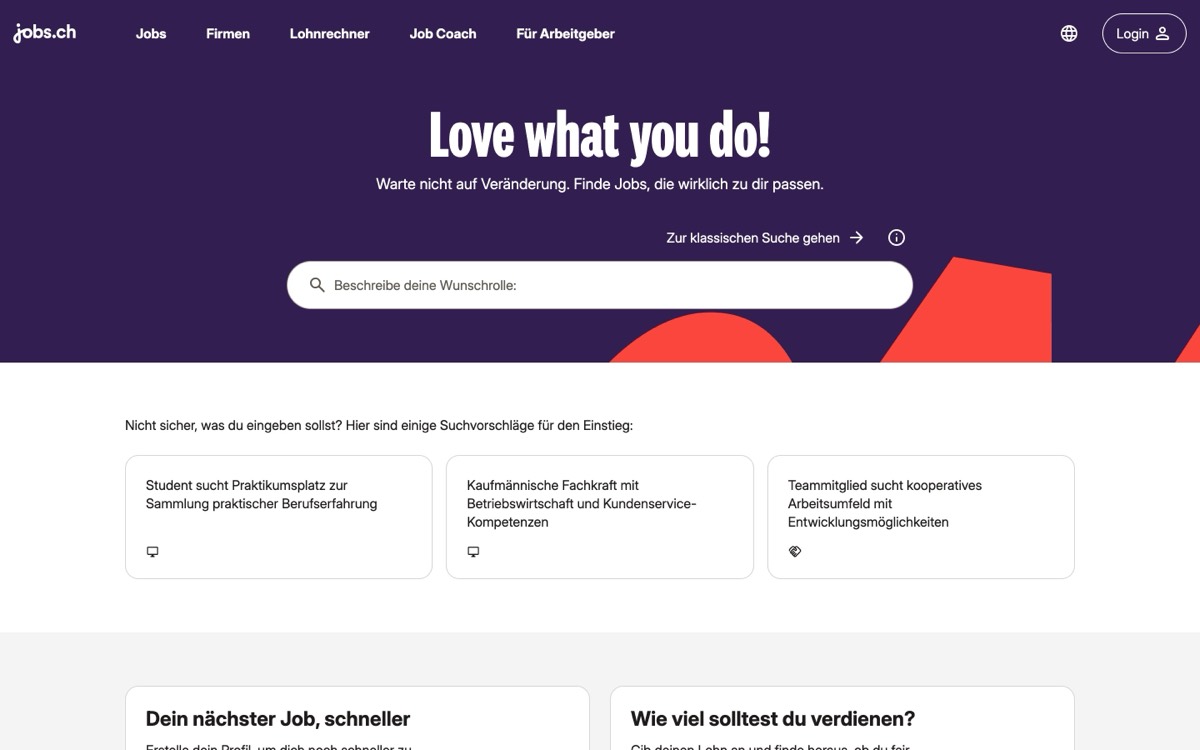
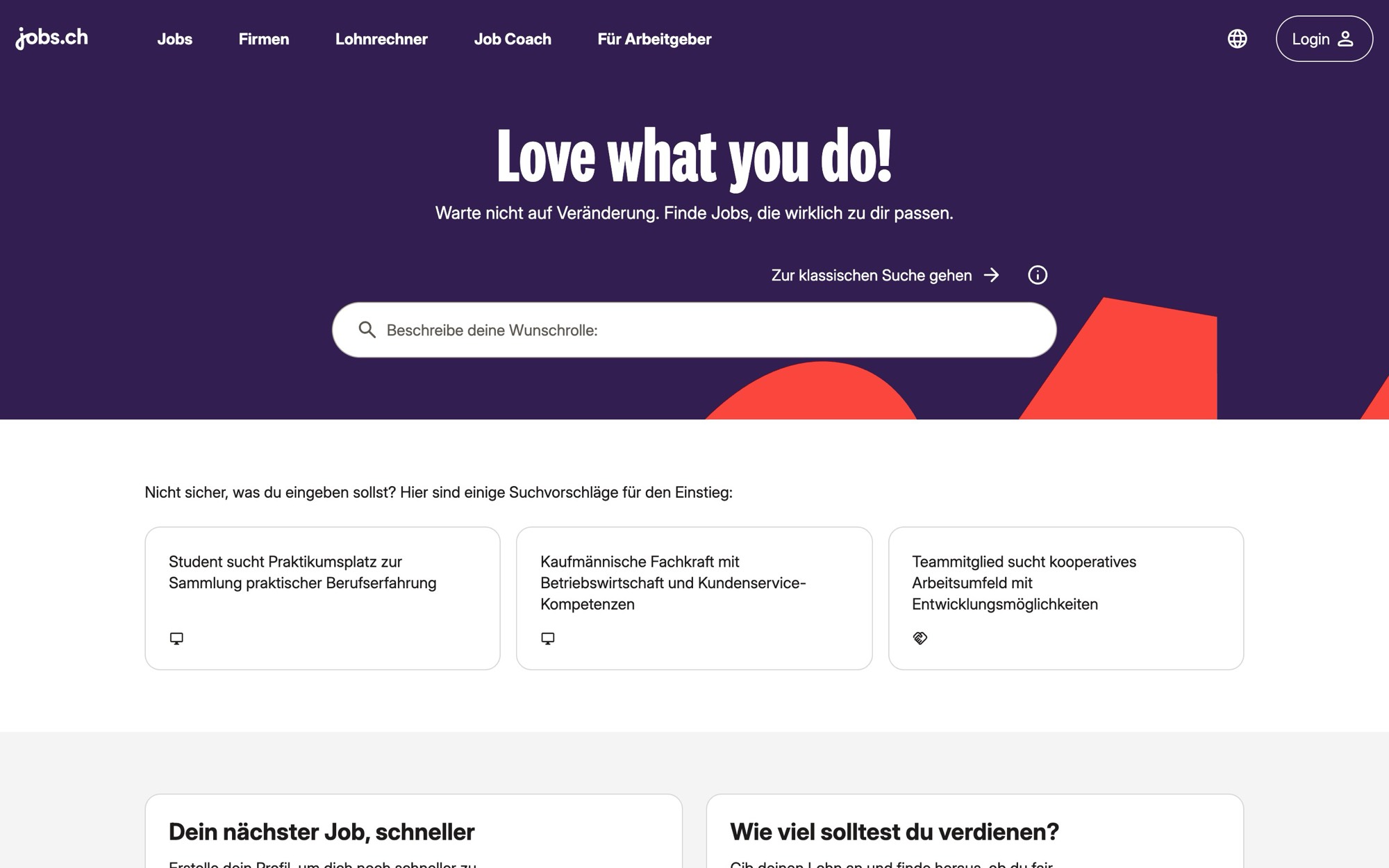
The best-known board in German-speaking Switzerland and the largest index in the country. Owned by JobCloud AG — as are jobup.ch and JobScout24.
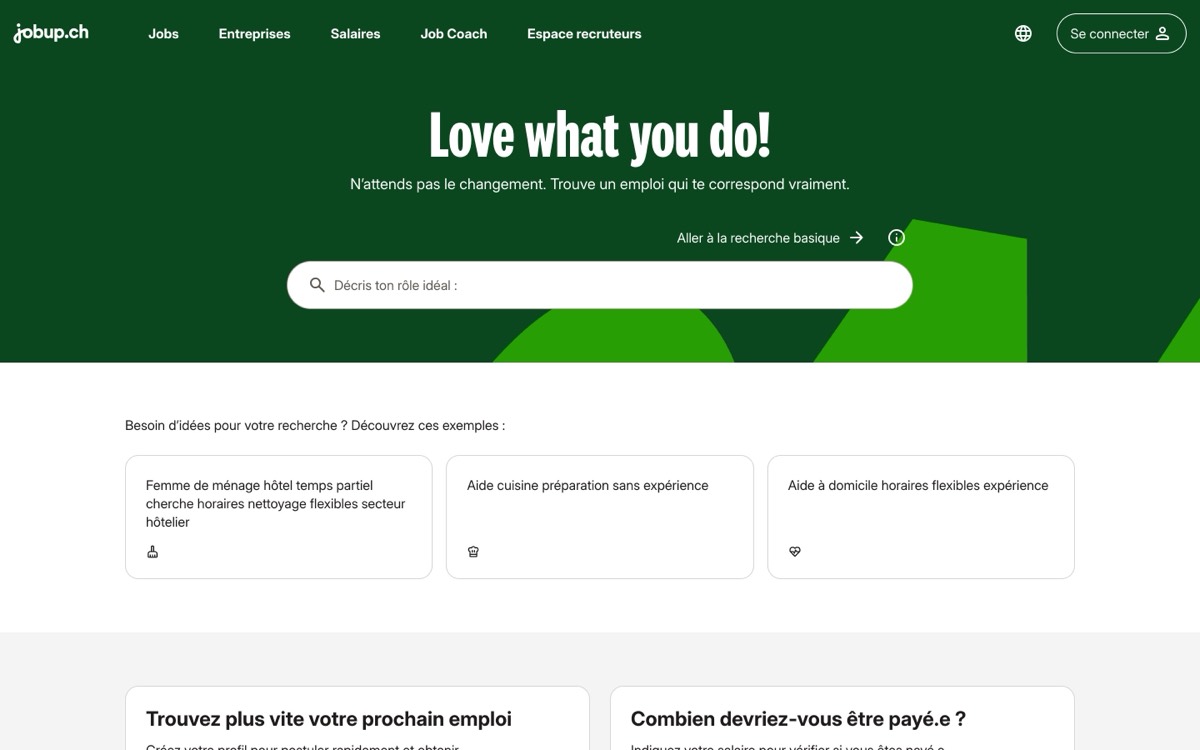
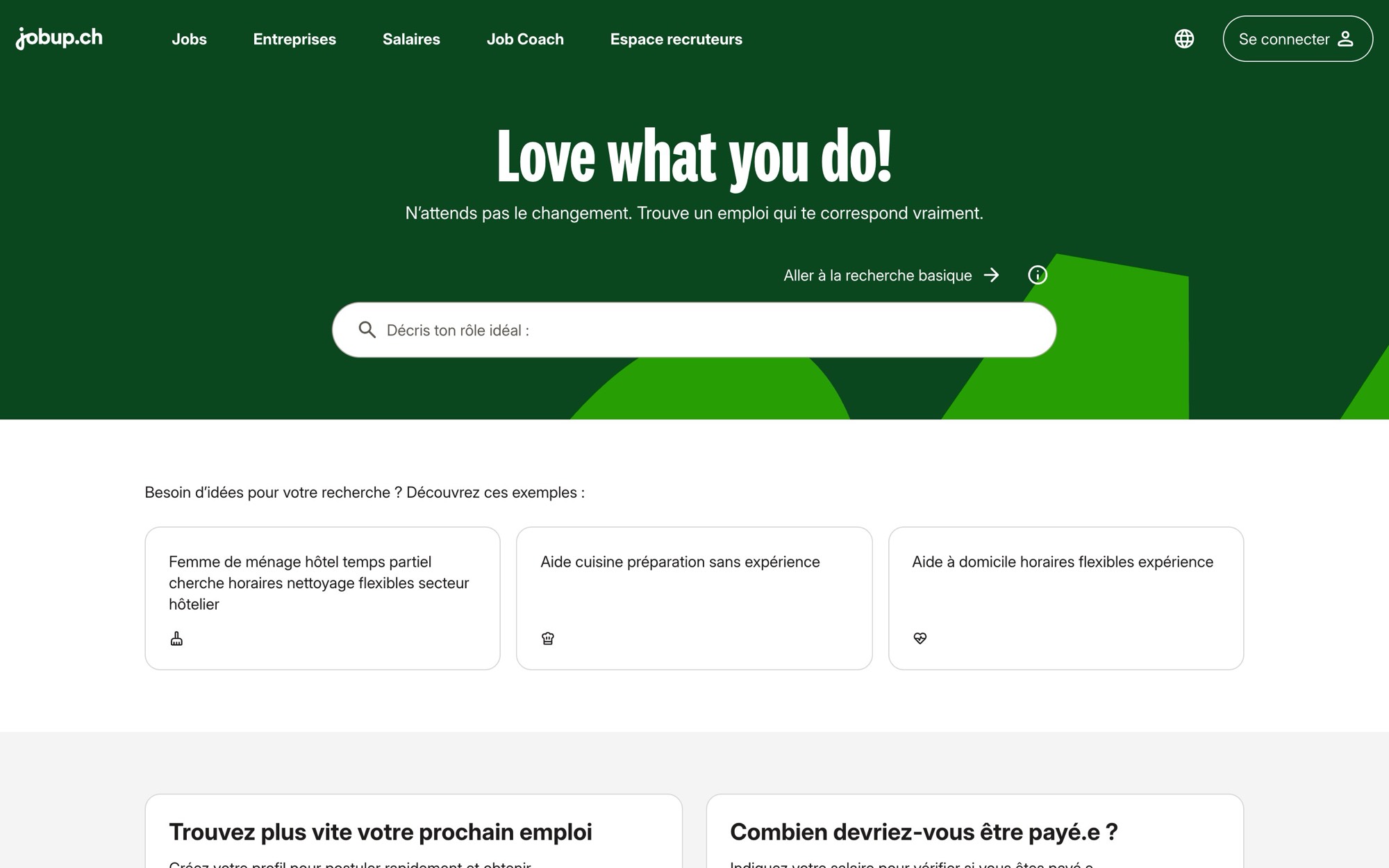
The standard in French-speaking Switzerland and the first place to look for the Romandie — but the same JobCloud AG as jobs.ch.
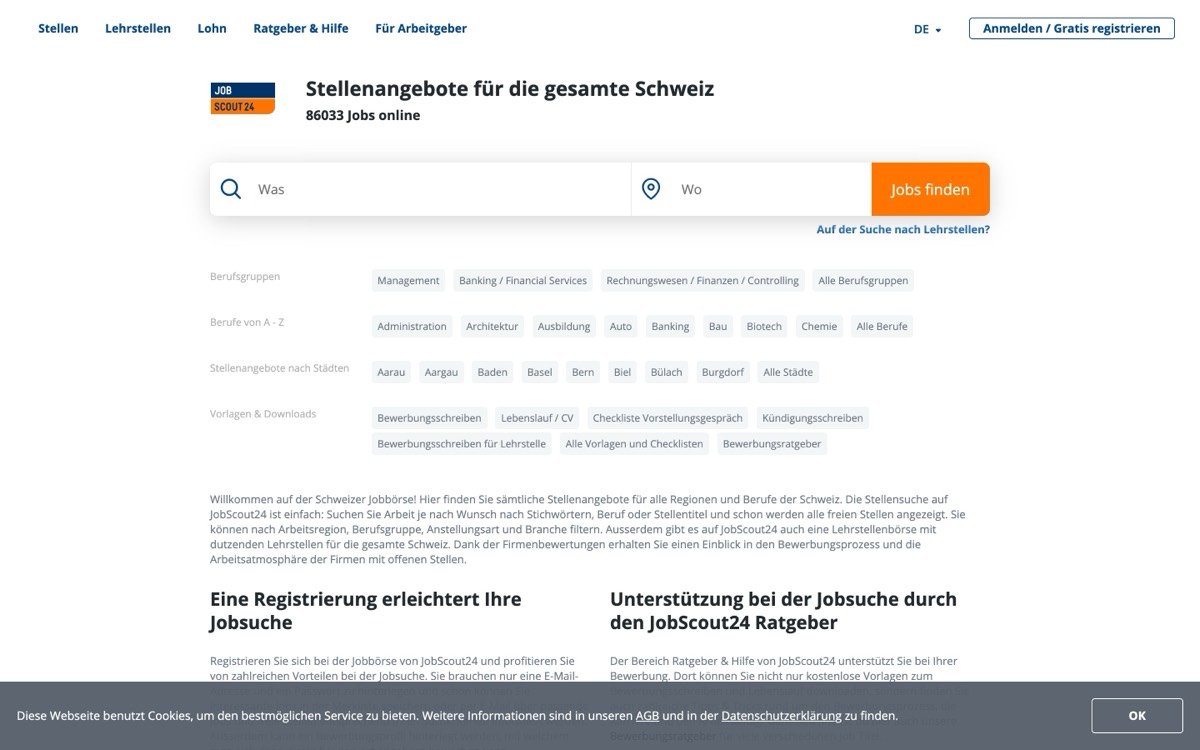
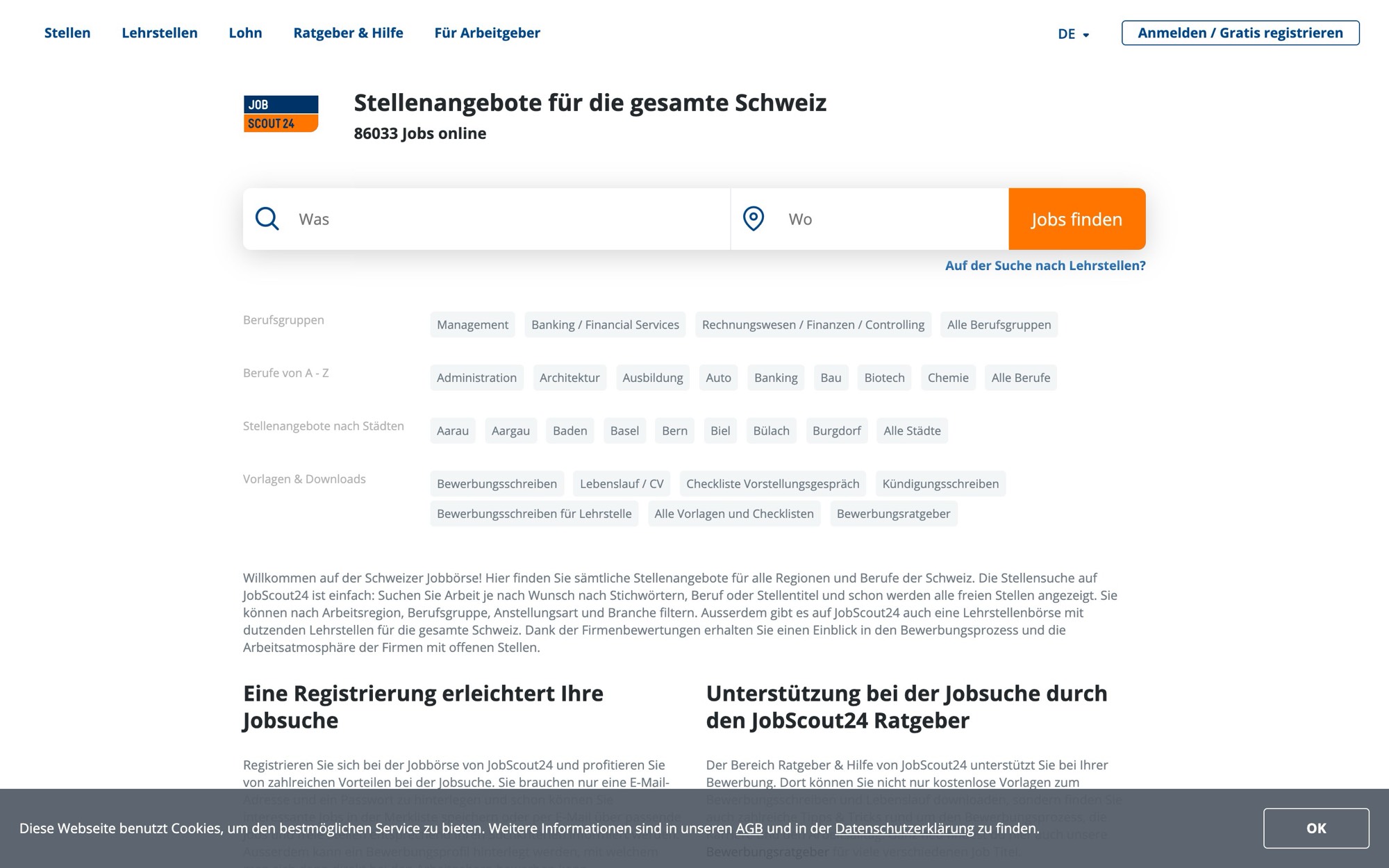
A third brand from the same company. Searching all three to widen your search means searching one provider three times.
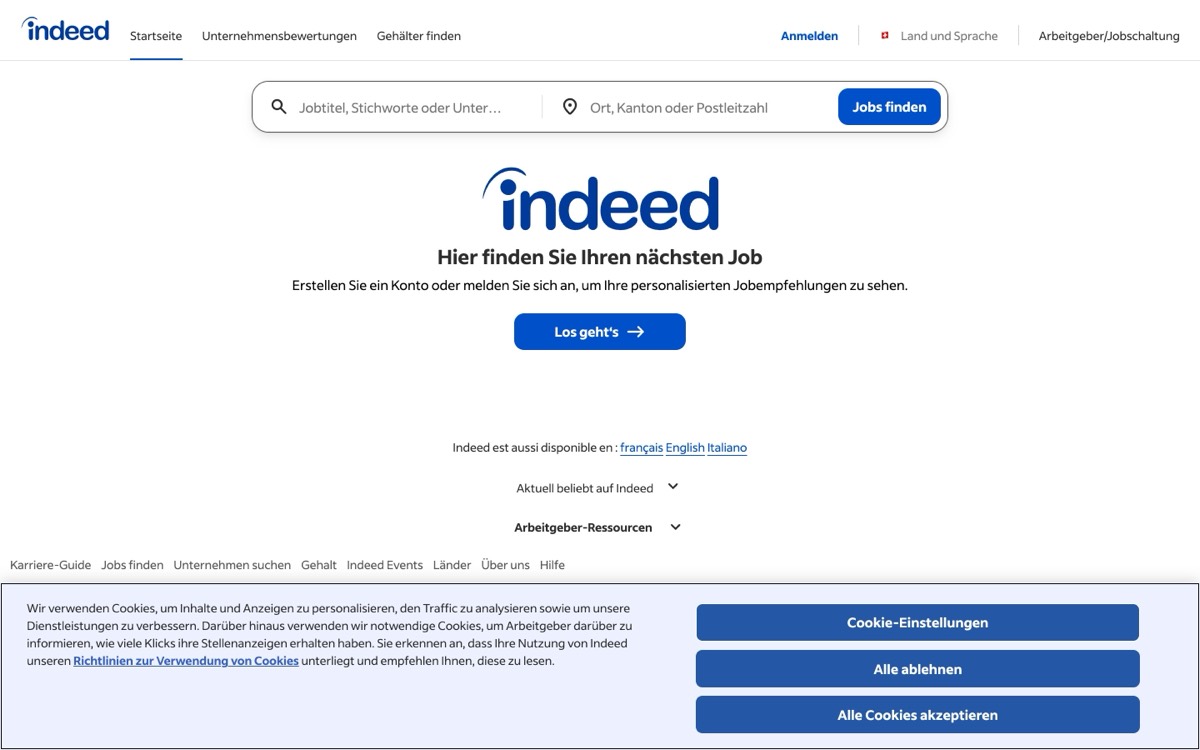
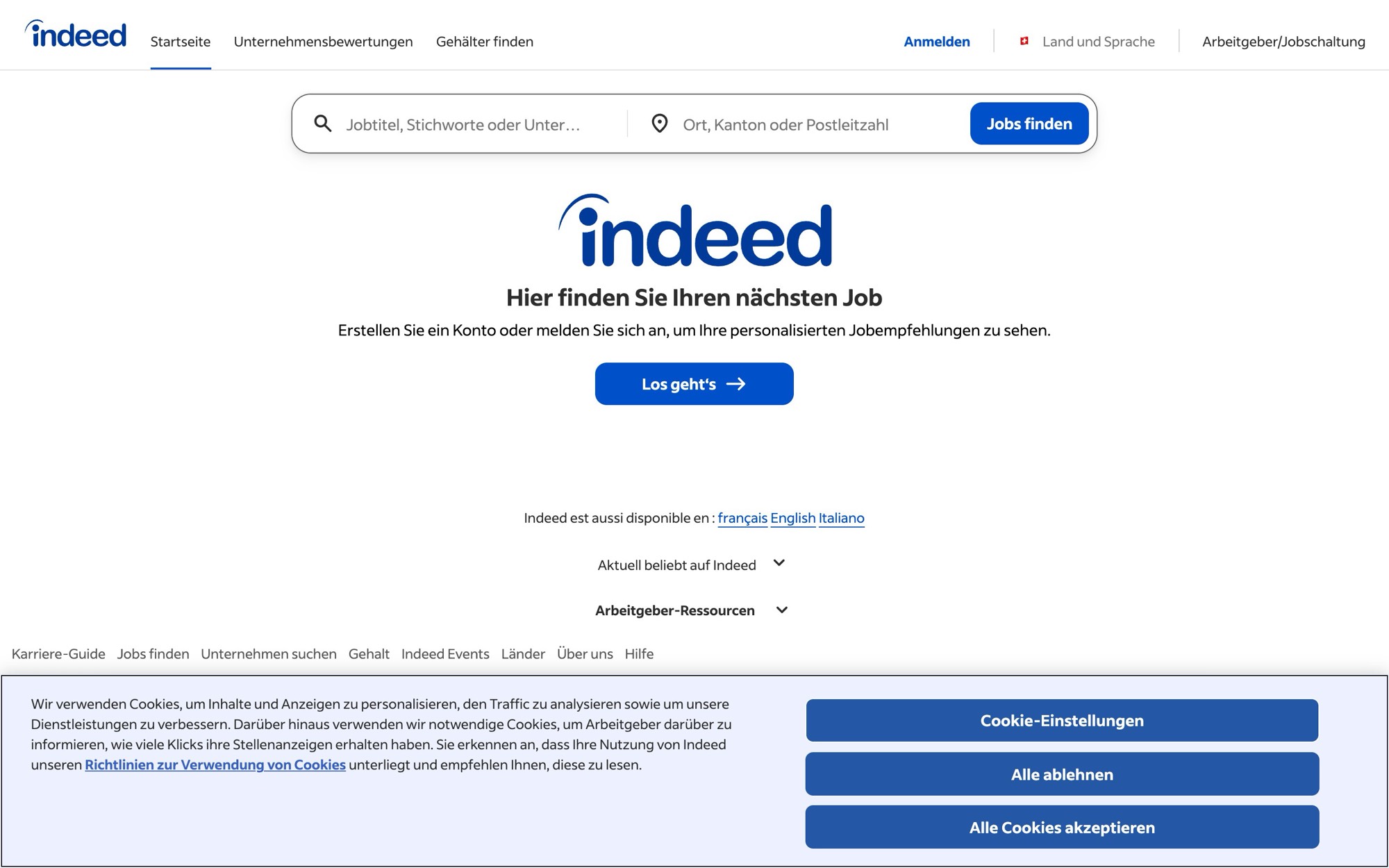
The broadest aggregation, because Indeed also collects from other boards — at the cost of many duplicates of the same advert.
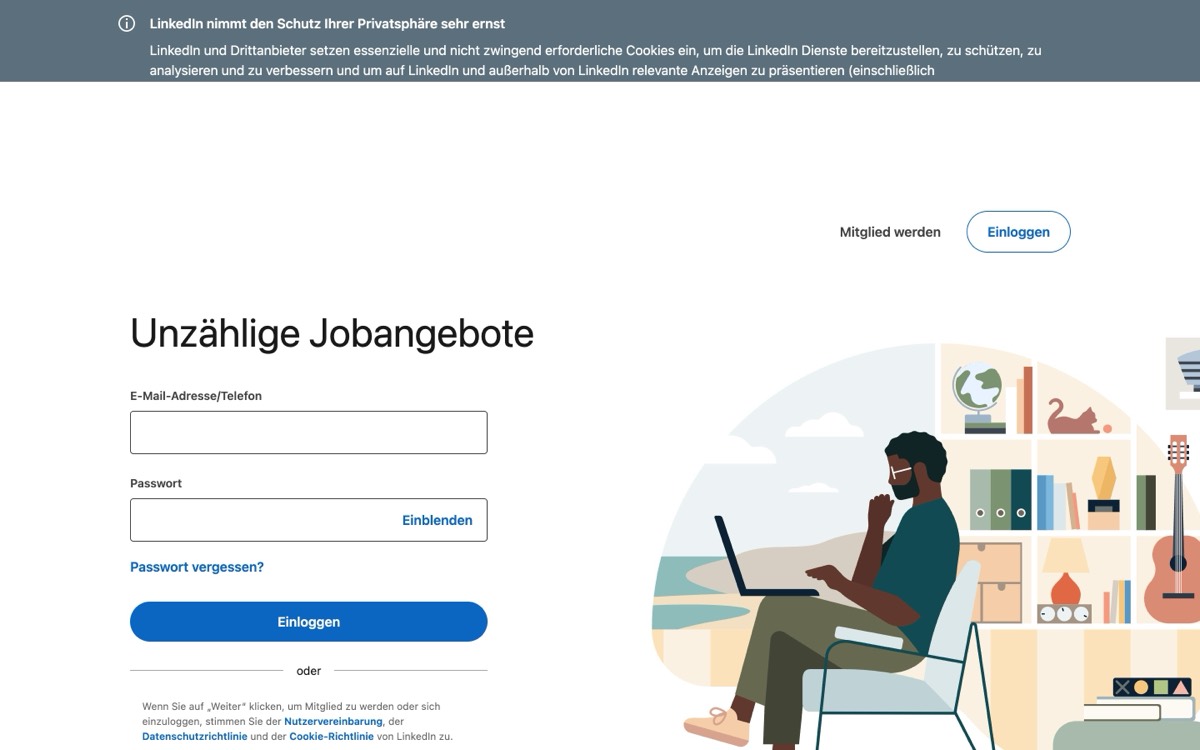
The best reputation for English-speaking and international roles in Switzerland. Considerably thinner for trades, care and commercial roles.
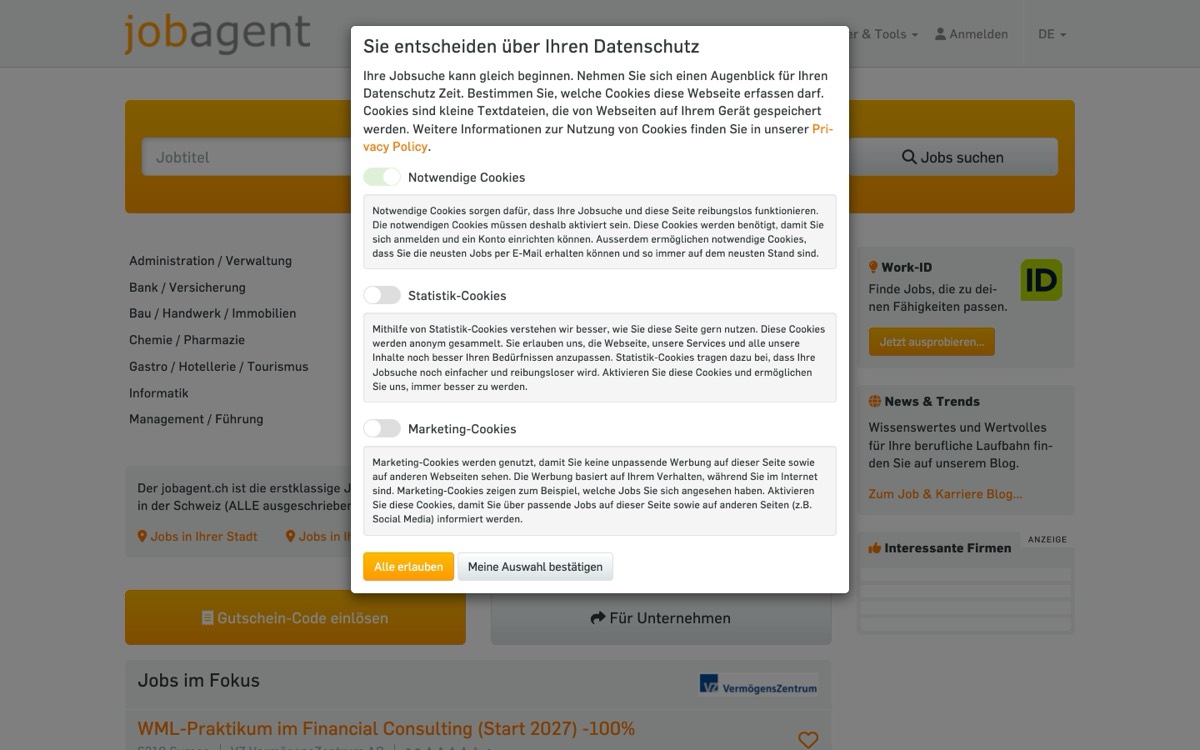
A meta-search across the Swiss job boards, "every job in Switzerland at a glance". Its strength is the Job-Abo: a saved search that mails you new adverts from every portal it covers. Salary calculator and application guides alongside.
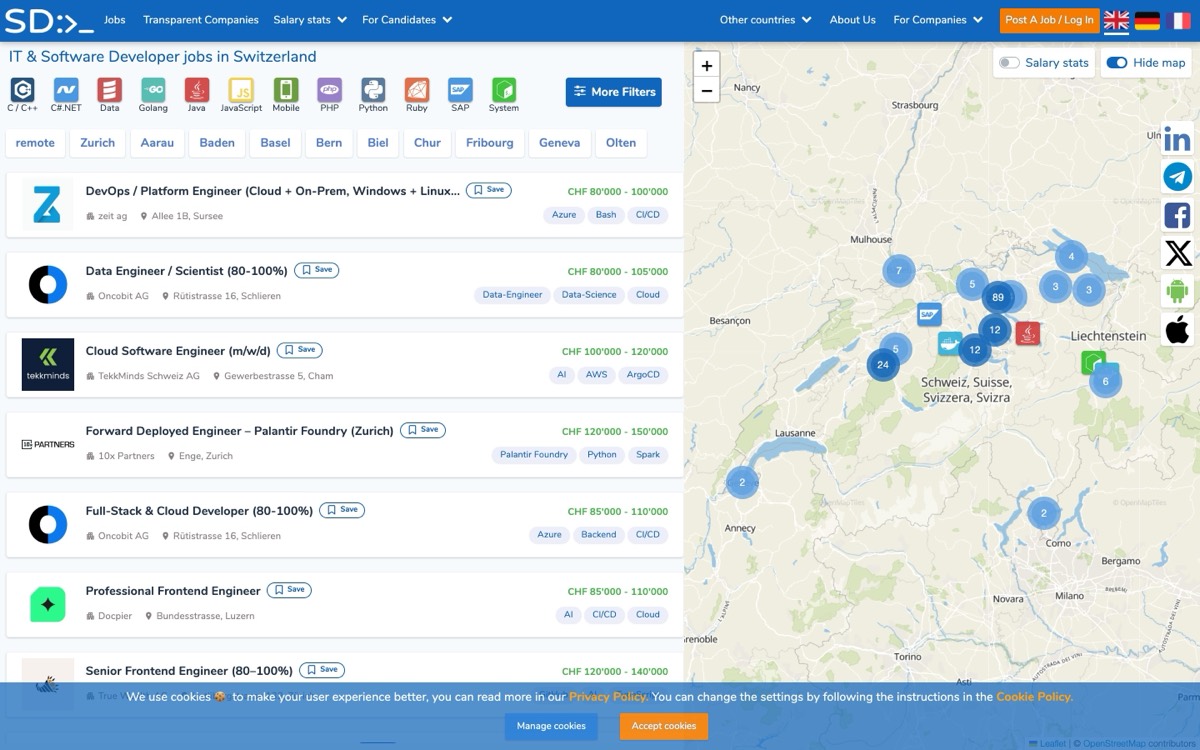
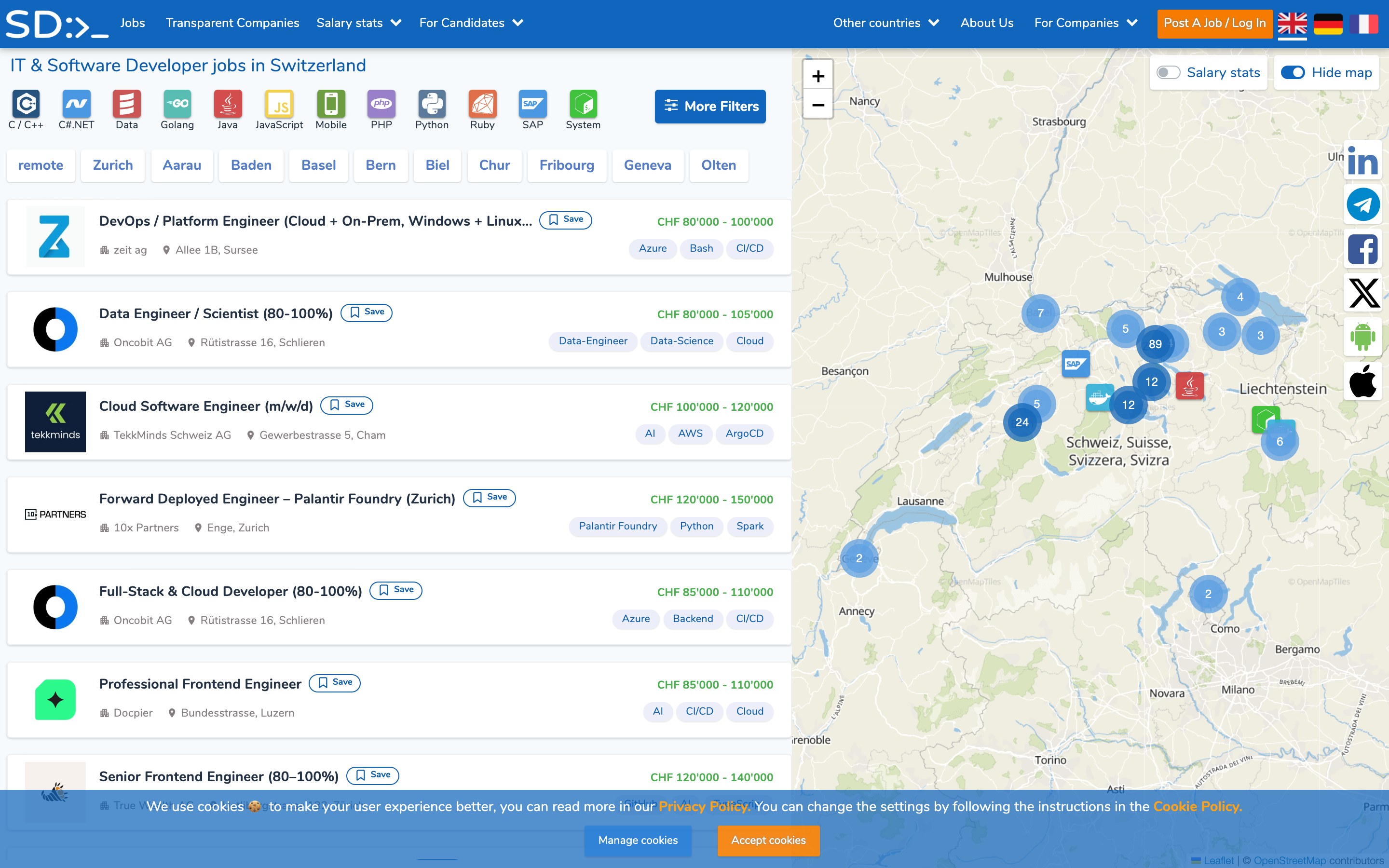
IT and software only, and thorough about it: "183 IT & Software developer jobs in Switzerland", filtered by technology (C#, Java, Python, DevOps, ML) rather than by industry. Publishes salary statistics and lists the companies that disclose their ranges. The site itself is in English.
Jobs by profession, city or language
Type a profession, a city or a language, the page shows the adverts currently open for it.
By profession
- Consultant
- Project Manager
- Retail Sales
- Nurse
- Nursing & Care
- Administrative Assistant
- Account Manager
- Software Engineer
- Public Administration
- Architect
- Insurance
- Chef
71 more — narrow the search
By work type
What you then see is shaped by a handful of senders. The single largest poster accounts for around eleven percent of all Zurich adverts, and the ten largest together for close to three in ten. At the same time, exactly half of the employers with a Zurich advert have only one — and together those single adverts add up to about as much as the largest poster alone.
Zurich is also not Switzerland in miniature. The canton carries just under a fifth of all adverts but around four in ten consulting roles and four in ten senior titles, while holding only about one in eight of the country's care and health roles and one in seven of its part-time adverts.
Share of each group of adverts that falls in the canton of Zurich. Ongoing analysis of the open Swiss adverts we track, August 2026.
- A literal search for «Zürich» returns only about three quarters of the canton's adverts: roughly one in six writes «Zurich» without the umlaut, and almost one in ten names no Zurich place name at all.
- The largest single poster in the canton is an intermediary and accounts for about eleven percent of Zurich adverts; the ten largest together for about 29 percent.
- Half of all employers advertising in Zurich have exactly one open role; together they make up around eleven percent of the canton's adverts.
- A senior, lead or head title appears in about 23 percent of Zurich adverts, against about 9 percent in the rest of the country.
- The median Zurich advert is around 26 days old, against about 19 days elsewhere — only about one in ten is less than a week old.
- Where German is required in Zurich, more than nine times in ten it is asked at professional or native level.
«Zurich» is three different places in one word
This is the mistake that costs the most choice, and it happens before your first click. Of the adverts we place in the canton of Zurich, around 75 percent use the umlaut spelling, a little over 15 percent write «Zurich» or «Zuerich», and just under 10 percent contain no form of the name at all — they sit under Winterthur, Wallisellen, Dübendorf, Uster, Schlieren, Opfikon, Dietikon or Kloten. Searching for one spelling therefore returns a slice, and not a random one: the English spelling clusters in internationally advertised roles, while the surrounding towns carry industry, logistics and trades.
The second ambiguity is city versus canton. About nine in ten adverts in our Zurich set name the city itself; just under one in ten name another place in the canton. For you that is a commute decision, not a volume one. A role in Wallisellen or Schlieren is often closer to the main station than an address in the outer city districts, but it only appears if you query the canton or a list of towns.
Finally, «Zurich» is also a company name in Switzerland. Part of what a plain text search returns comes from insurers and financial firms carrying the word, or from adverts listing several locations at once — «London; Zurich» is a common form. Those adverts are not wrong, but they are not always a Zurich job either. With international employers, always check the place of work in the body text.
In practice: make a canton query your baseline rather than a place name, and if you keep a list of towns, include the agglomeration communities that already belong to the Zurich labour market in everyday life.
Who actually advertises in Zurich — and why page one misleads
A Zurich list looks diverse and is highly concentrated at the top. The single largest poster in the canton carries around eleven percent of all Zurich adverts, the three largest together just over 20 percent, the ten largest around 29 percent. The leader is not an employer in the usual sense but an intermediary advertising mandates for other firms; behind it come a sportswear company headquartered in the city, a large retailer, the big audit and advisory firms, and the Zurich private banks.
At the other end sits the half of the market almost nobody scrolls to. Exactly half of the employers with a Zurich advert have precisely one. Together those single adverts account for around eleven percent of the canton's supply — roughly the same as the largest poster on its own. They are the part of the list with the fewest competing applicants, because they neither rank at the top nor carry a name you recognise.
That suggests a very concrete tactic. Do not only read a Zurich list by relevance; work it deliberately from the back as well, and treat intermediary adverts for what they are — access to a mandate whose employer is not named in the text. If one interests you, ask which company and which contract type before you send a full dossier.
The reverse also holds. If your occupation in Zurich is advertised mainly by two or three high-volume senders, the Zurich list is exhausted quickly, and adding a neighbouring canton will do more for you than adding another job site.
Zurich is not a scaled-up Switzerland
The canton carries just under a fifth of all the adverts we track — but not a fifth of every occupation. Of all Swiss adverts with a consulting title, around 42 percent are in Zurich; of senior titles around 40 percent; of English-language adverts and of finance and banking roles around 35 percent each; of IT and software titles around 30 percent. Those are far above the canton's overall share: in these fields Zurich is not merely large, it is dominant.
The opposite direction is just as clear. Only around 13 percent of the country's care and health roles, and around 14 percent of adverts explicitly posted as part-time, are in the canton of Zurich. Logistics, construction and the trades are likewise under-represented relative to the canton's overall weight. If you work in those fields you will still find many roles in Zurich in absolute terms, but no structural advantage over where you already live — and more applicants per role.
The second divide runs along seniority. A senior, lead, head or director title appears in about 23 percent of Zurich adverts against about 9 percent in the rest of the country. Zurich is where experience is most in demand, and equally the place where an entry-level profile stands out least. Junior, trainee and internship titles are also somewhat over-represented, but nothing like as strongly as senior roles.
So frame the search as «my occupation, my level, in the Zurich area» rather than «jobs in Zurich». A location filter on its own tells you nothing about whether this market suits your profile.
The Zurich list is older than it looks
The largest market is not the freshest one. The median Zurich advert is around 26 days old, against about 19 days in the rest of the country. Only around 10 percent of Zurich adverts are less than a week old, while roughly 32 percent are more than two months old. Part of the reason is structural: demanding specialist and leadership roles stay open longer, and high-volume senders leave adverts running until a post is filled.
Two things follow. First, sort by date before you work through a list, or you will systematically apply to roles whose selection process is already under way. Second, an old advert is not a lost advert. When a role has been open for weeks, the first round often produced nothing — which is a good moment for an application that speaks directly to the requirement the text keeps stressing.
The weekly rhythm is measurable too. Around 20 percent of Zurich adverts appear on a Wednesday and about as many on a Thursday, against roughly 7 percent on Saturday and 3 percent on Sunday. If you look once a week, look on Thursday or Friday; if you look on Monday, you are mostly seeing what was left over from the end of the previous week.
Because the Zurich list is long, a saved search you run weekly beats one broad sweep. In this market the gap between applying in the first days and applying three weeks later matters more than the gap between two job sites.
Language: English is everywhere, German is still the condition
Around 42 percent of Zurich adverts are written in German and around 37 percent in English; for the remainder the language cannot be determined reliably. That near-parity is where the city's reputation comes from — in the rest of the country the English share is about 16 percent. Zurich is the largest English-language segment in Switzerland: roughly 35 percent of all English-language adverts in the country sit here.
But the language of the advert is not the language required. Four in five Zurich adverts state at least one language requirement; of those, around 66 percent ask for German and around 60 percent for English, with French at only about 7 percent. The level is what decides: where German is asked for, more than 91 percent of the time it is at professional or native level. «Some German» almost never clears the bar in this market.
Conversely, around 33 percent of Zurich adverts with a stated language requirement ask for no national language at all, against about 16 percent in the rest of the country. That is the real room newcomers have — it exists, but it is not spread evenly across occupations.
So if you are searching without German, filter by employer type rather than by advert language: firms whose revenue and research are international run in English, firms serving the Swiss domestic market do not. And if you are learning German, the step that opens Zurich roles is the one to professional level, not the one from A2 to B1.
If you become unemployed in the canton of Zurich, your RAV depends on your postcode
The canton of Zurich runs fourteen regional employment centres (RAV), and which one is yours is decided by the postcode where you live, not where you work. The city of Zurich alone has five: Lagerstrasse, Schärenmoosstrasse, Nansenstrasse, Vulkanstrasse and Hardturmstrasse. The others are in Winterthur, Uster, Dietikon, Thalwil, Meilen, Regensdorf, Bülach, Rüti and Fehraltorf, and the canton publishes a postcode lookup for them.
On timing the canton is unambiguous: register while you are still working your notice period, and at the latest on the first day of unemployment. Unemployment insurance benefits can only run from the date you register with the RAV, and you have to document your job-search efforts during the notice period already. Waiting costs days you cannot recover.
Registration is possible online or in person; which documents you need and which unemployment fund you choose are set out on the canton's own page. Registration matters for your Zurich search even if you are looking on your own, because the roles reported to the public employment service and the counselling that comes with it run in parallel with whatever you do yourself.
Market figures come from our ongoing analysis of the open Swiss adverts we track, as of August 2026. "Zurich adverts" means the canton of Zurich: adverts marked with canton ZH plus adverts whose location names a Zurich municipality. Canton comparisons use only adverts whose canton can be determined. Language shares are derived from the advert text; about a fifth remain undetermined. Occupation groups are inferred from the job title and are therefore an approximation. We publish shares, not absolute inventory figures. Information on the RAV offices in the canton of Zurich comes from the canton's own pages (in German).
Sources
Related questions
What our job index says about the Swiss market
Computed live from our own index, not quoted from a study. Shares only, as of today.
Language the advert is written in
- Deutsch
- 60%
- English
- 23%
- Français
- 13%
- Italiano
- 3%
Of adverts that state a language requirement, the share asking for
- Deutsch
- 70%
- English
- 43%
- Français
- 21%
- Italiano
- 3%
19% posted in the last 7 days · Largest markets: Zürich 18% · Bern 10% · Genève 5% · Basel 5%