Personal details on a Swiss CV — photo, date of birth, nationality, work permit
Updated:
The block that carries more on a Swiss CV than almost anywhere else: what belongs in personal details, what is genuinely optional, and what Swiss law actually says about any of it. The block list is official; the legal reading comes from the Gender Equality Act and the Code of Obligations; the market figures are counted from the adverts live on SwissJobs.app.
- Should I put a photo on my Swiss CV?
- Should I include date of birth and nationality?
- How do I state my work permit?
Should I put a photo on my Swiss CV?
In short
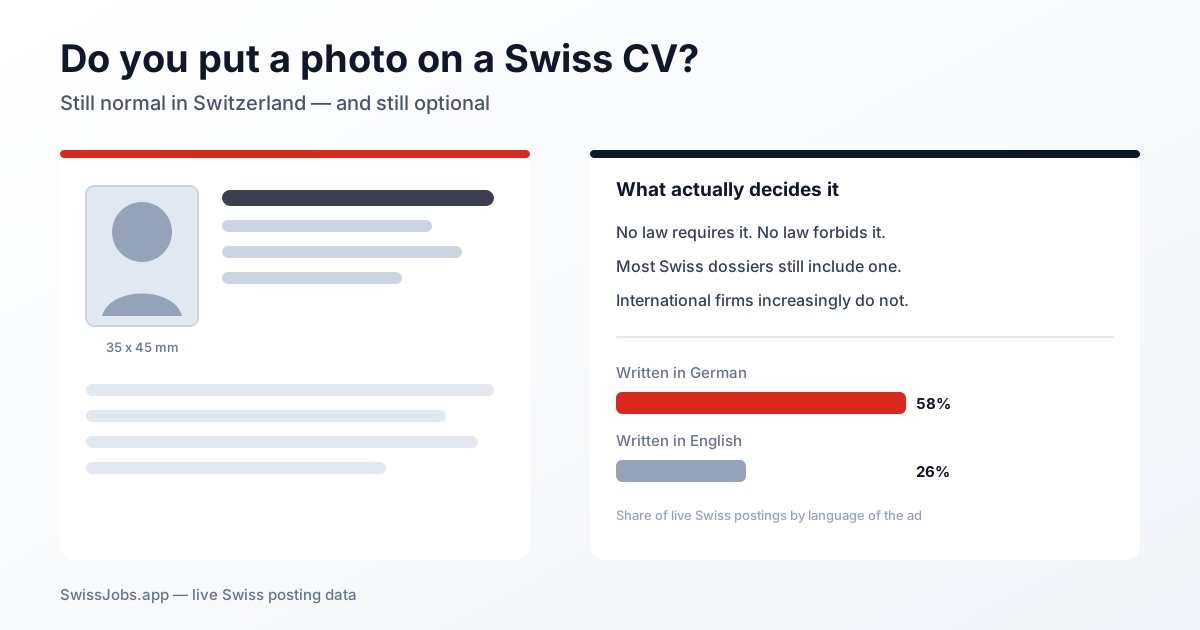
Yes — it is still customary, and it is still optional. Switzerland's official job-seeker guidance lists a photograph inside the personal-details block of the CV. No Swiss statute requires one and none forbids one. Put it at the top of page one, beside or above your personal details, recent and in portrait format. Leave it off when the advert asks for an anonymised file, or when the only picture you have is a holiday crop — a bad photo costs you more than a missing one does.
The reason this question gets a different answer in Switzerland than in Germany, the UK or the United States is not recruiter taste. It is the legal background. Switzerland has no general equal-treatment statute governing private-sector hiring. The one federal act that expressly covers hiring is the Gender Equality Act, and it protects against disadvantage on grounds of sex, marital status, family situation and pregnancy — not age, not origin, not appearance. A photo has therefore never become a legal liability here, and conventions that carry no legal risk do not disappear on their own.
The second half of the answer is practical, and it is where being a job board rather than a template site helps. Of the adverts live on SwissJobs.app, English-language ones behave completely differently from the rest: 65.5 per cent of them hand your application to an internationally sold HR suite and only 1.3 per cent to recruiting software built in Switzerland. German-language adverts run the other way — 41.8 per cent Swiss software against 12.6 per cent international suite. If you are answering an English advert in Switzerland, you are usually not applying into the Swiss convention at all.
- The photo belongs inside personal details — not in a section of its own, and not on a cover sheet. The official guidance lists eight CV components: the title, personal details including a photograph, professional experience to date, education and training, language skills, special knowledge or activities, personal interests, and references. The picture is a detail of the first block.
- The same official page grades the requirement differently in each of its four languages. German says «Persönliche Daten, gegebenenfalls mit Bewerbungsfoto» — personal details, if applicable with a photo. English drops the hedge: «personal details, including photograph». French goes furthest and asks for «données personnelles avec photo vous mettant en valeur», a photo that shows you to advantage. Italian asks for the photo «nell'apposito formato».
- The Gender Equality Act (SR 151.1) prohibits sex discrimination and says in Article 3(2) that the prohibition applies «in particular to hiring». It contains no rule about application documents and no list of impermissible details, so nothing in it makes a photo unlawful — or lawful to demand.
- Article 6 of that act reduces the burden of proof for allocation of duties, working conditions, pay, education and training, promotion and dismissal. Hiring is absent from that list — in the German, French and Italian versions alike. A rejected applicant claiming discrimination therefore carries the full burden, without knowing who else applied.
- Article 8 lets a rejected applicant request a written statement of reasons, but the right to compensation is forfeited unless an action is brought within three months of the refusal. Article 5 caps that compensation at three months' pay — and caps the total at that figure even if several people claim over the same post.
- Article 328b of the Code of Obligations (SR 220) allows an employer to process data «only insofar as it concerns the employee's suitability for the employment relationship or is necessary for the performance of the employment contract», with the Data Protection Act of 25 September 2020 applying otherwise. That binds the employer's processing, not your choice of what to send.
- Note that the English text of Swiss legislation on fedlex carries its own warning: English is not an official language of the Confederation, and the translation «has no legal force». For anything that matters, the German, French or Italian version is the text.
One authority, four degrees of insistence
Almost every Swiss CV article traces back to the same page: the official application guidance published by the federal job-seeker service. It is authoritative, it exists in four languages, and it enumerates what a CV contains. The photo appears there. It just appears differently each time.
The German version writes «Persönliche Daten, gegebenenfalls mit Bewerbungsfoto». «Gegebenenfalls» means where applicable — a genuine hedge. The English version of the same page drops it and says «personal details, including photograph». The French version goes furthest of all: «données personnelles avec photo vous mettant en valeur» — personal details with a photo that shows you to advantage, so not merely a picture but a good one. The Italian version asks for «dati personali, inclusa la vostra fotografia nell'apposito formato».
This is not a translation slip; it is a map of the convention. In German-speaking Switzerland the application photo is very common but negotiable. In French-speaking Switzerland and Ticino it is closer to a given. When two guides tell you opposite things about Swiss CV photos, they are usually not disagreeing about the law — they are writing from different language regions, and each is quoting the same federal page.
Why Switzerland kept the photo when its neighbours dropped it
In many markets the application photo has quietly disappeared, because a general anti-discrimination framework covers private hiring and employers treat every avoidable signal about age, origin or appearance as exposure. A German or British template therefore arrives on your desk with no space for a picture — not because it is more modern, but because it comes from a different legal order.
Switzerland never made that move. For employment relationships under the Code of Obligations, the Gender Equality Act is the only federal act that reaches hiring itself. Article 3(1) prohibits direct and indirect disadvantage on grounds of sex, expressly including marital status, family situation and, for female employees, pregnancy. Article 3(2) states that the prohibition applies in particular to hiring, allocation of duties, working conditions, pay, training, promotion and dismissal.
What the act does not do matters just as much. It says nothing about what an application file may contain. It lists no impermissible questions. And it does not cover age, origin or appearance as protected grounds at all. A CV photo is, in Swiss law, simply not a subject — which is precisely why the convention was never put under pressure.
How narrow the legal route after a rejection really is
Reading the rest of the Gender Equality Act explains why Swiss employers are relaxed about personal details in a way that surprises people arriving from the EU. Article 6 eases the burden of proof — but only for allocation of duties, working conditions, pay, basic and continuing education and training, promotion and dismissal. Hiring is not on that list, and the omission is identical in the German, French and Italian texts.
So an applicant who suspects a discriminatory rejection has to prove it while knowing nothing about the other candidates. Article 8(1) at least gives a rejected applicant the right to request a written statement of reasons from the employer. Article 8(2) then imposes a hard deadline: the right to compensation is forfeited unless an action is brought within three months of the employer giving notice of refusal.
Even a successful claim is bounded. Article 5(2) gives, in the case of a discriminatory refusal of employment, a right to compensation only — not to the job. Article 5(4) caps that compensation at the equivalent of three months' salary, and states that the total may not exceed that figure even where several people claim over the same discriminatory refusal. That is the whole lever, and it explains Swiss practice better than any argument about design taste.
What an employer may actually do with the picture
The second relevant provision sits in the Code of Obligations. Article 328b reads: the employer may process data concerning the employee only insofar as such data concern the employee's suitability for the employment relationship or are necessary for the performance of the employment contract. The second sentence refers everything else to the Data Protection Act of 25 September 2020, in force since 1 September 2023.
Advice sites frequently present this article as a ban on CV photos. It is not. It is addressed to the employer and limits what the employer may process — not what you may enclose. The distinction is practical. A photo you volunteer is your decision. An employer who insists on a photograph for a role with no public-facing element is on thinner ground, because they would have to explain what the picture says about suitability.
For you, the useful consequence is simple: on this question you genuinely have a choice, and it is a protected one. No one may reject your file on the formal ground that it carries no picture.
Where your PDF actually lands — and why that settles it
A CV is never sent into a vacuum. It is sent into a specific system, and Swiss adverts do not all point at the same kind of system. Of the adverts live on SwissJobs.app on 22 August 2026, 44.5 per cent send the application to a careers address belonging to the employer itself, 31.8 per cent to recruiting software built in Switzerland, and 23.2 per cent to an internationally sold HR suite. Half a per cent stays on LinkedIn.
Split by the language the advert is written in, the picture changes sharply. Italian-language adverts route to Swiss-built software 77.3 per cent of the time — the highest share of any language. German-language adverts: 41.8 per cent Swiss software against 12.6 per cent international suite. French-language adverts send 58 per cent straight to the employer's own careers address. English-language adverts invert everything: 65.5 per cent international suite, 1.3 per cent Swiss software.
For an English-speaking job seeker this is the single most useful number on the page. The adverts you can read are, disproportionately, the adverts that route into systems designed and sold for the American and British hiring market — the same market where a CV photo is actively discouraged. That does not prove what the person at the far end thinks about photos. It does tell you that the English-language slice of the Swiss market is the slice least anchored to the Swiss convention, and that leaving the photo off there is a defensible choice rather than a mistake.
There is also useful concentration here. The ten most common application addresses cover about a third of all adverts, and the hundred most common cover just over three fifths. Over a real search you meet the same handful of forms repeatedly, so it is worth keeping one clean file that works in the two or three you meet most.
The decision rule, short
Include a photo if you have a recent, calm one and nothing in the advert argues against it. That is the ordinary case in Switzerland and it costs you nothing.
Leave it off when the advert or the employer explicitly asks for an anonymised application — those processes exist and respecting them reads as attention, not as omission. Leave it off when your only available picture is a cropped holiday snap. No picture is neutral; a badly lit crop is not.
Whichever way you go, keep the image inside the PDF and never attach a separate image file. What you upload is a document, and everything on page one travels with it — whichever of those systems receives it.
What people report
Among the Swiss CV posts collected for the SwissJobs.app CV guide, only a handful address the photo at all — and those that do split cleanly in two. One group says the photo remains customary in Switzerland and helps at the shortlist stage; the other says it is not required and invites bias. Both groups write from Swiss recruiting practice.
A count over the Swiss CV posts gathered for the SwissJobs.app CV guide; only a small number mention the photo, and those were read individually.
In the same set, leaving the photo out appears twice as a selling point: platforms advertise dossiers passed to employers without a name and without a picture. That suggests anonymised processes do exist in Switzerland — but have to be marketed as a distinguishing feature rather than assumed as the norm.
The same set of Swiss CV posts; the observation rests on how those providers describe themselves, not on any audit of what they do.
The photo is the one point of Swiss CV convention where practitioners openly disagree. Most posts call it expected; recruiters arguing the other way cite unconscious bias and the space it costs. Both camps work in the same industry — so the convention is real, but it is not a rule you cannot break.
Opposing positions in Swiss LinkedIn posts by recruiters and applicants, read in August 2026.
Every market figure here was counted on 22 August 2026 from the adverts live on SwissJobs.app at that moment. Adverts were grouped by the address they send the application to: addresses belonging to known Swiss-developed recruiting products, addresses belonging to internationally sold HR suites, LinkedIn, and — as the remainder — careers addresses on the employer's own domain. That remainder also contains white-labelled products running under an employer domain, so it describes the address rather than the software behind it. The language split rests on the adverts whose language was identified, just under three quarters of the stock; the Italian-language slice is the smallest of the four and correspondingly noisier. Legal points come from the Gender Equality Act (SR 151.1) and the Code of Obligations (SR 220) on fedlex; the CV contents come from the four language versions of the official application guidance on arbeit.swiss.
Should I include date of birth and nationality?
In short
Yes on both, and neither is compulsory. The federal application-tips page lists eight parts of a CV and, at the second one, writes only «personal details» — the German, French and Italian versions all stop at exactly the same point, with no birth date and no nationality behind it. Write the date anyway, as a date rather than an age, and put your nationality on one line together with your permit status and where you live. You may leave both out; in a Swiss dossier the absence is noticed the moment somebody looks for them.
The two fields are almost always named in the same breath, and they do completely different jobs. Nationality is there because the employer has a decision to make that he cannot make without it: whether he can simply hire you or whether a procedure comes first. The date of birth is there by convention — and it is the one line in the block that translates directly into money for him, because Swiss occupational pension contributions are staged by age.
Swiss adverts themselves barely touch either subject. Across the Swiss adverts with a readable description recorded on 22 August 2026, fewer than one advert in a thousand mentions nationality at all, while 23.0 per cent name a qualification and 2.1 per cent ask for a driving licence. An advert is about thirty times more likely to want your driving licence than your passport. Neither field is on your CV because a posting demanded it; both are there because the person opening your PDF would otherwise have to work them out.
Share of adverts with a readable description, counted on 22 August 2026 across the stock then live on SwissJobs.app.
- Write a date, not an age. «14.03.1989» stays true; «37» is wrong in four months, and a CV gets reused for years. The date belongs in the personal-details block at the top, not in a footer and not on a separate line at the bottom of page two.
- One line, three elements: nationality, status, place of residence. «British citizen, B permit, resident in Zug» answers everything a first reader needs. «British» on its own answers almost nothing — it could equally describe somebody still living in Manchester with nothing arranged.
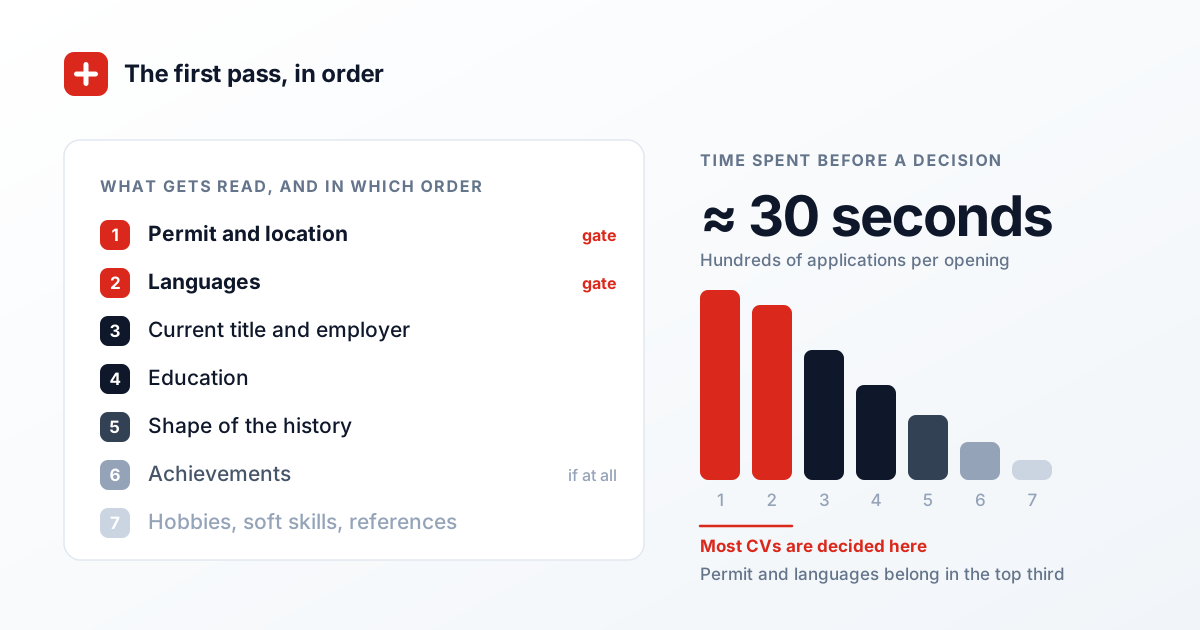
- Keep it in the top third of page one. The block is read before anybody weighs your experience, and a reader who has to hunt for your status on page two has usually stopped reading before finding it.
- Never put your AHV/AVS social-security number on a CV. Today's number is deliberately non-speaking: it encodes no birth date, no sex, nothing. It exists as an identifier for authorities and for your employer once you are hired, not for an application.
- Leave out marital status, children and religion. The one federal act that reaches private hiring directly protects against disadvantage on grounds of sex, marital status, family situation and pregnancy — volunteering exactly those facts hands over the characteristics that protection was written for.
- If you drop the birth date, your year figures have to be complete. Without it, a first reader infers your age from your education dates, and a missing year then reads as a gap rather than as a decision.
The official Swiss list stops exactly where the question starts
Every Swiss CV convention eventually traces back to the same page: the application tips published by the federal employment service. It is official, it exists in several languages, and it enumerates what a CV is made of — the title «Curriculum vitae», personal details, previous professional activities, schools and further training, language skills, particular skills, interests and references. Eight items, and the second one is where this question lives.
That second item says «personal details» and nothing more. We read the same page in its French and Italian versions to check whether either enumerates further: «données personnelles», «dati personali». No date of birth, no nationality, no marital status, no place of origin. The page is not shy about detail elsewhere — the application photograph is named explicitly — so the silence here is not an oversight but the absence of a rule.
This matters for a specific reason. People arriving from the United Kingdom, Ireland or North America often assume Switzerland has a rulebook that mandates the personal block, and people arriving from Germany or Austria often assume the opposite, that the Swiss version is simply the German one. Neither is right. There is a convention carried entirely by practice, and a convention is anchored in the expectations of the person opening your file rather than in a text you can cite.
So the decision is yours. Which is precisely why it is worth knowing what each field sets off on the other side of the desk. For nationality it triggers a question of competence: may this employer hire you directly? For the birth date it triggers an arithmetic problem that is written into federal law.
Why a year of birth carries a price tag in Switzerland
Occupational pension law is the reason the birth date is read differently here than in countries without a compulsory second pillar. The federal act on occupational old-age, survivors' and invalidity benefit provision sets the retirement credits as a percentage of the coordinated salary, staged by age: 7 per cent for ages 25 to 34, 10 per cent for 35 to 44, 15 per cent for 45 to 54 and 18 per cent from 55 onwards.
Then comes the split. The same act requires the employer's contribution to be at least equal to the total contributions of all his employees. The employer therefore carries at least half, and that half rises with the age of the workforce. Two people on identical salaries, one in their early thirties and one in their mid-fifties, are not equally expensive to the same company. The difference is in the statute, not in anyone's prejudice.
The act also ties the insurance directly to your birth date. An employee earning more than CHF 22 680 a year with one employer is insured for death and invalidity from the 1 January following their seventeenth birthday, and for old age from the 1 January following their twenty-fourth. The pension institution computes from your date of birth the moment you are on the payroll — which means the number cannot be withheld permanently, only until the contract is signed.
That is the honest version of the answer. Putting the date on your CV gives the employer information earlier that he receives anyway. It costs you nothing when your age band matches the level of the role, and it can cost you something when it does not. Somebody over fifty-five applying into a high-volume screening process has a real reason to leave it off. What they cannot do is leave it off and also leave the year figures incomplete.
Nationality answers a question your employer is not asking
The commonest mistake in this block is not omitting nationality but writing it alone. «German» tells a Swiss reader almost nothing. It could be somebody in Munich who has arranged nothing, or somebody who has lived in Zurich for twelve years and holds a settlement permit. Those are entirely different starting positions for the employer, and one word cannot separate them.
The same holds in reverse. A Swiss passport with an address in Singapore raises practical questions about a start date; a non-EU national with a settlement permit and a flat in Basel raises none at all. What carries the information is always the combination — citizenship, permit or status, place of residence. Three elements, one line, no explanation attached.
This is also why the line is worth writing when you are Swiss. It saves the first reader an assumption, and assumptions about a foreign-sounding name do not reliably fall in your favour. «Swiss citizen, resident in Winterthur» closes an entire category of follow-up questions before any of them are asked.
How to phrase a specific permit — which letter, which cantonal authority, what to write while a procedure is running — is a separate question that shares only its location on the page with this one. For the CV itself, the short form is enough. Anything longer belongs in the covering letter or in the first conversation.
Why there is no legal route if it goes against you
Applicants often assume that writing a birth date is risky for the employer, the way it is in the United States or the United Kingdom, because age discrimination must surely be prohibited. The Swiss Federal Constitution does name it: no person may be discriminated against, «in particular on grounds of origin, race, gender, age, language, social position, way of life» — origin and age are both expressly in the list.
The next relevant article decides whom that list binds. Fundamental rights must be upheld throughout the legal system, and whoever acts on behalf of the state is bound by them. Between private parties they apply only indirectly: the authorities «shall ensure that fundamental rights, where appropriate, apply to relationships among private persons». That is an instruction to the legislator, not a claim you can bring against a company that quietly did not shortlist you.
The only federal act reaching private hiring head-on is the one on equality between women and men, which covers sex, marital status, family situation and pregnancy. Age and origin are not in it. After a rejection there is, in practice, no provision built for the argument «it was my year of birth» — which is exactly why the convention survived here while comparable countries dismantled theirs.
The data protection act closes the circle. Its definition of sensitive personal data is a closed list: religious, philosophical, political or trade-union views and activities, health, the private sphere, affiliation to a race or ethnicity, genetic data, biometric data, criminal and administrative proceedings, social assistance measures. Neither a date of birth nor a nationality appears on it. They are ordinary personal data, legally unremarkable — and unremarkable data does not get pushed out of a convention on its own.
What English-language adverts in Switzerland ask for instead
We counted what the Swiss adverts recorded on 22 August 2026 explicitly require, splitting them by the language the advert is written in. English-language postings quantify the experience they want — 12.6 per cent state a number of years — while German-language postings do so in 0.7 per cent of cases and French-language ones in 9.9 per cent. English postings almost never ask for a driving licence, 0.3 per cent against 2.6 per cent in German and 3.6 per cent in French.
That split is a decent map of who is on the other end. An English-language advert in Switzerland usually comes from an employer whose screening habits were written somewhere else, which is why it quantifies years and never mentions a car. A German-language advert states neither, and expects your CV to show it. The same document is therefore read against two different sets of unstated expectations depending on the language it answers.
For the birth date this has a practical consequence. Where the advert never says how much experience it wants, the dates in your history carry the entire signal, and your birth year merely confirms what the education dates already imply. Where the advert asks for «8+ years», that requirement is checked against your history and the birth date adds nothing at all — which is a fair argument for leaving it off in exactly those applications.
For nationality the conclusion runs the other way. Because barely any advert raises the subject, silence in a posting is not an invitation. It usually means the employer assumes applicants who are already allowed to work here. Your CV line is the only place where that assumption gets confirmed or corrected before somebody spends time on you.
If you come from a market where this feels unthinkable
For applicants trained on American or British advice, both fields feel like a compliance error. The instinct is right about those markets and wrong about this one. In Switzerland the personal block is the part a first reader uses to place you: where you live, whether you can start, what languages you work in. Removing half of it does not make the CV neutral, it makes it incomplete in the exact place the reader looks first.
The workable compromise, if the birth date genuinely troubles you, is to keep the nationality-and-status line and drop the date. That keeps the field with operational value and removes the one with none. Do not do it the other way round: a CV that states a birth date but hides where you live and whether you may work here answers the harmless question and skips the decisive one.
Expect the rest of the dossier to reveal your age anyway. A Swiss application carries reference letters and diplomas, and both are dated. Removing the birth date from the CV while attaching a degree certificate from a particular year buys you one extra second, the one in which somebody does the subtraction.
And keep the two documents consistent. If your public profile shows a graduation year and your CV does not, the gap between them is what gets noticed — not the birth date you were trying to protect.
What people report
Of the Swiss posts collected for the SwissJobs.app CV guide, eighty discuss the CV itself. Only eight of those mention nationality or citizenship and only three mention the date of birth. The personal-details block is discussed far less often than the volume of questions about it would suggest.
Count of the Swiss posts gathered for the SwissJobs.app CV guide, by the keywords CV, nationality or citizenship, and date of birth.
Where the block is discussed, the direction is unanimous: state nationality and permit status, and treat the date of birth as still customary here. Not one post advises leaving either off, and two set the Swiss habit explicitly against American and British practice, where a birth date on a CV is treated as something an employer should never receive.
Review of the same collection; every post touching the personal-details block comes from Swiss recruitment or application coaching. What is reported is the pattern across them, not the wording of any individual post.
The market figures were counted on 22 August 2026 across the adverts then live on SwissJobs.app. Only adverts with a readable description are included, about 74 per cent of the stock. For each advert we recorded whether its description explicitly names the feature: a qualification (apprenticeship, federal certificate, degree, diploma), a quantified number of years of experience, a driving licence, or nationality. A requirement an advert assumes silently does not appear in these shares. The language split follows the language the advert is written in; the Italian-language subset is small and its values are correspondingly coarse. All figures are shares of the stock evaluated, never absolute counts. The nationality share rests on very few adverts; it establishes the order of magnitude rather than a precise rate.
Write a custom CV for every job you apply to
Most people send the same CV everywhere. The editor rewrites yours against the posting — Swiss format, the right language, in about a minute.
CV maker & resume builder: for a specific advertHow do I state my work permit?
In short
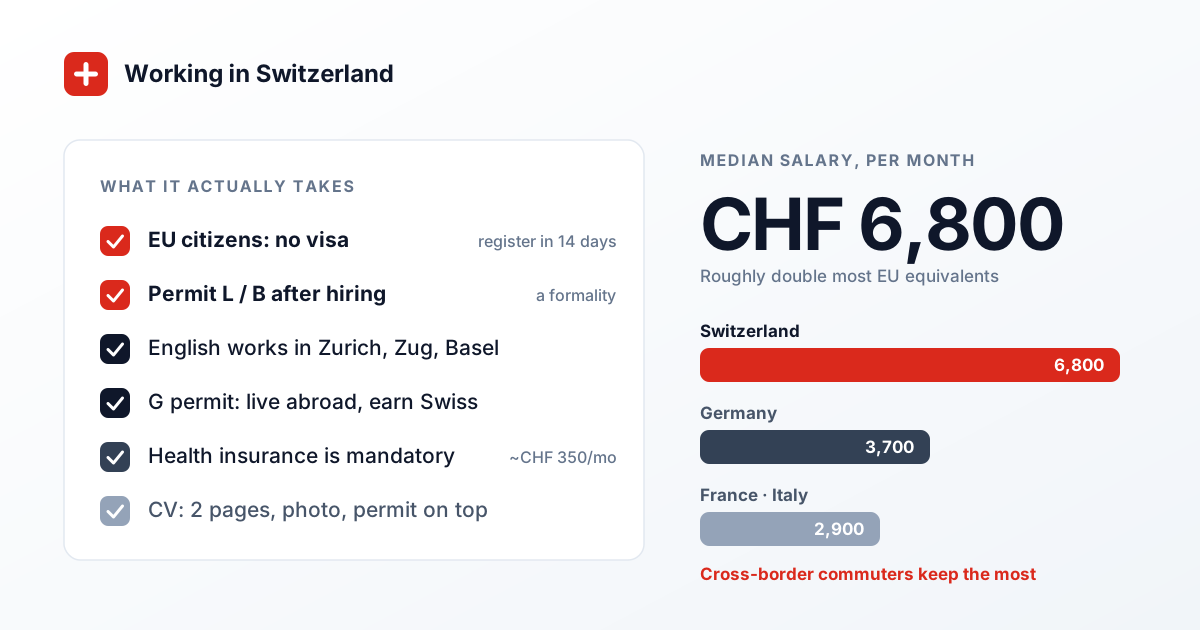
One line in the personal-details block, with the permit type written out before the letter and the validity after it: "Residence permit B (EU/EFTA), valid to 03/2028, may change employer without further authorisation". That answers something your future employer is legally obliged to establish anyway. Article 91 of the Foreign Nationals and Integration Act requires an employer, before a foreign national begins employment, to inspect their permit or check with the authorities that the person is entitled to work in Switzerland. Swiss nationals write nothing at all.
The letter on its own is the mistake. In English-language adverts a driving licence and a work permit are different words, so "B permit" reads cleanly — but the moment your CV goes to a German- or French-language employer, the bare letter lands in a market where a driving licence is named 26 times more often than a residence permit. Spell the permit type out and the ambiguity disappears in both directions.
The line is not evidence, and it should not try to be. The card itself gets inspected before your first day, not while someone is reading your dossier. So the CV carries the status: type, letter, validity, and what it allows — never the permit number, never a scan, never the address of a cantonal migration office.
What follows is the part that actually varies: what each permit lets you do, which date to print, and how the answer changes when you are applying from abroad without a permit at all.
Share of adverts that mention relocation or a relocation package, counted on SwissJobs.app on 22 August 2026 and grouped by the language the advert is written in. The English-language segment is roughly a fifth of the index and carries almost all of the relocation language; the French and Italian segments carry none of it. If you need an employer who will apply for a permit on your behalf, this is where that conversation exists — and where the permit line on your CV does the most work.
- Write the permit type in words, then the letter: "Settlement permit C", "Residence permit B", "Short-term residence permit L", "Cross-border commuter permit G". Those are the categories the Act itself uses in Articles 32 to 35.
- Put the line in the personal-details block near the top. Eligibility is checked first, in the same pass as language — a fact buried on page three is a fact someone has to hunt for.
- Add "EU/EFTA" if that is your case. The State Secretariat for Migration labels the documents exactly that way — "B EU/EFTA permit (Resident foreign nationals)", "G EU/EFTA permit (Cross-border commuters)" — and the suffix tells the reader instantly which rulebook applies.
- On a B permit, say that changing employer needs no new authorisation. Article 38 paragraph 2 says holders admitted to gainful employment may work anywhere in Switzerland and may change jobs without further permission. That is the worry behind the question, and half a clause removes it.
- On a C permit, write "indefinite" rather than a date. Article 34 paragraph 1 grants it with no time limit and no conditions; the date printed on the card comes from Article 41 paragraph 3, which has the card reissued every five years for control purposes.
- On a time-limited permit, give month and year. Where adverts raise the subject at all, roughly half of them ask for a "valid" permit — the word is aimed at a date, not at a letter.
- Say so when a renewal is running: "valid to 10/2026, renewal filed in August". A pending procedure with a date is information; an expired date with no comment is an open question.
- On an L permit, name the limit rather than hide it. Article 32 caps it at one year, extends it to two at most, and allows a change of job only for good cause; Article 40 paragraph 2 adds a cantonal labour-market pre-decision where there is no entitlement to work.
- On a G permit, give the town you live in abroad. The permit covers employment in a border zone and requires a return to that foreign residence at least once a week under Article 35 — stating it settles the commute question before it is asked.
- Leave the permit number off and attach no scan. The original document is inspected before you start; in a dossier the number does nothing except expose data nobody needs yet.
- If you hold a Swiss passport, write no line. A sentence explaining that you need no permit raises the very question it was meant to close.
- Applying from abroad with no permit yet? State the position you are in: nationality, where you live now, earliest start date — and, if you are a third-country national, that the employer files the application. Article 11 paragraph 3 puts that step on the employer, not on you.
The line answers a legal duty, not curiosity
Most personal-details questions on a Swiss CV are matters of custom. This one is not. Article 91 paragraph 1 of the Foreign Nationals and Integration Act reads, in the Confederation's own English version: "Before a foreign national begins employment, an employer must inspect their identity card or check with the competent authorities to ascertain that the said foreign national is entitled to work in Switzerland." It is a duty of care with a deadline attached — before employment begins, not at some convenient later point.
There is a criminal provision behind it. Under Article 117, an employer who intentionally employs foreign nationals not entitled to work in Switzerland faces a custodial sentence of up to one year or a monetary penalty, more in serious cases, and a fine where the act was merely negligent. The person reading your application carries a share of that exposure. It is why the permit question is asked openly in Swiss interviews while other questions about your private life are not: this one bears directly on your suitability for the specific job.
The official guidance, oddly, says nothing about it. The application-tips page on arbeit.swiss lists what a CV should contain — title, "personal details, including photograph", professional experience to date, education and training, language skills, special knowledge or activities, interests, references — and no permit appears in that list. The German, French and Italian versions of the same page list the same items and are equally silent. So the line is not prescribed anywhere; it exists because the employer's obligation exists.
That fixes both its position and its tone. Position: in the personal-details block, where the reader is already looking for nationality and contact details. Tone: factual, one line, no justification. Applicants who move the subject into a paragraph of explanation in the cover letter turn a formality into a topic, and a topic invites doubt.
And for anyone holding a Swiss passport the correct answer is silence. The duty in Article 91 concerns foreign nationals; there is no permit to name, so there is no line to write.
What the line says, permit by permit
Swiss law works with four basic categories, and each allows something different. A short stay permit under Article 32 is granted for stays of up to one year, may be extended to two, and allows a change of job only for good cause. A residence permit under Article 33 covers stays of more than a year, is time-limited and renewable. A settlement permit under Article 34 is granted with no time limit and no conditions. A cross-border commuter permit under Article 35 covers work in a border zone and obliges the holder to return to a foreign residence at least weekly.
As documents these are L, B, C and G. The State Secretariat for Migration lists them for EU and EFTA nationals as "L EU/EFTA permit (Short-term residents)", "B EU/EFTA permit (Resident foreign nationals)", "C EU/EFTA permit (Settled foreign nationals)", "Ci EU/EFTA permit (Resident foreign nationals with gainful employment)" and "G EU/EFTA permit (Cross-border commuters)". Third-country nationals hold the same letters without the suffix, alongside the F permit for provisionally admitted persons, N for asylum seekers and S for people in need of protection.
Four model lines cover almost everyone. With a C: "Settlement permit C, indefinite". With a B: "Residence permit B (EU/EFTA), valid to 03/2028, may change employer without further authorisation". With an L: "Short-term residence permit L, valid to 11/2026, extension possible". With a G: "Cross-border commuter permit G, resident in Annemasse, valid to 05/2027".
The clause attached to the B permit is the most valuable half-sentence in the whole block, and hardly anyone writes it. Article 38 paragraph 2 states that holders of a residence permit who are admitted to gainful employment may pursue that employment anywhere in Switzerland and may change jobs without further authorisation. The question behind the question is always whether hiring you triggers a procedure. That clause answers it in nine words.
With an L permit the honest move is to name the constraint. Article 38 paragraph 1 allows a change of job where good cause exists and the conditions of Articles 22 and 23 are met, and Article 40 paragraph 2 requires a cantonal labour-market pre-decision wherever there is no entitlement to work. Disclosing that after an offer has been made costs both sides weeks; disclosing it on the CV costs one line.
If you hold no permit at all, describe the position rather than the wish. "Portuguese national, currently resident in Porto, no permit applied for yet, start date by arrangement" is information a recruiter can act on. Third-country nationals should add the clause that dispels the most common misconception in this field: under Article 11 paragraph 3 the application for a permit is filed by the employer, not by the candidate.
Which date to print — and why a C permit has none
The most common wrong line on a Swiss CV is "Settlement permit C, valid to …". It is wrong, and the mistake is forgivable, because there genuinely is a date printed on the card. Article 34 paragraph 1: the settlement permit "is granted for an indefinite period and without conditions". Article 41 paragraph 3: the permit document for settled foreign nationals "is issued for five years for control purposes". The date belongs to the plastic, not to your status. Copying it onto a CV invents an expiry for the one permit that has none, and weakens the strongest line available in this field.
For the time-limited permits the date is the substance of the line. A residence permit is limited and renewable under Article 33 paragraph 3 provided no grounds for revocation exist; a short stay permit runs out after a year and stretches to two at most under Article 32; a commuter permit is limited and extendable under Article 35 paragraph 3. Month and year are enough. The day is a precision nobody uses.
That the date is what gets checked shows up in the adverts themselves. Very few raise the subject — roughly one advert in eight hundred names a permit or sponsorship requirement at all — but of those that do, about half use the word "valid", "gültig" or "valable". Only a minority name a letter. In other words, employers are not asking which category you hold so much as whether it runs long enough to matter, and they are leaving the specifics to you.
If your permit expires within the next few months, put the procedure in the line rather than leaving a gap: "Residence permit B, valid to 10/2026, renewal filed in August". That is checkable, dated, and it forecloses the obvious follow-up question. An expired date with no comment produces exactly the uncertainty the line was written to remove.
What does not belong: the permit number, a photograph or scan of the card, the name of the cantonal migration office, your date of entry into Switzerland. The document is inspected in the original before you start work. Until then the status is all anyone needs, and everything beyond it is data with no function in a dossier.
Where the question gets hard: quotas, precedence and relocation
It is worth knowing where in the market the permit genuinely becomes an issue, because that is where the line has to work hardest. In our count the handful of adverts that state a permit requirement fall into two groups. One is cleaning and facility work: adverts with such titles make up 0.4 per cent of the indexed stock but supply roughly half of all adverts that explicitly demand a permit. The other is English-language engineering and IT, phrased as "a valid Swiss work permit or EU/EFTA citizenship is required".
That second group is also the only one where moving to Switzerland is negotiable. Relocation or a relocation package is mentioned in 3.1 per cent of English-language adverts, 0.2 per cent of German-language ones, and in none of the French- or Italian-language ones we counted. If you are applying from outside Switzerland and need an employer willing to run the procedure, the English-language segment — around a fifth of the index — is where that willingness is expressed in writing.
Third-country nationals face one hurdle that no phrasing can remove. Under Article 21, foreign nationals from outside the free-movement area may be admitted to employment only if it is proven that no suitable domestic employees, or nationals of states with which a free movement agreement has been concluded, can be found; under Article 20 the Federal Council may set quotas. Crucially, "domestic employees" is defined in that same article to include Swiss nationals, holders of a settlement permit, and holders of a residence permit that entitles them to work. If you already hold a B, you are inside the preferred group — which is another reason to make the Article 38 clause visible instead of assuming the reader knows.
One case catches people out more often than it should: applying in a different canton. Under Article 37, holders of a short stay or residence permit who want to move their residence to another canton must apply to the new canton in advance; a residence permit holder who is not unemployed has a right to the change of canton absent grounds for revocation, and no authorisation at all is needed for a temporary stay in another canton. Someone applying from Vaud to a job in Zurich can settle that in a clause instead of leaving it hanging.
For commuters, seniority is worth stating. Article 39 allows a change of job for cross-border commuter permit holders and creates an entitlement to it after five uninterrupted years of employment, together with an entitlement to shift the centre of that employment into another canton's border zone. Five years in, the constraint has quietly turned into a right. It is the one entry in this field that improves with time, and it deserves the words.
A last check before the dossier goes out: read your line the way someone who has to verify it will read it. Is there a permit category in plain words, a letter, and either a date or the word "indefinite", plus a hint of what hiring you would trigger? If so, the reader already has what the law will make them confirm before your first day — and the question that quietly sinks a lot of applications has been settled in a single line.
All market figures were counted from the live advert stock on SwissJobs.app on 22 August 2026. The wording counts run over each advert's editorial short version plus its job title; that short version is produced from the advert text when the advert is taken in, so it reflects what an advert requires rather than the exact words of its full text. Side conditions can drop out of a short version, so every share quoted here is a lower bound — which does not affect the ratio between driving licences and residence permits, since both are subject to the same shortening. Only adverts with a usable short version were analysed, roughly three in four of the stock. Language grouping follows the language the advert is written in, not the location of the job. The relocation figure counts adverts mentioning relocation or a relocation package. We publish shares and ratios, never absolute stock figures. Legal statements come from the Federal Act on Foreign Nationals and Integration (SR 142.20) in the Confederation's English translation, which has no legal force; permit designations come from the State Secretariat for Migration and the CV contents list from the application-tips page on arbeit.swiss. All retrieved on 22 August 2026.
Write a custom CV for every job you apply to
Most people send the same CV everywhere. The editor rewrites yours against the posting — Swiss format, the right language, in about a minute.
CV maker & resume builder: for a specific advertSources
- arbeit.swiss (SECO) — Tips on applying for jobs: CV contents, "personal details, including photograph", three pages maximum
- arbeit.swiss (SECO) — application tips: the eight parts of a CV, with «Persönliche Daten» left unenumerated (German)
- Federal Act on Gender Equality (GEA, SR 151.1) — Articles 3, 5, 6 and 8 (unofficial English translation)
- Swiss Code of Obligations (SR 220) — Art. 328b, processing of personal data
- arbeit.swiss (SECO) — the same page in French: «données personnelles avec photo vous mettant en valeur»
- Federal Act on Occupational Old Age, Survivors' and Invalidity Pension Provision (BVG/LPP, SR 831.40) — Art. 16 retirement credits, Art. 66 para. 1 split of contributions, Art. 7 minimum salary and age (German text)
- Federal Constitution (SR 101) — Art. 8 para. 2 equality before the law and Art. 35 upholding of fundamental rights (English translation)
- Federal Act on Data Protection (FADP, SR 235.1) — Art. 5 let. c, the closed list of sensitive personal data (English translation)
- Central Compensation Office CCO — the AHV/AVS number as a non-speaking identifier (German)
- Federal Act on Foreign Nationals and Integration (FNIA, SR 142.20) — Art. 32–35 (permit categories), Art. 37–41 (changing job, canton and the permit document), Art. 91 (employer's duty of care), Art. 117 (penalties). Unofficial English translation
- State Secretariat for Migration SEM — EU/EFTA permits L, B, C, Ci and G
- State Secretariat for Migration SEM — non-EU/EFTA nationals: permits Ci, F, G, N and S
Related questions
What our job index says about the Swiss market
Computed live from our own index, not quoted from a study. Shares only, as of today.
Language the advert is written in
- Deutsch
- 60%
- English
- 23%
- Français
- 13%
- Italiano
- 3%
Of adverts that state a language requirement, the share asking for
- Deutsch
- 70%
- English
- 43%
- Français
- 21%
- Italiano
- 3%
19% posted in the last 7 days · Largest markets: Zürich 18% · Bern 10% · Genève 5% · Basel 5%