Why was I rejected without even an interview?
Updated:
In short
Because nobody judged you — a pile of files was sorted. arbeit.swiss, the federal job platform, puts it plainly: if you are invited to interview, you have made it onto the shortlist. The invitation is therefore a ranking decision, not a pass mark, and the same letter goes to the candidate ranked fifth and the one ranked fortieth. On top of that, the bar you missed is rarely written down: in the English-language Swiss adverts we hold, 83.0 per cent mention experience and only 9.5 per cent attach a number of years to it.
Practise the interview out loud, and see how you scored
An AI panel asks the questions and you answer by voice, the way the real call goes. Afterwards you get a pass probability and the moments that cost you.
Start a live practice interviewThat leaves two very different reasons behind an identical letter. Either your application failed a gate — permit, place of residence, start date, language level, workload — in which case you were never in the comparison and a better CV would have changed nothing. Or you were in the comparison and finished behind the two to four people who got the slots, in which case your dossier was not weak but less well evidenced than theirs.
If you are applying from outside Switzerland, there is a third layer worth naming early. A Swiss application is a file of evidence rather than a set of claims: employer references for every position, gapless and in reverse chronological order, plus diplomas, in a single PDF. A screener holding that can settle a "no" on paper that would have needed a phone call in your home market — which is why rejections here arrive faster, earlier and with less explanation than you may be used to.
Share of English-language short forms of open Swiss adverts on SwissJobs.app that mention each point. Stock of 4 September 2026, apprenticeships and internships excluded. The short form condenses the advert text, so a condition can appear in the full text and be missing here — the values measure how prominently something is stated.
- The English-language corner of the Swiss market is the one that does print the number. A years figure appears in 9.5 per cent of English-language short forms, 10.8 per cent of French-language ones, 8.3 per cent of Italian-language ones — and 0.7 per cent of German-language ones. If you can read the German adverts, expect the bar to be unstated; if you are applying in English, check the advert first, because it more often tells you.
- When a number is given, it is a round one. Among English-language short forms that name a figure, 37.0 per cent say five years, 14.5 per cent three and 11.7 per cent ten. Five, in other words, is a convention rather than a measurement — and someone with four and a half years is failing a convention, not a capability.
- Residence is the gate stated most often in English-language adverts and almost never in the others: 5.5 per cent of English-language short forms mention residence or relocation, against 0.5 per cent of German-language ones. That asymmetry is not an accident. Adverts written in English are the ones expecting applications from abroad, so they say the part the domestic adverts assume.
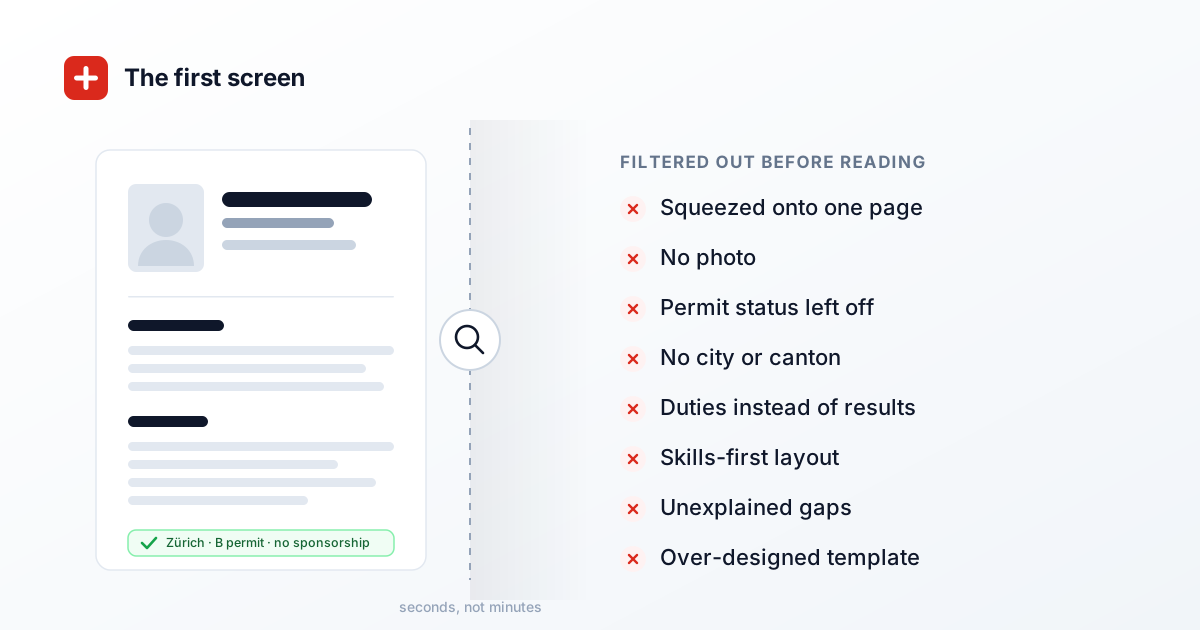
- Permit status is the cheapest line in the whole dossier and the one most often left out. If a screener cannot tell within seconds whether hiring you requires a permit step, you become a "maybe" — and on a shortlist of four, maybes are not called. One line at the top of the CV closes it: city and canton, permit type, and whether you can start without further formalities.
- Language levels belong in CEFR notation, not in adjectives. A language requirement is recorded for 92.2 per cent of English-language Swiss adverts, and 30.5 per cent of them require two or more languages. Where two are required, your level in the first one does not matter — the existence of the second does. "Fluent" is read down in a screen; B2 and C1 are read as stated.
- Nobody is checking up on you before the invitation. Under the Federal Data Protection and Information Commissioner, an employer needs your consent before asking a current or former employer for information, and may only request material that shows whether you meet the requirements of the advertised job. Before the interview, what exists of you at that company is exactly what you sent.
The screen is three passes, and only the third is a judgement
What happens between "sent" and "unfortunately" is sorting, not reading. The first pass checks completeness: cover letter, CV, employer references, diplomas, one file, right order. The second checks the gates — can this person actually take the job. The third ranks whatever survives by how well the advert's own requirements are evidenced, and hands out the interview slots from the top.
Only that third pass evaluates anything, and it is comparative. There is no score above which you are invited. There is a number of slots — usually two to four, because the hiring manager is fitting interviews around a day job — and they are filled downwards. Rank five gets the same letter as rank forty, which is precisely why a run of rejections is so hard to read: it contains no gradient.
So "was I not good enough?" is the wrong question. The usable one is: did I fail a gate, or did I lose a ranking? The two call for opposite responses — the first changes which adverts you apply to, the second changes the first half page of your CV. Change both at once and you will not know afterwards which one worked.
Why a Swiss "no" can be decided on paper
In many markets a CV is a claim and the interview is where the claim gets tested. A Swiss dossier is closer to a file of evidence. arbeit.swiss states the expectation directly: make sure the application file includes all work references, that they contain no gaps, that they are ordered chronologically with the most recent first, and that everything sits in one PDF along with diplomas and certificates.
Those employer references — Arbeitszeugnis in German, certificat de travail in French — have no equivalent in an American or British application. Each is a written assessment issued by a previous employer covering the period, the duties, performance and conduct. A screener reading a complete set has the documented version of your entire working life in front of them before deciding whether to spend an hour with you.
The consequence is unintuitive for anyone arriving from a market where hiring runs through calls and networks: here, a decision to reject can be fully evidenced without anyone speaking to you. It also means the reverse is a real cost. A missing reference, an unexplained year, a diploma named only in its home-country wording — each is a hole the screener cannot fill, and holes are cheap to reject at that stage.
The gates you can check yourself before sending
Gates are conditions you cannot meet better or worse, only meet or not: work permit, where you live and how you would commute, when you can start, the required language level, the workload in per cent, shift or weekend availability. They are the reason a technically well-matched application ends without a conversation, and they are the part you can verify yourself in ten minutes.
Most of them are not in the advert. Across English-language short forms, a start date appears in 1.3 per cent, shift or weekend work in 2.7 per cent, a permit or nationality condition in 0.9 per cent. That is not because these conditions are rare; it is because employers treat them as obvious. Residence is the one exception in English-language adverts at 5.5 per cent, which tells you something in itself — the adverts written in English are the ones that expect applicants from abroad.
Two practical moves close most of this. Write city and canton, not "Europe" or a country: for a small firm in Aargau, a vague location is an open question about commuting, relocation and start date all at once. And write one line on your status — resident with a B permit, C permit, Swiss or EU/EFTA national, no sponsorship required — because that line is what turns a "maybe" into a candidate.
The number nobody wrote down
Experience is named in 83.0 per cent of English-language short forms. A quantity of it is named in 9.5 per cent. So the requirement people fail most often is, nine times in ten, an expectation held in the head of the person opening your file rather than a criterion published anywhere.
Where a figure does appear, it clusters on round numbers: 37.0 per cent say five years, and two, three, five and ten together account for 67.8 per cent of all figures given. Round numbers are conventions, and conventions can be argued with — but only in writing, in the dossier, because there is no conversation at this stage. If your relevant years are spread across three positions, add them up yourself and put the total where it is visible. Nobody in a screen does arithmetic on your behalf.
The same goes for the local names of qualifications. A degree stated only in the wording of your home country makes the screener guess at its level; adding what it corresponds to here — a Bachelor from a university of applied sciences, an EFZ-level vocational qualification — removes a guess. Every guess you remove is a reason to reject that you have taken off the table.
Losing the ranking: what "better evidenced" actually means
Interview slots are the scarce resource in the whole process, so the screen is not looking for suitable people but for the first few. A dossier that meets every condition is rejected the moment four others have shown the same conditions more legibly. "More legibly" is mechanical: is the required task in the first half page, in the advert's own words, with an outcome next to it?
"Responsible for the marketing budget" reads identically across every file in the pile. A line naming what you ran and what changed because of it is distinguishable, and distinguishable is the whole game at this stage. This is also the reason the Swiss two-page norm is not a style preference: squeezing a decade onto one page removes exactly the detail the comparison runs on.
Two formats reliably lose ground here, and both are presentation rather than substance. A skills-first layout that pushes positions down the page is read as concealment, whether or not it is. And an unexplained gap is filled in with the least favourable assumption available; one line — study, relocation, family, sabbatical — closes it. Neither costs anything but half an hour of rebuilding.
What to measure over your next ten applications
Keep three columns and nothing else. First: were all the gates open — permit, location, start date, languages, workload — provably from the dossier rather than in your head? Second: did the advert state a quantified condition, and did you meet it? Third: were the two technical points the advert names first present in your first half page, in the same words?
After ten applications the answer is unambiguous. If columns one or two are often "no", you have a targeting problem: you are applying to jobs you are not startable for on paper, and no rewrite fixes that. If all three are usually "yes" and still no invitation came, you have a presentation problem, and it lives in the first half page — which is where the screen happens.
arbeit.swiss recommends keeping exactly this kind of record: a list of applications sent, procedures under way and responses outstanding. It also suggests following up politely if you have heard nothing for a while. That will rarely produce a reason — there is no obligation in Switzerland to give one — but it does occasionally produce a status, and a status is data your own list can use.
Where this answer stops
We see the adverts, not the piles. Nobody outside the company knows how many dossiers arrived for a given post, who formed the shortlist or where the line fell. Everything above is either counted from the adverts themselves or read today from official Swiss sources; it describes the conditions of the process, not its outcome in your case.
The short forms behind the percentages are condensations of the advert text, so a condition can be in the full advert and absent here. The figures measure prominence, not existence. The direction survives that caveat: a ten-to-one difference between English-language and German-language adverts in how often a years figure is stated prominently is not something condensing produces.
What you can take from it is modest and still useful. Check the gates before you send, quantify your own experience rather than leaving it to be inferred, and build the first half page against the specific advert. The rest is ranking, and the ranking is not yours to decide.
What people report
Swiss recruiters who work with people arriving from abroad describe the same pattern repeatedly: rejections are less often about missing experience than about how the experience is presented. The items named most often are nationality and permit status left unstated, no visible link between past duties and the advertised role, no location or statement about relocating, and language skills buried at the bottom of the page.
Aggregated from a collection of over 400 Swiss LinkedIn posts on applications, rejections and CVs, including a February 2026 post by a Swiss recruiter working in the life-sciences market.
People who have applied in Switzerland after applying elsewhere report a second surprise: the advice they get here runs against the machine-readable orthodoxy they arrived with. Swiss recruiters told them to include a photo, to state the permit type, and to make the document visually clear, on the grounds that a person rather than a filter is usually doing the first read.
Pattern across the same collection, including a September 2025 post by an applicant comparing recruiter advice in Switzerland with international practice.
Market figures are our own count of the adverts open on SwissJobs.app on 4 September 2026; we publish shares, never stock counts. Apprenticeships and internships are excluded, because those adverts name the qualification they lead to and would otherwise distort every requirement share. The requirement shares are based on the short form of the advert text, available for roughly nine adverts in ten; it is a condensation, so the values measure how prominently a condition is stated rather than whether it appears anywhere in the full text. A years figure counts only when the number sits in the same expression as the word experience; ages are excluded. Language requirements are recorded fields and are counted once per advert, not once per language named. The language of an advert is the detected language of its text. The statements about the application file, the work references and the shortlist come from arbeit.swiss (SECO), read on 5 September 2026; the statements about the selection procedure come from the Federal Data Protection and Information Commissioner, read the same day. Legal references are not legal advice.
Check how your CV fits a job — and the Swiss market
Free checker: languages, work permit, skills and more — scored against a specific posting.
ATS CV checker: against a specific advert, freeSources
Related questions
What our job index says about the Swiss market
Computed live from our own index, not quoted from a study. Shares only, as of today.
Language the advert is written in
- Deutsch
- 60%
- English
- 23%
- Français
- 13%
- Italiano
- 3%
Of adverts that state a language requirement, the share asking for
- Deutsch
- 70%
- English
- 43%
- Français
- 21%
- Italiano
- 3%
19% posted in the last 7 days · Largest markets: Zürich 18% · Bern 10% · Genève 5% · Basel 5%