What does an ATS actually check — and what do Swiss recruiters check?
Updated:
In short
Both checklists are public, and they overlap less than the advice suggests. Jobscan states its own order: hard skills, education level, job title, soft skills, other keywords — a word-matching exercise. The Swiss recruiter's checklist is written into the advert, and in our 4 September 2026 sample of 502 postings, 54.4 per cent name a language, 29.9 per cent a workload in per cent, 13.1 per cent a start date and 6.6 per cent a driving licence. None of those is a keyword. 71.5 per cent of postings set at least one such condition.
The Swiss job portals at a glance
Click an image for the full-size view. What each portal actually is stands beside it.
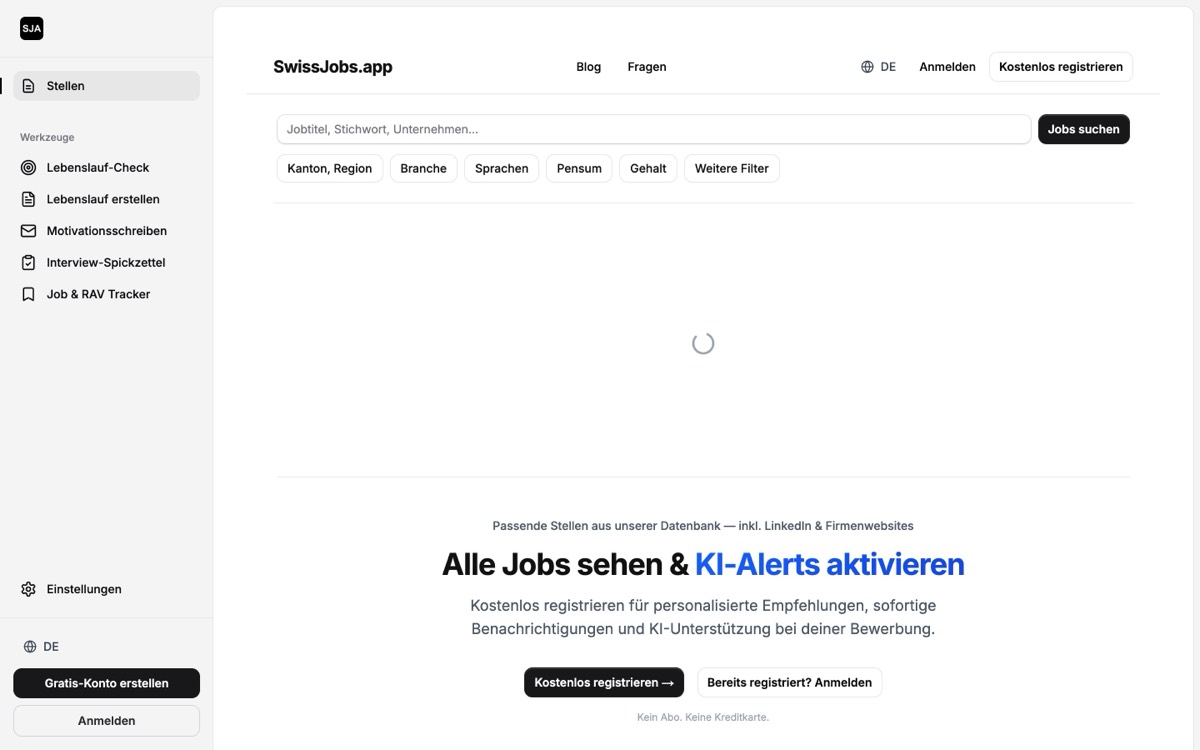
1. SwissJobs.appOur app
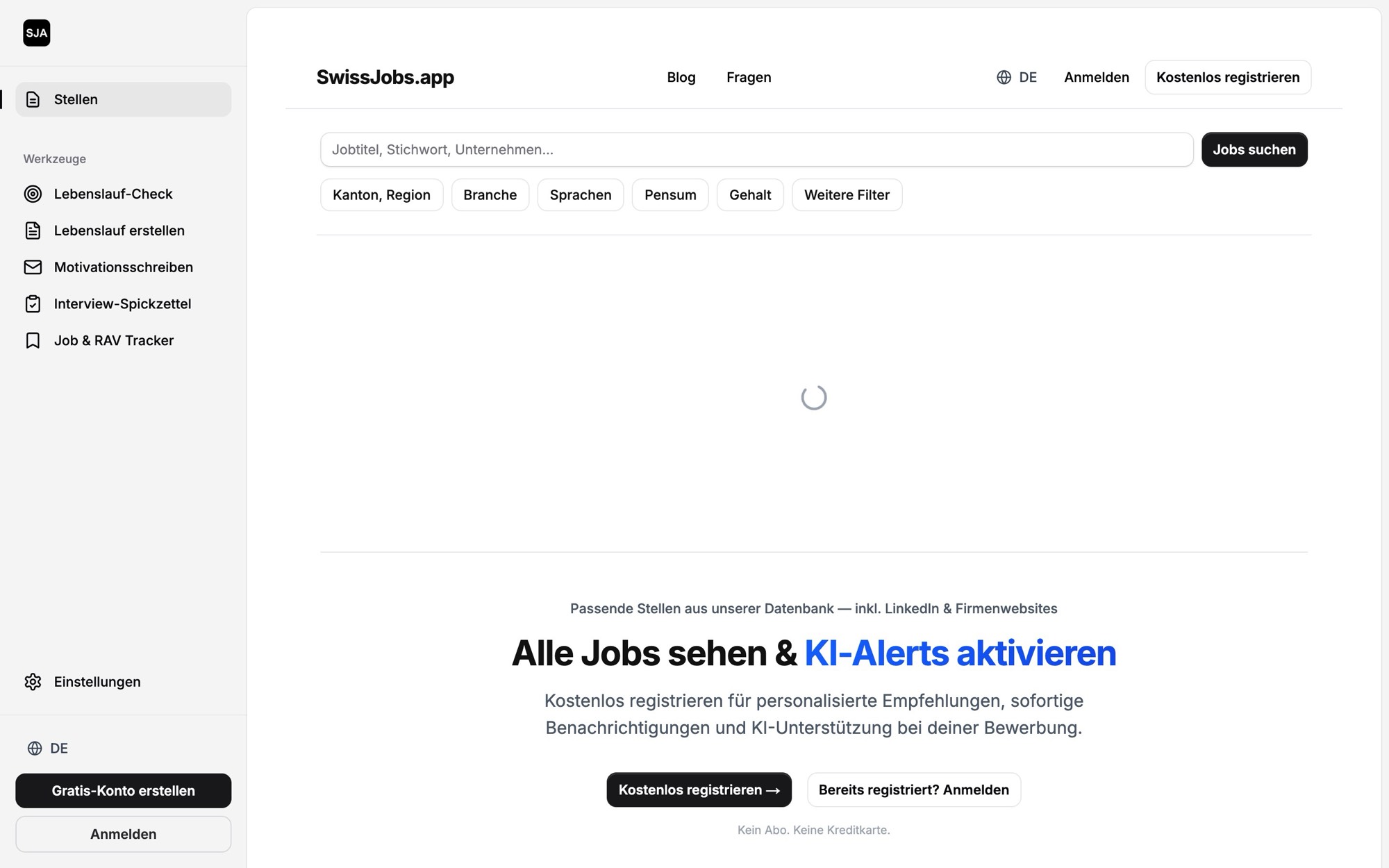
Over 21,000 open Swiss roles from ATS systems, company sites and LinkedIn in one place — and from any advert, straight into a CV, a motivation letter, a CV check and interview prep. The RAV job-search-efforts form fills itself from your application tracker. Free to use; the account is asked for at save.
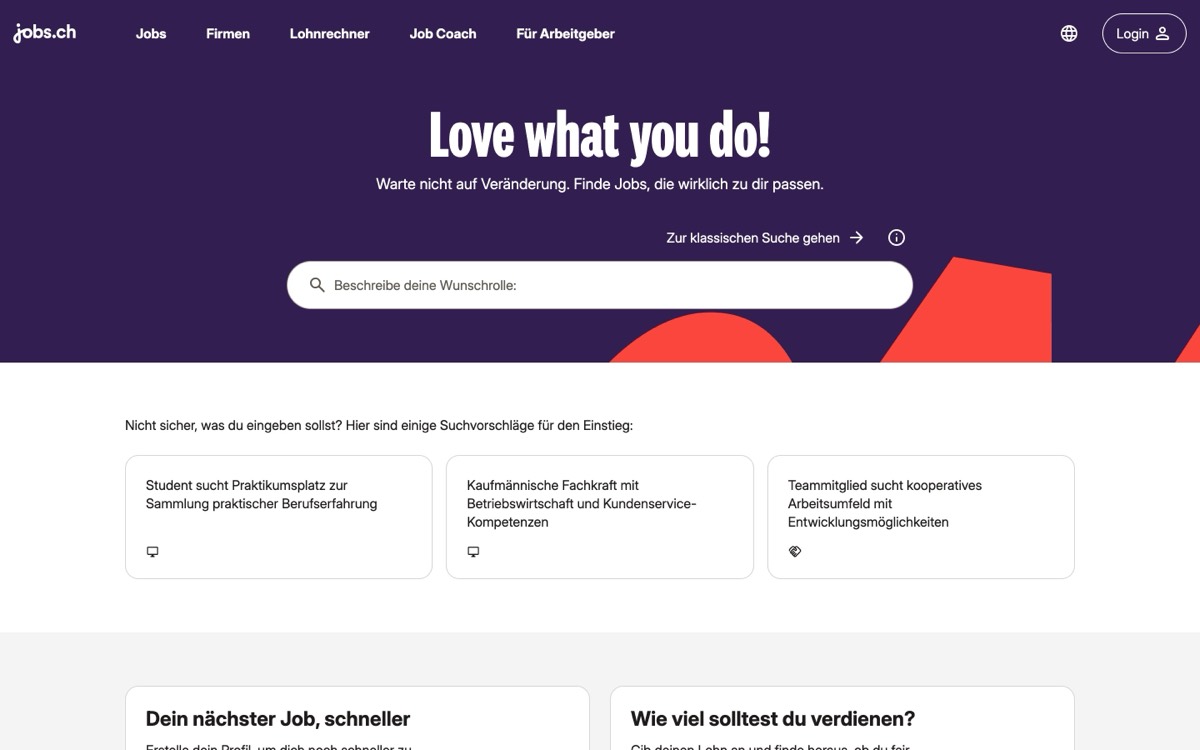
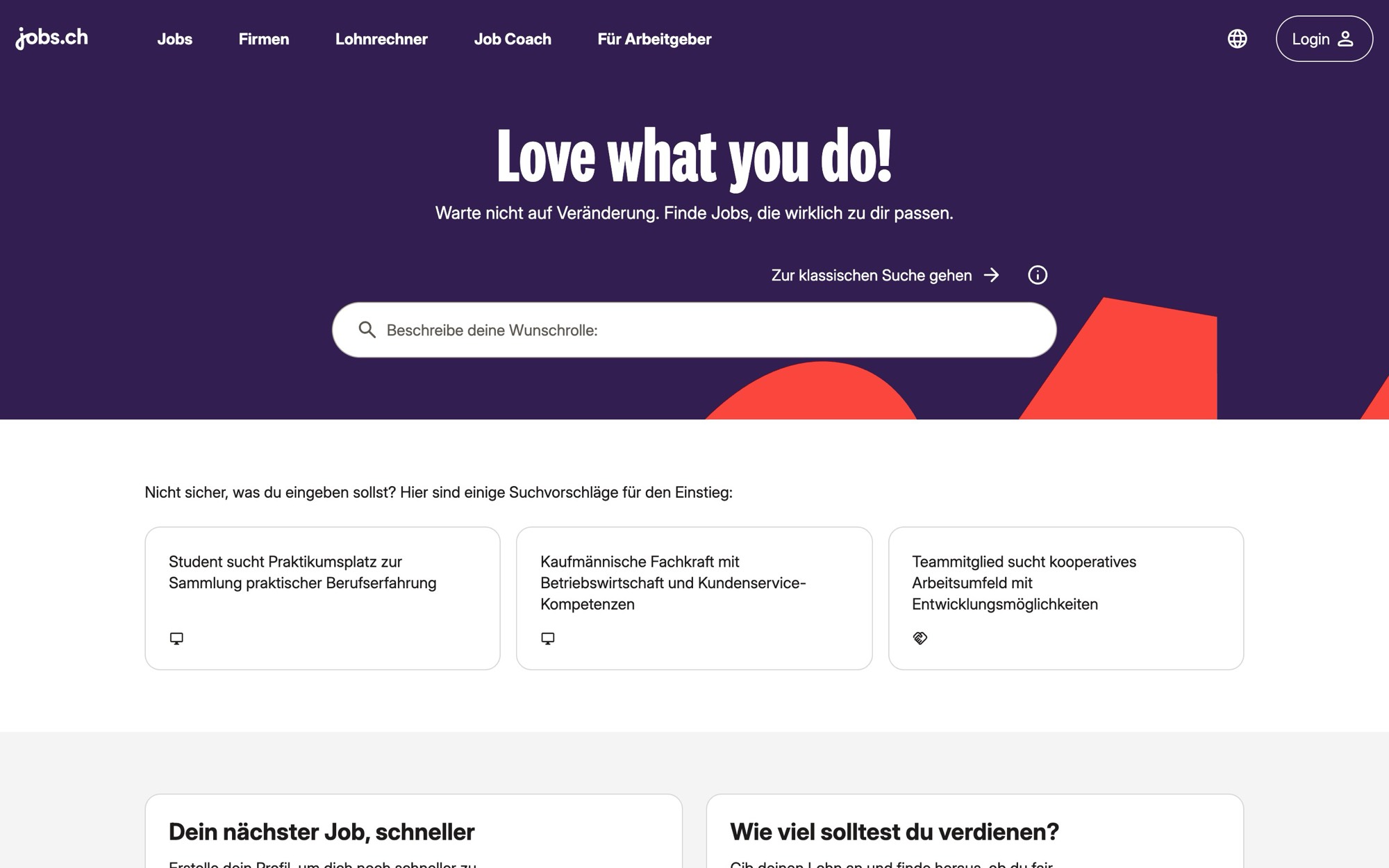
The best-known board in German-speaking Switzerland and the largest index in the country. Owned by JobCloud AG — as are jobup.ch and JobScout24.
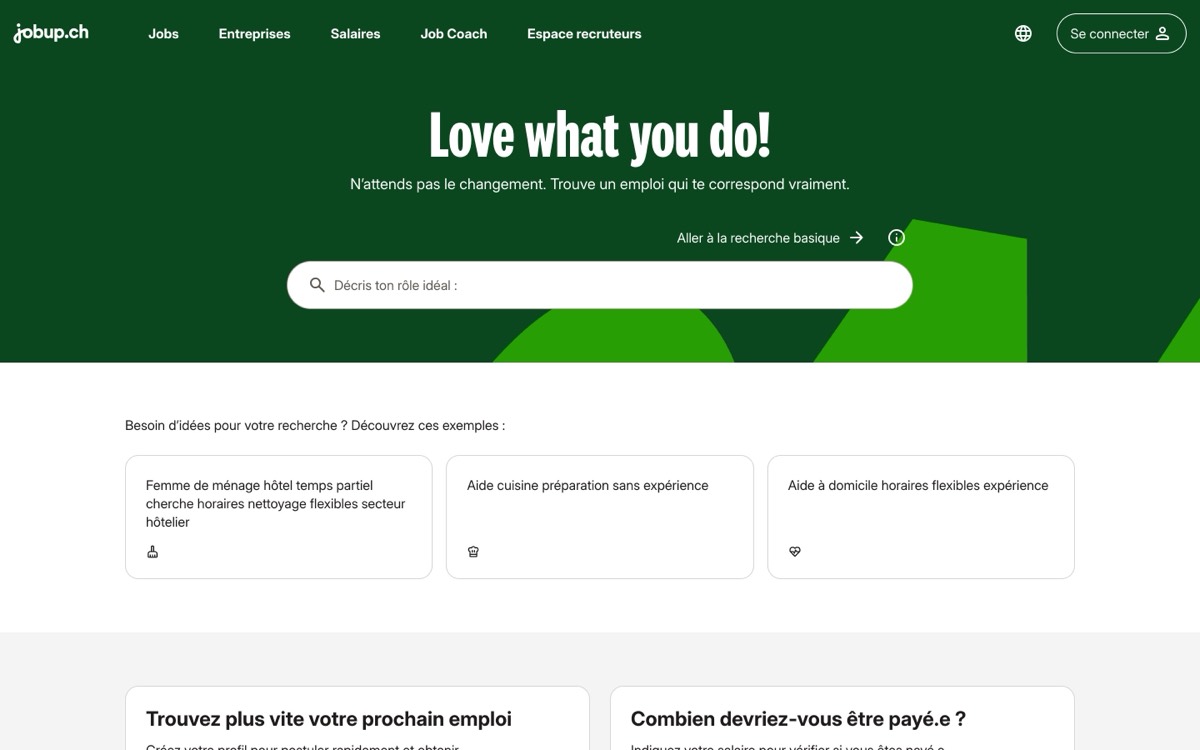
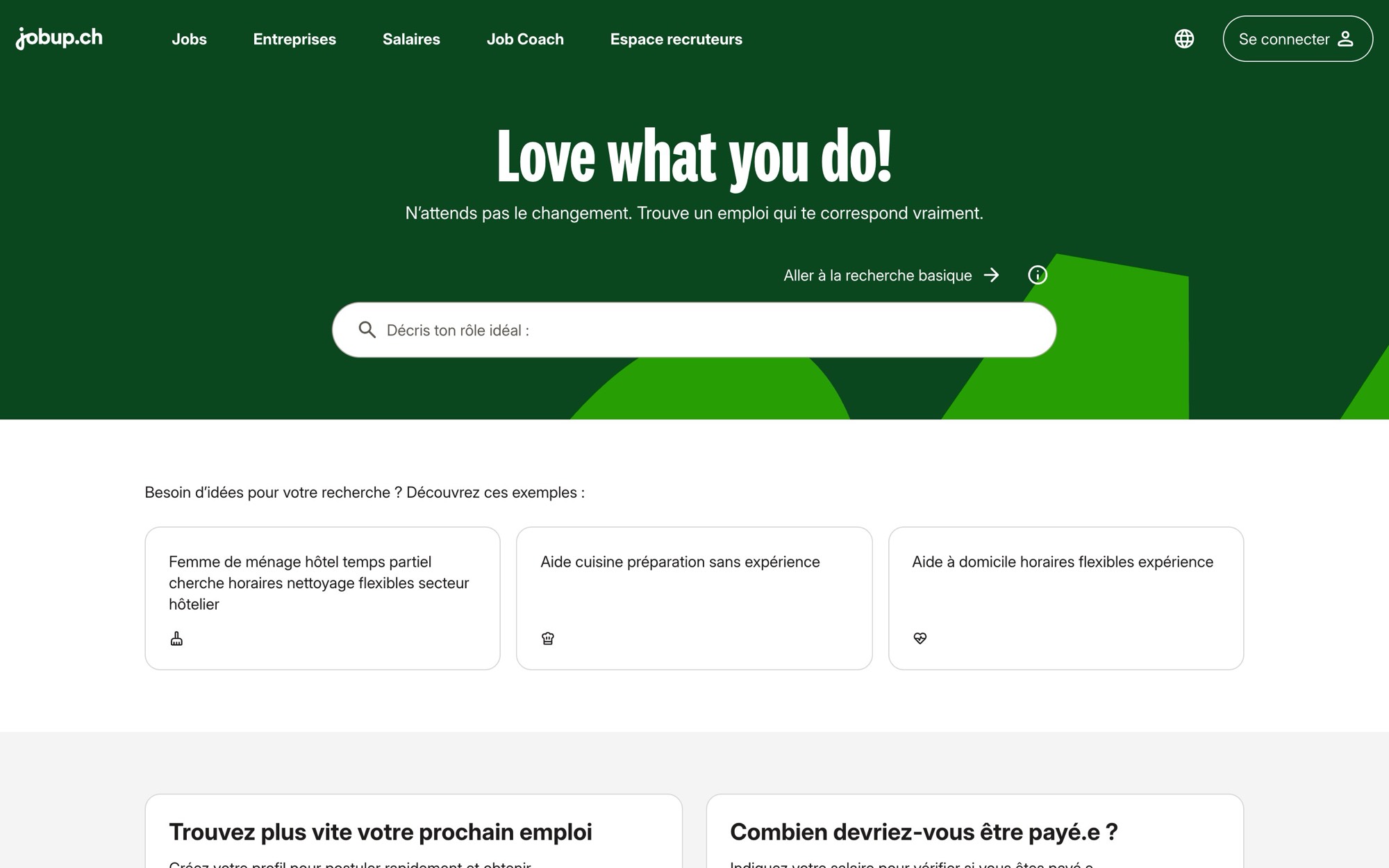
The standard in French-speaking Switzerland and the first place to look for the Romandie — but the same JobCloud AG as jobs.ch.
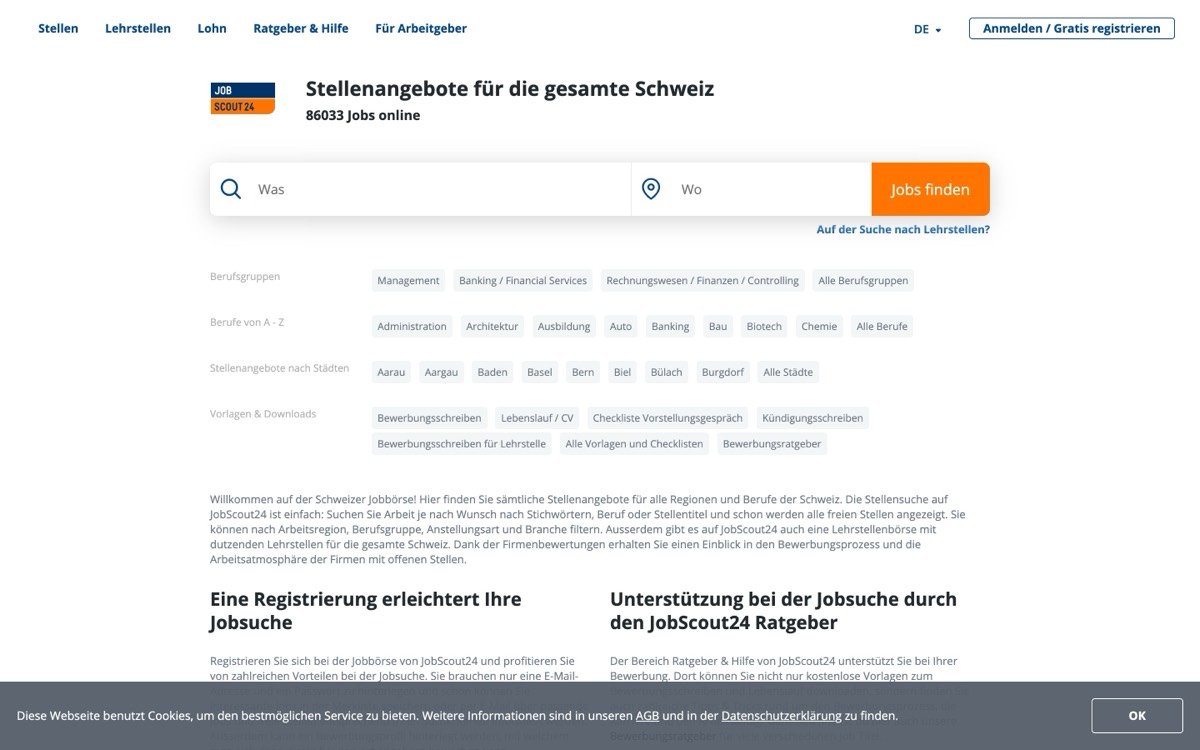
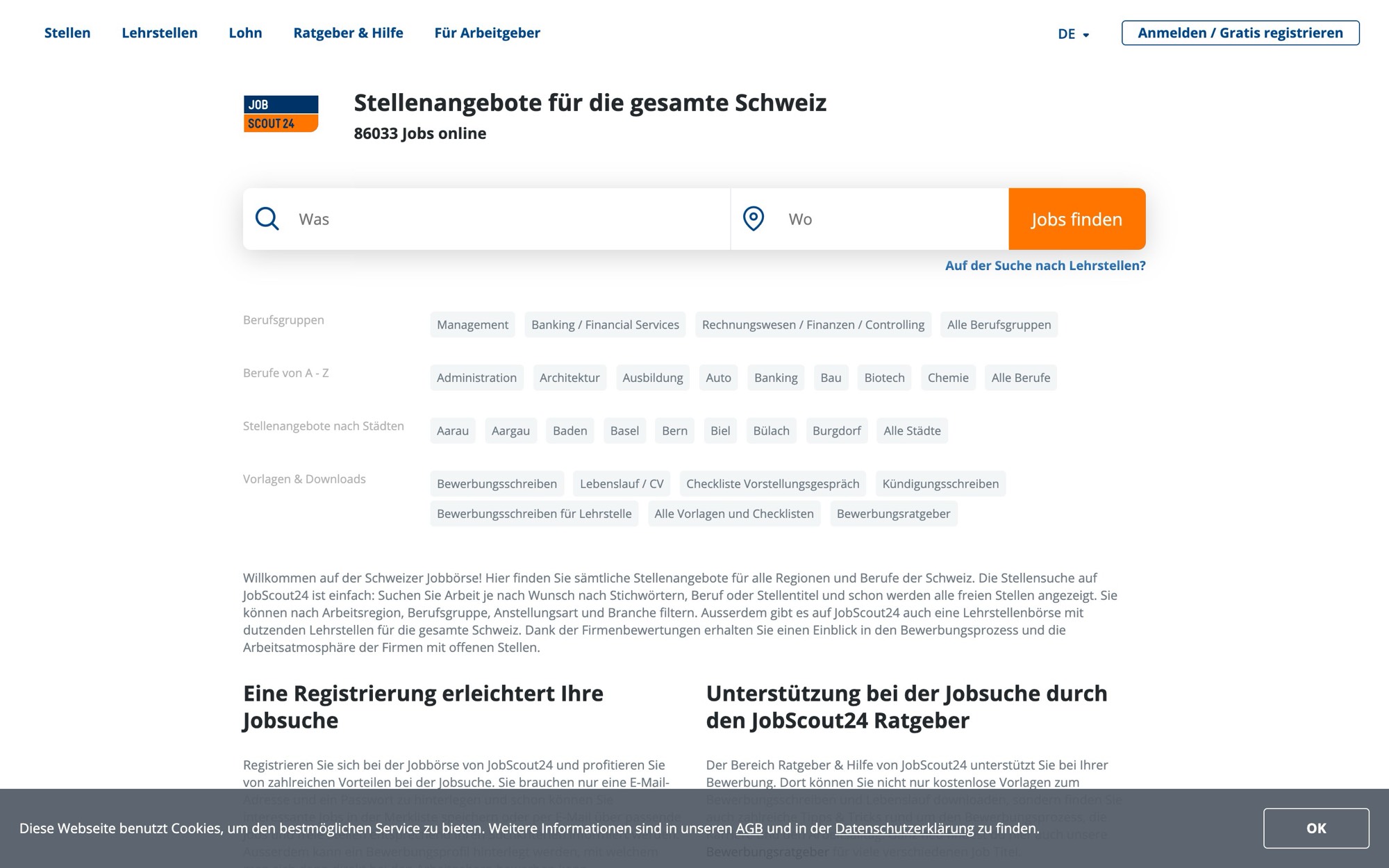
A third brand from the same company. Searching all three to widen your search means searching one provider three times.
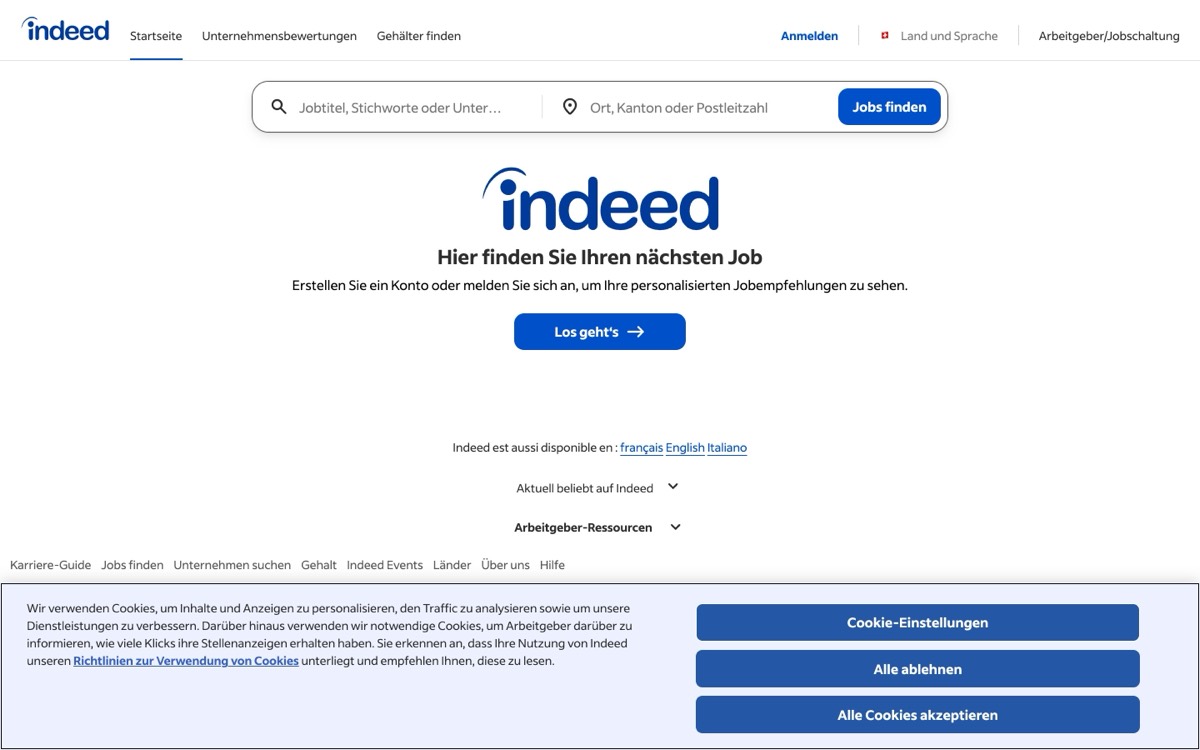
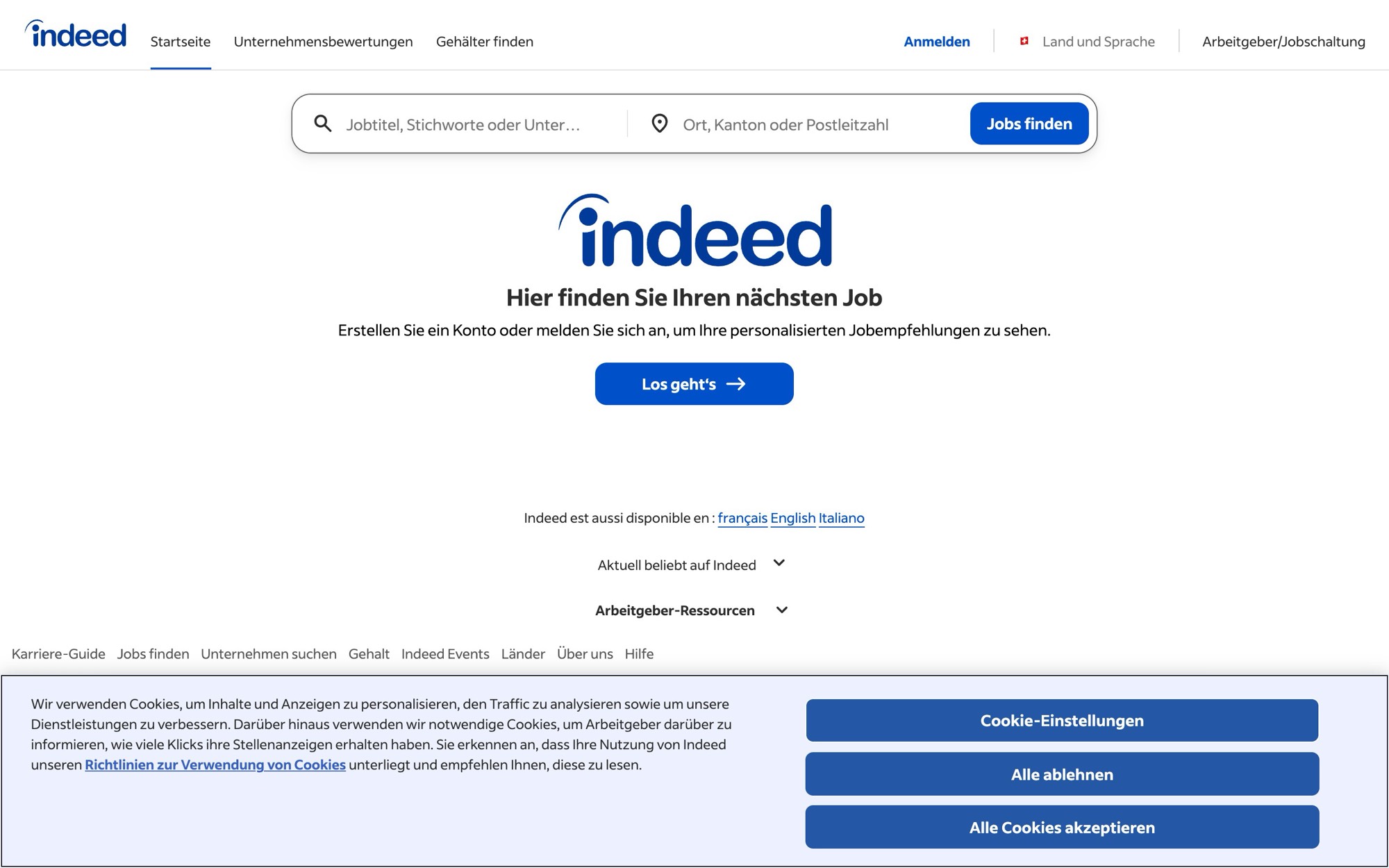
The broadest aggregation, because Indeed also collects from other boards — at the cost of many duplicates of the same advert.
The best reputation for English-speaking and international roles in Switzerland. Considerably thinner for trades, care and commercial roles.
A meta-search across the Swiss job boards, "every job in Switzerland at a glance". Its strength is the Job-Abo: a saved search that mails you new adverts from every portal it covers. Salary calculator and application guides alongside.
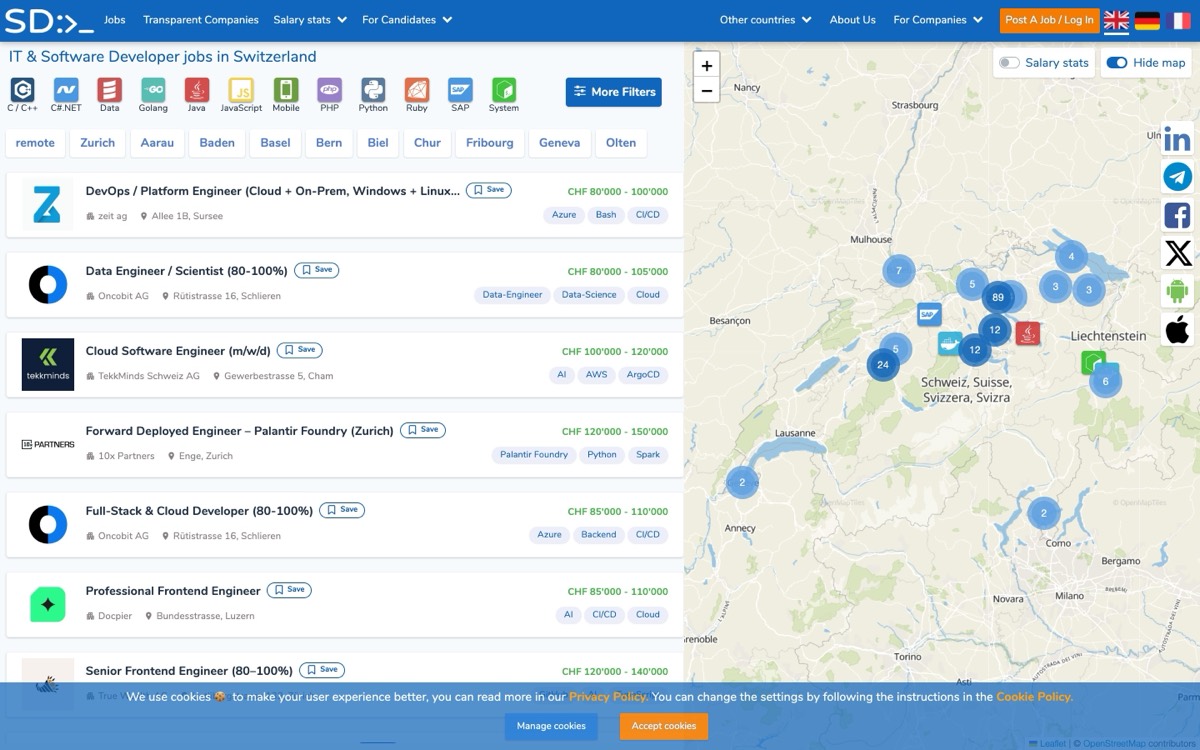
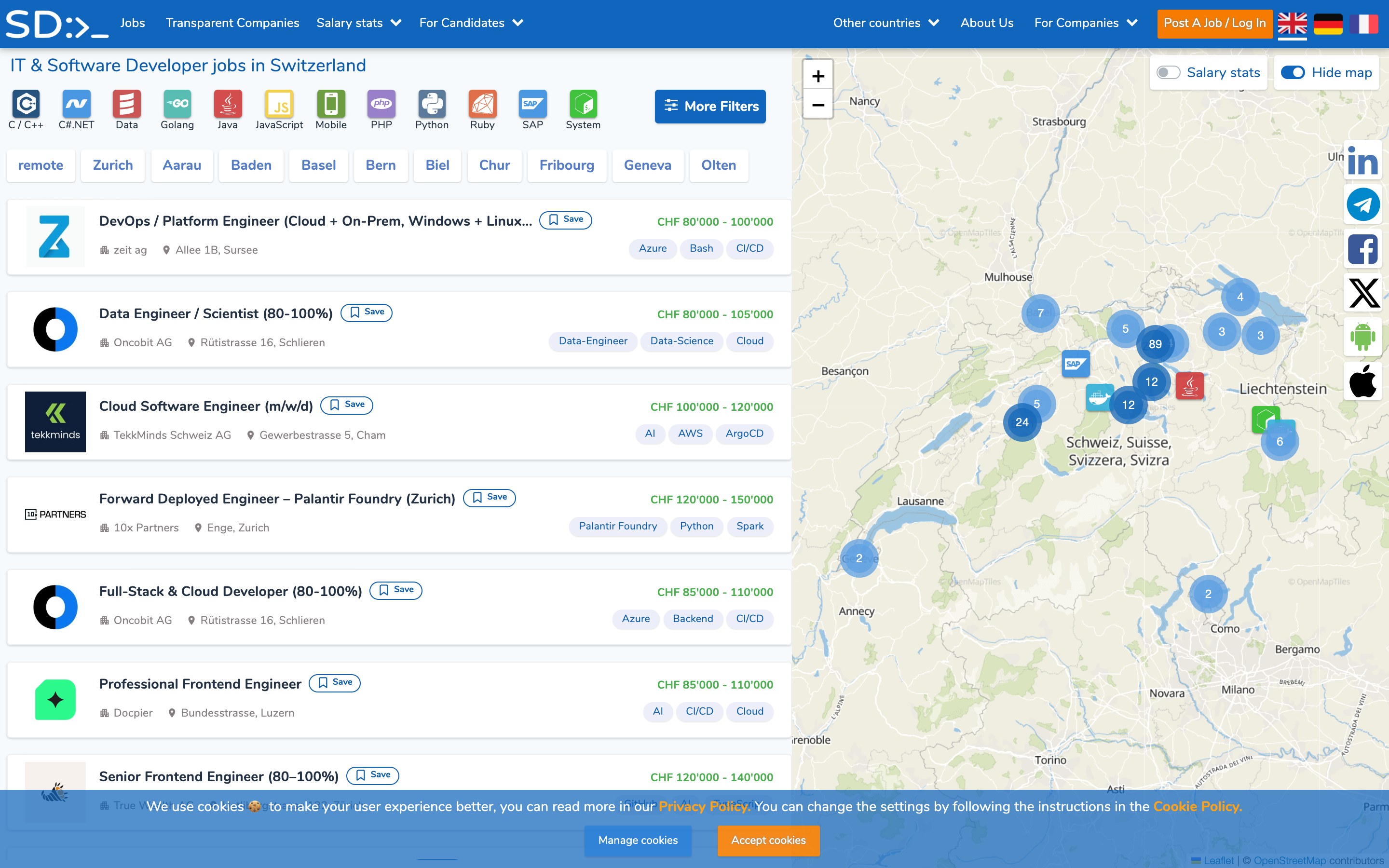
IT and software only, and thorough about it: "183 IT & Software developer jobs in Switzerland", filtered by technology (C#, Java, Python, DevOps, ML) rather than by industry. Publishes salary statistics and lists the companies that disclose their ranges. The site itself is in English.
Jobs by profession, city or language
Type a profession, a city or a language, the page shows the adverts currently open for it.
By profession
- Consultant
- Project Manager
- Retail Sales
- Nurse
- Nursing & Care
- Administrative Assistant
- Account Manager
- Software Engineer
- Public Administration
- Architect
- Insurance
- Chef
71 more — narrow the search
By work type
This is worth stressing because it reverses the usual framing. What happens inside an employer's filter is invisible — no vendor, ourselves included, can see it, and anyone claiming otherwise is selling a guess. What a Swiss employer requires is written out, in full sentences, in their own advert. One of these two things can be counted, and it is the one nobody counts.
If you are applying to Switzerland from abroad, or have arrived recently, there is a second reason to read on. The Swiss application dossier is not a resume with different spelling, and the federal employment service publishes what it contains — including two items that surprise most newcomers.
- Comparison table, one row per checkable fact. Columns in a fixed order: Jobscan · the free cvswiss.ch ATS check · SwissJobs.app · how often a Swiss advert names it at all.
- Skill keywords from the posting — Jobscan: yes, its first priority · cvswiss.ch: no, the tool takes only the CV, not a posting · SwissJobs.app: yes, one of ten categories · in the advert: almost always.
- Formal qualification — Jobscan: only when the posting names an advanced degree, by its own wording · cvswiss.ch: — · SwissJobs.app: yes · in the advert: 45.8 per cent name one, usually an EFZ, HF, FH or Bachelor.
- Language level on the A1–C2 scale — Jobscan: not in its stated priorities · cvswiss.ch: — · SwissJobs.app: yes, part of the Swiss readiness gate · in the advert: 54.4 per cent name a language, very often with a level.
- Work permit — B, C, L or EU/EFTA eligibility — Jobscan: — · cvswiss.ch: — · SwissJobs.app: yes, checked as its own line · in the advert: 3.6 per cent state it explicitly, many more assume it.
- Pensum, the workload as a percentage — Jobscan: — · cvswiss.ch: — · SwissJobs.app: yes · in the advert: 29.9 per cent overall, 38.9 per cent of German-language postings.
- Start date — none of the three tools checks it · in the advert: 13.1 per cent overall, 28.0 per cent of German-language postings.
- Photograph — Jobscan: — · cvswiss.ch: — · SwissJobs.app: yes, and scored as a plus rather than a fault · in the dossier: the federal guidance lists "personal details, including photograph" outright.
- Language of the file you upload — Jobscan: English interface · Resume Worded states above its own upload box "English resumes in PDF or DOCX only" · cvswiss.ch: PDF and DOCX, English interface · SwissJobs.app: German, French, Italian and English.
- Price in Swiss francs, everything read on 4 September 2026 — Jobscan: free for 5 scans a month, then USD 49.95 monthly, about CHF 40, or USD 89.95 a quarter, about CHF 73 · cvswiss.ch: the check free, a CV then CHF 5 once or CHF 15 a month · SwissJobs.app: first check free without an account, then a free account, then a 7-day trial and CHF 15 a month.
- Account needed before you see a number — Jobscan: yes · cvswiss.ch: no · SwissJobs.app: no, one check per browser without signing up, since 4 September 2026.
- What none of them can do: see how a particular employer actually filters. No score is a prediction of an outcome.
Who to choose
The other tools here are real and good at what they do — the table says what each is for. The reason we lead is one row in it: the job index is our own, so the advert is already there.
Choose SwissJobs.app if
Pick the job directly — You choose the posting from our own Swiss index, and the CV, letter and check are written against exactly that text — no searching, no copying.
Four tools, not one — CV, motivation letter, CV check and interview prep from one account, on the same data.
The RAV sheet — Job-search efforts from the tracker, printed on the official SECO form. None of the other tools in this list has it.
Start without an account — Open it and write without signing up; the account is asked for to save and from the second document.
CHF 15 a month, seven free days first — Full access during the trial, cancel monthly, billed in francs — no four-week periods, no exchange-rate risk.
The tools compared directly
| Criterion | SwissJobs.app | Jobscan | Resume Worded | cvswiss.ch ATS-Check |
|---|---|---|---|---|
| Price | CHF 15/Mt · CHF 95/J | n/s | n/s | from CHF 15/mo |
| Check without an account | Yes | No | No | n/s |
| Against a specific advert | Yes | Yes | n/s | Yes |
| Advert from its own job index | Yes | No | No | No |
| ATS readability | Yes | Yes | Yes | Yes |
| Names missing keywords | Yes | Yes | Yes | n/s |
| Swiss conventions checked | Yes | No | No | Yes |
| A corrected CV as the result | Yes | No | No | n/s |
| Languages | DE/EN/FR/IT | EN | EN | DE/EN/FR |
As of 4 September 2026. Every figure for another tool comes from that tool's own site; "n/s" means it was not readable there — not that the feature is missing. Our row comes from the code and from walking the live flow.
What the scanners check, in their own words
There is no need to speculate about the method. Jobscan sets out on its own home page what its Match Rate is built from, in a numbered order: hard skills first; then education level, with the qualifier printed right there — "only when an advanced degree is included in the job description"; then job title; then soft skills; then other keywords. Immediately below, it adds that resume word count and measurable results are not factored into the match rate. Read 4 September 2026.
That is a word comparison, and described honestly as one. Two documents are laid side by side, the posting and the CV, and the tool counts which terms appear in one and not the other. Resume Worded does the same under the name Relevancy Score, adding that a score below 80 suggests the CV is missing important skills from the posting. Both statements are about two text files. Neither is a statement about a candidacy.
The marketing around them is less careful. Resume Worded writes that pretty much every company uses screening software and that a CV lacking critical keywords "will be instantly rejected". Jobscan cites 99 per cent of the Fortune 500 and names the systems it has modelled: iCIMS, Recruiterbox, Lever, Greenhouse, Taleo. Those five describe a real market. It is simply not this one — a large share of Swiss postings sit behind vendors that do not appear on that list at all.
And one caveat binds every tool on this page, ours included. Nobody sees inside a given employer's filter settings. What can be stated is a mechanism, not a guarantee: a CV that uses the advert's own vocabulary matches a search for that vocabulary better than a generic one does. Anything beyond that is advertising.
What the Swiss dossier contains — the federal list, and the two surprises in it
For the human half of the question there is an official source. arbeit.swiss, run by the State Secretariat for Economic Affairs (SECO), publishes an English page of application tips setting out what a Swiss application dossier consists of. Read 4 September 2026.
The list is specific. The CV is called the core of the application and should run to no more than three pages. It contains personal details, including a photograph; previous roles; schools and further training; language skills; special skills; interests; and references. It is chronological, most recent first. Work references — Arbeitszeugnisse, the written employer references you receive on leaving each job — must be complete with no gaps and in chronological order, newest on top, and everything is submitted as a single PDF. Even the sender's address gets a line: use a serious email address containing your own name.
Two items reliably catch out people arriving from the UK, the US, Canada or India. First, the photograph: in Switzerland it is conventional and expected, not a liability, and a Swiss CV without one looks incomplete rather than modern. Second, the Arbeitszeugnis: you are expected to hold a written reference from every previous employer and to attach them all, in an unbroken sequence. A gap in that sequence is noticed. There is no equivalent to this in an American application, which is why no international CV tool asks about it.
The third thing worth noticing about that page is an absence. The abbreviation ATS does not appear on it once. We fetched the same page in all four language versions — German, French, Italian and English — and searched each: zero occurrences in every one. The Confederation's own advice to jobseekers does not mention screening software at all.
What the advert itself demands — 502 postings counted
The third source is the strongest, because here the recruiter writes the checklist down. On 4 September 2026 we drew a random sample of open postings from our index, apprenticeships excluded, and read the employer's advert text itself rather than our summary of it. At most three postings count per employer per language, because otherwise a single staffing agency's boilerplate would have become the result. That leaves 502 adverts.
What they ask for, in order of frequency: a language or language level, 54.4 per cent; a formal qualification, 45.8; a workload in per cent, 29.9; a number of years of experience, 23.9; a start date, 13.1; references or work certificates, 7.2; a driving licence, 6.6; a place of residence or proximity to the workplace, 5.0; and a work permit named explicitly, 3.6 per cent.
Now set that beside Jobscan's five priorities. Skills and job title are covered. The qualification is half-covered, because by the vendor's own wording the check applies only when an advanced degree is named — which excludes exactly the commonest Swiss qualification, the EFZ, the federal certificate that follows an apprenticeship and that a large part of this workforce holds. Everything else on the list — language level, workload, start date, driving licence, residence, permit — does not appear in the priorities at all. Nor could it. These are not words to match. They are facts about a person.
71.5 per cent of the counted postings set at least one condition of that second kind; 33.9 per cent set two or more, and 11.6 per cent three or more. In roughly seven Swiss adverts out of ten, a pure keyword comparison cannot assess part of the requirement — not because the tool is poor, but because there is nothing there to compare.
Two dialects of advert — and why imported advice fits one of them
Splitting the count by the language the advert is written in explains why the English-language guidance feels accurate to some readers in Switzerland and absurd to others.
A German-language Swiss posting names a workload 38.9 per cent of the time, a start date 28.0 per cent and a driving licence 10.8 per cent — but a number of years of experience only 12.1 per cent. An English-language posting in the same country inverts that: 52.2 per cent name years of experience, 20.3 per cent a workload, 2.9 per cent a start date and 1.4 per cent a driving licence.
So the English-language advert, even when it is written in Zurich or Zug, follows the shape of an American job posting — and that shape is precisely what the keyword tools were built against. For that segment the imported advice works. The German-language advert asks mostly for things the tool has no field for: 82.2 per cent of German-language postings set at least one such condition, against 59.4 per cent of English-language ones.
This matters most to the reader who has just moved here, because the two dialects map roughly onto two employers. The international firm in Zug advertising in English is running a process the American guides describe. The cantonal hospital, the Gemeinde, the SME in Aargau advertising in German is not. Applying to both with one CV and one mental model is where people lose weeks.
The figure everyone quotes, and what can honestly be said about it
On 4 September 2026 the cvswiss.ch home page carried the sentence: "75% of CVs in Switzerland never reach a human — they get filtered by ATS software." No source is given on the page, and we could not find one.
We are not claiming the number is wrong; establishing that would require seeing inside employers' filters, which nobody can do. What can be said is narrower and still useful. The federal application guidance mentions no screening software in any of its four language versions. A large share of Swiss postings send you to the employer's own address rather than to a vendor. And most solidly: even where software does read first, by its makers' published method it is reading words — while about seven in ten Swiss adverts set at least one condition that is not a word.
The practical consequence is reassuring in one direction and uncomfortable in the other. Reassuring: a CV is rarely discarded for missing a fashionable term. Uncomfortable: the conditions that do sink applications — no workload stated, no permit line, no language levels, a gap in the work references — are printed in the advert in plain language and still go unanswered.
What a checking tool can do with this — and which one to use
Our own check is built along the second list, and that is the difference we will defend. It scores ten categories: seven on content — one of which is ATS and keyword match, alongside hard skills, soft skills, motivation, fit with the working environment, unique selling point and evidenced results — plus a three-part Swiss readiness gate covering work permit and eligibility, languages with an A1–C2 level, and the photograph. The photo is treated as a plus and never as a fault, because here it is the convention. Keyword matching, in other words, is one category of ten rather than the whole examination.
Add a specific posting and the check runs against that posting instead of against a general norm — and because we are a job board as well, you usually do not have to paste the advert in yourself. That is the narrow claim, and it is the true one. The broad claim would be false: cvswiss.ch also puts advert-based tailoring at the centre of its generator, and that deserves saying plainly.
Since 4 September 2026 the first check runs with no account. We verified it on the live site the same day: the first anonymous run returns a report; a second from the same browser answers "Your free check is used — create a free account to run more." One check per browser, then a free account with 5 documents a day and 10 per rolling week, then a 7-day trial, then CHF 15 a month or CHF 95 a year, cancellable at any time.
The honest counter-arguments. If you want a number quickly and nothing else, use the free cvswiss.ch check: no account, PDF or DOCX, an instant result — the shortest route to an assessment that exists, at no cost. If you are applying to English-language postings at international employers, Jobscan is the better tool than ours; it modelled exactly the systems used there, and the count above shows the English-language advert really is written in that idiom. If you want line-by-line phrasing feedback on an English CV, Resume Worded gives the sharpest, with the limit stated above its own upload box: "English resumes in PDF or DOCX only." A German, French or Italian CV is not provided for.
For a Swiss advert in German, French or Italian, use ours, because the permit line, the language levels and the Pensum are assessed at all, and because the comparison runs against the specific posting. For anything in English, the others are ahead.
The answer in four sentences
An ATS checker, by its makers' published method, checks words: skill terms, the job title, the qualification when an advanced degree is named, soft skills, remaining keywords.
A Swiss recruiter checks a complete dossier — a CV of no more than three pages, chronological, with a photograph, an unbroken run of work references, language levels, referees — plus the conditions they wrote into the advert themselves.
The second list is longer and the one you can actually verify: 71.5 per cent of counted postings set at least one condition no keyword comparison can assess, rising to 82.2 per cent among German-language adverts.
So the useful order is to answer the advert's questions in the CV first and align the vocabulary second — not the other way round.
Basis: 502 open postings from the SwissJobs.app index, random sample of 4 September 2026, apprenticeships excluded, read on the employer's own advert text and capped at three postings per employer per language. Plus the product and pricing pages of Jobscan, Resume Worded and cvswiss.ch, and the arbeit.swiss application tips in all four language versions, all retrieved 4 September 2026. US dollars converted at the European Central Bank reference rate of 3 September 2026. As of 4 September 2026.
Check how your CV fits a job — and the Swiss market
Free checker: languages, work permit, skills and more — scored against a specific posting.
ATS CV checker: against a specific advert, freeSources
Related questions
What our job index says about the Swiss market
Computed live from our own index, not quoted from a study. Shares only, as of today.
Language the advert is written in
- Deutsch
- 60%
- English
- 23%
- Français
- 13%
- Italiano
- 3%
Of adverts that state a language requirement, the share asking for
- Deutsch
- 70%
- English
- 43%
- Français
- 21%
- Italiano
- 3%
19% posted in the last 7 days · Largest markets: Zürich 18% · Bern 10% · Genève 5% · Basel 5%