What is wrong with my CV?
Updated:
In short
A CV that fails in Switzerland almost always fails in the same five places: it does not say what you are applying for, the languages are written as adjectives instead of CEFR levels, the workload percentage is missing, the qualification is not given in its Swiss designation, and the dossier is incomplete. Two out of three open postings in our index record a language requirement, and 78.9 per cent of those requirements sit at working level or above. "German — good" answers none of them.
This is worth saying plainly because the question is usually asked as a design question and is not one. A Swiss CV is read against two things: one specific advert, and a convention that the advert never states. The first is checkable, because the advert writes its conditions down. The second is the expensive half — a permit line, a photo, an unbroken run of Arbeitszeugnisse (the Swiss employer references) are demanded in almost no advert, and their absence is still noticed.
The five faults below are ordered the way you should check them, and they take about twenty minutes. If they are all right and nothing changes, the cause probably is not the document at all — it is which adverts you are applying to, or simply the scale of the process. Both answers are honest, and they are different questions, answered elsewhere in this section.
Share of all recorded language requirements on open, non-apprenticeship postings on SwissJobs.app, by the level recorded. Counted on 4 September 2026.
- Write languages as levels, not adjectives. 66.6 per cent of open postings record a language requirement at all; of every requirement recorded, 78.9 per cent is at working level, only 16.2 per cent at conversational level. One posting in five asks for two or more languages at once, and the commonest pair is German with English — it appears in 10.2 per cent of all open postings.
- English alone is a smaller market than it looks. English is demanded in 31.0 per cent of open postings, but only 13.8 per cent of postings ask for English and nothing else. The rest of that 31 per cent wants English alongside a national language, which is why an English-only CV can look strong and still lose on a line it never wrote.
- Put the Pensum on every position. 23.5 per cent of open postings carry a workload percentage in the job title itself, and 58.4 per cent of those state a range rather than a fixed figure — 80 to 100 per cent, for instance. A CV that never mentions a workload leaves open exactly the number the advert opens with.
- Name the qualification the way it is named here. A formal qualification is named in 16.2 per cent of the requirement texts, and when it is named it is named Swiss-style: EFZ in 3.6 per cent of postings, FH or HES in 2.5, HF in 2.1, Bachelor or Master in 2.4. A degree written only in its home-country form leaves the sorting to the reader.
- A Swiss CV may be longer than you were told. arbeit.swiss, the federal job-seeker portal, states that "A CV should be no longer than three pages" and that it should "be complete, clear and not contain any gaps". Compressing a career onto one American-style page deletes precisely the lines that are checked here.
- The work references are part of the file, and they are inspected for gaps. arbeit.swiss requires that all Arbeitszeugnisse are included, "must not contain any gaps and must be organised chronologically, with the most recent reference coming first", all summarised in one PDF, and the same for diplomas and certificates.
- What is not the reason: the font, the colour, the template. A layout instruction appears in practically none of the requirement texts we analysed. Time spent on how the document looks is nearly always time taken from the five points above.
Fault 1: the CV does not say what you are applying for
First screening is a matching exercise, not a reading. Someone has an advert with a title and a handful of conditions in front of them and looks for the same words in your document. A CV that opens with personal details and then lists employers hands that work over: the target role has to be inferred from the history, and across twenty files nothing gets inferred.
The fix costs two lines. Above the work history, one line naming the function you are applying for, in the advert's own words rather than a broader label that would fit three other jobs. Under it, three to five lines that evidence that function: field, responsibility, scale. This is labelling, not marketing.
The second half of the same fault is the identical file sent everywhere. A dossier that fits an industrial firm, an accountancy office and a care home equally well fits none of them, and the people receiving it see that immediately — it is the observation Swiss staffing firms make publicly more often than any other. It does not mean starting from scratch each time. It means the top line and the top five lines change per advert.
Fault 2: the language line is not written in levels
This is the fault our own data shows most sharply. 66.6 per cent of open postings record a language requirement. Of all requirements recorded, 78.9 per cent sit at working level, 16.2 per cent at conversational, 3.6 per cent at native and 1.3 per cent at basic. The market is asking almost entirely about being able to work in a language, not about familiarity with it.
By language: German is demanded in 43.2 per cent of open postings, English in 31.0, French in 14.5 and Italian in 2.3. The pattern moves by region. In the German-speaking cantons, 49.8 per cent of postings ask for German and 33.1 per cent for English; in the Suisse romande, French is asked for in 40.9 per cent and English in 39.3 — practically level. In Ticino, Italian is asked for in 57.7 per cent, English in 22.1 and German in 19.5.
20.7 per cent of all open postings want two or more languages at once, and the commonest combination by a distance is German with English, in 10.2 per cent of postings. This is the number that catches people arriving from abroad: English is genuinely in demand, but usually as the second half of a pair. Only 13.8 per cent of postings ask for English on its own.
In practice: give languages their own block, each with a level from A1 to C2, split into spoken and written where the levels differ. "German C1, French B2, English C2" — not "good German". arbeit.swiss lists language skills as a standard component of the CV; how precisely you state them is left to you by the authority, and not by the market.
Fault 3: the Pensum is missing, although the advert leads with it
Workload in Switzerland is a first-class field, stated as a Pensum in per cent, and postings put it somewhere you can measure: in the title. 23.5 per cent of open postings carry a percentage in the job title. By region it is 26.2 per cent in the German-speaking cantons, 13.4 in the Suisse romande and 7.4 in Ticino — so the habit is strongest in the German-speaking market, but there it is the rule rather than the exception.
The shape of it matters more than the share. 58.4 per cent of those titles state a range rather than a fixed figure, and among the figures that are not a plain 100 per cent, 62.3 per cent start between 80 and 89 per cent. The employer is saying in advance that the size of the job is negotiable. A dossier that says nothing about workload is not in that negotiation.
For the CV this is one small change: the first line of every position carries the Pensum alongside function, employer and dates, wherever it was not 100 per cent. That does two things at once. It explains apparent gaps and overlaps without anyone having to ask, and it shows you are thinking in Swiss categories. Almost no CV written for the UK, the US or Ireland carries this line, which is exactly why it is the one most often missing.
Fault 4: the qualification is not in its Swiss designation
A formal qualification is named in 16.2 per cent of the requirement texts we analysed — and when it is named, it is named in the Swiss short form: EFZ in 3.6 per cent of all postings, FH or HES in 2.5, HF in 2.1, Bachelor or Master in 2.4, CFC in 2.0. The advert is not asking for a level. It is asking for a title, and the match happens on the word.
People trained outside Switzerland lose ground here for no good reason. A qualification written only in its home-country name has to be placed by the reader, and at first screening the reader does not place it. The fix is a bracket: the original title, then the Swiss equivalent as far as you can support it.
The line between placing and recognising matters. SERI, the State Secretariat for Education, Research and Innovation, states that "Recognition is required to practise certain professions in Switzerland" — the regulated ones — and that which body handles it depends on the qualification. For everything else there is no obligation, but you can apply to SERI for recognition or for a level certificate. If you hold one, it belongs on the CV. If you do not, an honest equivalence still belongs there, and a claim does not.
Fault 5: the dossier is incomplete — and the advert will never tell you
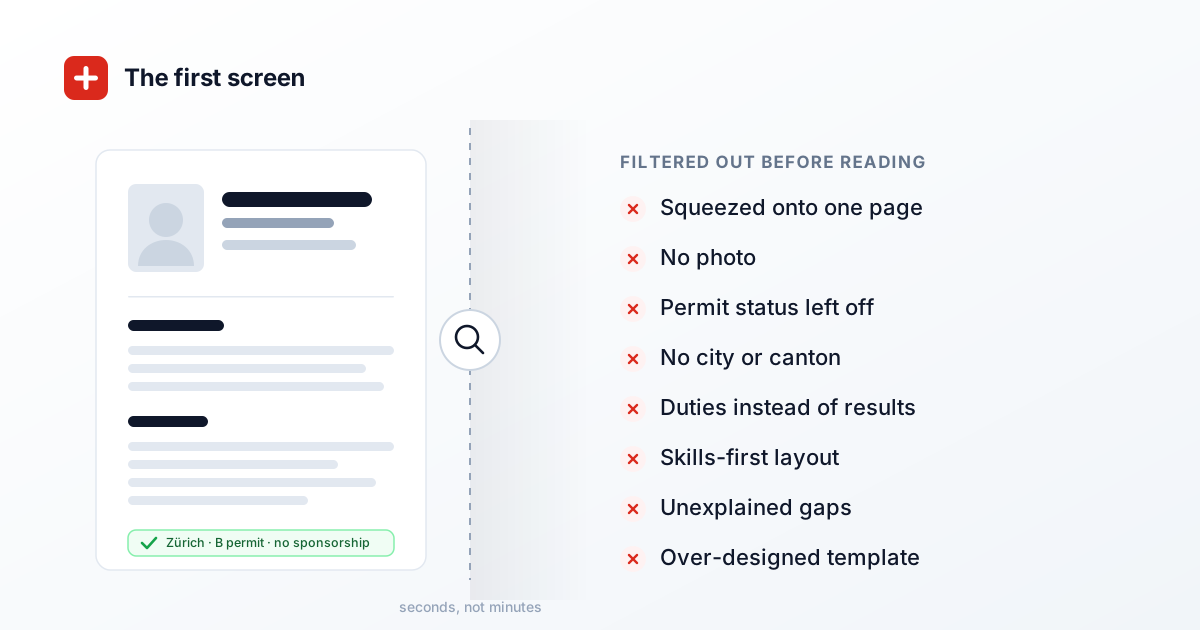
This is the most awkward asymmetry in Swiss hiring, and it can be counted. In the same requirement texts where 66.6 per cent carry a language requirement, a work permit is mentioned in 0.5 per cent, work references in 0.1 per cent and a photo in 0.1 per cent. These conventions are almost never written into the advert. They are assumed anyway.
What belongs in the file is set out officially. arbeit.swiss lists the usual contents of a CV: the title "CV", personal details including a photograph, professional experience to date, education and training, language skills, special knowledge or activities, personal interests, and references. Structure is chronological, most recent first.
The dossier also contains the Arbeitszeugnisse, and the requirement is stricter than most newcomers expect: all of them, no gaps, chronological with the most recent first, gathered into one PDF, and the same for diplomas and certificates. References are normally handled with a note on the CV saying they can be provided on request. If you come from a country that does not issue employer references, you do not have a choice between two customs here — you have a gap in the file, which you name and replace with referees.
For anyone without a Swiss passport, the permit line is the most expensive omission of all. It costs half a line in the personal details and answers a question that otherwise triggers a query, and queries are rare at first screening. Your Swiss town and canton do the same job for the commute question, silently.
What is probably not wrong with your CV
The design. A specification for layout, typeface or template appears in practically none of the requirement texts. A template can certainly make a document harder to read — multi-column layouts and graphical bars for language levels regularly do — but it is not where the match fails. Changing the template while leaving the five points above untouched changes nothing.
The length, at least downwards. The one-page rule comes from a different market. arbeit.swiss puts the ceiling at three pages, and a Swiss career with workloads, continuing education and language levels usually needs two. When you do cut, cut the bullet lists on old positions, not the lines that evidence the advert's conditions.
And part of what feels like a document fault is not one. A Swiss rejection usually gives no reason at all. One rejection therefore teaches you nothing about your CV; ten applications sent with the same, deliberately unchanged document teach you a great deal. Change the document once, not after every rejection — otherwise you end up measuring nothing.
The order to check this in
Take an advert you applied to and were turned down for. Mark every condition it states explicitly. Then, for each one, check whether it is findable on the first page of your CV in the same words — not whether it exists somewhere, but whether it is found on the first pass. Do that for three adverts; the pattern almost always repeats on the same line.
Then the four convention lines that no advert asks for and every advert assumes: languages as levels, Pensum per position, qualification in its Swiss designation, permit status and place of residence in the personal details. Together that is under twenty minutes of work, and it applies to every application you write afterwards.
If you would rather not do the comparison by hand, our CV check does exactly this step: it reads your document against a specific advert and against the Swiss criteria on top — photo, permit line, language levels, results rather than duties. What it cannot do is change which adverts you apply to. If the five points are right and nothing moves, that is the next place to look.
What people report
Recruiters working with people who have moved to Switzerland name almost the same short list of missing lines every time: a photo, nationality and permit status, a Swiss address with postcode, a reachable Swiss number — and languages given as levels rather than adjectives, explicitly in the form "German B2, French C1" instead of "German - good".
Aggregated from public LinkedIn posts by recruiters working in the Swiss market, collected in summer 2026. Reported as a pattern, not quoted, and no private individuals are named.
Swiss staffing firms describe the same recurring case from the other side: a file arriving with no visible connection to the advertised role, attached to a letter that would fit an entirely different employer just as well. The objection is not a missing qualification — career changes are treated as normal — but the absence of any sign that the advert was read.
Aggregated from public LinkedIn posts by Swiss staffing firms and recruiters, collected in summer 2026. No verbatim third-party text, no named private individuals.
Market figures were counted on 4 September 2026 from the postings open on SwissJobs.app at that moment. Apprenticeships, internships and training places are excluded, because they name the qualification they lead to and would otherwise distort the shares. Language requirements are a recorded field and are counted once per posting, not once per mention; the levels shown are the recorded ones. The Pensum is looked for in the job title, so titles without a percentage do not count — the true share of postings with a stated workload is therefore higher. The figures for qualifications, permits, work references and photos come from the short version of the advert text; that short version compresses, so those values should be read as a lower bound. The gap in order of magnitude between 66.6 per cent and under one per cent is not affected by it. Regions are derived from the advert location; Ticino, at 1.4 per cent of the stock, is a small base. Dossier requirements are from arbeit.swiss (SECO); recognition of qualifications is from SERI.
Check how your CV fits a job — and the Swiss market
Free checker: languages, work permit, skills and more — scored against a specific posting.
ATS CV checker: against a specific advert, freeSources
Related questions
What our job index says about the Swiss market
Computed live from our own index, not quoted from a study. Shares only, as of today.
Language the advert is written in
- Deutsch
- 60%
- English
- 23%
- Français
- 13%
- Italiano
- 3%
Of adverts that state a language requirement, the share asking for
- Deutsch
- 70%
- English
- 43%
- Français
- 21%
- Italiano
- 3%
19% posted in the last 7 days · Largest markets: Zürich 18% · Bern 10% · Genève 5% · Basel 5%