Cover letter Switzerland: who still asks for one, and who quietly stopped
I spent this morning on one question. How many Swiss job adverts actually ask for a cover letter? Not how many career sites say you should write one — how many employers put it in writing, in the advert, where it counts.
About four in a hundred.
I didn't expect that, and I've written more Motivationsschreiben than I care to remember. So before you delete the template, read the second half of this. "Not asked for" and "not expected" are two different sentences, and the gap between them is exactly where people get burned.
Short version
- Do you need a cover letter in Switzerland?
- Usually not, and increasingly the advert will tell you. Around 4% of Swiss job adverts name a cover letter. It rises to roughly 8% for adverts written in French and to about 7% for public employers — cantons, cities, hospitals, schools — so read the advert before you decide.
- Which Swiss employers still ask for a cover letter?
- Public and para-public ones above all: cantonal and communal administrations, hospitals, schools and universities ask about twice as often as private companies. By occupation, hospitality and the building trades ask most, and engineering, IT and finance ask least.
- What does 'vollständige Bewerbungsunterlagen' mean?
- Complete application documents — CV, cover letter, diplomas and Arbeitszeugnisse. It is the silent version of the request: the advert never names a letter, but it expects one. Add that phrasing to the explicit requests and the share of adverts wanting more than a CV goes from about 4% to about 5%.
- Is the cover letter dead in Switzerland?
- Not dead, but shrinking. Of the adverts that mention a cover letter at all, roughly one in twelve mentions it only to say you don't need to send one. Employers are competing for applicants by taking work out of the application.
- What should a Swiss cover letter contain if you write one?
- Half a page, four paragraphs, and only things your CV cannot say: your permit status, why Switzerland, your notice period, and one concrete reason you want this employer rather than any employer. Write it in the language of the advert.
Working on your CV right now? ATS CV checker: free, against a real Swiss job ad
See what a Swiss recruiter checks first
Upload your CV and get a score against a specific job ad in about 30 seconds — language levels, work permit, photo, how your achievements are phrased.
ATS CV checker, freeDo Swiss employers actually ask for a cover letter?
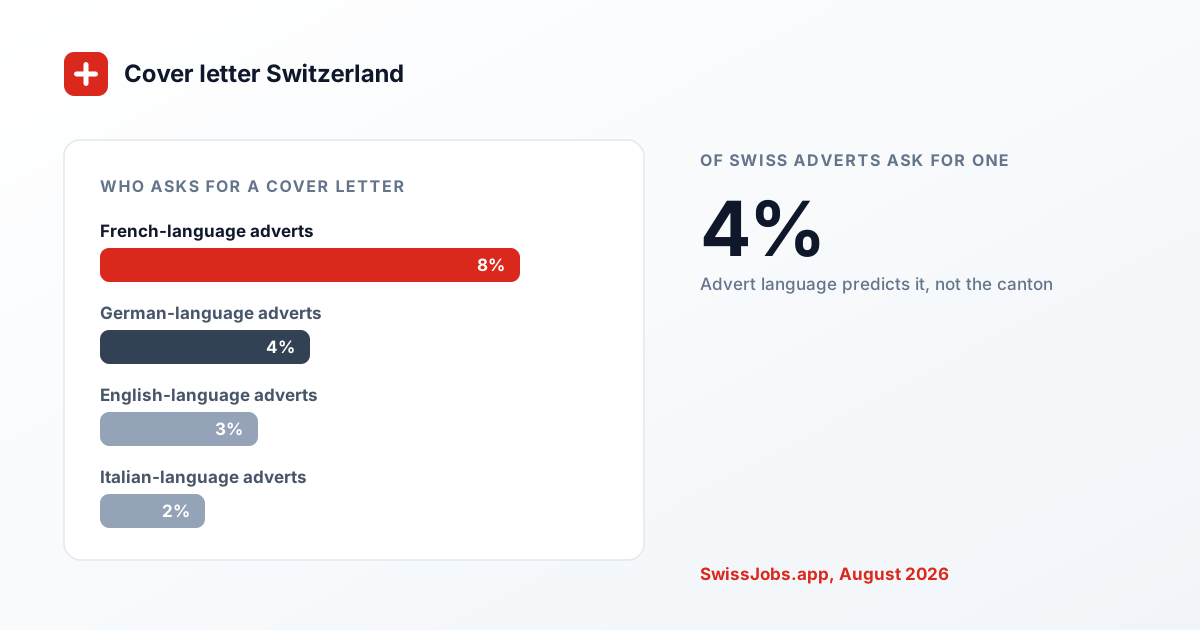
Around 4% of Swiss job adverts name a cover letter at all — and adverts written in English ask least of anyone, at roughly 3%.
The split that surprised me isn't geographic. It's linguistic. What predicts whether an advert asks for a letter is the language the advert is written in, and it predicts it strongly.
French-language adverts ask about twice as often as German ones, and close to three times as often as English ones. Italian-language adverts almost never do — under 2%.
If you're applying in English, which most internationals in Zurich, Zug and Geneva are, you're sitting in the part of the market that asks least. That's not permission to skip the letter everywhere. It's a reason to stop treating it as the main event of your application, which is what most people do with it.
Measured across Swiss job adverts on SwissJobs.app, August 2026
Write a custom CV for every job you apply to
Most people send the same CV everywhere. The AI editor rewrites yours per application — Swiss format, the right language, in about a minute.
CV maker & resume builder: tailor it to this jobIf almost nobody asks, why does every guide say it's mandatory?
Because a slice of employers ask without using the word — "vollständige Bewerbungsunterlagen" is a cover letter in a trench coat.
There's a second phrase running quietly through Swiss adverts. Vollständige Bewerbungsunterlagen in German. Dossier de candidature complet in French. Complete application documents. It never names a letter. It means one, and every Swiss applicant over thirty knows it means one.
Count that phrasing too and the share of adverts wanting more than a CV goes from roughly 4% to roughly 5% overall — and in French-language adverts to about one in ten. One French advert I read spelled the whole thing out in brackets: CV, lettre de motivation, diplôme, certificats de travail, pièce d'identité. Five documents. No ambiguity.
But it cuts the other way as well, and this is the bit I find genuinely interesting. Of the adverts that mention a cover letter at all, about one in twelve mentions it to tell you not to send one. "Wir freuen uns auf deine Onlinebewerbung – auch ohne Bewerbungsschreiben." Another one, a manufacturer, wrote that the biggest motivation they need is that you want to join, so they've dropped the letter entirely.
Employers are competing for applicants by removing work from the application. I'd bet on that trend continuing.
Measured across Swiss job adverts on SwissJobs.app, August 2026
See what a Swiss recruiter checks first
Upload your CV and get a score against a specific job ad in about 30 seconds — language levels, work permit, photo, how your achievements are phrased.
ATS CV checker, freeWhich employers and which jobs still want one?
Public bodies ask about twice as often as private companies, and — this one flipped my assumptions — kitchens and building sites ask more than banks and software firms.
If you'd asked me to guess which jobs demand a letter, I'd have said the white-collar ones. Consulting. Banking. Anything with a glass meeting room.
Wrong, and not narrowly wrong. Engineering and IT roles ask least of every group I looked at. Finance is lower still, around 1%. The roles that ask most are hospitality and kitchen jobs, then the building trades, then sales.
It makes sense once you stop being surprised by it. A software company collects applications through a form with structured boxes and doesn't want your prose. A Gemeinde has a process that has worked since 1994 and sees no reason to change it. A restaurant owner reading applications after closing wants to know whether you actually want to work there or just need any job that pays — and there's no box on a form for that.
Public and para-public employers — Kanton, Stadt, Spital, Universität, Schule — ask around 7%, against roughly 3 to 4% for everyone else. If you're applying to a Swiss administration, write the letter. Don't argue with the institution.
Measured across Swiss job adverts on SwissJobs.app, August 2026
Does it depend on where in Switzerland the job is?
Vaud is the highest of the big cantons at about 9% and Zurich among the lowest at about 3% — but that's the advert's language showing up again, not the border.
Counted across the adverts where the canton is known, Vaud sits at the top: roughly 9% ask for a letter outright. Zug is up there too, which I can't fully explain. Zurich, Lucerne and St. Gallen sit at the bottom, between 2 and 3%.
Here's the trap in that ranking. Geneva, which everyone would file under Romandie along with Vaud, asks about as rarely as Zurich does. Why? Because most Geneva adverts I looked at are written in English — international organisations, banks, commodity and watch firms. The expectation travels with the employer's culture, and the advert's language is the visible sign of it. The cantonal border isn't doing the work.
Practical version: don't reason from the postcode. Read what language the advert itself is in. That tells you more about the dossier the recruiter is picturing than the canton ever will.
Counted across the adverts where the canton is known. SwissJobs.app, August 2026
What do Swiss employers ask for instead?
Paper. Of the adverts that do want a letter, about a third also want diplomas and about a third want Arbeitszeugnisse — the written references from every job you've held.
This is the real Swiss dossier and it's the part internationals consistently underestimate. The Arbeitszeugnis is a formal, faintly coded reference letter that your employer owes you when you leave. Switzerland takes it seriously in a way almost nowhere else does, and a recruiter who asks for them and doesn't get them will assume the worst rather than chase you.
The photo, on the other hand, is nearly dead as a written requirement — fewer than one advert in a hundred asks for one. It's still convention on a Swiss CV and I still put one on mine, but nobody's demanding it in the text any more.
So if you've got one spare hour before you apply, spend it scanning diplomas and Zeugnisse into a single tidy PDF rather than polishing a third paragraph about your passion for the brand. The first one gets read. The second one mostly doesn't.
Among the adverts that ask for a cover letter. SwissJobs.app, August 2026
So do I write one or not?
Write a short one when the advert asks, when the employer is public, or when you need to explain something a CV structurally cannot — a permit, a gap, a move between countries.
My rule of thumb, and it is a rule of thumb rather than a law: half a page, four paragraphs, and only if it says something the CV doesn't already say. A letter that paraphrases your CV in full sentences is worse than no letter, because it proves you had nothing to add and sent it anyway.
For an EU or EFTA national already living in Switzerland, there's usually nothing to explain. Your permit is fine, your address is Swiss, your last job is legible. The letter is decoration.
For a non-EU applicant, or anyone applying from abroad, there's a great deal to explain, and none of it fits in a CV: which permit you hold or would need, why Switzerland specifically, whether you can start in a month or in four, whether you've already got the right to work. That's a letter worth writing, and honestly it's the only kind I'd call load-bearing.
One more thing, and it costs nothing. Write it in the language of the advert. A German-language advert answered in English tells the recruiter something about you before they've read a single word of your argument, and it isn't the thing you wanted to tell them.
What I'd actually use
Three of these are ours and one isn't. The honest ordering: fix the CV first, then worry about the letter.
- SwissJobs cover letter guide and builderour tool
Structure, the four paragraphs that do the work, and a builder if you'd rather not start from a blank page.
SwissJobs cover letter guide and builder SwissJobs CV Check our tool
Upload the CV and see in a minute what a Swiss recruiter notices first — permit, languages, location, last two jobs.
Try it free- SwissJobs job searchour tool
Swiss openings from across the market in one place, refreshed daily, filterable by canton and language.
SwissJobs job search - arbeit.swiss
The official Swiss public employment service — RAV registration, unemployment rules and the state job platform.
Visit site
The uncomfortable conclusion of a morning's counting: if you're not hearing back, the cover letter almost certainly isn't why. Roughly ninety-six adverts in a hundred never asked for it in the first place.
What they did ask for, implicitly, is a CV that survives about thirty seconds of scanning — permit status visible, languages stated with levels, a Swiss address or a clear plan to have one, and the last two jobs readable without effort. That's the screen. That's where applications actually die, and it's a much less interesting thing to fix than a letter, which is probably why so many people prefer to rewrite the letter.
The numbers here are measured across Swiss job adverts on SwissJobs.app in August 2026. They'll drift a little. The direction won't.
The tools compared
We checked 16 Swiss and international application tools on their own pages — prices, free tiers, and what is actually included.