Cover letter template Switzerland: one page, four paragraphs, built from the adverts
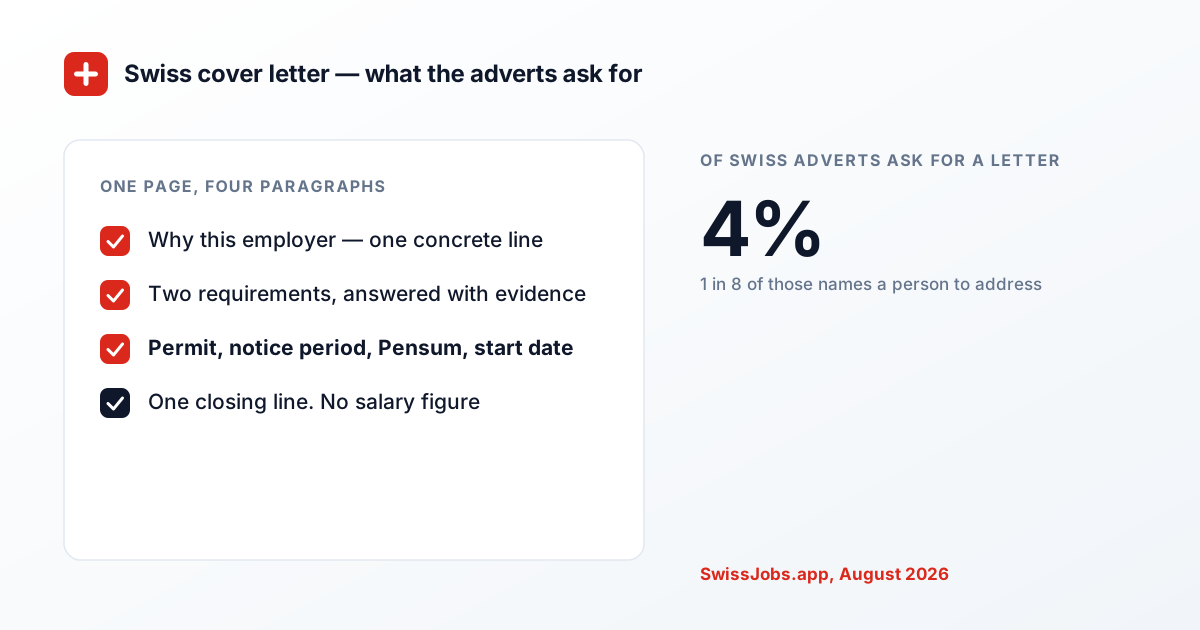
Swiss cover letter templates all look the same, and hardly any are built from the adverts they are supposed to answer. So I counted the adverts instead: what they ask for, what they hand you to work with, how they talk to you.
Three things fell out. Roughly four adverts in a hundred ask for a letter outright. Of the ones that do, about one in eight names the person who will read it. And in German, more than half of all adverts address you as du.
That is most of the template right there. One page, four paragraphs, a subject line copied out of the advert, and a salutation you will usually be writing blind.
Short version
- What does a Swiss cover letter look like?
- One page. Place and date, a subject line naming the exact job title and Pensum from the advert, a salutation, four short paragraphs, one closing line. Written in the language the advert is written in, and attached as a PDF rather than pasted into the e-mail body.
- Who do I address a Swiss cover letter to?
- Whoever the advert names — but among adverts that ask for a letter, only about one in eight names a person at all. If nobody is named, Sehr geehrte Damen und Herren, or Madame, Monsieur in French, is correct and costs you nothing.
- Should I write du or Sie?
- Follow the advert. Around half of German-language Swiss adverts address the reader as du, roughly one in five uses Sie, and about a quarter use neither. Match what they used. When the advert avoids the question, use Sie.
- What goes in the four paragraphs?
- One concrete reason you want this employer, two requirements from the advert you meet with evidence, the things your CV cannot say — permit, notice period, Pensum, where you will be living — and a single line offering to come in.
- Do I put my salary expectation in the letter?
- Only if the advert asks, and fewer than one advert in two hundred does. Swiss adverts almost never print a salary themselves, so a number in your letter is a guess against an unknown figure.
- What do I attach?
- Where an advert asks for a letter, close to half also want Arbeitszeugnisse or references and four in ten want diplomas. Scan them into one tidy PDF in the order the advert lists them.
Working on your CV right now? ATS CV checker: free, against a real Swiss job ad
See what a Swiss recruiter checks first
Upload your CV and get a score against a specific job ad in about 30 seconds — language levels, work permit, photo, how your achievements are phrased.
ATS CV checker, freeDoes a Swiss employer actually want a cover letter?
About four adverts in a hundred ask for one outright — roughly eight in a hundred when the advert is written in French, about three when it is in English.
That is the number this template has to survive. If you are applying in English, which most internationals in Zurich, Zug and Geneva are, you are sitting in the part of the market that asks least.
It does not mean the letter is dead. It means it is optional often enough that a weak one costs you more than none at all. A page that restates the CV in full sentences proves you had nothing to add and sent it anyway.
So: write one when the advert asks, when the employer is public — a Kanton, a Gemeinde, a hospital, a school — or when you have something to explain that a CV structurally cannot hold. Otherwise put the hour into the CV, which every one of them reads.
Measured across Swiss job adverts on SwissJobs.app, August 2026
Write a custom CV for every job you apply to
Most people send the same CV everywhere. The AI editor rewrites yours per application — Swiss format, the right language, in about a minute.
CV maker & resume builder: tailor it to this jobWhat goes in the subject line, and who do I address it to?
Copy the job title out of the advert word for word, Pensum included — and expect to write the salutation blind, because barely one advert in eight that wants a letter names a person.
Every guide tells you to quote the reference number and address the named recruiter. In Switzerland both are mostly unavailable. A reference number turns up in well under one advert in a hundred. A named contact, or even a phrase pointing at one, appears in around one advert in fifteen across the market — counted where the advert spells it out in its own text.
Among the adverts that do ask for a letter it improves: roughly one in eight names somebody, and about a quarter give an e-mail address or a phone number. Another quarter point at an online form, which is its own answer — there is no addressee, there is an upload slot and a box.
The practical version. Subject line: Application for [exact title from the advert], [Pensum]. Not a re-worded version, the advert wording, because that is the string the recruiter is sorting by. If a name appears anywhere in the text, use it. If not, Sehr geehrte Damen und Herren.
And if the advert gives you a phone number, that is not decoration. Two minutes on the phone before you write tells you more about what they want in the letter than any template, and the person you spoke to now has a reason to look for your name.
Among the adverts that ask for a cover letter. SwissJobs.app, August 2026
See what a Swiss recruiter checks first
Upload your CV and get a score against a specific job ad in about 30 seconds — language levels, work permit, photo, how your achievements are phrased.
ATS CV checker, freeDu or Sie — what register does the letter use?
The advert decides it for you: about half of German-language Swiss adverts address you as du, roughly one in five uses Sie, and a quarter avoid a personal address altogether.
This surprises people who learned their German outside Switzerland. Half. Not a handful of startups in Zurich West — retail, hospitals, prisons, cantonal administrations, industrial firms, all writing du to a stranger they have never met.
Among German-language adverts that ask for a letter, du is stronger still, close to three quarters. The kind of employer who still wants a written letter is not automatically the formal kind.
Match whatever they used. Sie in reply to a du advert reads a bit starched but is never actually wrong; du in reply to a Sie advert is the mismatch that gets noticed. Where the advert dodges both — and a quarter of them do, writing about the position rather than to you — use Sie.
Counted across German-language adverts. SwissJobs.app, August 2026
What actually goes in the four paragraphs?
One concrete reason for this employer, two requirements you meet with evidence, everything the CV cannot say, and a single line offering to come in.
Paragraph one: why this job, at this employer. One sentence, something only true of them — the department, the product, the shift pattern, the fact that they run their own workshop. Not that you were excited to see the posting. Everybody was excited to see the posting.
Paragraph two: take two requirements from the advert, in the advert order, and answer each with something you actually did. Not the adjective, the evidence. Managed a team of nine on the late shift. Ran the migration for the Basel site. The system that sorts applications matches words against the advert, but the person who opens it afterwards is looking for the work behind the word, and that is a different reader with a different question.
Paragraph three: the things a CV structurally cannot hold. Permit status if you are not Swiss or EU-resident. Notice period. The Pensum you want if the advert offers a range. Whether you are moving to the region and when. This is the paragraph internationals leave out and it is the one a Swiss recruiter is actually hunting for.
Paragraph four: one line. You would be glad to come in and talk it through. Then stop. No salary number unless they asked — fewer than one advert in two hundred does, and Swiss adverts almost never print a figure themselves, so anything you name is a guess made in public.
What do I attach to it?
Where an advert asks for a letter, close to half also want Arbeitszeugnisse or references and four in ten want diplomas — the letter is one document in a dossier, not the dossier.
The Arbeitszeugnis is the part internationals underestimate. It is a formal, faintly coded reference letter your employer owes you when you leave, Switzerland takes it seriously, and a recruiter who asks and does not get one will assume the worst rather than chase you for it.
The photo, by contrast, is nearly gone as a written requirement — around four in a hundred of the adverts asking for a letter mention one. It is still convention on the CV itself. Nobody is demanding it in the text any more.
Order the attachments the way the advert lists them, in one PDF, with a filename that has your name in it. It sounds trivial. A recruiter working through applications on a Friday afternoon is downloading files into one folder, and Bewerbung.pdf is the fourth file called Bewerbung.pdf they have opened.
Among the adverts that ask for a cover letter. SwissJobs.app, August 2026
Is it worth writing one when the advert never mentions it?
Sometimes — about seven adverts in a hundred want more than a CV, and roughly half of those never use the word letter at all.
There is a second phrase running quietly through Swiss adverts: vollständige Bewerbungsunterlagen, dossier de candidature complet, complete application documents. It never names a letter. It means one, and every Swiss applicant over thirty knows it means one.
Count that wording alongside the explicit requests and the share of adverts wanting more than a CV goes to roughly nine in a hundred in German, ten in French, three in English. The silent request is where people get caught: they read the advert, see no list of documents, send a CV, and are quietly filed under incomplete.
So the working rule. If the advert names a letter, write one. If it says complete documents, write one and attach the paper. If it says neither and gives you an upload form with three slots, fill the three slots and spend the saved hour on the CV instead.
Measured across Swiss job adverts on SwissJobs.app, August 2026
What I would actually use
Three of these are ours and one is not. The honest ordering: get the CV through the first screen, then write the letter.
- SwissJobs cover letter guide and builderour tool
Ours, free. The four paragraphs with worked examples, and a builder if a blank page is the problem.
SwissJobs cover letter guide and builder SwissJobs CV Check our tool
Ours, free. Upload the CV and see what a Swiss recruiter notices in the first thirty seconds — permit, languages, location, the last two jobs.
Try it free- SwissJobs job searchour tool
Ours. Swiss openings from across the market in one place, filterable by canton and language — this is where every number in this article was counted.
SwissJobs job search - arbeit.swiss
Neutral and official. The Swiss public employment service: RAV registration, the state job platform and the official application guidance.
Visit site
The letter is a smaller document than the advice industry makes it. One page, four paragraphs, and three of those paragraphs only exist to say things the CV cannot.
What the counting changed for me is the header. I used to hunt for a name to address it to, and the adverts mostly do not carry one — no reference number, no recruiter, just an upload form and a job title. Take the title exactly as written, use it as the subject, and put the effort into paragraph three, where the permit and the notice period live.
These figures are measured across Swiss job adverts on SwissJobs.app in August 2026. They will drift a little from month to month. The shape of the letter will not.
The tools compared
We checked 16 Swiss and international application tools on their own pages — prices, free tiers, and what is actually included.