Engineering jobs in Switzerland: the word you type decides which openings you see
Before a recruiter ever sees you, a search box has already thrown away most of the market on your behalf. It doesn't know what you do. It knows which letters you typed.
I went through the Swiss openings on our own search this morning and counted the job titles, because I wanted to know how much that costs an engineer. The answer is more than I expected. Of the engineering roles advertised here, 85% put Engineer or Engineering in the title. The other 15% say Ingenieur, ingénieur or ingegnere. Type the local word and roughly six openings in seven are simply not in your results.
And no, the body text doesn't quietly rescue you. Where I can read the advert's text, an English-titled engineering role uses the local word anywhere in it about 6% of the time. The vocabulary is consistent all the way down.
What surprised me is that the split isn't uniform. One discipline goes almost entirely the other way, and outside engineering there are whole fields where typing English is the mistake.
Short version
- Should I search Engineer or Ingenieur for jobs in Switzerland?
- Both, as two separate searches. Among Swiss engineering openings, 85% carry the English word in the title and 15% the local one, and there is almost no overlap — under 1% of titles use both. One search covers about six sevenths of the market, the other covers the rest, and the rest is where the classic disciplines sit.
- Are engineering jobs in Switzerland advertised in English?
- The titles mostly are. The jobs often aren't. Among English-titled engineering openings that state a language requirement, 60% still ask for German and 59% for English — the two overlap because plenty of roles want both.
- Which engineering fields still use the German word?
- Civil and structural engineering, overwhelmingly: only about one advert in ten there is titled in English. Mechanical, electrical, process and quality engineering sit around 60% English. Software, systems and network engineering are 97% English.
- Does a German-language advert use a German job title?
- Often not. Among engineering openings written in German, 80% still put Engineer in the title. Across all Swiss adverts, roughly a third carry an English word in the job title.
- Which fields go the other way?
- Nursing and care: 97% of those openings use the local-language title, so searching in English is what makes the market disappear. Project management is 76% local, sales 60%, logistics 52%.
Working on your CV right now? ATS CV checker: free, against a real Swiss job ad
See what a Swiss recruiter checks first
Upload your CV and get a score against a specific job ad in about 30 seconds — language levels, work permit, photo, how your achievements are phrased.
ATS CV checker, freeWhy does searching Ingenieur show so few jobs?
Because 85% of Swiss engineering openings are titled with the English word, and the two vocabularies barely overlap — under 1% of engineering titles contain both.
Roughly one Swiss advert in nine on our search carries an engineering title, which makes it one of the biggest hiring fields in the country. Split by the word in the title, it looks like this: Engineer or Engineering on 85% of them, Ingenieur, ingénieur or ingegnere on 15%.
That is not a translation question, it's a filter. A title search for Ingenieur returns the smaller slice and gives you no signal that a much larger one exists. And what stays in that smaller slice leans heavily towards the classic disciplines and towards employers who write their adverts in German or French, which I'll come to.
The obvious hope is that full-text search fixes it: surely a job called Quality Engineer says Ingenieur somewhere in the description? Mostly not. Where I can read the text, about 6% of English-titled engineering adverts use the local word anywhere at all. Employers pick one vocabulary and stay in it, so a search engine that ranks title matches first — which is all of them — hands you one half of the market and hides the other.
Share of Swiss engineering openings on SwissJobs.app by the word used in the job title, August 2026
Write a custom CV for every job you apply to
Most people send the same CV everywhere. The AI editor rewrites yours per application — Swiss format, the right language, in about a minute.
CV maker & resume builder: tailor it to this jobWhich kinds of engineering still say Ingenieur?
One: civil and structural. Nine adverts in ten there keep the local word, while software and systems engineering are 97% English.
Cut the same openings by discipline and the average stops being useful. Software, data and cloud roles are titled in English 97% of the time. Systems, network and IT engineering, the same. Those two together are most of what gets advertised under the word Engineer in Switzerland, which is why the overall number is so lopsided.
The classic disciplines are genuinely mixed. Mechanical and product engineering, electrical and automation, process and quality all sit around 60% English — so even there, typing Ingenieur costs you well over half the openings. Not all of them. Enough to matter.
Then civil and structural engineering, where about one advert in ten is titled in English. Bauingenieur, génie civil, Ingenieurbau: the local word holds. My read is that it follows the client — a road, a bridge or a rail line is commissioned by a canton or a municipality, the project runs in the local language, and the job title never had a reason to switch. Software has the opposite pressure. If you build for a market outside Switzerland, the title is written for candidates outside Switzerland too.
Share of Swiss engineering openings on SwissJobs.app whose title uses the English word, by discipline, August 2026
See what a Swiss recruiter checks first
Upload your CV and get a score against a specific job ad in about 30 seconds — language levels, work permit, photo, how your achievements are phrased.
ATS CV checker, freeDoes a German-language advert use a German job title?
Usually not: among engineering openings written in German, 80% still put Engineer in the title. French-language adverts keep ingénieur four times out of five.
This is the part I'd have got wrong if I'd guessed. The language an advert is written in barely predicts the language of its own title. Take the engineering openings written in German — three paragraphs of Deutsch about the team, the Pensum and the Weiterbildung, and 80% of them are headed Engineer.
The French-language adverts behave in the opposite way. Only 20% of them use the English word; ingénieur survives as the working title. So the same search habit costs a German speaker far more than a French speaker, which is not the story I'd have told before counting.
Region and advert language aren't the same thing, mind. Counted across the openings where the canton is known, about three quarters of engineering roles based in Romandie are titled in English — because a large share of them are written in English in the first place, by international employers who happen to sit in Geneva, Lausanne or Neuchâtel.
Share of Swiss engineering openings on SwissJobs.app whose title uses the English word, by the language the advert is written in, August 2026
Is this only engineers, or does every field do it?
Every field does it, in both directions — and in nursing the English search is the one that empties your results.
I ran the same count on eight other occupations, taking each field's local-language word against its English one and asking how much of the field a single search word actually reaches. The spread is wider than the engineering number on its own suggests.
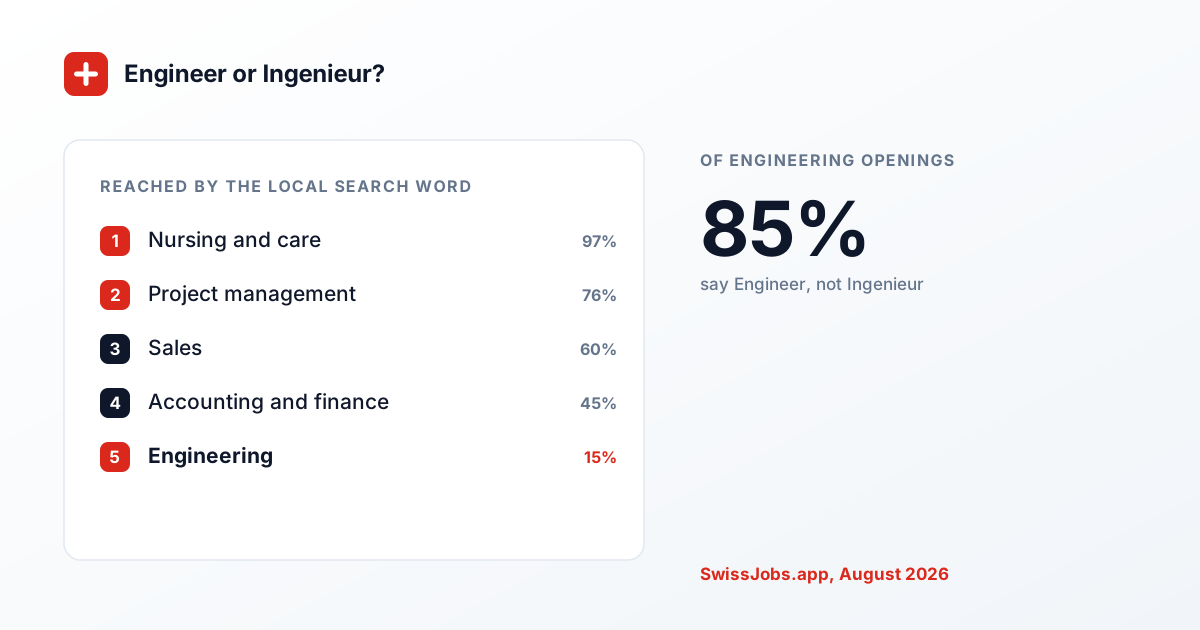
At one end, care work. Pflegefachfrau, infirmier, Fachfrau Gesundheit: 97% of those openings use the local title, so a nurse searching in English sees almost nothing. Project management is 76% local, sales 60%, logistics 52%, accounting and finance 45%. At the other end, IT and software at 16% and engineering at 15%.
The pattern is who the employer is talking to. Roles that are staffed locally and regulated locally keep the local word — care, trades, retail, public-sector project work. Roles recruited across borders switch to English, and the switch happens in the title first, before the advert body and long before the workplace itself.
Share of each field's Swiss openings on SwissJobs.app whose title uses the local-language word rather than the English one, August 2026
If the title is in English, is the job in English?
No. Among English-titled engineering openings that state a language, 60% still ask for German — the title tells you who wrote the advert, not what you'll speak at lunch.
This is the trap on the other side of the search box. You widen the search, you get five times the results, and you assume the English titles mean English-speaking teams. Among English-titled engineering openings that state a language requirement, 60% ask for German and 59% for English. Those overlap, because a lot of them want both.
The locally-titled openings are stricter in one direction and softer in another: 80% ask for German, 41% for English, and 33% for French — that last one is the Romandie showing up, since ingénieur is where the French-language market lives.
So the practical reading is that an English title buys you a shot, not a guarantee. It's the difference between an employer who recruits internationally and one who doesn't, and roughly six in ten of those international employers still want German in the building. If you want the detail on what a stated level actually means in a Swiss advert, I went through that separately in the piece on language levels.
Share of Swiss engineering openings on SwissJobs.app that ask for each language, among those stating a language requirement, August 2026
So what do I actually type into the search box?
Two searches and two alerts, one in each vocabulary, plus the discipline word — Bauingenieur and civil engineer are different queries and both are worth running.
Run the pair. Engineer and Ingenieur, developer and Informatiker, nurse and Pflegefachfrau, sales and Verkauf. Save both as alerts rather than deciding which one is right, because as the shares above show, the right one depends on a discipline boundary you can't see from outside.
Then go one level down. The generic word is the weakest query in either language: a search for Engineer buries the mechanical roles under systems and network posts, and a search for Ingenieur buries nothing because there's so little of it. Bauingenieur, Verfahrenstechnik, Automation, Instandhaltung, structural, commissioning, validation — the discipline word is what separates two openings that share a title and share nothing else.
And put both words on your CV, once. The headline of an engineering CV can carry the English title with the local one behind it — Process Engineer (Verfahrensingenieur) — which costs you five words and matches whichever vocabulary the employer's own system is searching in. The same logic works for the qualification: write the FH or ETH degree in the Swiss form and add the English equivalent in brackets, not the other way round.
What I'd use for this
Three of ours and one neutral. Every share above was counted across the Swiss openings on our own search.
- SwissJobs job searchour tool
Ours, free. Run the pair of search words here and filter by canton — this is where the shares in this article were counted.
SwissJobs job search SwissJobs CV Check our tool
Ours, free. Upload the CV and see what a Swiss reader picks up in the first thirty seconds — including whether your job title matches the vocabulary the advert uses.
Try it free- SwissJobs CV builderour tool
Ours, free. Builds a Swiss-format CV where the headline, languages and qualification lines sit where a Swiss recruiter looks for them.
SwissJobs CV builder - arbeit.swiss
Neutral and official. The Swiss public employment service, useful for recognition of foreign engineering qualifications and RAV registration.
Visit site
The thing I keep coming back to is that none of this is a hiring decision. Nobody sat down and decided that a bridge engineer should be harder to find in English than a network engineer. It's the residue of who each employer was talking to when they wrote the advert, and it hardens into a filter that quietly decides which jobs exist for you.
Which means the cheapest improvement to a Swiss job search isn't a better CV or a smarter cover letter. It's a second alert with the other word in it. Five minutes, and for an engineer it's the difference between one seventh of the market and all of it.
These shares are measured across Swiss job adverts on SwissJobs.app in August 2026, counting the words that appear in the job title itself. Where an advert uses a word only in its body text, it isn't in these numbers — so read each share as the least the vocabulary split costs you, not the most.
The tools compared
We checked 16 Swiss and international application tools on their own pages — prices, free tiers, and what is actually included.