Part-time in Switzerland: 4,488 of 20,777 live jobs will take you under 100%
Three days ago I published a canton-by-canton breakdown of the Swiss job market, and one line in it said 6.4% of live postings are part-time. That line has been bothering me ever since. It isn't wrong — it's exactly what the employment-type field says. It just describes the label on the tin rather than what's inside, and honestly, I knew that while I was writing it.
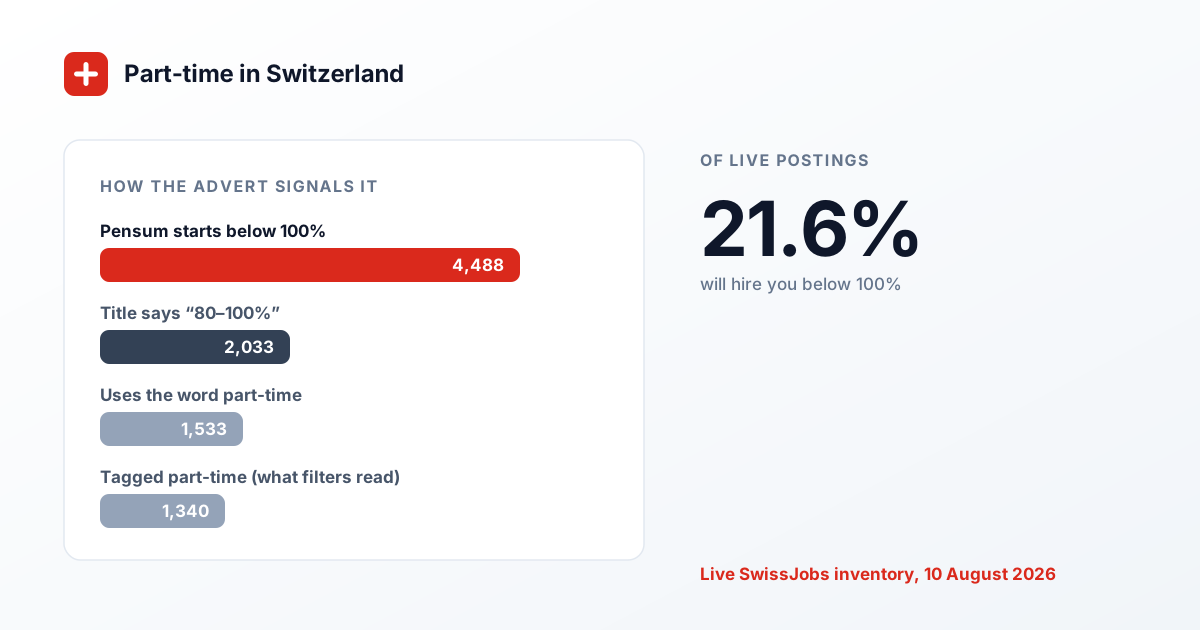
So this morning I went back to the same inventory, 20,777 published postings as of 08:15, and counted a different question. Not "does this advert say part-time" but "would this employer take me at less than 100%". Different question, very different answer: 4,488 postings. 21.6% of everything live. And 2,853 of those sit in the index tagged full-time, because the only place they admit the flexibility is a number in the job title.
If you've been filtering for part-time work in Switzerland and concluding there isn't much, this is why. You've been reading the tag. The Swiss market puts the real information somewhere else.
Short version
- How many jobs in Switzerland are actually part-time?
- Of the 20,777 postings live on our platform on 10 August 2026, 4,488 (21.6%) state a workload that starts below 100% — meaning the employer will hire you at less than full-time. Only 1,533 (7.4%) use the word part-time, Teilzeit or temps partiel anywhere, and just 1,340 (6.4%) carry a structured part-time tag. The gap between 6.4% and 21.6% is the whole story.
- What does 80–100% mean in a Swiss job advert?
- It's the Pensum — the workload the employer will hire at, expressed as a percentage of a full week. 80–100% means the floor is 80% and the ceiling is 100%, and it's negotiable in between. It is by far the most common phrasing in the Swiss market: 2,033 live postings carry exactly that range, and 1,697 of them are simultaneously tagged as full-time jobs. Read it as "we'd prefer 100, we'll happily hire at 80".
- Which Swiss jobs are most likely to go part-time?
- Healthcare, by a distance: 61.9% of the 1,349 nursing and health-titled postings accept under 100%. Then administration and Sachbearbeitung 38.1%, retail 30.7%, HR 29.8%, cleaning and facility 28.6%, hospitality 21.6%. At the bottom: engineering and IT 9.7% of 2,263 postings, sales and account management 8.2%, apprenticeships 0.4%.
- Where in Switzerland is part-time work most common?
- Graubünden 33.5%, Valais 33.4%, Aargau 33.1%, Bern 33.0% and Lucerne 32.3% of local openings accept a reduced Pensum. Geneva is last at 8.0%, then Ticino 9.4% and Fribourg 12.6%. Aggregated: 26.3% across the German-speaking cantons against 14.7% across the Romandie. The Röstigraben shows up in the data more clearly here than in anything else I've measured.
- Why don't job boards show me these part-time roles?
- Because the part-time filter reads a structured field, and 2,955 of the 4,488 flexible postings never populate it — the flexibility only appears as a percentage inside the job title. Search the number instead of the label: type 80 or 60 into the keyword box and you'll surface roles that every part-time filter in the country is hiding from you.
Working on your CV right now? ATS CV checker: free, against a real Swiss job ad
See what a Swiss recruiter checks first
Upload your CV and get a score against a specific job ad in about 30 seconds — language levels, work permit, photo, how your achievements are phrased.
ATS CV checker, freeHow many Swiss jobs are actually part-time?
4,488 of 20,777 live postings — 21.6% — will hire below 100%, but only 1,340 carry the part-time tag that job-board filters read.
Three ways to count the same thing, three wildly different numbers. The structured employment-type field says part-time on 1,340 postings, 6.4%. Widen it to any posting that uses the words part-time, Teilzeit, temps partiel, tempo parziale, stundenweise or auf Abruf, in the title or in the summary, and you get 1,533 — 7.4%. Then widen it once more to postings whose stated Pensum starts anywhere below 100%, and it jumps to 4,488. 21.6%.
That last number is the honest one, and here's why. A Swiss advert headed "Systemtechniker:in Raumautomation 80–100%" is not a full-time job that occasionally tolerates less. It is a job the employer has already decided to fill at 80% if the right person turns up at 80%. The willingness is stated in the headline. It's just stated as arithmetic instead of as a label.
The mechanics of why the tag misses it are dull but worth knowing: 2,955 of the 4,488 flexible postings show no part-time signal anywhere except the percentage in their own title. 2,853 of them are explicitly tagged full_time. So the filter isn't broken, it's answering a narrower question than you're asking it. You want "will they take me at 80". It's answering "did somebody tick the part-time box".
One caveat I want on the record, because I'd rather undersell this. Our structured Pensum field is empty — literally 2 postings out of 20,777 populate it, which is why I parsed the titles by hand instead. And I only parse titles and summaries, not full advert bodies. Plenty of postings mention a reduced Pensum three paragraphs into the description where I can't see it. So 21.6% is a floor, not a ceiling. The true figure is higher and I can't tell you by how much.
Live SwissJobs inventory, 10 August 2026. Base: all 20,777 published postings. Pensum parsed from job titles; the structured Pensum field is populated on 2 postings, so title text is the only usable source.
Write a custom CV for every job you apply to
Most people send the same CV everywhere. The AI editor rewrites yours per application — Swiss format, the right language, in about a minute.
CV maker & resume builder: tailor it to this jobWhat does 80–100% actually mean?
It's a hiring range with a floor and a ceiling — and of the 4,853 postings that state a Pensum at all, 3,683 have a floor below 100%.
4,853 live postings put a percentage in the job title. That's 23.4% of the market, which already tells you something about how central the Pensum is to a Swiss job advert — it sits in the headline, next to the gender brackets, before anyone has read a word about the work.
Of those 4,853, exactly 1,170 say 100% and nothing else. Every other one — 3,683 postings, 75.9% — has a floor somewhere below full-time. The most common floor by a mile is 80%: 2,235 postings won't go under 80 but will go to 80. Then 60% (520 postings), 50% (261), 40% (269), 20% (139), 70% (108). There's even a small tail down at 10% and 5%, which is what a Samstagseinsatz or an Aushilfe looks like in advert form.
The single most common string in the entire Swiss job market is "80–100%", on 2,033 postings. I've come to read it as a specific cultural sentence: we'd like a full-time person, we know we probably won't get one, 80 is fine, please apply. 1,697 of those 2,033 are tagged full-time in our data — which is exactly the mismatch this article exists to point at.
Two other patterns worth knowing before you read adverts. 3,113 of the stated Pensums are ranges rather than single figures, and 2,604 of those ranges top out at 100% — the range is open at the top, closed at the bottom. And 509 postings state a range that never reaches 100%, like 20–40% or 40–60%. That second group is a genuinely part-time job that will not become full-time later, no matter how well the interview goes. Worth spotting before you build a plan around it.
Live SwissJobs inventory, 10 August 2026. Base: the 4,853 of 20,777 postings that state a Pensum in the job title. "Floor" is the lower bound of the stated range, or the single figure where only one is given.
See what a Swiss recruiter checks first
Upload your CV and get a score against a specific job ad in about 30 seconds — language levels, work permit, photo, how your achievements are phrased.
ATS CV checker, freeWhich jobs will actually go part-time?
Healthcare at 61.9%, administration at 38.1% and retail at 30.7% flex routinely — engineering and IT at 9.7% and sales at 8.2% mostly don't.
I matched job titles against a set of role keywords and asked what share of each group accepts under 100%. The spread is enormous, and it maps almost perfectly onto whether the work is shift-based or project-based.
Care work is a different market entirely. 61.9% of the 1,349 postings with a nursing or health title flex, and if you narrow to Pflegefachfrau/-mann and infirmier/ère titles specifically it's 57.9% of 708. Rota-based work divides cleanly into fractions, so it does. Then administration and Sachbearbeitung at 38.1% of 598, retail at 30.7% of 1,033, HR at 29.8% of 282, cleaning and facility at 28.6% of 119, hospitality at 21.6% of 245, finance and accounting at 19.7% of 380.
The bottom is where it gets interesting for people reading this in English. Engineering and IT: 9.7% of 2,263 postings. Sales and account management: 8.2% of 417. Apprenticeships: 3 postings out of 755, which is 0.4% and basically a rounding artefact — a Lehrstelle is a full-time contract by construction.
Now, 9.7% of 2,263 is still 220 engineering roles that will hire at 80%, and they exist: Linux System Engineer 80–100%, Security Engineer 80–100%, ICT System Engineer DevOps 80–100%. They're just distributed differently. In healthcare the flexibility is the default and you negotiate up; in tech it's the exception and you have to go find the specific employer offering it. Which is a search problem, and search problems are solvable.
Live SwissJobs inventory, 10 August 2026. Role families matched on job-title keywords; the base for each is in brackets. National average across all 20,777 postings: 21.6%.
Where in Switzerland is a reduced Pensum normal?
26.3% of openings in the German-speaking cantons accept under 100%, against 14.7% across the Romandie — and Geneva sits at 8.0% while Bern sits at 33.0%.
Graubünden 33.5%. Valais 33.4%. Aargau 33.1%. Bern 33.0%. Lucerne 32.3%. Solothurn 27.4%. Thurgau 26.0%. St. Gallen 24.7%. Zurich 22.8%. Basel-Stadt 19.3%. Zug 19.3%. Then the drop: Vaud 14.9%, Neuchâtel 14.1%, Fribourg 12.6%, Ticino 9.4%, Geneva 8.0%.
By city it's even starker, because cities are where the employers actually are. Lucerne 38.4% of its 526 postings, Bern 33.1% of 946, St. Gallen 25.8% of 329, Zurich 19.5% of 2,630, Basel 19.2% of 937. Geneva: 7.6% of 1,059. One in thirteen. If a reduced Pensum is non-negotiable for you and you're job-hunting in Geneva, you're fishing in a pond that is genuinely, measurably smaller.
Valais at 33.4% is the one that broke my expectation, because it's a partly French-speaking canton sitting at the top of a German-speaking list. I don't have a clean explanation. The composition tilts heavily towards hospitality, care and public-sector work, all of which flex by nature, so I'd read it as an industry-mix effect rather than a cultural one. Small base too — 503 postings.
The regional pattern itself I'd bet on though, because it matches what anyone who has worked both sides of the Röstigraben will tell you without needing a dataset. An 80% Pensum is an unremarkable career in Bern or Aarau. In Geneva it's still a conversation. The adverts are just saying out loud what the culture already decided.
Live SwissJobs inventory, 10 August 2026. Base: each canton's postings with a resolved canton, shown in brackets. Aggregate: German-speaking cantons 26.3% of 9,570, Romandie 14.7% of 3,743.
Why does the English-language job market look so full-time?
Only 8.4% of English-language Swiss postings state a Pensum at all, against 29.3% of German ones — so if you read job ads in English, part-time Switzerland is almost invisible to you.
This is the finding I did not expect and the one I'd most like internationals to take away. Split the inventory by the language the advert is written in. German postings: 29.3% state a Pensum, and 27.3% of them accept under 100%. French: 19.3% state one, 16.8% flex. Italian: 3.7% state one, 6.5% flex. English: 8.4% state one, 7.8% flex.
So an English-reading job seeker in Switzerland is looking at a version of the market where the Pensum convention barely exists. Not because those employers are inflexible — because the convention of putting the workload in the headline is a German-language market habit that international employers writing in English simply don't share. You end up concluding that Switzerland doesn't do part-time, when what's actually happened is that you're reading the 4,749 English-language postings, where only 8.4% write it down at all.
The requirement data backs this up from the other side. Among the 4,488 flexible postings, 58.6% name German as a required language, against 48.2% in the rest of the inventory. English goes the other way: 20.6% of flexible postings versus 36.6% of the rest. Reduced-Pensum Switzerland is disproportionately German-speaking Switzerland. That's not a rule, it's a tilt — but it's a strong one.
Practical version: if you want 80% and your German is workable, search in German. Type Teilzeit, type 80%, type 60%. The postings are there, they're just not addressed to you in your language, and no filter is going to bridge that for you.
Live SwissJobs inventory, 10 August 2026. Base: postings whose advert language is detected, shown in brackets. Share stating any Pensum: German 29.3%, French 19.3%, English 8.4%, Italian 3.7%.
How do I ask for 80% without killing my chances?
Put the Pensum you want on the CV in the same block as your location and permit, state it as a range, and only apply to postings whose floor is at or below your number.
Start with the search, because most of this is solved before you write anything. If you need 60%, an advert that says 80–100% is not a maybe — it's a no, and applying anyway costs you an evening. Sort your list by the floor: postings at or below your number are live options, postings above it aren't. That one rule saves more time than any CV edit I could suggest.
Then the CV. Swiss screeners run a logistics check in the first few seconds — where can this person work, under what status, from when, at what Pensum — and they run it on the top third of page one. So it goes there, in the header block, not in a cover letter nobody opens: "Zurich · EU citizen · available from 1 October · 60–80%". Four facts, one line. I've read thousands of these and the ones that get through are the ones where a tired person at 16:40 can answer all four questions without scrolling.
State it as a range, not a point. "60–80%" reads as someone with a plan who's willing to talk. "60% only" reads as a constraint the recruiter has to solve, and at the screening stage they won't — they'll just take the next dossier. Same information, completely different reception. I think that's a bit unfair, honestly. It's still how it works.
One thing specific to non-EU applicants: a low Pensum makes a permit case harder, not easier, because the salary attached to the role is part of how the application is assessed. If you're on a permit that's tied to your employment, work out where your floor actually is with the cantonal migration office before you write a number on a CV. I'm an analyst and a CV person, not your Migrationsamt.
And if you're not sure whether your CV answers the four questions in five seconds, that's exactly the check we automated. Paste a posting, upload the CV, get told which of the four a Swiss screener can't find. It takes less time than reading this paragraph twice.
What I'd actually use for this
Three links. Two are ours and I'll say so.
- SwissJobsour tool
Ours. All 20,777 live Swiss postings, and the reason this article exists — every number above came out of it. For part-time, ignore the employment-type filter and put 80, 60 or Teilzeit in the keyword box instead. That's how you reach the 2,955 flexible roles no filter surfaces.
SwissJobs SwissJobs CV Check our tool
Ours, free. Run your CV against one specific posting. It flags what a Swiss first-pass screener looks for and usually can't find — location, permit status, availability, Pensum and language levels — in the top third of page one, where the decision actually gets made.
Try it free- Federal Statistical Office — employment and working hours
Not ours. My numbers count job adverts; the FSO counts people. If you want the official picture of how much of Switzerland actually works part-time — as opposed to how many employers advertise it — this is the source, and the two answer genuinely different questions.
Visit site
So the correction stands: 6.4% was the label, 21.6% is the market, and the difference is 2,955 jobs that will hire you at 80% while telling the world they're full-time. That's not employers being cagey. It's a market that writes its flexibility as a number in a headline instead of a checkbox in a database, and every job board built outside Switzerland gets it wrong the same way.
I'll re-run this in a quarter. The figure I'll be watching is the English-language one — 7.8% today. If international employers here start putting Pensum ranges in their headlines the way local ones do, that number moves, and it'll be the clearest signal I have that the convention is spreading rather than just surviving.
The tools compared
We checked 16 Swiss and international application tools on their own pages — prices, free tiers, and what is actually included.