RAV job search efforts: what counts, and where the adverts actually come from
If you register as unemployed in Switzerland, a number lands on you in the first meeting. Eight, ten, sometimes twelve documented job search efforts a month, handed in by the fifth of the following month in most cantons. It is written into your counselling record rather than into the law, and it is agreed with you. It is also almost never negotiated down afterwards.
What nobody works out in that meeting is whether the market supplies that many. I sorted north of twenty thousand live Swiss adverts on our own search by the date the employer posted them this morning, and the picture is thinner than a results page suggests. The median advert has been online for a little over three weeks. Only about three in a hundred went up in the last seven days.
That matters when you owe someone ten applications a month. A search box shows you thousands of hits and implies there is always something new. Most of it is the same stock you already clicked through last month, and you cannot put it on the form twice.
The useful part is in the breakdown. Refresh rates are nowhere near uniform. In retail, roughly seven in ten of today's openings went up within the last month; in construction and the trades, fewer than half. Between the fastest and the slowest region in Switzerland there are more than thirty percentage points.
Short version
- How many job applications does the RAV require per month?
- The figure is set individually and usually lands between eight and twelve a month. It depends on the canton, your occupation and the working percentage you are looking for. What binds you is the number written in your counselling record, not the one somebody quotes in a forum.
- When is the proof due?
- In most cantons by the fifth day of the following month, or the next working day. Late is treated as missing and can cost you suspension days on your benefit. The deadline is the hard part of the rule, not the count.
- Do speculative applications and phone calls count?
- Usually yes, if they are serious and you can evidence them: a speculative application, a call about a specific vacancy, registering with a staffing agency, a contact made at a job fair. Your counsellor decides what counts, so ask before you spend a month documenting something that gets struck off.
- Do I have to apply before I register as unemployed?
- Yes. The obligation starts when you know you are losing the job, which means during the notice period. Waiting until your first RAV appointment is the most common avoidable mistake in the whole process and it is sanctioned with suspension days.
- Does my permit change what I have to do?
- The search obligation is the same whatever your permit. What changes is the pool: adverts that name a language ask for German in about two thirds of cases and English in roughly four in ten, so a search restricted to English-language roles is a materially smaller market — worth saying out loud in the meeting rather than discovering in month three.
Working on your CV right now? ATS CV checker: free, against a real Swiss job ad
See what a Swiss recruiter checks first
Upload your CV and get a score against a specific job ad in about 30 seconds — language levels, work permit, photo, how your achievements are phrased.
ATS CV checker, freeHow many job search efforts does the RAV require, and by when?
Usually eight to twelve a month, agreed in your counselling meeting and due by the fifth day of the following month — and the deadline bites harder than the number.
No law states the figure. It is set between you and your counsellor and is meant to reflect your occupation, your region and the working percentage you want. In practice most people end up at ten. The proof goes on the cantonal form you sign: date, company, position, how you applied, outcome.
The part that actually costs people money is the deadline. By the fifth of the following month, or the next working day, and late counts as not submitted. The second trap is the period before you register. You are expected to be applying from the moment you know the job is ending, which means during your notice period. Start on the day you register and you have nothing to show for the months before it.
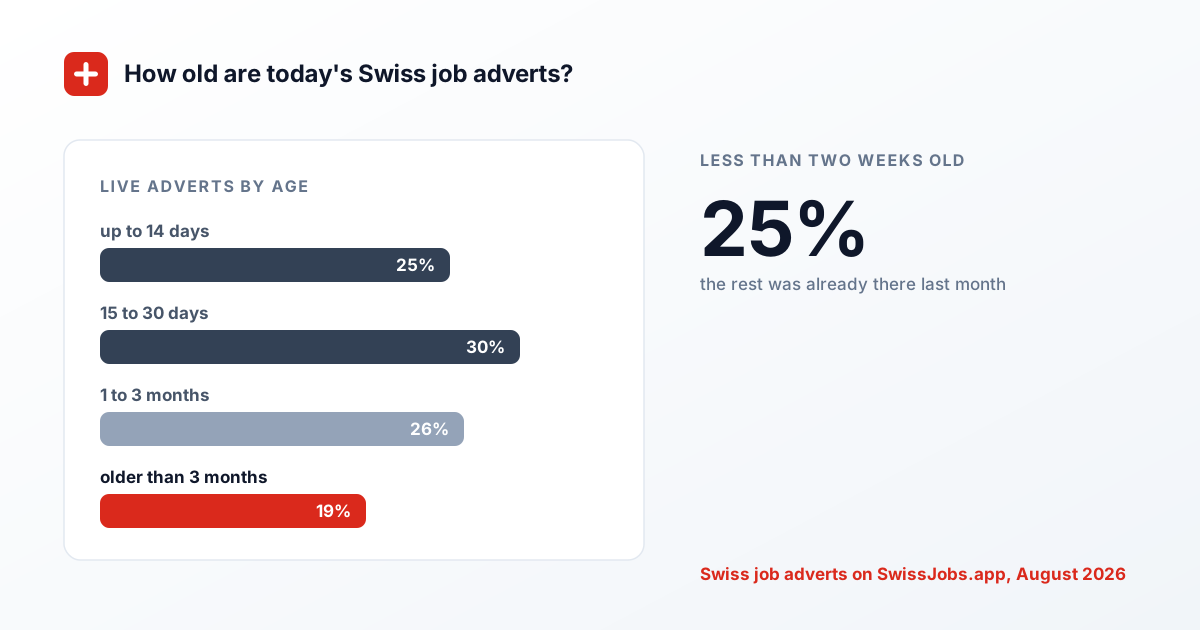
Now the side of it nobody raises in the meeting. There were north of twenty thousand Swiss positions advertised on our own search this morning — plenty, on the face of it. Sorted by the date the employer posted them, it reads differently: a quarter is less than two weeks old, and close to a fifth has been sitting there for more than three months.
Share of Swiss job adverts on SwissJobs.app by the date they were posted, August 2026
Write a custom CV for every job you apply to
Most people send the same CV everywhere. The AI editor rewrites yours per application — Swiss format, the right language, in about a minute.
CV maker & resume builder: tailor it to this jobHow fast does the list refresh in my field?
It varies enormously: in retail roughly seven in ten of today's openings appeared within the last month, in construction and the trades fewer than half.
This number is effectively the answer to how often you need to look at all. For each large occupational field I counted what share of today's live openings was posted within the last thirty days. Retail and shop floor roles sit at about 72%, hospitality and hotels at 68%, administration and back-office at 65%.
The trades sit at the other end. Construction, installation and fitting come in at 48%, so more than half of what you find there today was already there a month ago. Care and health are barely better at 53%, which surprises people because the shortage of staff is a national talking point. A shortage does not mean fast rotation — it means the same hard-to-fill post stays advertised for months and shows up in every search you run.
For your form that cuts two ways. In a fast field the monthly quota is a non-issue and weekly checking is enough. In a slow field the stock is exhausted after two or three weeks, and from then on you are applying to things you deliberately skipped the first time. That is where applications get written that both sides know are going nowhere.
Swiss job adverts on SwissJobs.app, share posted within the last 30 days, August 2026
See what a Swiss recruiter checks first
Upload your CV and get a score against a specific job ad in about 30 seconds — language levels, work permit, photo, how your achievements are phrased.
ATS CV checker, freeAnd in my region?
Bern and the Aargau/Solothurn belt refresh fastest, Ticino slowest — only about a third of what is open there is less than a month old.
The same calculation by region produced a wider spread than I expected. Bern runs at 65%, Aargau and Solothurn at 63%, eastern Switzerland at 58%. Zurich, the biggest market in the country, sits mid-table at 54% — a lot of adverts, and a lot of them open for a long time.
French-speaking Switzerland is at 48% and Ticino at 32%. Handing someone in Lugano the same monthly quota as someone in Bern is not the same instruction. Two thirds of what is advertised there today was advertised last month too.
Then there is the language filter, which no form captures. Among adverts that name a language at all, Bern asks for German in 91% of cases, French-speaking Switzerland asks for French in 62%, Ticino asks for Italian in 82%. Applying across a language border to make up the numbers produces applications nobody takes seriously — and roles that are not reasonably suitable in the sense the rule intends. A documented rejection is worth more than one extra line on the sheet.
Swiss job adverts on SwissJobs.app, counted across the adverts whose work location is stated, August 2026
What counts as a job search effort, and how do you prove it?
Anything serious and evidenced counts — written application, speculative application, a call about a named vacancy, a staffing agency, a job fair — and the evidence is the part people lose.
Proof sounds trivial and goes wrong constantly. About 57% of Swiss adverts send you to an address belonging to the employer to apply, another 27% into a recruiting system that carries its own name, and only around one in six keeps you on a job portal. So you usually do not apply where you found the job.
In practice: put the employer on the form, not the portal. And the evidence is the confirmation email that arrives after you submit, from the employer or the system — not a screenshot of the search results. Make one folder in your inbox and move every acknowledgement and rejection into it the moment it lands. On the fifth of the month that is the difference between ten minutes of typing and half an hour of hunting.
Two things counsellors strike out: the same company several times in one month without a new vacancy, and applications to roles that obviously do not match your profile. Both look like quota filling because they are. If a month genuinely has nothing in it, the better move is to say so — with the refresh rate from the chart above, not with an excuse.
Swiss job adverts on SwissJobs.app by where the apply link points, August 2026. An employer address does not mean there is no system behind it — it only means the system carries the company's name.
Does part-time count, and where would interim work even be?
Part-time counts like any other application, but it is thin on the ground: around 6% of adverts that state a working model are part-time, and in French-speaking Switzerland it is half that.
Interim earnings are usually the most sensible stopgap available. You work, the fund tops up the difference against your insured earnings, and the gap in your CV closes. It has to be registered in advance, and you keep searching either way — interim work does not suspend the monthly quota.
The supply is narrow, though. Across adverts that state a working model, roughly 91% are full-time, 6% part-time, and the rest splits between fixed-term assignments and internships. Regionally the spread is wide: around 9% of adverts in the Aargau/Solothurn belt and in Bern are part-time, against 3% in French-speaking Switzerland. Looking for less than a full-time percentage there means working a market a third the size of the one in the Mittelland.
If a reduced percentage is what you need, the detour through staffing agencies and through employers who have advertised nothing at all is worth the time. Both count as job search efforts when you can evidence them, and both lead to a conversation more often than a twentieth application to the same advert that has been up for three months.
Swiss job adverts on SwissJobs.app, part-time share among adverts stating a working model, August 2026
What do you do with this in the meeting?
Bring the refresh rate for your field and negotiate the composition of the quota rather than its size.
A counsellor can do very little with the sentence that there are no suitable jobs. They see the same results page you do, and it shows thousands of hits. A refresh rate is something they can work with: in my field, less than half of what is live today appeared in the last month, and I have documented my way through the rest. That is checkable, and it is not a complaint.
The second lever is composition. If ten written applications a month is unrealistic, six applications plus two staffing agencies plus two evidenced direct approaches is often the better agreement, and in most cantons it is allowed as long as it was discussed in advance. Reinterpreting it afterwards does not work.
One practical thing on top. Set two saved searches instead of one, because the same occupation is advertised in Switzerland under two vocabularies more often than people expect, and in a slow field look once a week properly rather than every day in passing. The genuinely new adverts in your field may be a fraction of what the list implies.
What I use for this
Three of our own tools and one official source. Every share above was counted across the Swiss positions on our own search.
- SwissJobs job searchour tool
Our tool, free. Filter by canton and occupation and sort by newest — that shows you exactly the part of the stock that has appeared since your last pass.
SwissJobs job search - SwissJobs RAV registration guideour tool
Our guide, free. The order of the steps, the deadlines and the documents you need to register as unemployed.
SwissJobs RAV registration guide SwissJobs CV Check our tool
Our tool, free. Upload your CV and see what a Swiss reader takes from it in the first thirty seconds — before you send it out ten times a month.
Try it free- arbeit.swiss
Neutral and official. Cantonal forms, the leaflets on interim earnings and suspension days, and the address of your local office.
Visit site
What bothers me about this arithmetic is the asymmetry. The quota is one round number for everybody, and the market behind it is nothing of the sort: one field turns over almost completely in a month, another halfway, and between Bern and Ticino there are more than thirty percentage points. The whole of that difference is carried by the person looking for work.
You cannot change much of it. You can stop reading it as a personal failure when month three produces nothing new, and you can walk into the meeting with a number somebody can check instead of a feeling. That is the entire point of this piece.
Measured across Swiss job adverts on SwissJobs.app in August 2026, sorted by the date the employer posted the role. Adverts that do not state a work location are left out of the regional shares.
The tools compared
We checked 16 Swiss and international application tools on their own pages — prices, free tiers, and what is actually included.