Swiss CV no experience: what a 15-year-old actually puts on it
I counted the apprenticeships on our platform this morning. About 4% of everything open is a Lehrstelle — one advert in twenty-five. Sounds small. It's a whole year group.
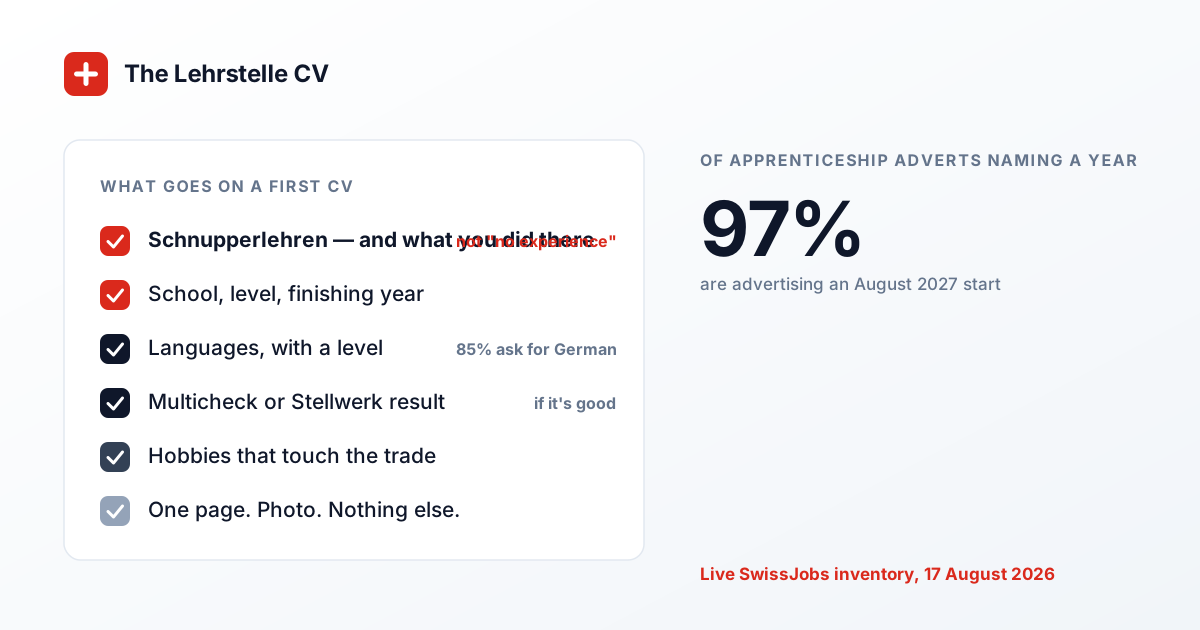
The number that actually matters is the start date. Of the apprenticeship adverts that name a year, 97% name 2027. Not this summer. The place being fought over this autumn begins in a year's time, and anyone who starts looking in spring 2027 is looking at a cleared-out board.
Then there's the real subject: the CV. Every template online opens with a fat block labelled work experience. At 14 or 15 that block is empty. That isn't a gap to disguise. It's just the wrong template.
Short version
- When do you apply for a 2027 Swiss apprenticeship?
- Now. Of the advertised apprenticeships that name a start year, 97% name August 2027. Dossiers go out from August to roughly February, and in popular trades most of it is decided before Christmas.
- What do you put on a CV with no work experience?
- Taster placements (Schnupperlehren) with the company, the length and what you actually did there; school with the stream and finishing year; languages with a level; the aptitude test result if it's good; and hobbies that touch the trade.
- How long should an apprenticeship CV be?
- One page. Two only if two genuinely fill up — and at 15 they don't.
- Can you do a Swiss apprenticeship in English?
- Effectively no. English is the language of 23% of adverts across the whole Swiss market but only about 1% of apprenticeship adverts, because vocational school, the block courses and the final exam all run in the local language.
- Does the CV need a photo?
- In Switzerland yes, apprenticeships included. A normal portrait on a plain background — not a holiday shot, not a mirror selfie.
Working on your CV right now? ATS CV checker: free, against a real Swiss job ad
See what a Swiss recruiter checks first
Upload your CV and get a score against a specific job ad in about 30 seconds — language levels, work permit, photo, how your achievements are phrased.
ATS CV checker, freeWhen do you apply for a 2027 apprenticeship?
Now — of the open apprenticeships that name a year, 97% point at the August 2027 intake, and the good places are gone by Christmas.
This is the part that catches parents out, especially parents who didn't grow up here. The apprenticeship begins in August 2027; the advert goes up in the summer of 2026. A full school year sits between the two.
About half the adverts don't write a year at all, because to a Swiss employer it's obvious. Of the ones that do write it, nearly all point at 2027. The small remainder are late openings for this August, freed up when someone pulled out. They exist, but you can't build a plan on them.
In practice: taster placements in the spring and summer of the last year of compulsory school, dossiers out from August, and earlier still in the crowded trades — commercial, IT, media, design. Anyone starting in March 2027 is applying for leftovers.
There's an upside to everyone hunting at once, though. You have time to prepare properly. The CV doesn't need to be finished today. It needs to be good in September.
Share of apprenticeship adverts naming a start year, SwissJobs.app, 17 August 2026
Write a custom CV for every job you apply to
Most people send the same CV everywhere. The AI editor rewrites yours per application — Swiss format, the right language, in about a minute.
CV maker & resume builder: tailor it to this jobWhat goes on a CV when you've never had a job?
Taster placements, school, languages and personal projects take the place of work experience — in that order, and with content rather than just names.
The commonest mistake isn't an empty CV. It's a CV where everything is merely named. "Taster placement, Müller garage, three days" tells the training supervisor nothing. "Taster placement, Müller garage, three days: did the oil and wheel changes myself, watched the diagnostic tool, wrote up a service report" tells him you know what you're signing up for.
So: placements at the top, with the company, the date, the length and two lines of substance. If you did three placements in the same trade, better still. That's exactly the signal an employer waits for — someone who has seen the daily reality and came back anyway.
Then school: which stream, which year, when you finish, and the subjects that touch the trade. Maths and physics in a polymechanic application, languages and business studies in a commercial one. Grade average only if it's good.
Then languages with a level, not an adjective. "German mother tongue, French school year six, English school year four" reads properly. "Good language skills" is air.
And at the bottom, the part most people leave off and which genuinely counts: delivering newspapers, babysitting, a summer job at the farm shop, junior coach at the football club, camp leader in the Pfadi, running the Instagram account for a village association. That is work experience. It just goes by another name.
See what a Swiss recruiter checks first
Upload your CV and get a score against a specific job ad in about 30 seconds — language levels, work permit, photo, how your achievements are phrased.
ATS CV checker, freeWhich apprenticeships are actually being advertised?
Technical and mechanical trades make up 20% of the open apprenticeships and commercial roles 18 — nearly four places in ten between them.
If a teenager is stuck between two directions, it's worth looking at where the places actually are. The technical and mechanical trades — polymechanic, automotive, plant operation, laboratory — plus the commercial track form the biggest block. Health and social care come next, then the electrical trades.
Two things stood out. How far the hospitality trades have shrunk: a little over 5% of apprenticeship adverts. And how heavy health and social care has become: one open apprenticeship in ten.
Around 7% of the adverts are two-year certificate courses (EBA) rather than three- or four-year EFZ apprenticeships. When school grades are marginal, that's the route that stays open, and moving up to a full EFZ afterwards is explicitly designed in. It gets talked about far too little.
For the CV the consequence is simple: write the dossier for the trade, not the sector. A letter praising "your dynamic company" without naming one concrete task of the job gives itself away by the second line.
Share of advertised apprenticeships, SwissJobs.app, 17 August 2026
Can you do a Swiss apprenticeship in English?
Almost not at all — English is the language of roughly one apprenticeship advert in a hundred, against nearly a quarter of the Swiss job market as a whole.
This is the sharpest divide I've found in the whole inventory. Across the Swiss market, English-language adverts are a large and growing minority. Among apprenticeship adverts they're a rounding error.
The reason is structural rather than cultural. Vocational school runs in the language of the region, the inter-company block courses run in it, the final qualification procedure runs in it. An employer taking on an apprentice is taking on someone who has to absorb three years of trade theory in German, French or Italian.
So if you moved here with a teenager and the family's working language is English, this is the corner of Swiss hiring where that hurts most. It is also, honestly, the corner where the system pays back the language effort fastest: an EFZ is a portable, recognised qualification, and the apprentice earns from month one.
Practical version: pick the trade by interest, then treat the language line as the second most important line on the page. And if the German or French is still a work in progress, say so plainly and add what you're doing about it. Hiding it doesn't survive the first taster day.
Language of the advert text, SwissJobs.app, 17 August 2026
How much German do apprenticeship adverts want?
German is named in 85% of apprenticeship adverts that state a language, against 69% across the whole market — and 93% of those want it fluent or native.
Apprenticeship adverts are also more explicit about language than the rest of the market: they state a requirement outright more often than adverts in general do. Employers know it's the thing that decides whether a 15-year-old can follow the theory.
The level matters as much as the language. "Deutschkenntnisse von Vorteil" and "verhandlungssicher" are not the same advert, and in the apprenticeship market the second is overwhelmingly the common case. Only about one advert in fourteen is happy with conversational German.
The trade changes the picture, though. In the electrical and healthcare trades essentially every advert asks for German — safety rules and patient handovers leave no room. Construction, logistics, technical trades and IT are noticeably more open, IT most of all at roughly three in four.
That's not an invitation to pick a trade by its language bar. But if the German is still coming along and a teenager is torn between two directions, it's worth knowing. And it tells you how to build the dossier: for an electrical apprenticeship the language line belongs in the top half of page one; for an IT apprenticeship, put the self-built project there instead — the website, the server you run, the Raspberry Pi in the basement doing something useful.
Share of adverts stating a language, SwissJobs.app, 17 August 2026
What sinks an apprenticeship dossier?
Motivation letter, CV, the last two school reports, placement assessments and a good aptitude test — one PDF, sensibly named.
Order inside the PDF: letter, CV, school reports, placement assessments, tests. File name with first name, surname and trade, not application_final_v2.pdf. Sounds trivial, except the training supervisor opens thirty of them in an evening and the file name is the first thing he sees.
What sinks a dossier: a template full of gradients and icon bars where the facts have to be hunted for. An email address you wouldn't read aloud to an employer. A missing phone number. And the generic application where only the company name changed.
On the language level I'd rather be blunt than encouraging: 93% of the apprenticeship adverts that ask for German want it fluent or native, and only 7% settle for conversational. If the level isn't there yet, one sentence in the letter about what you're doing about it beats silence — language course, homework club, reading practice, German at the dinner table.
Last and easiest: have the CV read by someone who isn't your mother. If there's nobody around, /cv-check reads it and tells you in a minute what a Swiss recruiter notices first.
Apprenticeship adverts asking for German, SwissJobs.app, 17 August 2026
Where to go next
Three things that genuinely help with an apprenticeship application. Two are ours, the third is the cantons' official portal.
- SwissJobs searchour tool
Apprenticeships and open roles from across Switzerland in one place, refreshed daily.
SwissJobs search SwissJobs CV Check our tool
Upload the CV and see in a minute what a Swiss recruiter notices first.
Try it free- berufsberatung.ch
The cantons' official portal: trade profiles, entry requirements, taster placements and the list of open apprenticeships.
Visit site
Short version, and I know it sounds demanding for a 15-year-old: the apprenticeship that starts in August 2027 is being handed out now. The CV that goes with it is one page long, and on that page there's no work experience — there's what you observed, learned and built yourself.
If you need a template: /resume walks through the structure of a Swiss CV and lets you build one free and download it as a PDF. Open places are on /jobs, and the trade profiles with the full entry requirements sit on berufsberatung.ch.
Good luck with the taster placements. That's the part that matters most, for the employer and for the kid.
The tools compared
We checked 16 Swiss and international application tools on their own pages — prices, free tiers, and what is actually included.