Applying to a Swiss company with no job advert: how an unsolicited application actually lands
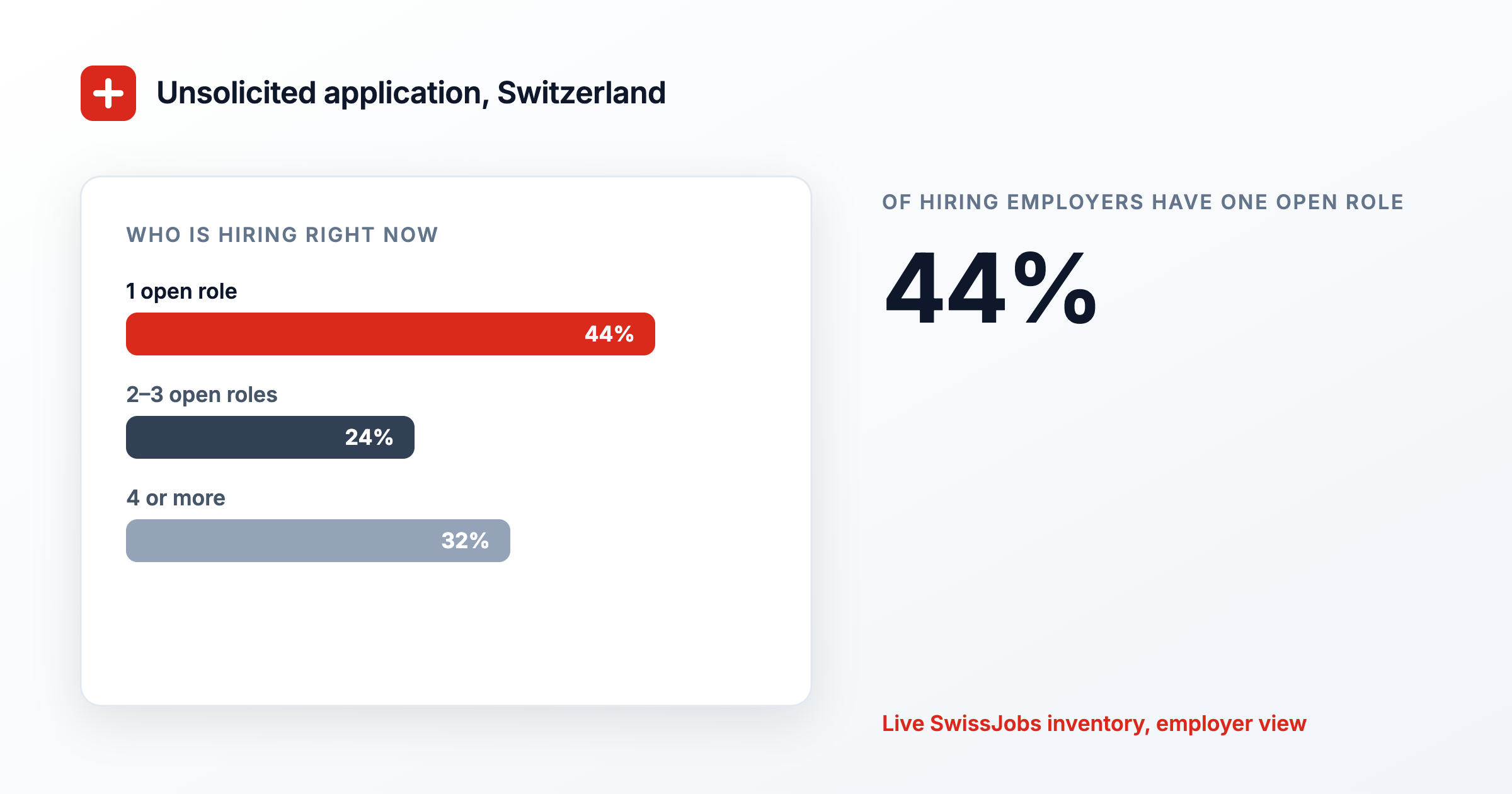
We pulled the employer side of our inventory this week instead of the advert side, and one number rearranged how we think about this. Of the employers with at least one live advert in Switzerland, 44% have exactly one. Not one department. One role. Another 24% have two or three.
Applications come under various names, yet the concept remains unchanged: an unsolicited application, sometimes referred to as an open application, a cold application or a speculative application. In Switzerland, this type of application is called an Initiativbewerbung or Spontanbewerbung (German), candidature spontanée (French), or candidatura spontanea (Italian). In all these cases, it involves submitting a comprehensive application to a company that has not publicly advertised the position.
This isn't a system where HR professionals manage a queue of applicants. Instead, most businesses are small and relatively informal, where the person reviewing your application is likely to be the one interviewing you in person. Moreover, companies with only one open position often have a much broader range of available roles than what's advertised on job boards. This disparity is exactly what an unsolicited application aims to bridge.
In Switzerland, there are specific conventions governing whether your letter will be met with a response or remain unanswered, with a couple of decisive factors determining the outcome.
Short version
- What is an unsolicited application in Switzerland?
- A complete application, comprising a letter, CV, and work references, is submitted to a company that has not publicly solicited candidates for the position in question. In Switzerland, this approach is known as an Initiativbewerbung, and employers typically regard it as a standard application rather than a cold email.
- Does an unsolicited application work in Switzerland?
- It works best at small employers, and most Swiss employers hiring are small: 44% of those with a live advert have exactly one open role. Send it to a named person, name the concrete work you would do, and follow up once by phone after about a week.
- Who do I address an unsolicited application to?
- To avoid having your unsolicited application ignored, track down the person in charge of the team you're interested in joining, rather than contacting HR or the company email address. Their name should be easily accessible on the company's website or LinkedIn profile. In fact, using a generic greeting such as "Dear Sir or Madam" is the most frequent reason why unsolicited applications are left unresponsive.
- How long should the letter be?
- One page, three paragraphs, under 900 characters of body. The first names the problem you solve for them, the second gives one example with a number, the third asks for a conversation. Same rules as any Swiss motivation letter, with the advert replaced by your own research.
- Does an unsolicited application count as an RAV job-search effort?
- Yes, for a genuine, thoroughly documented job application: a company is clearly identified, a specific contact person is mentioned, a letter and accompanying CV are submitted, and the date is accurately recorded. In such instances, most RAV advisors tend to accept these applications; it's recommended to retain both the original application and any subsequent response.
- What do I do if they do not answer?
- Wait for a week to ten days after submitting your dossier, then make one single phone call to inquire if it has been received and if a discussion is feasible. Then leave it and reapply when a new posting emerges, as your dossier will likely already be on record.
Working on your CV right now? ATS CV checker: free, against a real Swiss job ad
See what a Swiss recruiter checks first
Upload your CV and get a score against a specific job ad in about 30 seconds — language levels, work permit, photo, how your achievements are phrased.
ATS CV checker, freeWhy does an unsolicited application make sense in Switzerland at all?
Here, the majority of hiring companies are relatively small in size, which means that your letter is more likely to be seen by the person who makes the final decision. Small companies also tend to fill their job openings before posting an advertisement.
Look at the shape of who is hiring. Across the employers with a live advert in Switzerland this week, 44% have exactly one open role and another 24% have two or three. Only a third have four or more, and those are the ones with a recruiting team and an applicant tracking system between you and anyone with a budget.
A company with a single ad is one where the owner or the lead manager personally reviews applications. This is also a company that has advance knowledge of upcoming openings, typically months in advance: a forthcoming departure, a client project requiring additional staff. None of this information appears on a job board; it's held internally. An unsolicited application is you making a timely connection with someone who has this information.
The truth of the matter is that this is as far as it goes. An unsolicited application submitted to a bank or insurer with a robust HR pipeline gets stored in a database, but not much else happens. Target the right place for it to be effective.
Live SwissJobs inventory, 18 September 2026. Counted across employers with at least one advert.
Write a custom CV for every job you apply to
Most people send the same CV everywhere. The AI editor rewrites yours per application — Swiss format, the right language, in about a minute.
CV maker & resume builder: tailor it to this jobWho do you write to, and how do you find them?
The team leader's name can be found on the company website or LinkedIn, always named, and not a generic contact point.
This is where most unsolicited applications die, and it is fixable in ten minutes. A letter that opens Dear Sir or Madam and goes to info@ announces that you did not look. A letter to Ms Keller, Head of Logistics, announces that you did. Swiss employers read that difference as the first test of whether you would do the same on the job.
Starting with the company website, visit the team page, the legal notice section, and the news section where they post about new initiatives or significant deals. Next, search LinkedIn, filtered by company, for professionals with the exact title you're interested in. If you can't find a match, call the reception desk and ask who's in charge of the relevant department; this inquiry is not unusual and you'll likely receive a response.
One more thing that surprises people arriving from abroad: 92% of Swiss adverts on our platform take applications on the employer's own site, not through a portal. So the careers page you find is usually where a speculative dossier goes too, and it is worth checking whether it has an open-application form before you email.
See what a Swiss recruiter checks first
Upload your CV and get a score against a specific job ad in about 30 seconds — language levels, work permit, photo, how your achievements are phrased.
ATS CV checker, freeWhat goes in the letter when there is no advert to answer?
The same three paragraphs as any Swiss motivation letter, problem, proof, ask, except that the problem comes from your research rather than from a job ad.
Don't assume the only subject worth writing about is yourself. This misguided instinct needs to be suppressed. A speculative letter must serve not only as an advertisement for you but also as a stand-in for your application. Consequently, the first paragraph of the letter should draw attention to something that you know about the company: for instance, their new location in Aargau, their decision to transition to a new ERP system, or the fact that they cater to French-speaking clients while their team page remains exclusively in German. Your relevance to the company should be concisely stated in one sentence.
Paragraph two is your closest example, with a number. Not your whole history, the CV carries that, but the one piece of work nearest to what you just named. Paragraph three is the ask: a conversation, and thanks for their time. Sincerely and your name. Under 900 characters of body, one page, no bullets.
Above the letter: the date as city and month, the recipient on three lines with the company name in bold, and a subject line. Without an advert the subject line is yours to write, and the good ones name the role and the workload: Initiativbewerbung als Logistikkoordinator, 80–100%. That line is what gets forwarded internally, so make it forwardable.
Does the permit question change for an unsolicited application?
The importance lies in being explicit, not vague: since employers won't speculate, it's crucial to clearly state what you possess upfront.
When you apply without being asked, the employer's first question is often "can we hire you?" Since an unsolicited application doesn't come with a job description, your initial pitch is your proof of eligibility. State it clearly and concisely in the CV header: do you hold a Swiss B permit, are you an EU citizen, or are you willing to be transparent about your non-EU status?
For citizens of the EU and EFTA, the process is uncomplicated: they can be employed as easily as local residents, and explicitly stating this at the outset alleviates uncertainty. However, applicants from outside the EU face greater challenges, and it's more honest to put it bluntly: a small company with one open position is unlikely to initiate a permit process for a speculative employee, so focus on larger firms that have successfully navigated this before, or apply first with a permit you already possess.
Languages go in the same header line. If the company works in German and you have B2, say B2. An unsolicited application from abroad that leaves language off the CV is read as an application from someone who has not thought about the move.
What do you do after you send it?
Allow seven to ten days to elapse, make a single phone call, maintain a record of the attempt, and for all practical purposes, consider the matter filed.
It's common for there to be no immediate response to an unsolicited application, and a lack of response doesn't necessarily mean you won't be considered. Small businesses often review applications in batches, only responding when a position becomes available. If you haven't heard back after a week or ten days, make a follow-up call to the person you initially contacted, but just once. The key issue isn't whether you've landed the job, but rather whether the employer received your application and whether a brief conversation is warranted. Typically, a phone call elicits a higher response rate than a letter alone.
Registered individuals with the RAV can find relevant paperwork here as well. A genuine, documented application counts as a job search activity if it includes essential details such as the company, contact information, date of submission, and the materials sent. Maintain a copy of the application and any subsequent response. While many advisors consider such submissions, those who are more stringent require verification of the company's legitimacy and the feasibility of the role applied for.
File it, and make it count. By the time that employer advertises three months down the line, your file is already ahead of the pack on the hiring manager's desk. It's in that second application, though, that a lot of unsolicited efforts actually start to yield results.
The tools that make this faster
Ours are marked. One is not ours and is the best plain-language guide we know.
- SwissJobsour tool
Identify the current job openings in your industry, and target the employers with a single vacancy, as they are more likely to respond to your query before another opportunity arises.
SwissJobs CV check our tool
Before sending your application, make sure it stands on its own merits. Without an actual job posting to mask any shortcomings, your CV will be scrutinized on its own.
Try it free- Motivation letter generatorour tool
Three paragraphs, one page, under 900 characters, the same rules this article describes, applied to your own history.
Motivation letter generator - How to write an unsolicited application (Q&A)our tool
The short version, for when you have already read this and want the checklist.
How to write an unsolicited application (Q&A) - arbeit.swiss — tips on applying
The federal employment agency provides its own guidelines, detailing how job search activities are recorded.
Visit site
Surprisingly, sending an unsolicited application is often underused in the Swiss job market, primarily due to applicants targeting the wrong companies and crafting their applications around their own skills. However, achieving success with this approach requires pinpointing firms with a single open position and tailoring the application to their specific needs, while also making a subsequent phone call.
Review the CV before submitting it to anyone. In the absence of an ad to serve as a reference, the CV stands as the sole initial introduction, and a non-standard CV format is often the catalyst for a polite rejection of a strong unsolicited application.
The tools compared
We checked 16 Swiss and international application tools on their own pages — prices, free tiers, and what is actually included.