Where do I find construction and trades jobs in Switzerland — and why does the word "trades" match nothing?
Updated:
In short
Construction and the building trades make up about 4.7 per cent of the open Swiss vacancies we track. Two things make them harder to find than that number suggests. First, no advert describes itself by sector: not one carries the word "Handwerk" or "trades" in its title. What is advertised is always a specific occupation with its diploma attached — Elektroinstallateur EFZ, installateur sanitaire CFC, idraulico AFC. Second, 43.6 per cent of the adverts come from a staffing firm rather than the company whose site you would actually work on, against 11.7 per cent across the rest of the market.
The Swiss job portals at a glance
Click an image for the full-size view. What each portal actually is stands beside it.
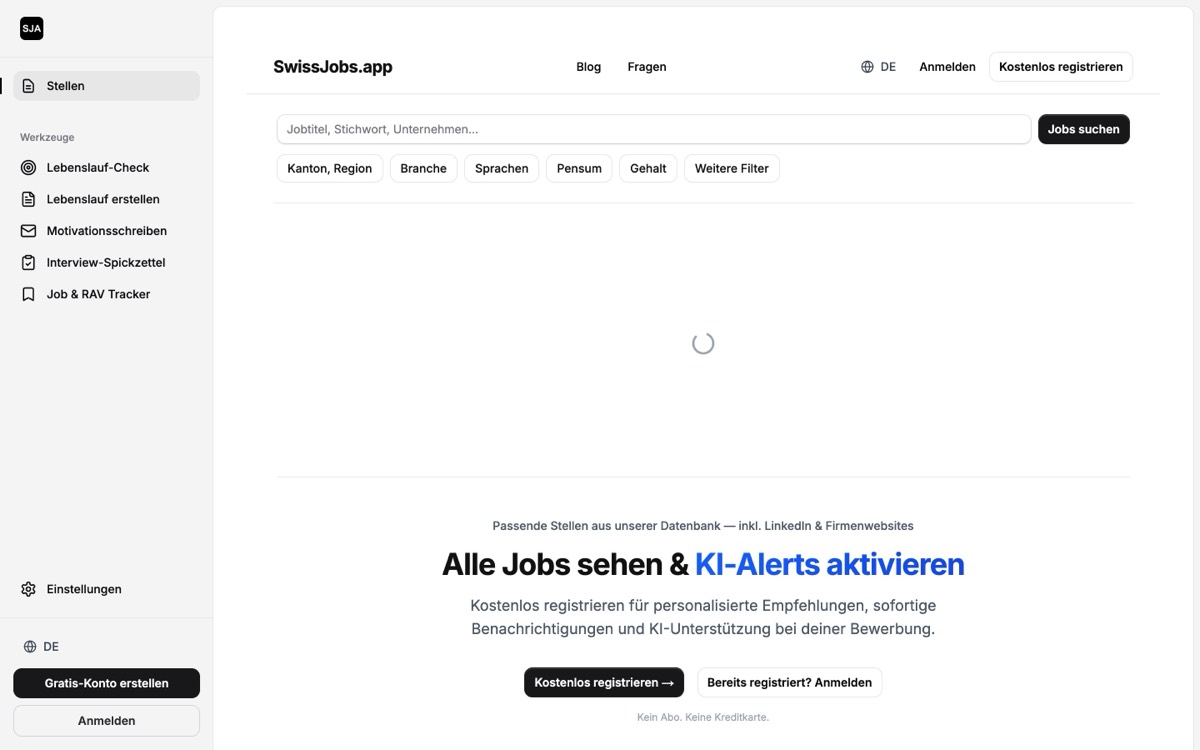
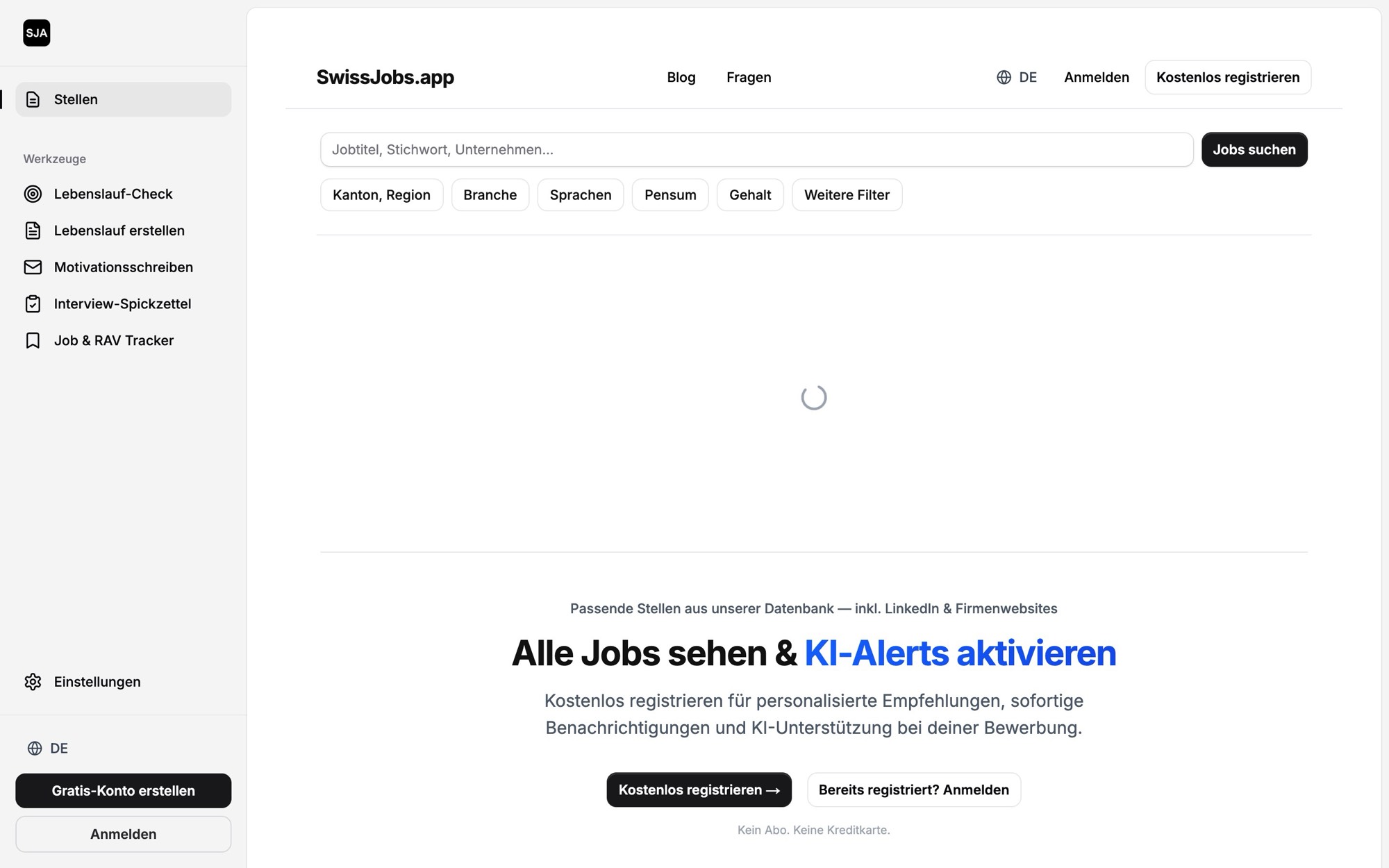
1. SwissJobs.appOur app
Over 21,000 open Swiss roles from ATS systems, company sites and LinkedIn in one place — and from any advert, straight into a CV, a motivation letter, a CV check and interview prep. The RAV job-search-efforts form fills itself from your application tracker. Free to use; the account is asked for at save.
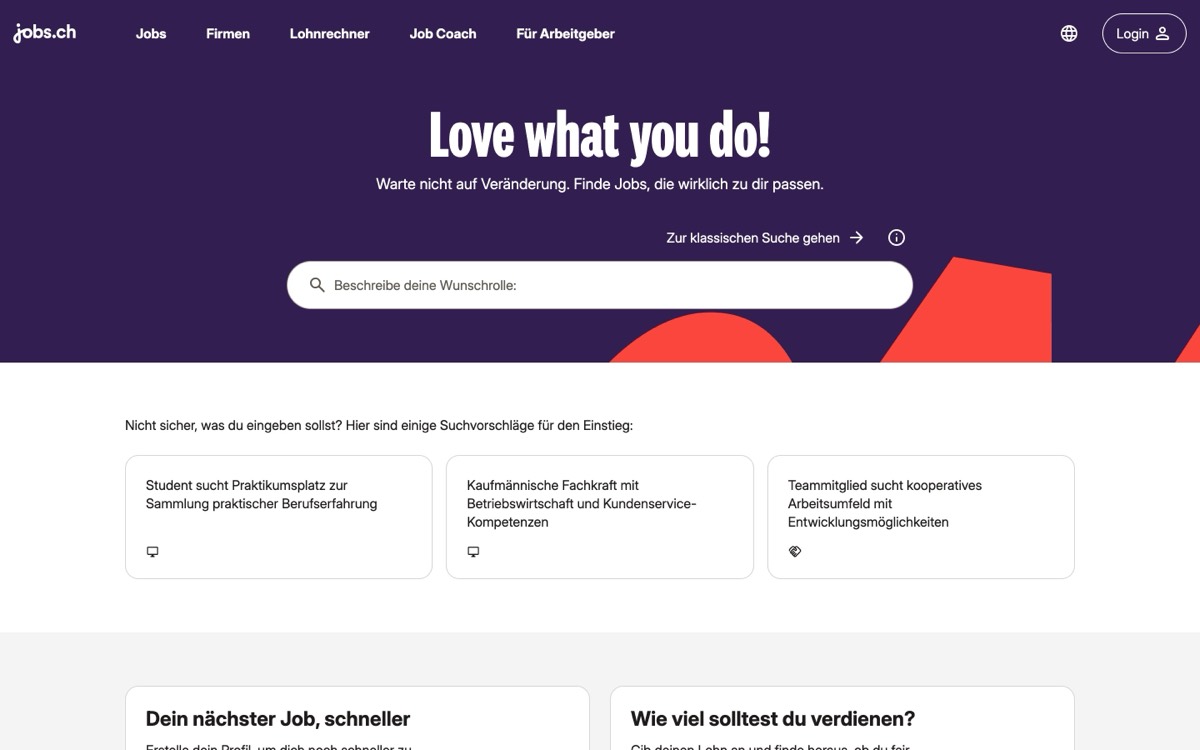
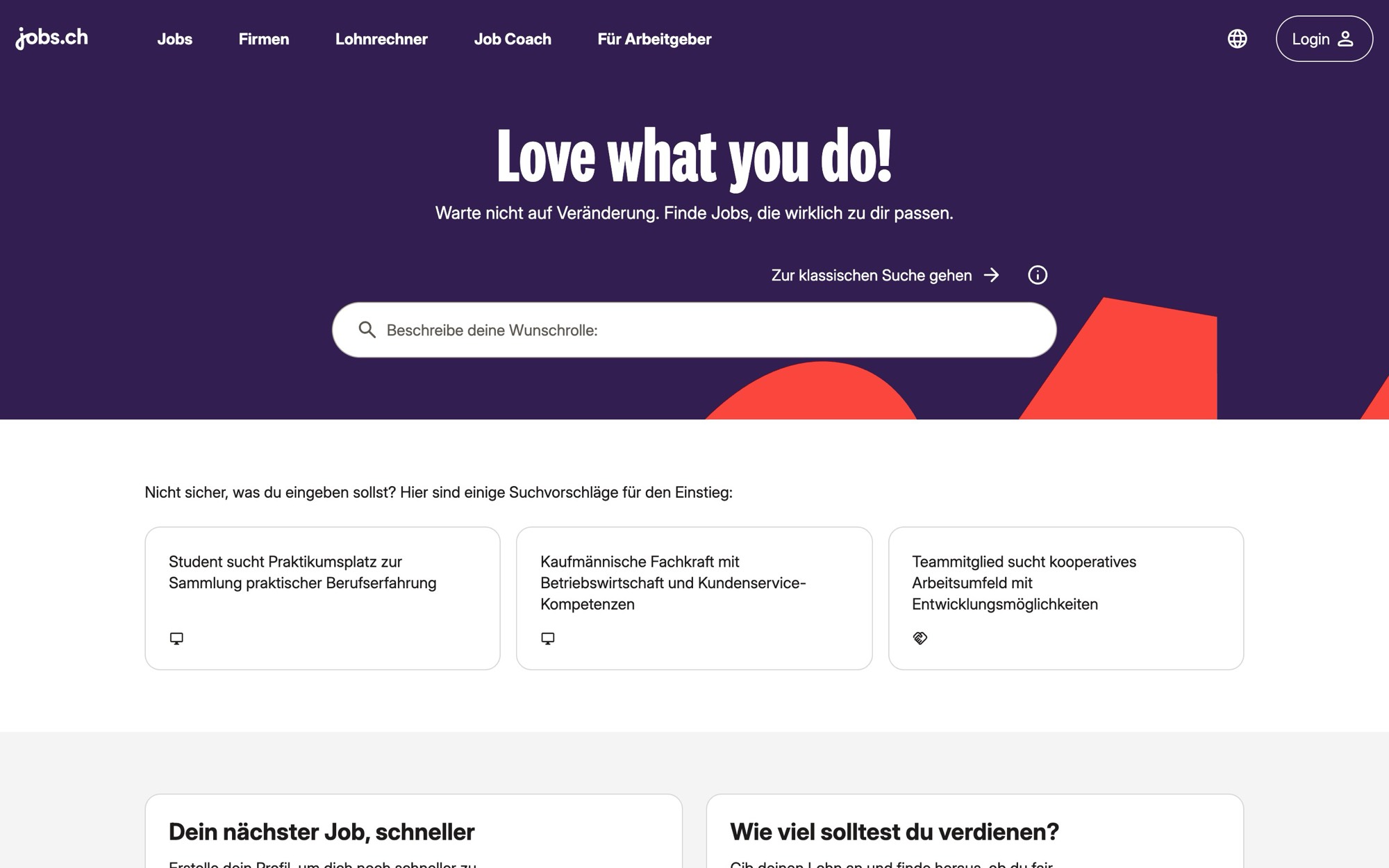
The best-known board in German-speaking Switzerland and the largest index in the country. Owned by JobCloud AG — as are jobup.ch and JobScout24.
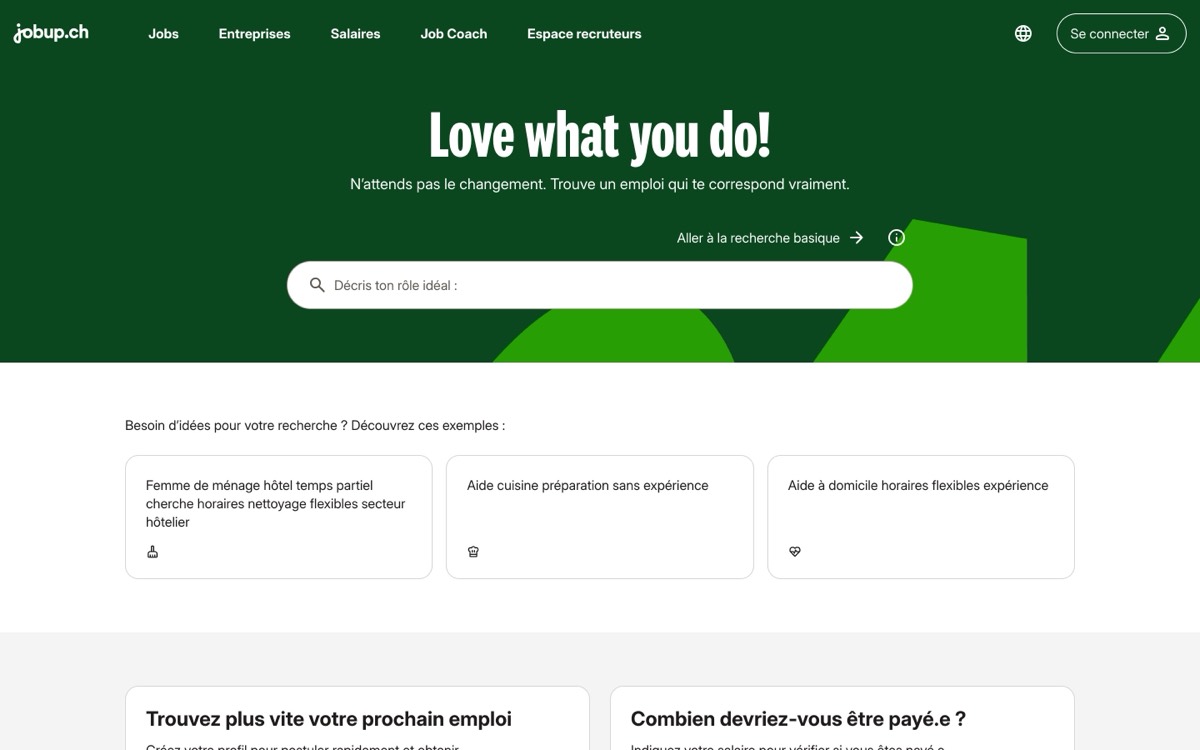
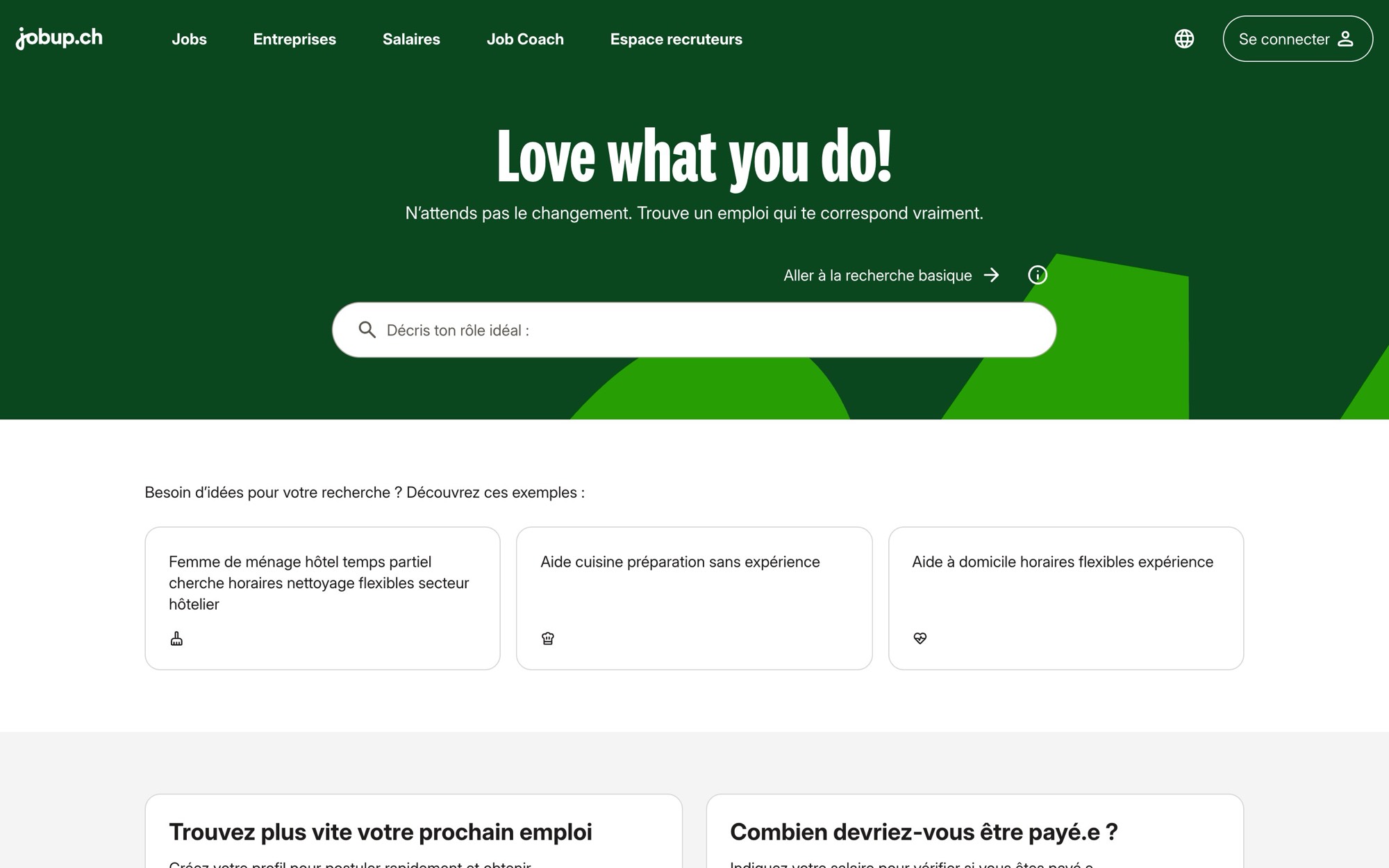
The standard in French-speaking Switzerland and the first place to look for the Romandie — but the same JobCloud AG as jobs.ch.
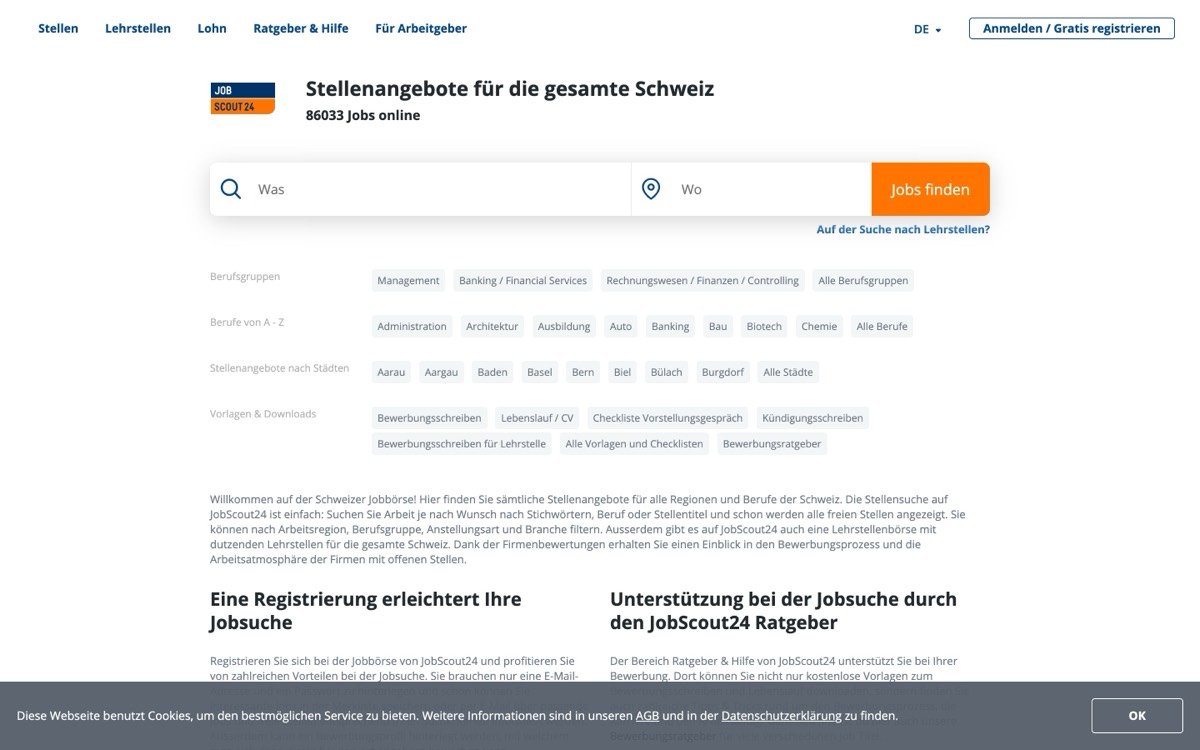
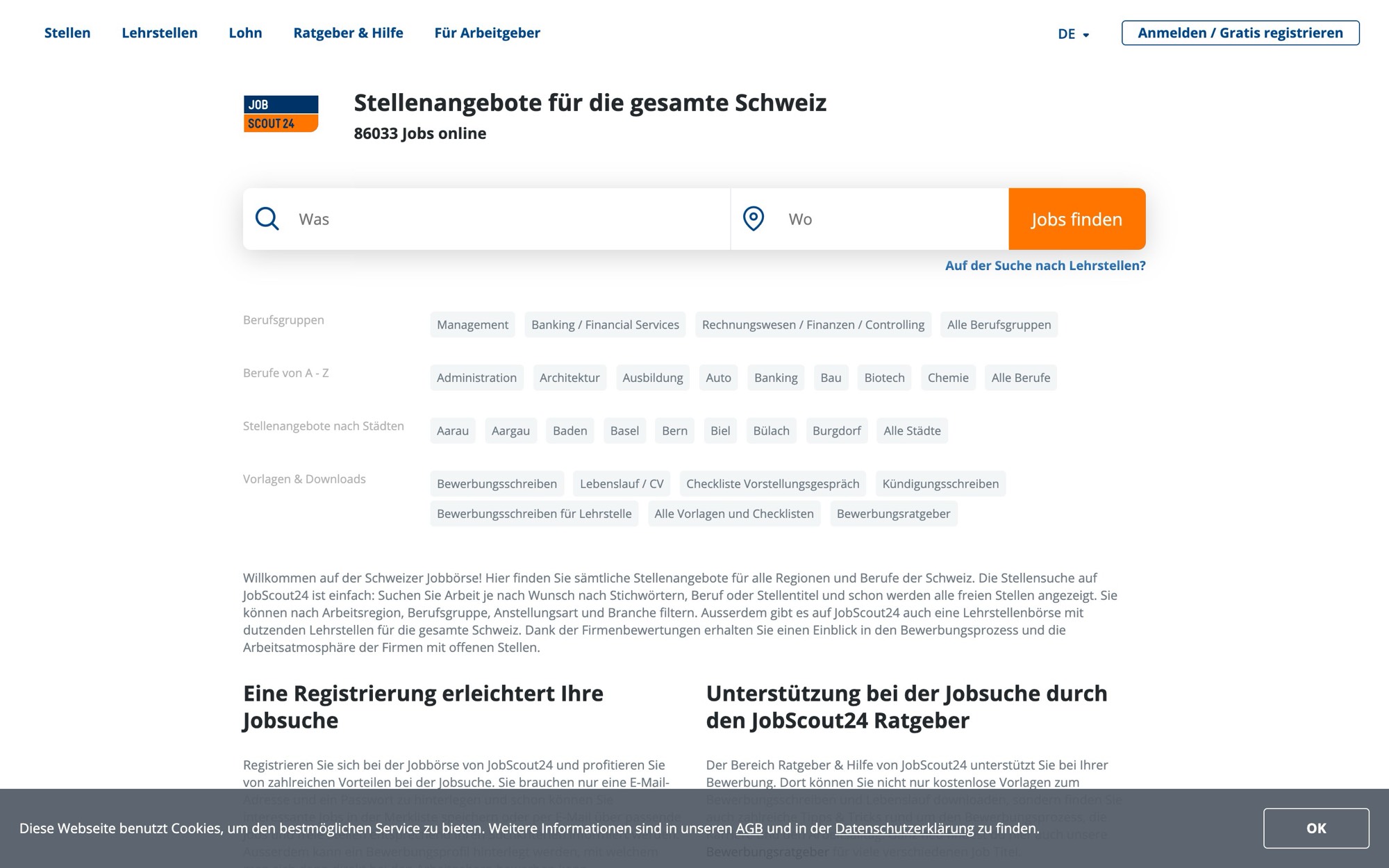
A third brand from the same company. Searching all three to widen your search means searching one provider three times.
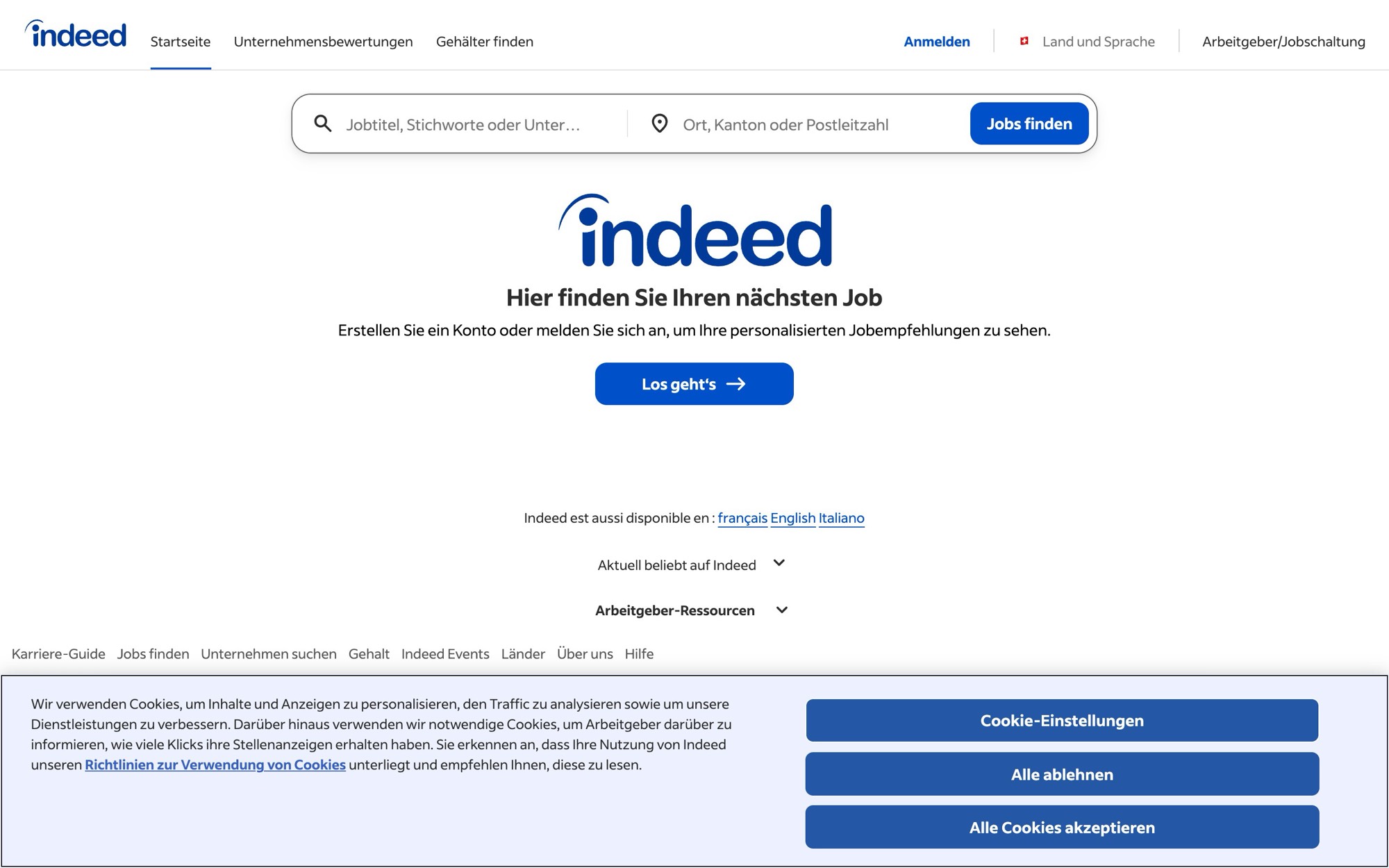
The broadest aggregation, because Indeed also collects from other boards — at the cost of many duplicates of the same advert.
The best reputation for English-speaking and international roles in Switzerland. Considerably thinner for trades, care and commercial roles.
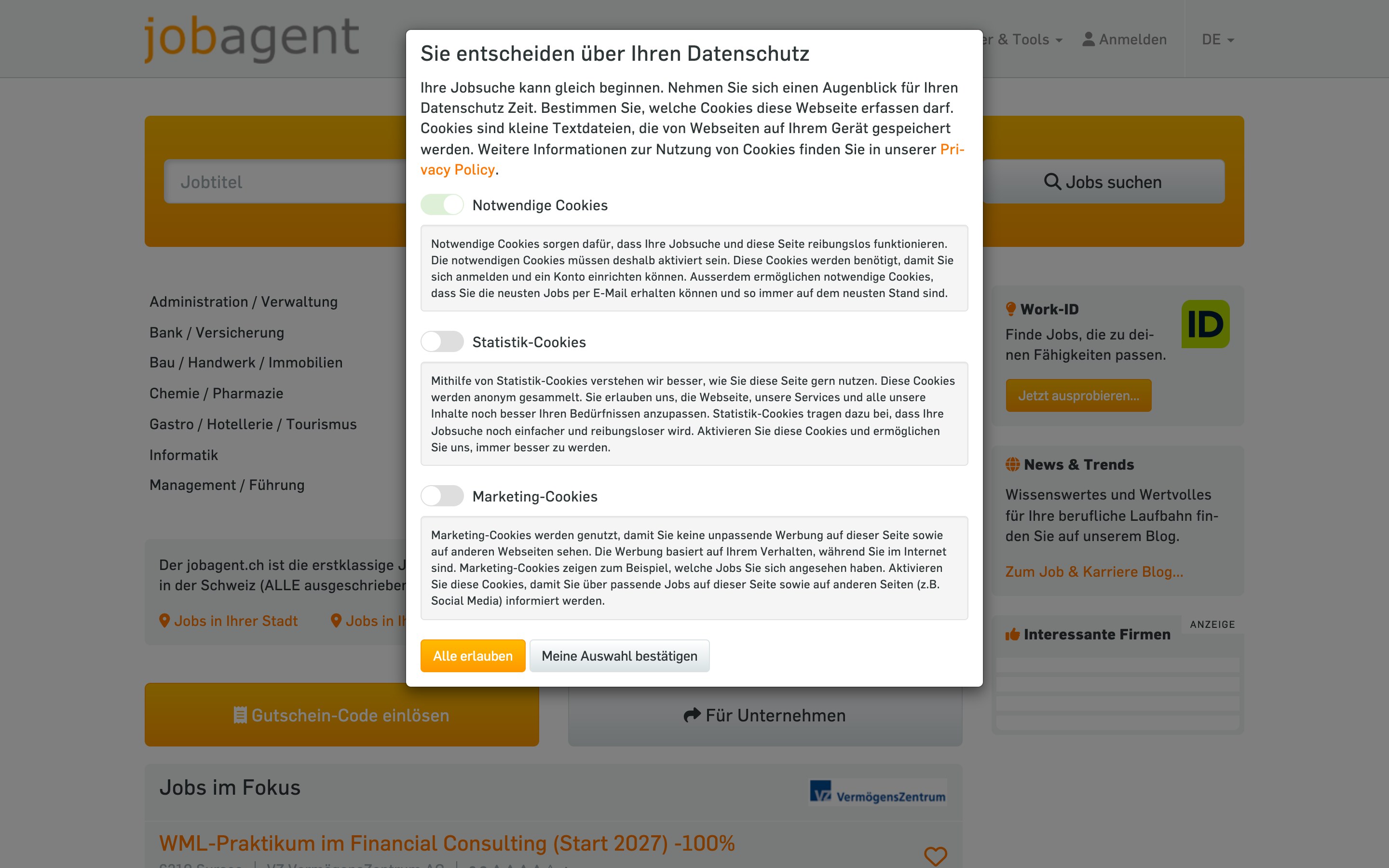
A meta-search across the Swiss job boards, "every job in Switzerland at a glance". Its strength is the Job-Abo: a saved search that mails you new adverts from every portal it covers. Salary calculator and application guides alongside.
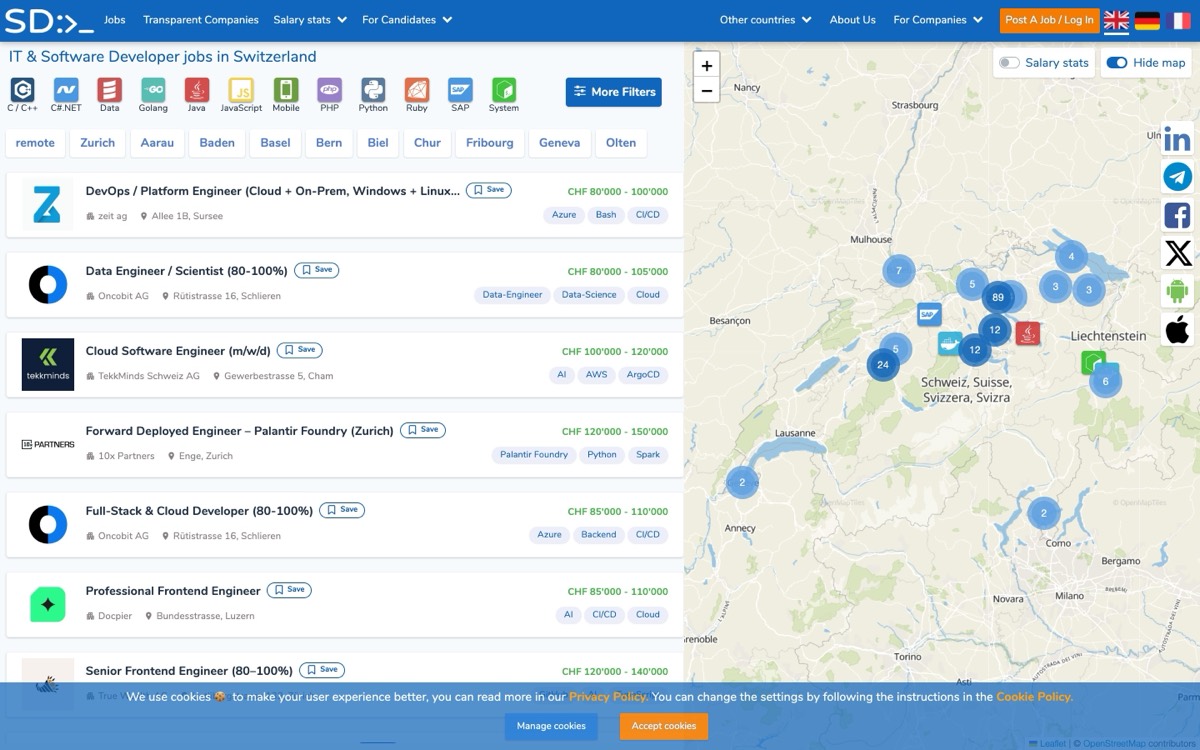
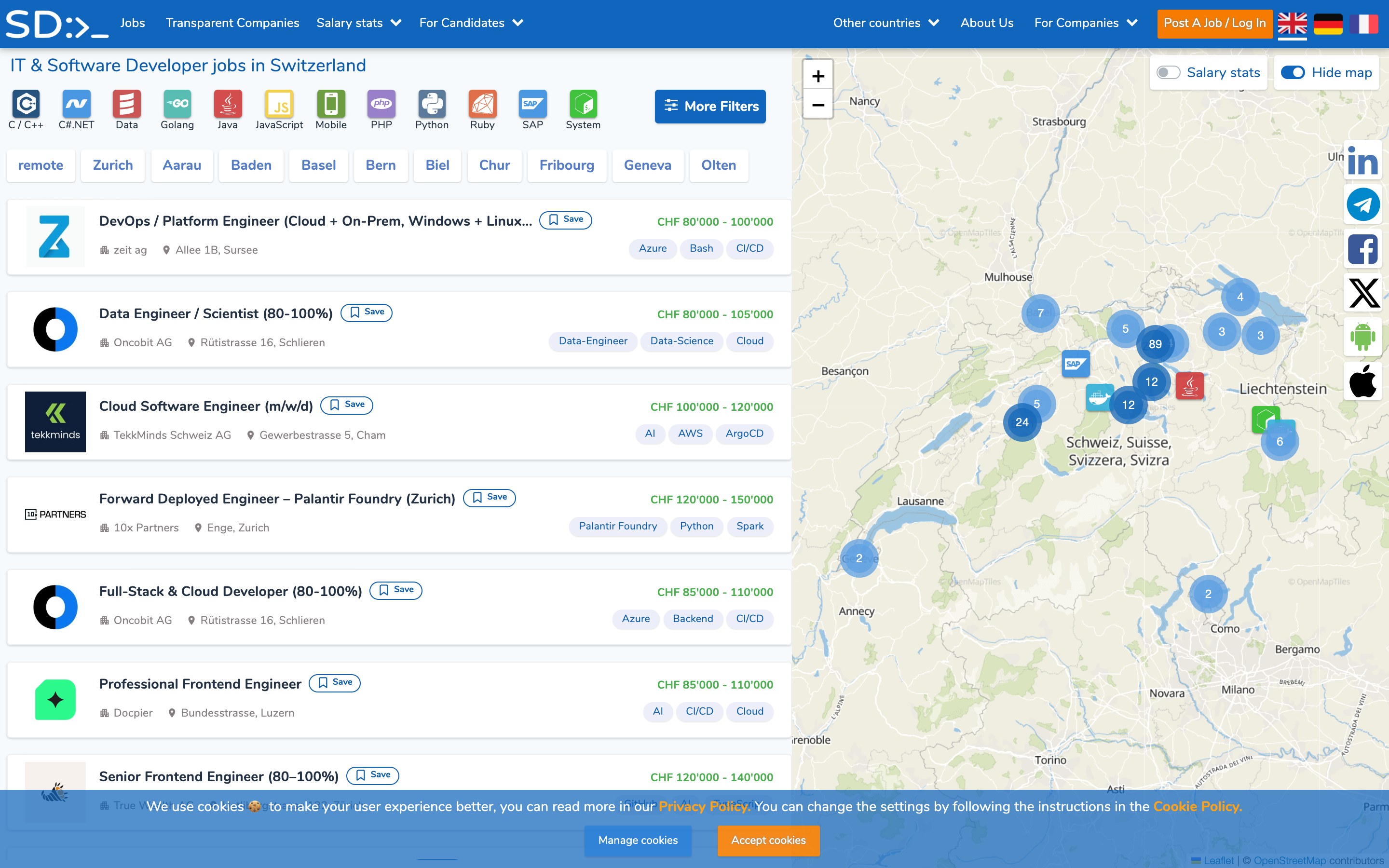
IT and software only, and thorough about it: "183 IT & Software developer jobs in Switzerland", filtered by technology (C#, Java, Python, DevOps, ML) rather than by industry. Publishes salary statistics and lists the companies that disclose their ranges. The site itself is in English.
Jobs by profession, city or language
Type a profession, a city or a language, the page shows the adverts currently open for it.
By profession
- Consultant
- Project Manager
- Retail Sales
- Nurse
- Nursing & Care
- Administrative Assistant
- Account Manager
- Software Engineer
- Public Administration
- Architect
- Insurance
- Chef
71 more — narrow the search
By work type
The cost of the first problem is measurable. Searching "Elektriker" in the job title reaches 33.8 per cent of the open electrical vacancies we hold. Add "Elektroinstallateur" and you are at 64.9 per cent; add the montage, network and plant variants and 65.6. Only the French "électricien" takes you to 88.3 per cent, and only adding "elettricista", "Elektroplaner" and "Gebäudeinformatiker" reaches 99.7. Building services is sharper still: "Sanitär" alone matches 12.7 per cent, the full word list 100.
Behind that sits the third peculiarity. This is the most multilingual and the least English-speaking corner of the Swiss job market. Of the construction adverts whose language is detectable, 66.7 per cent are written in German, 22.7 in French, 8.9 in Italian and 1.4 in English — against 28.6 per cent English across the rest of the market. Only 6.1 per cent mention English as a requirement at all, where the rest of the market does so in 43.4 per cent of adverts.
Share of the tracked open electrical vacancies whose job title is matched by each cumulative set of search words. Rolling analysis of the open Swiss adverts we hold, August 2026.
- Electrical work is the largest sub-field at 29.3 per cent, ahead of building services — plumbing, heating, ventilation, refrigeration — at 21.7, structural construction at 19.1, site management and planning at 11.4, timber and joinery at 8.0, finishing trades (painting, plastering, tiling, roofing, facades) at 5.7, metalwork at 3.1 and machine and crane operation at 1.5 per cent.
- 21.8 per cent of construction adverts carry a Swiss diploma code in the title — EFZ, CFC, AFC, EBA or AFP — against 5.2 per cent elsewhere. "CFC" appears in 7.3 per cent of construction titles and 0.5 per cent of everything else; "Installateur" or "installatore" in 17.7 per cent against 0.1.
- How much of a trade runs through agencies depends on the trade: finishing trades 80 per cent, crane operation 62.5, building services 61.8, metalwork 60.6, timber and joinery 41.7, structural construction 35.3, electrical 33.8 and site management 24.2 per cent.
- The field has unusually few advertisers. The ten largest carry 56.8 per cent of all construction adverts, against 21.0 per cent for the ten largest in the rest of the market — while 58.7 per cent of construction employers have exactly one advert open, against 45.6 per cent elsewhere.
- It is the least part-time field in the market: 96.2 per cent of construction adverts are full-time against 81.6, and only 1.6 per cent of titles carry a part-time word against 6.1. In exchange, 11.5 per cent of the adverts with readable text ask for a driving licence, against 1.5 per cent.
- The geography shifts south and west: 7.0 per cent of construction adverts sit in Ticino against 1.0 per cent for the rest of the market, and 9.2 per cent in Basel against 6.6 — while Zurich holds 10.8 per cent against 17.3.
- The list turns over more slowly. Excluding apprenticeships, the median construction advert is 26 days old against 19 for the rest of the market, and 34.9 per cent are more than two months old against 27.2. Apprenticeships and internships are 8.9 per cent of construction adverts against 5.4, and roughly two thirds of them already name 2027 as the start year.
Search the occupation, never the sector
This is the expensive mistake in this field, and it is invisible, because a search box never tells you what it missed. Of the open construction and trades adverts we hold, not one carries "Handwerk" or "Handwerker" in the title, and the English "trades" is no better. Even "Baustelle", "chantier" and "cantiere" appear in only 1.3 per cent. The industry never describes itself as an industry. It advertises the occupation, spelled the way the certificate spells it.
"Bau" as a fragment does better — it matches 29.0 per cent of the adverts, catching Hochbau, Tiefbau, Bauleiter, Bauführer, Baumaschinenführer and Metallbauer. But it is still under a third, and it misses precisely the two largest sub-fields: electrical and building services almost never use the word.
The list that catches nearly everything, by sub-field. Electrical: Elektroinstallateur, Montage-Elektriker, Netzelektriker, Betriebselektriker, Elektroplaner, Gebäudeinformatiker, installateur électricien, monteur électricien, planificateur électricien, elettricista. Building services: Sanitärinstallateur, Heizungsinstallateur, Lüftungsanlagenbauer, Kältemonteur, Gebäudetechnikplaner, Haustechnik, HLK, HLKS, installateur sanitaire, chauffagiste, monteur en chauffage, idraulico, installatore, termoidraulico.
Structural: Maurer, Polier, Vorarbeiter, Betonbauer, Strassenbauer, Gleisbauer, Baumaschinenführer, Baggerführer, maçon, génie civil, muratore, edile, gruista. Timber and finishing: Zimmermann, Holzbau, Schreiner, Innenausbau, Fenstermonteur, Bodenleger, Plattenleger, Maler, Gipser, Trockenbauer, Spengler, Dachdecker, menuisier, charpentier, ébéniste, peintre, plâtrier, carreleur, couvreur, ferblantier, falegname, carpentiere, imbianchino, piastrellista, lattoniere. Metal: Metallbauer, Stahlbau, Schlosser, Gerüstbauer, serrurier, constructeur métallique, échafaudeur.
Put the diploma code in the search box
No other field writes its qualifications into the job title this consistently. 21.8 per cent of construction adverts carry EFZ, CFC, AFC, EBA or AFP in the title, against 5.2 per cent elsewhere, where it is mostly apprenticeship postings. Within construction it runs 39.9 per cent in electrical, 35.0 in the finishing trades, 21.2 in metalwork, 17.9 in timber, 16.2 in building services and 12.9 in structural work. In site management and planning it is exactly zero — there, the function and the project size are what count.
In practice that makes "EFZ" and "CFC" search words in their own right. "CFC" alone appears in 7.3 per cent of construction titles and 0.5 per cent of all other adverts, which makes it close to a filter for French-speaking Switzerland. If you are looking in Romandie, "CFC" plus a place name gets you further than the occupation name, because the spelling of the occupation varies and the three letters do not.
It is also worth writing your own code exactly as the advert writes it, in your CV and in the first line of your application. 23.2 per cent of construction adverts with readable text explicitly ask for a federal certificate or attestation, against 4.6 per cent in the rest of the market. If your qualification is foreign, state where its recognition stands rather than leaving it open — in this field it is the first question, not the last.
Nearly half the adverts come from a staffing firm
43.6 per cent of the construction and trades adverts we hold were placed by a staffing or placement company rather than by the business itself. Across the rest of the market it is 11.7 per cent. This is the single biggest structural difference in the field, and it explains several other numbers at once: why supply concentrates on so few advertisers, why the ten largest carry 56.8 per cent of the adverts, and why the same role appears in several towns at the same time.
Two consequences for your search. First, if you only look at company career pages you are missing about half of what is open. Second, and more important: if you only answer agency adverts you are missing the other half — and that is the half with the permanent contracts. Firms that advertise directly are overwhelmingly small and medium businesses with a single vacancy; 58.7 per cent of the employers in this field have exactly one advert open.
You can spot an agency advert by three signs: the sender is a personnel, interim or recruitment firm; the location is a region rather than an address; and the text describes client projects rather than a workplace. None of that is a reason not to reply — temporary placements are a normal and often fast route into a permanent job in this field. It is a reason to know which contract you are signing, and with whom.
Your wage floor travels with you — Article 20 of the Recruitment Act
Because so many jobs here run through agencies, one provision matters more in construction than anywhere else. Article 20 of the Federal Act on Employment Services and the Hiring of Services states that where a hirer of services is subject to a collective agreement that has been declared generally binding, the staff-leasing firm must apply to the worker the wage and working-time provisions of that agreement.
In plain terms: if an agency sends you to a site covered by the national collective agreement for the main construction sector, that agreement's minimum wages and working hours apply to your placement. The floor attaches to the site, not to your employer's letterhead. The same holds for the mandatory contributions to further training and enforcement costs, payable pro rata for the length of the placement, and for supervision — the joint committee of the agreement may audit the staffing firm as well.
That is the one figure you should know before the conversation, and it is in no advert. Of the construction adverts we hold with readable text, effectively none mentions a collective agreement — the share rounds to 0.0 per cent. The price tag on your trade is something you have to bring with you.
What the collective agreements set from 2026
The national collective agreement for the Swiss main construction sector, the Landesmantelvertrag, took effect on 1 January 2026 and was declared generally binding from 1 April 2026 until the end of 2031. It sets five wage classes across three wage zones. For class C, workers without specialist skills, the monthly minimum runs from CHF 4’813 to CHF 4’885 depending on the zone. For class Q, a skilled construction worker holding a recognised Swiss certificate or attestation, from CHF 5’906 to CHF 5’988. For class V, foremen, from CHF 6’442 to CHF 6’702.
On top of that: an additional average monthly wage at year end, five weeks of holiday for those aged 21 to 50 and six weeks for younger and older workers, and a working week between 37.5 and 45 hours. The agreement runs six years, so annual wage rounds are not part of it.
Electrical work has its own agreement. The collective agreement of the Swiss electrical industry is generally binding from 1 January 2026 to 31 December 2029, across the whole country except the cantons of Geneva and Valais. Its monthly minimum after completed training is CHF 4’500 for a qualified Elektroinstallateur EFZ and CHF 4’300 for a Montage-Elektriker EFZ. If you are searching in Geneva or Valais, check the cantonal rules instead, because this agreement does not reach there.
Three languages, almost no English
Anyone searching this field should search in at least two languages. 22.7 per cent of adverts with a detectable language are French and 8.9 per cent Italian. In the finishing trades 41.7 per cent of adverts are in French; in crane operation 43.8 per cent are in Italian. Read the other way: 60.5 per cent of construction adverts that state a language requirement ask for German only, against 43.0 per cent in the rest of the market, and 0.4 per cent ask for English only, against 20.3 per cent.
For newcomers that is the hardest sentence in this answer and also the clearest one: an English-only entry point barely exists in this field. The language of the site is the language of the region, and it is already visible in the advert. If you have arrived from abroad, an A2 or B1 course in the right regional language will move you further here than any amount of CV polishing.
One caveat worth knowing. The Italian-language construction adverts we hold are 97.3 per cent agency-placed, and almost all of them come from a handful of senders. The French-language ones are 78.6 per cent agency-placed; the German-language ones 25.0 per cent, spread across a broad field of firms. That does not mean Ticino has no directly advertising builders — it means they are barely visible online. In Ticino and parts of Romandie, contacting firms directly is not a supplement to the online search, it is the main channel.
Six construction occupations go to the RAV first in 2026
The Swiss vacancy-notification duty applies to occupation types with an unemployment rate of at least 5 per cent. For 2026 the SECO list includes, among others: concreters and concrete finishers (rate 10.4 per cent), building construction and related occupations not elsewhere classified (7.0), plasterers and drywall installers (10.0), insulation fitters including building-envelope work (7.0), painters and related occupations (5.3) and welders and flame cutters (5.1 per cent). Alongside them sits the largest group on the whole list, labourers in construction excluding civil engineering, at 13.5 per cent.
What is striking is who is absent. Electrical installation, plumbing, heating and ventilation, bricklaying, carpentry and joinery are not on it. The construction lines are almost entirely finishing trades — the very sub-fields where 80 per cent of the adverts we see run through staffing firms. Both numbers point at the same thing: finishing work is the most cycle-sensitive part of building.
Practically: if your occupation is on the list and you are registered with a regional employment centre, you see those vacancies five working days before anyone else, because employers must notify the public employment service first and access is restricted to registered jobseekers during that window. Five working days is a real head start in a field where a site foreman often decides the same day.
Winter is insured, and that changes the conversation
Many applicants in the main construction sector hear "we will come back to you in spring" in the autumn and assume there is no alternative. There is. Swiss unemployment insurance provides bad-weather compensation: it covers 80 per cent of the countable loss of earnings when weather stops work, and the insurance additionally carries the employer contributions to the old-age, disability, loss-of-earnings and unemployment schemes.
The entitled branches are named in the ordinance: building and civil engineering, carpentry, stonemasonry and quarrying, sand and gravel extraction, track and overhead-line construction, landscape gardening, forestry and tree nurseries, clay pits and brickworks, sawmills, and professional fishing, with transport services qualifying under specific conditions. If you work in building, civil engineering or carpentry, you are not applying for a job that simply stops in December.
That is worth one question, asked early: does the firm plan to use bad-weather compensation over the winter, or does it end the employment in the autumn? The answer separates a year-round contract from a seasonal one far more reliably than any wording in the advert, and it costs nothing but the nerve to ask.
A search plan that fits this market
First, never search by sector. Build a list of eight to twelve job titles for your own occupation, including the French and Italian variants, and work through them one at a time. In electrical work and building services that doubles or triples what you see, as the figures above show.
Second, add your diploma code. "EFZ" and "CFC" are search words in their own right here, with four to fourteen times the hit density they have in the rest of the market.
Third, work both channels deliberately. Answer agency adverts if you need a placement quickly — they are close to half of what is open and often fillable at once. In parallel, work through a list of local firms, because that is where the permanent contracts sit and because most employers here have only a single advert online. In Ticino and Romandie, weight the second channel higher, since online visibility there sits almost entirely with the agencies.
Fourth, register with the regional employment centre if your occupation is on the notification list; five working days of exclusive access is a lot in this field. And fifth, walk into the salary conversation with the floor, not with a wish. The minimum for your class and zone under the construction agreement, or the electrical industry minimum, is a checkable figure that holds even when your contract is with an agency. No advert will tell it to you.
Shares from the rolling analysis of the open Swiss adverts we hold, August 2026. An advert counts as construction and trades when its title names an occupation in structural construction, the finishing trades, building services, electrical work, timber or metal construction, site management and planning, or machine and crane operation, in any of the four national languages or English; titles carrying the same words but clearly belonging to vehicle building, sales, grounds maintenance, cleaning or teaching are excluded. Language shares refer to adverts with a detectable posting language, and statements about advert text to adverts with a readable summary. The staffing-firm share rests on a hand-checked list of senders. Legal and collective-agreement figures come from the official sources linked below, not from our data.
Browse open electrical and installation vacancies by location
Sources
- GAV-Service — national collective agreement for the Swiss main construction sector (LMV)
- GAV-Service — collective agreement of the Swiss electrical industry
- Recruitment Act (AVG), Art. 20 — generally binding collective agreements
- SECO — occupation types subject to notification in 2026 (list)
- SECO — the vacancy-notification duty from 2026
- arbeit.swiss — bad-weather compensation (SWE)
Related questions
What our job index says about the Swiss market
Computed live from our own index, not quoted from a study. Shares only, as of today.
Language the advert is written in
- Deutsch
- 60%
- English
- 23%
- Français
- 13%
- Italiano
- 3%
Of adverts that state a language requirement, the share asking for
- Deutsch
- 70%
- English
- 43%
- Français
- 21%
- Italiano
- 3%
19% posted in the last 7 days · Largest markets: Zürich 18% · Bern 10% · Genève 5% · Basel 5%