Where do I find English-speaking jobs in Switzerland — and how do I tell which ones really work without German?
Updated:
In short
English-speaking work in Switzerland has two different addresses, and you need both. By volume, canton Zurich holds about a third of every advert that can be worked in English alone. By density, Geneva and Zug win: among adverts that state a language requirement at all, 46 and 44 per cent respectively need no national language, against 35 per cent in canton Zurich and 22 per cent nationally. Almost all of these roles — 98 per cent — are advertised in English, so search in English words, not German ones.
The Swiss job portals at a glance
Every link opens that portal's English filter directly, not its front page. The figures beside each are the result count on 10 September 2026.
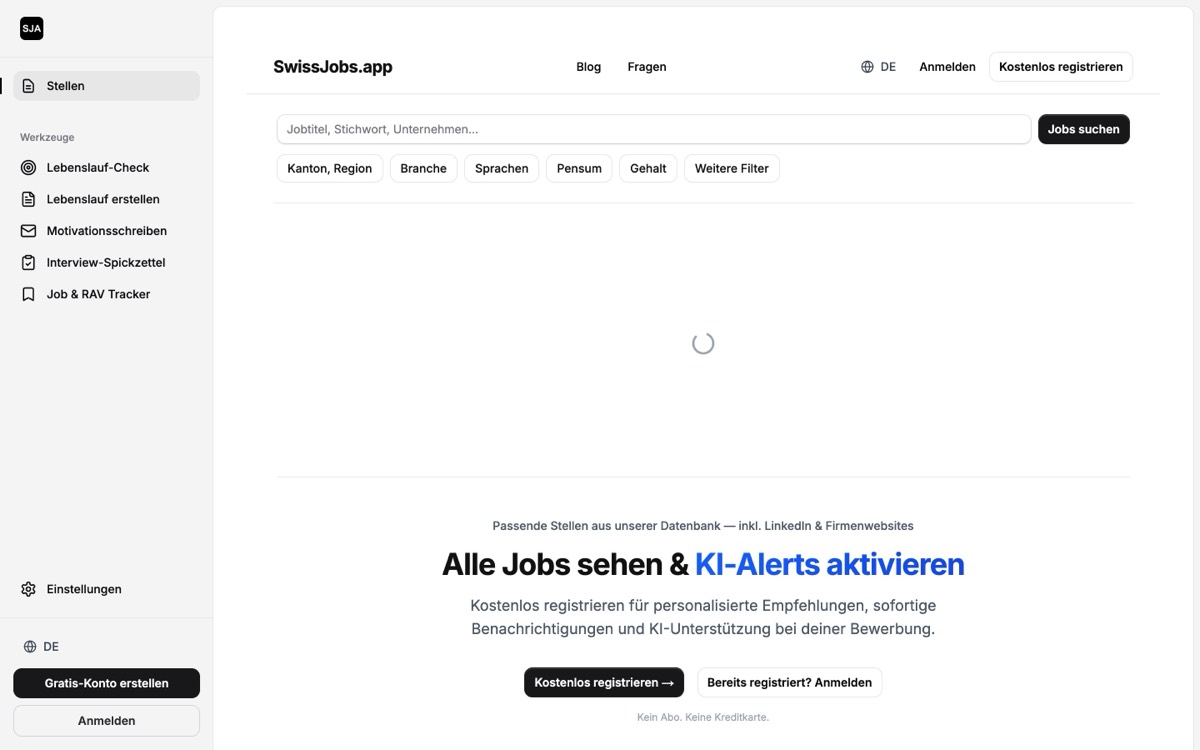
1. SwissJobs.appOur app
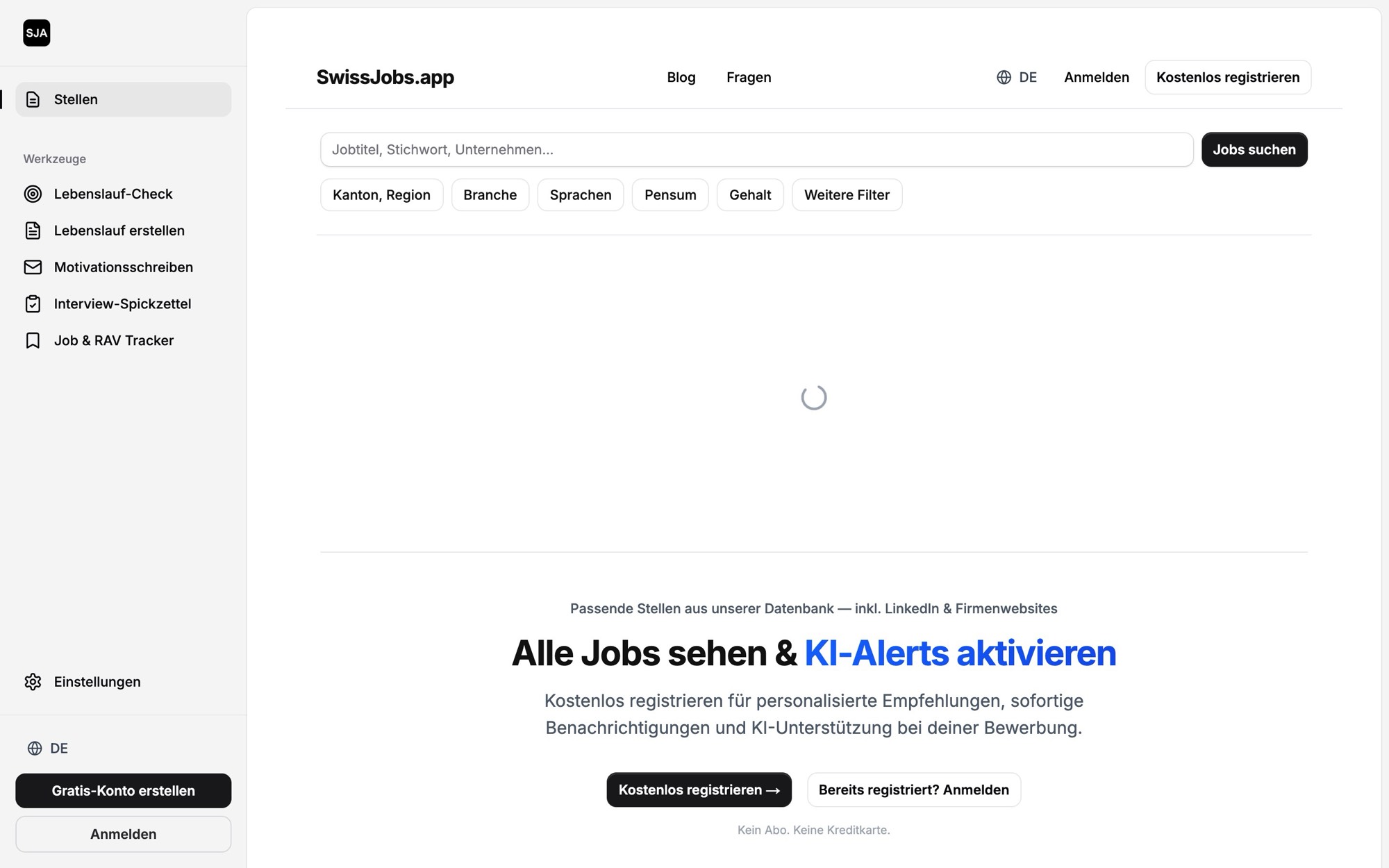
3,028 roles where English is the working language. The filter runs on what the advert REQUIRES and on the language it is written in, so a posting that demands Professional German does not appear here. Free, no account.
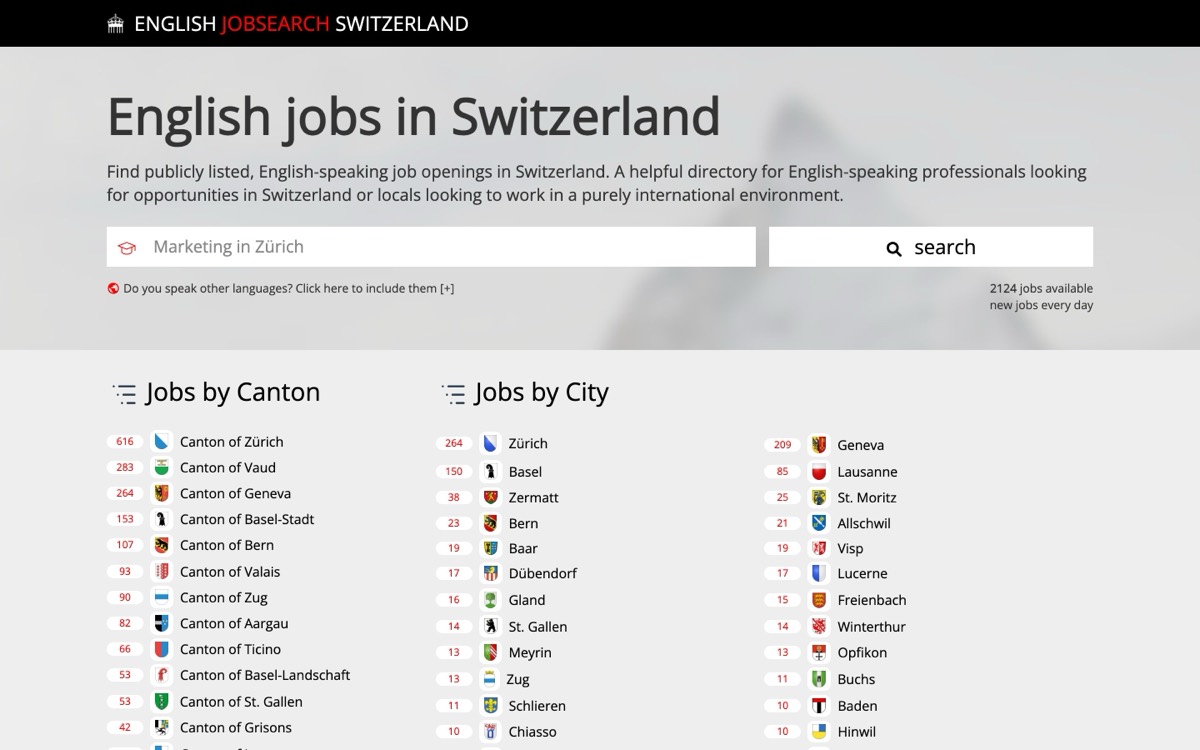
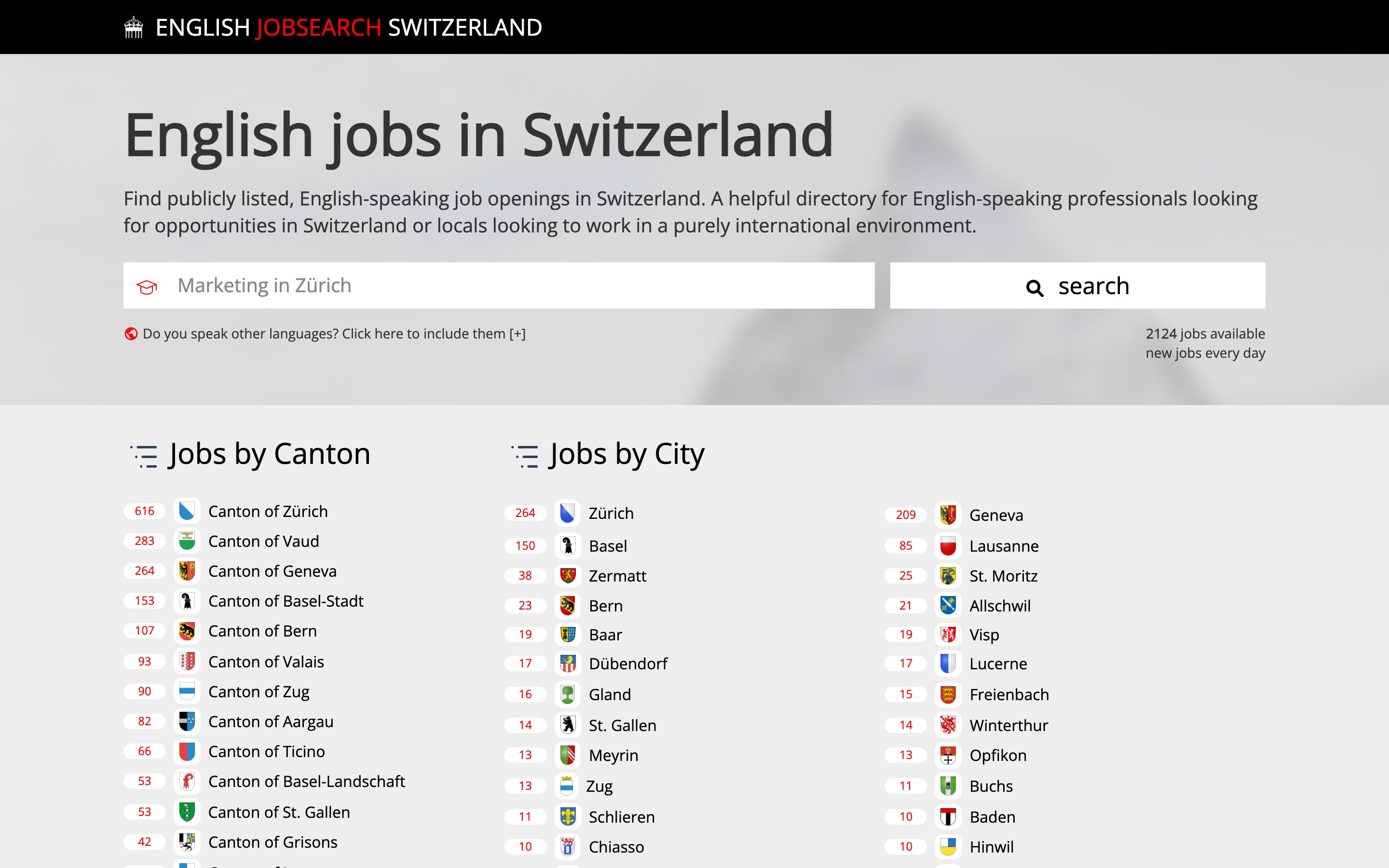
The only English-only directory for Switzerland here: "Find publicly listed, English-speaking job openings in Switzerland", 2,124 today. Its own front page splits them by canton (Zürich 616, Vaud 283, Geneva 264) and by type, 72 remote, 344 part-time, 12 with visa sponsorship. Not a language filter on a bigger index; English-speaking adverts are all it holds.
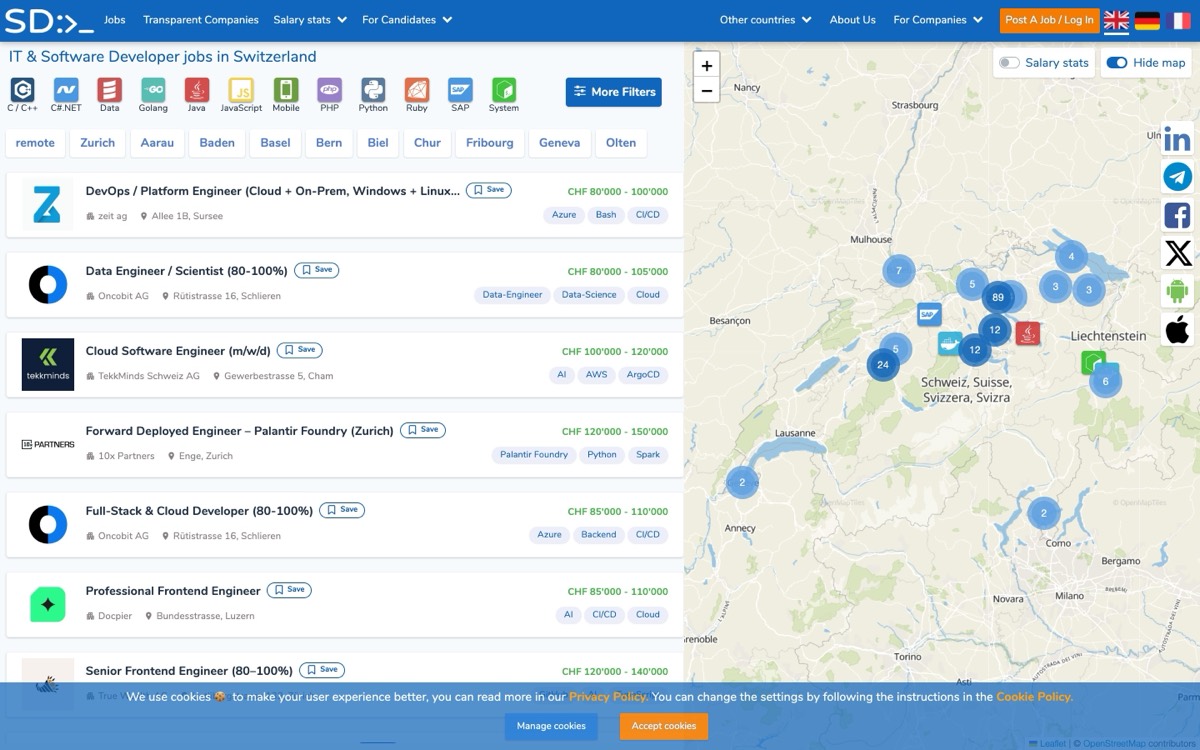
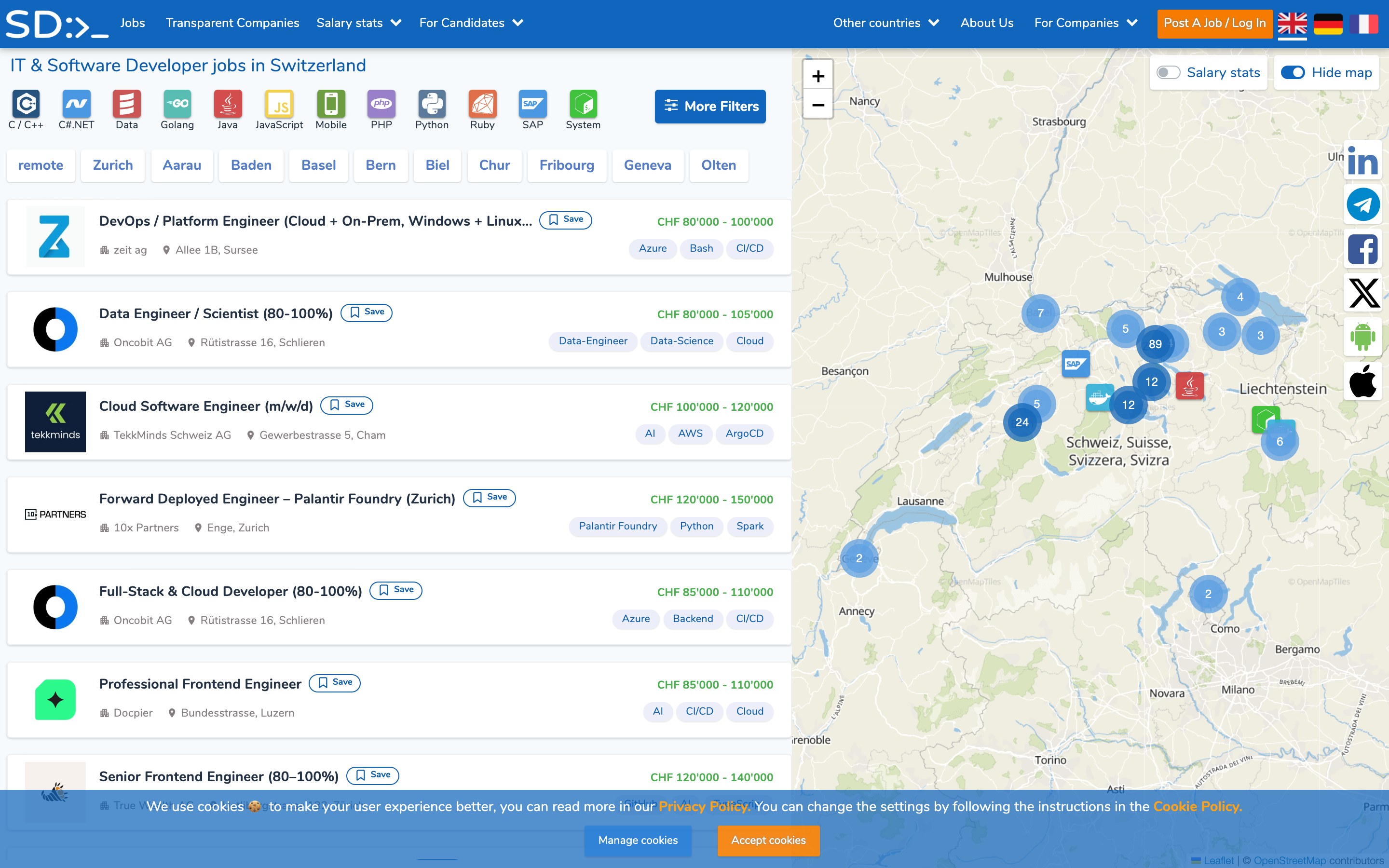
The narrower and better address if your field is IT: "183 IT & Software developer jobs in Switzerland", the site itself in English, filtered by technology rather than by language, C#, Java, Python, DevOps, ML. It also publishes salary statistics and a list of the companies that disclose their ranges.
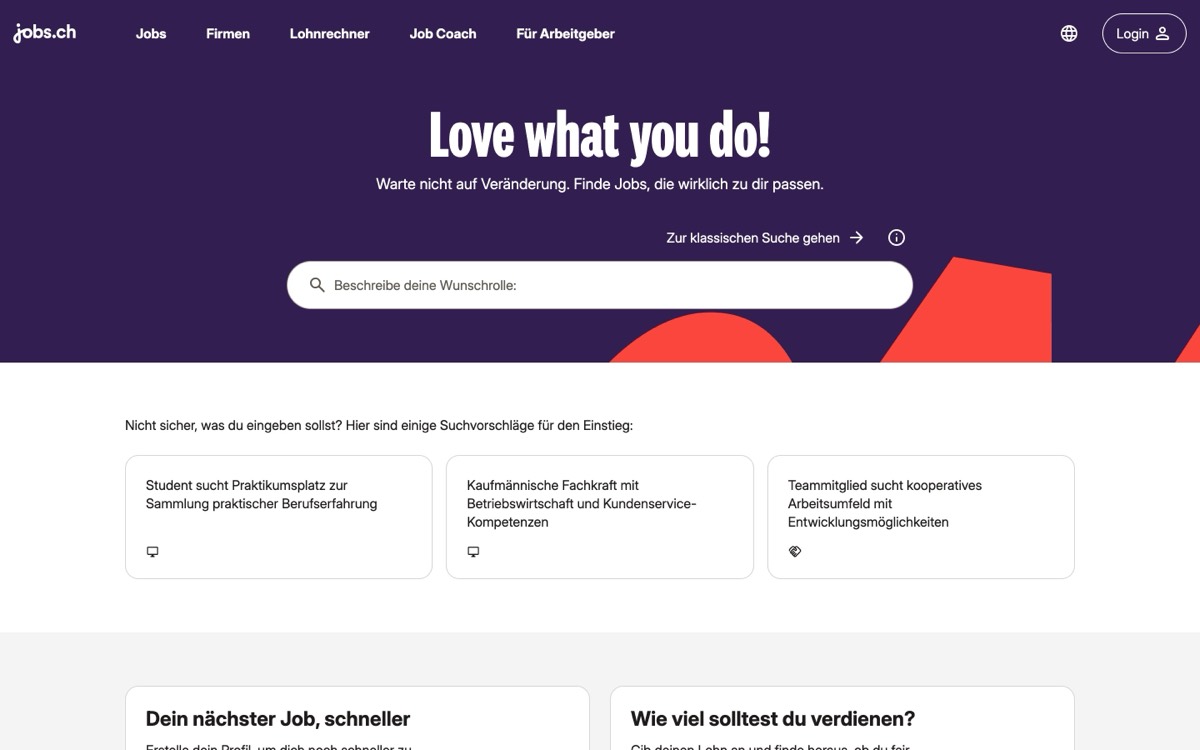
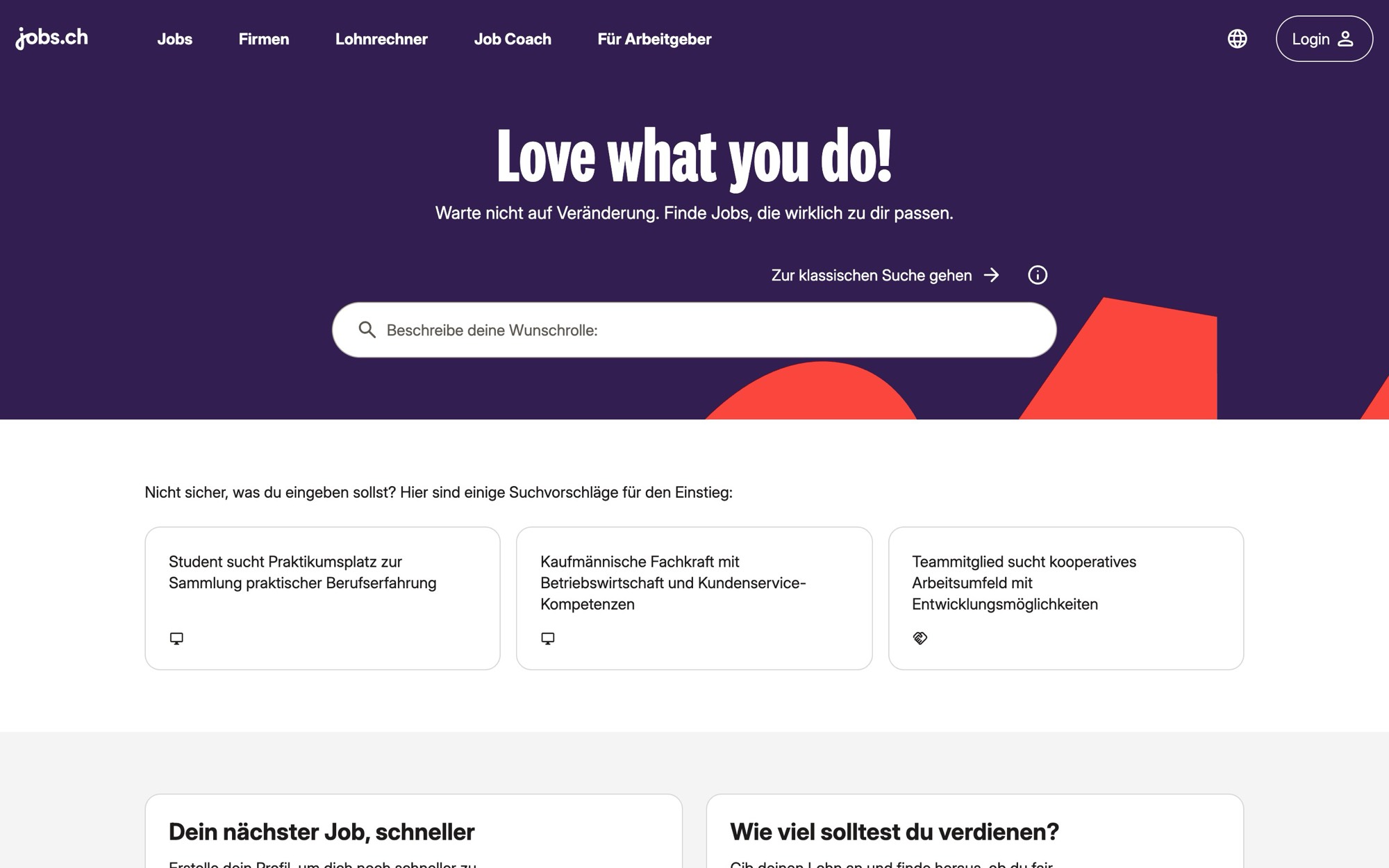
Its "Language: English" filter shows "27,815 job offers, English" today. That is every advert listing English as a language SKILL, most of them still require German, and the filter cannot say "without German". That gap is the difference between it and the 3,028 here.
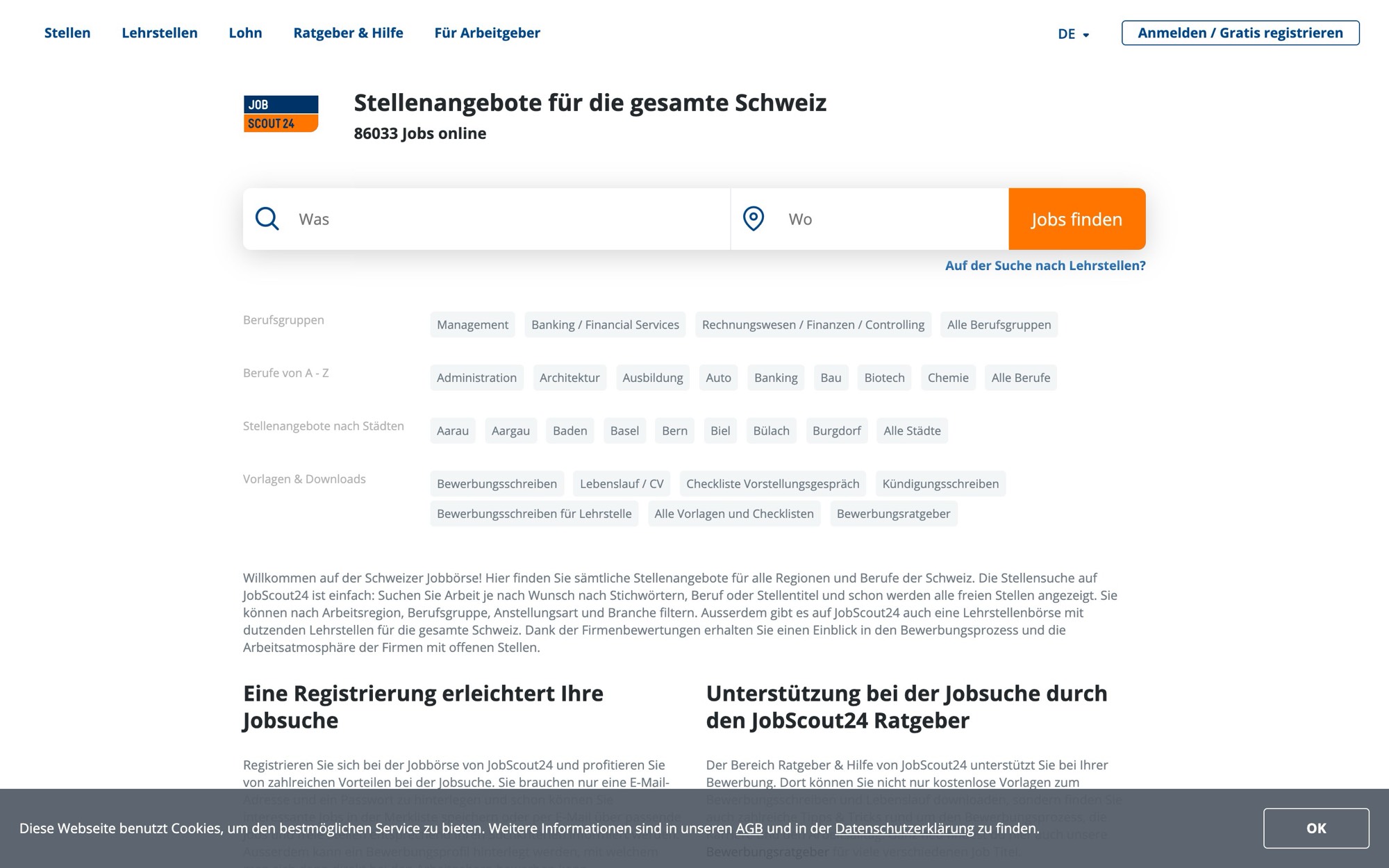
"English jobs, 549 vacancies". Unlike jobs.ch this is not a language filter but the search term in the path, /en/jobs/english teacher/ works the same way. Third brand of the same company.
"English Jobs in Switzerland (10,000+ Open Roles)", and with no keyword at all the same page shows "11,000+ Jobs". The keyword narrows almost nothing, and LinkedIn has no job-language filter. Still the best place for international employers and management roles.
Jobs by profession, city or language
Type a profession, a city or a language, the page shows the adverts currently open for it.
By profession
- Consultant
- Project Manager
- Retail Sales
- Nurse
- Nursing & Care
- Administrative Assistant
- Account Manager
- Software Engineer
- Public Administration
- Architect
- Insurance
- Chef
71 more — narrow the search
By work type
The trap sits one line further down the advert. Just over a fifth of the adverts we collect are written in English, and that is the number a language filter shows you. But one in five of those English-written adverts still demands a national language at a level you would have to work in: German in 82 per cent of those cases, French in 35 per cent, often both. The requirement line beats the headline every time.
The reverse almost never happens. 97.9 per cent of the roles that can be worked in English alone are also advertised in English, and only 3.2 per cent of them carry a German role word in the title, against 28.1 per cent of the market. There is no English-workable Sachbearbeiterin — there is an Accounts Receivable Specialist. Searching in German quietly excludes the exact subset you want.
And the field you work in matters more than the canton you live in. Among adverts that state a requirement, 85 per cent of research roles, 64 per cent in pharma and life sciences, 51 per cent in banking and finance, 49 per cent in supply chain and production and 41 per cent in IT need no national language. In nursing it is 5 per cent, in hospitality 4, in the trades 2. No search technique closes that gap.
Share within each field, counted against the adverts that state a language requirement at all. Rolling analysis of the open Swiss adverts we collect, 23 August 2026.
- Canton Zurich holds 33 per cent of all English-workable adverts, Geneva 14, Basel-Stadt 7, Vaud and Zug 5 each, canton Bern 2.
- Density is the other answer: 46 per cent of Geneva adverts stating a requirement are workable in English, 44 in Zug, 35 in canton Zurich, 27 in Neuchâtel, 24 in Vaud, 23 in Basel-Stadt — and 6 in canton Bern.
- One in five English-written adverts demands German or French at working level. Read the requirement line before you write anything.
- 97.9 per cent of English-workable roles are advertised in English, so English search terms are the main route, not a supplement.
- Just over a quarter of all adverts state no language requirement at all — neither promised nor ruled out, and worth a second search pass.
- 4.4 per cent of English-workable adverts give only the country or Remote as their location, so they never appear in a city search.
Share of English-language adverts by canton
| Canton | Adverts in English |
|---|---|
| Zurich | 59% |
| Geneva | 54% |
| Basel-Stadt | 34% |
| Vaud | 28% |
| Fribourg | 17% |
| Aargau | 15% |
| St. Gallen | 15% |
| Bern | 13% |
| Lucerne | 11% |
Counted in our index on 7 September 2026: 22,315 open adverts, 17,263 with a detected advert language. Cantons with at least 200 adverts only.
An English advert is not the same thing as an English job
This is the distinction that costs newcomers the most afternoons. 20.2 per cent of the adverts we collect are written in English. Of those, 20.1 per cent still require a national language at professional or native level — the level at which you actually have to work in it. German appears in 81.9 per cent of those cases and French in 34.8 per cent, frequently together.
The mechanism is banal. A group recruits in one language across all its markets, so the advert is English because the recruiting system is English. The team on site, the customers and the paperwork are German, so the requirement line says fluent German. Nothing about the advert is dishonest; it simply answers a different question than the one you asked.
Read the other way, the rule is nearly watertight: 97.9 per cent of the roles workable in English alone are advertised in English. German-written adverts that turn out to need no national language are a rounding error. So filtering to English adverts is the correct first move — it hands you almost the whole reachable market plus roughly a fifth of ballast, which the requirement line removes in seconds.
One nuance worth keeping: a job that mentions German at conversational level is still counted here as English-workable, and 10.4 per cent of the English-workable pool does exactly that. Swiss employers routinely list a second language as an advantage rather than a condition, and treating every mention as a blocker would empty the list for no good reason.
Volume says Zurich, density says Geneva and Zug
Both answers to where are correct, and they point in different directions. By share of the English-workable pool: canton Zurich 33.1 per cent, Geneva 14.2, Basel-Stadt 6.8, Vaud 5.1, Zug 4.7, canton Bern 2.1. If you want the longest list of openings, that list is in Zurich.
By density — counting only adverts that state a requirement — the ranking inverts. Geneva leads at 46.1 per cent, Zug follows at 43.6, then canton Zurich at 35.1, Neuchâtel at 27.1, Vaud at 23.8 and Basel-Stadt at 22.6. Fribourg sits at 16.4, Ticino at 14.6, Lucerne at 9.3, Aargau at 8.9 and canton Bern at 5.6.
The practical difference is your hit rate per advert read. In Geneva or Zug roughly every second advert with a stated requirement is open to you; in Zurich it is roughly every third, in a much bigger pool; in Bern it is one in eighteen. If you are choosing where to live before you have a job, that ratio matters more than the headline size of the local market.
Bern is the instructive outlier. It is the federal capital with a large public-sector and healthcare economy, and precisely those employers work in German. Arriving in Bern with English only puts you in the worst-fitting large market in the country; Lucerne and Aargau are milder versions of the same problem.
Search in the employer's spelling, not your own
Employers who advertise in English also write the place name in English, and the effect is large enough to reshape your results. Within canton Zurich's English-workable adverts, 47.0 per cent write Zurich without the umlaut and 52.0 per cent write Zürich. Across the canton as a whole the split is 15.0 against 71.8. In other words, the adverts you are looking for are disproportionately the ones a German-spelled search hides.
Geneva shows the same asymmetry in a smaller form: 34.6 per cent of English-workable Geneva adverts say Geneva rather than Genève, against 14.6 per cent across the canton. Type only Genève and you drop about a third of what suits you.
The second filter is the job title itself. Only 3.2 per cent of English-workable adverts carry one of the standard German role words — Mitarbeiter, Fachkraft, Leiter, Sachbearbeiter — where 28.1 per cent of the whole market does. German titles and English-workable jobs are close to mutually exclusive populations.
So run three searches, not one: the English job title, the place name in both spellings, and one search with no location at all, because 4.4 per cent of English-workable adverts name only the country or Remote and are invisible to any city filter.
Your field decides more than your canton
If you take one number away from this page, take the spread between fields. Among adverts stating a requirement, 84.7 per cent of research roles are workable in English alone, 63.6 per cent in pharma and life sciences, 51.4 in banking and finance, 48.9 in supply chain and production, 40.9 in IT and 39.0 in sales and marketing. HR sits at 28.7.
At the other end sit the parts of the economy that talk to people in the room: retail 6.7 per cent, nursing and care 4.9, hospitality 3.7, trades and construction 1.6. This is not a statement about openness. A ward in Bern or a building site in Aargau runs on the language its patients and colleagues speak, and no employer can hire around that.
By volume, though, IT dominates the English-workable pool: 16.0 per cent of it carries an IT or software title, followed by sales and marketing at 8.8, banking and finance at 7.7 and supply chain and production at 7.7. Research has the highest rate and a small absolute share at 4.4 per cent — a good market to be qualified for, a thin one to browse.
If your field is at the bottom of that list, two routes still work. One is the international employer inside your own profession: hospital groups with English-language research, hotel groups with international guests, industrial firms whose group language is English. The other is conversational-level language study rather than fluency, because only requirements at professional level actually exclude you.
Search by employer, not only by keyword
The English-speaking market is carried by a recurring cast of employers, and the cast changes by region. Geneva is private banking and international organisations: Union Bancaire Privée and Lombard Odier on one side, CERN, IOM and the World Economic Forum on the other, plus Geneva technology firms such as Proton and SonarSource.
Canton Zurich looks different. On is by a distance the largest single source of English-language openings there, followed by the private banks Julius Baer and Vontobel, the advisory firm PwC, robotics companies such as ANYbotics, and ETH with its programmes. Basel-Stadt is almost purely life sciences — Roche, Novartis, Idorsia, Lonza — with Jet Aviation at the airport.
Zug is the smallest of these markets and the least obvious: Thomson Reuters, GSK, Galderma, Partners Group, Medela and Specialized all advertise there in English. In Vaud the English-language side is carried by Nestlé, Logitech, IMD and a cluster of young technology firms such as Neural Concept and Adaptyv.
And a meaningful part of this market is not in a city at all. Solvias in Kaiseraugst, the Paul Scherrer Institute in Villigen, Thermo Fisher in Allschwil, SBM Offshore in Marly, UCB in Bulle, Bühler in Uzwil, The North Face in Stabio: research campuses and industrial sites in municipalities that appear on no city list. Searching by employer name is the only way to see them.
Two traps in any English-language list
First, not every English advert on a Swiss list is a Swiss job. Sitting between the Geneva and Zurich openings in our own collection are employers based elsewhere — an Australian university, an American retail chain, an Asian travel group. They appear because they advertise in English and distribute internationally, not because they are hiring in Switzerland. Whenever the location line contains no place you recognise, check where the work actually is before you invest an hour.
Second, Remote is a location that misleads in both directions. 4.4 per cent of English-workable adverts give only the country or no town at all. Some are genuine Swiss jobs with a home-office policy; others are globally advertised remote contracts with no Swiss employment behind them, which changes everything about social insurance, tax and permits.
Both checks take two minutes: open the employer's own careers page, find the role there, read the location and the contract type. If the role is not on the employer's site, it is either filled or was never meant for Switzerland in the first place.
What the official statistics say
The Federal Statistical Office explains why this market feels both large and narrow. In the structural survey as at 31 December 2024, 23.6 per cent of employed people usually speak English at work. In 2010 it was 16.5 per cent and in 2022 it was 22.6 — a steady climb across fifteen years, not a sudden shift.
At the same time 60.8 per cent usually speak Swiss German at work, 35.6 per cent standard German, 27.6 per cent French and 8.0 per cent Italian. Respondents could name several languages, and that is the whole resolution of the paradox: in Switzerland English is very often an additional working language and rarely the only one. Nearly a quarter of employees use it; only about a fifth of adverts that state requirements can be worked in it alone.
Two conclusions follow for your search. In the short term, sort by the requirement line rather than by the impression an advert makes. In the medium term, conversational competence in your region's language moves the boundary more than fluency does, because only professional-level requirements actually shut you out — and one in ten English-workable adverts already asks for the soft version.
Market figures come from our rolling analysis of the open Swiss adverts we collect, 23 August 2026. English-workable means the advert names English and demands no national language at professional or native level; requirements at conversational or basic level are not treated as exclusions. Shares by canton and by field are counted against the 72.8 per cent of adverts that state any language requirement; composition shares refer to the whole English-workable set. The canton is derived from the advert's location field — canton names in all national languages plus the largest municipalities — so cantonal figures are a lower bound. Fields are inferred from job titles and are an approximation. We publish shares, never absolute stock figures. Figures on languages spoken at work come from the Federal Statistical Office structural survey.
Sources
Related questions
What our job index says about the Swiss market
Computed live from our own index, not quoted from a study. Shares only, as of today.
Language the advert is written in
- Deutsch
- 60%
- English
- 23%
- Français
- 13%
- Italiano
- 3%
Of adverts that state a language requirement, the share asking for
- Deutsch
- 70%
- English
- 43%
- Français
- 21%
- Italiano
- 3%
19% posted in the last 7 days · Largest markets: Zürich 18% · Bern 10% · Genève 5% · Basel 5%