Where do I find hospitality jobs in Switzerland — and why does searching in English find almost none of them?
Updated:
In short
Hospitality is about 2.1 per cent of the open Swiss adverts we track, and the hardest part is not the size of the field but its vocabulary. Only 5.7 per cent of hospitality adverts are written in English, against 20.5 per cent across the rest of the market — this is the least English part of the Swiss job market. Worse, half of all kitchen vacancies carry a French title: Chef de Partie, Commis de Cuisine, Sous-Chef, Entremetier, Gardemanger. Search those words, in German and French, and you go from half the field to almost all of it.
The Swiss job portals at a glance
Click an image for the full-size view. What each portal actually is stands beside it.
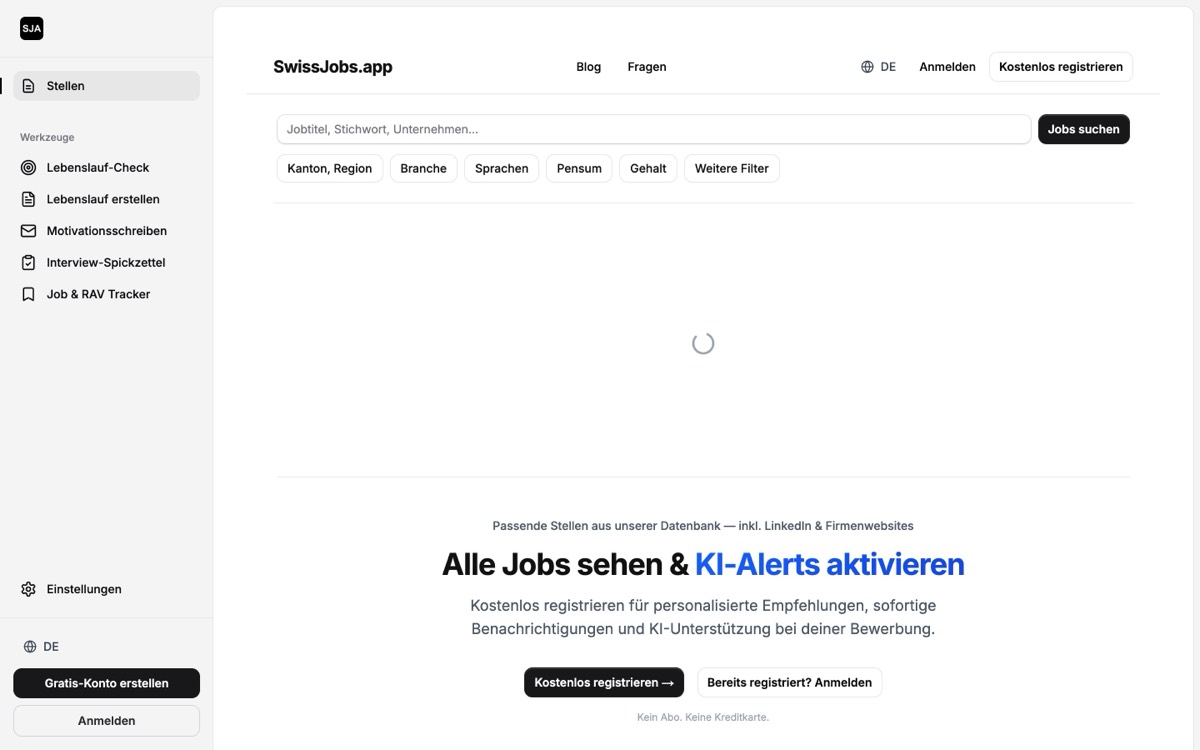
1. SwissJobs.appOur app
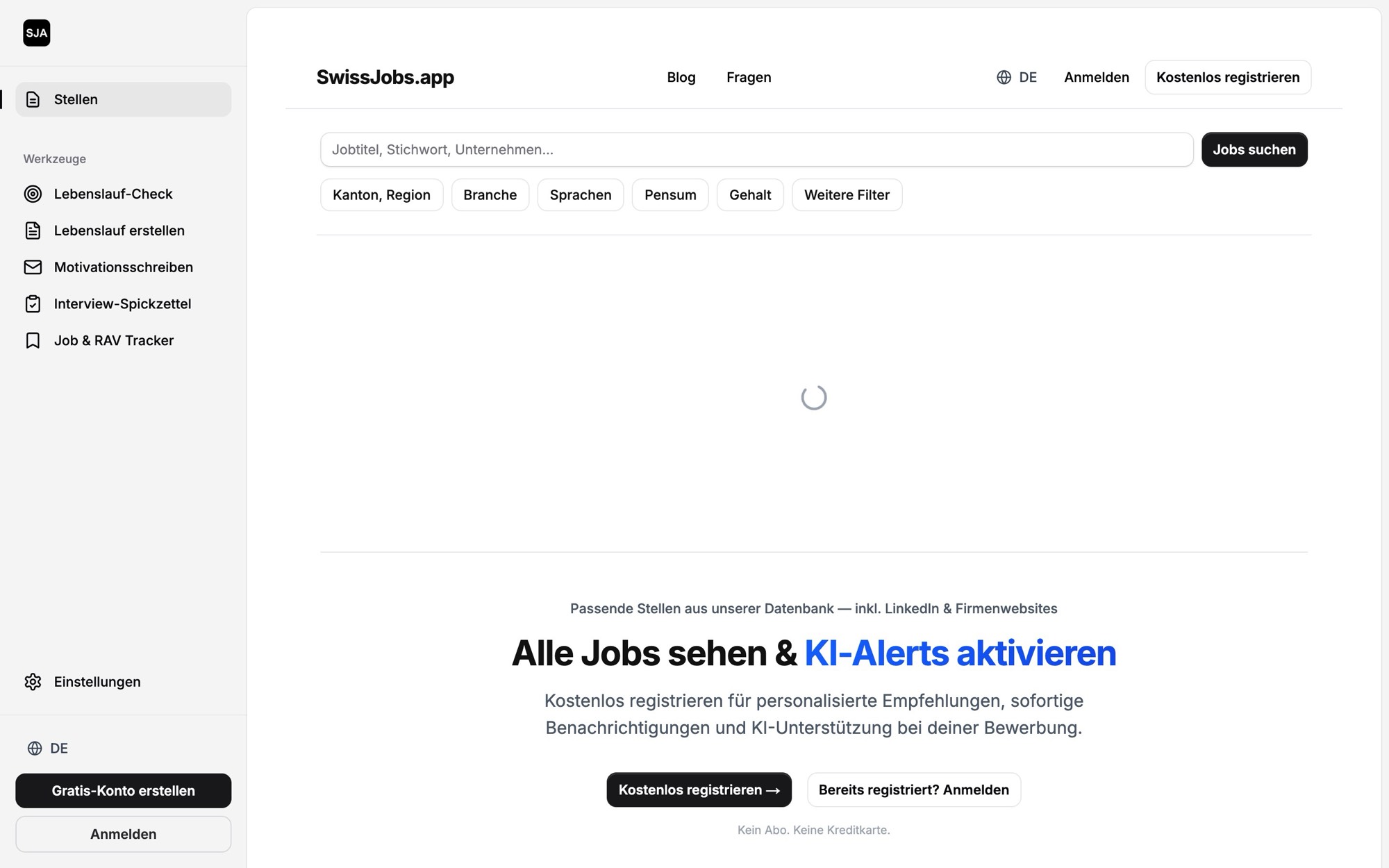
Over 21,000 open Swiss roles from ATS systems, company sites and LinkedIn in one place — and from any advert, straight into a CV, a motivation letter, a CV check and interview prep. The RAV job-search-efforts form fills itself from your application tracker. Free to use; the account is asked for at save.
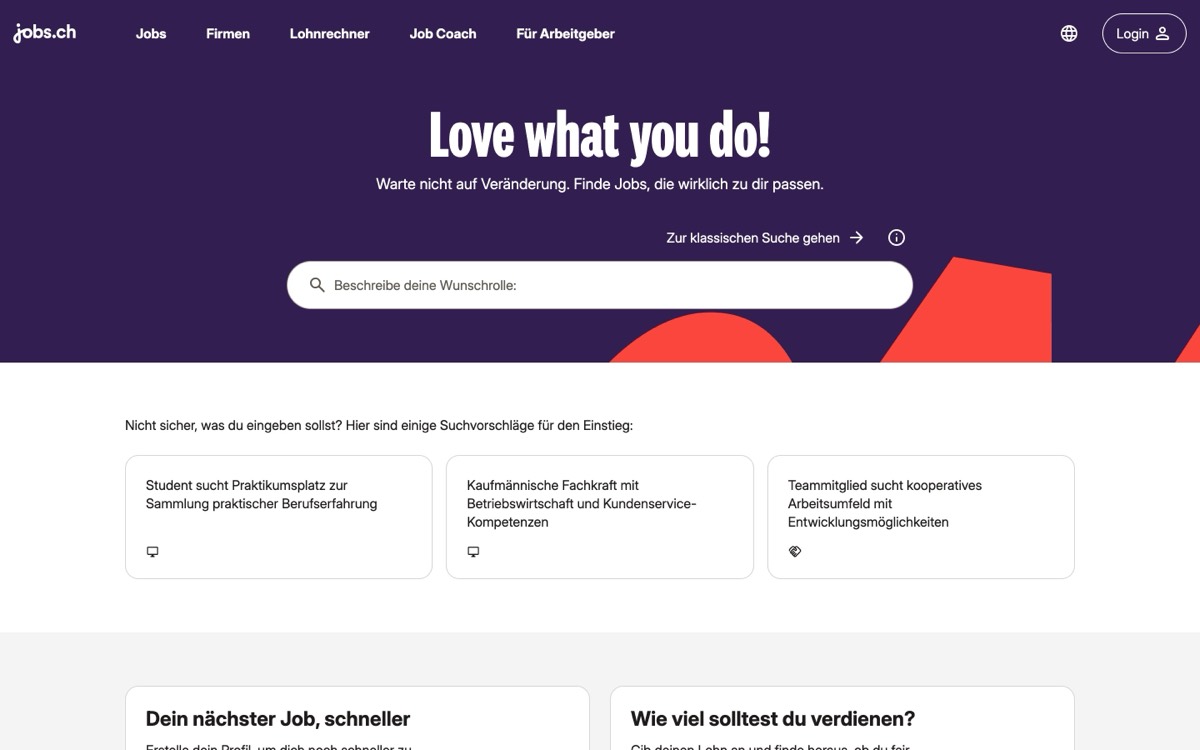
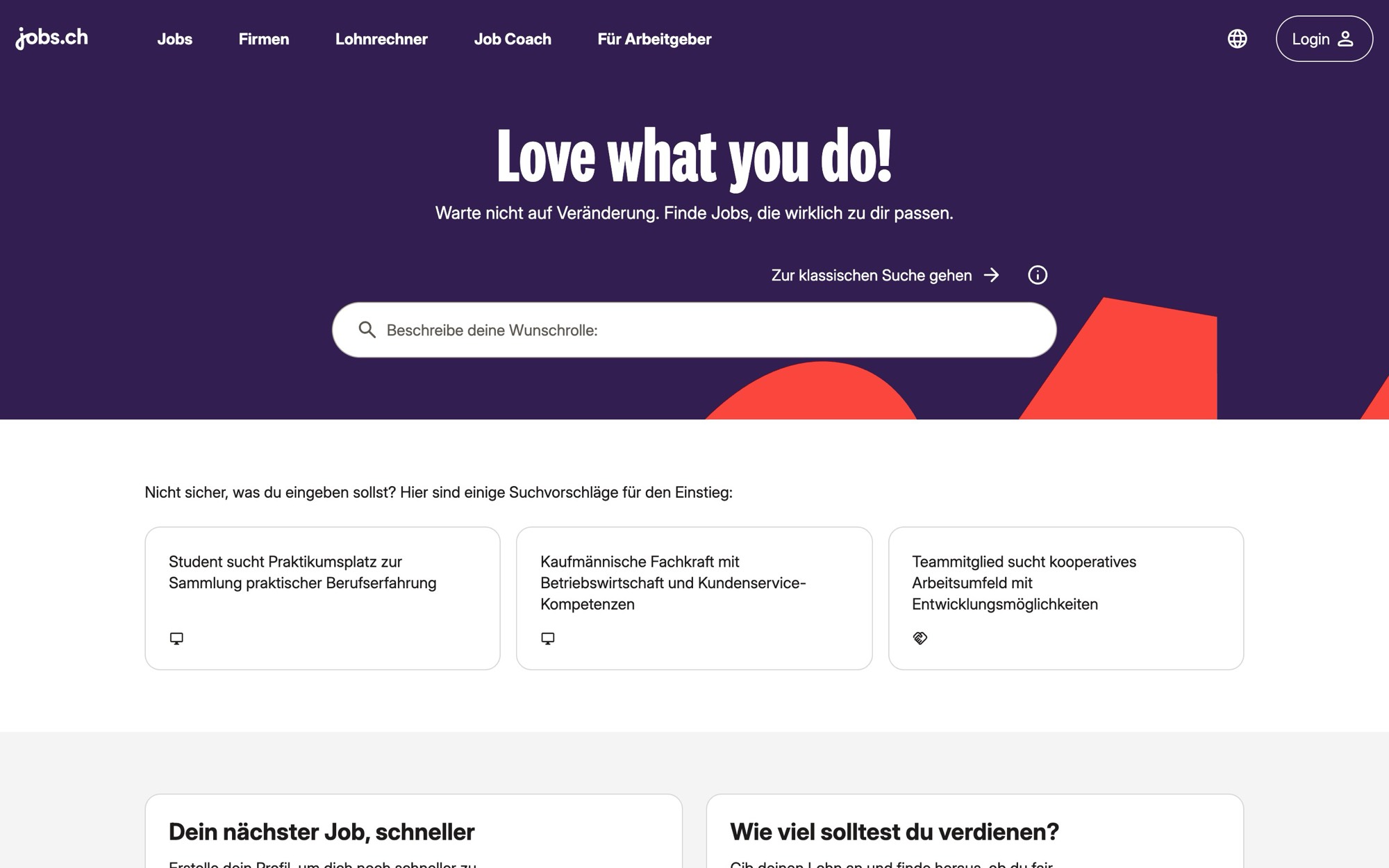
The best-known board in German-speaking Switzerland and the largest index in the country. Owned by JobCloud AG — as are jobup.ch and JobScout24.
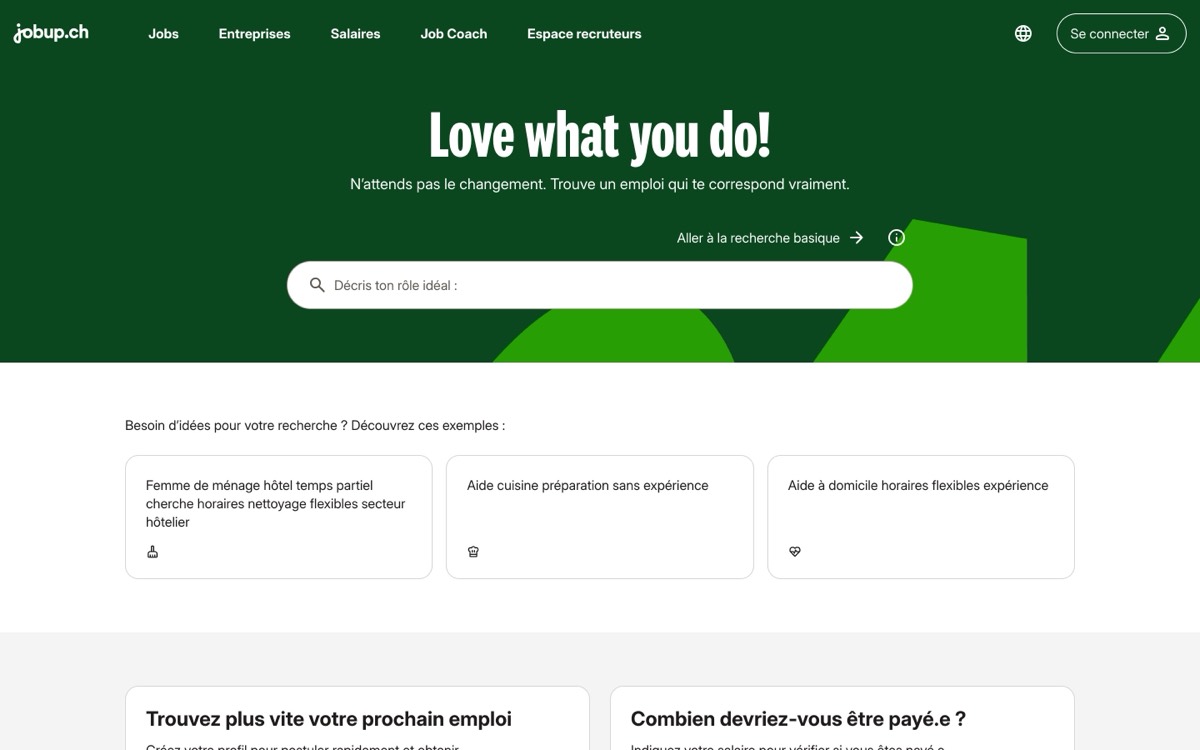
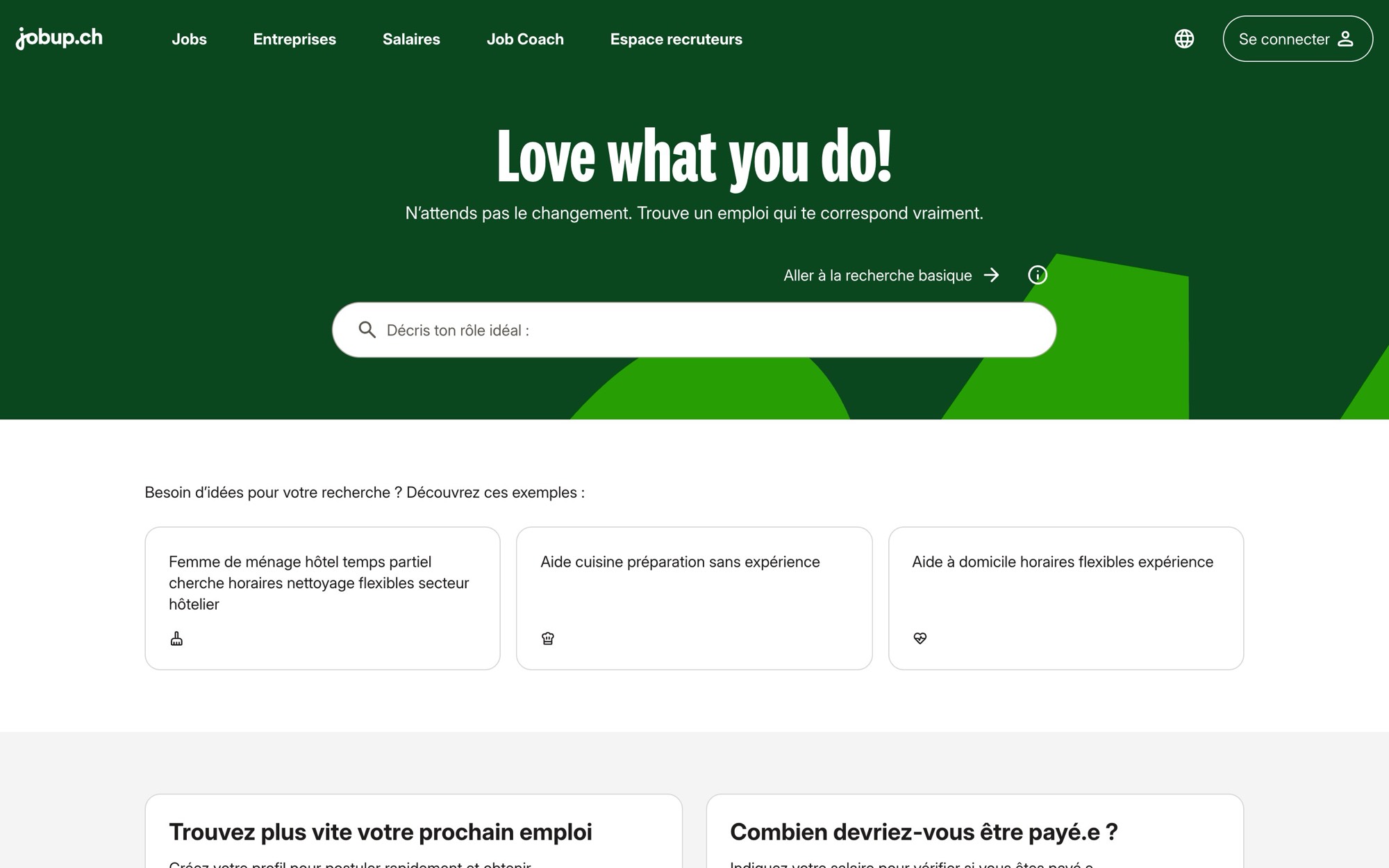
The standard in French-speaking Switzerland and the first place to look for the Romandie — but the same JobCloud AG as jobs.ch.
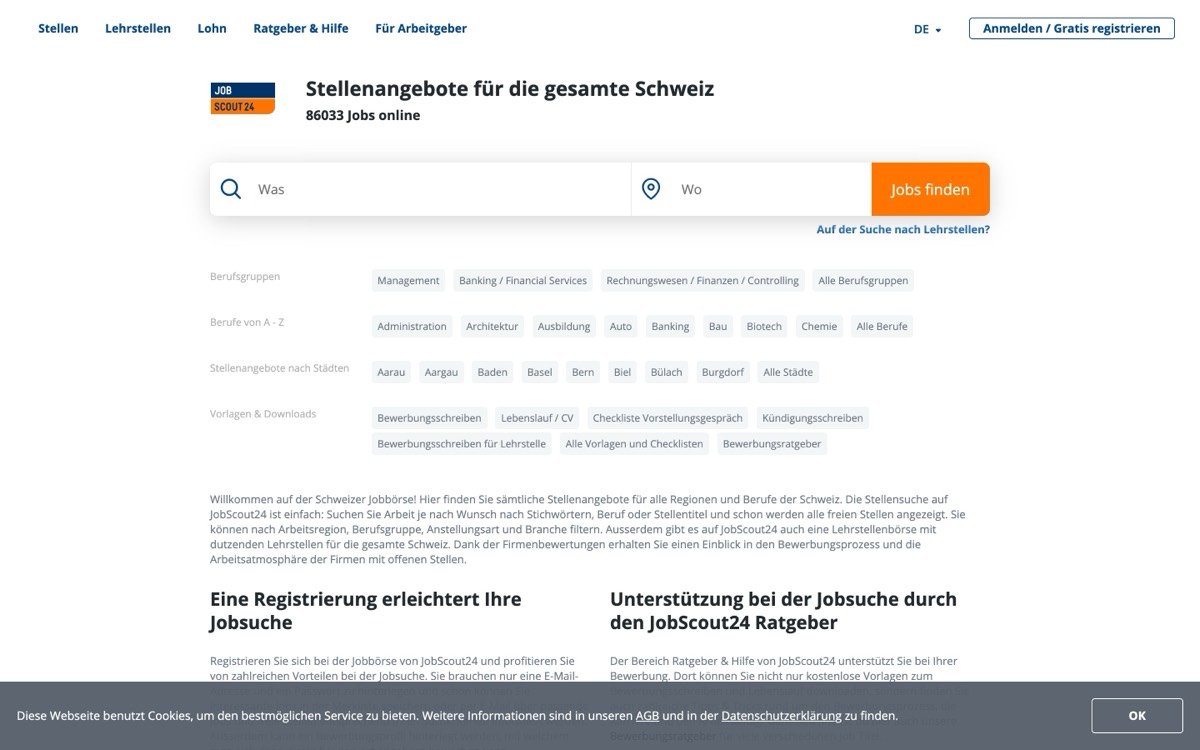
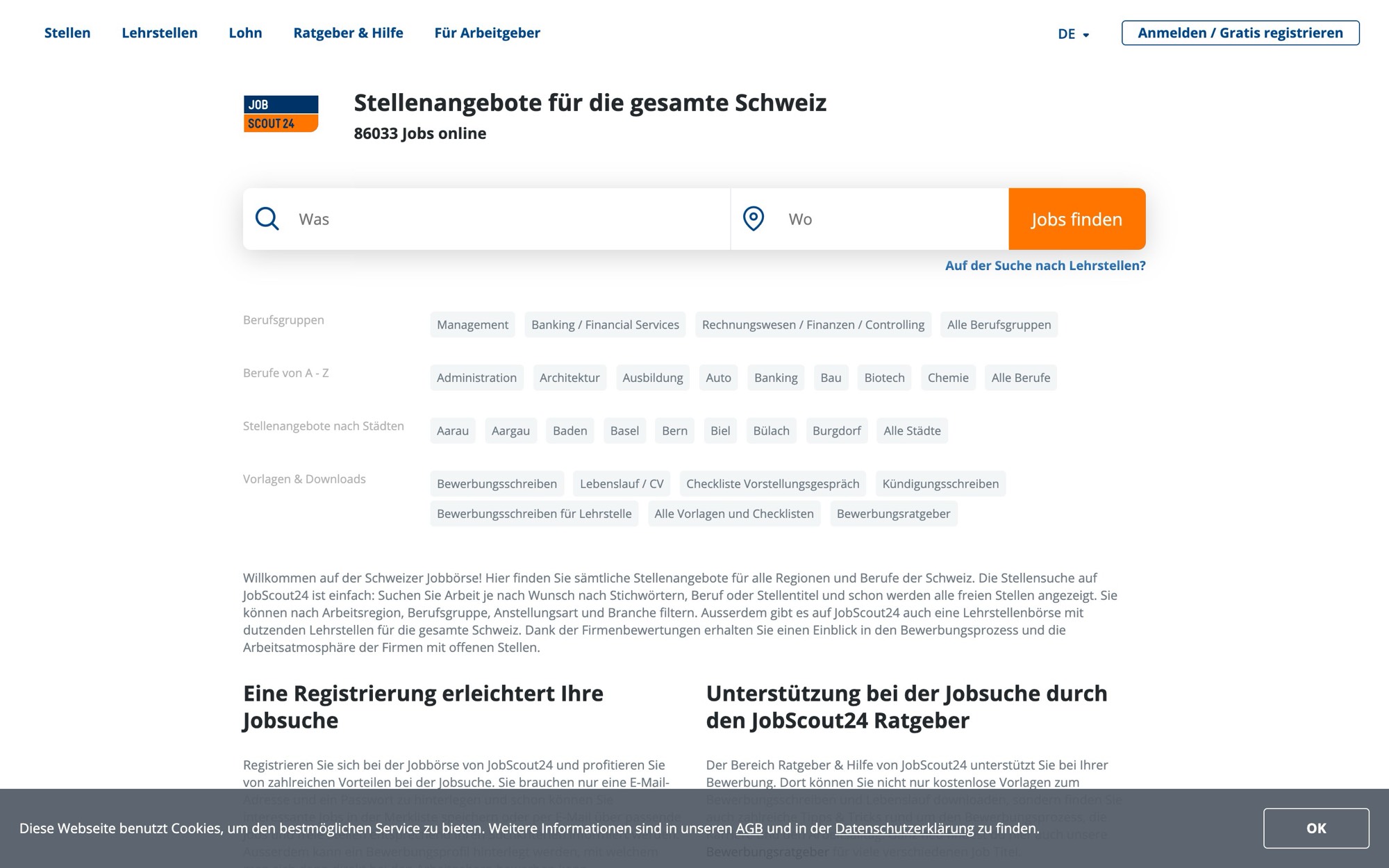
A third brand from the same company. Searching all three to widen your search means searching one provider three times.
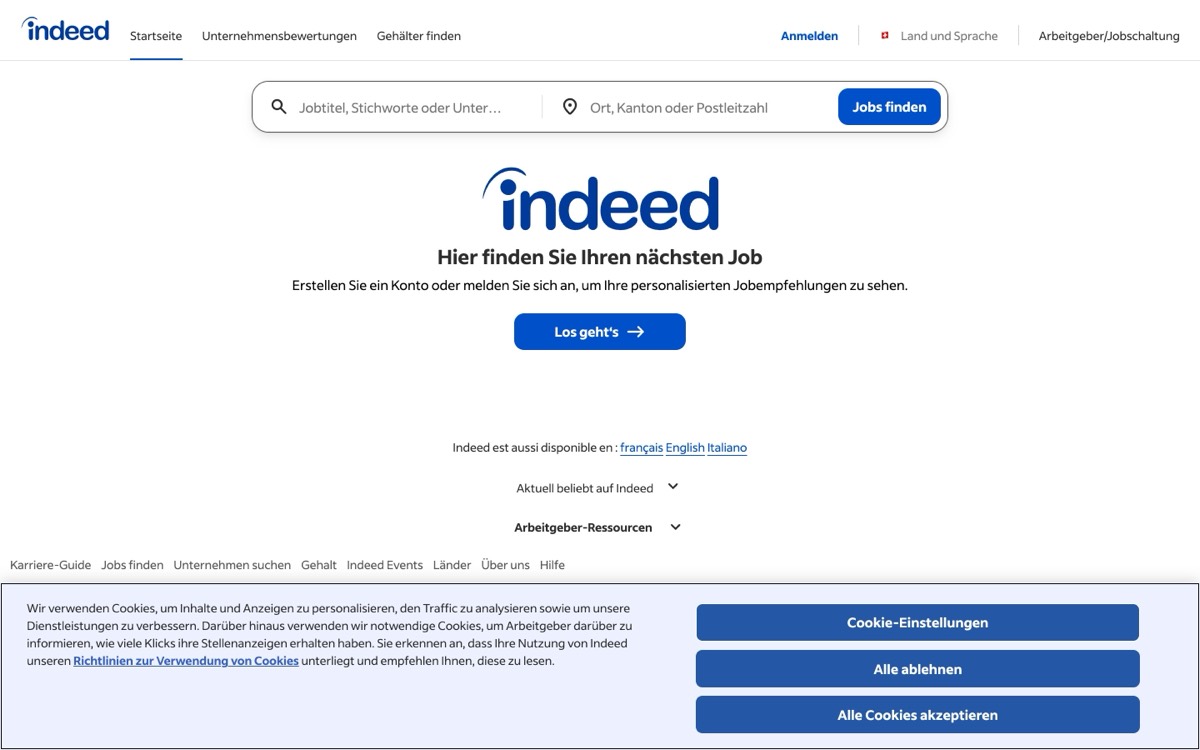
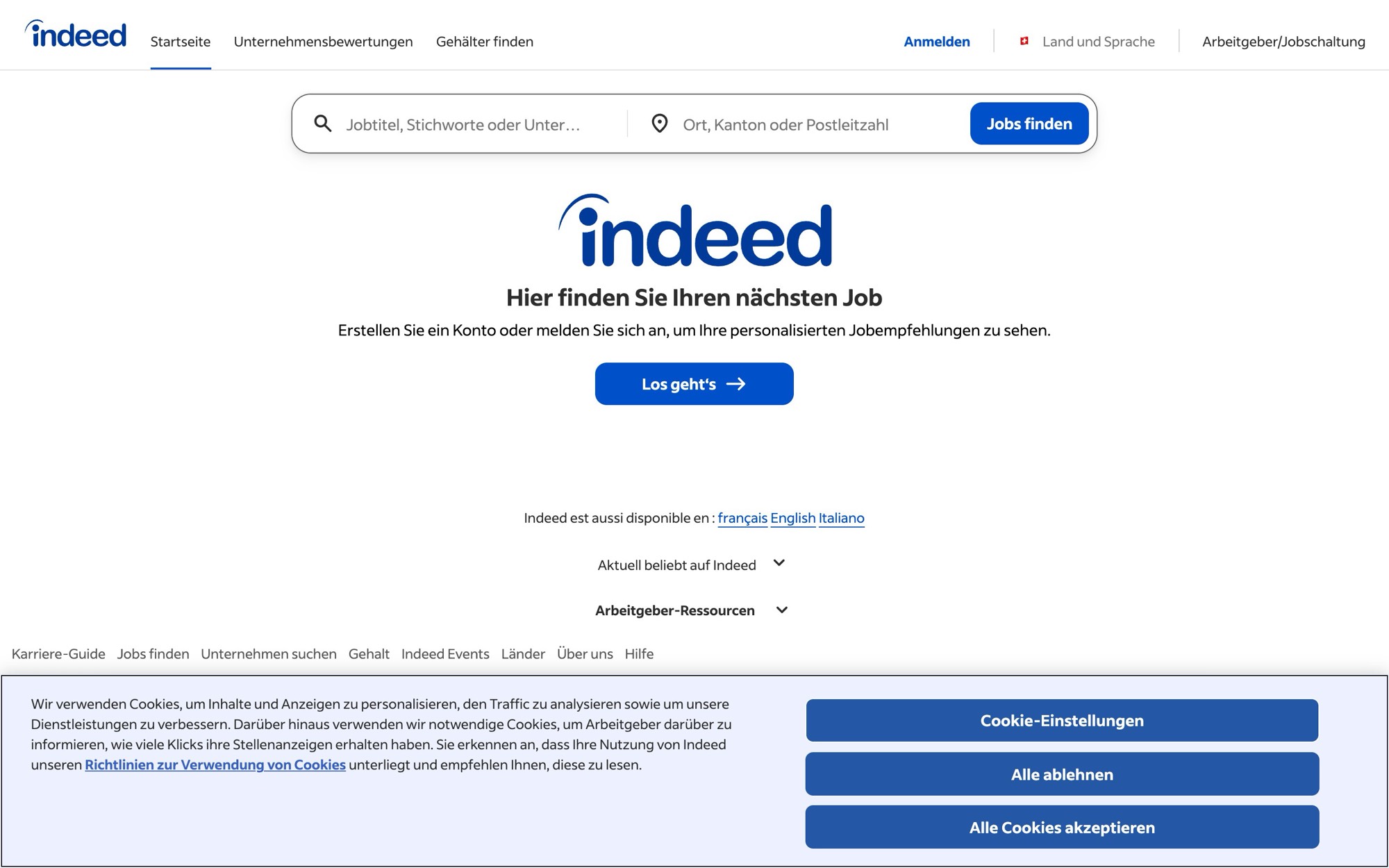
The broadest aggregation, because Indeed also collects from other boards — at the cost of many duplicates of the same advert.
The best reputation for English-speaking and international roles in Switzerland. Considerably thinner for trades, care and commercial roles.
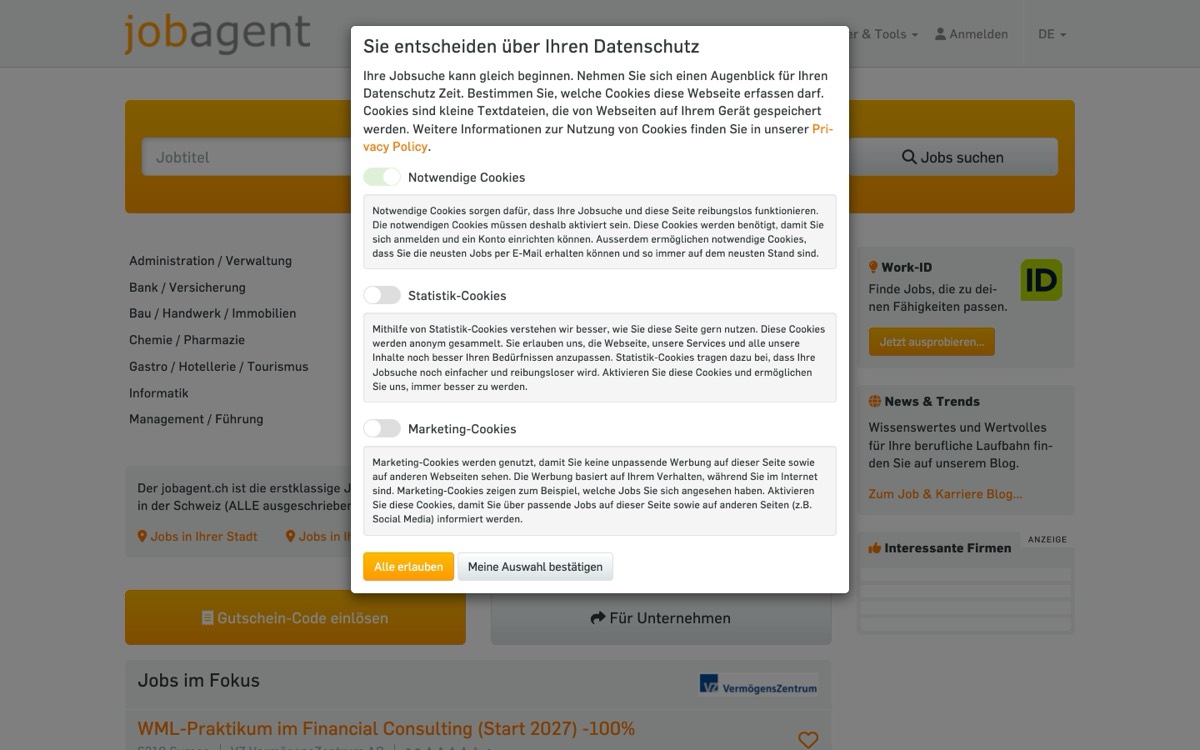
A meta-search across the Swiss job boards, "every job in Switzerland at a glance". Its strength is the Job-Abo: a saved search that mails you new adverts from every portal it covers. Salary calculator and application guides alongside.
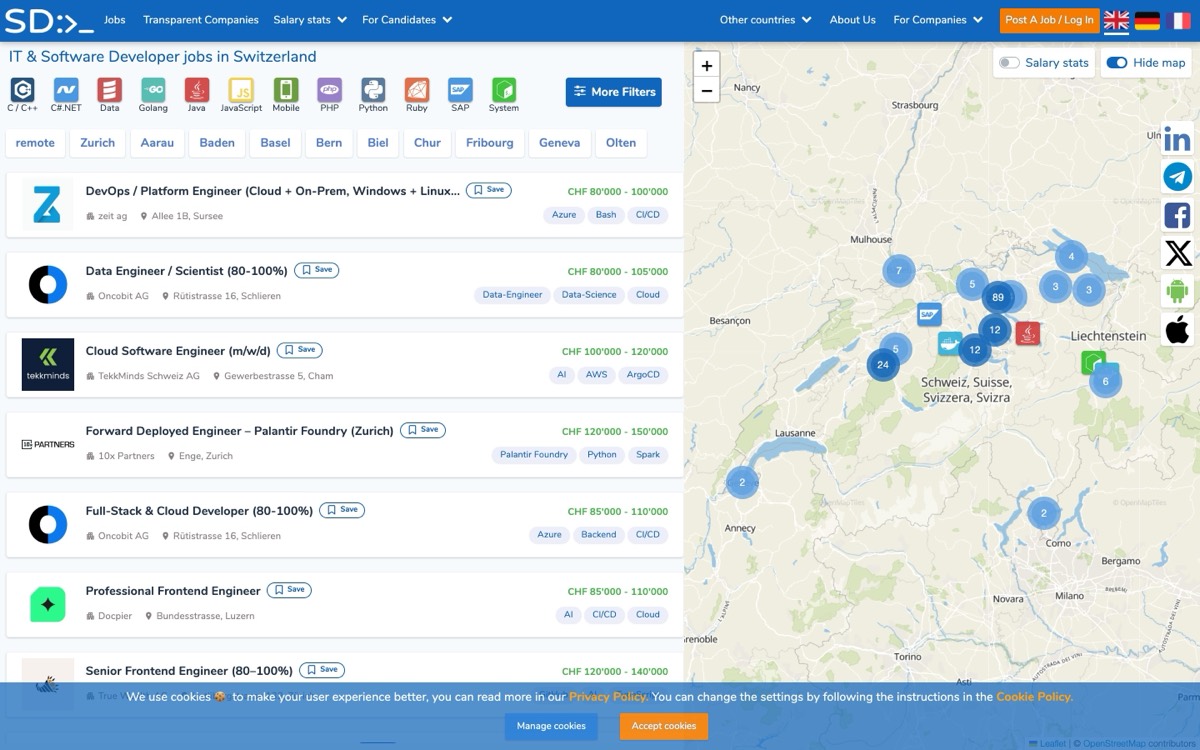
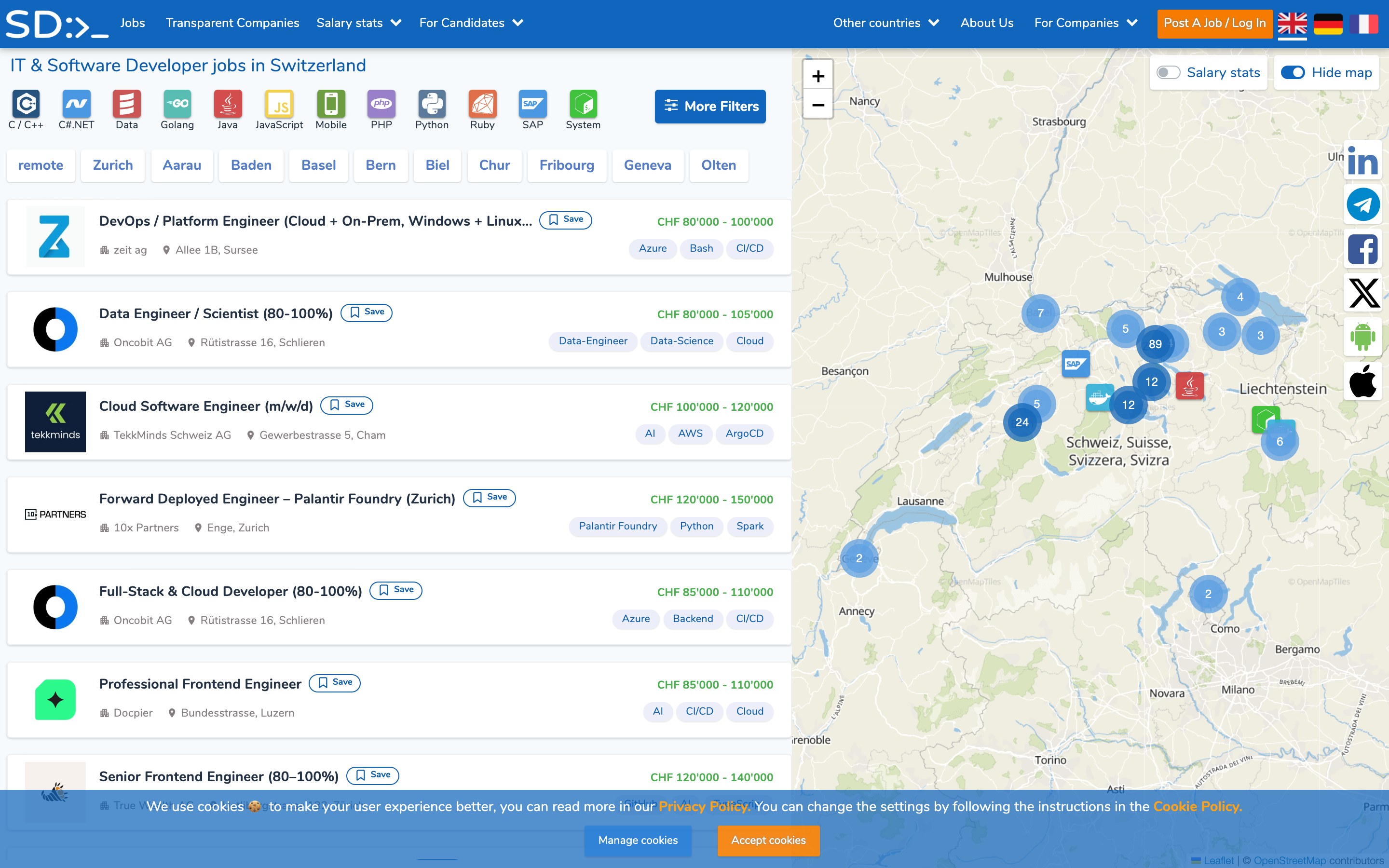
IT and software only, and thorough about it: "183 IT & Software developer jobs in Switzerland", filtered by technology (C#, Java, Python, DevOps, ML) rather than by industry. Publishes salary statistics and lists the companies that disclose their ranges. The site itself is in English.
Jobs by profession, city or language
Type a profession, a city or a language, the page shows the adverts currently open for it.
By profession
- Consultant
- Project Manager
- Retail Sales
- Nurse
- Nursing & Care
- Administrative Assistant
- Account Manager
- Software Engineer
- Public Administration
- Architect
- Insurance
- Chef
71 more — narrow the search
By work type
The second surprise is who is hiring. Only 20.1 per cent of hospitality adverts come from hotels and resorts and 9.8 per cent from restaurant, bar and café chains. A further 23.4 per cent are independent single establishments. The remaining 46.7 per cent come from employers nobody thinks of as hospitality: hospitals and care homes at 17 per cent, retailers at 16.2, contract caterers and staff canteens at 6.1, schools, public administrations and mountain railways at 4.1. Kitchens exist wherever people are fed.
And third, the geography inverts. One per cent of the rest of the market sits in an Alpine or spa resort; in hospitality it is 10.5 per cent. Read the other way round, in places like Verbier, Zermatt, St. Moritz, Davos, Saas-Fee, Gstaad and Bad Ragaz, 18.3 per cent of every open advert we record is a hospitality role. If you are willing to move, that is the densest hunting ground this occupation has anywhere in the country.
Share of adverts written in each language, hospitality against the rest of the market. Rolling analysis of the open Swiss adverts we record, August 2026.
- The word "chef" in English is not the Swiss job title. Kitchen roles are advertised as Koch, Köchin, Küchenhilfe, Cuisinier, Chef de Partie, Commis de Cuisine, Sous-Chef, Entremetier, Gardemanger and Pizzaiolo. Kitchen work is 42.8 per cent of the whole field.
- Even English-language hospitality adverts use the French brigade titles: 26.9 per cent of them carry one in the headline, against 16.1 per cent of the German-language ones.
- Hospitality accounts for 3.7 per cent of every French-language advert we record, 2.4 per cent of the German ones and 0.6 per cent of the English ones. Searching this field in English alone is the single most expensive mistake you can make.
- The field is flat, not concentrated: 54.9 per cent of hospitality employers have exactly one advert open. Set the largest advertiser aside and the next ten together account for only 22.9 per cent.
- 9 per cent of hospitality adverts with usable text mention meals, a staff room or accommodation, against 0.6 per cent across the rest of the market — in a resort village that is often the part that makes the job viable at all.
- The list turns over fast. The median hospitality advert is 17 days old against 20 elsewhere, and only 16.4 per cent are older than two months against 27.5 per cent. Weekly checking beats a perfect application to a stale posting.
Search in German and French, not in English
Most guidance for foreigners looking for work in Switzerland says that English will get you a long way. In hospitality it will not, and the numbers are unusually blunt about it. Just 5.7 per cent of the hospitality adverts we record are written in English, compared with 20.5 per cent across the rest of the market. Flip the measure and it is starker still: hospitality makes up only 0.6 per cent of all English-language adverts in our index, while it makes up 3.7 per cent of all French-language ones.
That is not a quirk of what we happen to collect. It reflects how the industry works. A kitchen and a dining room run on spoken instructions, and the language of instruction is the language of the region. Of the hospitality adverts that state a language requirement, 71.5 per cent ask for German and 30.3 per cent for French, against 20.1 per cent for French across the rest of the market. English is asked for in 34.2 per cent, but almost always alongside another language, not instead of one — 32.7 per cent of hospitality adverts with a stated requirement ask for two languages or more.
The practical instruction follows directly. Run every search three times: once in German, once in French, and only then in English. In German use Koch, Köchin, Küchenhilfe, Servicemitarbeiter, Restaurantfachfrau, Housekeeping, Rezeption, Gastronomie, Hotellerie. In French use cuisinier, cuisinière, aide de cuisine, serveur, serveuse, réceptionniste, employé de restauration, gouvernante. The same vacancy is rarely posted twice, so the two searches return two different lists, not the same one translated.
There is one honest exception. International hotel groups in Geneva, Zurich, Verbier and St. Moritz do advertise in English, and those adverts are genuinely open to candidates without German. They are a real segment — but a small one, and building a search strategy on it means seeing a twentieth of the field.
Half of all kitchen jobs are advertised under a French title
The classical kitchen brigade is named in French, and Swiss employers use those names untranslated regardless of which language the rest of the advert is in. Of the open kitchen vacancies we record, only 49.5 per cent contain "Koch" or "Köchin" in the title. Adding "Küche" and "Küchenhilfe" raises it to 54.6 per cent. Adding the French brigade terms raises it to 96.4 per cent.
This is why 16.1 per cent of German-language hospitality adverts and 26.9 per cent of the English-language ones carry a French title in the headline. A hotel in the Bernese Oberland advertises a Demi Chef de Partie; a five-star house in Zurich a Commis de Cuisine for pastry; a Zermatt kitchen an Entremetier and a Gardemanger. None of those adverts contains the English word "chef" or the German word "Koch" anywhere in the title.
The full working list, in rough order of seniority: Chef de Cuisine or Küchenchef, Sous-Chef, Chef de Partie, Demi Chef de Partie, Commis de Cuisine, Entremetier, Gardemanger, Pâtissier, plus Küchenhilfe, Hilfskoch and aide de cuisine at entry level, and Pizzaiolo as its own category. On the dining-room side: Chef de Rang, Restaurantfachfrau or Restaurantfachmann, Serveur and Serveuse, Maître d'Hôtel, Barkeeper, Barista, Sommelier. Front of house: Front Office, Réceptionniste, Concierge, night porter. Housekeeping: Housekeeping, Gouvernante, Hausdame, étage.
One warning about English search words. "Service" is close to useless here: of all the adverts in our index with "service" in the title, only 2.3 per cent are hospitality — the rest are customer service, field service, service engineers and IT support. "Hotel" and "restaurant" are the opposite: every advert we record with either word in the title really is a hospitality role, but between them they find only 22.5 per cent of the field.
Nearly half the vacancies are not in a hotel or a restaurant
If you picture hospitality as hotels and restaurants, you are picturing half of it. Sorting the employers behind the hospitality adverts we record by type of business, 20.1 per cent are hotels and resorts, 9.8 per cent are restaurant, bar or café chains, and 23.4 per cent are independent establishments with no visible group behind them — the village inn, the mountain restaurant, the neighbourhood bistro.
The other 46.7 per cent are somewhere else entirely. Hospitals, clinics, nursing homes and assisted-living operators account for 17 per cent of hospitality adverts; every one of them runs a kitchen, a dining room, a cafeteria and a housekeeping department. Retailers account for 16.2 per cent — the single largest hospitality advertiser in our index is not a hotelier but a retail group with in-store restaurants. Contract caterers and staff-restaurant operators add 6.1 per cent, schools, public administrations and mountain railways 4.1 per cent, and staffing agencies 3.3 per cent.
This changes the address list completely. These employers advertise on their own career pages under wording that no hospitality search will ever surface: "Mitarbeiter:in Gastronomie", "Mitarbeiter/in Patienten-Hotellerie", "Personalrestaurant und Bistro", "Stationshotellerie", "employé polyvalent en cuisine". You have to know the words exist before you can find the jobs.
They also differ in substance. Institutional kitchens generally mean earlier and more predictable hours, less evening and weekend work, no seasonal rhythm and no tips. For anyone leaving classical restaurant service because of the split shifts rather than because of the trade, this is the escape route — and at nearly one advert in two, it is large enough to build a search around.
Seasonal contracts, and why "Winter 26/27" appears in August
Hospitality is effectively the only part of the Swiss market where the season appears in the job title. Two per cent of hospitality adverts carry a seasonal word — Saisonstelle, saisonal, Wintersaison, "Winter 26/27", "Hiver 26/27" — against 0.1 per cent across the rest of the market. That sounds small, and it is still the most important calendar fact in the field: the winter season is staffed in late summer.
The industry agreement defines the season precisely. The social partners' statement on the 2026 minimum wages says the winter season runs "at the latest until 30 April 2026" and the summer season begins on 1 May 2026. So a "Winter 26/27" advert seen in August is not a leftover; it is the normal recruiting cycle. Start looking for a winter season post in December and you are searching a market that was cleared months earlier.
Seasonal establishments also work to different terms. Under Art. 15 of the industry agreement the average working week is 42 hours, "43.5 hours per week in seasonal establishments" and 45 hours in small establishments. Minimum-wage increases reach seasonal contracts not on 1 January but at the start of the summer season. Both belong in the conversation before you sign.
The compensation is the rest of the package. Nine per cent of hospitality adverts with usable text mention meals, a staff room or accommodation, against 0.6 per cent elsewhere. In a resort village where housing is scarce and expensive, that is frequently the difference between a job that works and one that does not. If the advert is silent, ask: board, lodging and how they are set against your wage are all regulated by the industry agreement, but they are not offered identically everywhere.
The binding minimum wage that no advert mentions
Switzerland has no national minimum wage, but hospitality has something close to one. The national collective agreement for the hospitality industry covers hospitality employers and employees across the country and has been declared generally binding from 1 May 2026 to 31 December 2027. Excluded from it are, among others, managers and directors, family members of the operator, musicians, performers and disc jockeys, and apprentices under the federal vocational training act.
The social partners published the 2026 minimum monthly gross wages last October. Category Ia, staff without a completed apprenticeship: CHF 3'713. Category Ib, without an apprenticeship but with a Progresso certificate: CHF 3'943. Category II, with a federal vocational certificate or equivalent: CHF 4'070. Category IIIa, with a federal diploma of vocational education or equivalent: CHF 4'528. Category IIIb, with that diploma plus further training: CHF 4'635. Category IV, with a federal professional examination: CHF 5'293. Interns: CHF 2'390.
The rest of the agreement is worth as much as the wage floor. Art. 17 gives five weeks of holiday a year, expressed as 35 calendar days, or a 10.65 per cent supplement where the holiday pay is settled with an hourly wage. Art. 12 gives a full thirteenth month's salary. There are six paid public holidays. The working week is the 42 hours above. A monthly figure quoted to you without the thirteenth month is not the number you should be comparing.
Here is the finding from our own index: not one of the hospitality adverts with usable text mentions the agreement, the collective agreement, or the CCNT by name. That is not a breach — the agreement applies whether or not an advert cites it — but it does mean the burden of knowing your own price sits entirely with you. Work out which wage category your qualification falls into before the first conversation, not after it.
Since January 2026, cook vacancies go to the employment office first
One recent change lands squarely on this field. Since 1 January 2026 cook vacancies are again subject to the Swiss job-registration requirement. The State Secretariat for Economic Affairs applies a single criterion — a nationwide unemployment rate of at least 5 per cent for the occupation — and cooks reached 5.3 per cent in the reference period. Cleaning and auxiliary staff in offices, hotels and other establishments were added on the same basis, also at 5.3 per cent. Overall coverage rises from 6.5 to 10.8 per cent of the working population.
In practice a registered vacancy must be reported to the regional employment centre and appears first in the protected area of job-room.ch. Only five working days later may the employer advertise it anywhere else. Jobseekers registered with a regional employment centre and signed up for that portal therefore see these vacancies before they are public — and in hospitality that covers the largest role group in the field, since kitchen work is 42.8 per cent of it.
This answer deliberately stops there. How the registration works, which numbers you need and how the five working days are counted are covered in our answer on Job-Room. For a hospitality search the consequence is enough: if you are registered anyway, that portal has been the earliest list for cook vacancies since the start of this year — alongside the career pages, not instead of them.
A search order that reflects the data
First, fix the words. One search for "chef" is not a search of this field. Build a list of German and French titles for the part of the house you want — kitchen, dining room, front office, housekeeping — and run it in both languages. This single step roughly doubles what you can see, before anything else changes.
Second, widen the employer list beyond hotels. Add the hospital and care-home kitchens in your region, the staff restaurants of the large local employers, the contract caterers and the retail groups. Together they are nearly half the field. And because 54.9 per cent of hospitality employers have exactly one advert open, breadth beats depth here: unlike nursing, this field is not concentrated in a handful of big addresses, so following twenty small ones pays better than following five large ones.
Third, use place names rather than cantons if you can move. Alpine and spa resorts hold 10.5 per cent of hospitality adverts against 1 per cent of the rest of the market, and within those places 18.3 per cent of everything advertised is hospitality. Querying a dozen resort villages by name takes ten minutes and reaches a market that a canton-level search buries under the cantonal capitals. One caveat we should state plainly: our coverage of Ticino is thin — only 0.2 per cent of our hospitality adverts sit there — so for Lugano, Locarno and Ascona, regional portals and direct employer pages will serve you better than our list.
Fourth, match your rhythm to the market. This list moves faster than the rest: median advert age 17 days against 20, and only 16.4 per cent older than two months against 27.5 per cent. Check weekly. If you are entering the trade rather than moving within it, look additionally at the 11.1 per cent of adverts that are apprenticeships or internships, against 5.5 per cent elsewhere, and the 3.7 per cent offering hourly, on-call or casual work against 0.7 per cent. Both are far more common here than anywhere else in the market, and both are a real way in.
Shares come from our rolling analysis of the open Swiss adverts we record, August 2026. An advert counts as hospitality when its title names a function in the kitchen, dining room, bar, housekeeping, reception or hospitality management (Koch, Küche, Chef de Partie, Commis, Sous-Chef, Cuisinier, Servicemitarbeiter, Restaurantfach, Chef de Rang, Serveur, Barkeeper, Housekeeping, Gouvernante, Réceptionniste, Front Office, Gastronomie, Hotellerie, Restauration and related terms); titles carrying those words but clearly belonging to sales, IT, logistics, building caretaking or unrelated teaching are excluded. Language requirements are counted only on adverts that state one, and text measures only on adverts with a usable summary. Employer type is inferred from the company name and is therefore approximate. Our coverage of Ticino is thin and uneven across the mountain cantons; the text says so where it matters. We publish shares, never absolute index sizes. Wage, holiday and working-time figures come from the national collective agreement for the hospitality industry and the social partners' announcement; the registration-requirement figures come from the State Secretariat for Economic Affairs.
Sources
Related questions
What our job index says about the Swiss market
Computed live from our own index, not quoted from a study. Shares only, as of today.
Language the advert is written in
- Deutsch
- 60%
- English
- 23%
- Français
- 13%
- Italiano
- 3%
Of adverts that state a language requirement, the share asking for
- Deutsch
- 70%
- English
- 43%
- Français
- 21%
- Italiano
- 3%
19% posted in the last 7 days · Largest markets: Zürich 18% · Bern 10% · Genève 5% · Basel 5%