Where do I find logistics jobs in Switzerland — and why does one word cover two separate labour markets?
Updated:
In short
Logistics accounts for roughly 1.8 per cent of the open Swiss vacancies we record, and the single word hides two labour markets that barely touch. In supply chain and planning, 61.7 per cent of adverts are written in English. In road transport, delivery and dispatch, not one is: 86 per cent of those adverts are in German. Search the wrong half and you will find a real market, just not yours — different employers, different towns, different language, different way in.
The Swiss job portals at a glance
Click an image for the full-size view. What each portal actually is stands beside it.
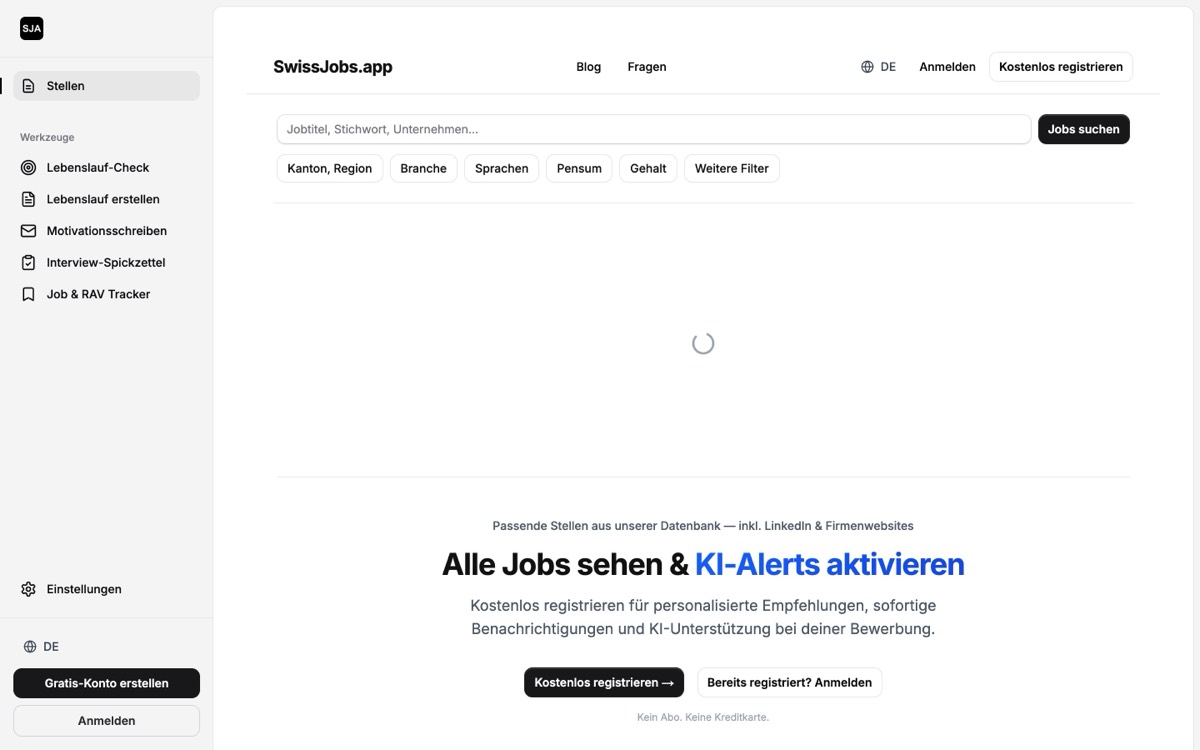
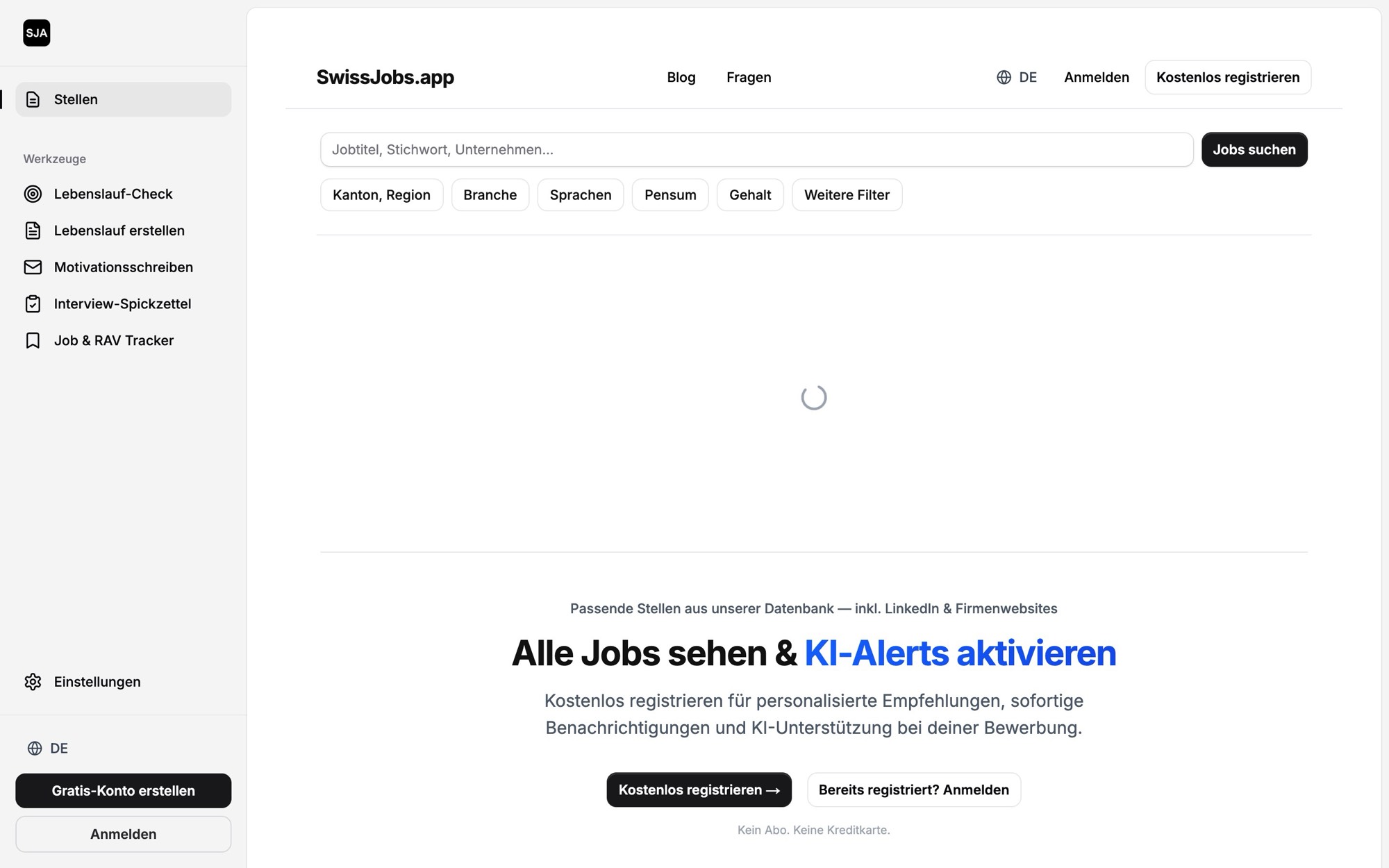
1. SwissJobs.appOur app
Over 21,000 open Swiss roles from ATS systems, company sites and LinkedIn in one place — and from any advert, straight into a CV, a motivation letter, a CV check and interview prep. The RAV job-search-efforts form fills itself from your application tracker. Free to use; the account is asked for at save.
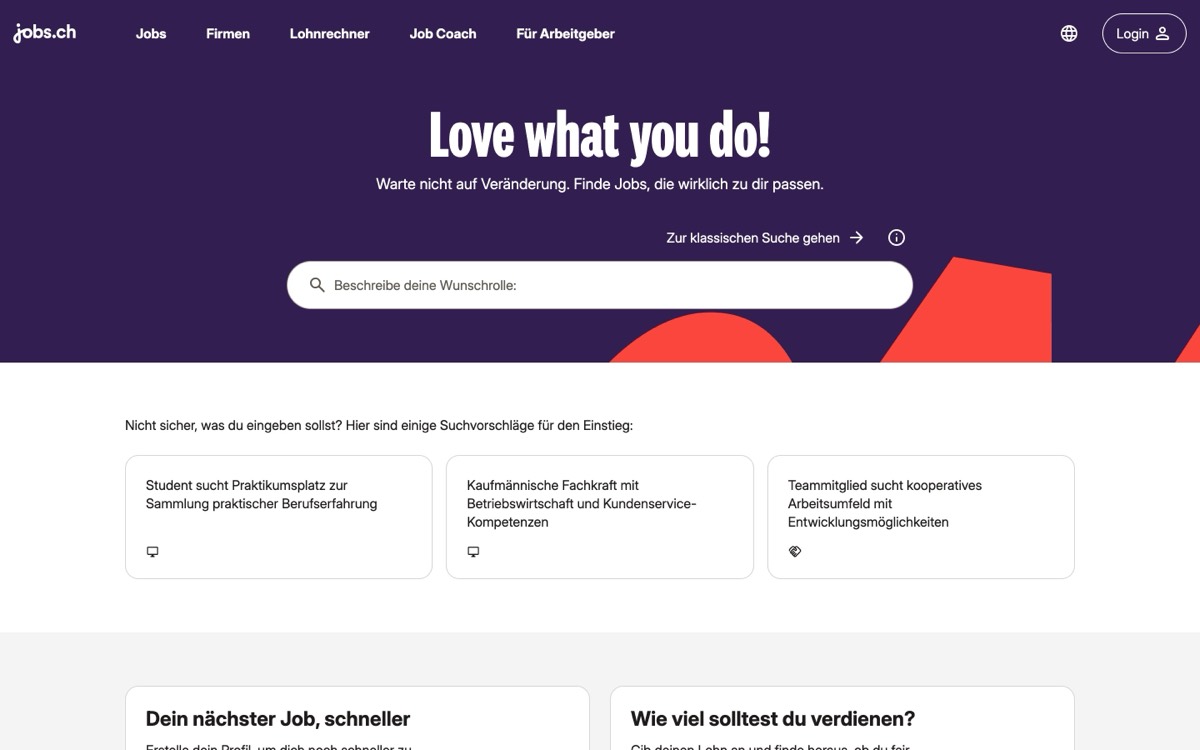
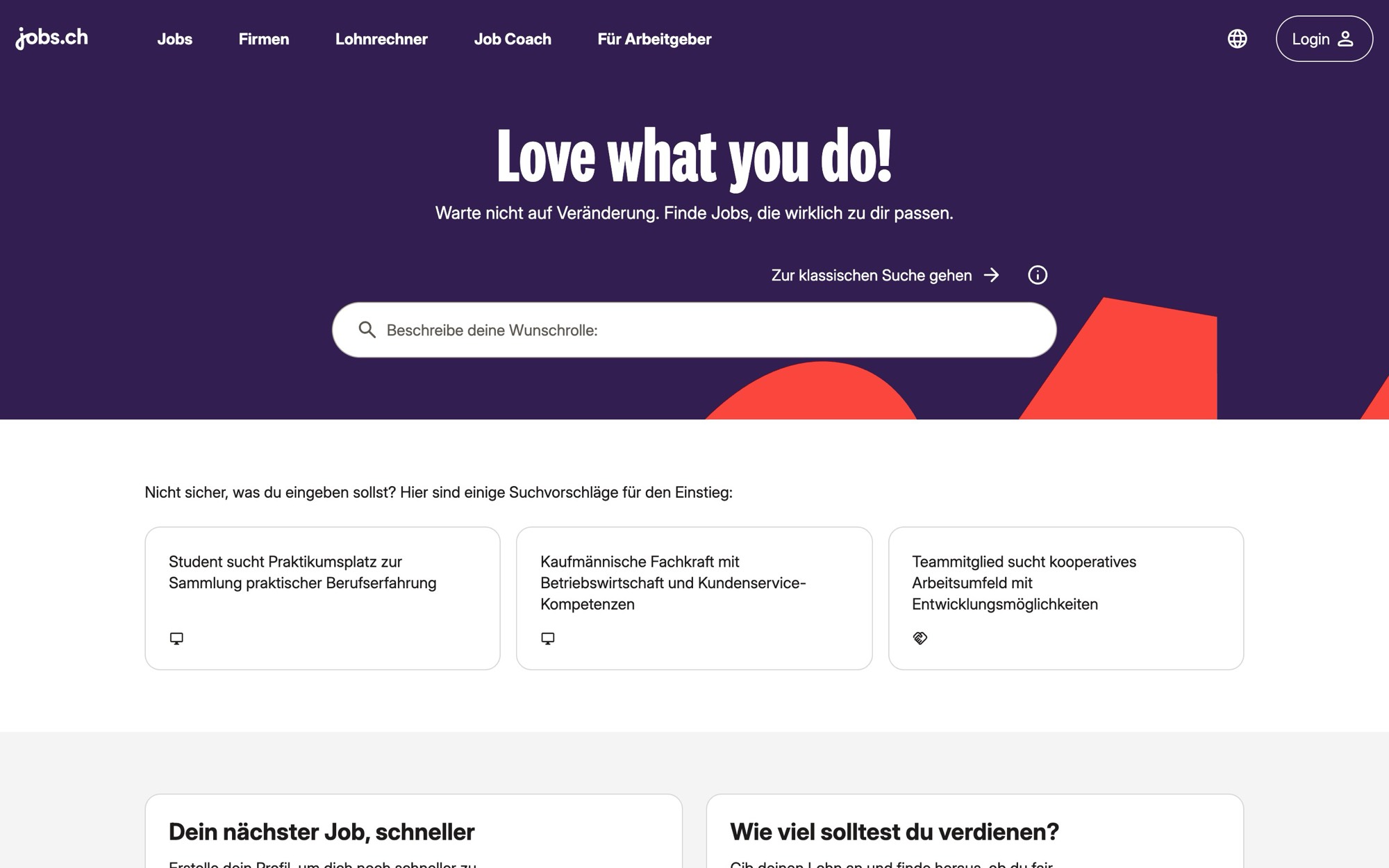
The best-known board in German-speaking Switzerland and the largest index in the country. Owned by JobCloud AG — as are jobup.ch and JobScout24.
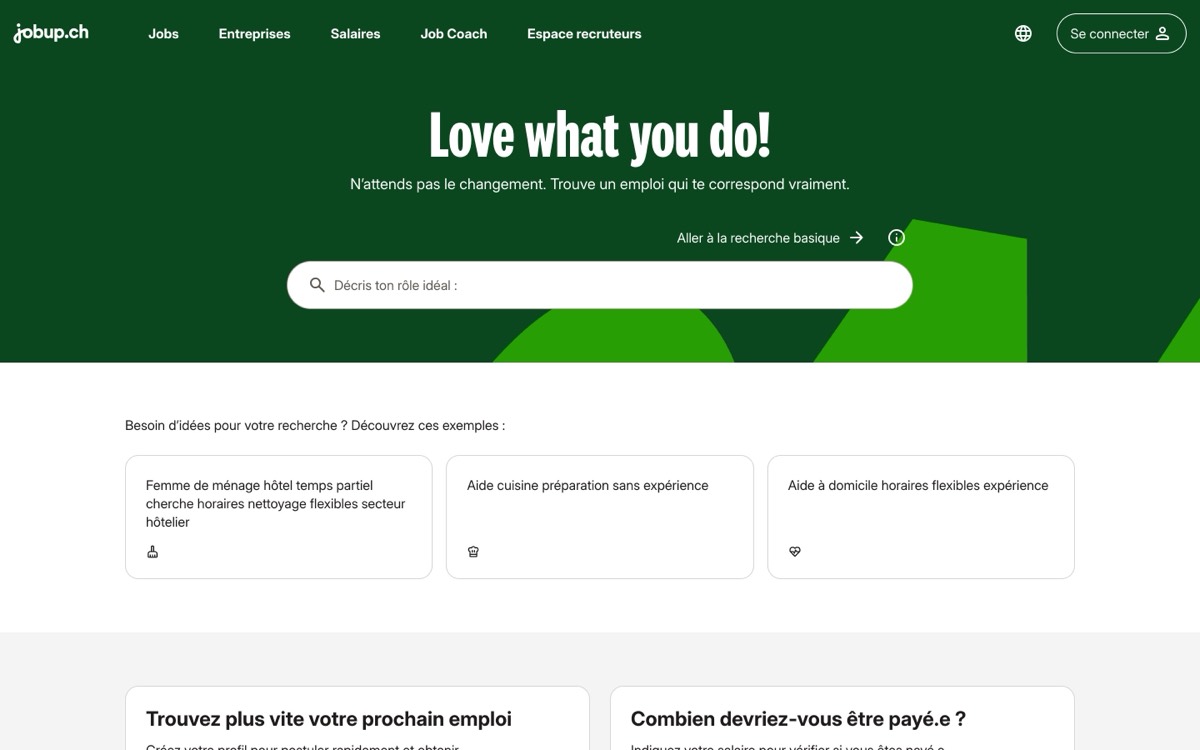
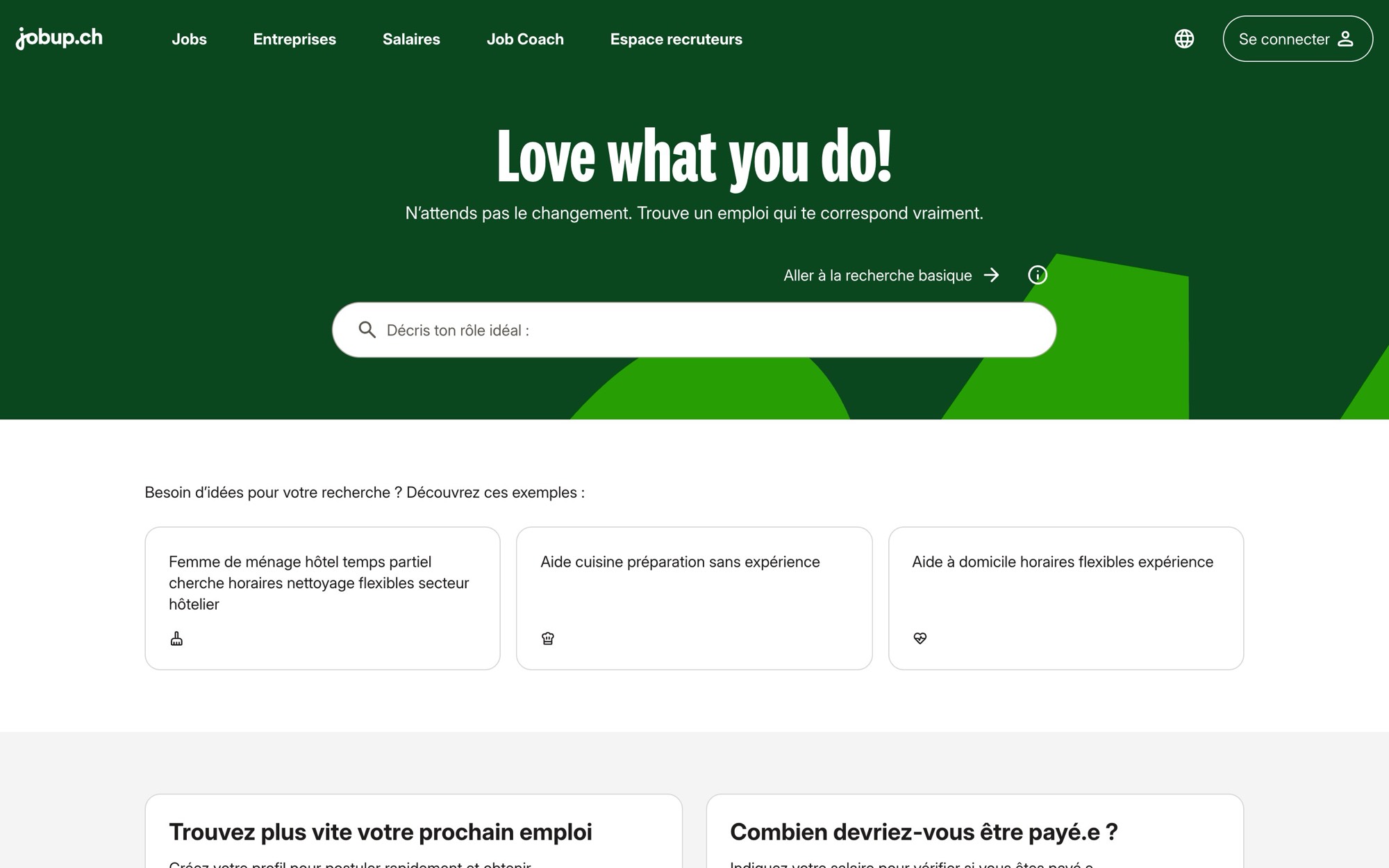
The standard in French-speaking Switzerland and the first place to look for the Romandie — but the same JobCloud AG as jobs.ch.
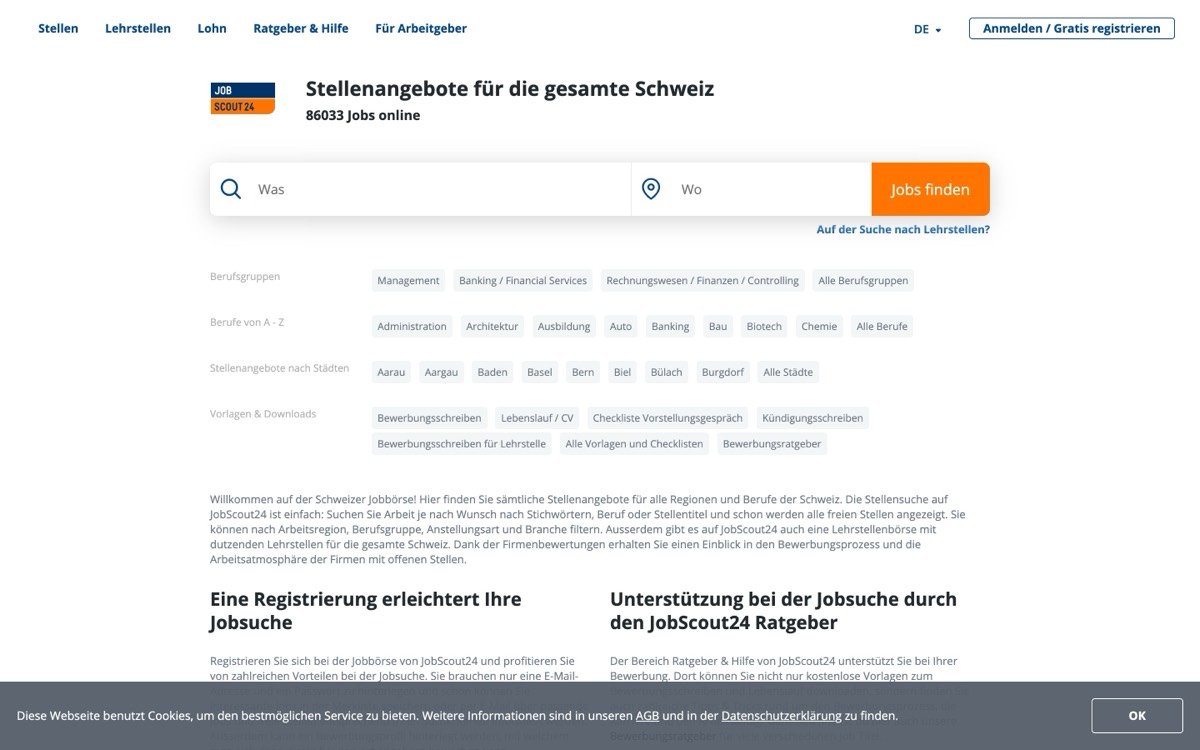
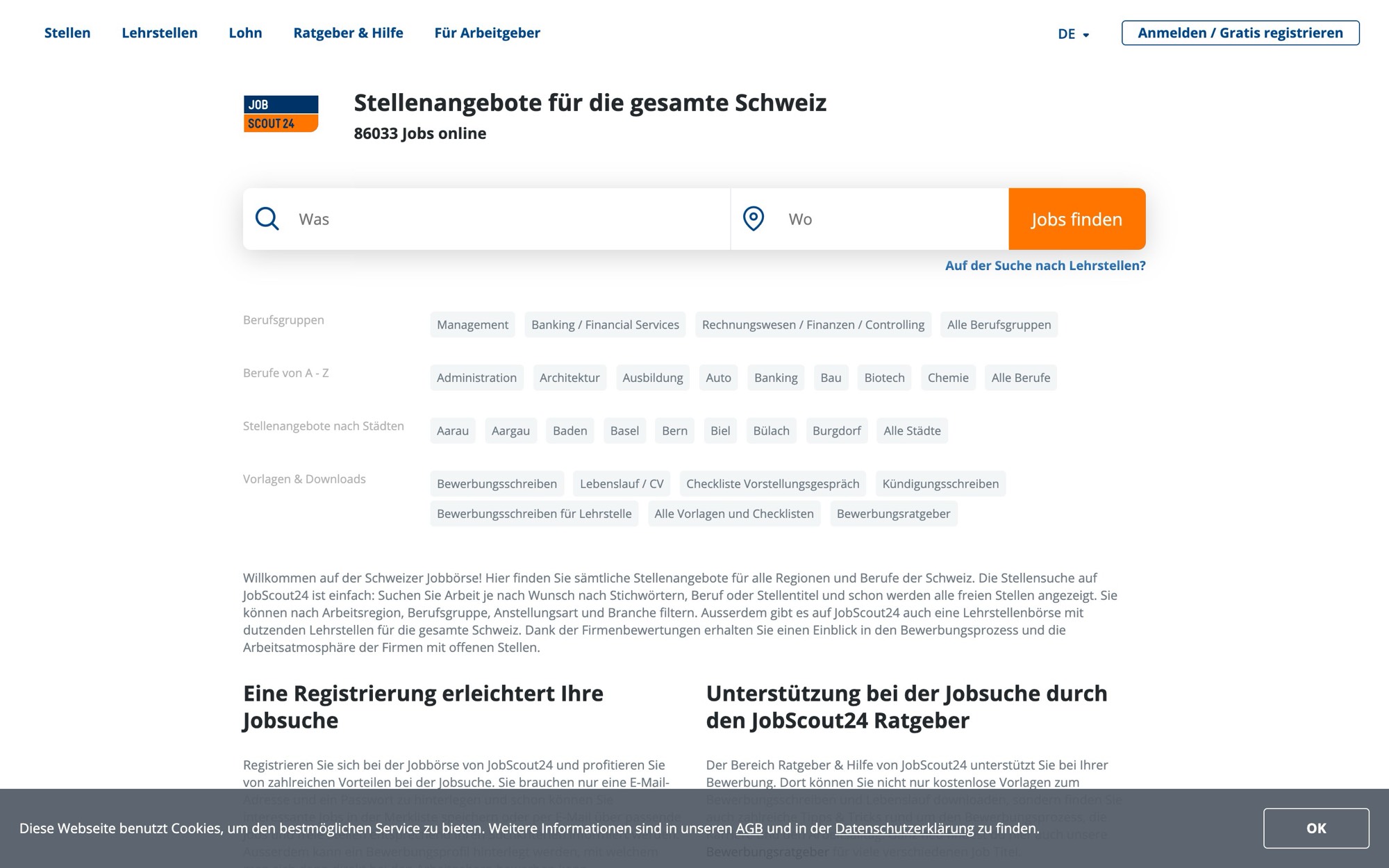
A third brand from the same company. Searching all three to widen your search means searching one provider three times.
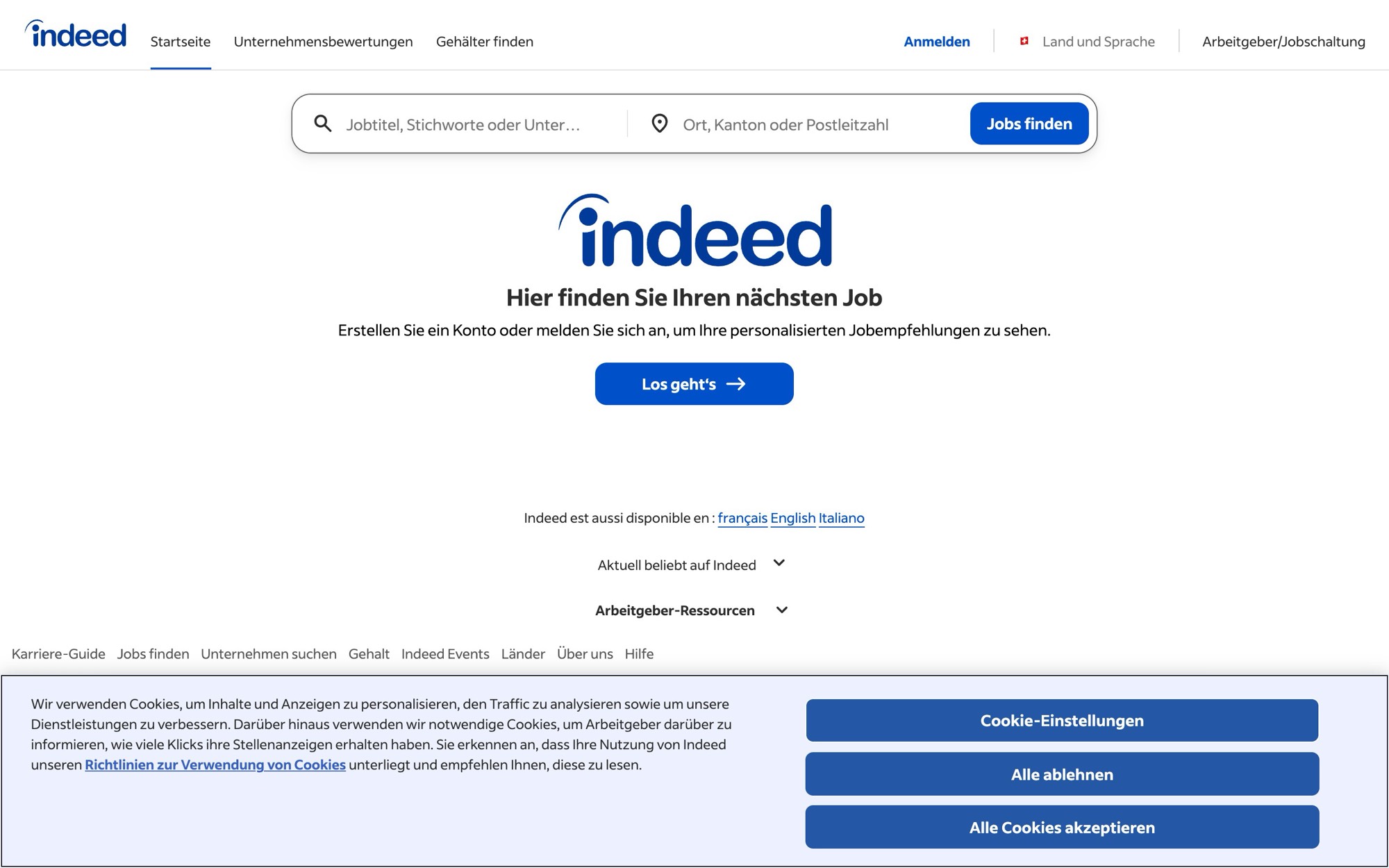
The broadest aggregation, because Indeed also collects from other boards — at the cost of many duplicates of the same advert.
The best reputation for English-speaking and international roles in Switzerland. Considerably thinner for trades, care and commercial roles.
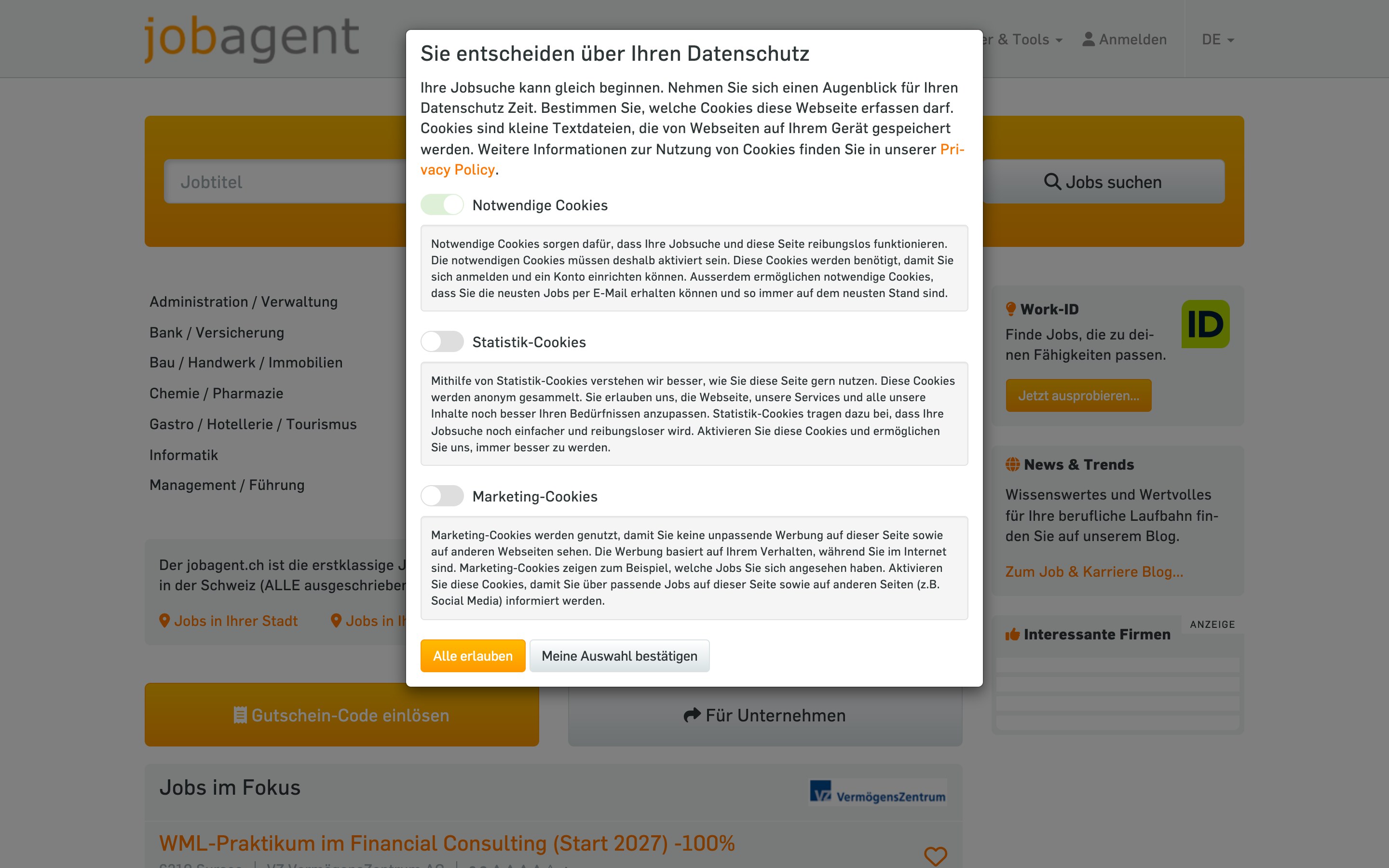
A meta-search across the Swiss job boards, "every job in Switzerland at a glance". Its strength is the Job-Abo: a saved search that mails you new adverts from every portal it covers. Salary calculator and application guides alongside.
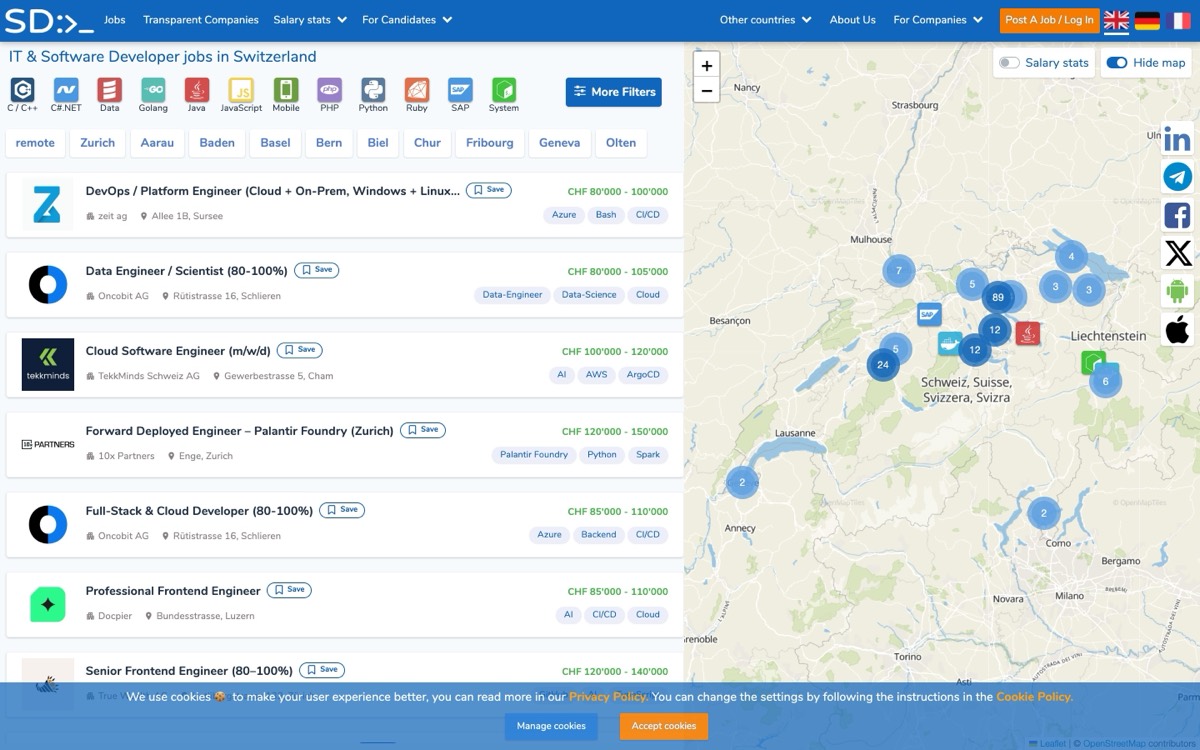
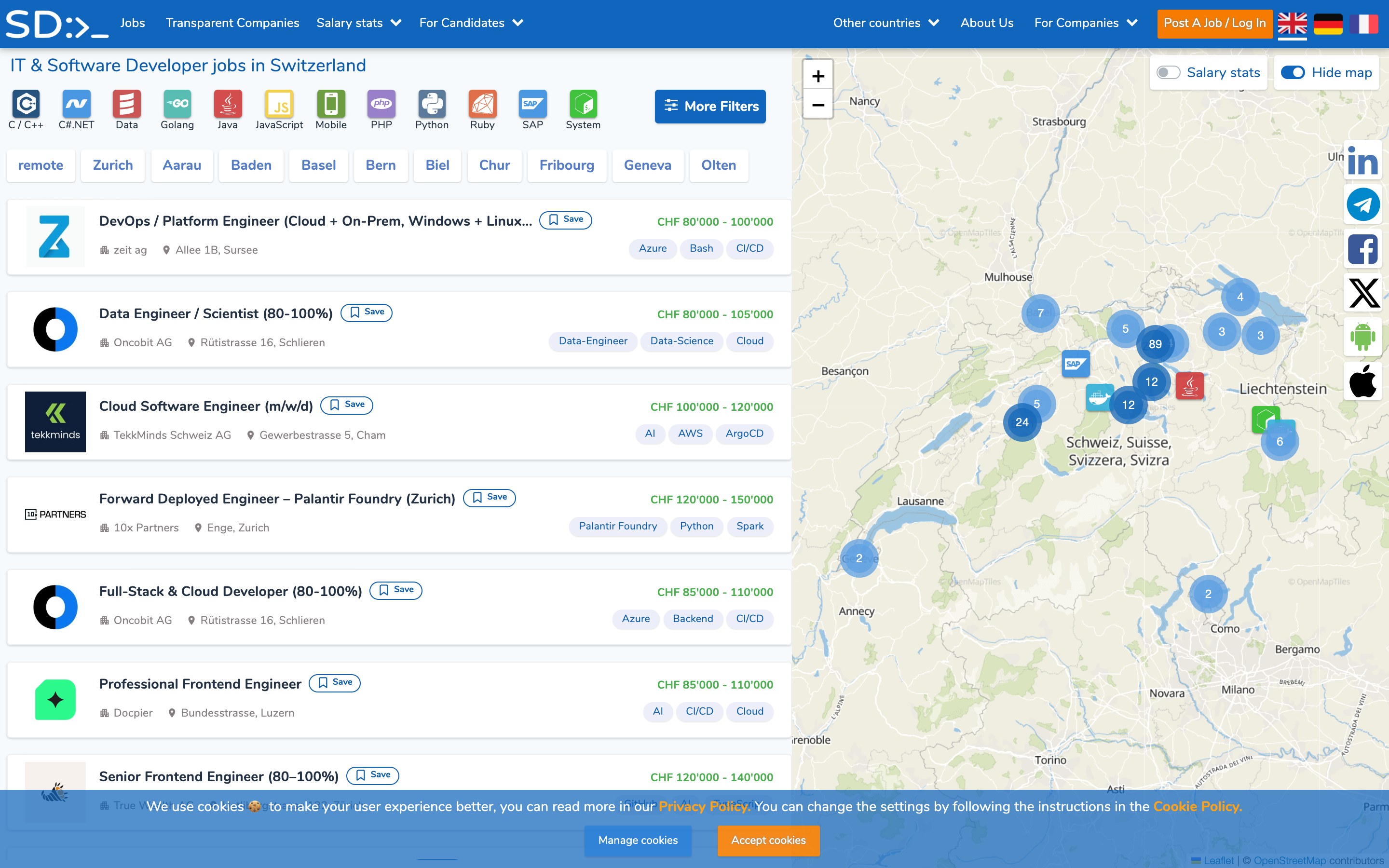
IT and software only, and thorough about it: "183 IT & Software developer jobs in Switzerland", filtered by technology (C#, Java, Python, DevOps, ML) rather than by industry. Publishes salary statistics and lists the companies that disclose their ranges. The site itself is in English.
Jobs by profession, city or language
Type a profession, a city or a language, the page shows the adverts currently open for it.
By profession
- Consultant
- Project Manager
- Retail Sales
- Nurse
- Nursing & Care
- Administrative Assistant
- Account Manager
- Software Engineer
- Public Administration
- Architect
- Insurance
- Chef
71 more — narrow the search
By work type
The geography is the second surprise. Only 30.2 per cent of logistics adverts sit in one of the large cities, against 45.6 per cent across the rest of the market, and 49.2 per cent sit outside the twenty most frequently named places, against 39.4 per cent. The towns that carry far more logistics adverts than their share of the market are not centres at all: Schafisheim and Othmarsingen in Aargau, Niederbipp on the cantonal border, Winkeln outside St Gallen, Dielsdorf north of Zurich, and Balerna in Ticino, where the air and sea freight desks sit within sight of the Italian border.
And a third of what the word returns is not a job. Of every recorded open advert with "logistics", "Logistiker", "logisticien" or "logistica" in the title, 34 per cent are apprenticeship places — and of those that name a start year, none names the current one. Across the whole field, 18.1 per cent of adverts are training places against 4.1 per cent in the rest of the market.
Share of adverts with an identifiable English posting language, by sub-field of logistics. Rolling analysis of the open Swiss vacancies we record, August 2026.
- The field splits into five parts: warehouse and order picking at 19.3 per cent, supply chain and planning at 14.1, road transport and delivery at 13.8, freight forwarding and customs at 8.3, and dispatch at 6 per cent. The remainder says only "logistics" in the title and nothing more.
- 19.8 per cent of logistics titles carry a Swiss qualification abbreviation — EFZ, CFC, AFC, EBA — against 5.8 per cent in the rest of the market. Those letters narrow a search sharply, and they narrow it towards apprenticeships unless you also exclude the words for apprenticeship in the local language.
- 10.3 per cent of logistics adverts name a driving licence against 1.2 per cent elsewhere. Inside road transport it is 58.2 per cent, and 38.2 per cent put the category straight into the job title — "Chauffeur:in Kat. CE" is a search term in this field, not a job description.
- Only 1.5 per cent of logistics adverts carry the name of an agency or staffing firm, against 11.9 per cent in the rest of the market. What you see is almost always the employer, which also means the address a speculative application should go to.
- 85.7 per cent of logistics adverts are full-time and just 1.8 per cent part-time, against 5.5 per cent elsewhere. If you need less than a full week here, search for evening, night and weekend shifts rather than for a percentage.
- Freight forwarding sits at the customs post: 39.4 per cent of the forwarding and customs adverts we record are in Basel, Balerna or Schaffhausen — three border crossings. In that sub-field you are not searching a canton, you are searching a national border.
- The median logistics advert we hold is 21 days old against 19 for the rest of the market. In a field with steady turnover, an older advert usually means a role that is refilled repeatedly rather than one already taken.
Decide which half you are in before you type anything
At one end of this field is the operational floor: warehouse work, order picking, goods-in and goods-out, loading, driving, delivery, dispatch. At the other end is planning: supply chain manager, demand planner, logistics analyst, procurement lead. Both call themselves logistics. They do not share employers, locations, entry requirements or language.
The language gap is the cleanest way to see it. English appears in 61.7 per cent of supply chain and planning adverts, 26.7 per cent of freight forwarding, 12.1 per cent of warehouse adverts, and in none at all in transport, delivery or dispatch. Taken as a whole the field is more German than the market — 76.4 per cent of adverts that state a language requirement ask for German, against 68.2 per cent elsewhere, and only 31.9 per cent ask for English, against 41.3 per cent. The English-speaking part of logistics is real, but it is the planning end, and it is smaller than the field as a whole.
So pick your half and search in its vocabulary. For the floor, the words that actually appear in titles are Lagerist, Lagermitarbeiter, Kommissionierer, Staplerfahrer, Wareneingang, Verlad and Chauffeur in German, magasinier, cariste and préparateur de commandes in French, magazziniere in Italian. For planning, they are supply chain, planner, demand, forecasting, procurement and S&OP, and those you can search in English. A single query meant to cover both mostly returns what sits between them: adverts that say nothing but "Logistik".
The openings are at the distribution centre, not in the city
Logistics is the least city-bound part of the Swiss market we measure. Fewer than a third of its adverts sit in a major city, and nearly half sit outside the twenty most commonly named places. The field spreads across more distinct locations than an equally sized sample of the rest of the market does, even though it holds far fewer adverts in total.
The reason is unglamorous and decisive for a search: a distribution centre is built where the motorway arrives and the land is affordable. Schafisheim, Othmarsingen, Niederbipp, Dielsdorf, Möhlin, Winkeln, Landquart — these are place names that carry a multiple of their usual market share in our logistics data. Type "Zurich" into a search box and you miss the Furttal and the Unterland. Type "Aarau" and you miss the two largest logistics sites in Aargau.
Search the catchment area instead of the city, and add the corridor towns along your own axis. Then check, before you apply, how you would reach the site at five in the morning: a warehouse twenty minutes away by car can be an hour away on the first bus, and shift work is what this field mostly offers.
A third of the hits are next summer’s apprenticeships
This is the expensive trap of the field. Adverts reading "Lehrstelle als Logistiker:in EFZ", "Apprenti/-e logisticien/-ne CFC" or "Apprendista impiegato/-a in logistica AFC" make up 34 per cent of everything with a logistics word in the title. They are not mistakes; they are simply addressed to somebody else, and they run on a different calendar. None of the ones that name a start year names the current one.
Two moves fix it. Exclude the local words for apprenticeship — Lehrstelle, Lehre, Ausbildung, apprenti, apprendista — and your result list drops by about a third, to the vacancies that are actually vacancies. And treat the qualification abbreviations with care: EFZ, CFC and AFC do appear in real job titles here, but they appear in training adverts far more often.
If you do want the training route, the federal apprenticeship is Logisticien/ne CFC — Logistiker/in EFZ in German — which runs three years and has two orientations, distribution and storage. The entry requirement is completed compulsory schooling, with an aptitude test at some employers. There is also a two-year federal certificate, Logistiker/in EBA, from which the career-guidance service says a shortened route to the full qualification is normally open. Road transport has its own three-year qualification, and our data holds training places for it too, all starting next summer.
The certificate is the real gate
Nowhere else in the market does access depend so directly on a piece of paper. One advert in ten in this field names a driving licence, and inside road transport almost three in five do. Forklift certification is named in 2.5 per cent of logistics adverts and 6.5 per cent of warehouse adverts — against almost nothing elsewhere.
For trucks the rule is federal and explicit. Under the Swiss ordinance on the admission of drivers to the carriage of goods and passengers, anyone carrying goods commercially with a category C or C1 vehicle needs the certificate of professional competence for goods transport. It is valid for five years and is only renewed on proof of 35 hours of further training at a recognised centre. The ordinance does list exceptions — non-commercial journeys, vehicles limited to 45 km/h, police, fire and rescue services, and the one most likely to apply to you: carrying material, equipment or machinery you use in your own trade, provided driving takes up at most half your working time in an average week.
Very few adverts mention any of this. The licence category is in the title; the recurring 35 hours are not. Ask who pays for the courses and whether they count as working time, because it is a standing cost, not a one-off. For forklifts, Suva sets out the requirements: category R needs a basic course plus instruction at the workplace and a minimum age of 18, category S needs instruction at the workplace from a designated specialist from age 15, and a completed course produces a training record. Someone trained only in-house can sit the examination at a training centre to get that record.
Two of these occupations reach registered jobseekers first
There is one channel in this field where vacancies appear earlier than anywhere else, and it costs nothing. The federal list of occupations subject to the vacancy-notification duty this year includes forklift drivers and related occupations, with an unemployment rate of 7.2 per cent, and the broad group of unskilled workers — including those in transport — at 13.5 per cent, the largest single group on the list.
What that means is set out by arbeit.swiss: employers must report vacancies in occupations with a nationwide unemployment rate of at least 5 per cent to the regional employment centre, and the position may only be advertised elsewhere five working days after it is published in the protected area of the Job-Room portal. Anyone registered with a regional employment centre therefore sees these roles a working week before everybody else.
If your way in is the warehouse, the forklift or general transport work, the protected area belongs in your daily round — not instead of the other channels, but ahead of them. And if you see the same role again elsewhere five days later, that is not a second employer. It is the same vacancy in its second week.
Shift work, night work, and what the law attaches to it
Logistics is one of the few fields where working time is stated in the job title itself: night logistician, order picking on the evening shift, team lead on permanent nights. Titles like these appear more than twice as often in our logistics data as in the rest of the market, where night work shows up mainly in hospitals and hospitality. That is a search advantage — if you want evenings or nights, you can search for the shift word directly and find something.
Before you accept, look at the rule behind it. SECO defines the night period as 23.00 to 06.00, which a business may shift by at most one hour. Anyone working nights temporarily is entitled to a wage supplement of 25 per cent for the hours worked at night. Anyone working nights permanently or regularly — which SECO defines as 25 or more nights in a calendar year — receives a time supplement of 10 per cent instead: time off, not money.
The difference is large enough to be worth a question, and adverts almost never state it. Ask how many nights a year are planned, whether the supplement comes as time or as pay, and how it is written into the contract. Professional drivers sit outside this framework altogether: their driving times, breaks and rest periods are governed by the separate federal drivers’ ordinance rather than by the Labour Act.
A search plan that fits this market
Choose one end of the field and use its vocabulary rather than the word "logistics". Exclude apprenticeship adverts, or a third of your hits will be for a course starting next summer. Search by region rather than by city, and add the distribution towns along your axis. If you fall into one of the notifiable occupations, register with the regional employment centre and check the protected area daily.
Apply directly. Barely more than one advert in a hundred here carries an agency name, and the ten largest senders together account for 26.9 per cent of the field. That is enough concentration to justify following two dozen career pages — the large retailers, the federal administration, the forwarders, the beverage and food distributors — and too little to rely on them alone: the field spreads across more than two hundred distinct senders.
Finally, be relaxed about dates. The typical logistics advert here is a few days older than the market average, and in a field with this much turnover, age rarely means the role is gone. A three-week-old warehouse advert is worth an application, and a short call to the site to ask whether they are still hiring is worth more than either.
Shares come from the rolling analysis of the open Swiss vacancies we record, August 2026. An advert counts as logistics when its title names work in warehousing and order picking, road transport and delivery, freight forwarding and customs clearance, dispatch and transport control, or supply chain planning, in the four national languages and in English; titles carrying the same words but clearly belonging to passenger transport, vehicle workshops, emergency services or driving schools are excluded. Language shares refer to adverts with an identifiable posting language, and statements about advert text to those with a usable summary. The agency share rests on a hand-checked list of senders. Legal statements come from the official sources linked below rather than from our data, and are given in the language in which we read them; the competent authority is always the binding source.
Sources
- Ordinance on the admission of drivers to passenger and goods transport (CZV), SR 741.521
- Suva — training requirements for forklift drivers, categories R and S
- SECO — list of occupation types subject to the vacancy-notification duty in 2026
- arbeit.swiss — FAQ on the vacancy-notification duty (five working days)
- SECO — night and Sunday work: wage and time supplements
- orientation.ch — Logisticien/ne CFC: apprenticeship, duration and orientations
- SECO — Labour Act or drivers’ ordinance: which applies to professional drivers
Related questions
What our job index says about the Swiss market
Computed live from our own index, not quoted from a study. Shares only, as of today.
Language the advert is written in
- Deutsch
- 60%
- English
- 23%
- Français
- 13%
- Italiano
- 3%
Of adverts that state a language requirement, the share asking for
- Deutsch
- 70%
- English
- 43%
- Français
- 21%
- Italiano
- 3%
19% posted in the last 7 days · Largest markets: Zürich 18% · Bern 10% · Genève 5% · Basel 5%