Where do I find nursing jobs in Switzerland — and why does so much of the market sit with about two dozen employers?
Updated:
In short
Nursing vacancies are unusually concentrated. Roughly 4.5 per cent of the open Swiss adverts we track are nursing or care roles, but the ten largest advertisers carry 44.9 per cent of them and the twenty-five largest carry 69.4 per cent. Measured on equally sized samples of the rest of the market, the same figures are 22.3 and 30.2 per cent. Follow the career pages of two or three dozen hospitals, clinics, care homes and home-care organisations in your region and you have already seen two thirds of what exists.
The Swiss job portals at a glance
Click an image for the full-size view. What each portal actually is stands beside it.
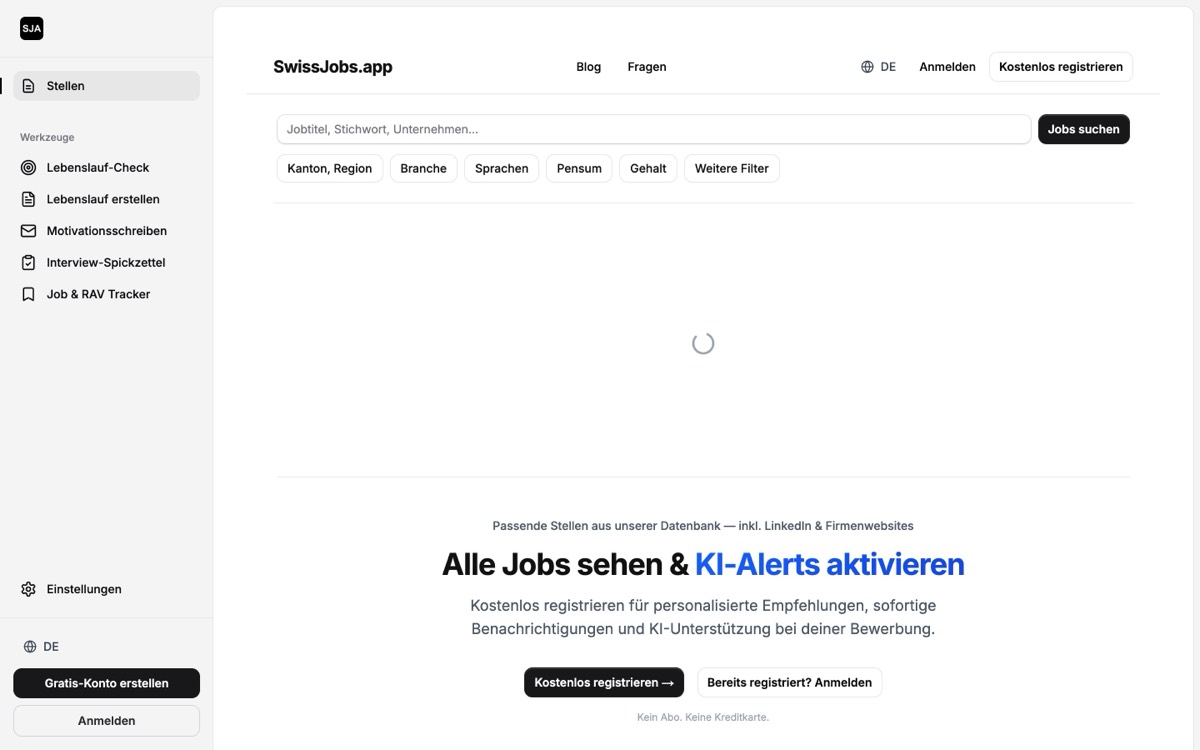
1. SwissJobs.appOur app
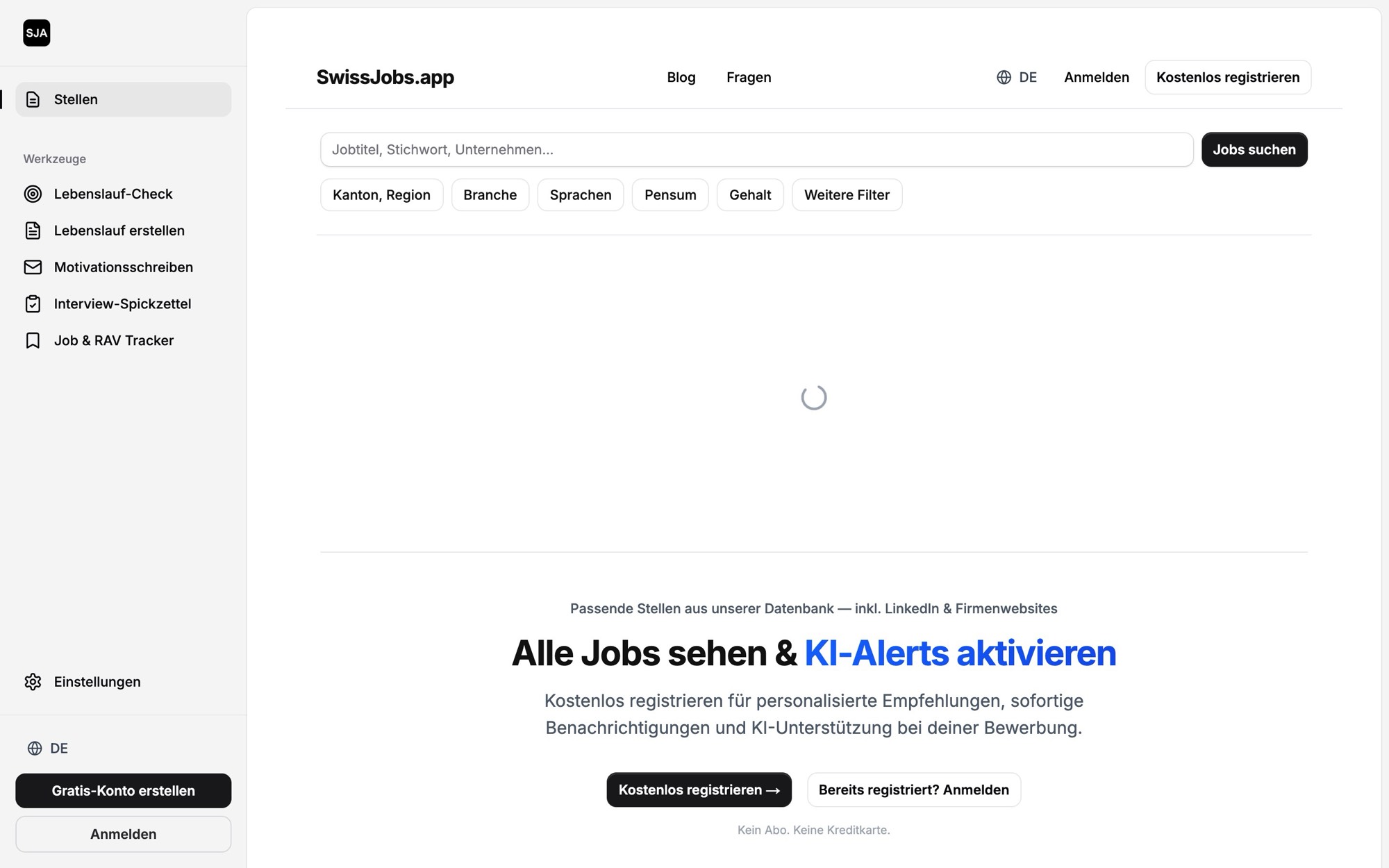
Over 21,000 open Swiss roles from ATS systems, company sites and LinkedIn in one place — and from any advert, straight into a CV, a motivation letter, a CV check and interview prep. The RAV job-search-efforts form fills itself from your application tracker. Free to use; the account is asked for at save.
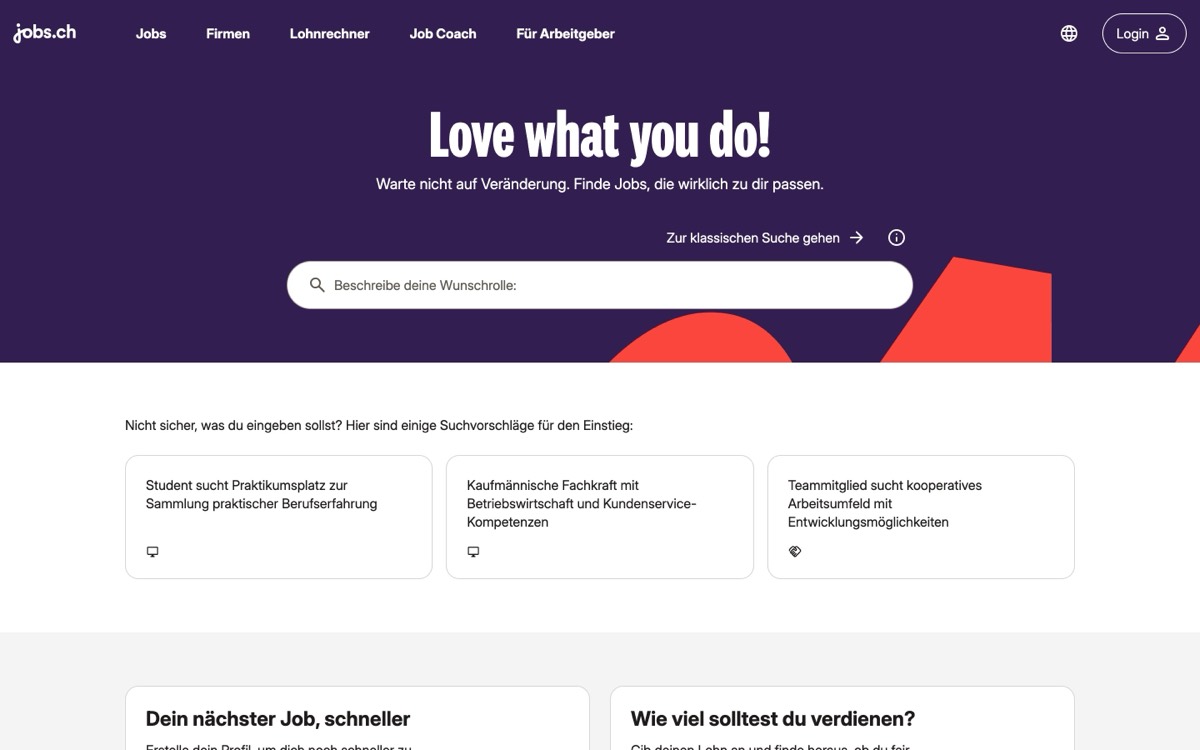
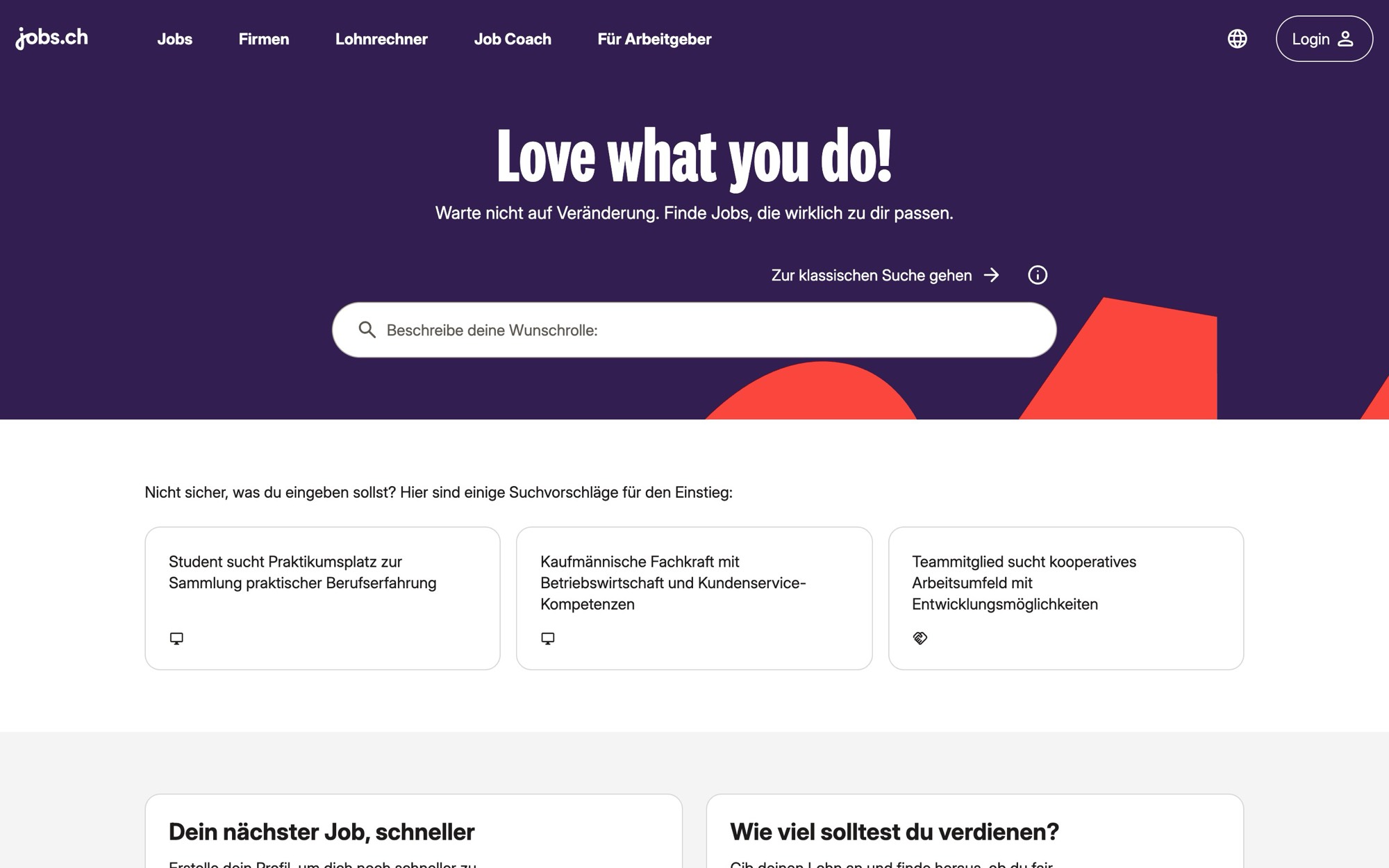
The best-known board in German-speaking Switzerland and the largest index in the country. Owned by JobCloud AG — as are jobup.ch and JobScout24.
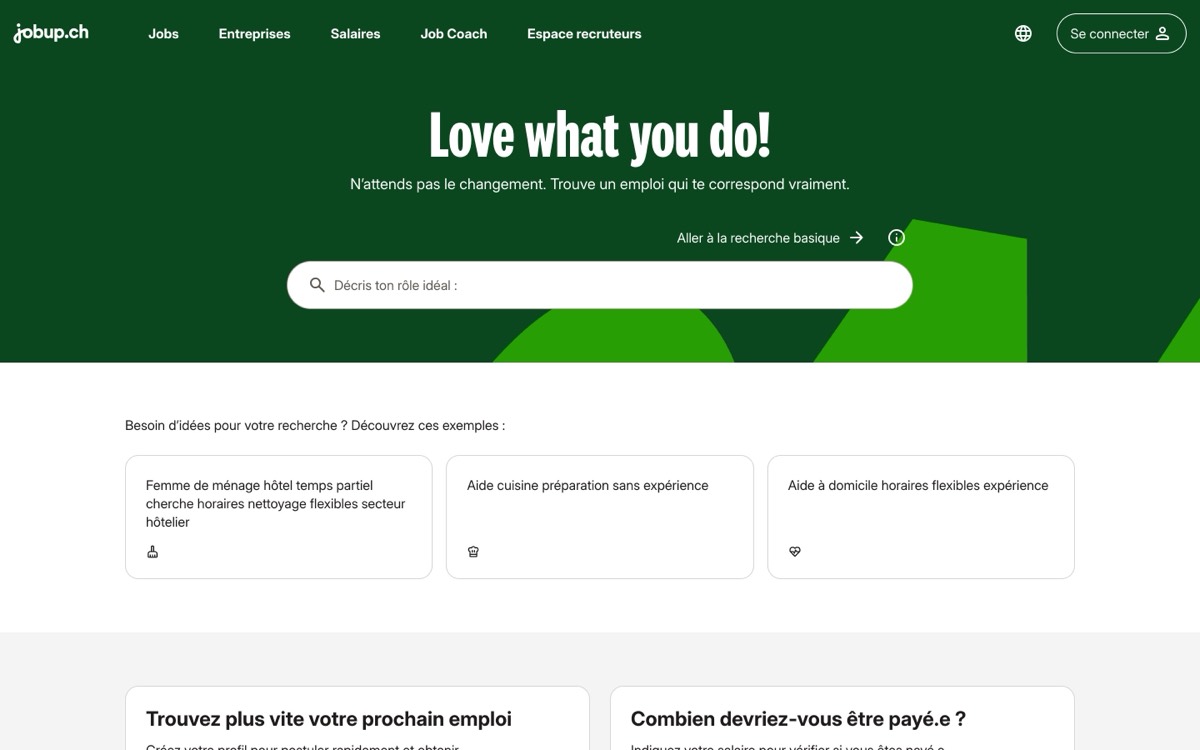
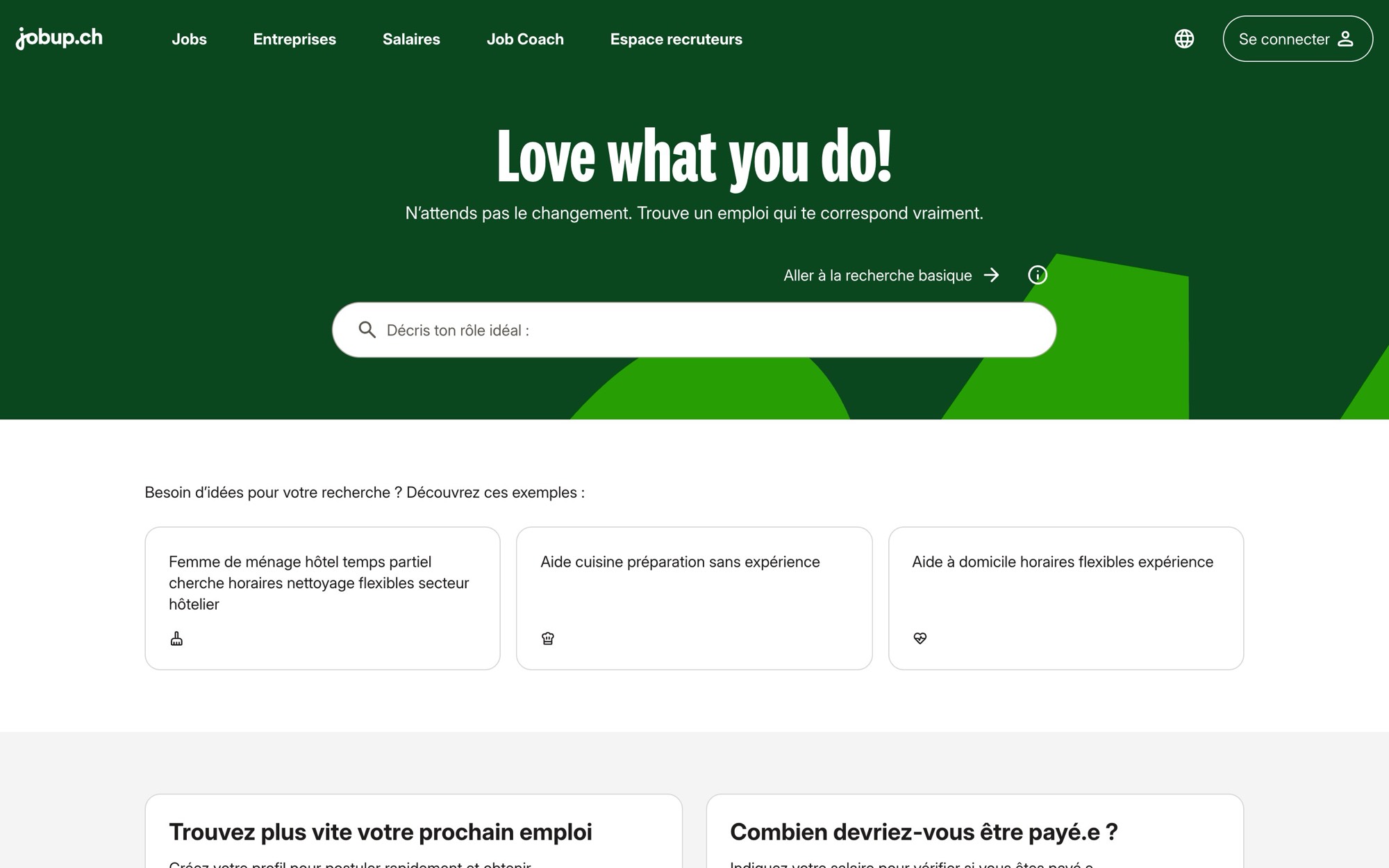
The standard in French-speaking Switzerland and the first place to look for the Romandie — but the same JobCloud AG as jobs.ch.
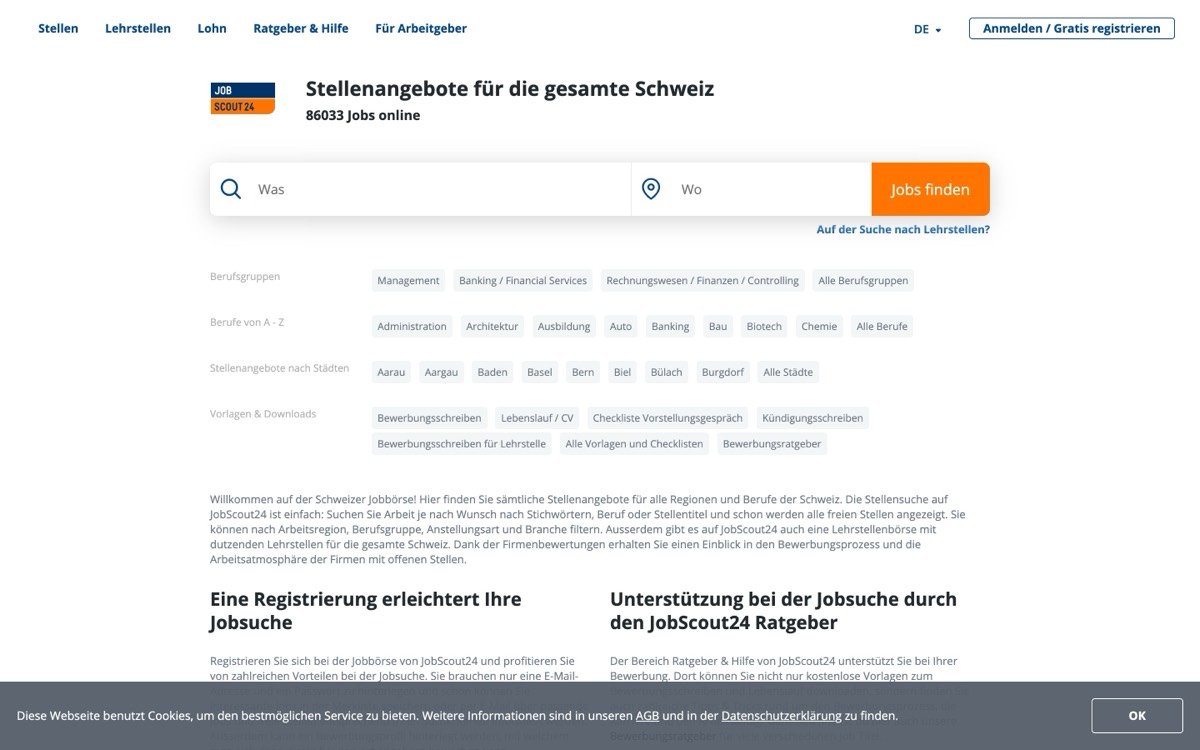
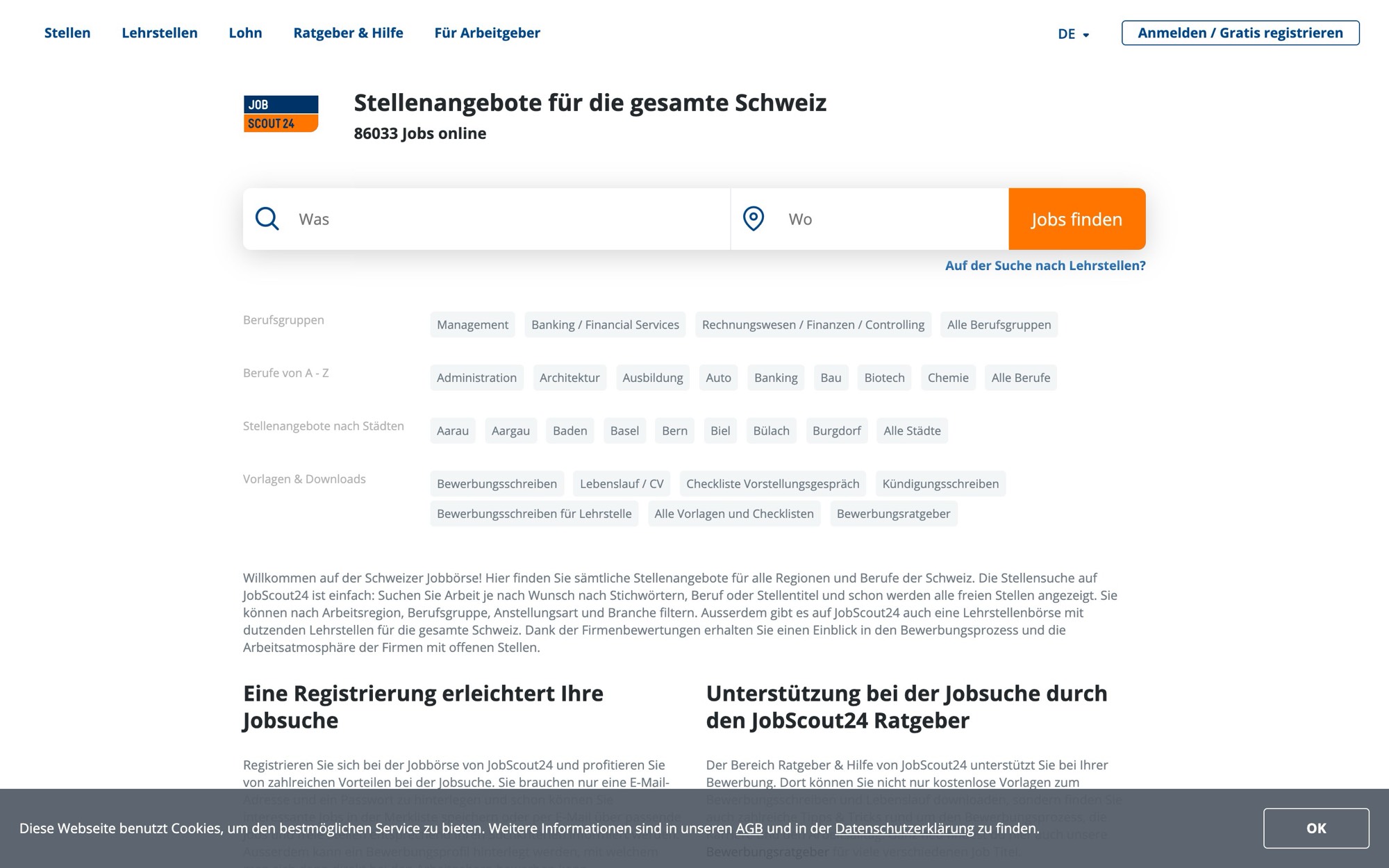
A third brand from the same company. Searching all three to widen your search means searching one provider three times.
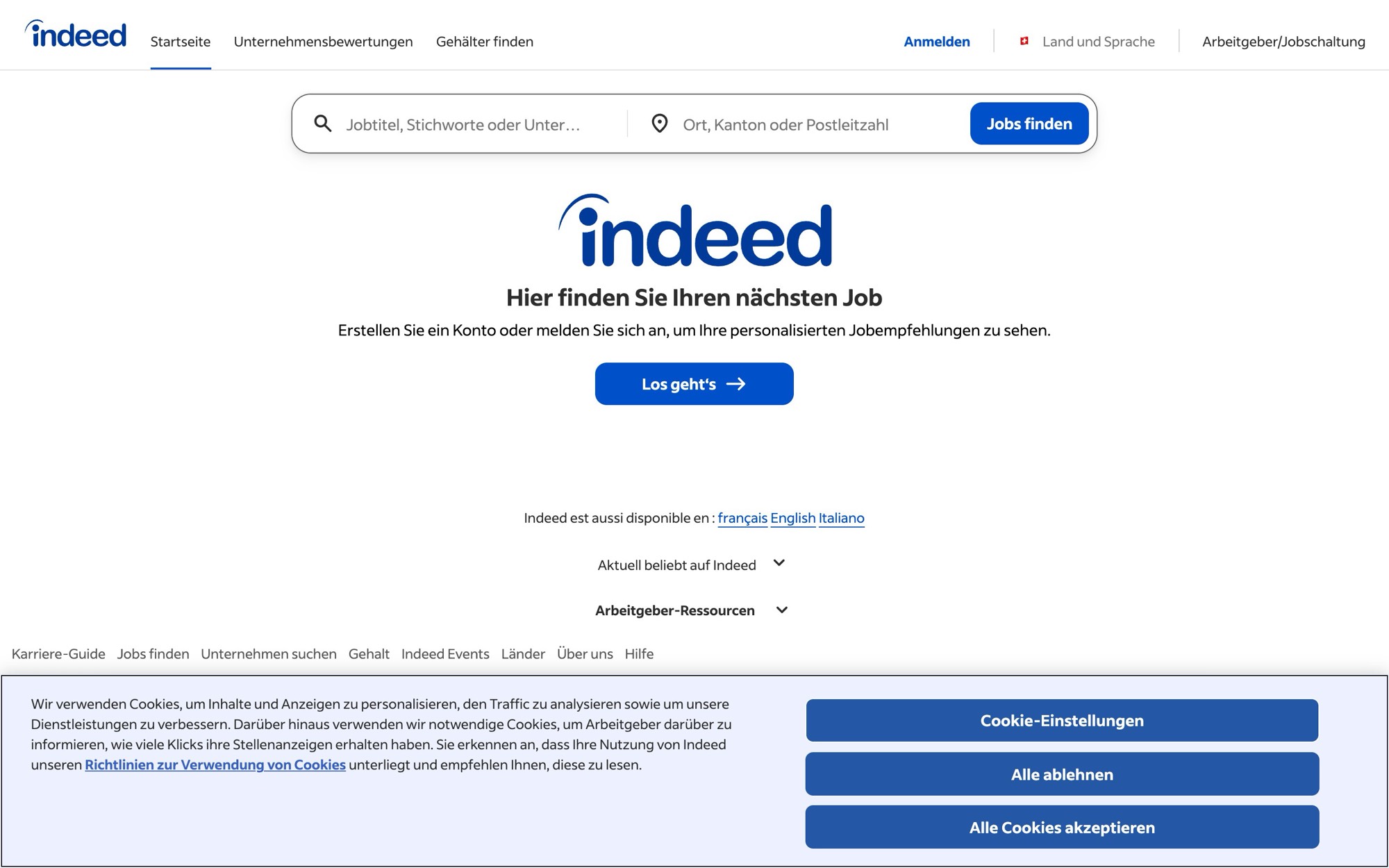
The broadest aggregation, because Indeed also collects from other boards — at the cost of many duplicates of the same advert.
The best reputation for English-speaking and international roles in Switzerland. Considerably thinner for trades, care and commercial roles.
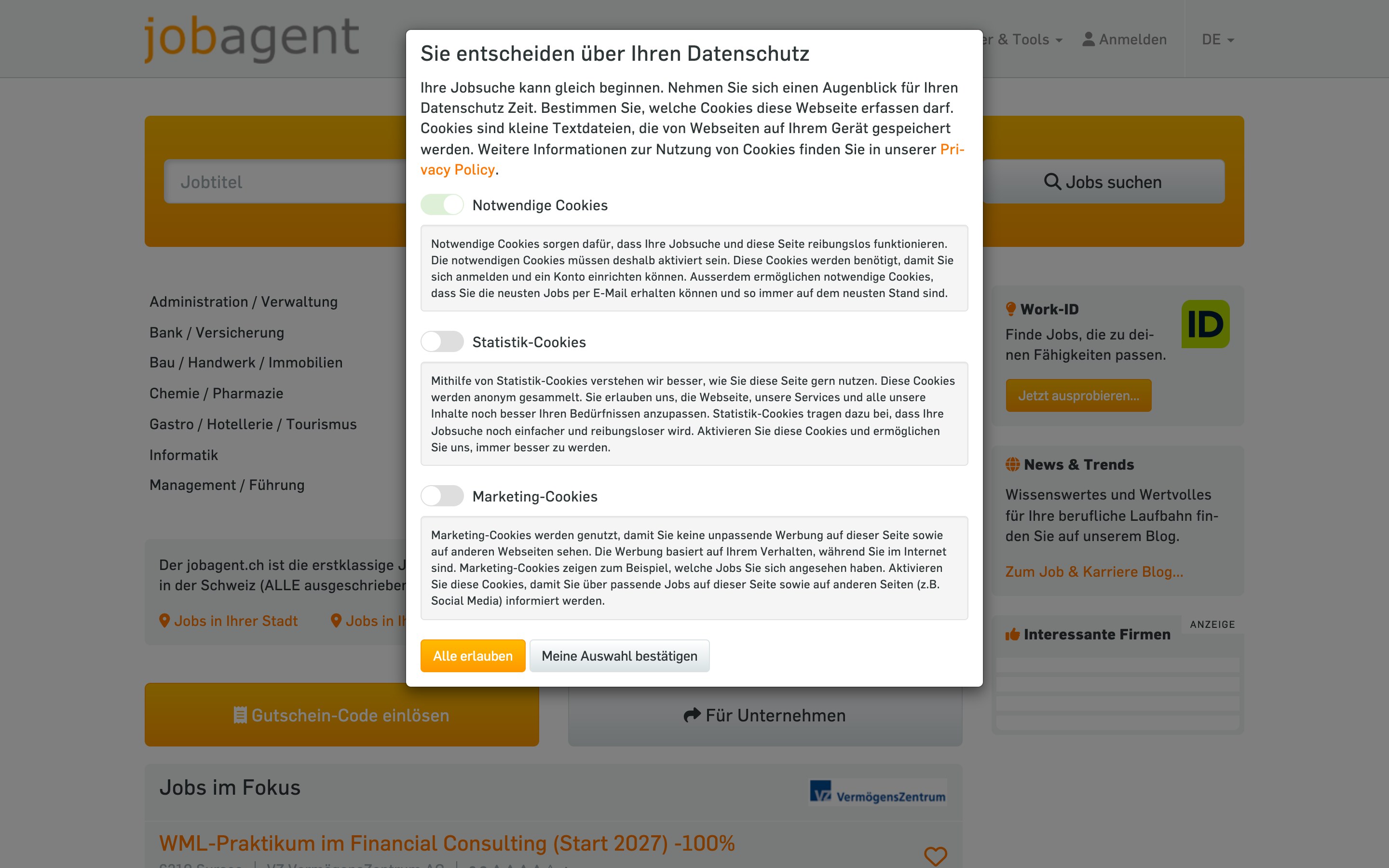
A meta-search across the Swiss job boards, "every job in Switzerland at a glance". Its strength is the Job-Abo: a saved search that mails you new adverts from every portal it covers. Salary calculator and application guides alongside.
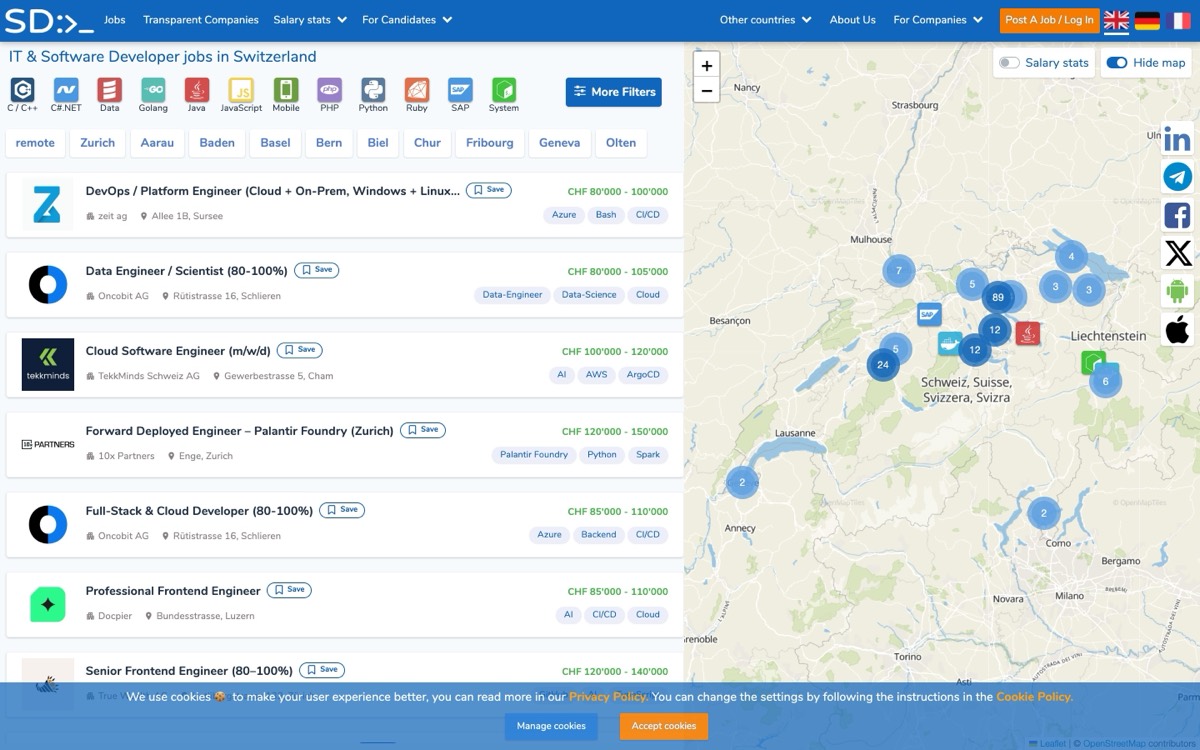
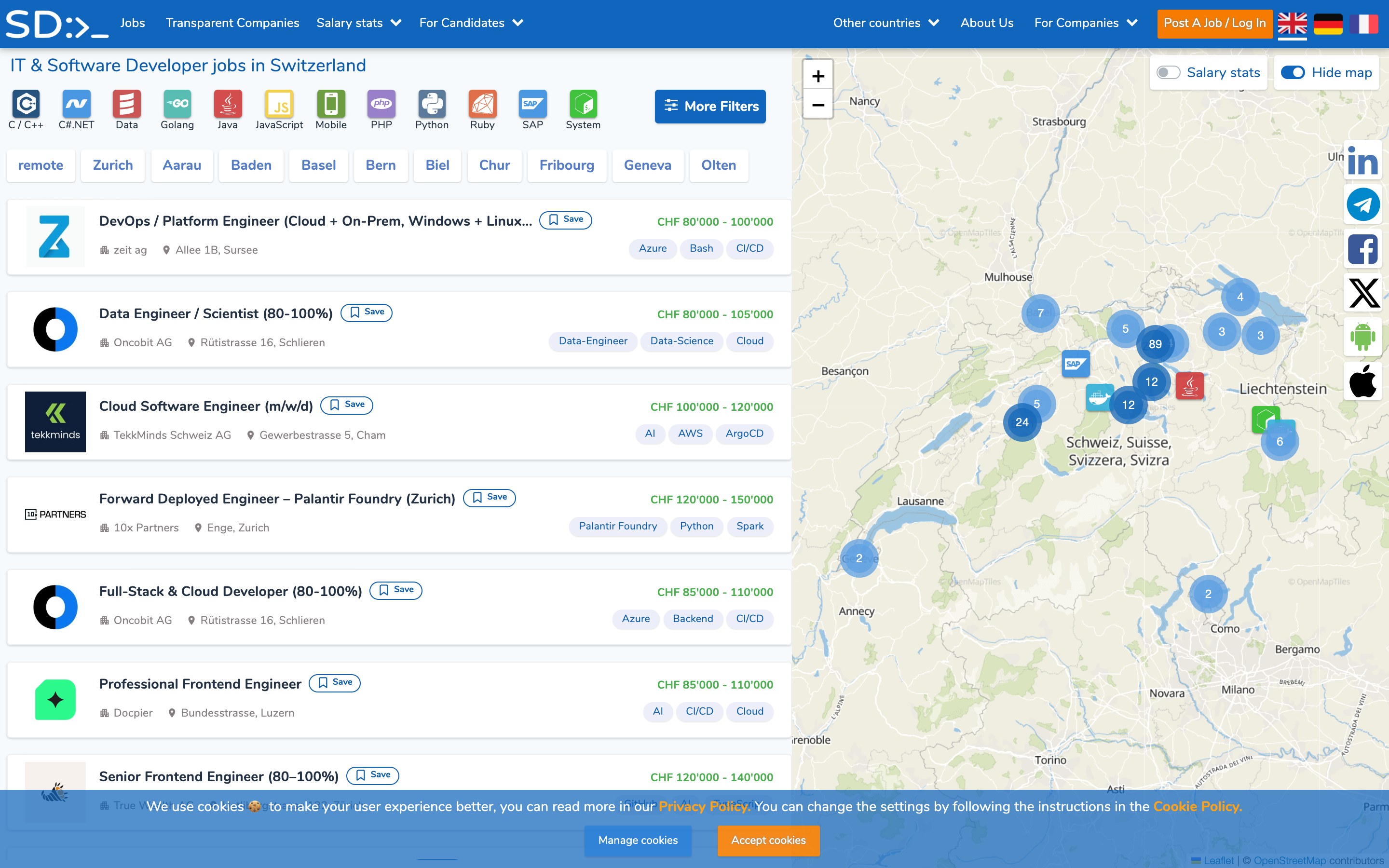
IT and software only, and thorough about it: "183 IT & Software developer jobs in Switzerland", filtered by technology (C#, Java, Python, DevOps, ML) rather than by industry. Publishes salary statistics and lists the companies that disclose their ranges. The site itself is in English.
Jobs by profession, city or language
Type a profession, a city or a language, the page shows the adverts currently open for it.
By profession
- Consultant
- Project Manager
- Retail Sales
- Nurse
- Nursing & Care
- Administrative Assistant
- Account Manager
- Software Engineer
- Public Administration
- Architect
- Insurance
- Chef
71 more — narrow the search
By work type
The second thing to know is that English will not carry you here. Only 0.7 per cent of nursing adverts are written in English, against 21.1 per cent across the rest of the market. Of the nursing adverts that state a language requirement at all, 89.8 per cent want German, and 94.1 per cent of those ask for professional or native level rather than conversational. English is asked for in 3 per cent of them, against 43 per cent elsewhere. Nursing has no English-language fallback segment.
The third is that the job title does the work. 81 per cent of nursing adverts name a qualification code, a workload percentage or a ward in the title itself, against 28.1 per cent in the rest of the market, and a nursing title averages 57 characters against 43. So the search term is not the word "nursing" — it is the abbreviation. HF appears in 31.3 per cent of nursing titles, FH in 15, EFZ in 7, FaGe in 6.3, NDS in 4.3, SRK in 4.2 and ASSC in 2.6 per cent.
Share of adverts carried by the largest advertisers. Nursing is measured against equally sized samples of the rest of the market, so sample size does not drive the gap. Rolling analysis of the open Swiss adverts we track, August 2026.
- Thirty-five employers between them account for 78.7 per cent of the nursing adverts we track; one cantonal hospital alone accounts for 10.2 per cent.
- 25.1 per cent of nursing adverts carry the name of an agency or a health-sector portal rather than the institution you would actually work in; another 8.8 per cent run under a sector recruitment campaign.
- 9.8 per cent of nursing adverts name two qualifications at once ("FaGe or registered nurse"), against 2 per cent elsewhere. Those are the most permeable adverts on the list.
- 8.4 per cent of nursing adverts are for an assistant or aide grade and 4.8 per cent name the Red Cross certificate in the title — in the rest of the market both are close to zero.
- The median nursing advert is 23 days old against 19 elsewhere, and 33 per cent are older than two months against 26.9 per cent. Old rarely means filled in this field.
- 2.6 per cent of nursing adverts are for a float pool or relief post, against 0.2 per cent elsewhere; 4.9 per cent name night or day shift in the title.
Two dozen addresses cover two thirds of the list
The number that matters here is not how big nursing is, but how it is distributed. Nursing is about 4.5 per cent of the open Swiss adverts we track — a mid-sized field. Inside that field, though, the supply sits differently from anywhere else in the market: the ten largest advertisers carry 44.9 per cent of nursing adverts and the twenty-five largest carry 69.4 per cent. Run the same measure on equally sized slices of the rest of the market and you get 22.3 and 30.2 per cent. One cantonal hospital alone accounts for 10.2 per cent of all nursing adverts.
That is the shape of the industry, not an artefact of what we collect. Care happens inside institutions, and institutions are large. In our own data the recurring names include Luzerner Kantonsspital, Insel Gruppe, Kantonsspital Winterthur, the Lindenhofgruppe, Kantonsspital Graubünden, Spitalzentrum Biel/Centre hospitalier Bienne, the Oberaargau regional hospital, the cantonal hospitals of Frauenfeld and Baden, Psychiatrie St.Gallen, the Clienia group, ZURZACH Care, Tertianum, Viva Luzern and the municipal old-age centres of Zurich. Thirty-five employers together account for 78.7 per cent of the nursing adverts we hold.
The practical consequence reverses the usual advice. In most occupations a job search is the main instrument and employer career pages are the supplement. In nursing it is the other way round: two or three dozen subscribed career pages in your region cover most of what exists, and they show it earlier, because institutions of that size publish on their own portal first. A job search is then the tool that sweeps up the remainder — the practices, the small homes, the foundations and everyone without a careers site of their own.
One caveat belongs with this. Just under a quarter of nursing adverts, 25.1 per cent, carry the name of a staffing agency or a health-sector job portal rather than the institution where the work happens, and another 8.8 per cent run under a sector-wide recruitment campaign. Together that is a third of the list where the advert alone does not tell you where you would be standing. There is nothing improper about it, but with those adverts the question of which house the post belongs to belongs before the application, not after it.
The one field where an English-only search fails
If you have come to Switzerland expecting the English-speaking corner of the market to work here as it does in IT, pharma or finance, this is the field where that expectation breaks. Only 0.7 per cent of nursing adverts are written in English, against 21.1 per cent across the rest of the market. Not a smaller segment — effectively no segment. Nor is Italian an option: our data holds no Italian-language nursing advert at all, and only 0.3 per cent of nursing adverts ask for Italian.
The stated requirements are correspondingly hard. Among nursing adverts that name a language at all, 89.8 per cent require German, against 67.2 per cent in the rest of the market, and 94.1 per cent of those German requirements are set at professional or native level rather than conversational. French appears in 15 per cent, almost entirely in French-speaking Switzerland and the bilingual part of canton Bern. English is asked for in 3 per cent, against 43 per cent elsewhere — and where it is asked for, it is an addition to the local language, not a substitute.
There is an honest tension worth naming before you spend money on a course. The entry-level Red Cross qualification asks for language at level B1. The job market writes "professional" into nine adverts out of ten. Both are true at once. B1 is enough to complete the course and to find work in long-term care, where the same residents and the same routines repeat daily. It is generally not enough for an acute ward, where handover, medication orders and documentation all run in the local language and a misunderstanding has consequences.
So if you are arriving from abroad, the sequence is language first, application second — and the language is the one spoken where you intend to work, not English. German for most of the country, French for Geneva, Vaud, Neuchâtel, Jura, Valais and Fribourg, and both in Biel/Bienne and the Bernese Jura, where our data shows one large hospital advertising in both.
Recognition is a gate with a fixed price and a fixed clock
Nurse and midwife are regulated health professions in Switzerland, which means a foreign diploma has to be recognised before you can practise. The Swiss Red Cross, which runs the procedure, states it plainly: if you want to work in a regulated health profession in Switzerland, your diploma must be recognised. This is not a formality that an employer can waive, and it is the reason a good application can stall for months.
The process is documented and time-bound, which makes it plannable. It opens with a PreCheck that is compulsory and free, with a result within a maximum of four weeks. The recognition application itself gets a first decision within a maximum of four months from the point where your file is complete. The fee is CHF 930 where no compensatory measures are required. For nursing and midwifery diplomas listed under Annex V of EU Directive 2005/36/EC the fee is CHF 550. Depending on the profession, a further CHF 130 covers entry in the national health professions register, GesReg/NAREG.
Two things follow for the job search. First, start the PreCheck before you start applying, not after an employer asks for it — four weeks plus four months is a long time to discover you needed to begin earlier. Second, while recognition is running, the assistant and aide grades are open to you and do not require it. In our data those grades are 8.4 per cent of all nursing adverts, and they sit overwhelmingly in long-term care, disability services and home care, which is precisely where a newcomer can build Swiss references and Swiss language at the same time.
Read the abbreviations — they are the search terms
81 per cent of nursing adverts name a qualification code, a workload percentage or a ward in the title, against 28.1 per cent in the rest of the market. A nursing title averages 57 characters against 43 elsewhere. "Registered nurse HF/FH, palliative care, early, late and night shift, 80%" is not an unusual title in this field; it is the normal one.
That density is why a plain title search actually works in nursing, where it fails for occupations whose adverts say only "specialist" or "project manager". But it only works with the right input, and the right input is the abbreviation rather than the English word. HF and FH both mean a registered nurse, trained at a higher technical college or a university of applied sciences. EFZ marks the end of a Swiss vocational apprenticeship and in this field almost always means Fachfrau or Fachmann Gesundheit, shortened to FaGe — roughly a healthcare assistant with a three-year apprenticeship. NDS is a post-diploma specialisation and flags intensive care, emergency and anaesthesia nursing. SRK is the Red Cross care-aide certificate, ASSC is the French-speaking equivalent of FaGe, and AGS and EBA sit at assistant level.
Wards are the third component, and they are unusually often in the title: 35.5 per cent of nursing adverts name one, against 3.4 per cent elsewhere. The most frequent are leadership and deputy roles (7.7 per cent of all nursing adverts), long-term care and geriatrics (4.5), psychiatry (4.2), intensive care (3.8), home care (3.7), the operating theatre (3.5), emergency (3.3), paediatrics and maternity (2.8), anaesthesia (2.5) and palliative care (0.8). Typed into a search box, those words find the adverts you actually mean far better than a city name does.
Old adverts, float pools, and the order to work in
Nursing adverts stay up longer than others. The median one is 23 days old against 19 in the rest of the market, 33 per cent are older than two months against 26.9 per cent, and 19.8 per cent are older than three months against 15.9 per cent. Only 9.4 per cent are less than a week old, against 13.7 per cent elsewhere.
The usual reading of an old advert — the post is long gone, nobody took it down — is mostly wrong here. In a field where the large institutions recruit continuously, an old advert is generally a post that has not been filled yet. Two consequences: apply to nursing adverts that are two months old, and do not lean on a date-sorted list, because the turnover is lower here and the interesting adverts are not necessarily at the top.
One advert type is almost unique to this field. 2.6 per cent of nursing adverts are for a float pool, relief pool or talent pool, against 0.2 per cent in the rest of the market, and 4.9 per cent name night or day shift in the title, against 0.2 per cent. Both are unusually good doors. A pool post is employment without a fixed ward, often at a low base workload, and in many institutions it is the ordinary way of getting to know someone before a permanent post opens. Separately, 18.1 per cent of nursing adverts are explicitly flagged part-time, against 4.9 per cent in the rest of the market.
In order, then. Subscribe to the career pages of the two or three dozen institutions in your region — the cantonal hospital, the clinic groups, the psychiatric services, the municipal old-age centres, the home-care organisation, the large care-home operators. Search with your abbreviation rather than the word "nursing", adding the ward if you want a specific one. Read the adverts naming two qualifications first, because they are the most permeable. Do not skip the pool and relief posts. And whenever an advert carries an agency name, ask which institution the post belongs to before you apply.
Shares from our rolling analysis of the open Swiss job adverts we track, August 2026. A nursing advert here is one whose title names a nursing, care or healthcare-assistant occupation; cosmetic, dental, veterinary and facility "care" is excluded. Comparisons with the rest of the market use equally sized sub-samples for concentration measures, so sample size does not drive the result. Language figures cover only adverts that state a requirement at all. We publish shares, never absolute totals.
Sources
Related questions
What our job index says about the Swiss market
Computed live from our own index, not quoted from a study. Shares only, as of today.
Language the advert is written in
- Deutsch
- 60%
- English
- 23%
- Français
- 13%
- Italiano
- 3%
Of adverts that state a language requirement, the share asking for
- Deutsch
- 70%
- English
- 43%
- Français
- 21%
- Italiano
- 3%
19% posted in the last 7 days · Largest markets: Zürich 18% · Bern 10% · Genève 5% · Basel 5%