Job alerts in Switzerland: the keyword, the cadence and what slips through
Updated:
An alert is a filter, not a feed. Three settings decide what reaches you — the words, the place field and how often it fires. Here is what each one costs, measured on our own index of open Swiss adverts.
In short
Setting up a job alert takes a minute; choosing what it will send you is the actual work. In our index of open Swiss adverts, the keyword «Informatiker» matches 4,9 per cent of the adverts whose title names an IT role, while «Koch» matches 54,3 per cent of kitchen adverts. Same mechanism, wildly different coverage. An alert is not a notification setting — it is a slice of the market, and the slice is defined by words you choose before you know which words employers used.
The Swiss job portals at a glance
Click an image for the full-size view. What each portal actually is stands beside it.
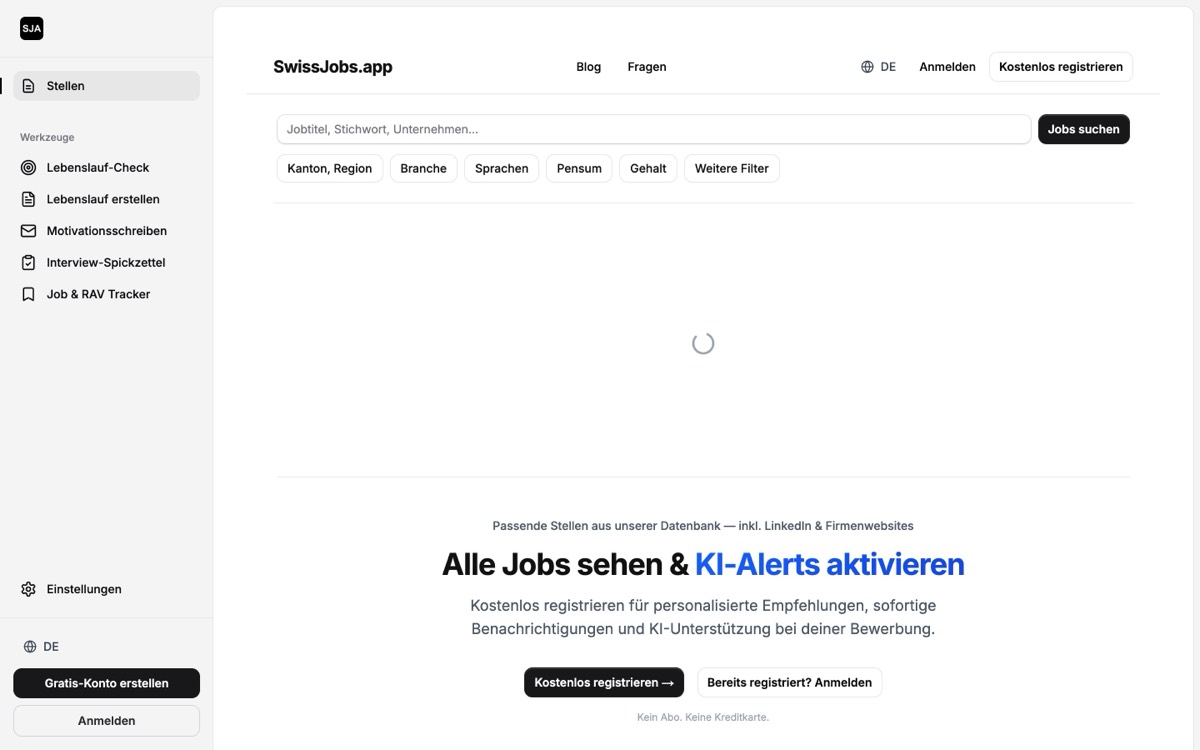
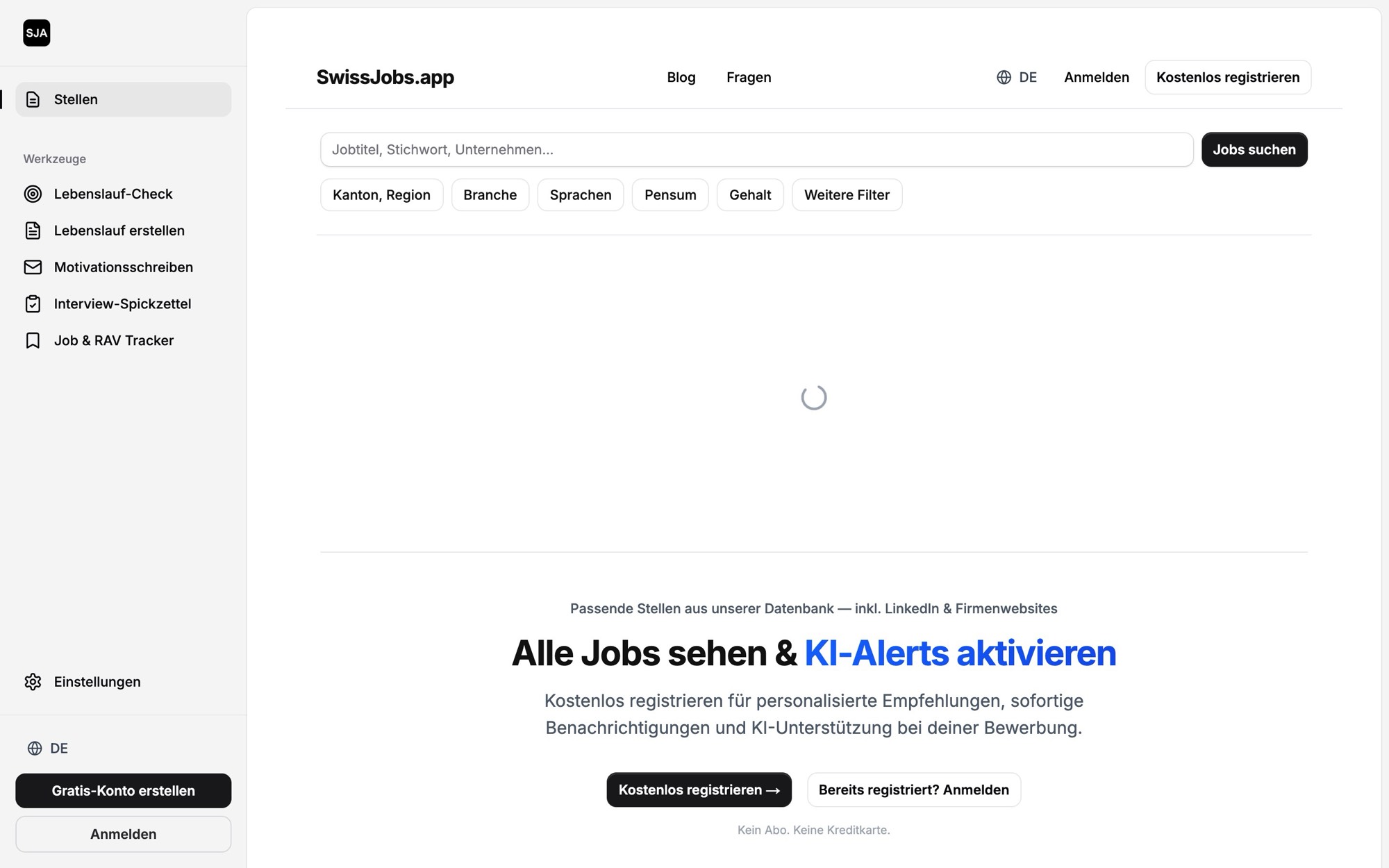
1. SwissJobs.appOur app
Over 21,000 open Swiss roles from ATS systems, company sites and LinkedIn in one place — and from any advert, straight into a CV, a motivation letter, a CV check and interview prep. The RAV job-search-efforts form fills itself from your application tracker. Free to use; the account is asked for at save.
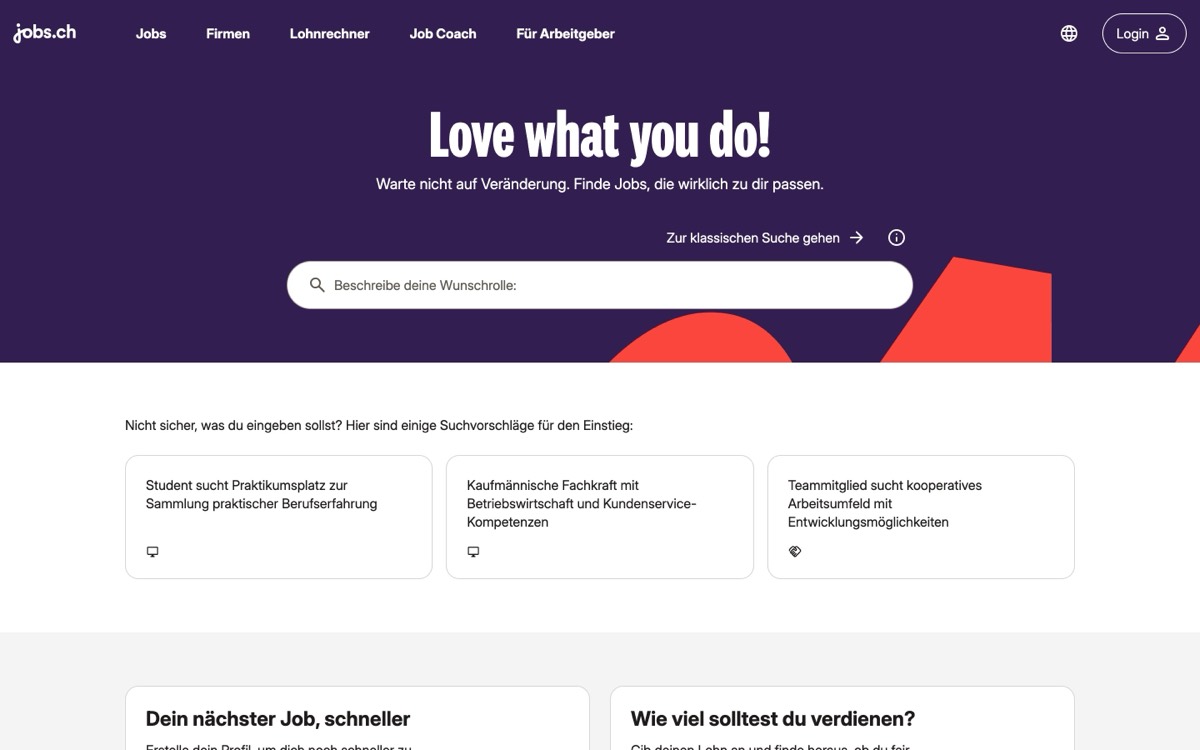
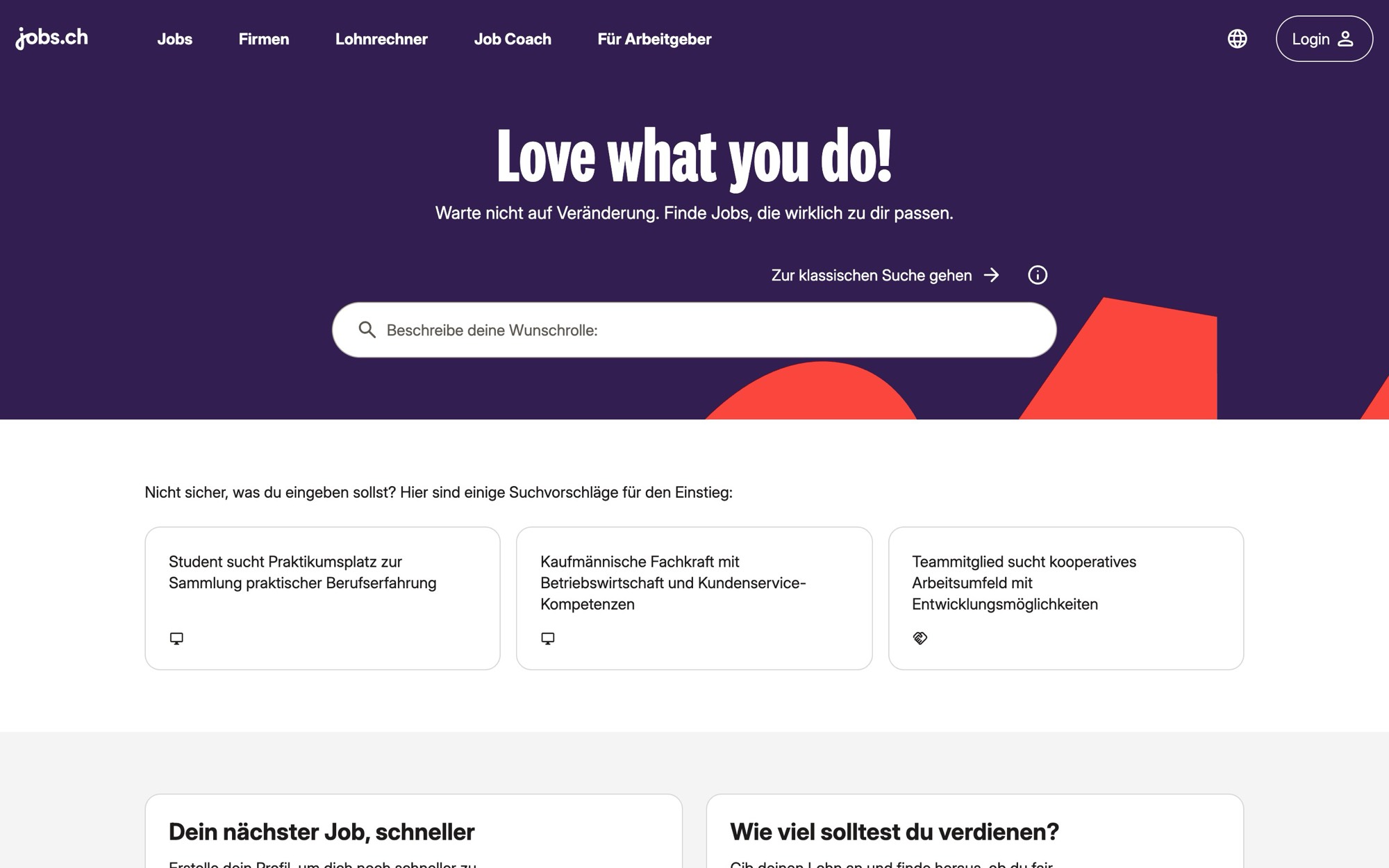
The best-known board in German-speaking Switzerland and the largest index in the country. Owned by JobCloud AG — as are jobup.ch and JobScout24.
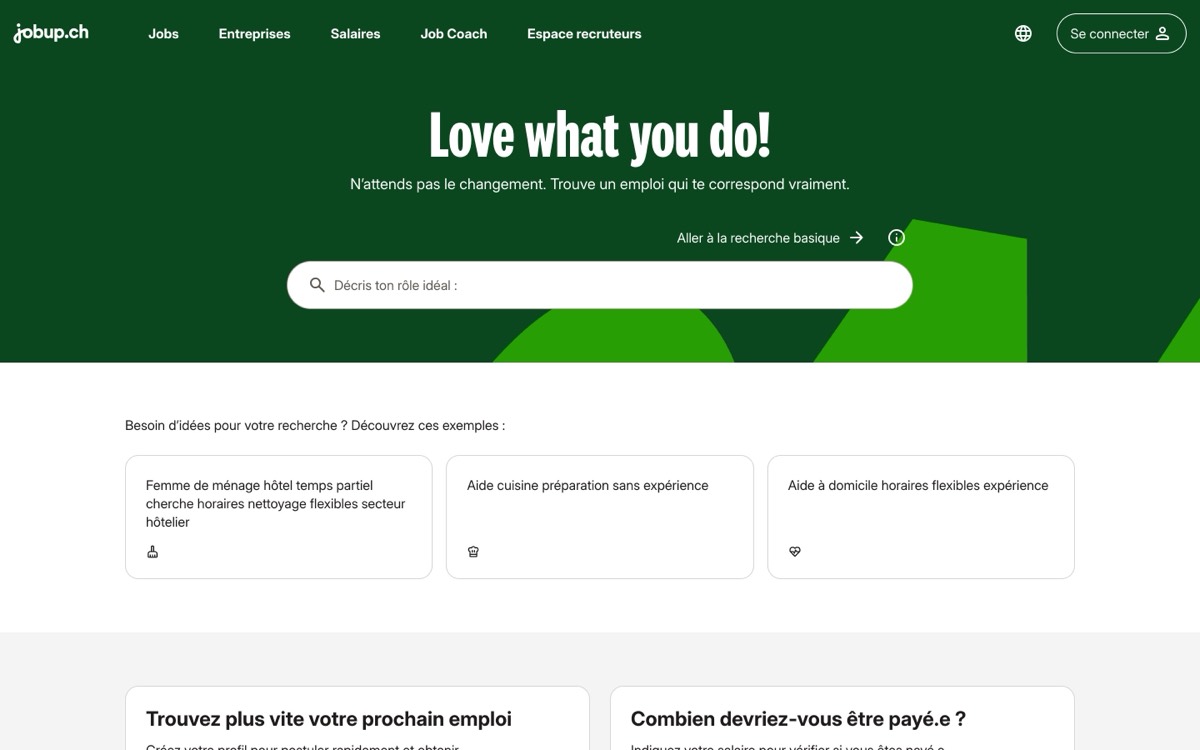
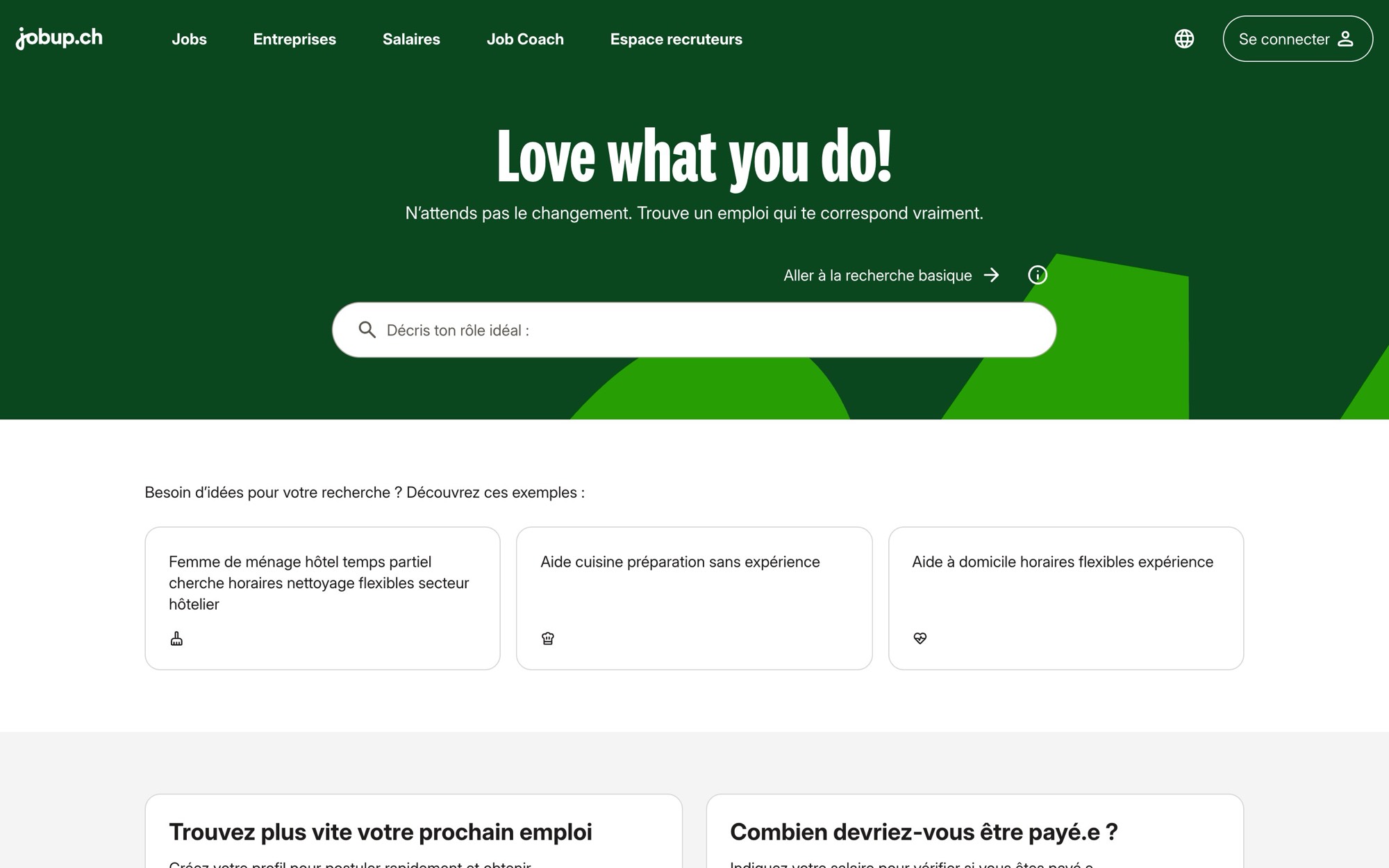
The standard in French-speaking Switzerland and the first place to look for the Romandie — but the same JobCloud AG as jobs.ch.
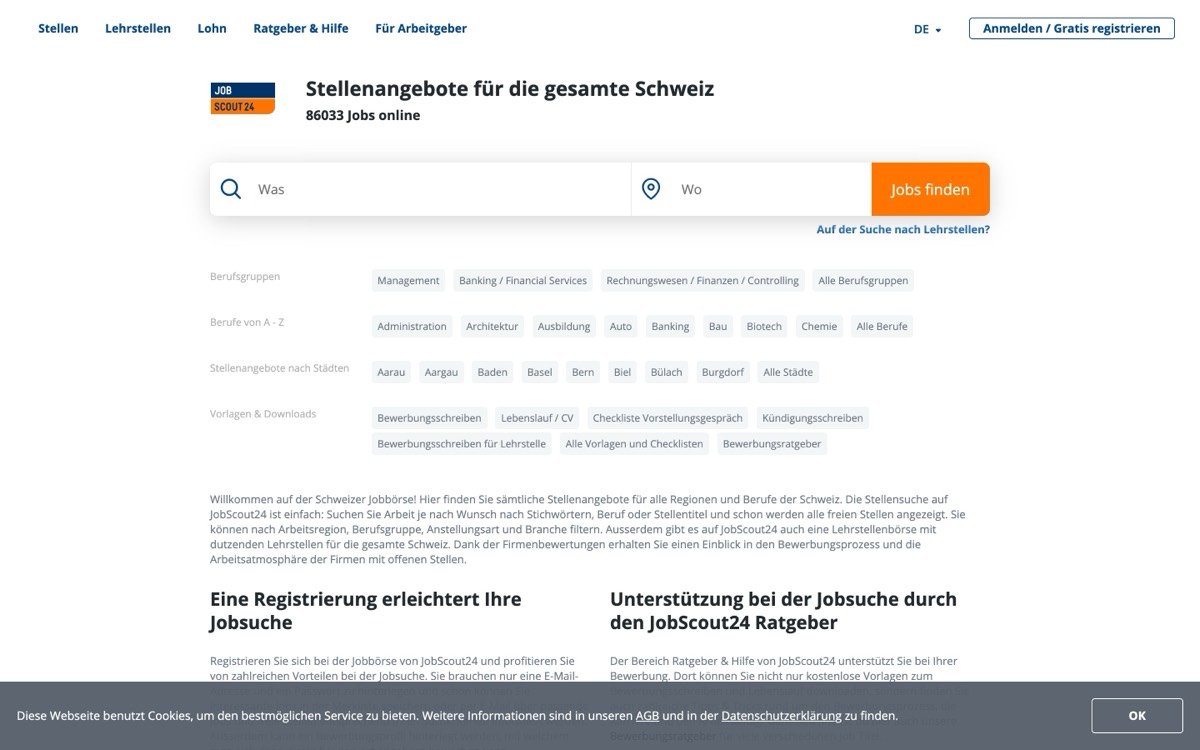
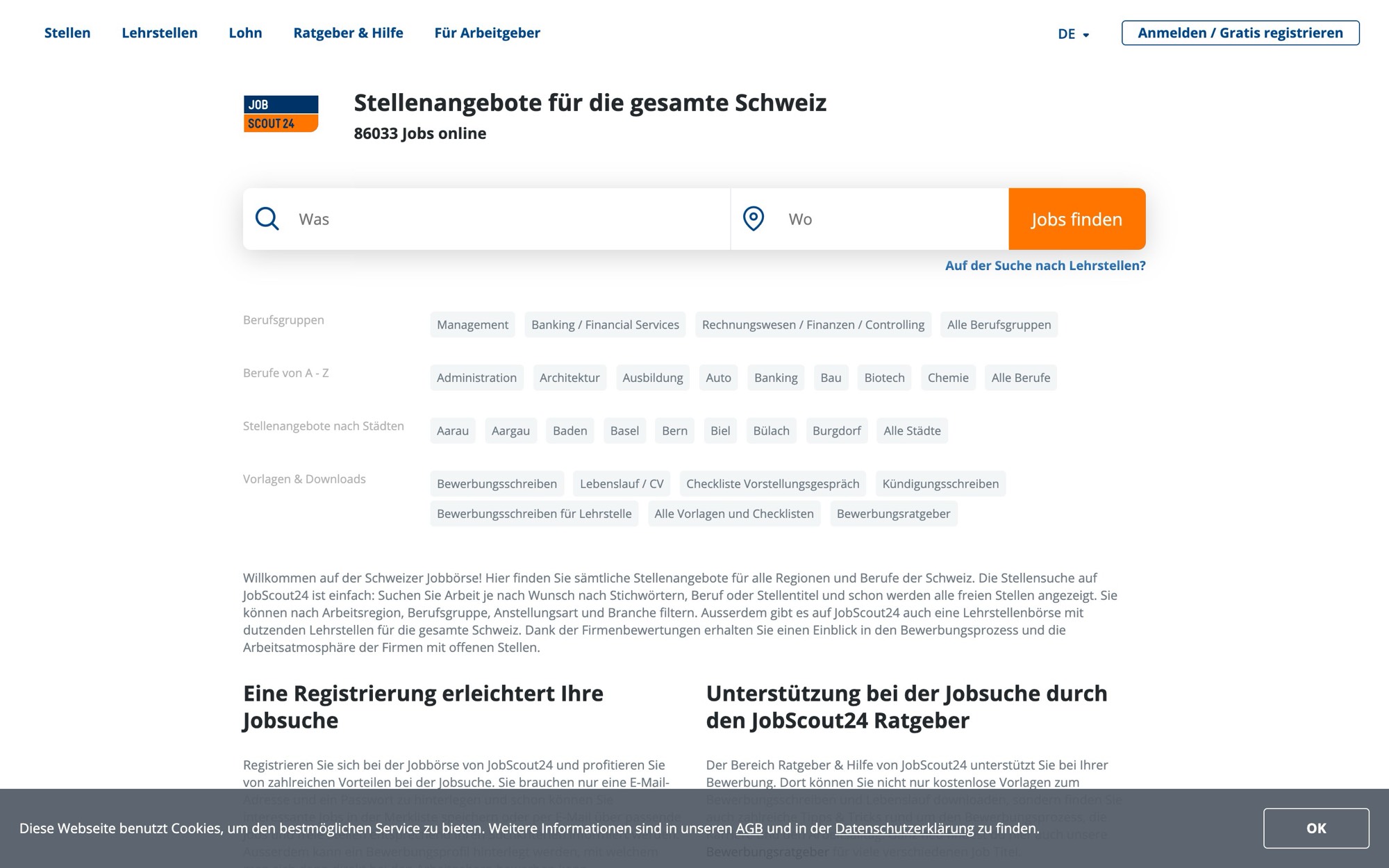
A third brand from the same company. Searching all three to widen your search means searching one provider three times.
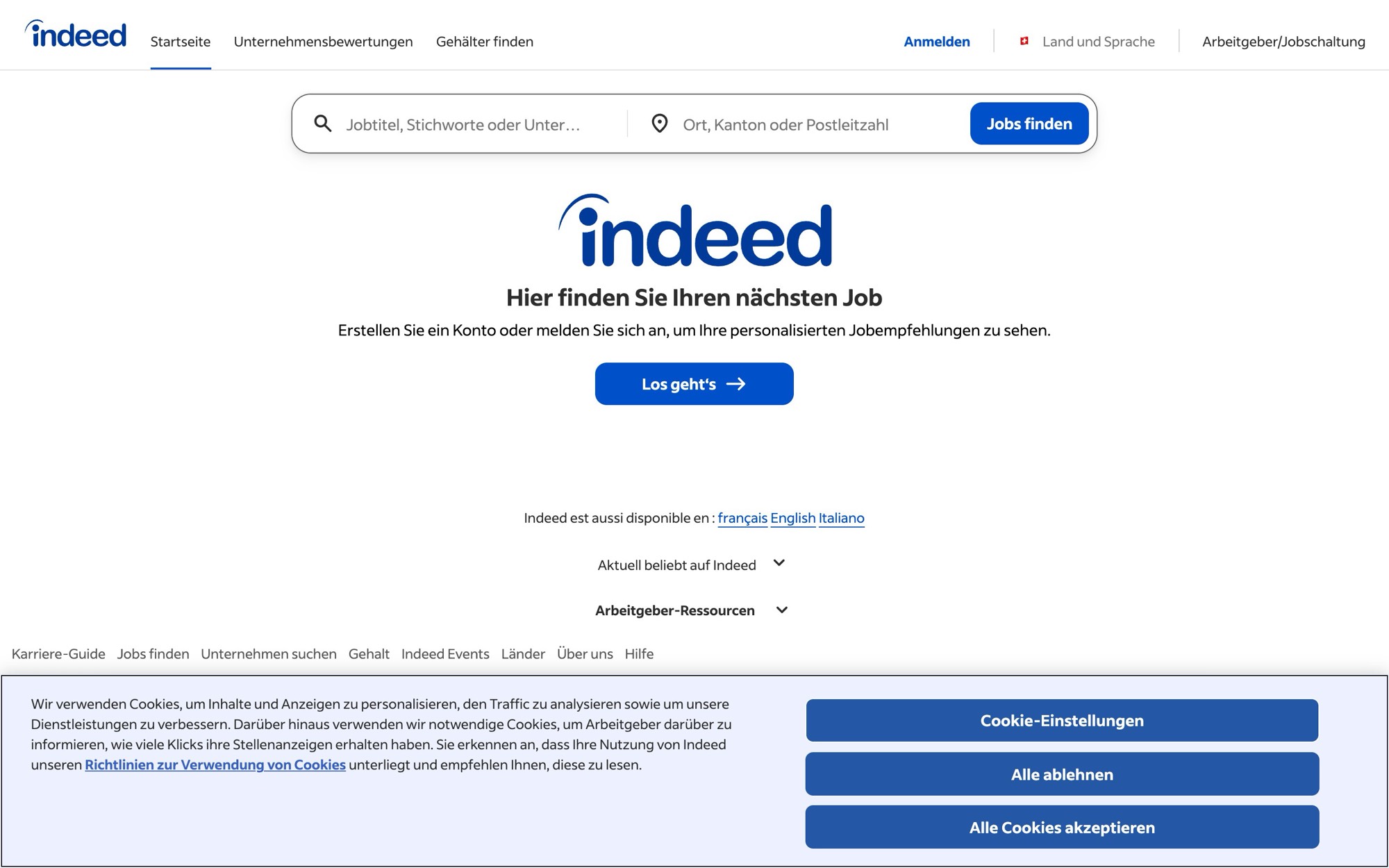
The broadest aggregation, because Indeed also collects from other boards — at the cost of many duplicates of the same advert.
The best reputation for English-speaking and international roles in Switzerland. Considerably thinner for trades, care and commercial roles.
A meta-search across the Swiss job boards, "every job in Switzerland at a glance". Its strength is the Job-Abo: a saved search that mails you new adverts from every portal it covers. Salary calculator and application guides alongside.
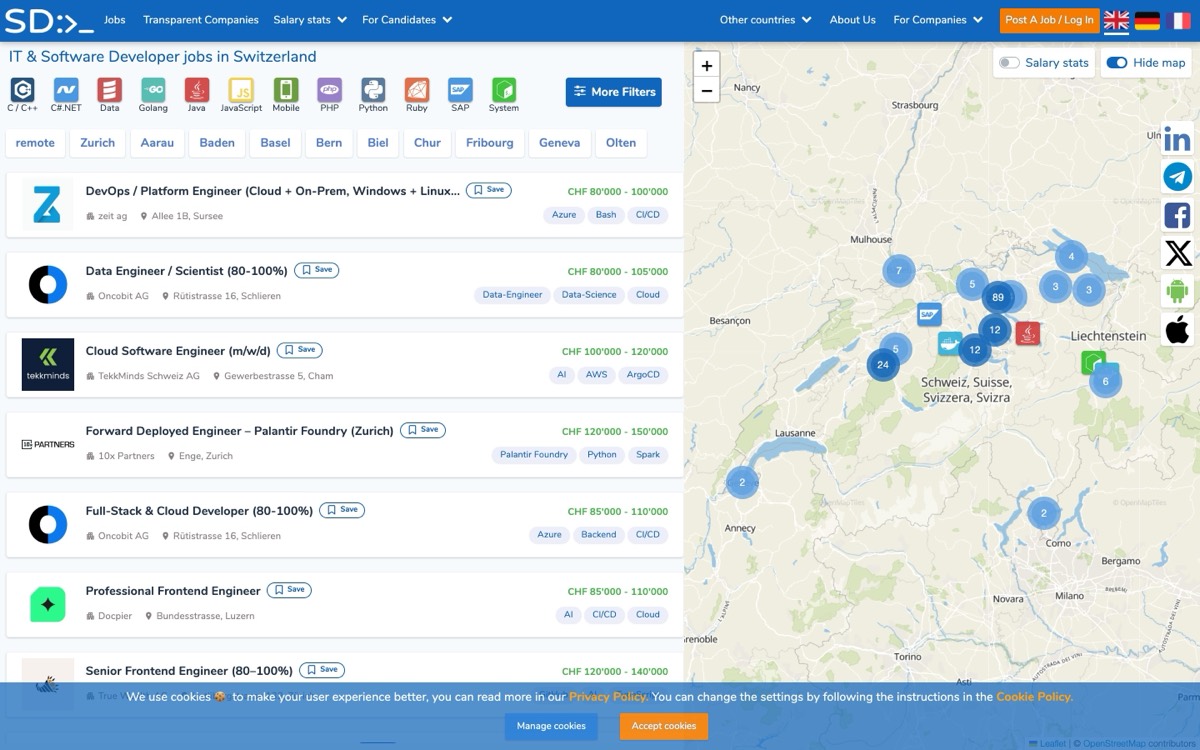
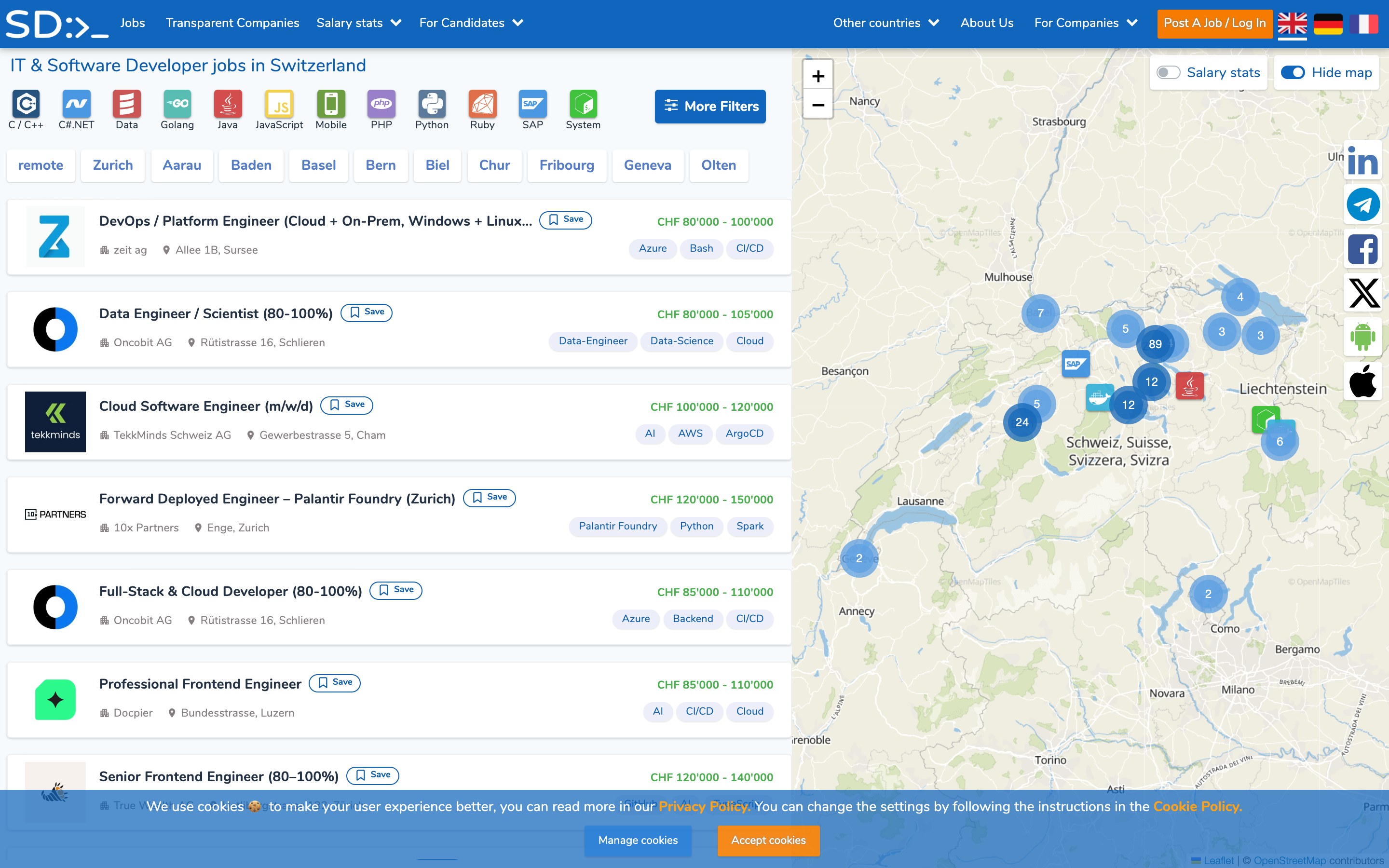
IT and software only, and thorough about it: "183 IT & Software developer jobs in Switzerland", filtered by technology (C#, Java, Python, DevOps, ML) rather than by industry. Publishes salary statistics and lists the companies that disclose their ranges. The site itself is in English.
Jobs by profession, city or language
Type a profession, a city or a language, the page shows the adverts currently open for it.
By profession
- Consultant
- Project Manager
- Retail Sales
- Nurse
- Nursing & Care
- Administrative Assistant
- Account Manager
- Software Engineer
- Public Administration
- Architect
- Insurance
- Chef
71 more — narrow the search
By work type
The official Swiss alert has an entry condition worth knowing first. arbeit.swiss lists «creation of job alerts» among the benefits of registering, and says in the same section that the services tied to registration are «available exclusively to individuals already signed on as jobseekers with a regional employment centre (RAV)». Searching job-room.ch needs no account; the alert does. Everyone else sets alerts up on private job sites, one per search.
For an English speaker there is a second condition, and it is linguistic. Of the adverts in our index whose language we can determine, 57,9 per cent are in German, 26,1 per cent in English, 13,8 per cent in French and 2,3 per cent in Italian. An alert built only from English job titles is therefore fishing in roughly a quarter of the market, and the quarter it reaches is not evenly distributed across occupations.
What follows is the part that can be measured rather than assumed: how wide a keyword reaches, where your real requirements are written, when adverts are actually published, what a weekly digest costs you in days, and why a fifth of what arrives is something you have already seen.
Share of an occupation's adverts whose title literally contains the obvious keyword. The occupation is the set of all adverts whose title names that job in any spelling the market actually uses, in any language. Open Swiss adverts in our index, 23 August 2026.
- Coverage of a single keyword within its own occupation, in our index: «Koch» 54,3 per cent, «Verkäufer» 48,3, «Logistiker» 38,3, «Elektriker» 34,9, «Kaufmann/Kauffrau» 27,9, «Pflegefachfrau» 27,7 and «Informatiker» 4,9 per cent.
- Occupation titles are not standardised. The adverts naming a nursing role carry 607 distinct title spellings between them, and it takes 257 of those spellings to cover even half of the adverts.
- Your real requirements are in the body text. Of the adverts that mention German language skills at all, 99 per cent never carry the word in the title; for a driving licence it is 99,6 per cent, for Excel 96,5, for home office or remote 85,7 and for SAP 74,9 per cent.
- Titles are formatted, not written: 33,7 per cent carry an (m/w/d)-style marker, 22,4 per cent a workload percentage and 13,9 per cent a slashed dual form such as «Koch/Köchin». Exact-phrase alerts break on all three.
- Publication is a weekday event. Of the still-open adverts published in the last three months, Wednesday carries 22,8 per cent, Thursday 19,4, Tuesday 18,8, Monday 17,6 and Friday 14,1; Saturday and Sunday together carry 7,3 per cent.
- That distribution prices the cadence: a daily alert reaches you on average one day after publication, a weekday-only alert 1,3 days, a twice-weekly alert 2,2 days and a Monday-weekly alert 4,8 days.
- Repetition is structural: 22 per cent of adverts share employer and title with at least one other, and in 42,1 per cent of those groups the postings are more than 14 days apart — the same role, put back up.
- One retailer runs the same sales title across more than a hundred separate adverts in 58 different towns, one per store. In retail, three employer names account for half of all adverts in the field; in IT, 46,8 per cent of adverts come from named staffing firms against 12 per cent across the whole index.
Set the alert in the language the advert is written in
The most expensive mistake an English speaker makes here is not a bad keyword — it is a monolingual one. German is the majority language of the adverts in our index, and the German title is often a compound word that shares no substring with its English equivalent. «Sachbearbeiter» does not contain «administrator». «Fachfrau Gesundheit» does not contain «care». An alert typed in English will simply never see them.
Two occupations show the two extremes. IT is the friendliest: within the set of adverts whose title names an IT role, 23,3 per cent are written in English, and the English-derived words themselves do the work — «engineer» appears in 9,8 per cent of all titles in our index, «manager» in 7,4 and «specialist» in 3,3. Nursing and retail are the opposite: the titles are German or French compounds, and an English alert reaches almost none of them.
The practical fix is to store both. Take the English word you would type, run the search once by hand, and read the first thirty titles that come back; the German or French words that keep appearing are the ones your alert needs. Two to five terms per occupation, across two languages, is a realistic setup — one term in one language is not.
The keyword is the alert
Inside a single language the same problem repeats, and the chart above measures it. Kitchen work is robust: «Koch» sits in 54,3 per cent of titles naming a kitchen role, because the alternatives — chef de partie, commis de cuisine, cuoco — exist but stay a minority. IT collapses: «Informatiker» reaches 4,9 per cent, because the roles are advertised as system engineer, software engineer, Applikationsentwickler or Systemtechniker. Switching that single word to «software» raises coverage to 28,6 per cent, and both together reach further still.
The reason is title inflation rather than a quirk of one industry. In the nursing set, 607 distinct title spellings are spread across the adverts, and no single spelling accounts for more than 1,4 per cent of them. In IT the largest single title carries 4,5 per cent. Retail is the exception that proves the rule: 17 title spellings cover half the field, because a handful of large chains write their adverts from a template.
So the reasonable target when setting up an alert is not precision but reach. Add the neighbouring roles you would accept — an administrative alert should carry «Sachbearbeiter», «Assistenz», «Administration» and «Backoffice», because that field spreads across 404 title spellings and needs 175 of them to reach half its adverts.
Requirements belong in the filter, not in the keyword
The second common setup error is to alert on conditions instead of occupations. Language level, driving licence, Excel, SAP, home office: these are what an application actually turns on, and they are written in the body text. Of the adverts in our index that mention German at all, 99 per cent never put it in the title; for a driving licence it is 99,6 per cent and for Excel 96,5 per cent.
An alert listening for «Excel» therefore does not return the jobs that require Excel. It returns the handful whose headline happened to mention it — an empty inbox that reads like an empty market. Conditions belong in a structured filter where one exists, or in your own reading after the advert opens.
There is one condition that behaves differently, and it is worth the exception. Workload appears in the title of 22,4 per cent of adverts in our index, usually as «80–100 %», so a part-time seeker can genuinely use the title. That is the only requirement in this list that survives the trip from body text to headline often enough to alert on.
How often it should fire
Adverts do not arrive evenly. Among the still-open adverts published in the last three months in our index, 92,7 per cent carry a Monday-to-Friday publication date, Wednesday is the strongest day at 22,8 per cent and Sunday the weakest at 2,0. A weekend alert usually reports on an empty market; a Thursday-morning alert lands on top of the strongest block of the week.
From the same distribution you can price the cadence exactly. A daily alert reaches you on average one day after publication. Weekdays-only costs 1,3 days, twice weekly costs 2,2 days, and a single Monday digest costs 4,8 days. The gap between daily and weekly is therefore just under four days of head start.
Whether four days matter depends on the field, not on the alert. In an occupation where two dozen people apply, one day rarely decides anything. In one with few applicants and a fast process, the first week is the whole race. A workable compromise for most people is daily for the core occupation and weekly for the adjacent fields you watch but do not chase.
Why the same advert keeps arriving
Part of what an alert delivers is not new. In our index, 22 per cent of adverts share an employer and a title with at least one other advert, and most of that is ordinary practice rather than duplication: one retailer carries the same sales title across more than a hundred separate adverts spread over 58 towns, one per store. A nationwide retail alert can be filled by a single employer without the market having moved at all.
The rest is republication. In 42,1 per cent of the groups that share employer and title, the publication dates are more than 14 days apart — a role put back up after the first round produced nobody. That is not a flaw in the alert. It is information: the position is still open, and the employer is short of candidates.
Sender concentration compounds it. Three employer names cover half the retail field and twelve cover half of nursing, while 46,8 per cent of the IT adverts in our index come from named staffing firms against 12 per cent across the index as a whole. A broad IT alert is, to a large extent, one agency's outbound list.
The place field, which fails more quietly
A badly set location does not produce an error, only fewer results. The adverts for the city of Zurich in our index appear under 56 different location spellings: 80,8 per cent read «Zürich» and 10,9 per cent read «Zurich» without the umlaut. An alert keyed to the umlaut form quietly loses roughly one advert in nine, with nothing to indicate it.
This is regional. Geneva needs two spellings — «Genève» and «Geneva» — to reach 90 per cent of its adverts, while Bern and Lausanne carry 98 and 94,7 per cent under a single spelling each. It is the umlaut cities that leak, not the French-speaking ones.
So use a canton or region selector where the site offers one, and treat a free-text place field as something that needs a second alert with the plain-ASCII spelling. If you commute, widen the radius past your own municipality: Dübendorf, Winterthur and Zollikofen carry their own place names in our index even though they sit inside a commuting zone.
Setting one up here, and reading whether it works
On this site there are two routes. On an occupation-and-city page — /jobs/nursing/zurich, for example — there is a single field for an email address and no account: you subscribe to exactly that search and receive, on weekday mornings, the adverts that appeared for it since the last mail, at most eight per mail and only genuinely new ones. With an account, the profile drives it instead: your job title and preferred locations produce a daily weekday mail whose language you choose. Either can be switched off in one click.
Then read the alert as a diagnostic. Nothing for days means the slice is too narrow — usually a single keyword that does not cover the field, or a requirement typed into a field that matches titles. Run the search by hand first: if it returns results and the alert does not, the fault is in the setup, not in the market.
Too much is almost never the occupation. It is three removable groups: apprenticeship adverts carry 4,2 per cent of our index in the title, internships 2,9 per cent, and the branch adverts of one large employer do the rest. Excluding «Lehrstelle», «Lernende» and «Praktikum» buys more quiet than narrowing the occupation word ever will — and if the same advert keeps returning, that is a finding about the vacancy, not a defect in the alert.
Every percentage here is computed on our own index of open Swiss adverts as of 23 August 2026. Weekday and cadence figures use the still-open adverts published in the last three months and the publication date reported by each advert's source. «Occupation» means the set of adverts whose title names that job in a spelling the market actually uses, regardless of the advert's language.
Sources
Related questions
What our job index says about the Swiss market
Computed live from our own index, not quoted from a study. Shares only, as of today.
Language the advert is written in
- Deutsch
- 60%
- English
- 23%
- Français
- 13%
- Italiano
- 3%
Of adverts that state a language requirement, the share asking for
- Deutsch
- 70%
- English
- 43%
- Français
- 21%
- Italiano
- 3%
19% posted in the last 7 days · Largest markets: Zürich 18% · Bern 10% · Genève 5% · Basel 5%