Where do I find jobs for cross-border commuters in Switzerland?
Updated:
In short
Search where the federal statistics already count cross-border workers. At the end of June 2026 just over four hundred thousand people held a G permit and worked in Switzerland, and almost three quarters of them worked in five cantons: Geneva 28.5 per cent, Ticino 19.1, Vaud 11.2, Basel-Stadt 8.6 and Basel-Landschaft 6.4. Twenty-five municipalities alone account for 53.8 per cent. That geography is the first filter of any commuter job search — narrower than the country, wider than your own border town.
The Swiss job portals at a glance
Click an image for the full-size view. What each portal actually is stands beside it.
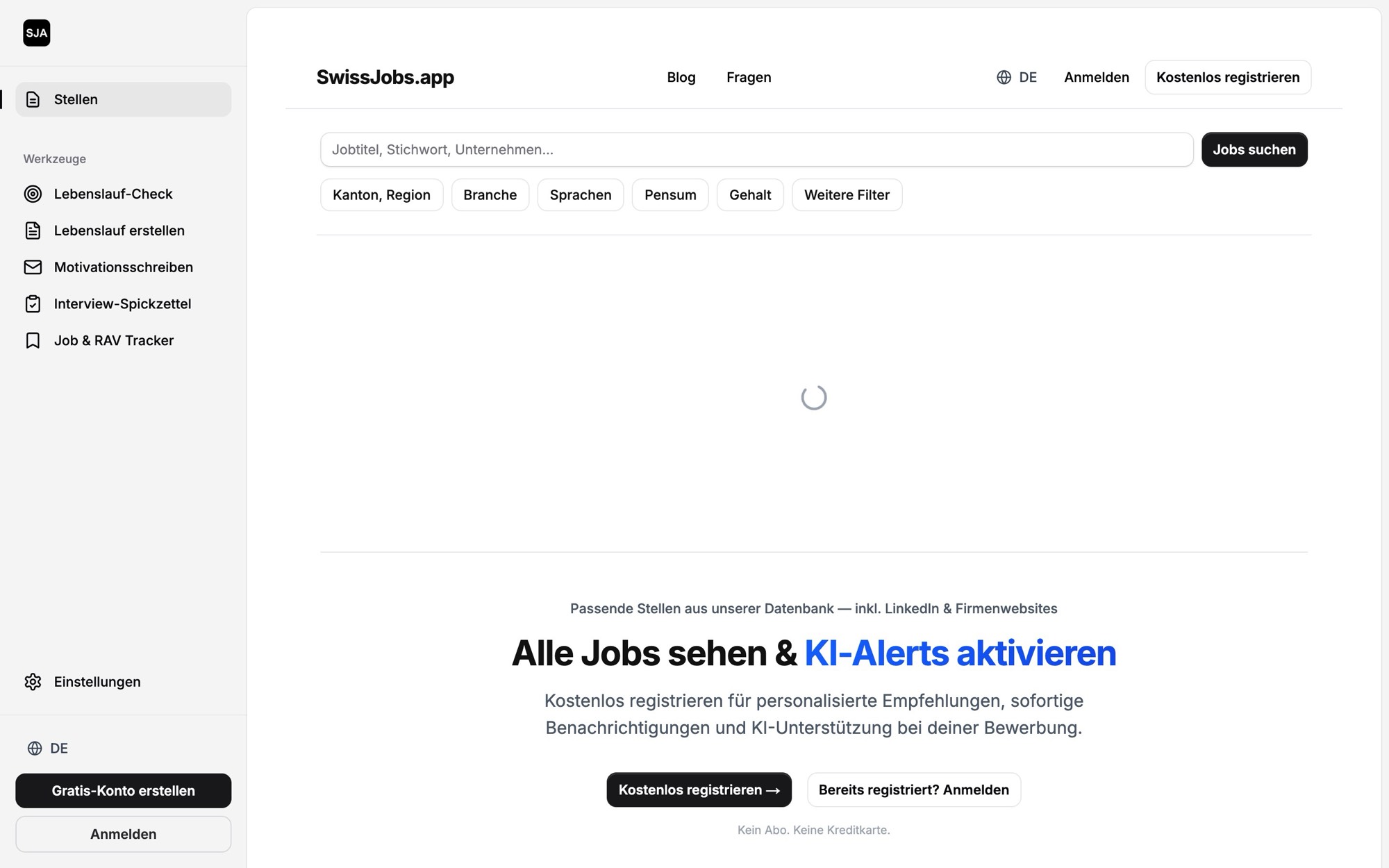
1. SwissJobs.appOur app
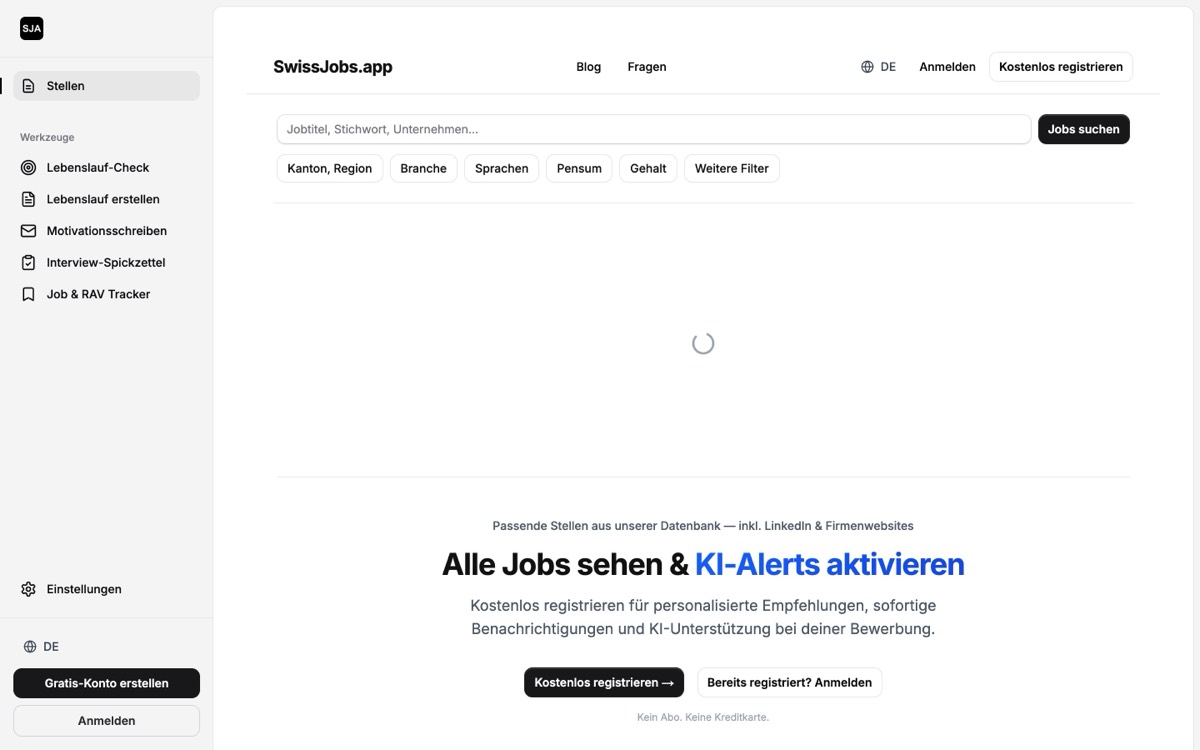
Over 21,000 open Swiss roles from ATS systems, company sites and LinkedIn in one place — and from any advert, straight into a CV, a motivation letter, a CV check and interview prep. The RAV job-search-efforts form fills itself from your application tracker. Free to use; the account is asked for at save.
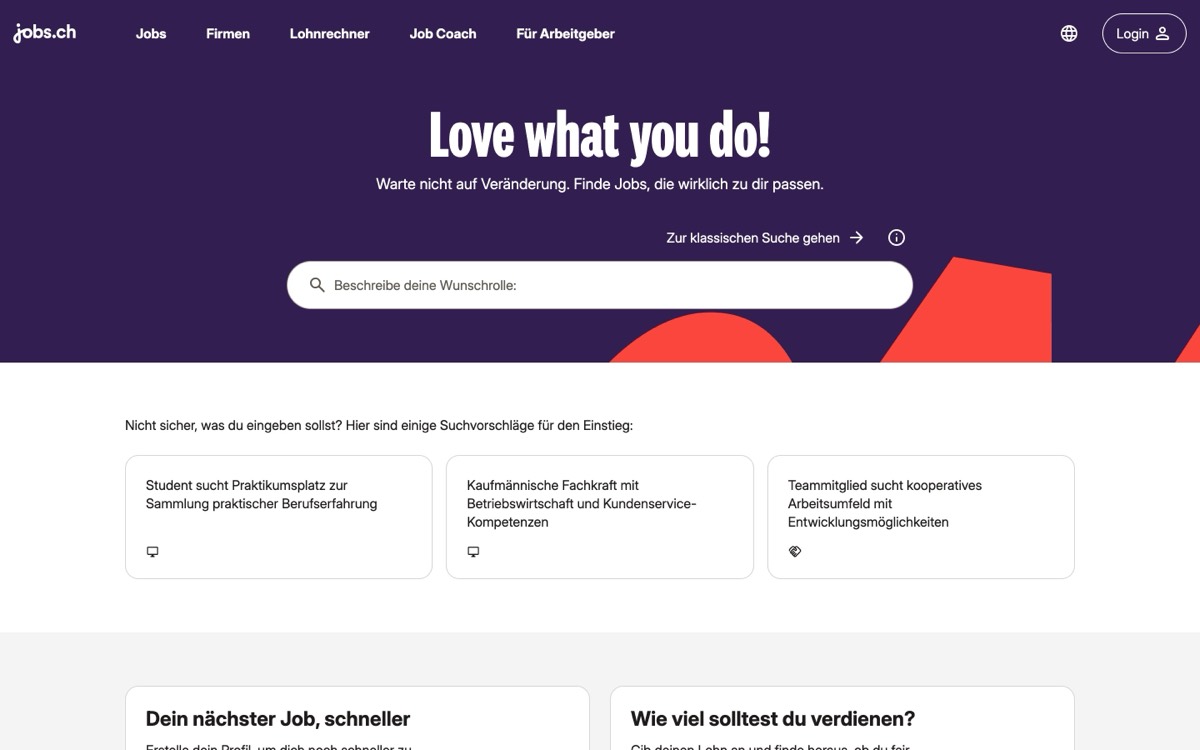
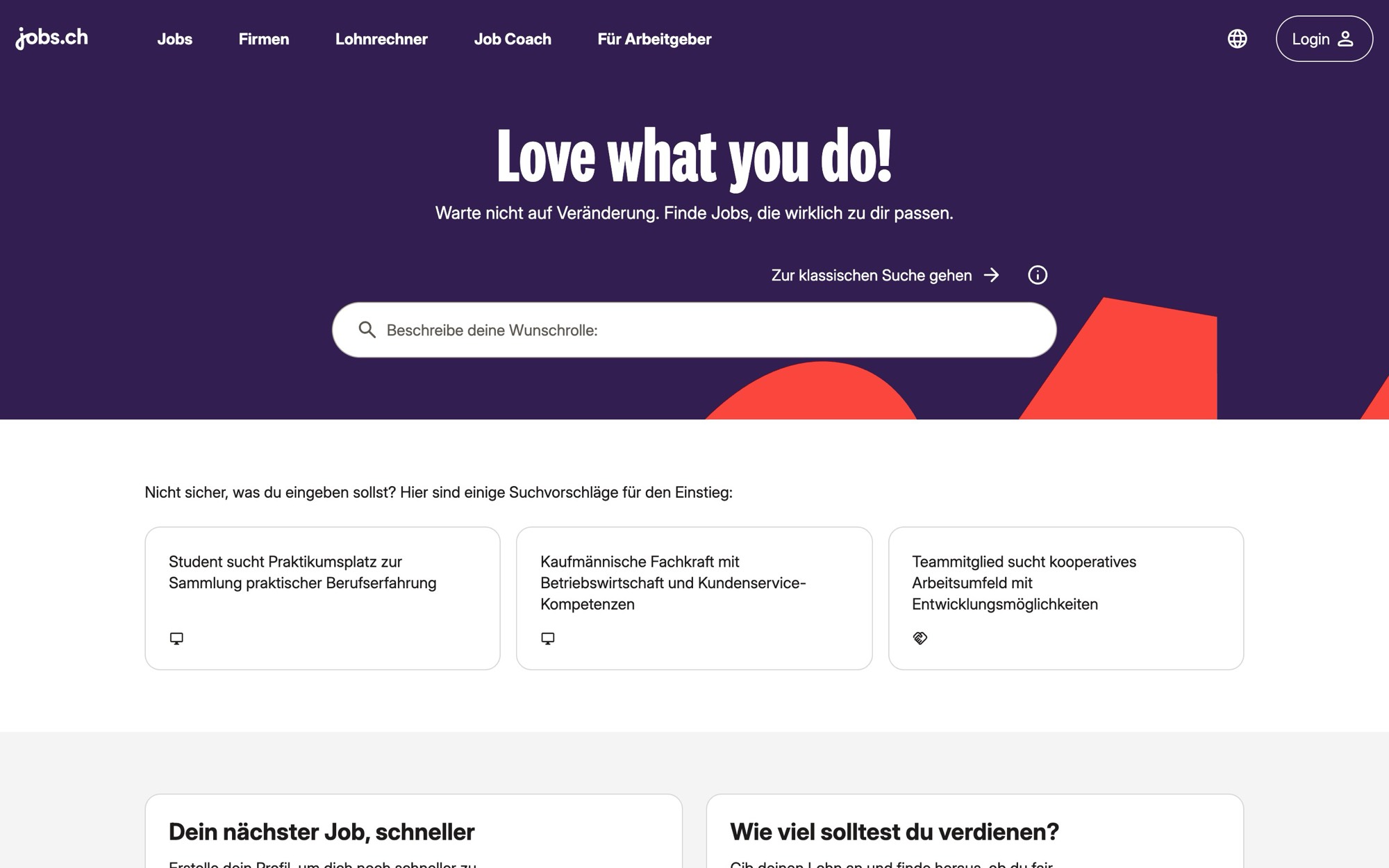
The best-known board in German-speaking Switzerland and the largest index in the country. Owned by JobCloud AG — as are jobup.ch and JobScout24.
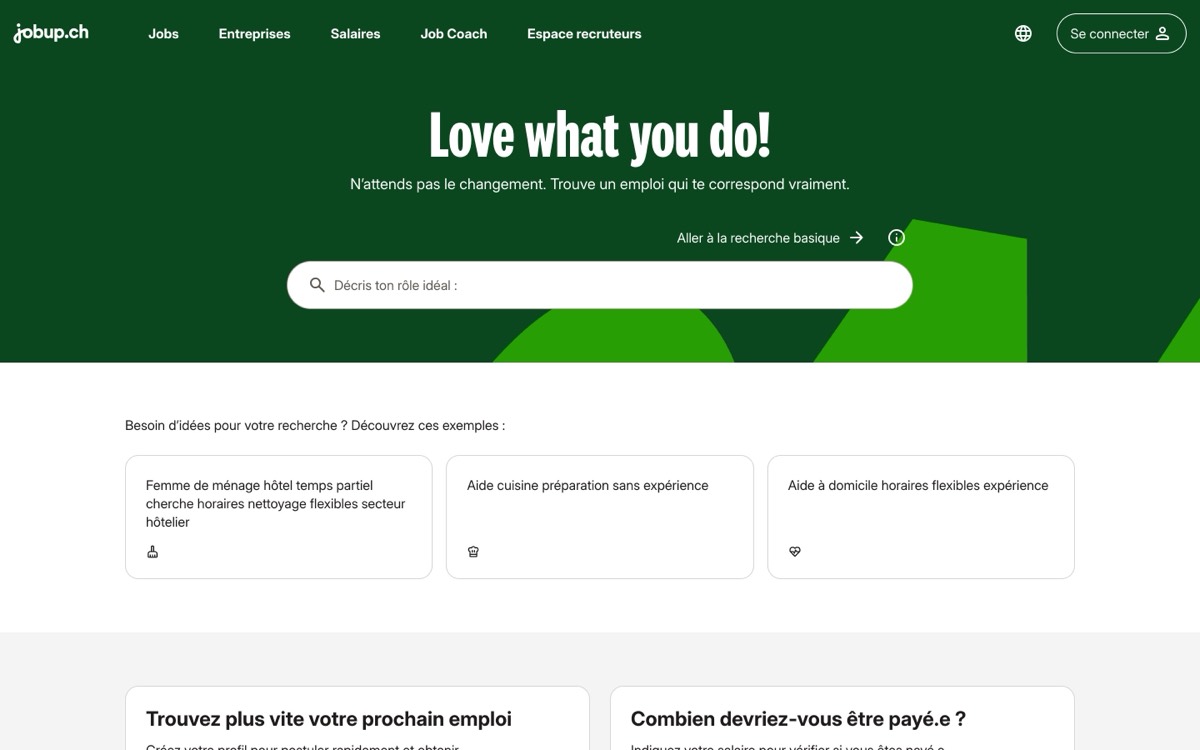
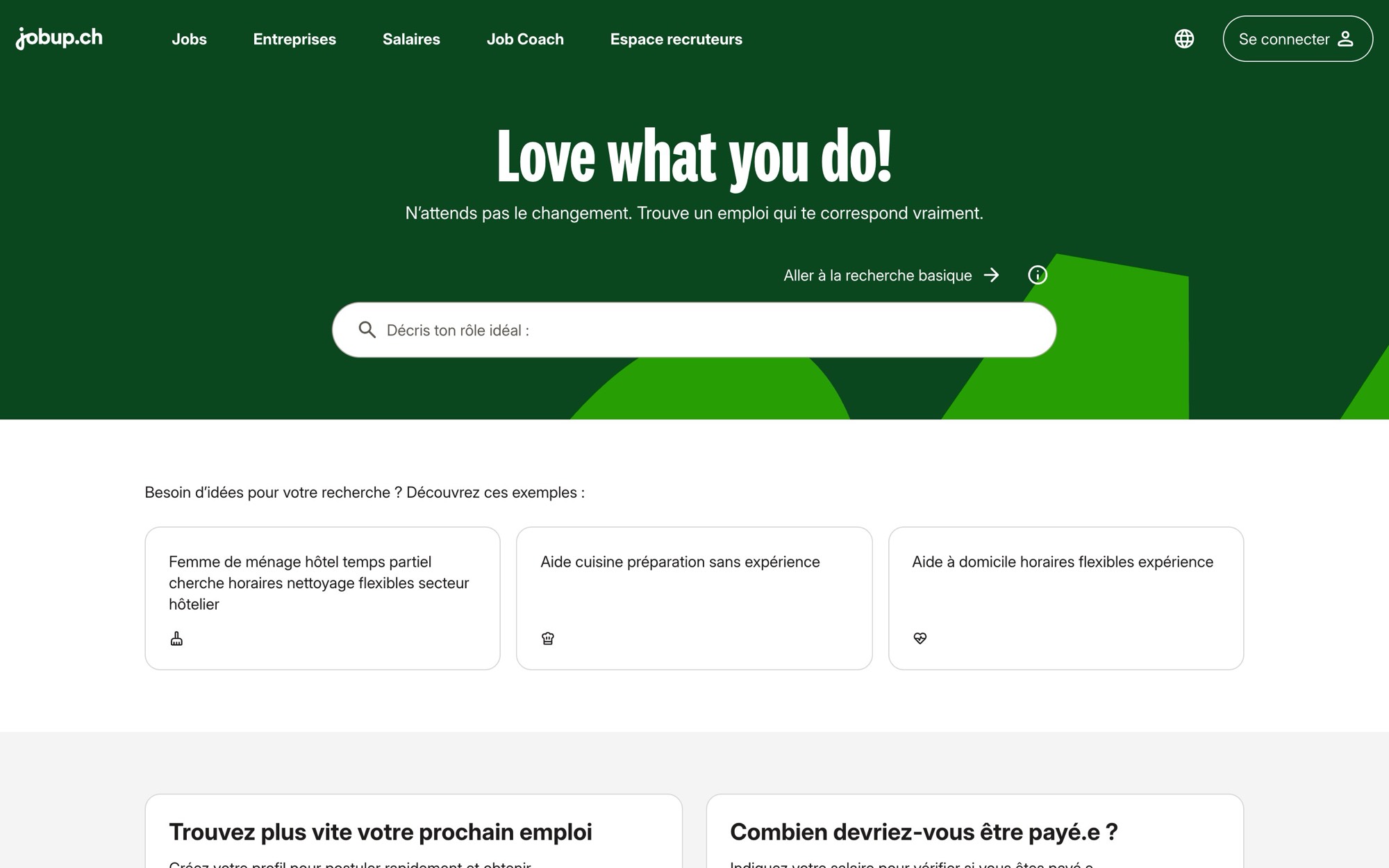
The standard in French-speaking Switzerland and the first place to look for the Romandie — but the same JobCloud AG as jobs.ch.
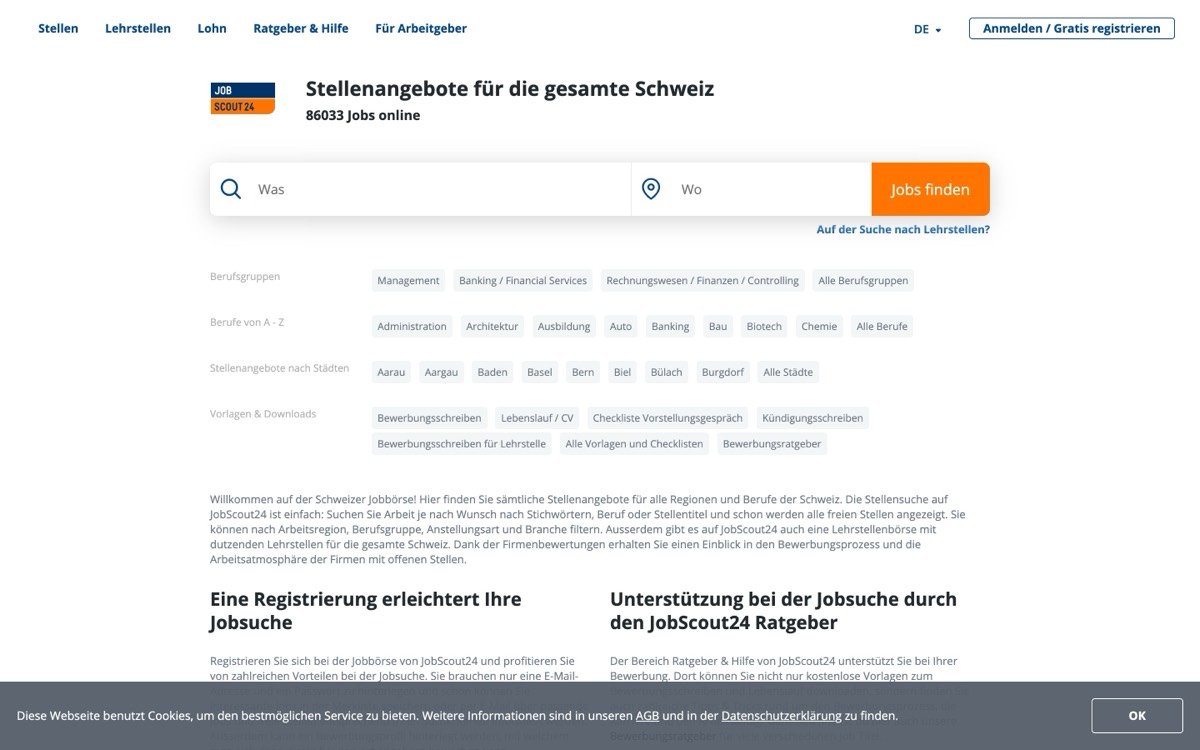
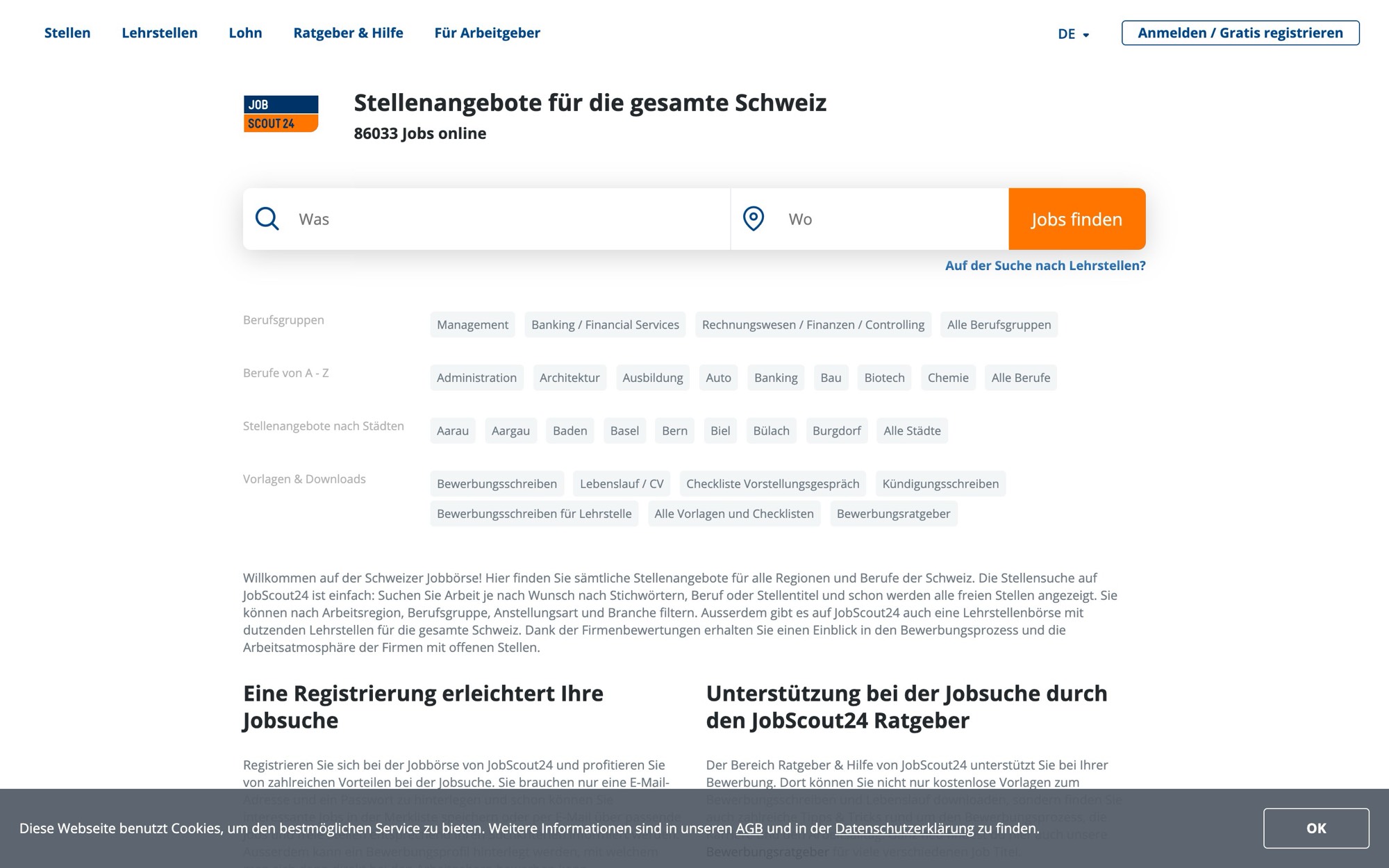
A third brand from the same company. Searching all three to widen your search means searching one provider three times.
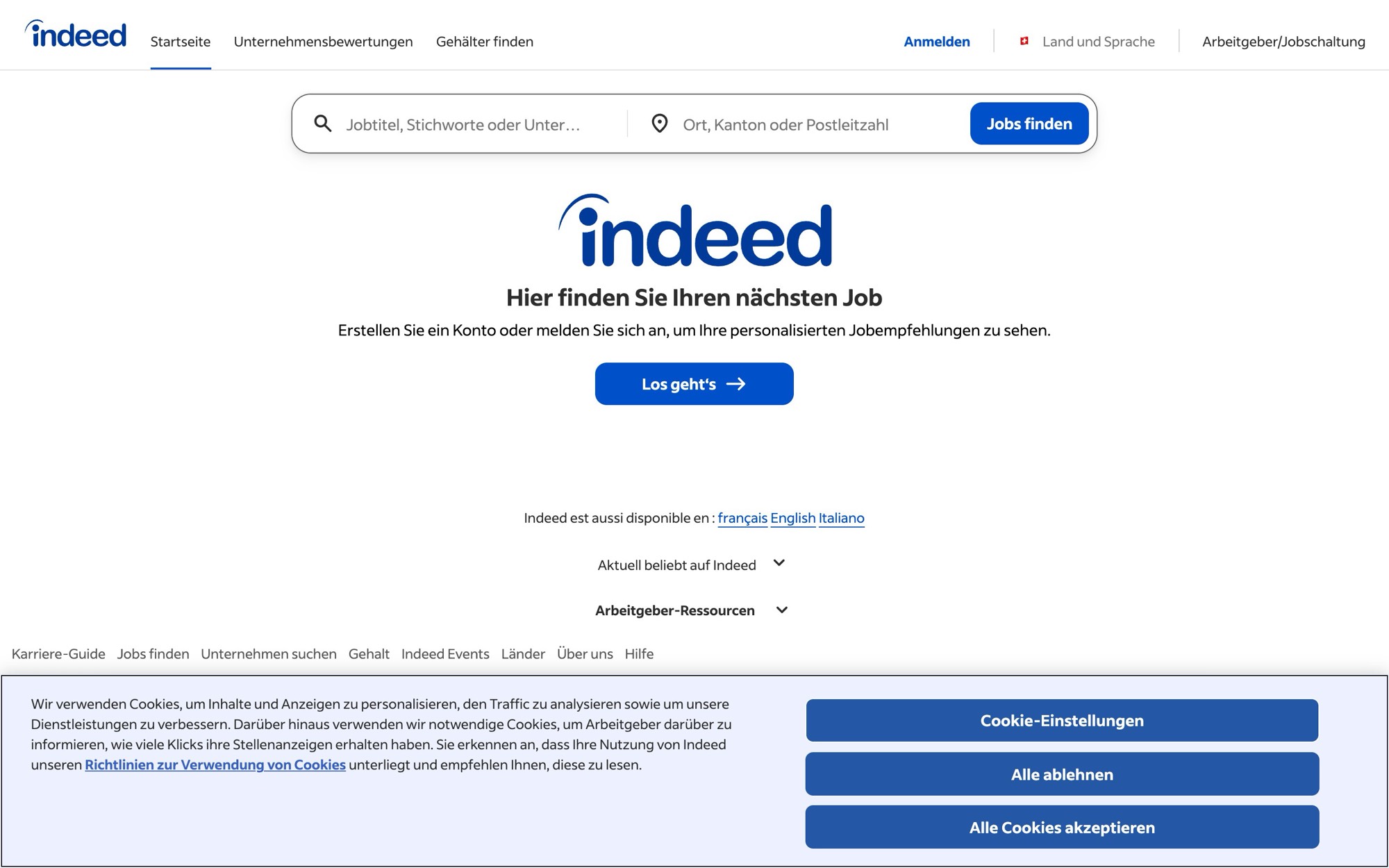
The broadest aggregation, because Indeed also collects from other boards — at the cost of many duplicates of the same advert.
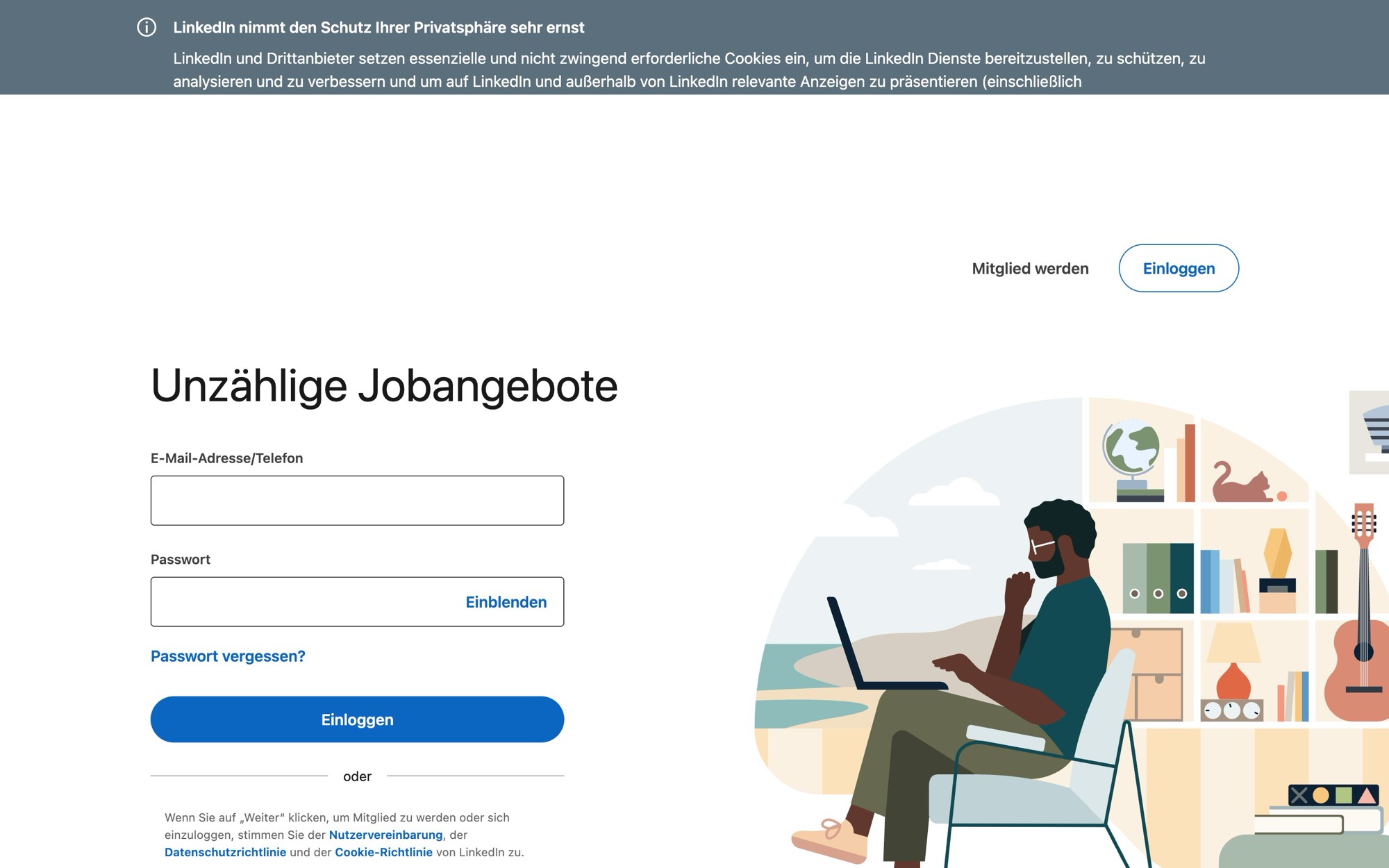
The best reputation for English-speaking and international roles in Switzerland. Considerably thinner for trades, care and commercial roles.
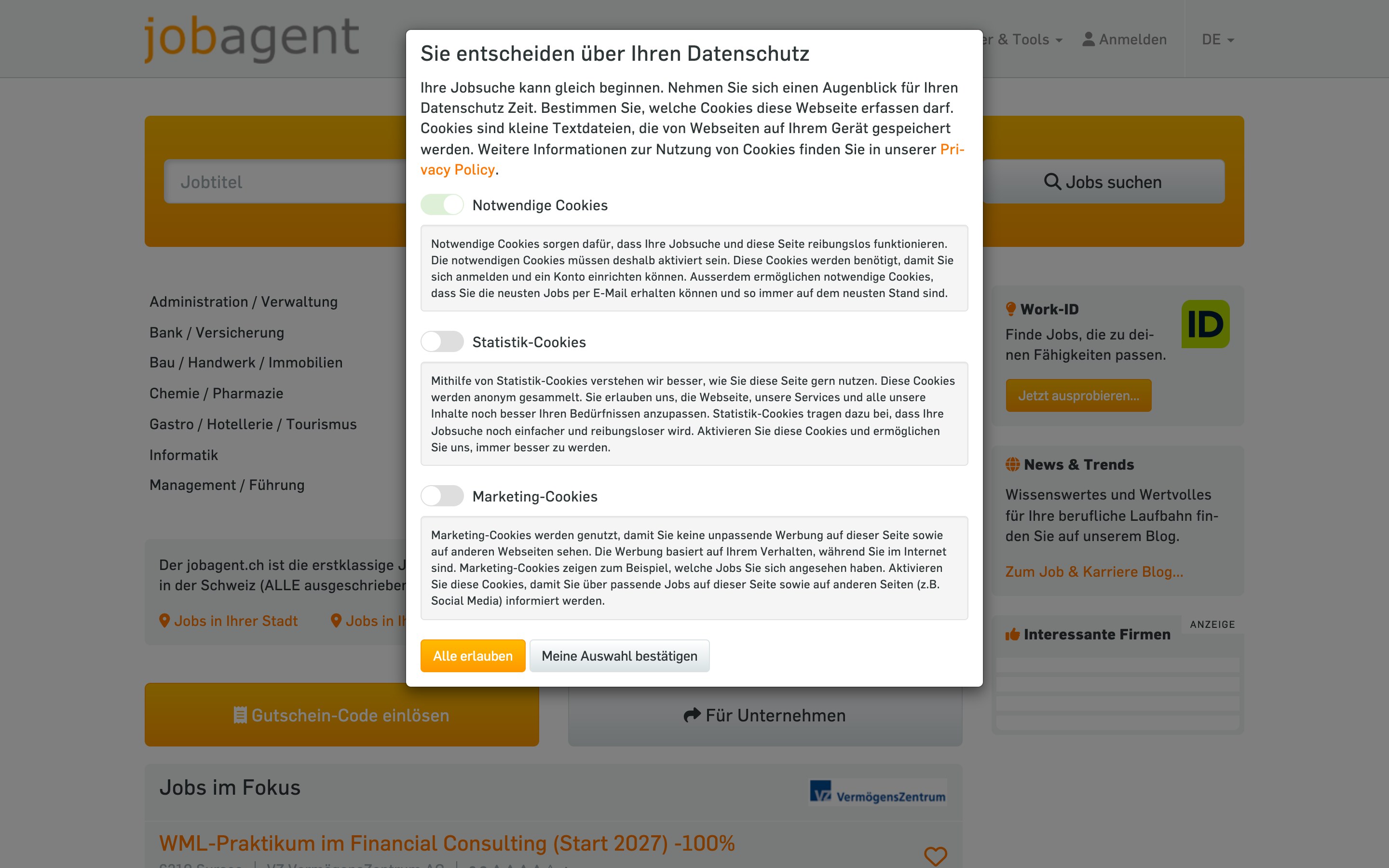
A meta-search across the Swiss job boards, "every job in Switzerland at a glance". Its strength is the Job-Abo: a saved search that mails you new adverts from every portal it covers. Salary calculator and application guides alongside.
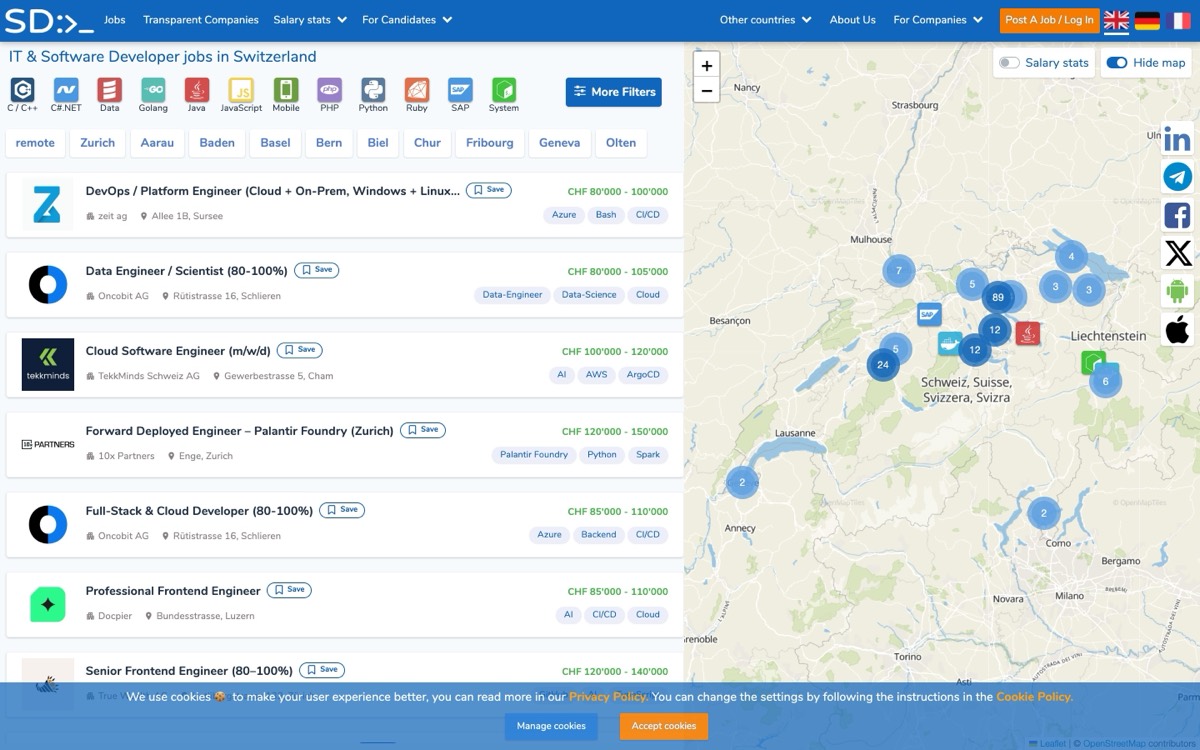
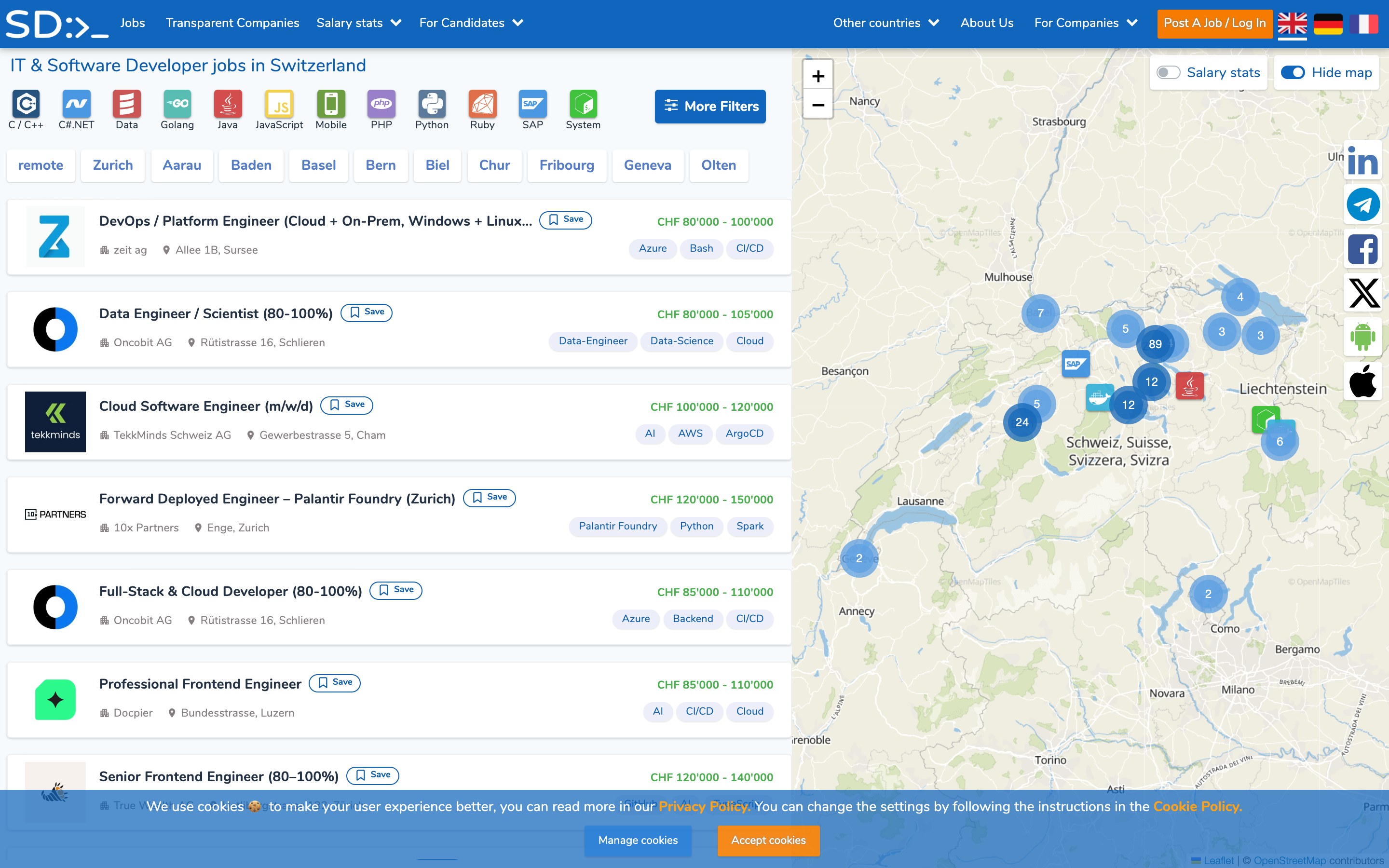
IT and software only, and thorough about it: "183 IT & Software developer jobs in Switzerland", filtered by technology (C#, Java, Python, DevOps, ML) rather than by industry. Publishes salary statistics and lists the companies that disclose their ranges. The site itself is in English.
Jobs by profession, city or language
Type a profession, a city or a language, the page shows the adverts currently open for it.
By profession
- Consultant
- Project Manager
- Retail Sales
- Nurse
- Nursing & Care
- Administrative Assistant
- Account Manager
- Software Engineer
- Public Administration
- Architect
- Insurance
- Chef
71 more — narrow the search
By work type
The second filter is which border you cross. The quarterly statistics break every canton of work down by country of residence, and the split is close to absolute: 99.5 per cent of Geneva's commuters live in France, 99.6 per cent of Ticino's live in Italy, 98.6 per cent of Schaffhausen's live in Germany, and 69.0 per cent of St. Gallen's live in Austria. In practice that means each border feeds two or three cantons, whose employers already handle your residence country as routine.
Basel is the exception and therefore the most open market of the group. In Basel-Stadt 53.5 per cent of commuters live in France and 45.2 per cent in Germany; in Basel-Landschaft it is 58.4 against 40.3. No other canton draws at that scale from two countries at once, which is why an address in Alsace and an address in Baden are both unremarkable to a Basel HR desk.
The third filter is language, and it varies more across the borders than any other requirement. Among the adverts in our index that state a language at all, 79.6 per cent in the Basel region ask for German, 94.0 per cent in the St. Gallen Rhine valley and 97.1 per cent around Lake Constance. In Geneva the order reverses: 66.1 per cent name English against 52.9 per cent French, and 41.4 per cent ask for English alone. The same CV opens very different doors at two different borders.
Share of all foreign cross-border commuters holding a G permit, by canton of work, end of June 2026. Source: Federal Statistical Office, cross-border commuter statistics, published 6 August 2026. The remaining eleven cantons together account for under 5 per cent.
- Five cantons hold 73.8 per cent of all cross-border commuters but only around 27 per cent of the adverts we can place in a canton. Zurich inverts it: 3.0 per cent of commuters, the single largest block of adverts — and 79.1 per cent of its commuters live in Germany, which is a long drive, not a border hop.
- Commuting is not confined to the border strip: at least one G-permit holder works in roughly four out of five Swiss municipalities. Concentration is still extreme at the top — ten municipalities carry 39.6 per cent, led by Geneva 10.9, Basel 8.5, Lugano 3.8, Meyrin 3.3 and Mendrisio 2.6 per cent.
- Staffing is one of the widest single doors: 6.2 per cent of all cross-border commuters are employed in employment-agency activities nationally, rising to 9.5 per cent in Geneva, 8.6 in Vaud and 7.8 in Valais. Our own index agrees from the other side — the largest single advertiser in the Geneva and Ticino border samples is a personnel-services firm.
- Neuchâtel and Jura are a market of their own: 21.1 and 18.4 per cent of their commuters work in the manufacture of computer, electronic and optical products, which is the watch and microtechnology industry. Basel-Stadt pairs chemicals at 8.2 per cent with pharmaceuticals at 7.6.
- In small border regions a handful of career pages is most of the market: the ten largest advertisers cover 74 per cent of adverts in the St. Gallen Rhine valley, 63.5 per cent in the Fricktal and 62.2 per cent in Ticino — against only 30.5 per cent in Geneva.
- Part-time is a realistic entry point on the northern border: 15.0 per cent of adverts stating a workload in the Schaffhausen region are part-time, and 14.2 per cent in Graubünden, against 6.1 per cent nationally and 3.8 per cent in Geneva.
The permit says the border zone is gone — the map says it isn't
For EU and EFTA nationals the State Secretariat for Migration is unambiguous: cross-border commuters «enjoy professional and geographical mobility. No border zones exist for them anymore. These persons may live anywhere in the EU/EFTA region and work anywhere in Switzerland», subject only to returning to their foreign residence at least once a week. Legally, a resident of Lyon may take a job in Zug.
The statistics show what people do with that freedom, which is to stay close. Geneva, Ticino, Vaud and the two Basel cantons carry 73.8 per cent of the whole stock; the ten heaviest workplace municipalities carry 39.6 per cent. The permit removed the legal zone, but the commute keeps its own zone, and it is the commute that decides where your search is worth its time.
The exception is instructive. Zurich holds 3.0 per cent of all commuters, and 79.1 per cent of them live in Germany — an hour or more of driving in exchange for the largest concentration of open adverts in the country. If you are willing to take that trade, your market roughly doubles. If you are not, the five-canton map is your market.
Each border feeds a specific set of cantons
The country-of-residence split by canton is close to deterministic. France supplies 99.5 per cent of Geneva's and Vaud's commuters, 99.8 per cent of Neuchâtel's and 99.9 per cent of Jura's. Italy supplies 99.6 per cent of Ticino's and 90.6 per cent of Graubünden's. Germany supplies 98.6 per cent in Schaffhausen, 88.3 in Thurgau, 79.5 in Aargau and 79.1 in Zurich. Austria supplies 69.0 per cent in St. Gallen, ahead of Germany's 22.1.
Valais is the one canton split down the middle between two southern neighbours, 50.0 per cent Italy against 47.6 per cent France. The Basel cantons are split between France and Germany. Everywhere else, if you know where you sleep, you know which cantonal labour markets treat your situation as ordinary — and which cantonal migration office you will eventually deal with.
This is worth using as a search constraint rather than a curiosity. Filtering a job search to two or three cantons that match your border removes most of the noise from a national list, and it does so without discarding anything you could realistically accept.
What the adverts on your side actually ask for
Language is the requirement that decides whether an advert is worth an application, and it is the one that changes most between borders. Counting only the adverts in our index that state a language: around Lake Constance 97.1 per cent ask for German, in the St. Gallen Rhine valley 94.0, in Graubünden 93.6, in Schaffhausen 84.6 and in the Basel region 79.6. English alone is enough in 1.5 per cent of Lake Constance adverts and 6.0 per cent in the Rhine valley.
On the western border the picture inverts. Geneva adverts name English in 66.1 per cent of cases and French in 52.9, with 41.4 per cent asking for English alone. Along the Vaud border French holds at 76.1 per cent; in the Jura arc it is 62.2 per cent French alongside 21.9 per cent German. Ticino asks for Italian in 76.6 per cent of cases, but 24.4 per cent also want German — the customers are north of the Alps.
Between a fifth and two fifths of adverts name no language at all: 25.2 per cent in Geneva, 22.9 in the Basel region, 41.6 around Lake Constance. That silence is not permission, it is an unanswered question that surfaces in the first call. Naming your level in the regional language, honestly and on the CV, is what closes it.
The doors: industry, health, and the staffing desk
Across all cantons, 69.8 per cent of cross-border commuters work in services and 29.5 per cent in the secondary sector. The largest branches are manufacturing at 21.1 per cent, trade and vehicle repair at 12.8, professional and technical services at 11.6, health and social work at 10.9 and administrative and support services at 10.7. Construction is 7.8, transport 5.3, hospitality 4.7 and information and communication 2.8 per cent.
One line inside that list matters more than the rest for a job search: employment-agency activities account for 6.2 per cent of all cross-border commuters nationally, and 9.5 per cent in Geneva, 8.6 in Vaud, 7.8 in Valais and 7.0 in Neuchâtel. On the western border, agencies are the single largest employer category there is. Our index shows the same thing from the advert side, where a personnel-services firm is the biggest single advertiser in the Geneva, Ticino and Valais border samples.
The second door is a short list of career pages, because supply in small border regions is extraordinarily concentrated. Ten advertisers cover 74 per cent of the St. Gallen Rhine valley — VAT Group, Stadler, SFS Group, NeoVac among them — 63.5 per cent of the Fricktal with Solvias, Roche, Feldschlösschen and ERNE, and 47.5 per cent of Schaffhausen with the city administration, Syntegon, Georg Fischer and IVF Hartmann. In Basel the names are Roche, Endress+Hauser, the university hospital and the canton of Basel-Landschaft; in Ticino the cantonal hospital group; in Graubünden the cantonal hospital and the cantonal bank.
Non-EU nationals: the border zone is still real
The mobility described above applies to EU and EFTA nationals. For third-country nationals the same authority sets a much tighter frame: a G permit may be issued only to people who hold a permanent right of residence in a neighbouring state and have lived in the border zone for at least six months. The first permit is normally issued for one year and is valid only for the border zone of the canton that issued it.
Two further limits follow from that. Changing employer or moving into self-employment requires authorisation rather than a simple notification, and labour-market rules apply on top. Under this regime the choice of canton is not a search preference, it is a legal boundary — and it is worth confirming with the migration office of the canton you are targeting before investing in applications elsewhere.
For everyone, the permit follows the contract rather than preceding it. It is applied for once an employer wants to hire, which is why the right place for it in an application is a single line stating where you live and where the permit stands, not a paragraph of reassurance.
A search order that fits the geography
Filter by canton before municipality. Municipality search is least reliable exactly where commuting is heaviest: Carouge carries 2.4 per cent of all cross-border commuters yet appears as the location of a fraction of a per cent of the adverts we hold, and Pratteln and Muttenz together carry nearly 1.7 per cent of commuters while barely appearing as advert locations at all. Industrial municipalities employ heavily and advertise publicly very little.
Then work the channels in order: the cantonal filters of a job search that covers all four national languages; the public Job-Room portal of the public employment service; two or three regional staffing agencies, because roughly one in sixteen commuter jobs sits there; and finally the career pages of the ten largest employers in your border region, which in small regions is two thirds of the market.
Finally, match your rhythm to the region's. In our index the median advert is 16 days old in the St. Gallen Rhine valley and 18 in the Basel region, against 26 days in Schaffhausen. Where adverts turn over fast, weekly searching is what wins; where they sit, a complete and correctly documented application is what wins.
Official figures come from the Federal Statistical Office's cross-border commuter statistics for the second quarter of 2026, published on 6 August 2026, including the tables by place of work and by canton of work, economic branch and country of residence. Permit rules follow the State Secretariat for Migration's pages on the G permit. All advert figures come from our continuous analysis of the open Swiss job adverts we cover, as of August 2026; border regions are built from the location field of the adverts, and language shares are calculated over adverts that state a language at all. We publish shares, never absolute stock figures. What we cover is a slice of what is publicly advertised — few adverts in a municipality does not mean little work there.
Sources
Related questions
What our job index says about the Swiss market
Computed live from our own index, not quoted from a study. Shares only, as of today.
Language the advert is written in
- Deutsch
- 60%
- English
- 23%
- Français
- 13%
- Italiano
- 3%
Of adverts that state a language requirement, the share asking for
- Deutsch
- 70%
- English
- 43%
- Français
- 21%
- Italiano
- 3%
19% posted in the last 7 days · Largest markets: Zürich 18% · Bern 10% · Genève 5% · Basel 5%