Jobs near me
Updated:
How far "near me" actually reaches in Switzerland — and why a place-name search is the one thing that will not find it.
In short
Search your region, not your town. The Federal Statistical Office puts the average Swiss commute at 14 kilometres and 30 minutes each way, and 71% of commuters work outside the municipality they live in. Typing your own place name into a search box therefore searches the one area where seven in ten employed people do not work. Use your canton plus the cantons that border it instead: for an address in Zug that multiplies the reachable postings roughly fourteenfold, for one in Aargau roughly eightfold, for one in Thurgau roughly fourteenfold.
Jobs by profession, city or language
Type a profession, a city or a language, the page shows the adverts currently open for it.
By profession
- Consultant
- Project Manager
- Retail Sales
- Nurse
- Nursing & Care
- Administrative Assistant
- Account Manager
- Software Engineer
- Public Administration
- Architect
- Insurance
- Chef
71 more — narrow the search
By work type
The Swiss job portals at a glance
Click an image for the full-size view. What each portal actually is stands beside it.
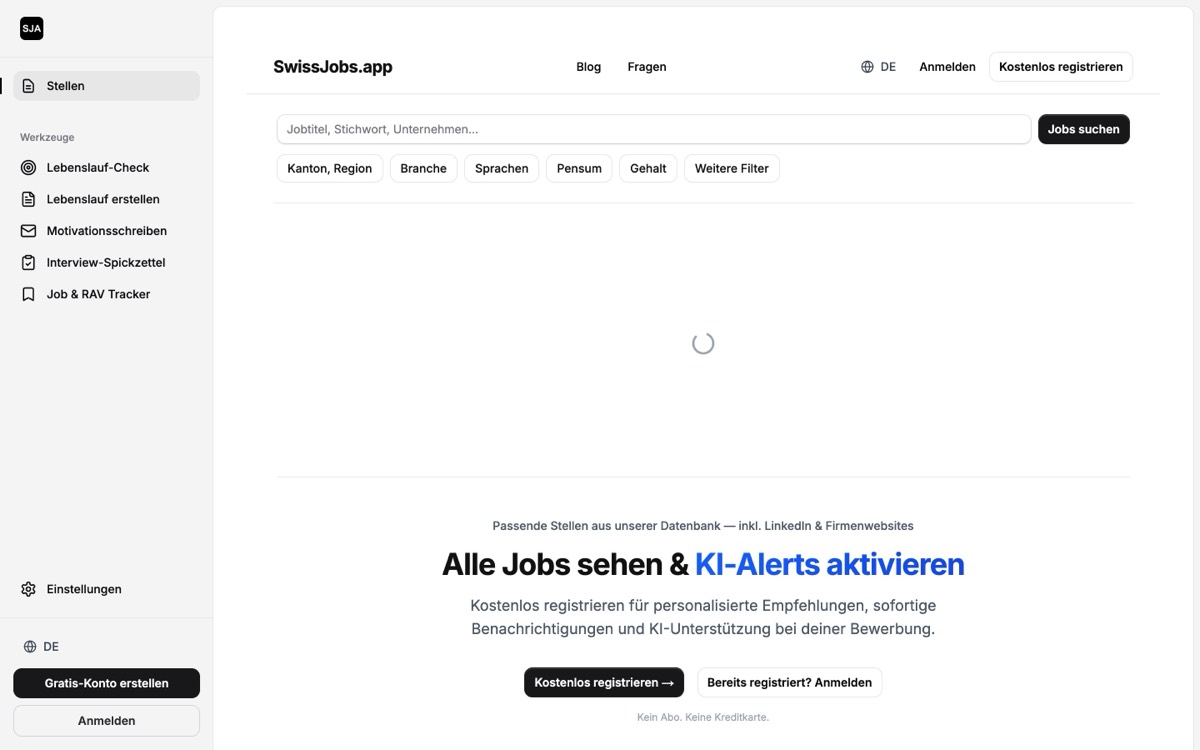
1. SwissJobs.appOur app
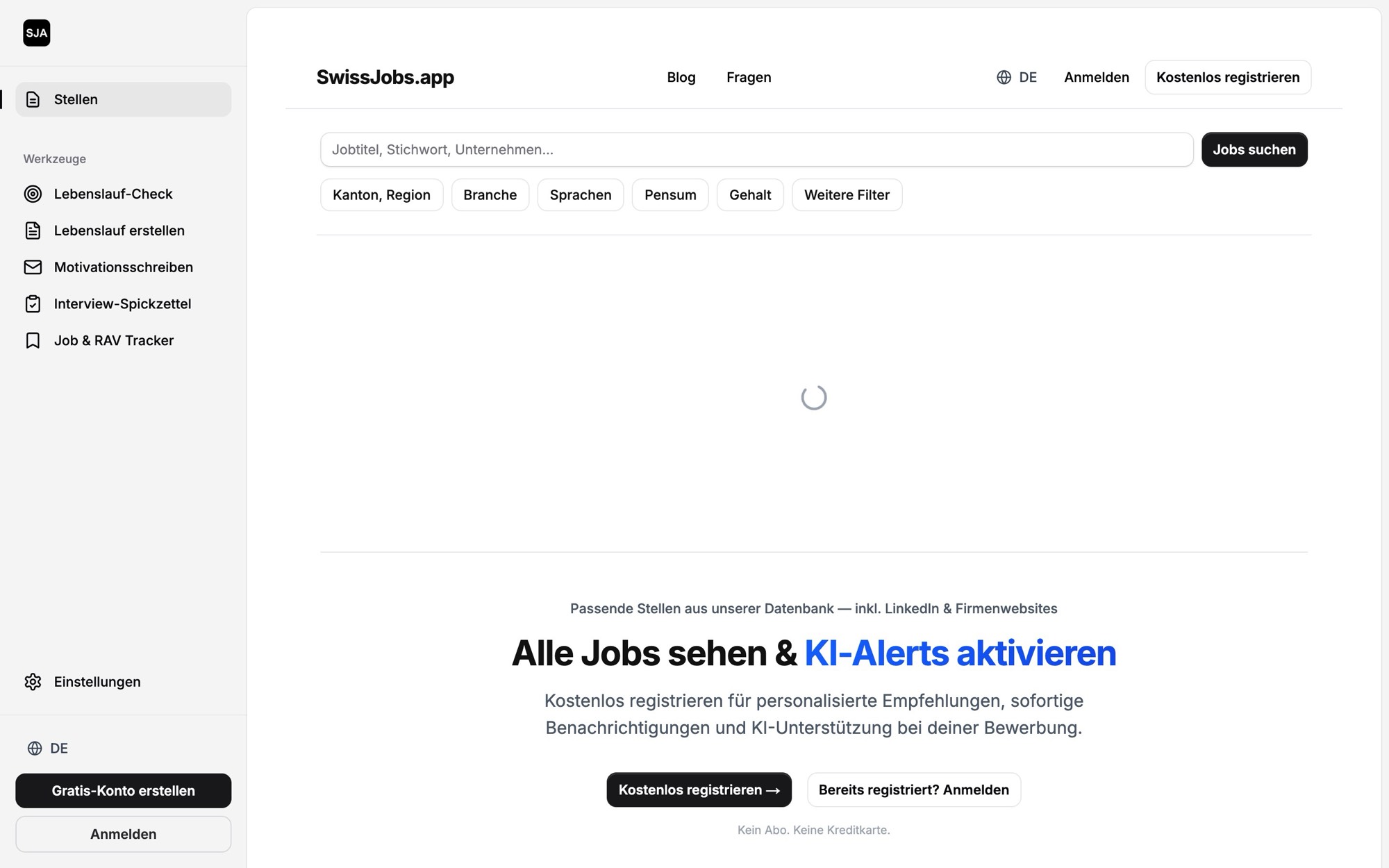
Over 21,000 open Swiss roles from ATS systems, company sites and LinkedIn in one place — and from any advert, straight into a CV, a motivation letter, a CV check and interview prep. The RAV job-search-efforts form fills itself from your application tracker. Free to use; the account is asked for at save.
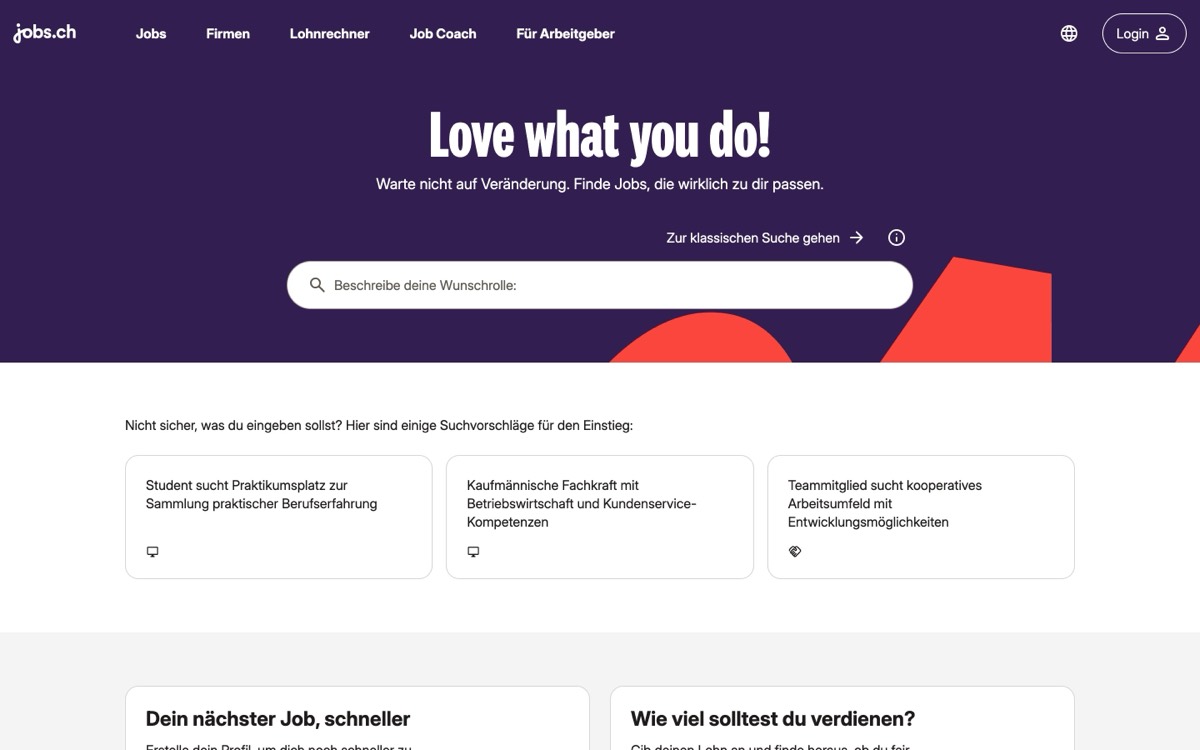
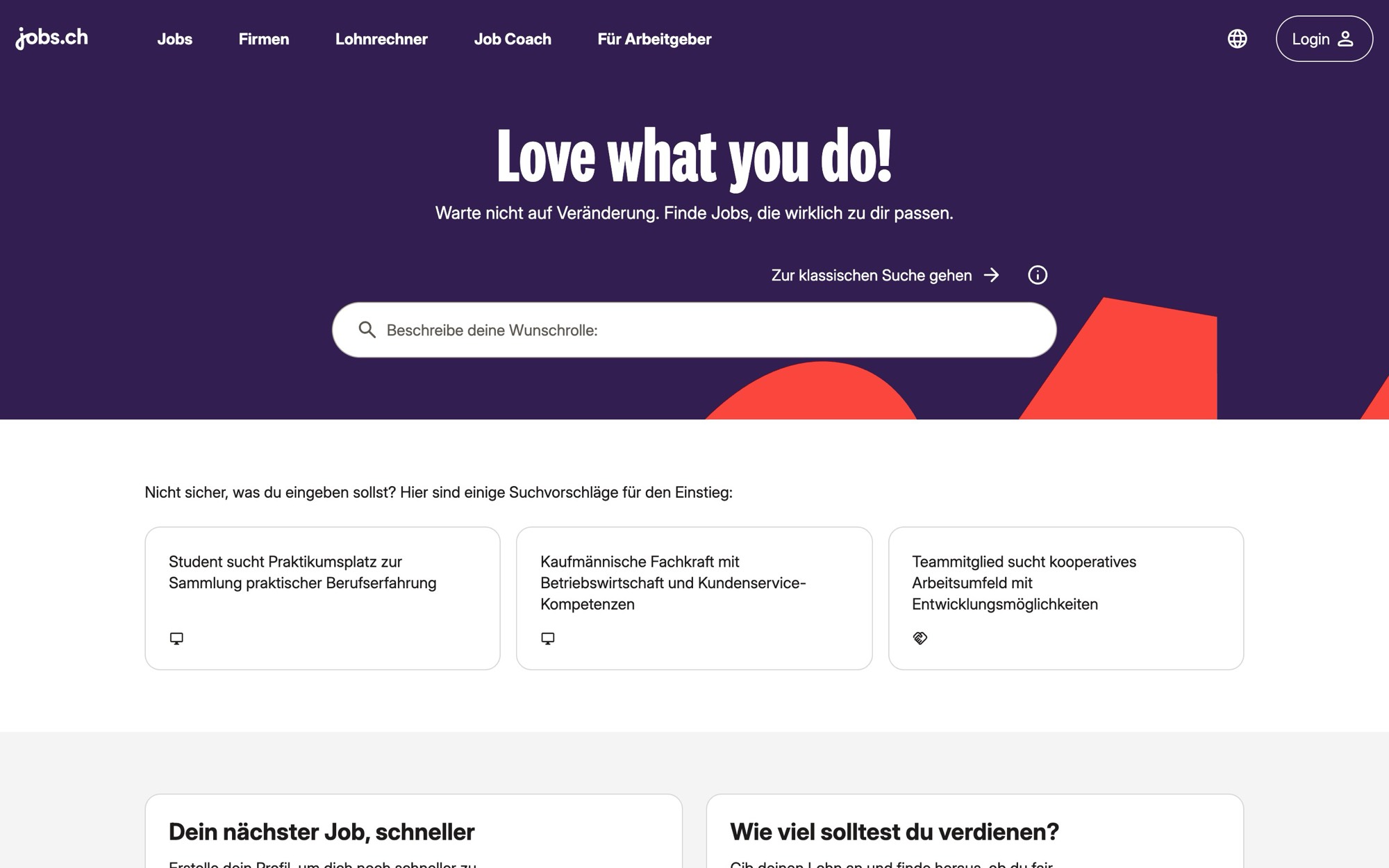
The best-known board in German-speaking Switzerland and the largest index in the country. Owned by JobCloud AG — as are jobup.ch and JobScout24.
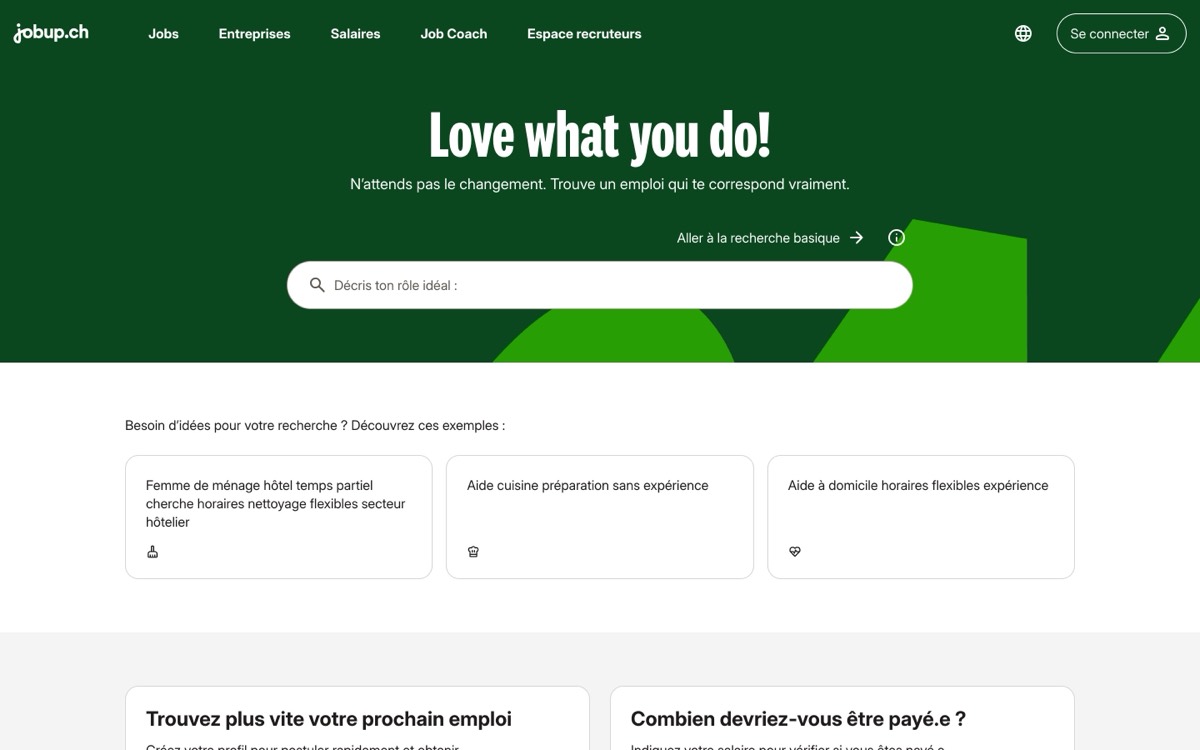
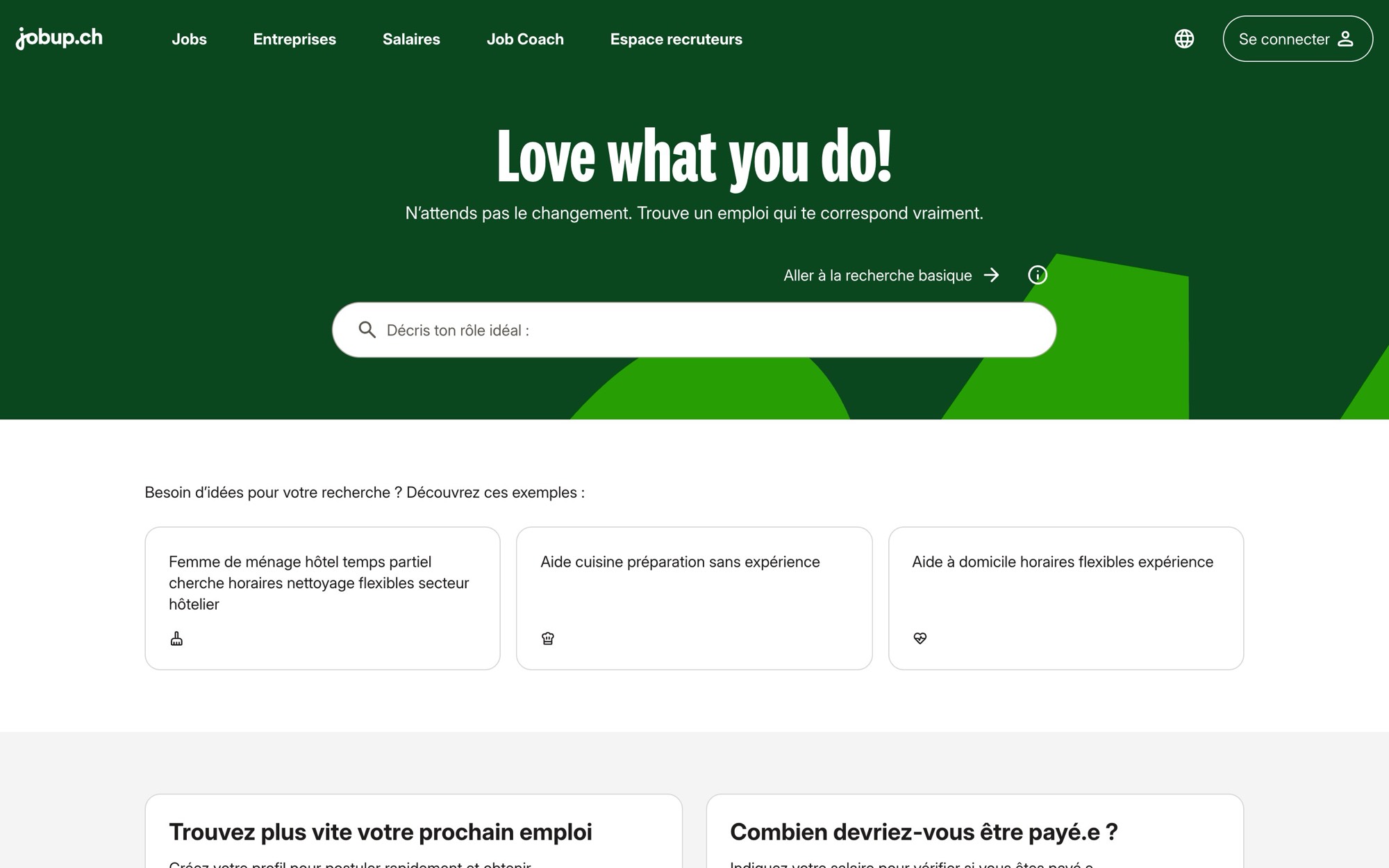
The standard in French-speaking Switzerland and the first place to look for the Romandie — but the same JobCloud AG as jobs.ch.
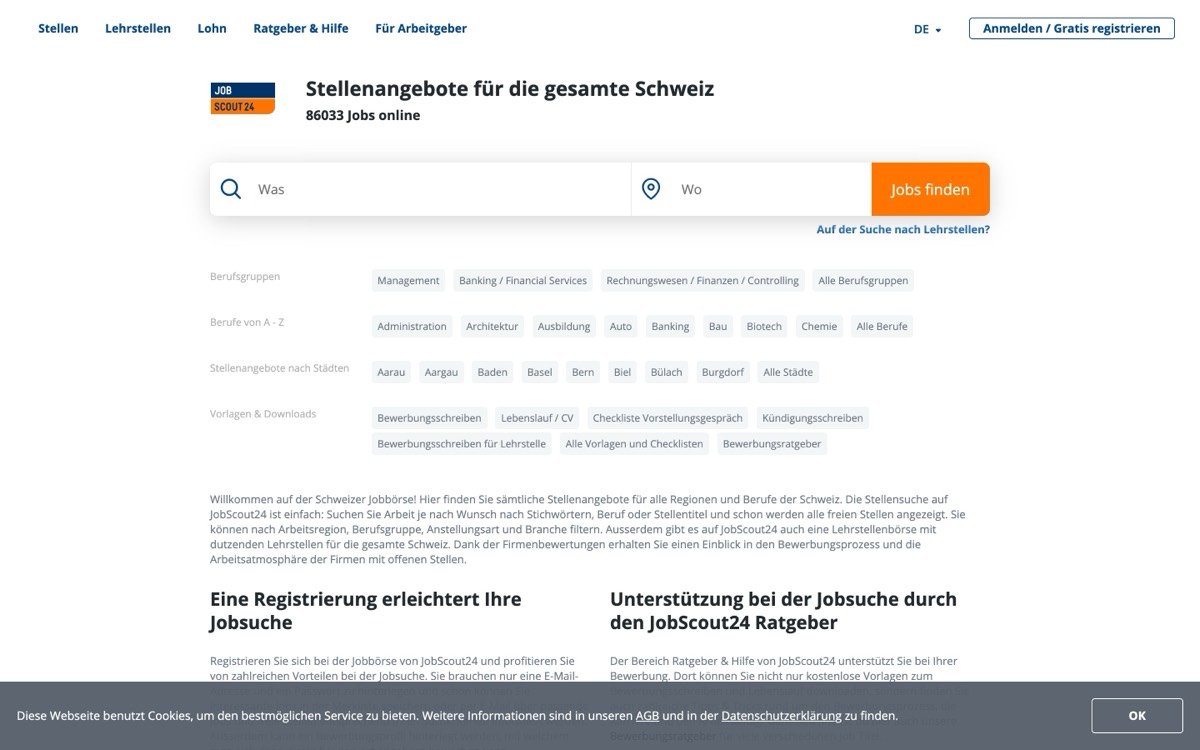
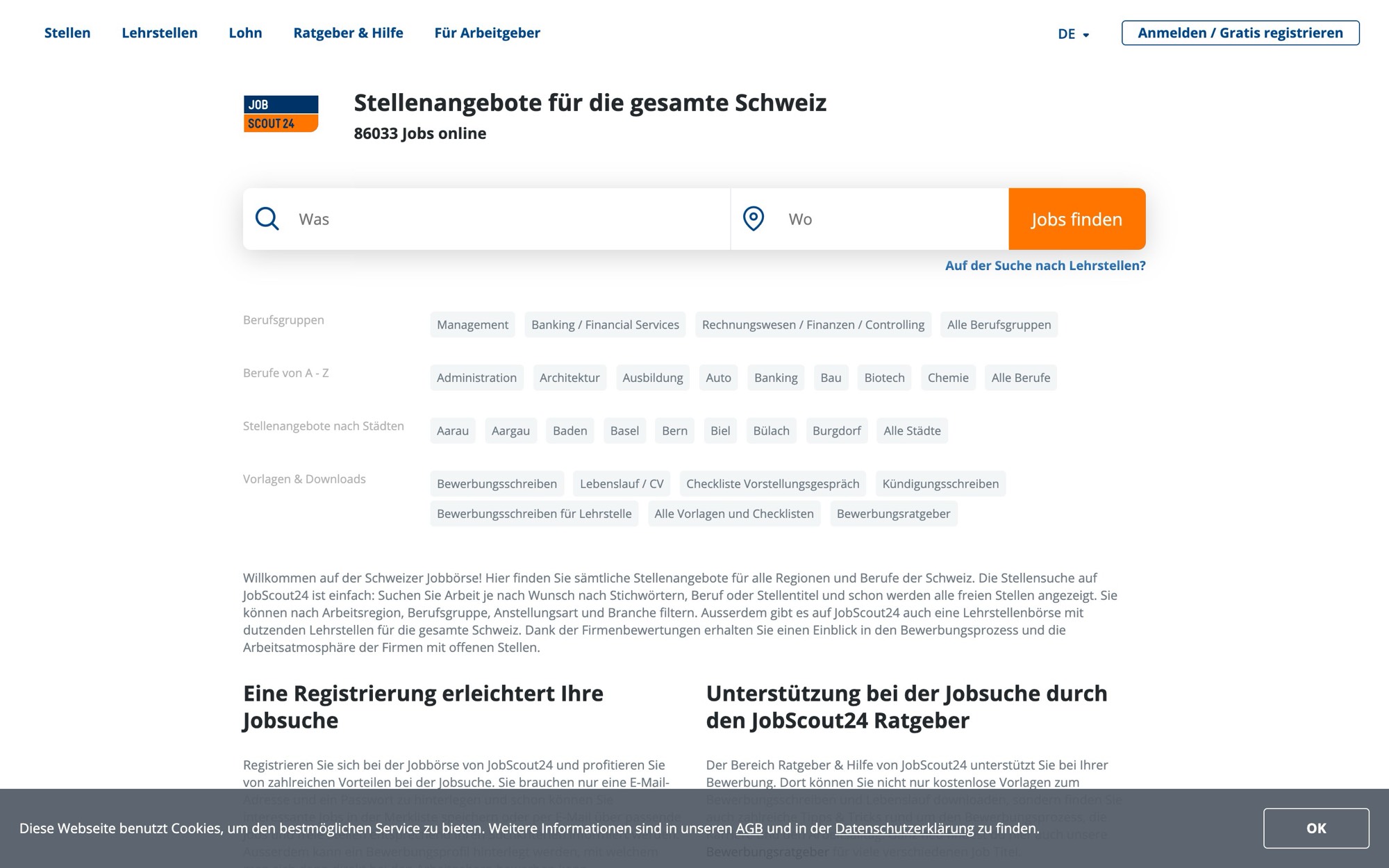
A third brand from the same company. Searching all three to widen your search means searching one provider three times.
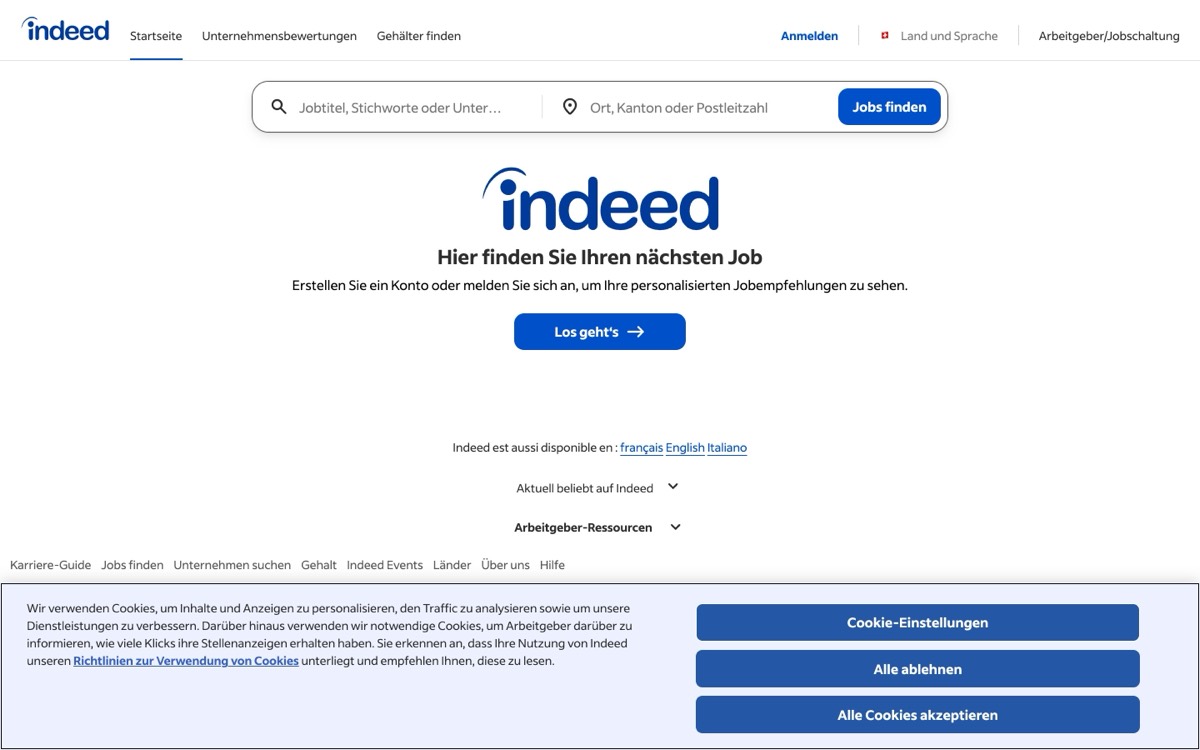
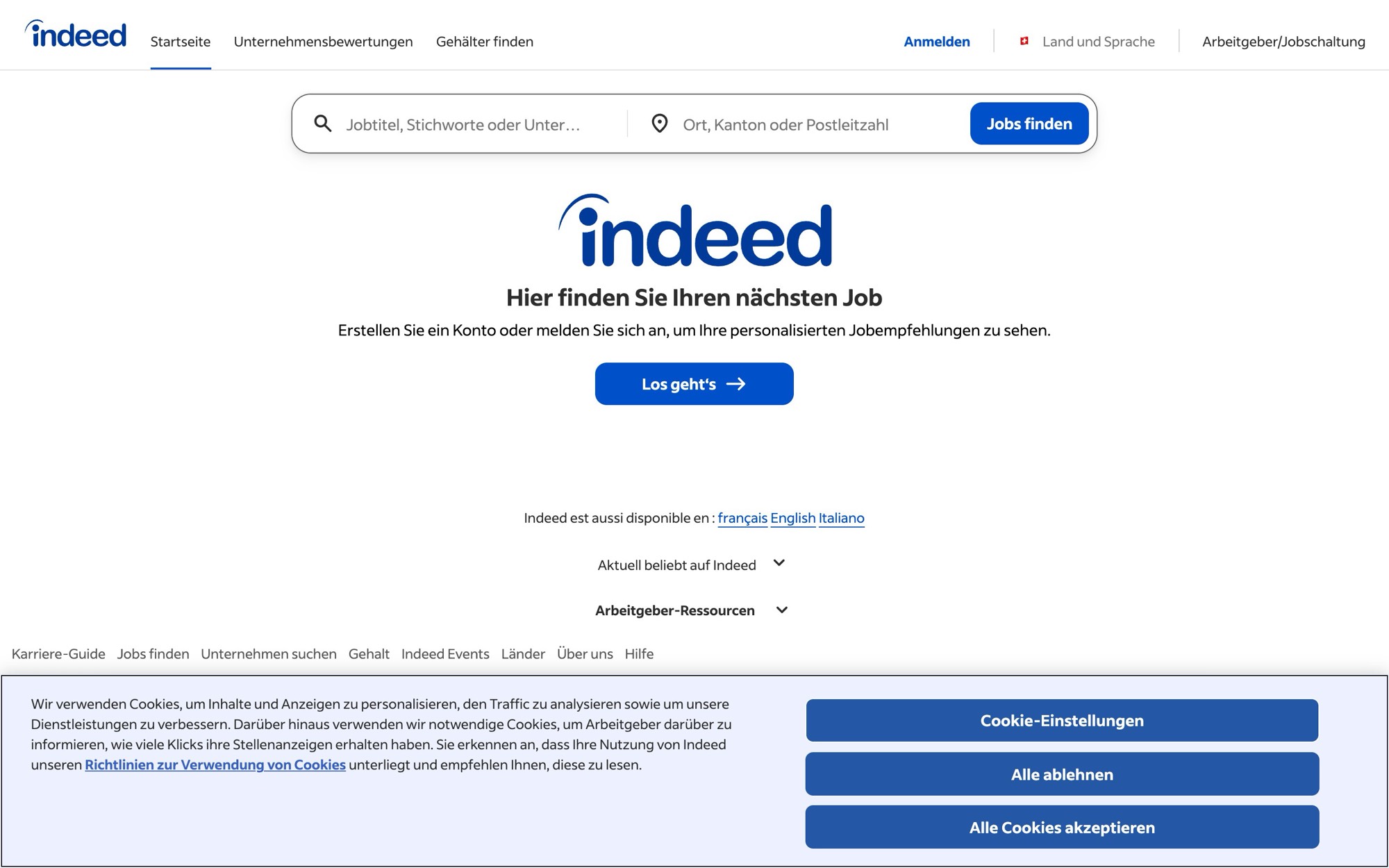
The broadest aggregation, because Indeed also collects from other boards — at the cost of many duplicates of the same advert.
The best reputation for English-speaking and international roles in Switzerland. Considerably thinner for trades, care and commercial roles.
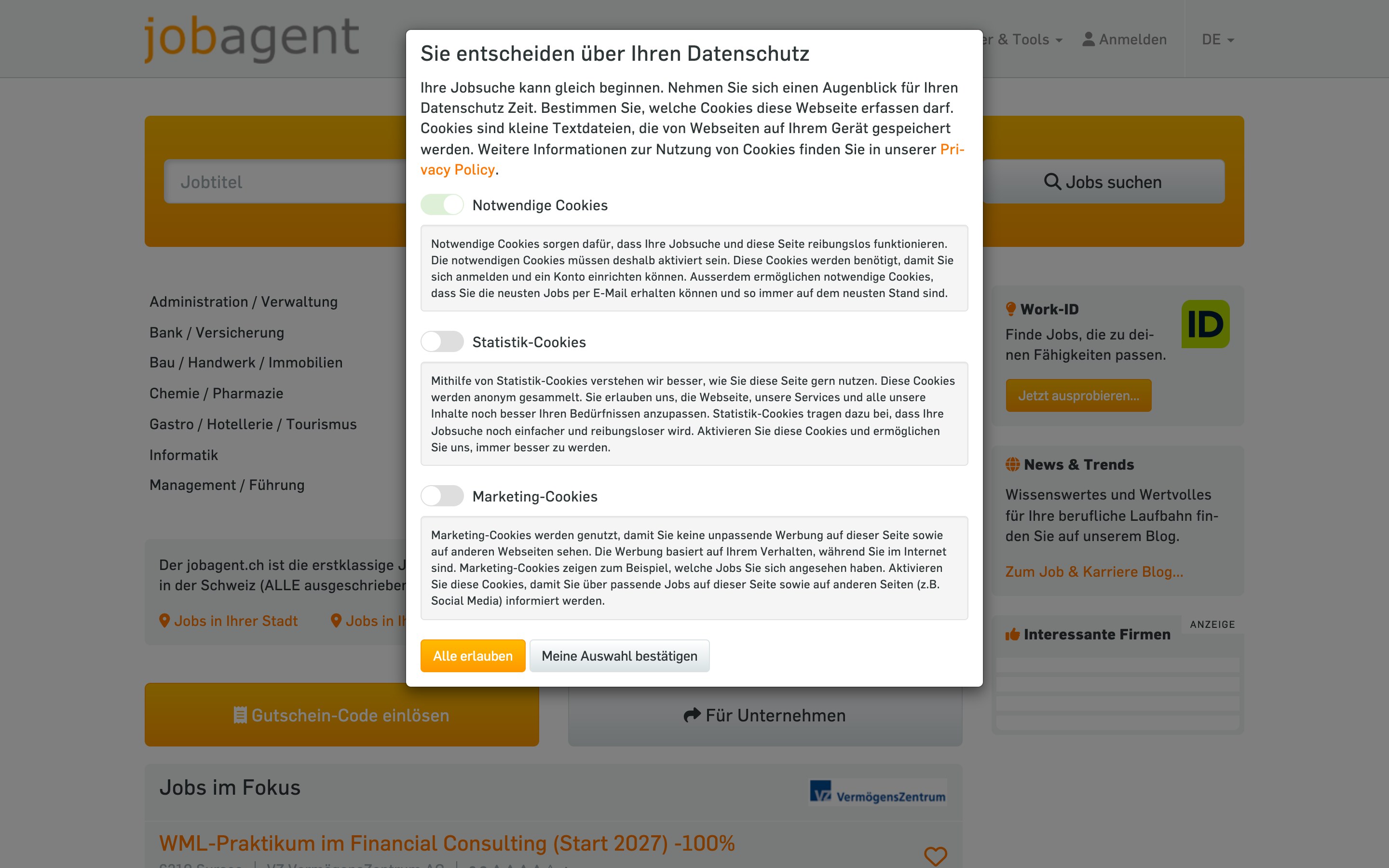
A meta-search across the Swiss job boards, "every job in Switzerland at a glance". Its strength is the Job-Abo: a saved search that mails you new adverts from every portal it covers. Salary calculator and application guides alongside.
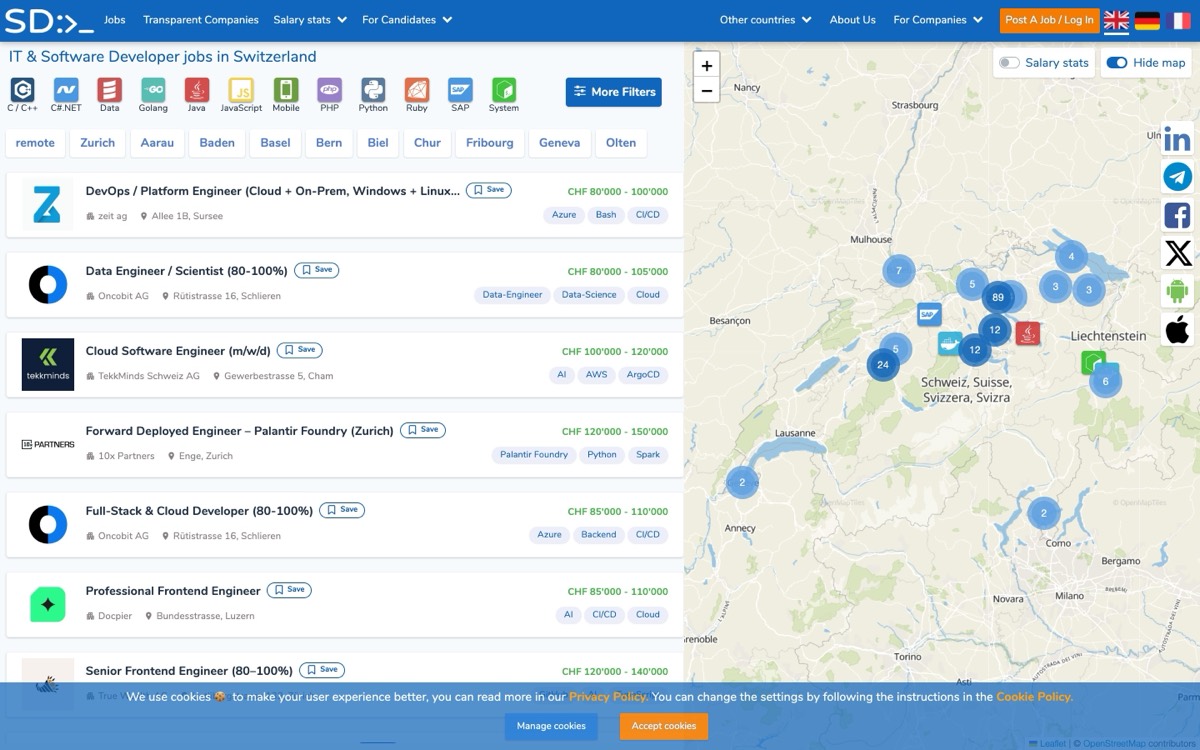
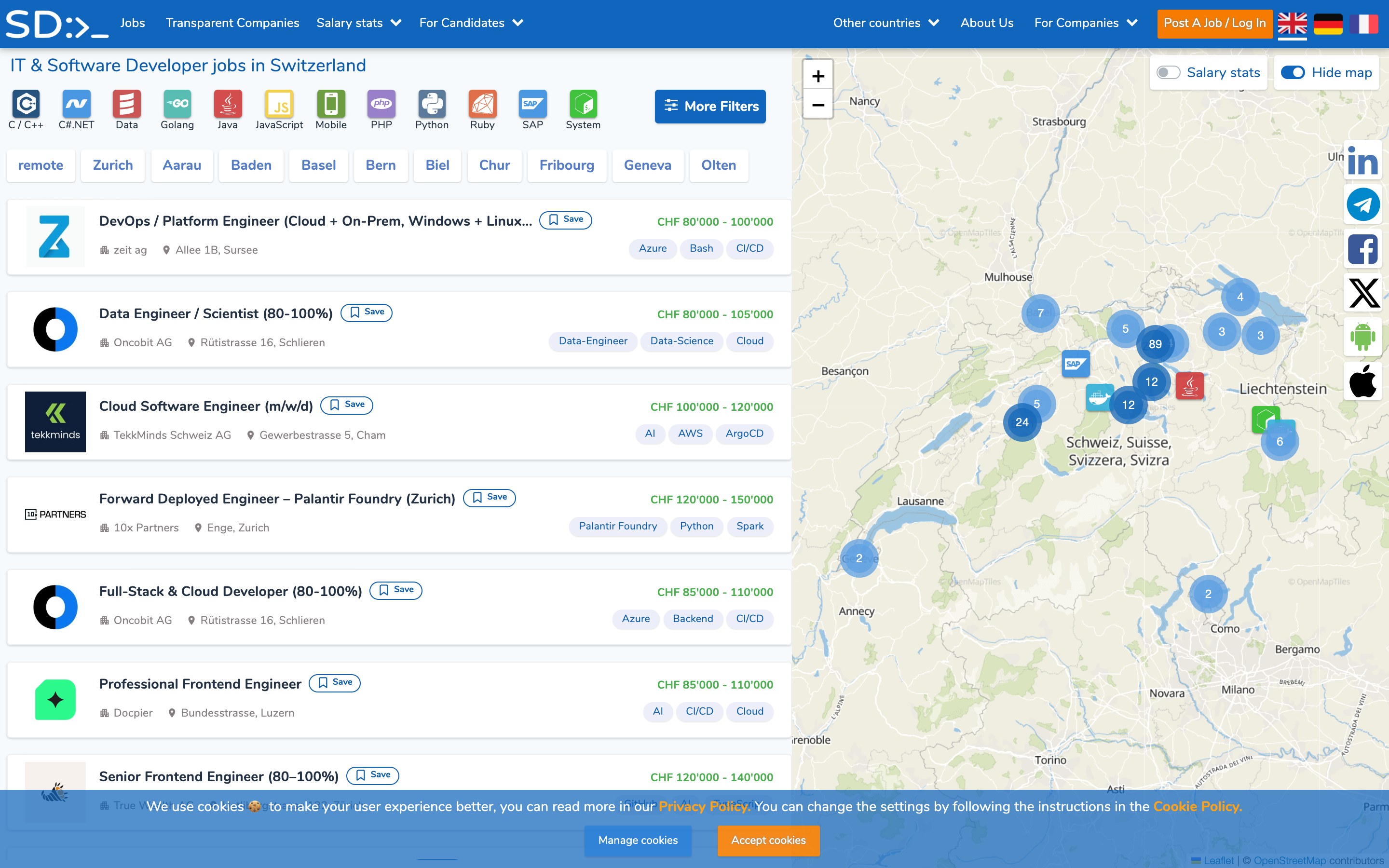
IT and software only, and thorough about it: "183 IT & Software developer jobs in Switzerland", filtered by technology (C#, Java, Python, DevOps, ML) rather than by industry. Publishes salary statistics and lists the companies that disclose their ranges. The site itself is in English.
The second reason a place search comes back thin is the advert itself. Across the open Swiss postings we index, about 22% of location fields name no municipality at all — they give a canton, the country, or a working model; about 1.6% say nothing but "Switzerland". Where a municipality is named, the spelling moves: roughly 85% of postings from the city of Zürich use the umlaut and 15% write "Zurich", and roughly 92% of St. Gallen postings write "St Gallen" with no full stop.
So the sequence that works is always the same. Filter by canton rather than by town, add the neighbouring cantons, then sort by travel time rather than distance. A role twenty minutes away by train in the next canton is closer to your actual day than an address fifteen kilometres away in your own canton with no rail link.
Indexed open postings per resident, 100 = Swiss average. Own analysis of the open Swiss postings we index that carry a recognisable canton, August 2026; population from the FSO permanent resident population, 2025. Basel-Stadt and Basel-Landschaft are combined because postings from the region usually say only "Basel".
- Only about 45% of the postings we index name one of the ten largest Swiss cities as their location — the majority of open roles sit in municipalities that appear on no city list.
- About 22% of location fields are not a municipality at all but a canton, the country or a working model, which is exactly the input a radius search cannot use.
- The federal register of municipalities contains 44 names that occur in more than one canton, covering 96 municipalities or about 4.5% of all Swiss municipalities. "Rickenbach" exists in five different cantons.
- Sion appears in our data almost entirely under its German name "Sitten" — and roughly three quarters of those postings are written in French.
- Only about 3.4% of the postings we index mention home office, remote or hybrid work at all; among English-language postings it is about 6.6%, among Italian-language ones about 0.9%.
- The median posting is about 20 days old nationally, but about 17 days in Bern, about 31 in Vaud and Fribourg, and about 46 in Ticino — how fast a regional list moves is itself regional.
What "near me" statistically means in Switzerland
Before you set a radius, it is worth knowing which radius the country actually lives. For 2024 the Federal Statistical Office counted eight in ten employed people as commuters, 3.7 million in total. Of those, 71% work outside the municipality they live in, up from 58% in 1990. The average journey to work measures 14.0 kilometres and takes 30.2 minutes one way.
That is the figure a naive place search breaks on. Search "jobs in Baden" and you are searching the single town where fewer than three in ten employed residents actually work. The rest of your realistic market sits in Brugg, Wettingen, Zurich, Lenzburg — and for many occupations in Zug, which is a different canton with a different filter setting. The search has to describe that area, not your postal address.
The federal government has even defined the area officially. Since the 2018 revision Switzerland is divided into 101 labour market regions, grouped into 16 larger ones. They were not drawn along cantonal borders but from actual commuter flows: a labour market region is an area in which at least 57% of employed people both live and work. The regions vary enormously in size — the largest, in Graubünden, covers roughly ninety times the area of the smallest, the city of Geneva. Zurich, Geneva and Basel each form a region of their own.
Two things follow for your search. First, your search area is larger than your municipality and smaller than the country, and it follows transport corridors rather than circles on a map. Second, it does not stop at the cantonal border. Someone living in Rothrist has Olten, Zofingen and Aarau within commuting distance, which means Solothurn and Aargau at once. A location filter that knows one canton cuts half of that away.
The mode of transport then decides what "near" even means. 49% of commuters drive, 31% use public transport, and 18% walk or cycle. A rail commuter measures in minutes and changes; a driver measures in kilometres and traffic. Two people at the same address genuinely have two different catchment areas, and they should be running two different searches.
The place name in a posting is a string, not a point on a map
A radius search assumes every advert carries a coordinate. What it actually carries is a sequence of characters somebody typed into a form field. Across the open Swiss postings we index there are well over a thousand distinct location strings — and about 22% of them name no municipality: they give a canton ("Aargau"), the country ("Switzerland", about 1.6% of all postings), or a working arrangement where a place should be.
Where a municipality is named, the spelling drifts. Among postings from the city of Zürich, roughly 85% use the umlaut and 15% write "Zurich". For St. Gallen, roughly 92% write "St Gallen" without the full stop, about 6% write "St. Gallen" and about 3% "Sankt Gallen". Filter literally on one of those forms and you lose the others — and not at random, because the anglicised spelling clusters on internationally advertised roles, which is precisely the segment many newcomers are looking for.
Valais is the clearest lesson. Sion appears in our data almost entirely under its German name "Sitten", even though roughly three quarters of those postings are written in French and they come from more than a dozen different employers. The name in the data field follows neither the language of the advert nor local usage — it follows whatever the employer's recruiting system stored. Search "Sion" and you see a fraction of Sion.
And sometimes the place is not a place. Valais contains a municipality called Fully, which is also the first word of a very common English phrase for location-independent work. Under that location string our data therefore also holds roles whose actual workplace is on another continent. Any search that reads text as geography is blind to the difference.
The remedy is unglamorous but effective: use the canton filter as your base rather than the town field, and check the workplace in the body text of every posting that interests you before you calculate a journey time. The location line at the top of an advert is a hint, not evidence.
Same name, different canton
The federal register of municipalities lists roughly two thousand municipalities across 26 cantons and 144 districts as of the start of 2026. The register itself appends canton abbreviations wherever names would otherwise collide — and collide they do: 44 municipality names occur in more than one canton, covering 96 municipalities, about 4.5% of the total.
The list reads like a catalogue of search traps. "Rickenbach" exists in five cantons: Basel-Landschaft, Lucerne, Solothurn, Thurgau and Zurich. "Buchs" exists in Aargau, St. Gallen and Zurich; "Wald" in Appenzell Ausserrhoden, Bern and Zurich. Then come the better-known pairs: Wil in St. Gallen and Zurich, Wohlen in Aargau and Bern, Muri in Aargau and Bern, Gossau in St. Gallen and Zurich, Kirchberg in Bern and St. Gallen, Reinach in Aargau and Basel-Landschaft.
Job adverts routinely drop the abbreviation. About 2.2% of the postings we index sit on such a bare name — "Wil", "Wohlen", "Muri", "Buchs", "Gossau", "Kirchberg" with nothing attached. That produces two errors at once: roles genuinely near you never surface because the search files them under another canton, and roles two hours away surface because they happen to share a name.
Once you know the pattern it is easy to handle. If your town carries one of these names, always search with the suffix — "Wil SG", "Wohlen AG" — and for any hit without a suffix, look at the employer first. A hospital, a municipal administration or a local manufacturer identifies the canton far more reliably than the location field does.
Canton plus neighbours: the arithmetic your search box never does
The single biggest lever in a near-me search is mundane: include the neighbouring cantons. Swiss cantons are small, so for most addresses more of the reachable market lies across the border than inside it. Run that through the postings we index that carry a recognisable canton and the magnitudes are stark.
Zug accounts for about 3% of those postings. Add Zurich, Lucerne, Schwyz and Aargau — all ordinary commuting distance from a Zug address — and you reach about 42%. That is a factor of fourteen. Aargau grows from about 6.7% to about 55%, a factor of eight. Thurgau grows from about 2.2% to about 32%. Schaffhausen, hemmed in by the German border, still grows from about 0.8% to about 28% once Zurich and Thurgau are included.
The same arithmetic holds in the French-speaking west. Neuchâtel alone carries about 2.5% of the postings; together with Bern, Vaud, Fribourg and Jura it carries about 25%, a factor of about ten. Fribourg grows from about 4.1% to about 25%, Valais from about 2.9% to about 22%. None of these involve exotic distances — they are journeys tens of thousands of people make daily.
These multipliers are not an argument for searching everywhere at once. They are an argument against the standard failure, in which somebody picks one canton, reads three pages of results and concludes that their region has nothing. In almost every case the region does have something; it is one canton over, and often closer to home than their own cantonal capital.
In practice, run two searches side by side. A narrow one on your own canton that you work through weekly, and a wide one across the canton plus its neighbours that you filter by travel time. The wide search returns fewer useful hits per click, but it is the one that surfaces roles your competitors never see.
How thick the market actually is where you live
Regions do not carry equal numbers of open roles per head, and that is the second number worth knowing before you decide your search has failed. Setting the postings we index that carry a recognisable canton against the FSO permanent resident population, and indexing the Swiss average at 100, produces a range from roughly 200 down to under 40.
Zug sits at about 202, more than twice the national density. Zurich follows at about 140, the Basel region at about 131, Lucerne at about 130 and Geneva at about 129. Bern lands almost exactly on the average at about 96. Below that begins the other half: Aargau about 82, Vaud about 71, St. Gallen about 70, Thurgau about 68 — and Ticino about 39, under a fifth of the density in Zug.
The result for Zug and Basel matches an official observation: the FSO notes that relative to their size, Zug and Basel-Stadt attract the most commuters from other cantons. These are not cantons with many residents but cantons with many workplaces per resident. Conversely a low density is not a verdict on your chances — it simply tells you that your radius has to be wider than someone's in Zug.
Two caveats belong with the number. First, like any job board we do not capture every advert with equal completeness; in the smallest cantons the count is small enough that we deliberately do not publish a density for them. Second, density measures stock, not flow — a region with few but fast-turning roles can be more productive for you than one with many long-running adverts.
What else changes with the region
Proximity decides not only how many roles you see but which ones. The median posting we index is about 20 days old nationally. In Bern, Aargau, Zurich, St. Gallen and Valais that sits at 17 to 18 days; in Vaud and Fribourg at about 31 days; in Ticino at about 46. In a region with older adverts the answer is not to be faster but to be more persistent — a vacancy there often stays open until somebody genuinely fits.
Working hours are regional too. Nationally about 5.5% of the postings we index are explicitly part-time. In Schaffhausen that is about 12.5%, in Graubünden about 10.2%, in Solothurn about 10.1% and in Schwyz about 9.7% — against about 2.7% in Fribourg, about 3.3% in Geneva and about 3.5% in Vaud. Reduced hours are advertised far more openly across the German-speaking countryside than in the western urban centres.
Then there is who is doing the advertising. In smaller cantons the list hangs on a handful of names: in Ticino about 42% of the postings we index come from a single advertiser, in Lucerne the five largest account for about 46%, in Thurgau about 46%. At the same time, in each of those cantons roughly half to two thirds of employers have exactly one open advert. If a regional list looks thin, it is often because one large advertiser fills the first pages — the interesting part is further down.
Finally, a radius in Switzerland can cross a language border. In canton Fribourg about 46% of the postings we index that state a language requirement ask for German and about 55% for French; in Valais about 24% ask for German and about 26% for French. Anyone searching around Murten, Biel or Sierre is searching two labour markets at once, and should have application documents ready in both languages.
When "near me" should mean "no commute at all"
The most radical answer to the proximity question is to abolish the journey. The adverts show little of it: only about 3.4% of the open Swiss roles we index mention home office, remote or hybrid work anywhere in the title or summary. Among English-language postings it is about 6.6%, among German-language ones about 3.1%, French about 2.0% and Italian about 0.9%.
That measures what gets advertised, not what gets practised — plenty of employers settle home office in the contract conversation and never write it into the advert. Which is exactly why the figure is useful as an expectation: solving the location problem with a remote filter narrows you to a very thin slice of the Swiss market and cuts away almost everything genuinely inside your commuting range.
The more productive route is travel time. FSO figures put 17% of commuters on the railway and 14% on public road transport; for them a role at a rail junction is nearer than one in their own village with no connection. Drivers do the sum differently. Either way it takes five minutes to check before applying, and it beats any radius slider.
The search that actually works
Set the canton as your base filter, not the town. Add the bordering cantons as soon as your address is anywhere near a border — which in Switzerland is most addresses. Sort the list by date before you work through it, and read the workplace out of the body text rather than the header. If your town's name occurs in several cantons, search with the canton abbreviation attached.
Build a weekly routine rather than one broad search. Regional lists are short enough to review completely, and that is precisely their advantage over the big centres: where less is advertised in total, fewer people usually apply per role.
Do not skip the official channel. Job-Room, the portal of the Swiss public employment service, carries the vacancies reported to the regional employment centres and lets you search by region as well; roles in occupations with above-average unemployment are subject to a reporting duty and appear there first. That list is smaller than the open market, but it holds adverts that never surface elsewhere.
And keep in mind that "near me" is a decision, not a property of your address. Thirty minutes is the Swiss average, not your ceiling. In most regions, widening the radius by ten minutes shifts your odds more than any amount of CV polishing.
Shares come from a rolling analysis of the open Swiss postings we index, August 2026; about 90% of them can be attributed to a canton. Commuting, population and municipality figures come from the Swiss Federal Statistical Office.
Sources
Related questions
What our job index says about the Swiss market
Computed live from our own index, not quoted from a study. Shares only, as of today.
Language the advert is written in
- Deutsch
- 60%
- English
- 23%
- Français
- 13%
- Italiano
- 3%
Of adverts that state a language requirement, the share asking for
- Deutsch
- 70%
- English
- 43%
- Français
- 21%
- Italiano
- 3%
19% posted in the last 7 days · Largest markets: Zürich 18% · Bern 10% · Genève 5% · Basel 5%