Where do I find jobs in Switzerland if I am over 50?
Updated:
In short
Searching by age finds nothing — an age phrase such as «50+» appears in almost no Swiss advert, so there is no segment to aim at. What exists is a years-of-experience threshold, and it is concentrated in one place. Only 8.1 per cent of the advert texts we analyse name a number of years at all, and 73.6 per cent of the adverts demanding five years or more are written in English. In German-language adverts a year threshold appears in 0.9 per cent of cases. Search by occupation, location and workload instead.
This page explains publicly available figures and services; it is not advice. Whether you qualify for viamia or for unemployment insurance benefits is decided by the contact point in your canton of residence or by your regional employment centre, not by this page. Cantonal practice differs.
The Swiss job portals at a glance
Click an image for the full-size view. What each portal actually is stands beside it.
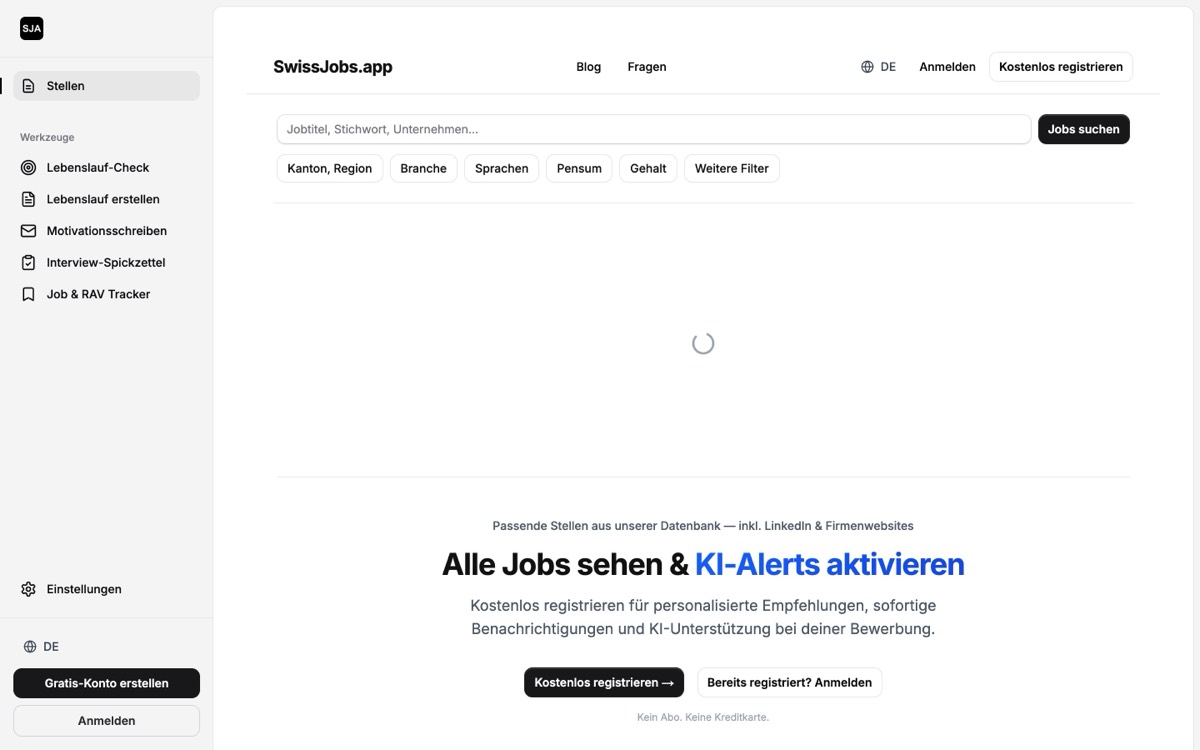
1. SwissJobs.appOur app
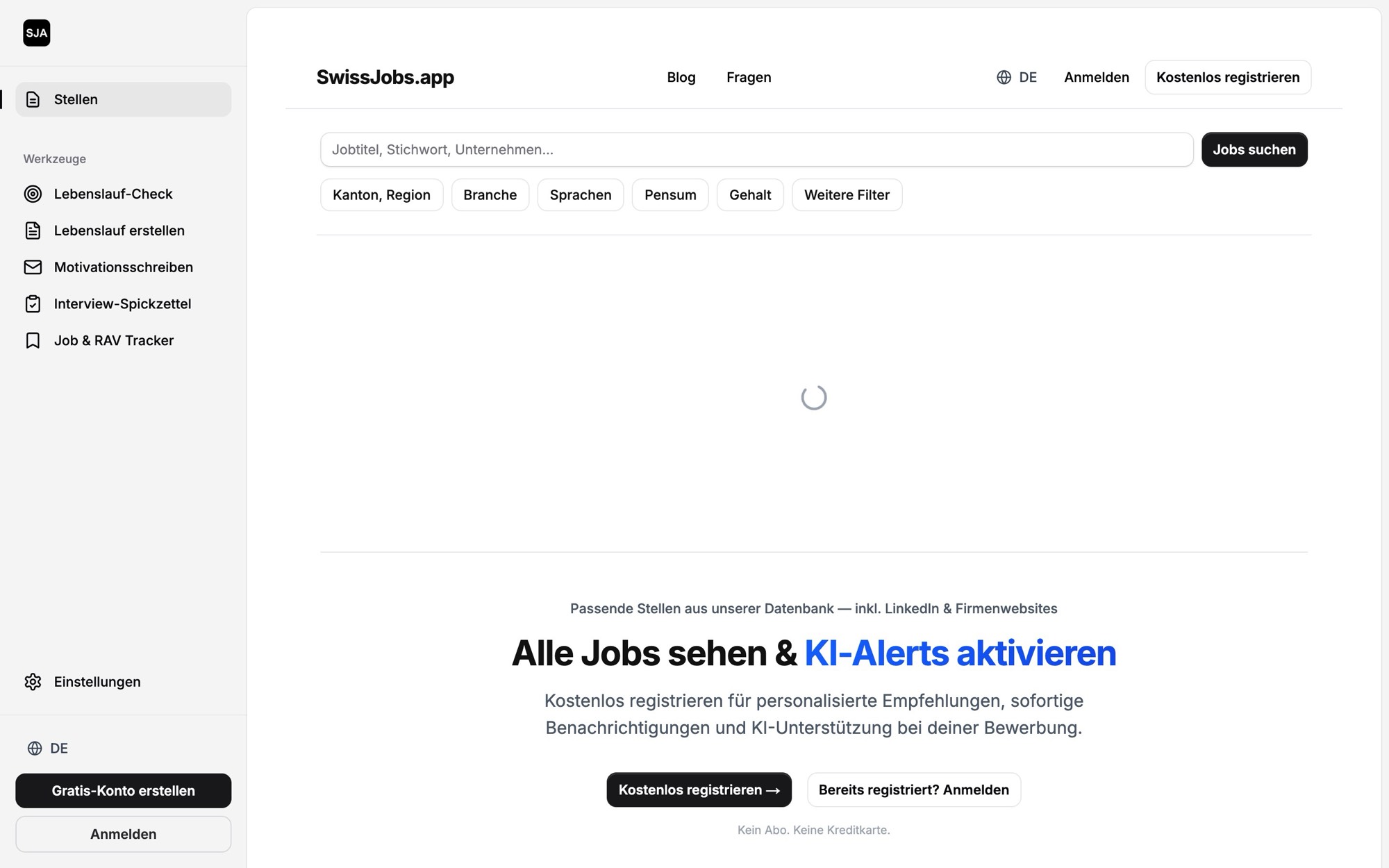
Over 21,000 open Swiss roles from ATS systems, company sites and LinkedIn in one place — and from any advert, straight into a CV, a motivation letter, a CV check and interview prep. The RAV job-search-efforts form fills itself from your application tracker. Free to use; the account is asked for at save.
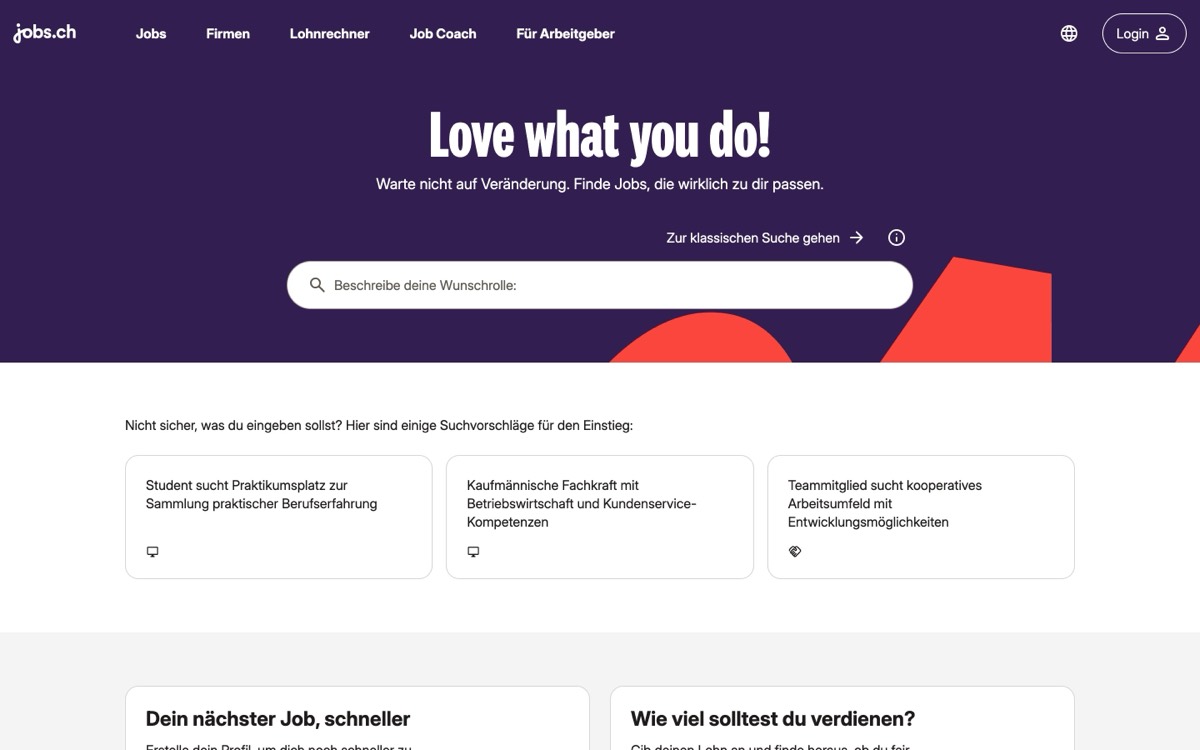
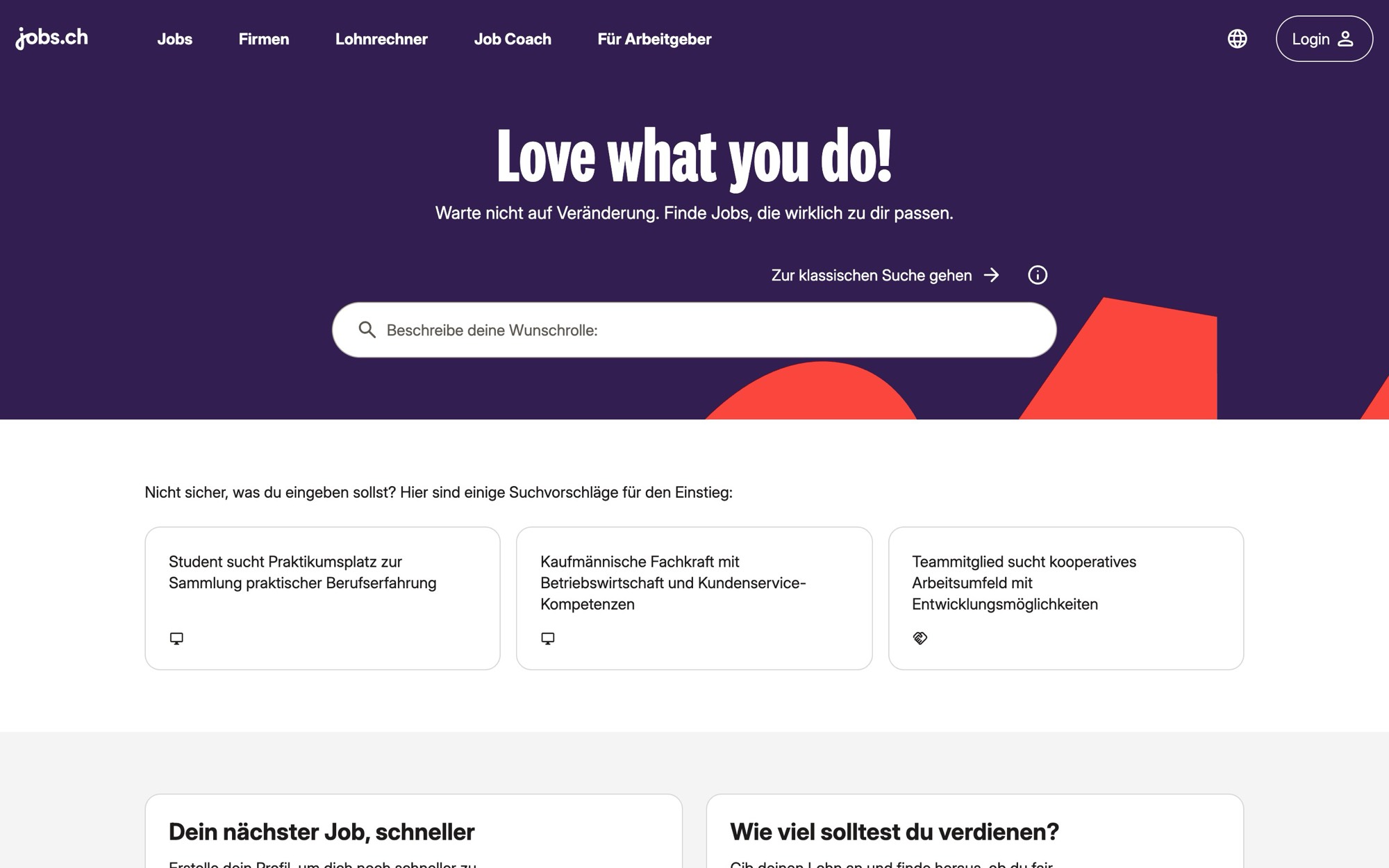
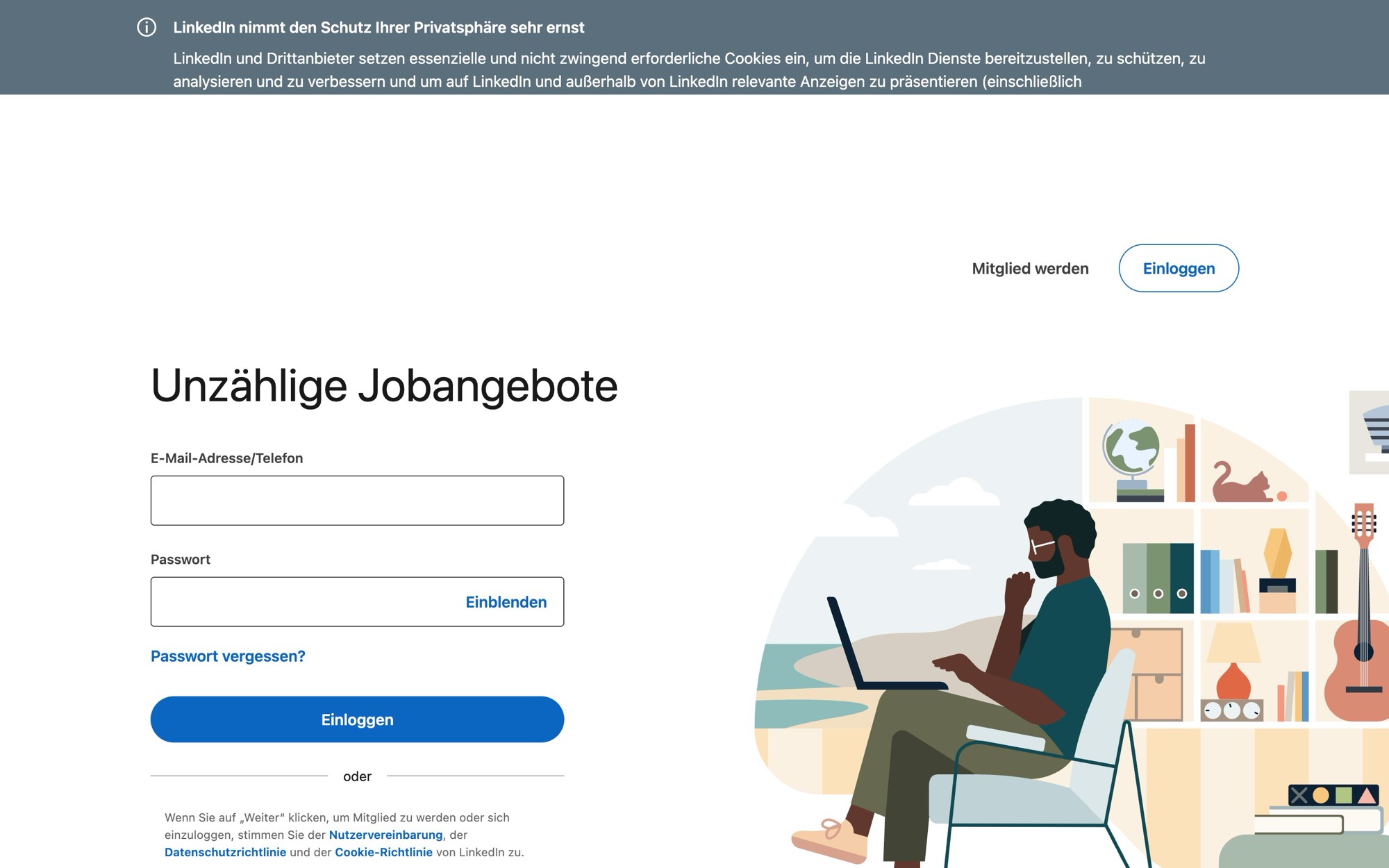
The best-known board in German-speaking Switzerland and the largest index in the country. Owned by JobCloud AG — as are jobup.ch and JobScout24.
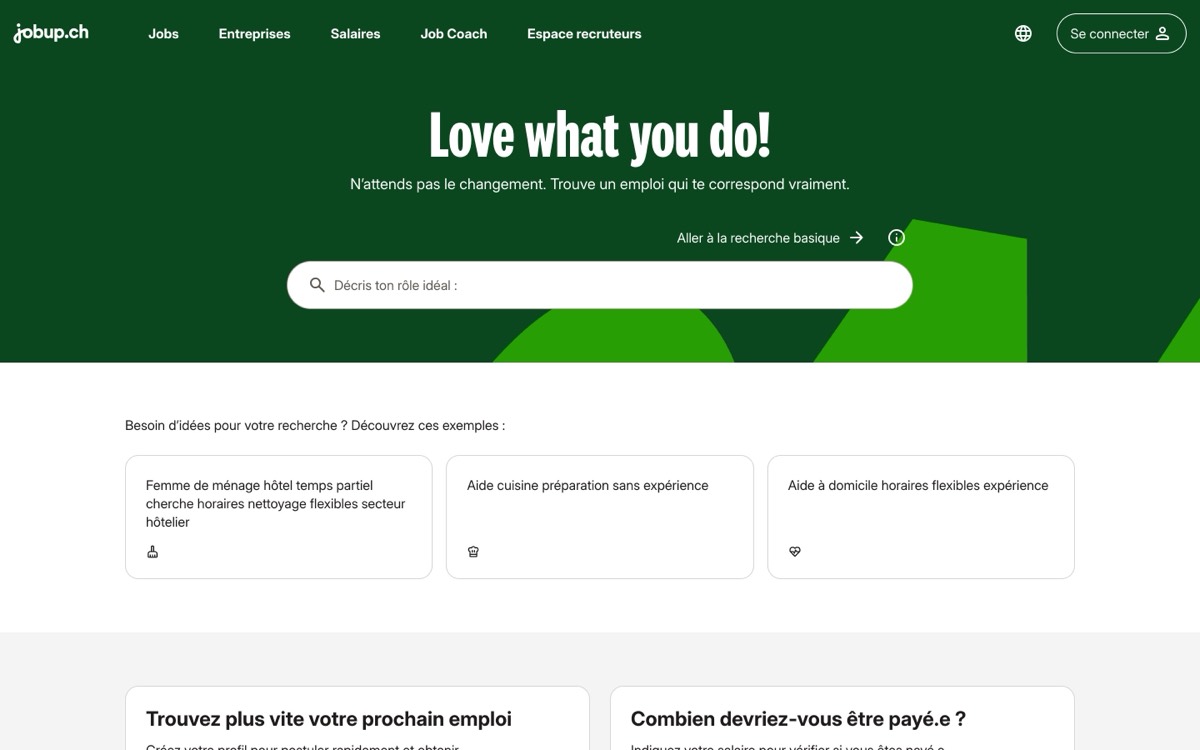
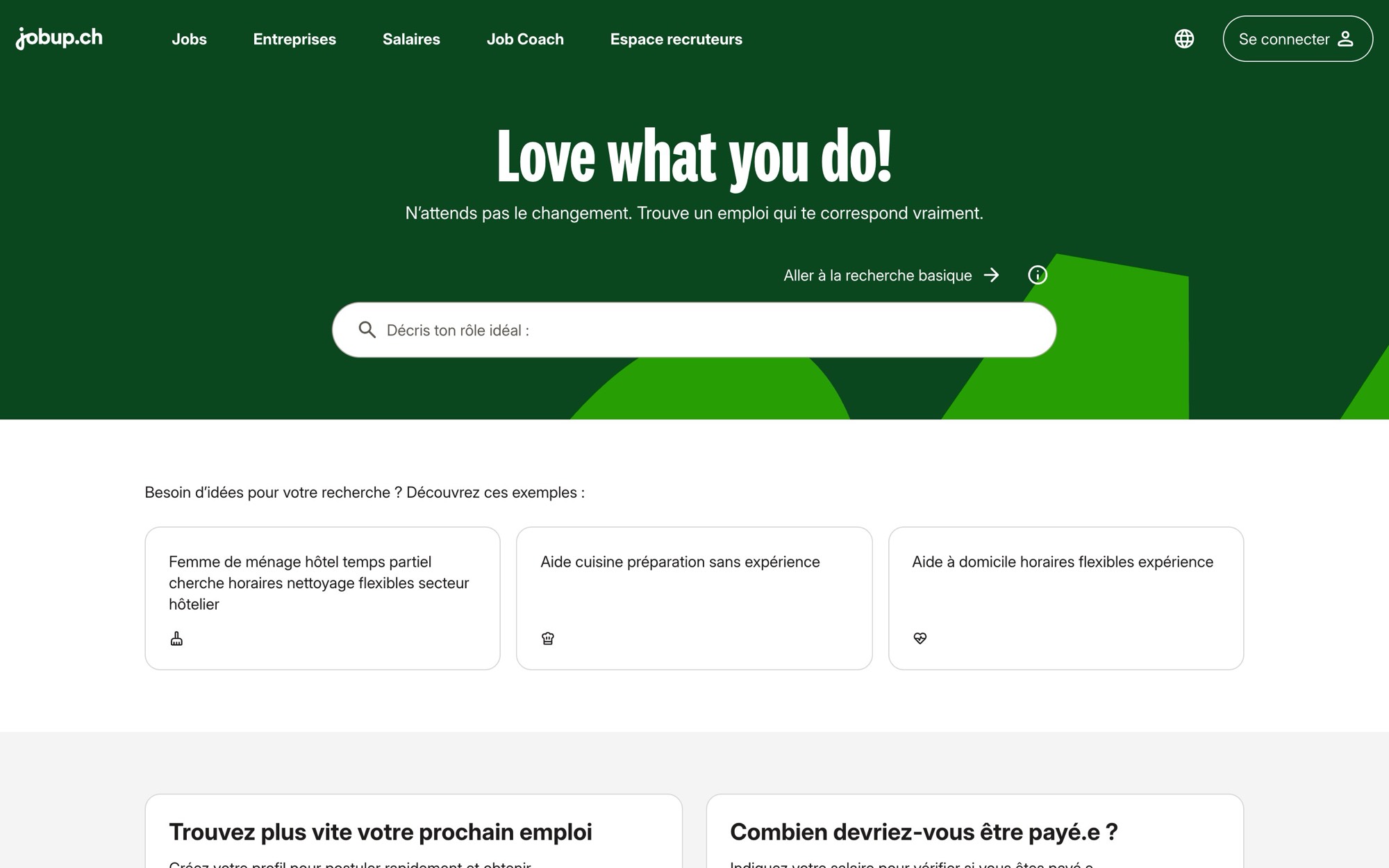
The standard in French-speaking Switzerland and the first place to look for the Romandie — but the same JobCloud AG as jobs.ch.
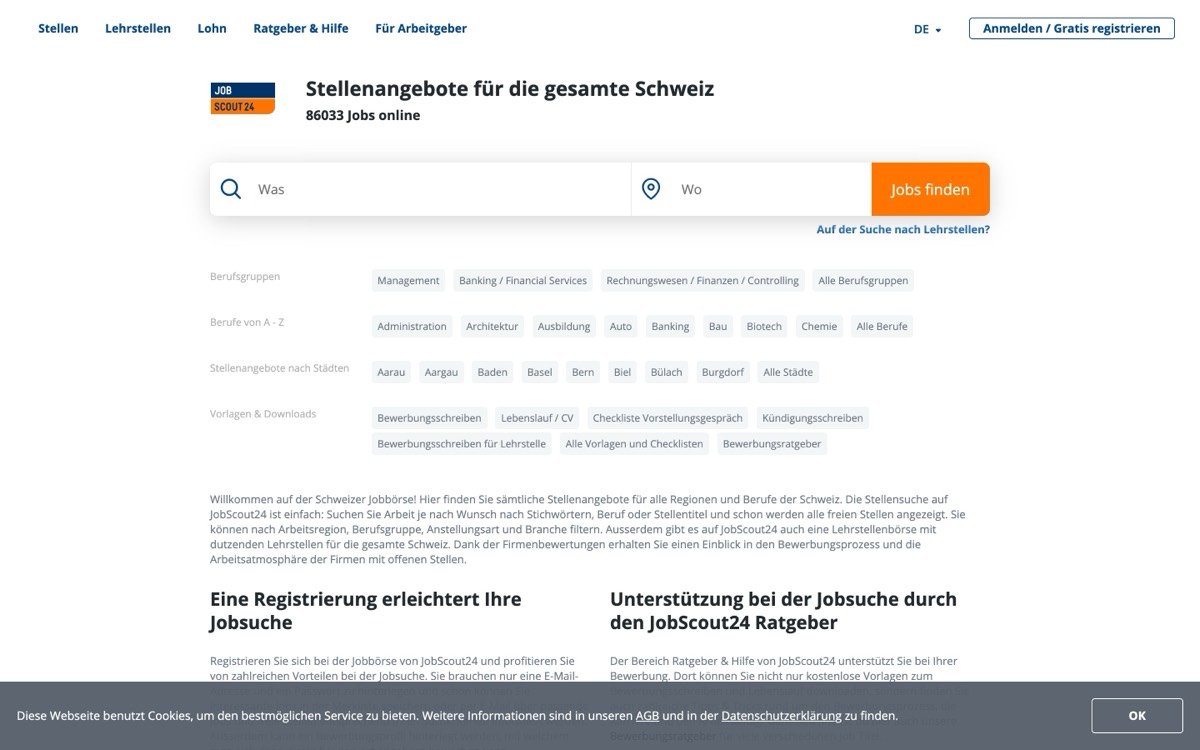
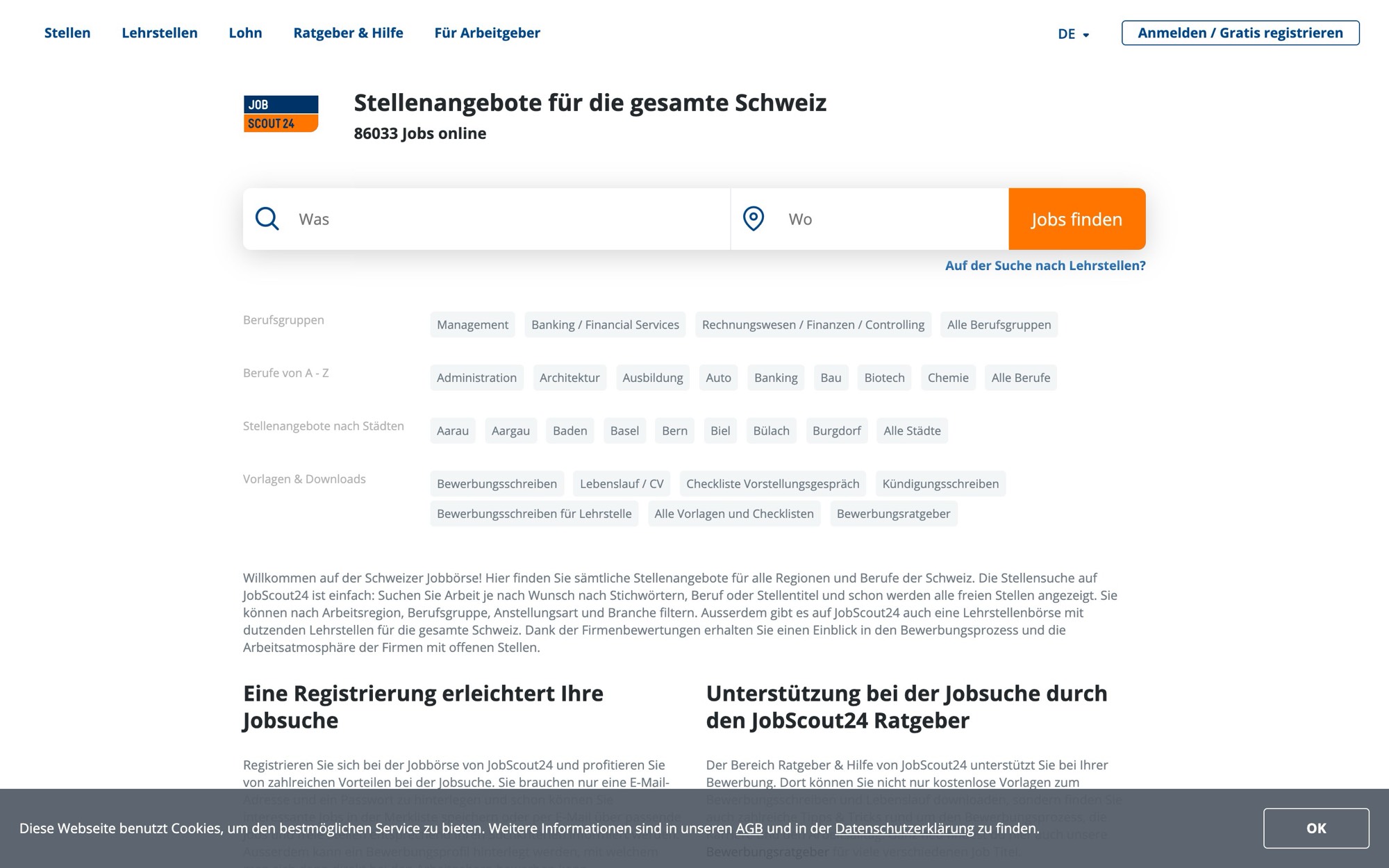
A third brand from the same company. Searching all three to widen your search means searching one provider three times.
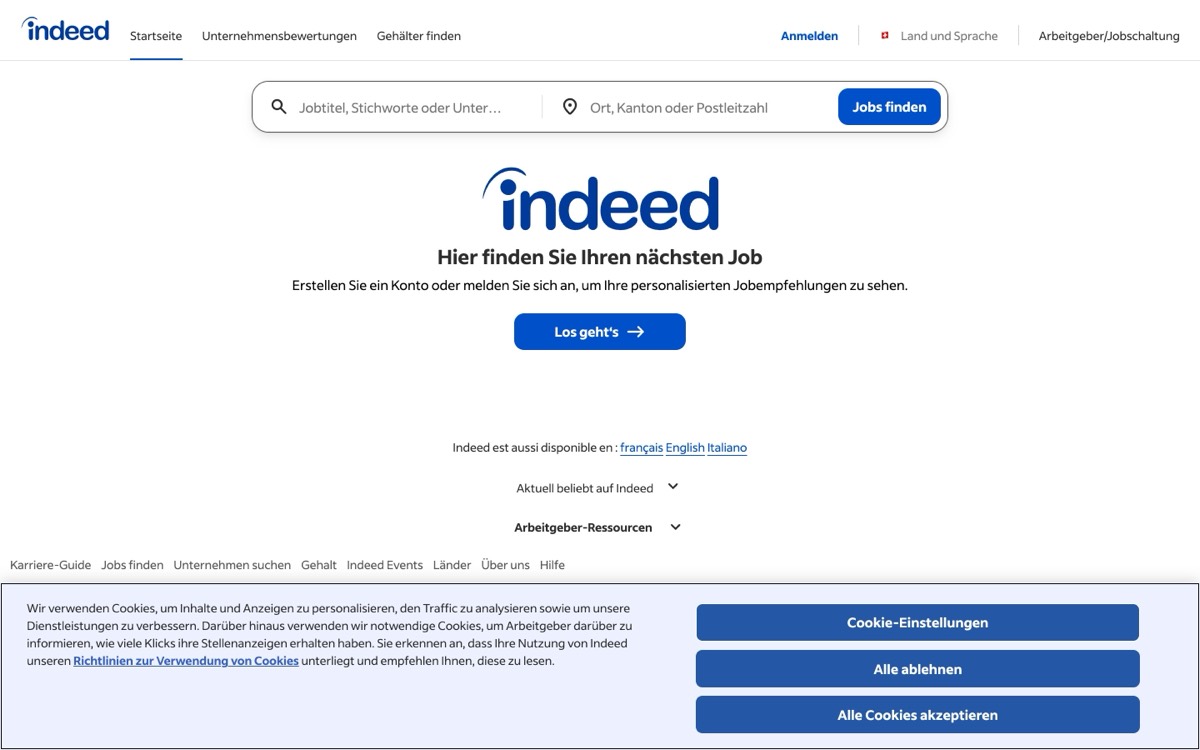
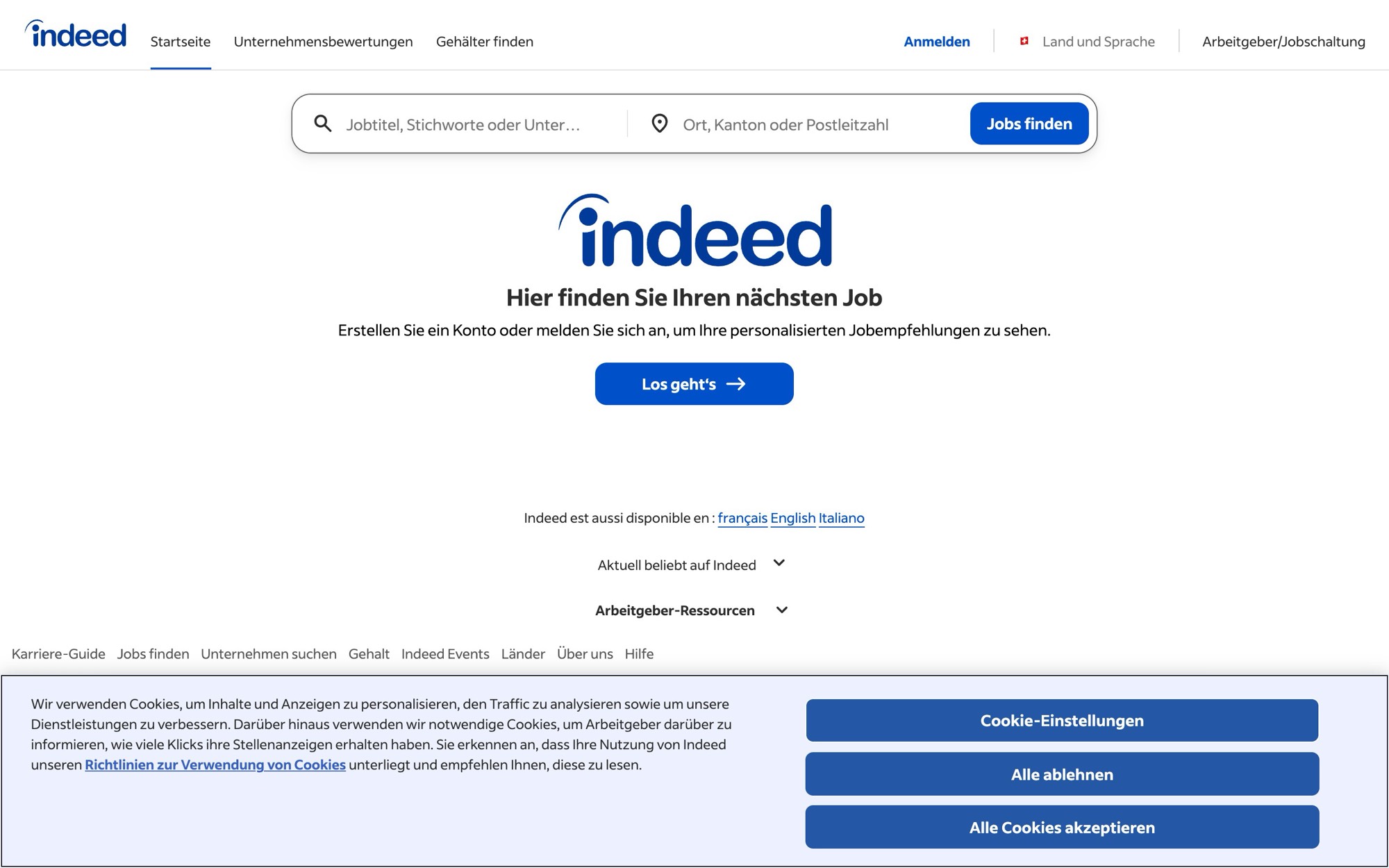
The broadest aggregation, because Indeed also collects from other boards — at the cost of many duplicates of the same advert.
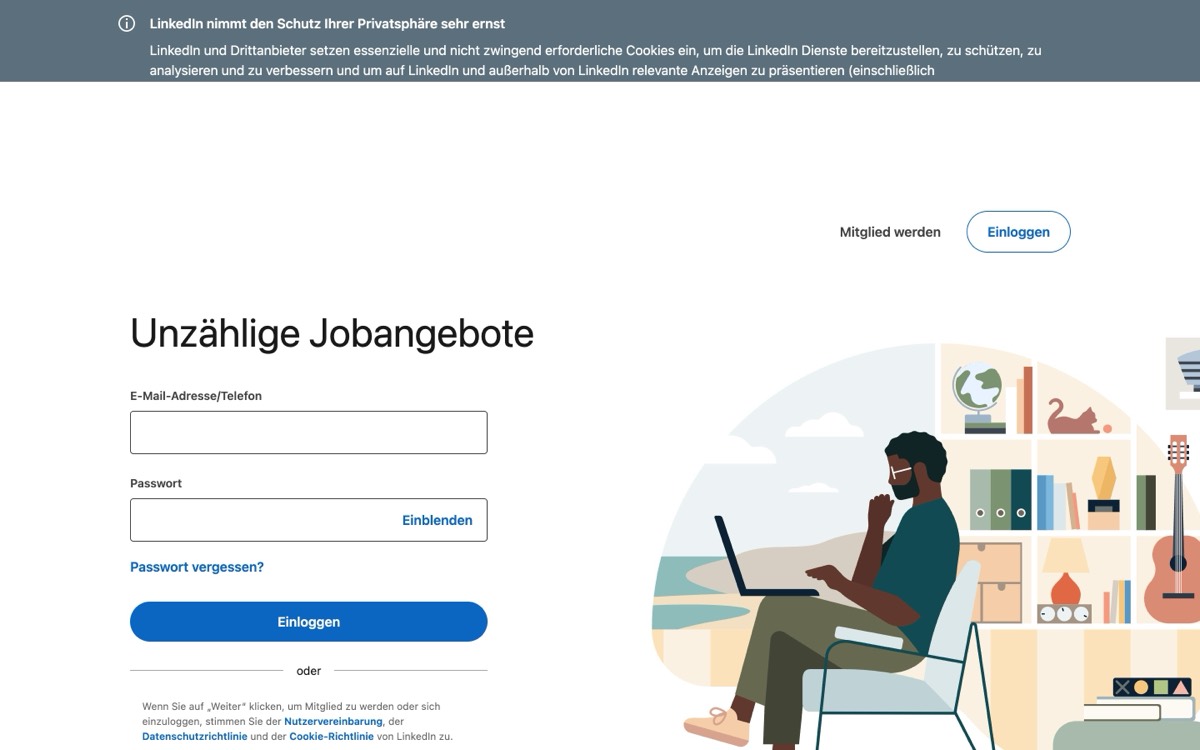
The best reputation for English-speaking and international roles in Switzerland. Considerably thinner for trades, care and commercial roles.
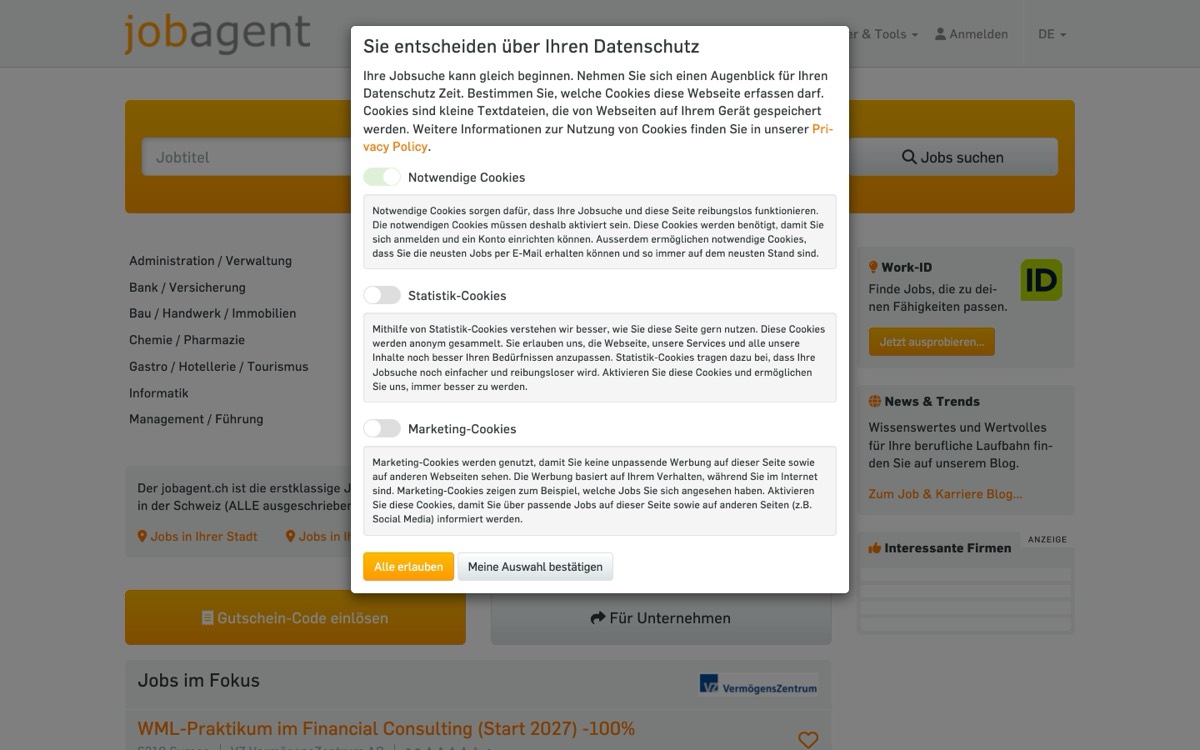
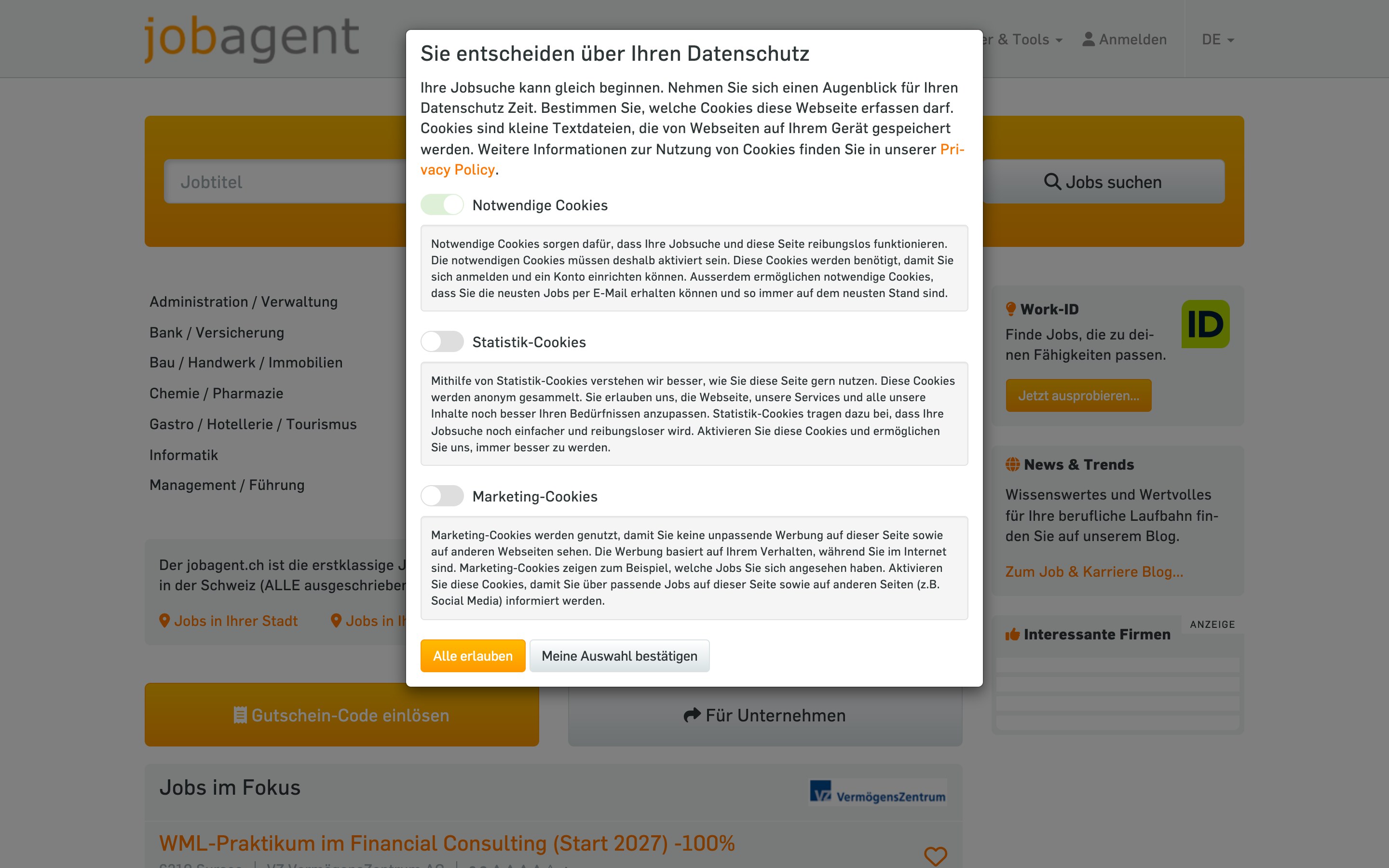
A meta-search across the Swiss job boards, "every job in Switzerland at a glance". Its strength is the Job-Abo: a saved search that mails you new adverts from every portal it covers. Salary calculator and application guides alongside.
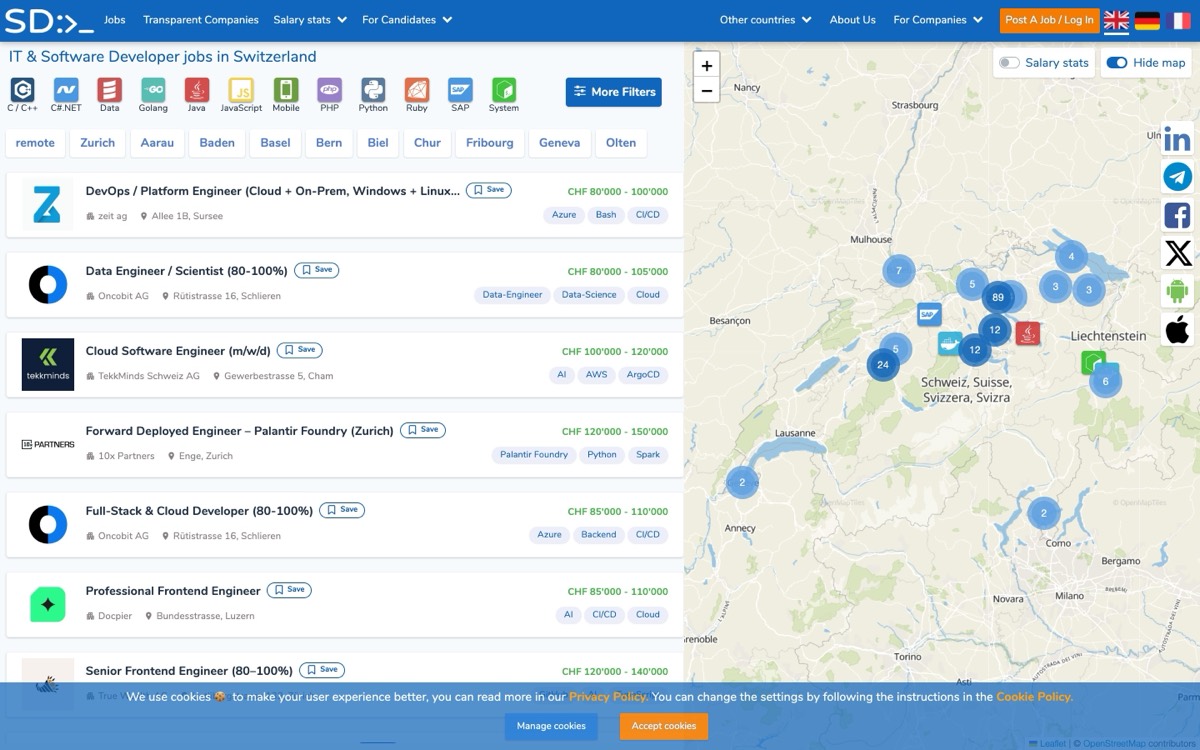
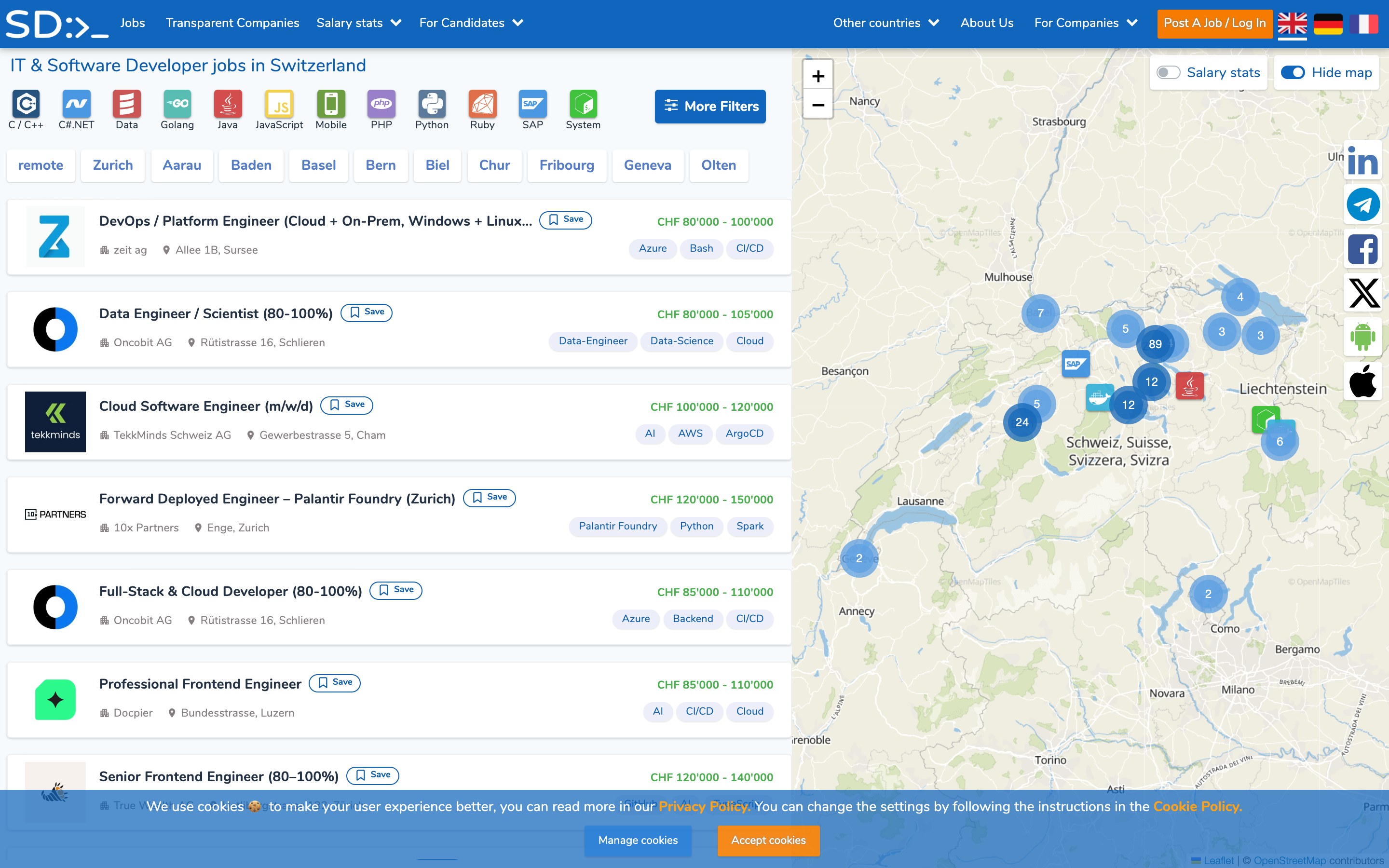
IT and software only, and thorough about it: "183 IT & Software developer jobs in Switzerland", filtered by technology (C#, Java, Python, DevOps, ML) rather than by industry. Publishes salary statistics and lists the companies that disclose their ranges. The site itself is in English.
Jobs by profession, city or language
Type a profession, a city or a language, the page shows the adverts currently open for it.
By profession
- Consultant
- Project Manager
- Retail Sales
- Nurse
- Nursing & Care
- Administrative Assistant
- Account Manager
- Software Engineer
- Public Administration
- Architect
- Insurance
- Chef
71 more — narrow the search
By work type
That last point matters most if you job-hunt in English. English-language adverts are 25.8 per cent of the Swiss postings we analyse, but they supply nearly three quarters of every advert that sets a five-year bar. Read only English adverts and you are reading the slice of the market that counts years — a convention that arrives with an imported template rather than from Swiss hiring practice. The same roles advertised in German name a qualification instead: a federal apprenticeship certificate, a professional diploma, a degree.
The federal numbers behind the question are also less bleak than the question assumes. In the 2024 Swiss Labour Force Survey the participation rate of 55-to-64-year-olds was 77.8 per cent, up from 71.6 per cent ten years earlier, and their ILO unemployment rate was 3.4 per cent against 4.3 per cent for everyone aged 15 to 74. The Federal Statistical Office puts it plainly: people aged 55 to 64 are unemployed less often than the population as a whole. Staying employed is not the hard part.
Re-entry is. In SECO's July 2026 labour-market statistics the 50-to-64s make up 27.8 per cent of all registered unemployed, the 25-to-49s 63.2 per cent and the 15-to-24s 8.8 per cent — shares, not risks, since the middle band spans 25 birth years and the older one 15. The figure that carries weight sits beside them: 16.7 per cent of registered unemployed have been searching for more than a year. Shortening that search is a question of where you look.
Share of analysed advert texts that state a concrete number of years as an experience requirement, split by the language the advert is written in. Rolling analysis of the open Swiss adverts we index, August 2026.
- Search by occupation, location and workload — never by age. Two of the advert texts we analyse contain an age phrase such as «50+»; none of the titles do. A search term nobody writes returns nothing.
- If your career is long, read adverts in the national languages. German-language adverts mention experience in 73.9 per cent of texts but quantify it in 0.9 per cent. English-language adverts quantify it in 21.1 per cent — the single biggest difference in this analysis.
- The fields where nobody counts years: nursing and care 1.0 per cent, medicine 1.2, hospitality 1.9, retail 2.0, education and childcare 3.3, trades and technical 4.0. The fields that count: banking and insurance 16.6 per cent, pharma and life sciences 13.3, IT 8.6.
- Use the workload as a second filter. 22.4 per cent of advert titles carry a percentage, and in 74 per cent of those the workload starts below 100 per cent. Medicine leads at 61.0 per cent carrying a part-time signal, nursing and care at 59.1 per cent.
- Go to institutional employers directly — cantons, cities, communes, hospitals, clinics, care homes, home-care organisations, schools and universities. They post 8.4 per cent of adverts, 45.4 per cent of theirs carry a part-time signal against 17.6 per cent elsewhere, and only 1.5 per cent name a number of years.
- Book viamia, the free career check-up run by the cantonal guidance services for everyone aged 40 and over. Its stated condition is that you have no entitlement to comparable offers from unemployment insurance, disability insurance or social assistance; the site is published in German, French and Italian.
The language of the advert is the filter you did not know you were applying
Of the Swiss adverts we analyse, 76.4 per cent mention experience in some form. Only 8.1 per cent put a number on it. Five years or more is demanded by 4.9 per cent of all adverts and ten years or more by 0.9 per cent. Among adverts that do count, five is the most common figure at 34.1 per cent, followed by three years at 19.7 and two years at 11.8 per cent. A demand for twenty or thirty years effectively does not exist in this market.
Where the threshold sits is more revealing than how high it is. Of the adverts demanding five years or more, 73.6 per cent are in English and 19.2 per cent in French; German-language adverts account for 4.8 per cent. Against a corpus that is 57.8 per cent German and 25.8 per cent English, that is a striking concentration. The year count travels with the English-language job-advert template, not with Swiss recruitment practice.
Read from the other direction, the contrast is just as sharp. German-language adverts mention experience in 73.9 per cent of texts and quantify it in 0.9 per cent; instead they name a credential, with an apprenticeship certificate, a federal professional diploma or a degree appearing in 21.3 per cent of them. In English-language adverts credential and year count run level, at 19.5 and 21.1 per cent. A German advert asks what you trained in and what you can do. An English one also asks how long.
One caveat on method. This analysis reads shortened summaries of the advert texts, available for roughly three quarters of the adverts we index, rather than every sentence of every posting. Absolute shares are therefore understated rather than overstated. The comparison between groups holds, because every group is measured the same way, and it survives a deliberately crude cross-check that looks for any «number + years» token anywhere in the text: 1.0 per cent in German adverts, 21.3 in English, 14.5 in French, 12.6 in Italian.
What the federal statistics actually show about the 55-to-64s
The 2024 Swiss Labour Force Survey, published by the Federal Statistical Office in April 2025, gives the participation rate of 55-to-64-year-olds as 77.8 per cent, against 71.6 per cent a decade earlier — a rise of 6.1 percentage points. Among women the increase was steeper, 7.8 points to 71.9 per cent, than among men, 4.5 points to 83.6 per cent. Measured in full-time equivalents the same group gained 5.1 points, to 65.3 per cent.
The unemployment comparison points the same way. In 2024 the ILO unemployment rate was 3.4 per cent for 55-to-64-year-olds and 4.3 per cent for the whole 15-to-74 population; women aged 55 to 64 came in below men of the same age, at 3.1 against 3.8 per cent. The average age of leaving the labour market was 65.0 years — 65.3 for men, 64.7 for women.
A third figure from the same survey is more useful for a search than it first appears. The average age of the labour force is 42.3 years, but it is 47.9 in agriculture and forestry and 40.6 in hospitality; the self-employed average 49.2 years against 42.4 for employees. Age structure is a property of industries and of forms of employment, not of «the» labour market. That is precisely why the search should be steered by industry, employer type and workload rather than by anything you write about yourself.
Where experience is required but never counted
The practical answer to «where» follows from the counting. Look for fields that demand experience but never translate it into a number, because there a thirty-year career cannot lose an arithmetic comparison. A year count appears in 1.0 per cent of nursing and care texts, 1.2 per cent in medicine, 1.9 in hospitality, 2.0 in retail, 3.3 in education and childcare, and 4.0 per cent in the trades. At the other end sit banking and insurance at 16.6 per cent, pharma and life sciences at 13.3 and IT at 8.6.
The second route runs through the type of employer. Adverts from cantons, cities, communes, hospitals, clinics, care homes, home-care organisations, schools, universities and federal bodies make up 8.4 per cent of the adverts we index. Within that group 66.8 per cent of texts mention experience while just 1.5 per cent name a number of years — a sixth of the market average. Their weight varies by region: 9.5 per cent of adverts in German-speaking Switzerland, 2.6 per cent in French-speaking Switzerland and 0.7 per cent in Ticino. They also account for 39.6 per cent of all nursing and care adverts.
A third signal is how long adverts stay open. Adverts that name a year count sit online for a median of 36 days against 24 days for the rest, and among those demanding five years or more, 39.7 per cent stay live for more than two months against 29.6 per cent of all analysed adverts. If you meet a high threshold you are disproportionately often applying to a vacancy the employer has failed to fill for weeks. That is the one place where a large number in the advert works in your favour — provided you read it as an invitation rather than as a wall.
Workload: the filter almost nobody uses
Many people asking this question do not want the same job they had at forty; they want one at a lower percentage, as a bridge, for health reasons, or because caring work sits alongside it. Swiss adverts make that unusually visible. 22.4 per cent of advert titles carry a percentage in the title itself, and in 74 per cent of those the workload starts below 100 per cent — 16.6 per cent of all indexed adverts. The most common band is 80 to 99 per cent at 46.1 per cent of workload titles, followed by exactly 100 per cent at 26.0, then 60 to 79 per cent at 12.9 and below 60 per cent at 7.2 per cent.
Density varies sharply by field. Counting the part-time signal from employment type and workload figure together, it appears in 61.0 per cent of adverts in medicine, 59.1 per cent in nursing and care, 45.9 per cent in education and childcare, 29.4 per cent in commercial and HR roles and 24.5 per cent in construction and planning. At the bottom sit logistics at 9.7 per cent, pharma at 10.0 and the trades at 10.3. Anyone looking for a reduced workload is, in practice, looking in health, education and public administration — the same fields where nobody counts years.
Region matters too: 22.1 per cent of adverts in German-speaking Switzerland carry a part-time signal, against 11.2 per cent in French-speaking Switzerland and 9.6 per cent in Ticino, the last on a small base. Among institutional employers the figure is 45.4 per cent against 17.6 per cent for everyone else — the largest single gap in this whole analysis, and the reason employer type belongs in your search before job title does.
viamia: the free federal-origin career check-up from 40
Switzerland runs an official service aimed exactly at this age group, and English-speaking residents rarely hear about it because it is published only in German, French and Italian. viamia is for people aged 40 and over, is delivered by the cantonal career guidance offices and is free for the person seeking advice. The consultation analyses your professional situation, tests whether your skills are in demand on the labour market and identifies development options; the site describes a five-step process from booking to agreeing concrete next steps.
One condition is stated explicitly and often missed: you must have no entitlement to comparable offers from unemployment insurance, disability insurance or social assistance. If you are registered with a regional employment centre, the equivalent counselling comes through that centre instead — not as a downgrade, but because the insurance already owes you the same service. If you are unsure, viamia asks you to check with the contact point in your canton of residence.
Delivery is cantonal and not uniform. For the canton of Aargau, viamia states that the service is not offered there and refers people directly to the canton for alternatives. Every other canton is listed with a named office, address and phone number — the BIZ and career centres in the German-speaking cantons, the offices d'orientation and the Cité des Métiers in Geneva, and the Ufficio dell'orientamento scolastico e professionale in Lugano for Ticino. There is also a self-assessment portal with questionnaires and labour-market information.
The search, in four moves
First, move the search from the person to the post. No age vocabulary exists in these adverts to match against, and none to defend yourself from. What you type is the occupation, the location and, if you want to reduce, the workload.
Second, treat the language of the advert as a filter in its own right. An English-language advert sets a year threshold in more than one case in five; a German-language one in fewer than one in a hundred. If your German, French or Italian is good enough to work in, restricting yourself to adverts in that language costs you little and removes almost every arithmetic comparison.
Third, search employers, not only adverts. The 8.4 per cent of postings that come from cantons, communes, hospitals, care homes and schools are the group with the highest part-time share and the lowest counting rate, and they also advertise on their own career pages, often in waves that do not surface everywhere at the same moment.
Fourth, book the check-up before writing a hundred applications. viamia from 40 is free, and the question it answers — which of your skills the current market is asking for — is the same question that decides the hit rate of those applications. If you are registered as unemployed, ask it at your regional employment centre instead.
Advert shares come from our rolling analysis of the open Swiss adverts we index, as at August 2026. The analysis reads shortened summaries of the advert texts, available for roughly three quarters of indexed adverts; requirements stated only in the full text are missing from it, so absolute shares are conservative. Comparisons between languages, fields and employer types are all measured the same way. Participation figures come from the Federal Statistical Office's 2024 Swiss Labour Force Survey; unemployment figures from SECO's labour-market statistics for July 2026, published in German, French and Italian.
Sources
Related questions
What our job index says about the Swiss market
Computed live from our own index, not quoted from a study. Shares only, as of today.
Language the advert is written in
- Deutsch
- 60%
- English
- 23%
- Français
- 13%
- Italiano
- 3%
Of adverts that state a language requirement, the share asking for
- Deutsch
- 70%
- English
- 43%
- Français
- 21%
- Italiano
- 3%
19% posted in the last 7 days · Largest markets: Zürich 18% · Bern 10% · Genève 5% · Basel 5%