Where do I find part-time jobs in Switzerland?
Updated:
In short
Swiss adverts record a reduced workload in two ways that barely overlap. About 7.6 percent of the adverts we track offer one: 5.5 percent carry an explicit part-time marking, 2.9 percent state a workload of 60 percent or less in the text, and only 0.8 percent do both. Search with the part-time filter alone and you see roughly seven in ten of them. The rest are written as a bare number in the job title, without the words "part-time" appearing anywhere.
The Swiss job portals at a glance
Click an image for the full-size view. What each portal actually is stands beside it.
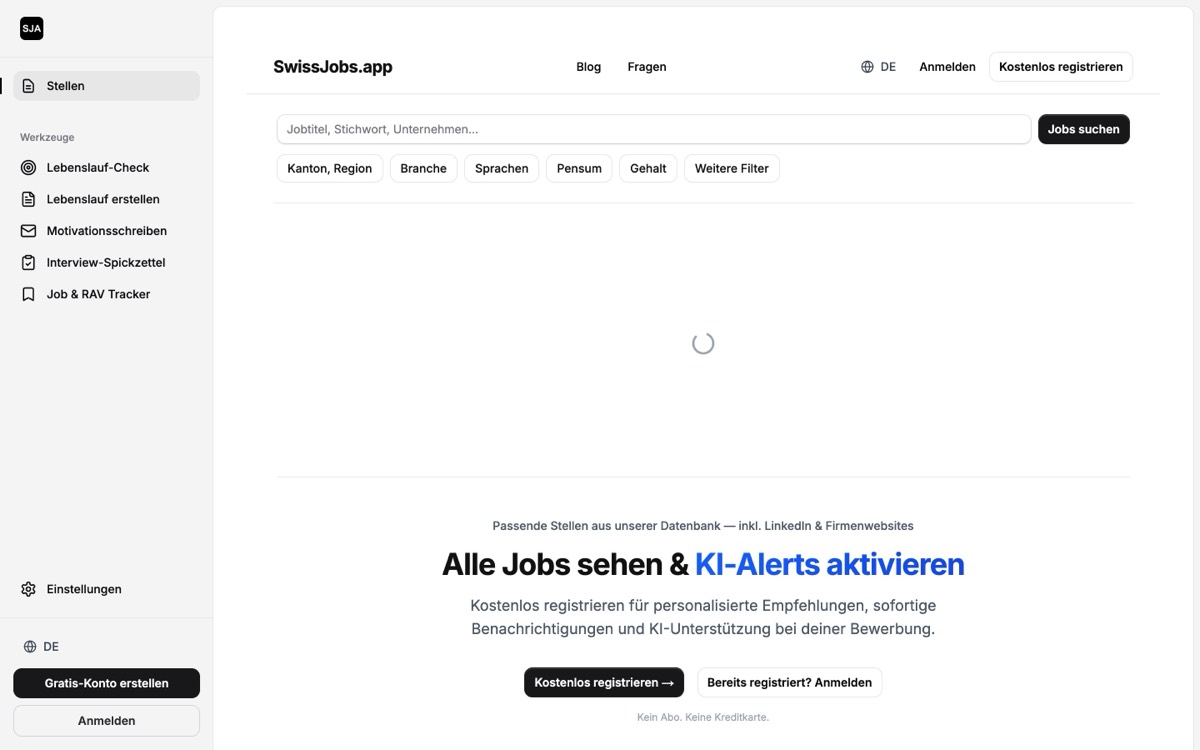
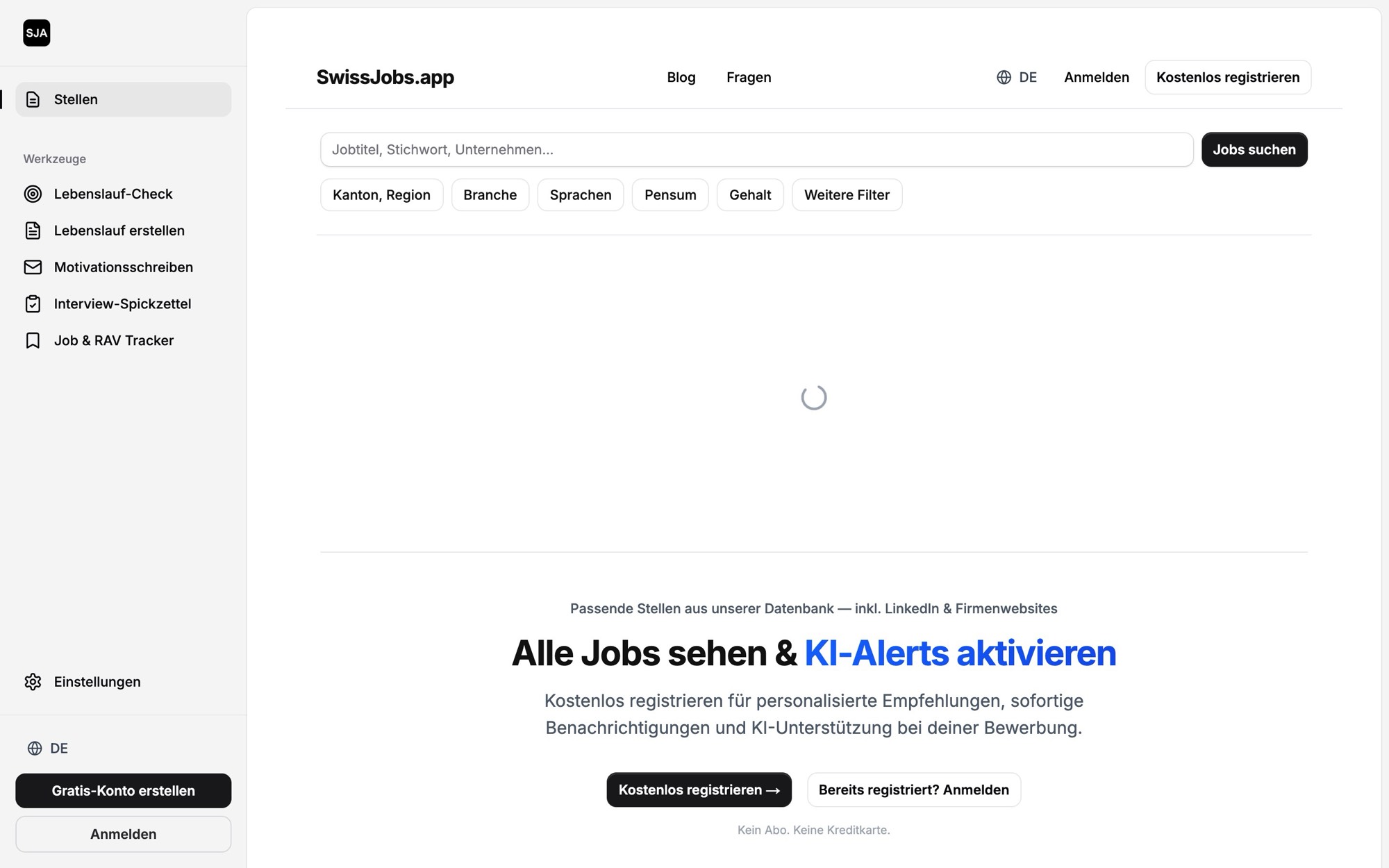
1. SwissJobs.appOur app
Over 21,000 open Swiss roles from ATS systems, company sites and LinkedIn in one place — and from any advert, straight into a CV, a motivation letter, a CV check and interview prep. The RAV job-search-efforts form fills itself from your application tracker. Free to use; the account is asked for at save.
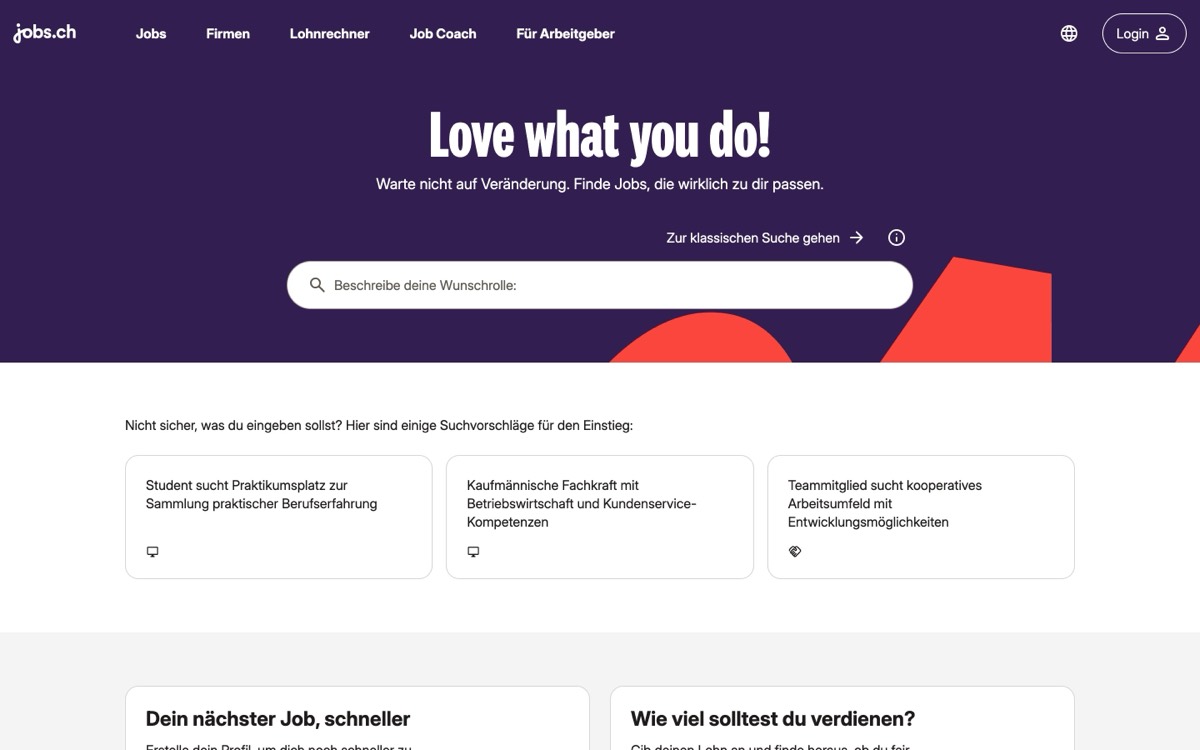
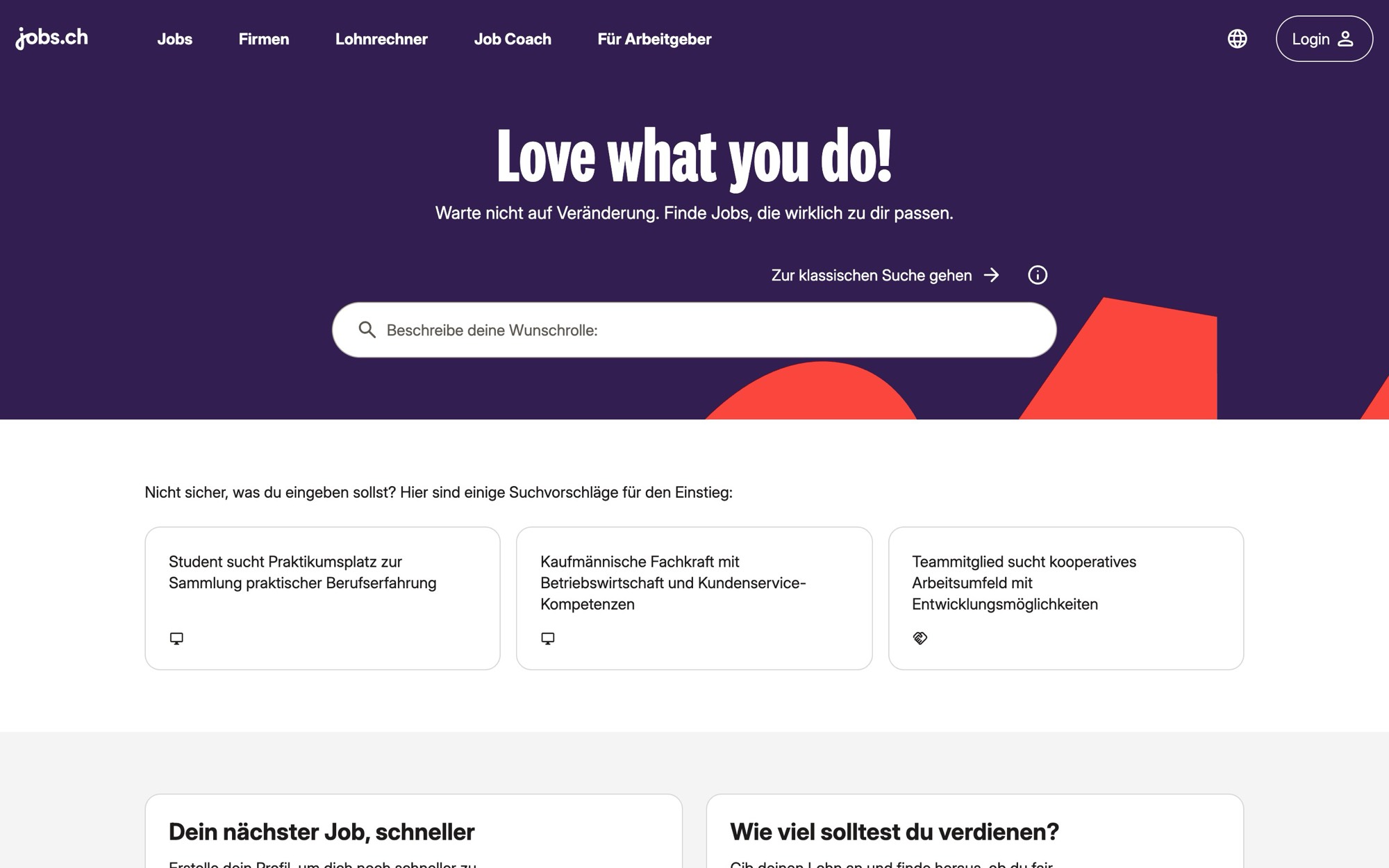
The best-known board in German-speaking Switzerland and the largest index in the country. Owned by JobCloud AG — as are jobup.ch and JobScout24.
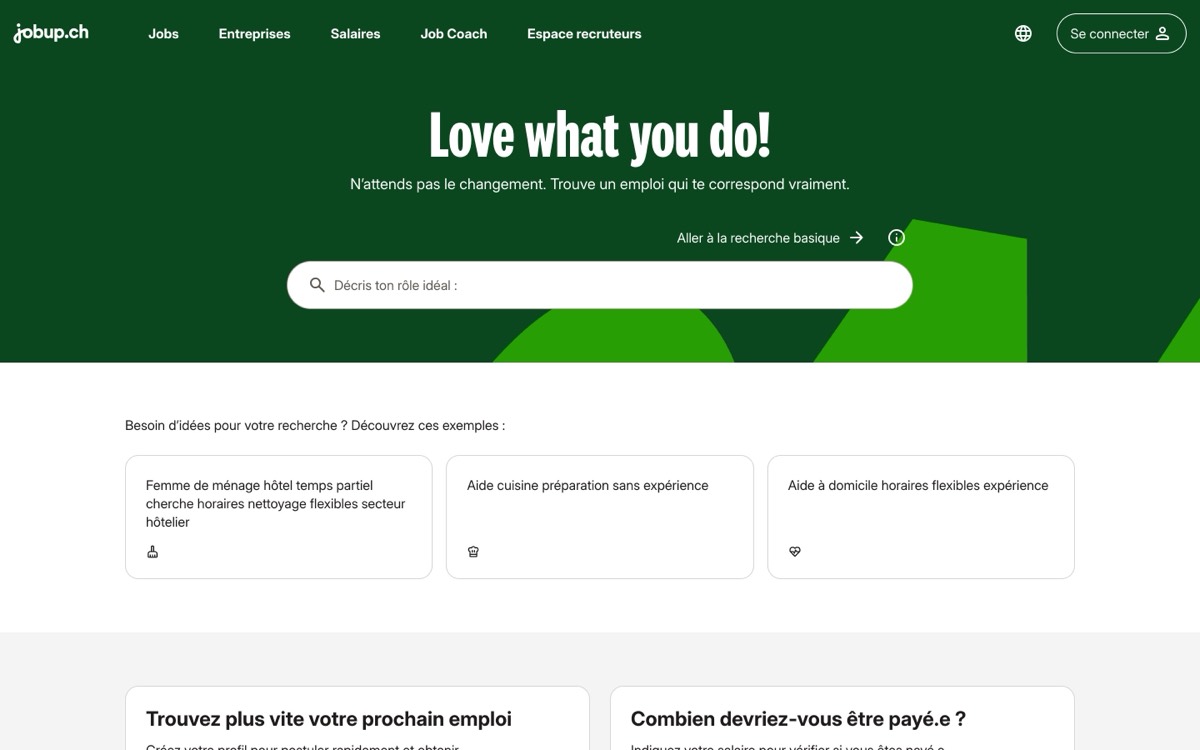
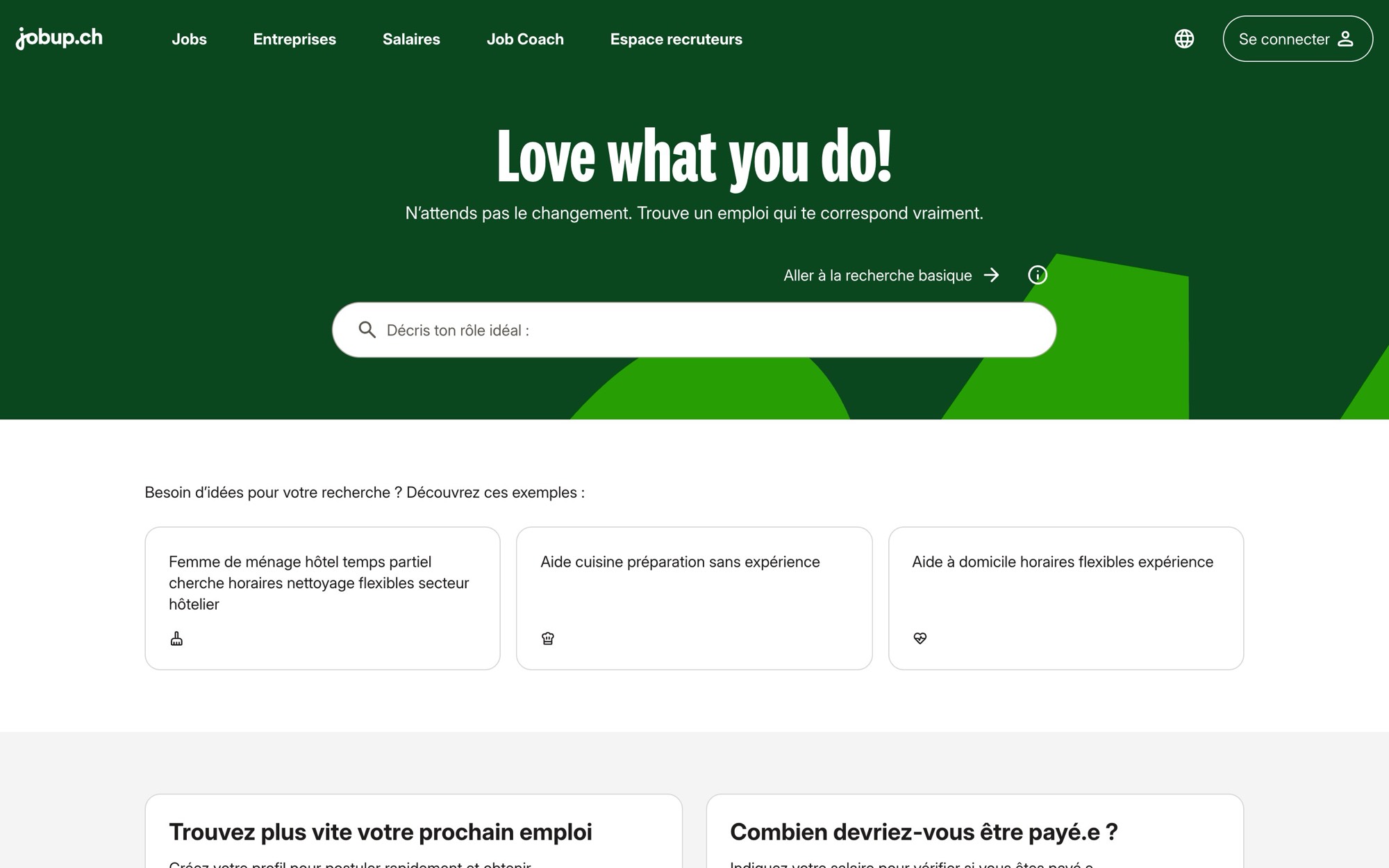
The standard in French-speaking Switzerland and the first place to look for the Romandie — but the same JobCloud AG as jobs.ch.
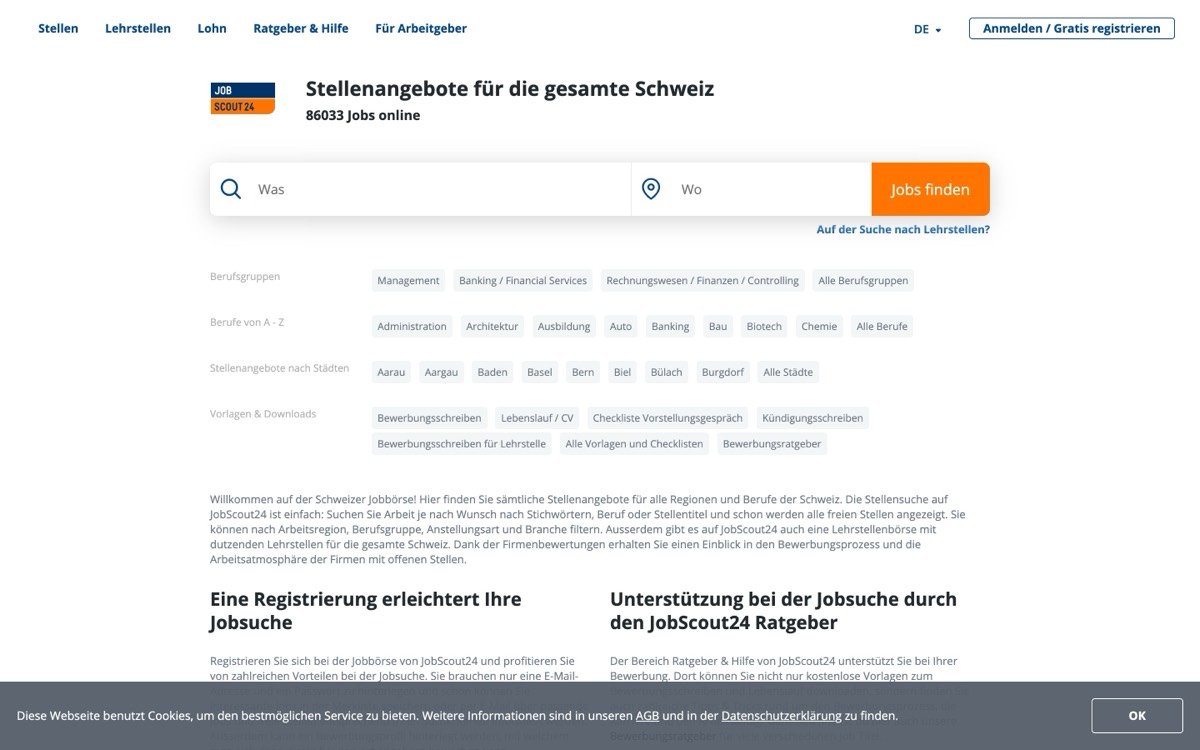
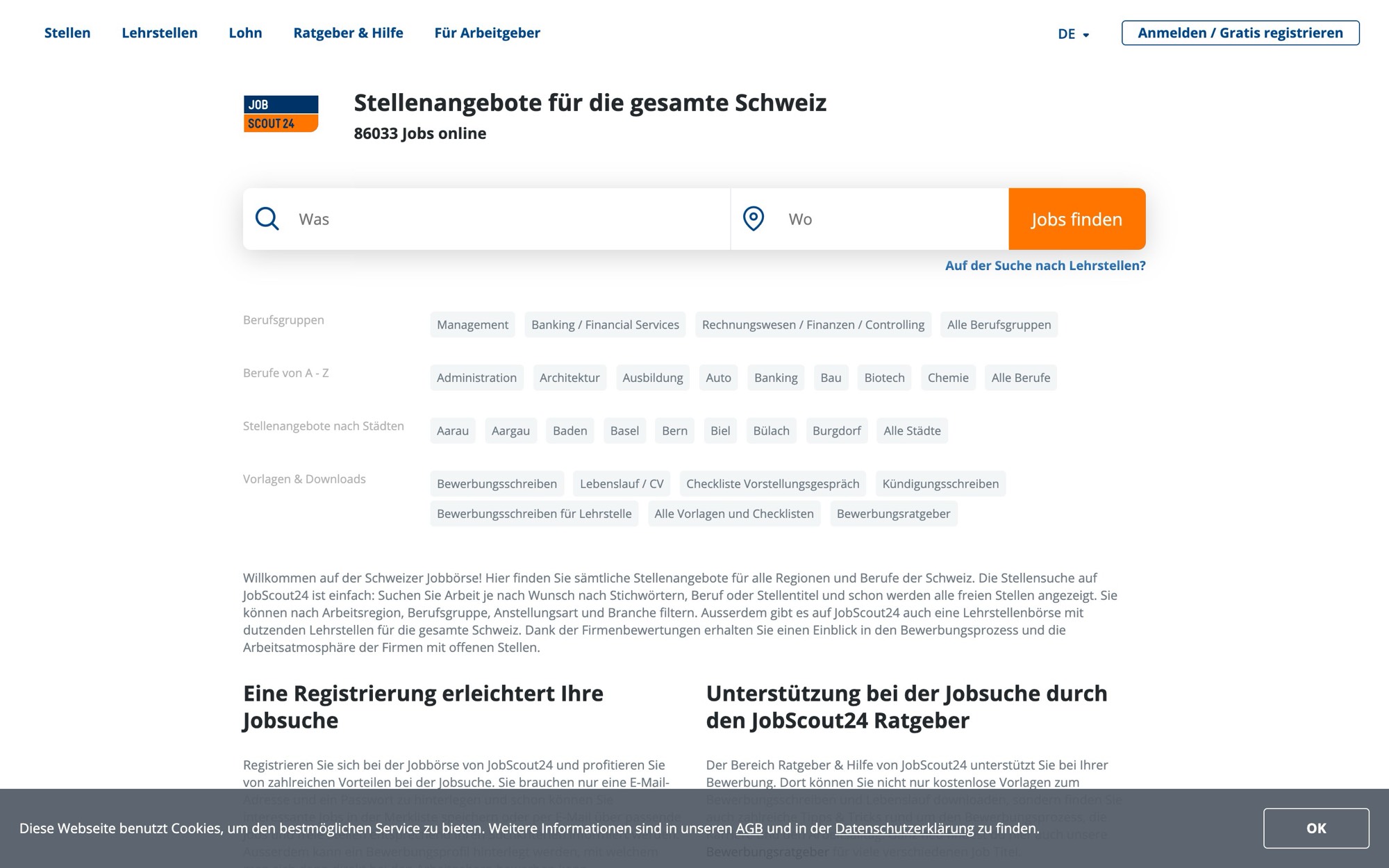
A third brand from the same company. Searching all three to widen your search means searching one provider three times.
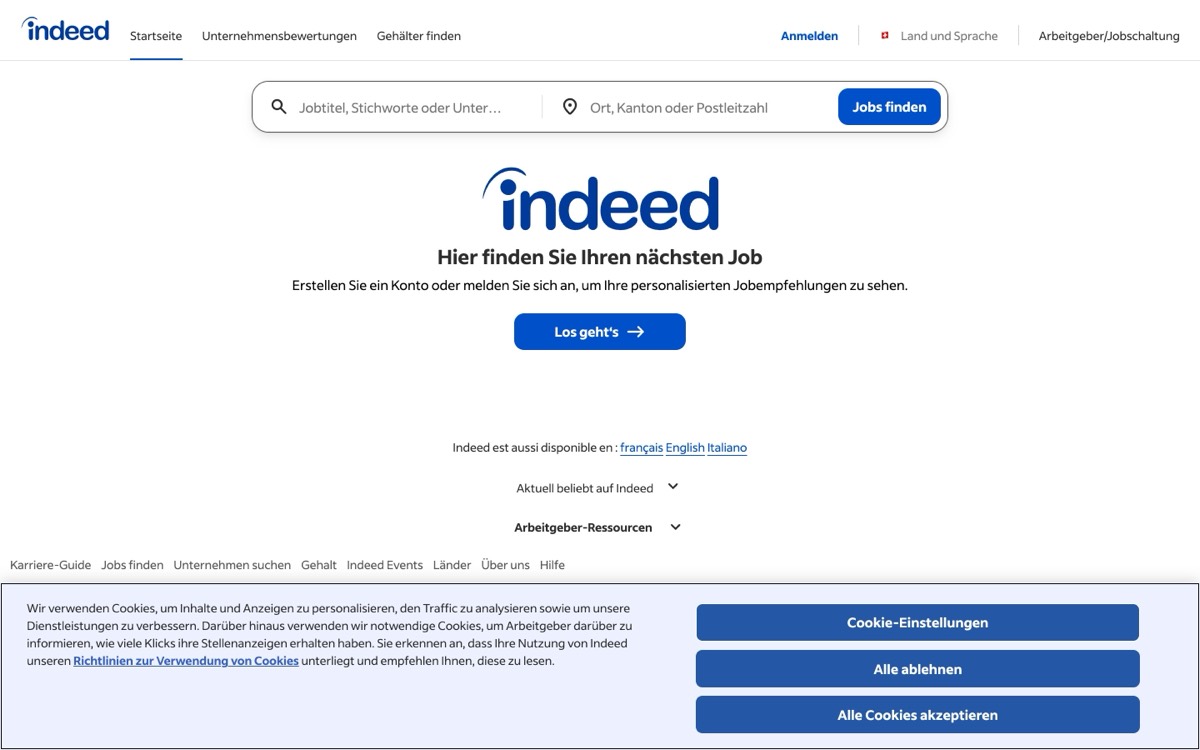
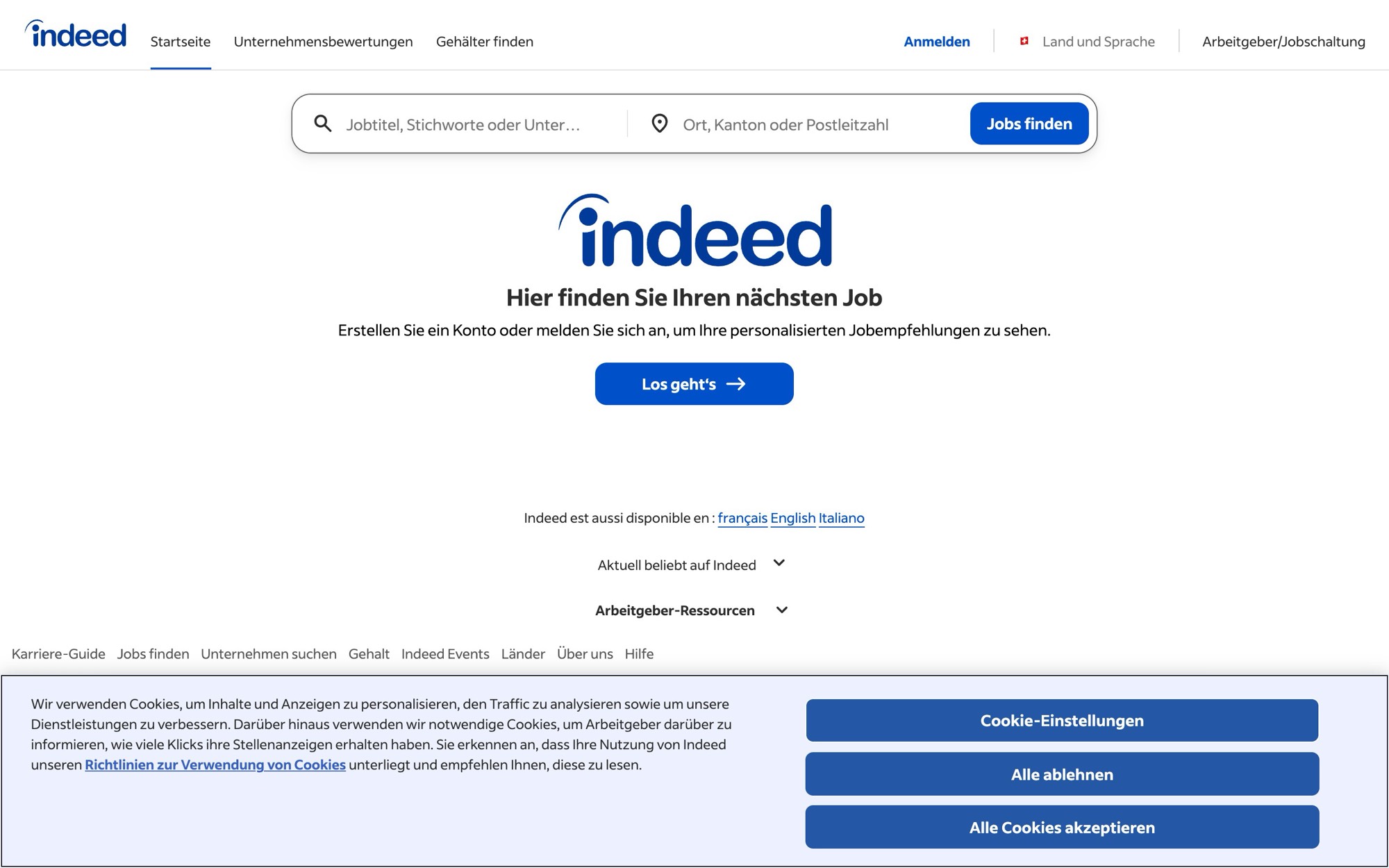
The broadest aggregation, because Indeed also collects from other boards — at the cost of many duplicates of the same advert.
The best reputation for English-speaking and international roles in Switzerland. Considerably thinner for trades, care and commercial roles.
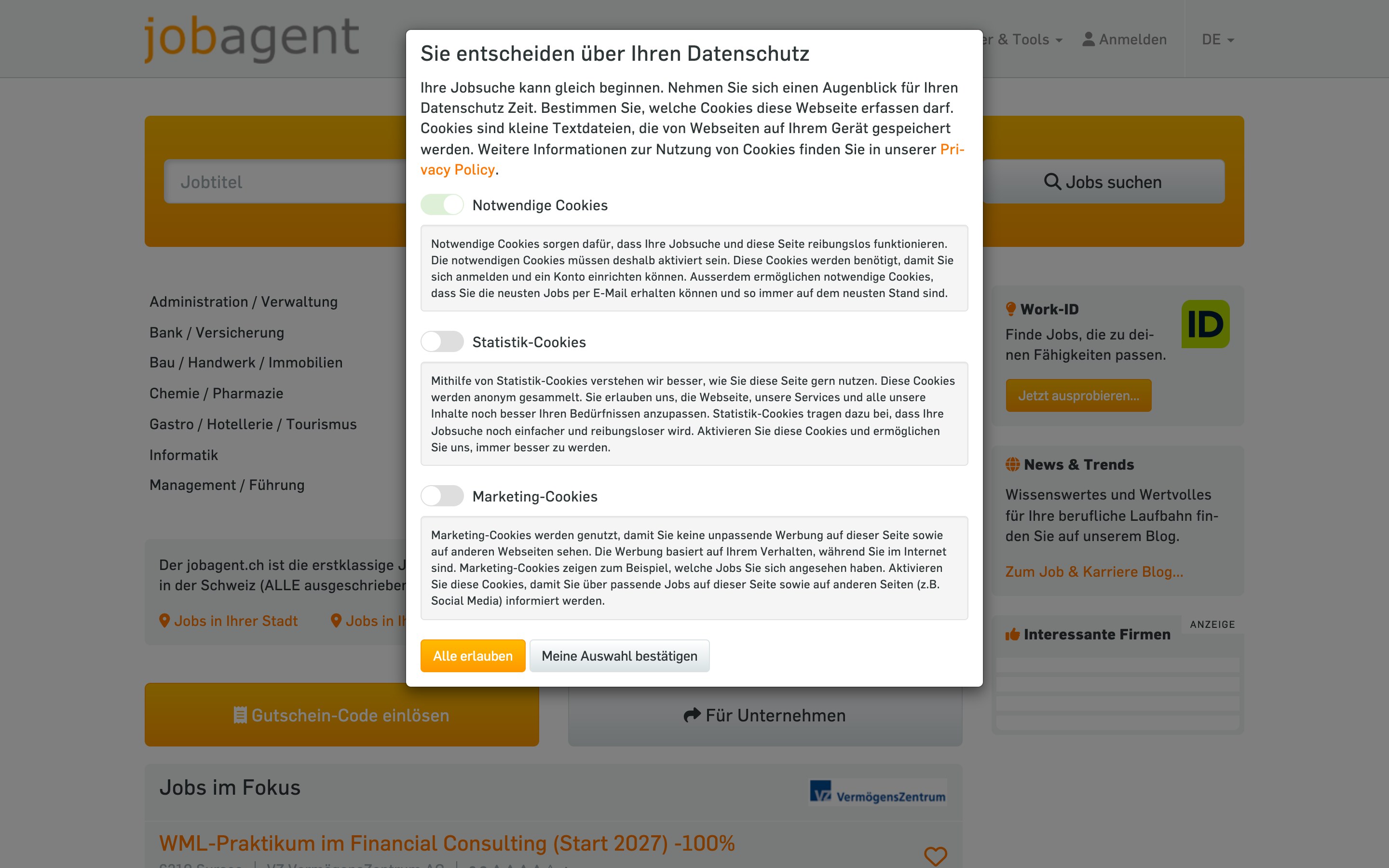
A meta-search across the Swiss job boards, "every job in Switzerland at a glance". Its strength is the Job-Abo: a saved search that mails you new adverts from every portal it covers. Salary calculator and application guides alongside.
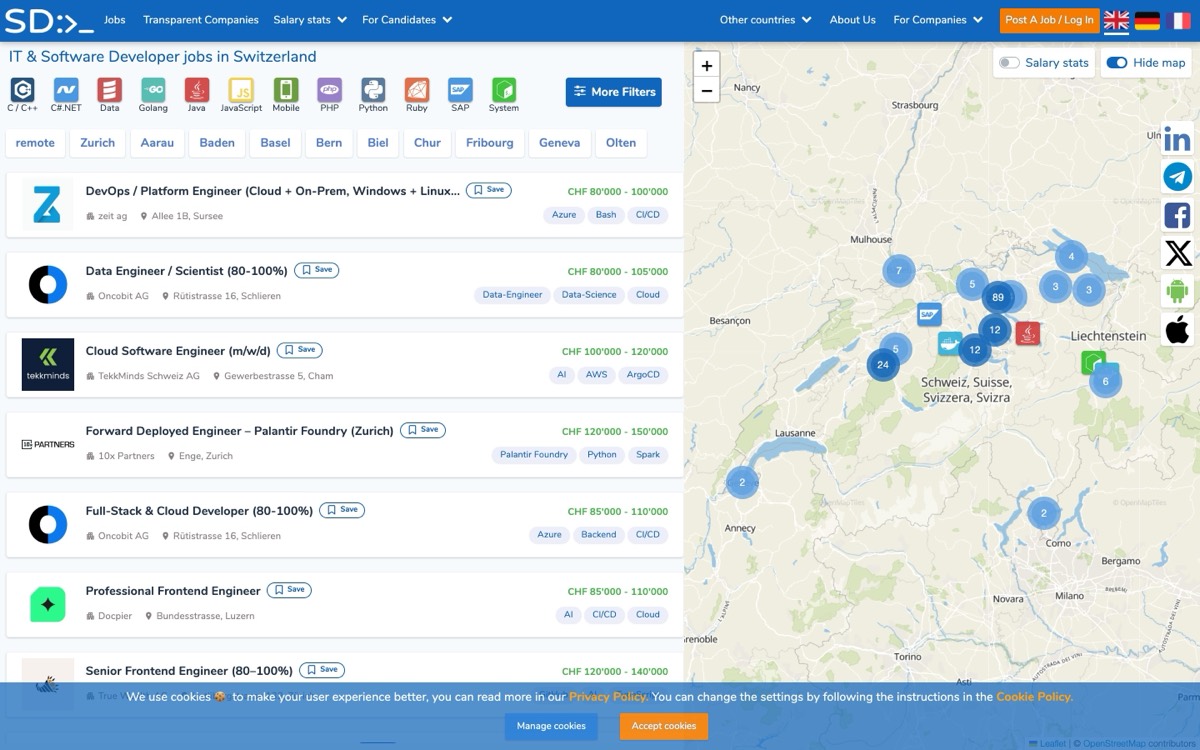
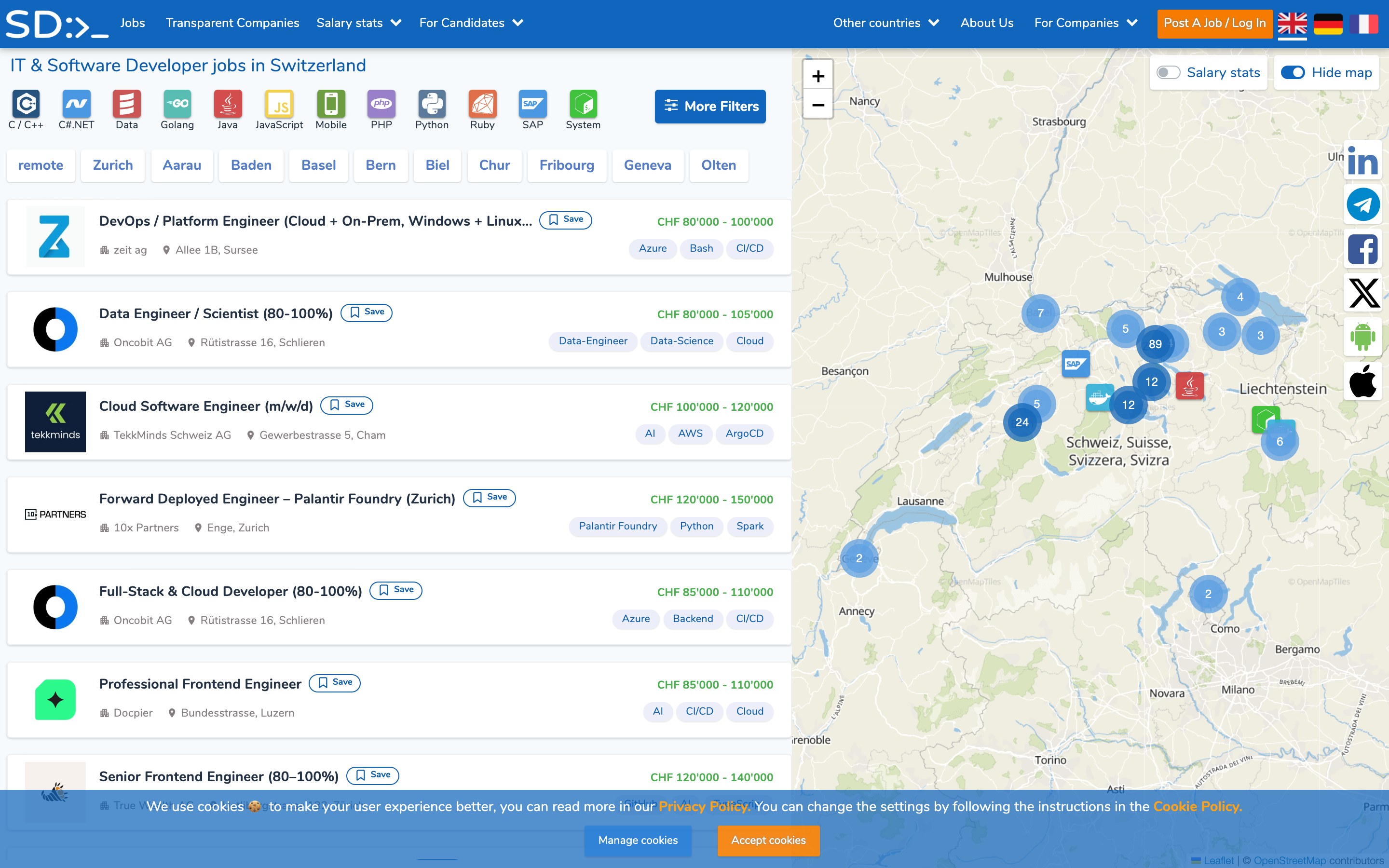
IT and software only, and thorough about it: "183 IT & Software developer jobs in Switzerland", filtered by technology (C#, Java, Python, DevOps, ML) rather than by industry. Publishes salary statistics and lists the companies that disclose their ranges. The site itself is in English.
Jobs by profession, city or language
Type a profession, a city or a language, the page shows the adverts currently open for it.
By profession
- Consultant
- Project Manager
- Retail Sales
- Nurse
- Nursing & Care
- Administrative Assistant
- Account Manager
- Software Engineer
- Public Administration
- Architect
- Insurance
- Chef
71 more — narrow the search
By work type
The number itself is the second trap. Workload percentages appear in 22.5 percent of all adverts, but for three quarters of those the lowest figure quoted is 100 percent. Ranges account for 62.2 percent of all workload statements, and 65.6 percent of those ranges start at 80. "80–100%" is the single most common way a Swiss advert states a workload — and it describes a full-time post that could be trimmed, not a part-time one.
Where genuinely reduced workloads are advertised depends far more on the occupation than on the city. Education and social work run at 41.3 percent of adverts, nursing and care at 29.1, therapy and medical practice at 23.3, cleaning and domestic services at 21.1, retail at 15.2 — against 2.4 percent in IT and 0.5 percent in construction and the trades.
Share of each occupation’s adverts that are marked part-time or state a workload of 60 percent or less. Ongoing analysis of the open Swiss adverts we track, as of August 2026.
- 71.4 percent of the adverts that state a workload of 60 percent or less carry no part-time marking — the filter on its own does not reach them.
- In the other direction, 55.4 percent of adverts marked part-time state no figure at all, so searching for "50%" does not reach those.
- Within the adverts offering 60 percent or less, the ladder runs 60 percent (36.8%), 50 (25.0%), 40 (19.0%), 30 (6.9%) and 20 (5.7%); everything below that is about 4 percent of the group.
- The 50 employers advertising the most reduced-workload roles account for 50.9 percent of all such adverts, against 35.7 percent for the 50 largest advertisers across the whole market.
- Only 9.5 percent of English-language adverts state a workload percentage, against 29.7 percent of German-language and 19.9 percent of French-language ones.
- Adverts offering 60 percent or less are 18 days old at the median; adverts whose only stated figure is 100 percent are 23 days old.
Where part-time work is actually advertised
| Canton | Part-time share | Adverts counted |
|---|---|---|
| Aargau | 36.0% | 419 |
| Lucerne | 34.5% | 551 |
| Bern | 30.8% | 626 |
| Zurich | 21.0% | 1,822 |
| Vaud | 14.0% | 677 |
| Basel-Stadt | 13.6% | 463 |
| Fribourg | 12.8% | 423 |
| Geneva | 5.8% | 669 |
Counted 7 September 2026 over 22,518 adverts. Note: the employment-type field reports only 5.1% part time, while 20.0% carry a workload below 100% — we count both signals. The Romandie figures are also pushed down by measurement: only 12.7% of adverts there state the workload in the title at all, against 23.0% nationally. This shows where part-time work is VISIBLY advertised, not where it exists.
Two notations, two different result lists
The most useful finding here is not a share but a gap. A Swiss advert can record its workload as a marking — posted as part-time, which is what a part-time page or filter reads — or as a figure in the title, such as "60%" or "20–40%". Both conventions are normal, but different kinds of employer pick different ones, and the result is two nearly separate lists. Of the adverts stating 60 percent or less, 71.4 percent carry no part-time marking. Of the adverts marked part-time, 55.4 percent state no figure.
That split is not random. Hospitals, cantonal administrations and large retailers tend to mark the employment type; medical practices, schools, smaller firms and staffing agencies tend to put the number in the title and leave the type unset. So a search that uses only one of the two conventions loses a slice of the market that is sorted by employer type rather than scattered evenly across it.
The fix is dull and it works: search twice. Once through the part-time page, which reads the marking, and once through the workload setting in the job search, which reads the figure. Together the two routes cover the 7.6 percent of the market that offers a reduced workload at all. Separately they cover 5.5 and 2.9 percent.
Expect a third slice to stay invisible to both: posts advertised full-time that the employer would in fact split. Only 0.4 percent of adverts write "or by arrangement" into the text. That is not evidence that few employers would negotiate — it is evidence that the negotiation happens in the first conversation rather than on the page.
Why "80–100%" is not a part-time job
Writing the workload into the job title is a Swiss convention with no direct equivalent in British or American adverts, and newcomers routinely misread it. The figure is usually a confirmation, not an offer. Across the adverts that state a workload, 74.8 percent have 100 percent as their lowest quoted figure, and a further 11.1 percent bottom out between 80 and 99 percent.
The range notation is what does the damage. Ranges make up 62.2 percent of workload statements and 65.6 percent of ranges open at 80 percent. So the "80–100%" you keep seeing means the employer would accept four days a week from the right person. If you need half a week, it is a polite refusal written in advance.
Ranges that genuinely reach downwards are much rarer: 13.4 percent of ranges start at 60 percent, 7.3 percent at 40 and 6.0 percent at 50. The practical reading rule follows from that — ignore the number at the top of the range entirely and read only the number at the bottom.
One more piece of local vocabulary. The German word is Pensum or Beschäftigungsgrad, the French taux d’occupation, the Italian grado di occupazione; "FTE" is almost never used in Swiss adverts aimed at candidates. An advert that says nothing about workload is, by default, a full-time post — Swiss employers who intend to offer less almost always say so, in one notation or the other.
The occupation matters more than the city
The spread between occupations is the largest single number in this answer: roughly eighty to one, from 41.3 percent of adverts in education and social work down to 0.5 percent in construction and the trades. No location, employer size or season comes close to that in our index.
The ordering follows how the work is organised rather than how generous the employer is. Where shifts, timetables or opening hours are already being planned, a 50 percent post is just another planning unit: nursing and care 29.1 percent, therapy and medical practice 23.3, cleaning and domestic services 21.1, retail 15.2, administration 12.9. Where the work is organised around projects, clients and on-call availability, it is advertised whole: engineering 3.2 percent, IT 2.4, construction and trades 0.5.
If your field sits at the bottom of that list, hunting for an advertised part-time post in your own occupation is the wrong strategy, because the inventory does not exist in any quantity. Aim instead at a full-time advert from an employer who already advertises reduced workloads elsewhere in the building, and raise the workload as a range in the first conversation.
If your field sits at the top, the opposite holds. There a reduced workload is ordinary and you can treat it as a hard filter without emptying the list. Note that education and social work is the smallest group shown here — about half a percent of all adverts — so the rate is meaningful but the absolute choice is modest.
Fifty employers carry half of it
Reduced-workload adverts are more concentrated on a few names than the market as a whole. The 50 employers posting the most of them account for 50.9 percent of all such adverts, while the 50 largest advertisers overall account for only 35.7 percent of the market. The top ten alone hold 22.5 percent.
That makes searching by employer the third route, alongside the marking and the figure. Among advertisers with at least forty open adverts, the leaders are hospitals, cantons and retail: 77.8 percent of Insel Gruppe’s open adverts offer a reduced workload, 66.7 percent at Kantonsspital Graubünden, 53.7 percent at Lidl Switzerland, 44.7 percent at the Hôpitaux Universitaires de Genève, 35.8 percent at Medbase Gruppe and 29.6 percent at Kantonsspital Baden. Canton Bern runs at 13.7 percent, Luzerner Kantonsspital at 13.3 and Volg at 13.2.
The opposite end is just as informative. Several large advertisers with forty or more open roles — Nestlé, Swiss Life, Axpo and Vontobel among them — show no reduced-workload advert at all in our index. Looking for four days a week there is not a thin search; it is an empty one.
One caveat belongs with those figures: they measure how an employer writes its adverts, not how it actually staffs. A company that runs plenty of reduced contracts internally but never writes them into an advert appears here at zero. For a job search that is still the number that matters, because you can only find what somebody wrote down.
The words that actually surface part-time work
The phrase "part-time" itself appears in the text of only 0.4 percent of adverts, and the German "Teilzeit" in 0.8 percent. As a search term it is close to useless, because the information usually lives in the employment type rather than in the prose. Other words do live in the prose, and they are far more reliable.
Of the adverts mentioning payment by the hour, 97.4 percent offer a reduced workload. For on-call work it is 91.3 percent, for student and working-student roles 85.6, for casual and stand-in help 79.2, for weekend work 77.6, for night shifts 75.4 and for cover and relief duties 71.4 percent. Each of those words appears in well under one percent of adverts, so they are narrow — but almost nothing they return is full-time.
Use them as an addition rather than a replacement. They lead into a different segment — hourly, irregular, often fixed-term — and that segment is precisely where the workload was never expressed as a percentage in the first place, so neither the filter nor a number search would have found it.
If you search only in English, correct for one bias first. English-language adverts state a workload figure in 9.5 percent of cases, against 29.7 percent in German and 19.9 percent in French, and of the English adverts that do quote a figure only 8.9 percent go below 60 percent. Italian-language adverts quote a percentage rarest of all, in 3.9 percent of cases, so in Ticino the workload is almost always a question for the interview rather than a line in the advert.
What to do here, in order
First, open the part-time page and pick your city. It lists the adverts carrying the part-time marking and has its own sub-page for every larger city. That is one half of the market, and the easier half.
Second, in the job search set the workload from 20 to 60 percent and leave your occupation in the search box. That setting works by overlap: an advert written "60–100%" still appears in a search capped at 60, because the two ranges touch. Adverts that state no workload at all are kept rather than discarded — otherwise the 55.4 percent of part-time adverts that quote no figure would drop out of your list.
Third, take two or three employers from the top of the list — in most regions the cantonal hospital, the canton itself, a home-care organisation, a clinic group and a retailer — and read their openings directly. For half of the reduced-workload inventory, that is the shortest path there is.
Fourth, write your workload as a range as soon as you make contact. "I am looking for 50 to 70 percent" leaves an employer room to shape the post; "50 percent only" forces a yes-or-no decision before anyone has met you. And do apply to full-time adverts in the right occupation: at an employer whose other adverts show reduced workloads, asking about 60 percent is routine rather than presumptuous.
Shares from our ongoing analysis of the open Swiss job adverts we track, as of August 2026. "Reduced workload" means adverts recorded as part-time or stating a workload of 60 percent or less in the title or short description. Occupations are assigned from keywords in the job title; education and social work is the smallest group shown, at roughly half a percent of all adverts. Employer rates cover advertisers with at least forty open adverts. We publish shares, not absolute inventory figures.
Sources
Related questions
What our job index says about the Swiss market
Computed live from our own index, not quoted from a study. Shares only, as of today.
Language the advert is written in
- Deutsch
- 60%
- English
- 23%
- Français
- 13%
- Italiano
- 3%
Of adverts that state a language requirement, the share asking for
- Deutsch
- 70%
- English
- 43%
- Français
- 21%
- Italiano
- 3%
19% posted in the last 7 days · Largest markets: Zürich 18% · Bern 10% · Genève 5% · Basel 5%