Which job board has the freshest Swiss listings — and how can you tell?
Updated:
In short
Measured on 4 September 2026: the freshest Swiss list is the smallest one — ostjob.ch, where almost six in ten adverts are at most a week old and none is older than eleven days. Among the national lists the official Job-Room leads, with almost three in ten under a week and nothing over sixty days. Our own list comes next, jobup.ch far behind. The two largest counters cannot be checked at all from outside: both stop their result list after two thousand entries.
The Swiss job portals at a glance
Click an image for the full-size view. What each portal actually is stands beside it.
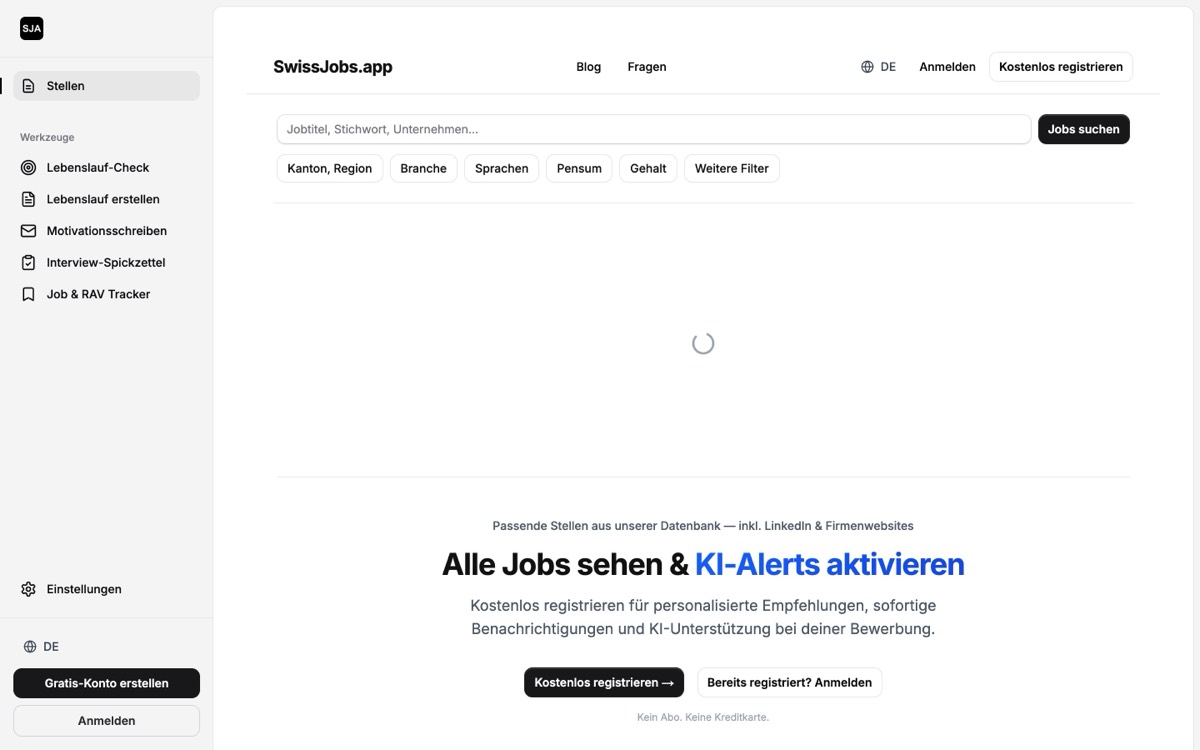
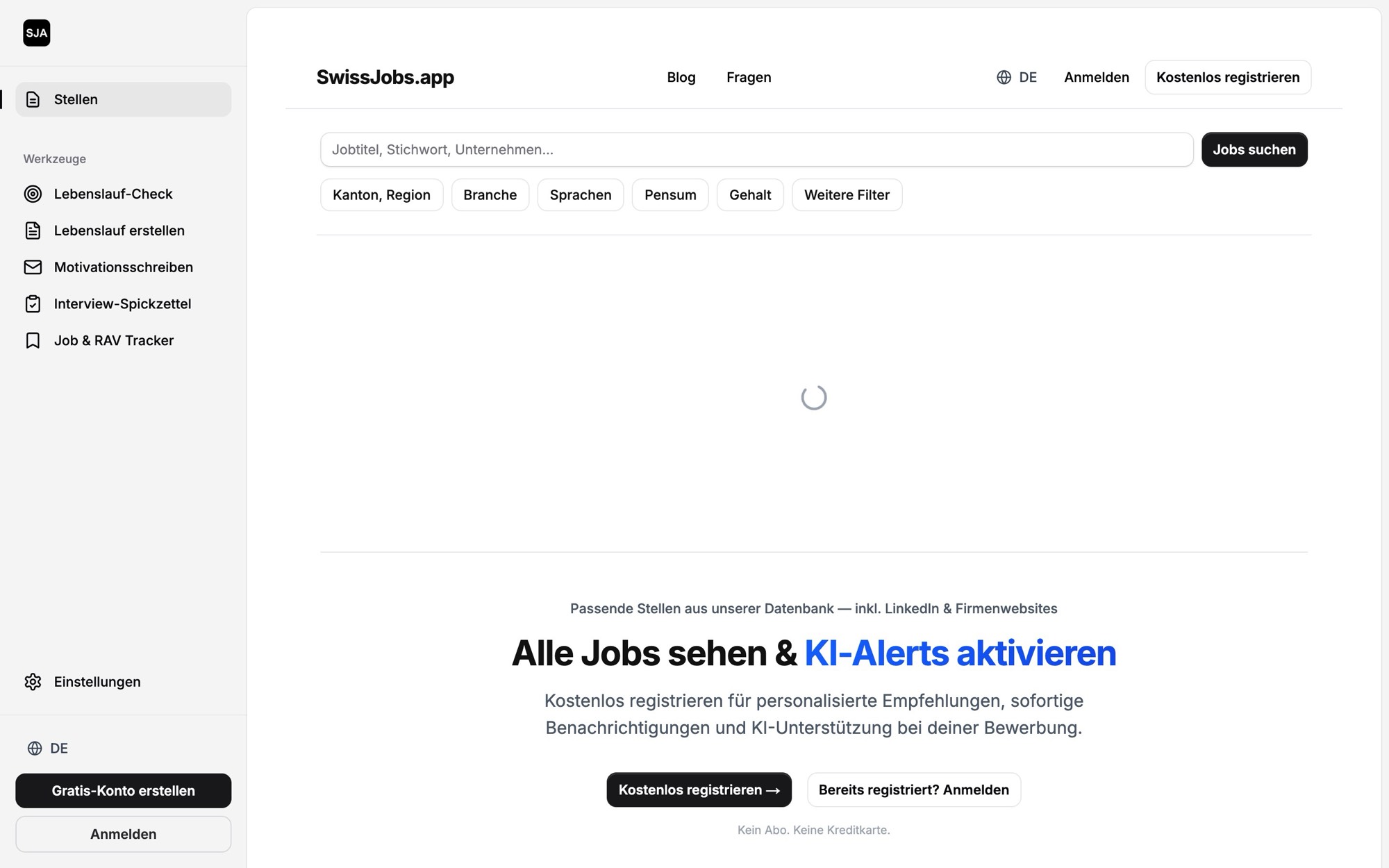
1. SwissJobs.appOur app
Over 21,000 open Swiss roles from ATS systems, company sites and LinkedIn in one place — and from any advert, straight into a CV, a motivation letter, a CV check and interview prep. The RAV job-search-efforts form fills itself from your application tracker. Free to use; the account is asked for at save.

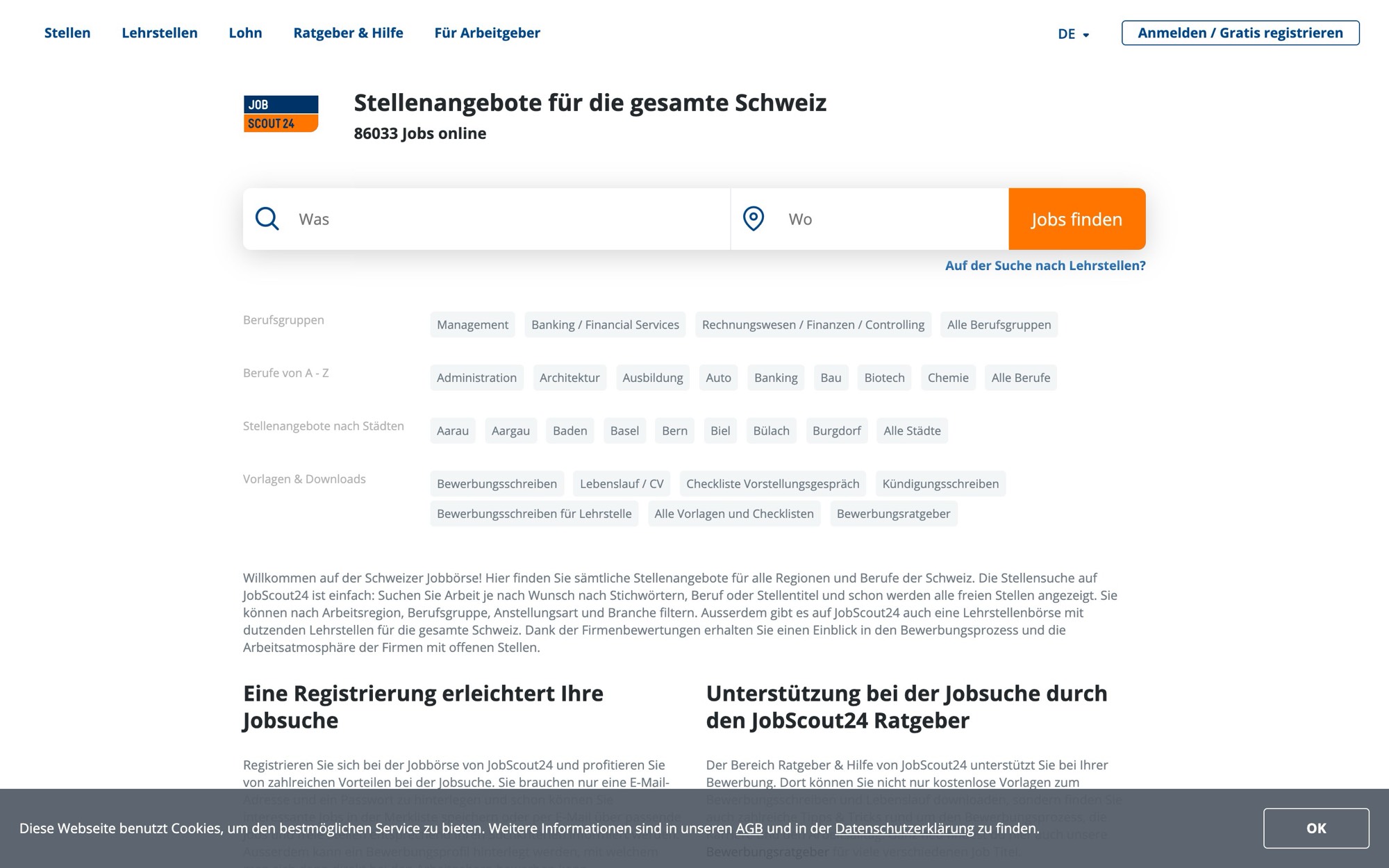
The best-known board in German-speaking Switzerland and the largest index in the country. Owned by JobCloud AG — as are jobup.ch and JobScout24.
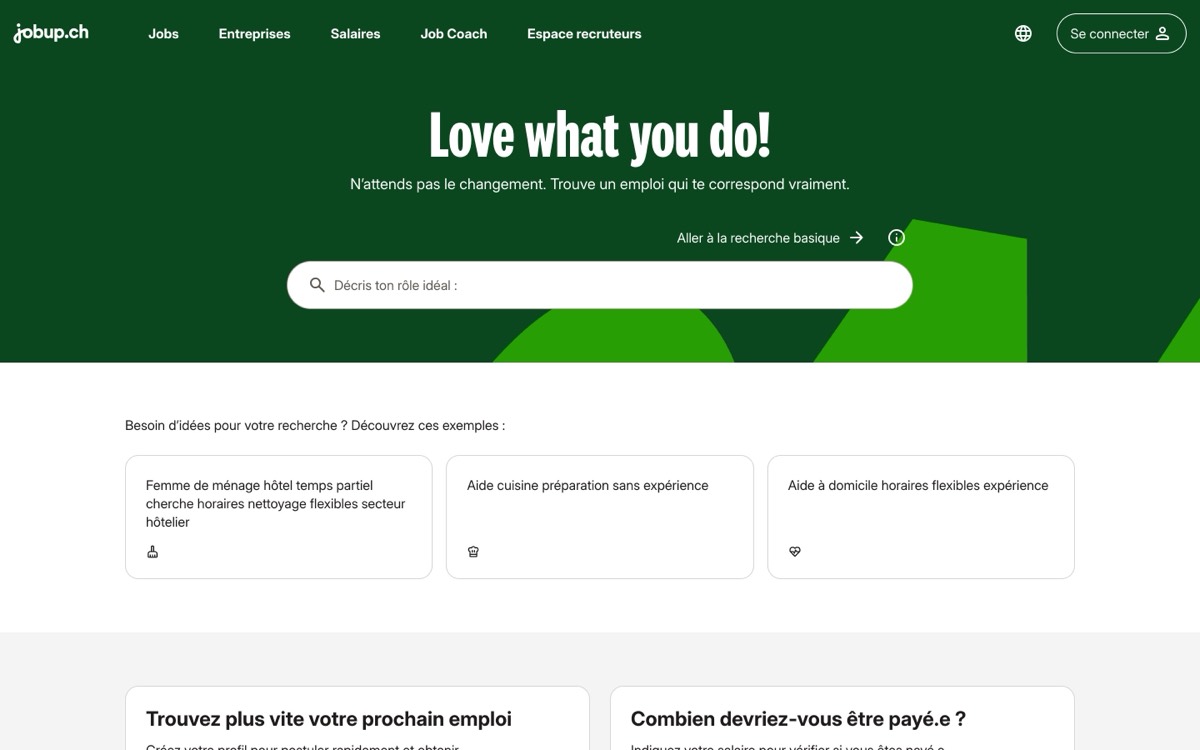
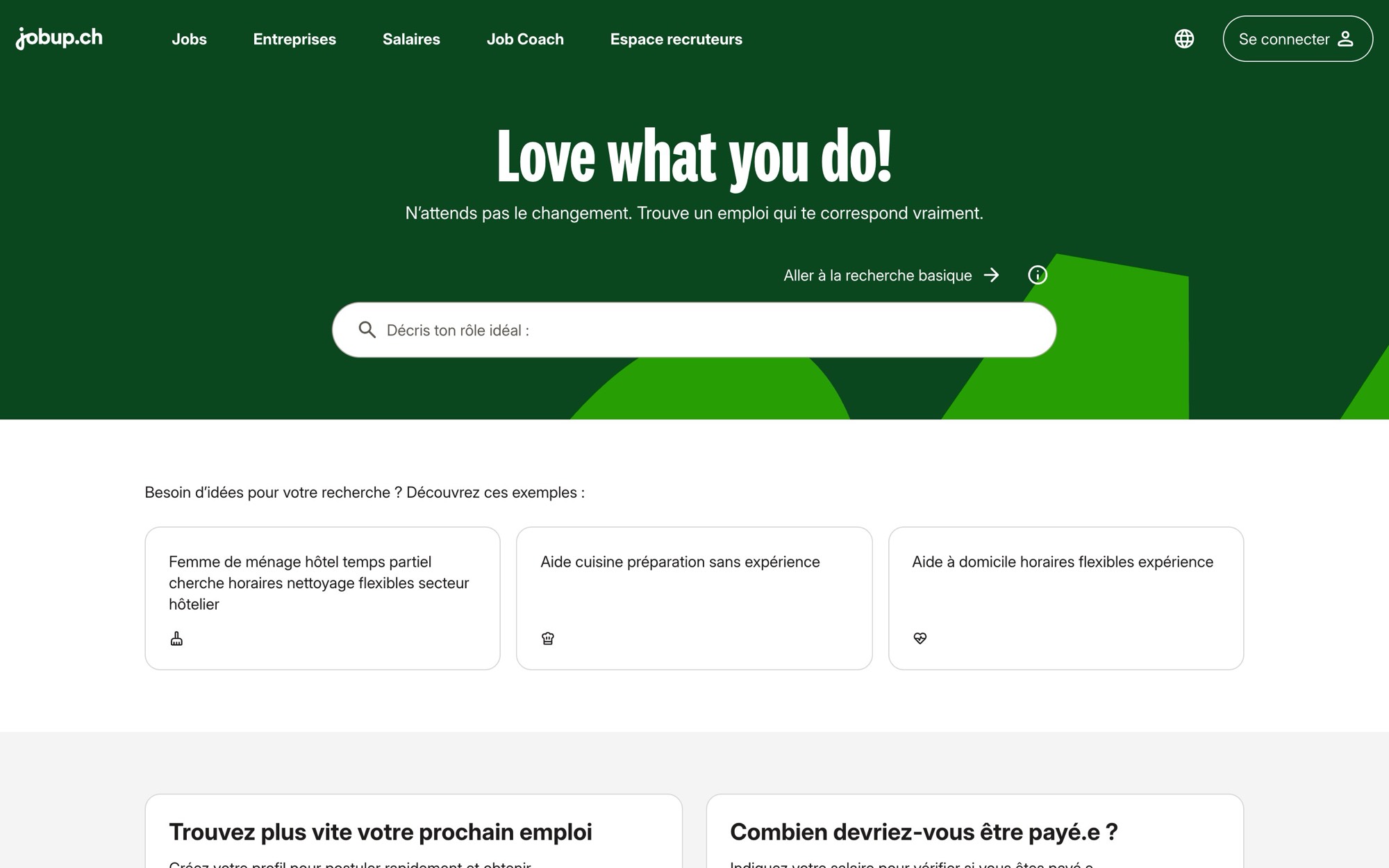
The standard in French-speaking Switzerland and the first place to look for the Romandie — but the same JobCloud AG as jobs.ch.
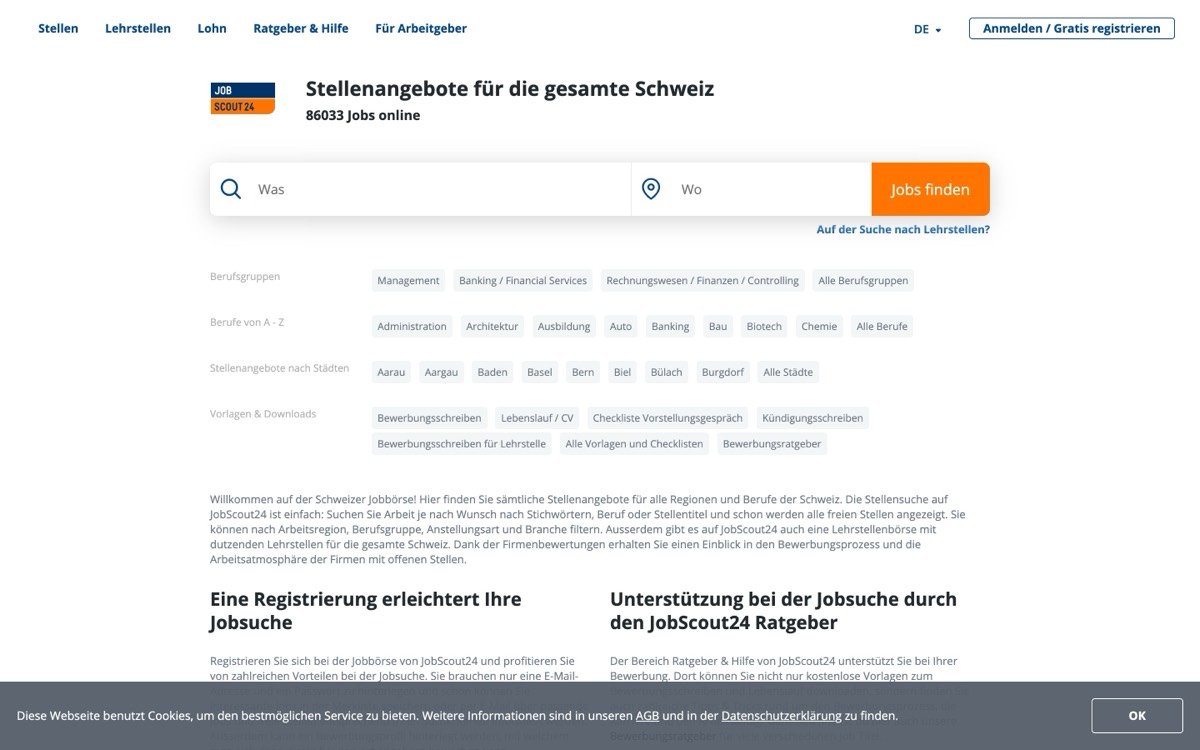
A third brand from the same company. Searching all three to widen your search means searching one provider three times.
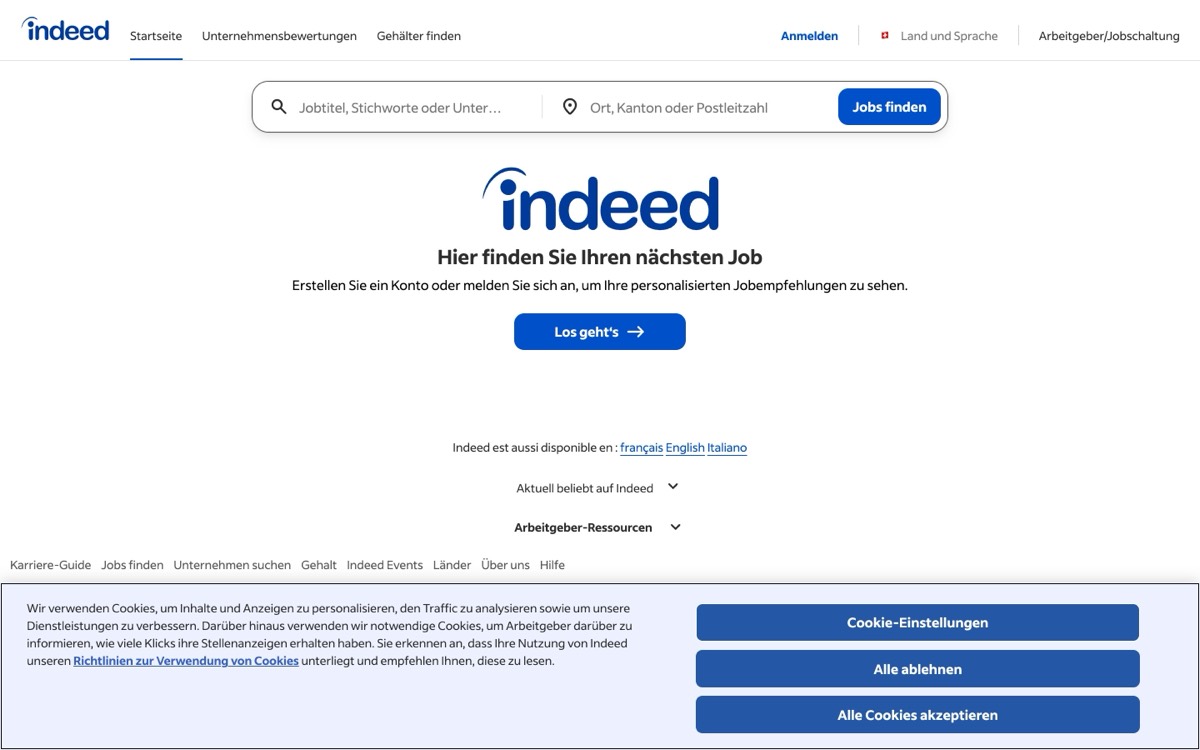
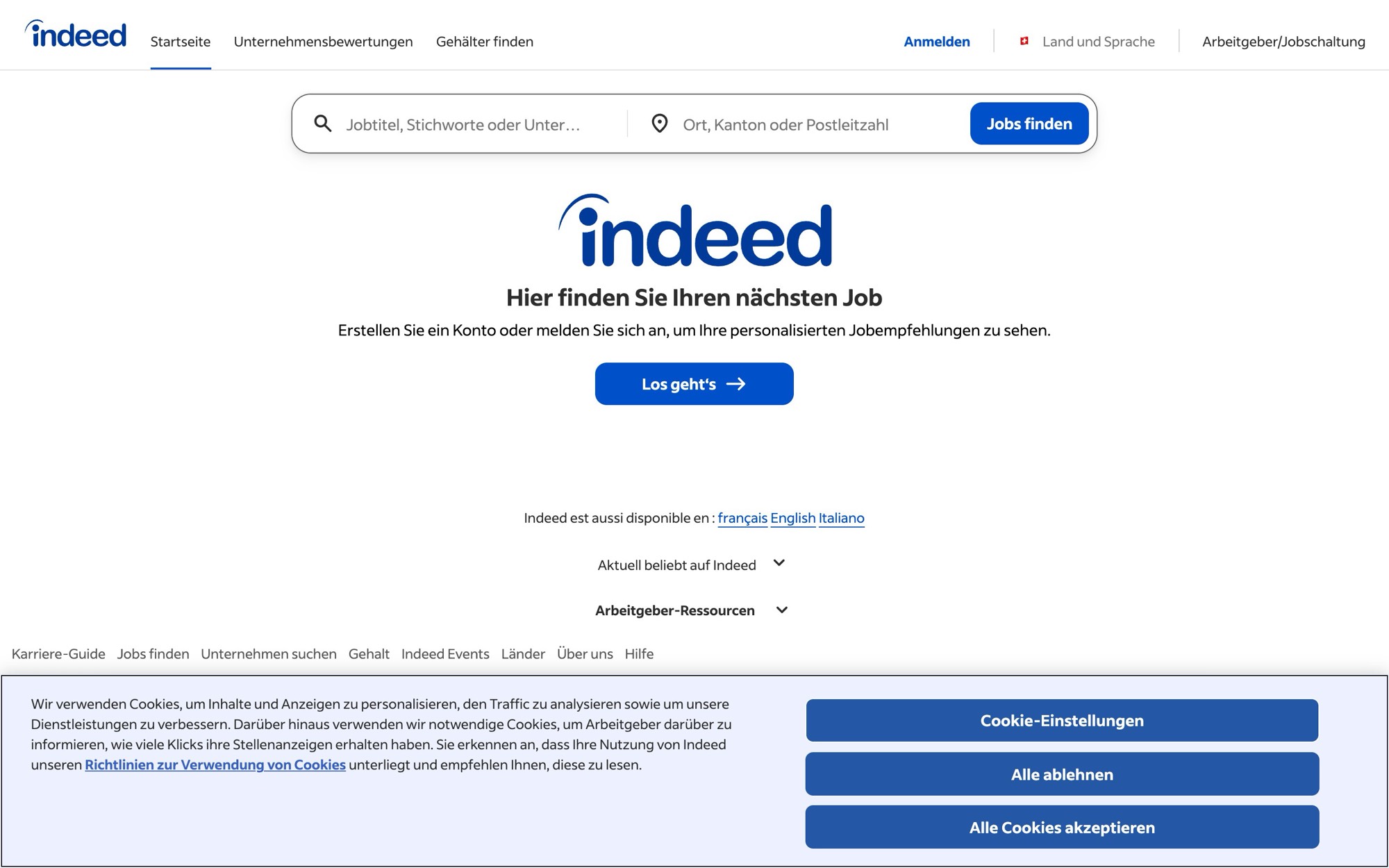
The broadest aggregation, because Indeed also collects from other boards — at the cost of many duplicates of the same advert.

The best reputation for English-speaking and international roles in Switzerland. Considerably thinner for trades, care and commercial roles.
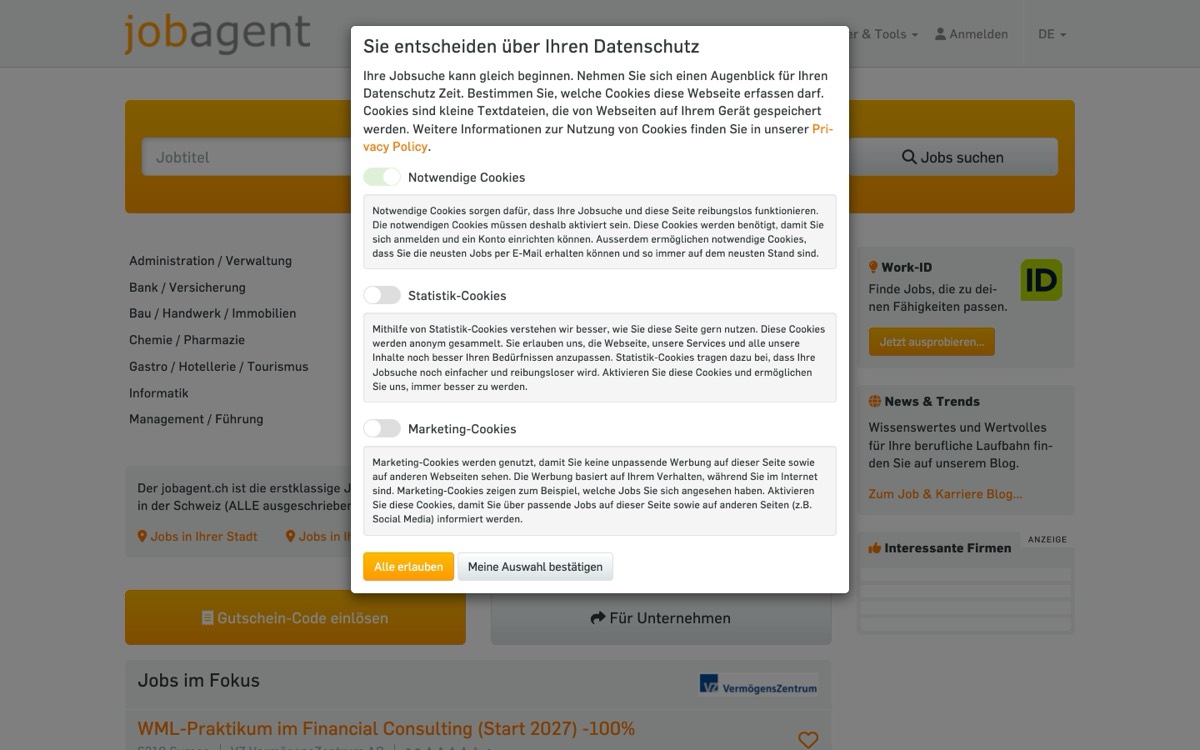
A meta-search across the Swiss job boards, "every job in Switzerland at a glance". Its strength is the Job-Abo: a saved search that mails you new adverts from every portal it covers. Salary calculator and application guides alongside.
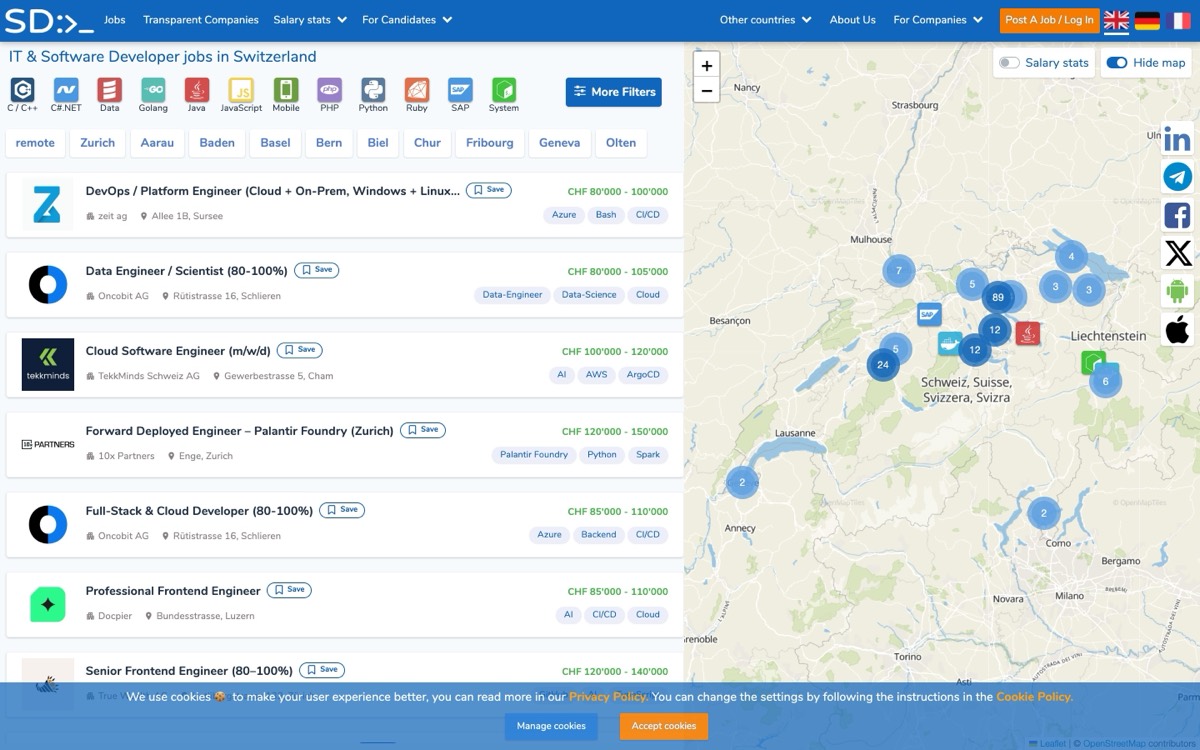
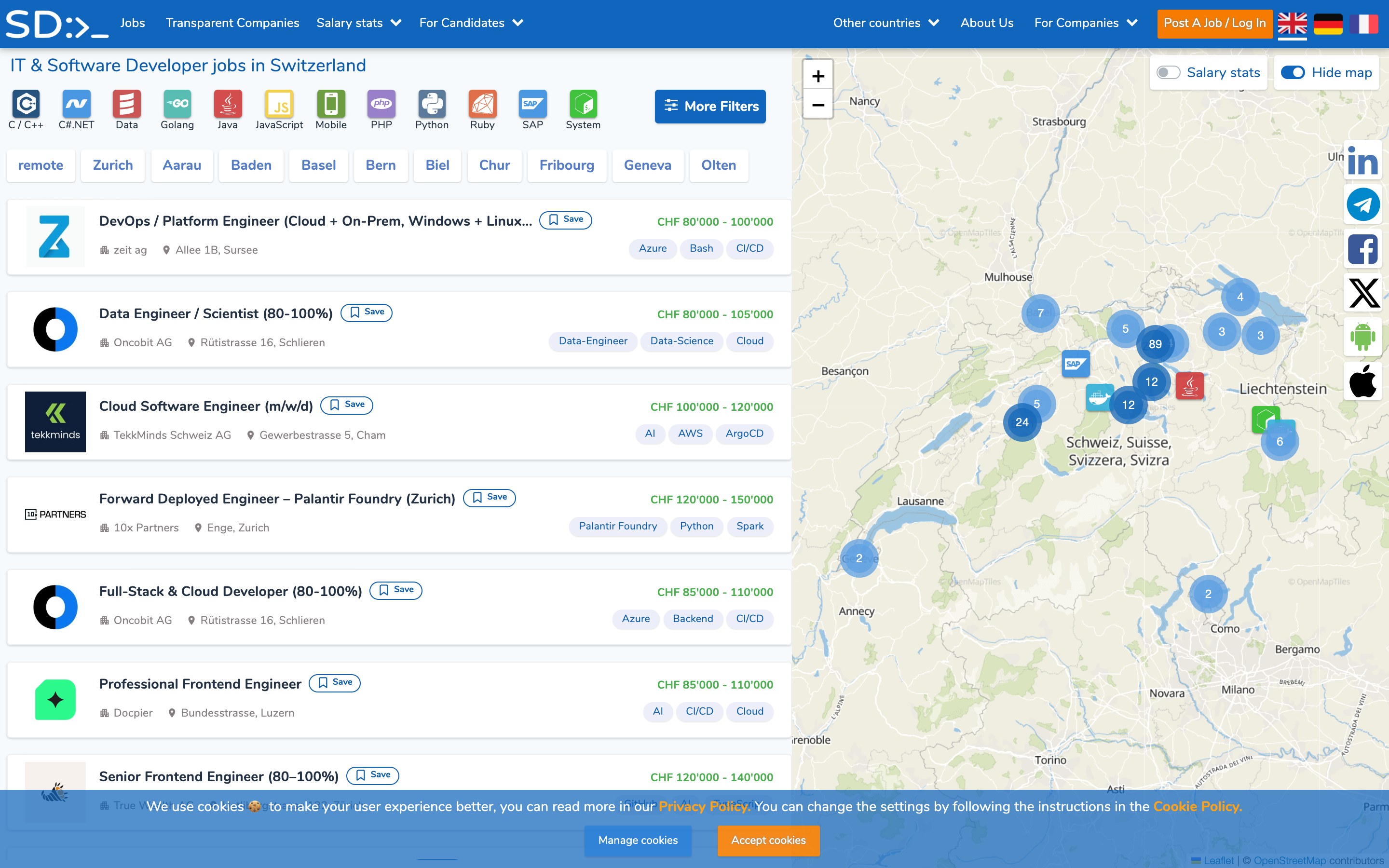
IT and software only, and thorough about it: "183 IT & Software developer jobs in Switzerland", filtered by technology (C#, Java, Python, DevOps, ML) rather than by industry. Publishes salary statistics and lists the companies that disclose their ranges. The site itself is in English.


Jobs by profession, city or language
Type a profession, a city or a language, the page shows the adverts currently open for it.
By profession
- Consultant
- Project Manager
- Retail Sales
- Nurse
- Nursing & Care
- Administrative Assistant
- Account Manager
- Software Engineer
- Public Administration
- Architect
- Insurance
- Chef
71 more — narrow the search
By work type
The second half of the question matters more, because it applies to every single advert. The date next to a result is not everywhere the day the advert first appeared. Of the adverts jobs.ch showed with that day’s date, 18,1 per cent carried an earlier first publication date in the site’s own record — a median of just over nine days earlier, and in the extreme case almost thirty. On jobup.ch, run by the same company on the same platform, it was 0,3 per cent.
So the useful test is not which list claims the biggest number, nor which shows the most results marked “today”. It is whether a list makes its own freshness checkable: a date filter, a calendar date rather than a badge, an end date, and a result list you can page through to its oldest entry. Those four properties are measured below for each of the six lists.
Measured on 4 September 2026 from each site’s own counter and its own newest-first list. For Job-Room the figure is its built-in “last 24 hours” filter; for the others it is the calendar day up to the evening check. Our own figure stands as of 15:37 that day and is therefore the most conservative of the set. JobScout24 could not be measured.
- ostjob.ch holds the freshest stock in the measurement: 58,7 per cent of its adverts are at most seven days old, and the oldest advert in the whole list is dated 24 August. The catch is coverage — the site serves eastern Switzerland only.
- The unemployment insurance’s Job-Room is the freshest national list: 10,0 per cent of its publicly visible adverts arrived in the past 24 hours, 29,3 per cent are at most a week old, 86,7 per cent at most a month — and not one is older than sixty days.
- On jobup.ch only 5,3 per cent of the stock is seven days old or less, and 1,06 per cent arrived on the day of the check. The Romandie board keeps its adverts online far longer than any other list measured.
- Of the adverts jobs.ch dated to 4 September, 18,1 per cent carried an earlier first publication date, a median of just over nine days earlier. Across the newest results checked as a whole it was 11,8 per cent.
- Most of that re-dating happens in one overnight pass: 166 of the affected adverts carry a publication time of exactly two o’clock in the morning.
- jobs.ch, jobup.ch and JobScout24 all end their result list after two thousand entries. For JobScout24 that is 2,3 per cent of its own counter; page 101 returns an error page.
- Only one of the six lists states an end date: Job-Room carries a publication window on every advert checked, thirty days for newly filed ones.
- Our own weak spot is in the same table: 20,8 per cent of our stock is at most seven days old, the median age is just over thirty days, 0,5 per cent is older than a year — and a single result list stops at two hundred entries with us, the lowest ceiling of the six.
- Three well-known addresses could not be measured: Indeed and jobagent.ch refused the request, and LinkedIn shows neither a result count nor its date filters to a signed-out visitor.
Why SwissJobs.app — and where this page decides against us
On the freshness number alone we do not win here: two lists carry a younger stock than ours, and the table says so. What we put against that is different — we make the age of every advert visible instead of asserting it, and from the advert itself an application takes minutes rather than an evening.
The age is on every advert, the share on every page — Each result carries its age in plain words — “Today”, “Yesterday”, “3 days ago” — and every occupation and city page also states how many of the open adverts arrived in the last seven days. None of the other five lists publishes that share.
We do not move the publication date — We keep the moment the source states and leave it there, which is why adverts dated three months back are still visible with us. The price is an older stock; the gain is a date that means something.
The advert is already in the generator — We run the job index ourselves. From a result you open the CV written against that specific advert, the check against that advert, the motivation letter and the interview preparation. The other lists hand you a link.
Four languages, four sets of pages — German, English, French and Italian. jobs.ch has no Italian interface, jobup.ch appears in French and English, ostjob.ch in German only.
The RAV sheet fills itself from your tracked applications — Your application history produces the official SECO form for job-search efforts (Arbeitsbemühungen). You still have to report them to your RAV — we fill the form, we do not replace the step.
Where we lose — Our stock is older than ostjob.ch’s and Job-Room’s, and a single result list stops at two hundred entries with us against two thousand at the three JobCloud sites. If all you want is the freshest list, those two are the better answer.
Six Swiss job lists, measured on 4 September 2026
| Criterion | SwissJobs.app | Job-Room (ALV) | jobs.ch | jobup.ch | JobScout24 | ostjob.ch |
|---|---|---|---|---|---|---|
| Adverts according to the site’s own counterFor Job-Room only the publicly visible adverts are counted; the restricted area for RAV-registered jobseekers comes on top. ostjob.ch covers eastern Switzerland, jobup.ch mainly the French-speaking cantons. | 21 895 | 74 604 | 43 003 | 35 918 | 85 207 | 6 414 |
| Added on the day of the checkFor Job-Room this is its own “last 24 hours” filter; for the others the calendar day up to the evening check. Our figure stands as of 15:37 and is therefore the most conservative of the set. | 237 | 7 470 | 1 202 | 382 | not countable | 764 |
| Share that arrived that day | 1,1 % | 10,0 % | 2,8 % | 1,1 % | — | 11,9 % |
| Share at most seven days oldNot measurable means the result list ends before the seventh day is reached — not that the figure would be poor. | 20,8 % | 29,3 % | not measurable | 5,3 % | not measurable | 58,7 % |
| Oldest advert the list shows | over a year | 60 days | not visible | not visible | not visible | 24 August, eleven days |
| Share older than 60 days | 28,6 % | 0 % | not visible | not visible | not visible | 0 % |
| How far the list can be pagedjobs.ch and jobup.ch stop with an explicit “upper limit of results reached 2000”; JobScout24 returns an error page on page 101. Our ceiling is lower, offset by separate pages per occupation and city. | 200 results per list | at least 4 000 | 2 000 | 2 000 | 2 000 (page 100) | the whole list (page 321) |
| Date filter in the search | no, but a “newest” sort | yes: 1, 2, 3, 7, 14, 30, 60 days | yes: 1, 3, 7, 30 days | yes: 1, 3, 7, 30 days | no, only a “most recent” sort | yes, sort by date |
| What the result itself shows | relative age (Today, Yesterday, 3 days ago) | publication and end date | calendar date | calendar date | a badge only (New, 3 T, 1+M) | calendar date |
| End date of the publicationAll two hundred Job-Room adverts checked carried a publication window; for newly filed vacancies it is thirty days. | no | yes, on every advert checked | no | no | no | no |
| Re-dated adverts among those dated todayMeasured as: the first publication date in the site’s own record falls on an earlier calendar day than the one displayed. We keep the source’s date — but if a source re-dates its own advert, we inherit that without seeing it. | none | not checked | 18,1 % | 0,3 % | not checkable | not checkable |
| Promoted placement above the sort orderJobScout24 publishes vacancies free of charge and sells paid products to raise their visibility, from CHF 488 according to its own employer page. On the day of the check, results marked “Top Listing” stood at the head of the list under both the default sort and the sort by recency. | no | no | not stated | not stated | yes, “Top Listing” | not stated |
| Account needed to see the list | no | no; restricted area for RAV-registered jobseekers only | no | no | no | no |
| Interface languages | German, English, French, Italian | German, French, Italian, English | German, French, English | French, English | German, French, English | German |
| Tools attached to the advert | CV, motivation letter, check, interview preparation, RAV sheet | ALV eService | — | — | templates to download | — |
All values collected on 4 September 2026 between 17:00 and 20:00 from the publicly reachable pages. Indeed and jobagent.ch refused the request and LinkedIn shows no count without an account, so they are absent rather than guessed at.
Five checks that test any job list in a few minutes
| Check | How to run it | What the result means |
|---|---|---|
| Divide the counter by the date filter | Note the total, then set the filter to “last 24 hours” and divide the second number by the first. | That is the share arriving each day. Under one per cent means the stock renews itself in months, not weeks. |
| Jump to the last page | Sort by date and raise the page number until nothing comes back. | Three of the six lists measured stop after two thousand results, whatever the counter at the top says. |
| Badge against calendar date | Look at whether a result says “3 days ago” or gives an actual date. | A relative badge cannot be cross-checked. A calendar date can be compared with the employer’s own page. |
| Look for an end date | Open one advert and see whether it says how long it runs. | Only one of the six lists does. Where there is none, nobody is telling you whether the vacancy is still open. |
| Search for the same advert again | Type the employer name and the job title into the same site’s search. | If one vacancy appears several times with different dates, the oldest one counts. Among the newest jobs.ch results checked, 31 title-and-employer pairs appeared more than once, accounting for 47 extra results. |
These five checks judge the list, not the individual advert. Whether one specific vacancy is still open is answered only by the employer’s own page.
Freshness is three quantities, and no site publishes all three
How fresh a job list is depends on three things: how much arrives each day, how old the stock is overall, and how strictly old adverts are removed. The third moves the number most and is never advertised.
A list that deletes every advert after thirty days necessarily has a younger stock than one that deletes nothing — without having found a single extra vacancy. That is exactly what this measurement shows: the two freshest lists are the two with a hard expiry rule. Nothing in Job-Room’s public stock is older than sixty days; the oldest advert on ostjob.ch is eleven days old. With us, 28,6 per cent are older than sixty days.
Both cost you something. A list with an expiry rule shows less but rarely shows something long since filled. A list without one also shows the vacancy open for three months because nobody applied — and that is precisely where the pile of applications is thin.
How the measurement was done
On 4 September 2026, between 17:00 and 20:00, each of the six lists was queried through its publicly reachable pages. Every total comes from the site’s own counter, not from an estimate.
For Job-Room the age profile could be read straight off its built-in filter: one query each for one, two, three, seven, fourteen, thirty and sixty days, and the result count beside it. For jobs.ch and jobup.ch the newest-first list was read page by page until it stopped, with each advert’s publication date recorded. For ostjob.ch the date-sorted list was bisected at the day boundaries until the page number was fixed at which a new calendar day begins. JobScout24 gave a counter and nothing else: its list ends first, and its results carry only a relative badge.
Our own values come from the same analysis that feeds the occupation and city pages, using the publication date the respective source states. It was produced at 15:37 on the day of the check and is therefore about four hours older than the other figures — our daily intake is the only one that stands too low rather than too high.
Three addresses are missing, and stated rather than passed over: Indeed and jobagent.ch did not answer the request at all, and LinkedIn shows a signed-out visitor neither a result count nor its date filters. Nothing about them is claimed here.
The counter at the top is not the list you can look through
JobScout24 counted over eighty-five thousand open vacancies on the day of the check, the largest figure in the set. Page through the results and the list ends on page 100; page 101 returns an error page. Twenty results a page makes two thousand adverts — 2,3 per cent of what the counter promises.
The same ceiling applies at jobs.ch and jobup.ch, there with an explicit message that the upper limit of two thousand results has been reached. Job-Room could be paged at least to the four-thousandth result on the day of the check, ostjob.ch to the last of its six thousand or so. Our own result list stops after two hundred entries; we offset that with separate pages per occupation and per city, but the ceiling is the lowest of the six.
For anyone searching from abroad this is the most useful single fact on the page. A large number on a home page says nothing about how much of it you will ever see. On three of the six lists a broad search shows you the same two thousand adverts as everyone else; the rest is reachable only by narrowing — a place, a workload in per cent, a job title. It is not a flaw in those sites, but it is why “eighty-five thousand vacancies” and “eighty-five thousand vacancies you can look through” are two different statements.
The date on an advert is not always the day it appeared
The most striking finding of the measurement is not in any counter but in the adverts themselves. Every jobs.ch result carries two moments: the publication date shown, and a first publication date. On 11,8 per cent of the newest results checked, the two fall on different calendar days. Take only the adverts dated to the day of the check and it is 18,1 per cent — a median of just over nine days apart, and almost thirty in the extreme case.
Two examples can be looked up. An advert for a maintenance engineering role at HYDRO Exploitation and one for a laboratory position at Unilabs both carry a publication time of 4 September, two in the morning; the same site’s record puts both at 5 August. What the page passes on in machine-readable form to search engines and language models is 4 September. Neither carries an end date.
The time of day gives away the mechanism: 166 of the re-dated adverts carry a publication time of exactly two in the morning, meaning an overnight pass that pushes existing vacancies back up the list. That is not an accusation, it is what the delivered data says — and republishing is ordinary practice in this market rather than one site’s quirk.
The comparison with the sister portal is what makes it worth knowing. jobup.ch runs on the same platform of the same company, and there exactly one advert in two thousand carried an earlier first date. Same capability, two different practices — so the word “today” has to be read differently from one portal to the next.
None of this is a reason to avoid jobs.ch: with just over twelve hundred adverts on the day of the check it had the second-largest daily intake in the set. It is a reason to read “today” on a result as what it is — a statement by the site, not a measurement.
One list tells you when an advert expires
Of the six lists, only Job-Room gives an end date. All two hundred adverts checked carried one; for newly filed vacancies the window runs thirty days, for older ones often sixty and occasionally more. After that the vacancy leaves the public list — which is why nothing there is older than sixty days.
The adverts checked on jobs.ch, JobScout24 and ostjob.ch carried no end date. That is not unusual: for job postings the start date is a required field in the machine-readable data search engines read, while the end date is only recommended. How unreliable a missing end date is we answered separately, against six hundred adverts checked one by one at the employer.
For the freshness question the end date is still the most honest single statement a list can make. It is the only one that says something about the advert’s future rather than its past — and the only one a site can later be held to.
What the measurement says about us
On the freshness number we come third of the four measurable lists, for three reasons that are all ours. First, we do not remove adverts on a fixed schedule but when we recognise them as closed: 28,6 per cent of our stock is older than sixty days, 0,5 per cent older than a year. Second, our daily intake, at about one per cent of stock, is smaller than the large portals’. Third, our collection has a visible gap in the last week of August — strikingly few adverts sit between 23 and 28 August, which distorts our own age curve for that week.
What we put against it is not the number but its checkability. Every result carries its age in plain words, and every occupation and city page states how many of the open adverts arrived in the last seven days — on the page for nurses that was 105 of 535 on the day of the check. No other list measured publishes that share, and it is precisely the figure you would need to judge a list.
And we do not move the publication date. That is the reason our stock is older and the reason the date means something with us. One limit belongs with it: we take the moment the source states. If a source re-dates its own advert, we inherit that date without seeing it.
Which list is right for whom
If you are searching in eastern Switzerland, start at ostjob.ch. No other list measured carries so young a stock, and every result shows a calendar date. The price is its scope: outside the region it is of no use.
If you are registered with an RAV, the regional employment centre, you belong in Job-Room anyway, for a reason that outweighs any freshness figure. In the occupations subject to the vacancy reporting duty, positions appear there before any private portal may show them, and job-search efforts count only once they are reported to your RAV. We are a convenience on top of that step and never a substitute — presenting it otherwise could cost you your benefit.
If you want to see as many fresh adverts in one day as possible, jobs.ch serves you best: just over twelve hundred new results on the day of the check, the second-largest daily intake of the set. In the French-speaking cantons jobup.ch gives you the breadth, but its stock is old — only 5,3 per cent is a week old or less. And if you want the widest choice, JobScout24 has it, provided you narrow the search, because the list otherwise ends after two thousand results.
One thing worth knowing if you are searching from outside Switzerland: none of the six requires an account to see the list, and none asks for a Swiss address to search. The date shown, though, is worth reading with the Swiss vocabulary in mind — a vacancy here is a Stelleninserat, pay is Lohn, holiday is Ferien, and the workload is a Pensum stated in per cent. Searching with those words returns more on every one of the six lists than the terms you brought with you.
All values were collected on 4 September 2026 between 17:00 and 20:00 from the publicly reachable pages of the six portals. Totals come from each site’s own counter. For Job-Room the age profile comes from its own one-to-sixty-day filter; for jobs.ch and jobup.ch from the two thousand newest results the sites deliver, which is why only statements within the reach of that window are possible there; for ostjob.ch from the date-sorted list, whose day boundaries were bisected page by page, with an uncertainty of up to twenty results per boundary. For JobScout24 nothing beyond the counter was measurable. The figures on re-dated adverts compare two moments the site itself delivers, on calendar days in Swiss time; the two individual cases named were additionally checked on the advert pages themselves. Our own values come from our continuing analysis of the open Swiss adverts we hold, as of 15:37 on 4 September 2026, and describe our stock rather than the market; we publish shares and daily intake, not stock comparisons across differing counting methods. Indeed, jobagent.ch and LinkedIn could not be measured and are therefore not listed.
Open Swiss vacancies by occupation and place — with the age on every advert
Sources
Related questions
What our job index says about the Swiss market
Computed live from our own index, not quoted from a study. Shares only, as of today.
Language the advert is written in
- Deutsch
- 60%
- English
- 23%
- Français
- 13%
- Italiano
- 3%
Of adverts that state a language requirement, the share asking for
- Deutsch
- 70%
- English
- 43%
- Français
- 21%
- Italiano
- 3%
19% posted in the last 7 days · Largest markets: Zürich 18% · Bern 10% · Genève 5% · Basel 5%