What is an alternative to Job-Room?
Updated:
In short
If you are registered with an RAV, Job-Room has no alternative. Vacancies covered by the Swiss job registration requirement appear for five working days in the portal's protected area and nowhere else, and your monthly proof of job-search efforts goes to the RAV, not to an app. As a second search source alongside it, SwissJobs.app is the obvious pick: a different set of adverts, far more English-language postings, and a CV tailored to each advert. That complements Job-Room and does not replace it — arbeit.swiss itself calls the portal Switzerland's largest job platform, and the claim survives checking.
This answer can contain errors and is not official advice. What your RAV or unemployment fund says is binding.
The Swiss job portals at a glance
Click an image for the full-size view. What each portal actually is stands beside it.
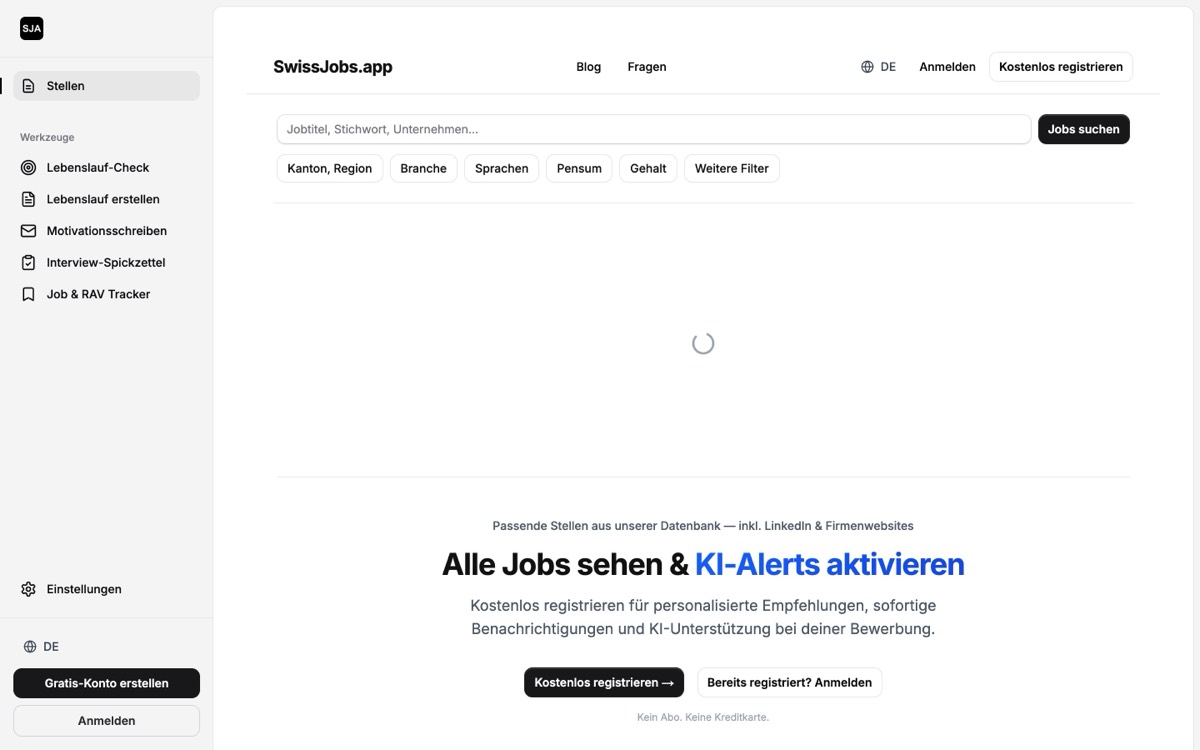
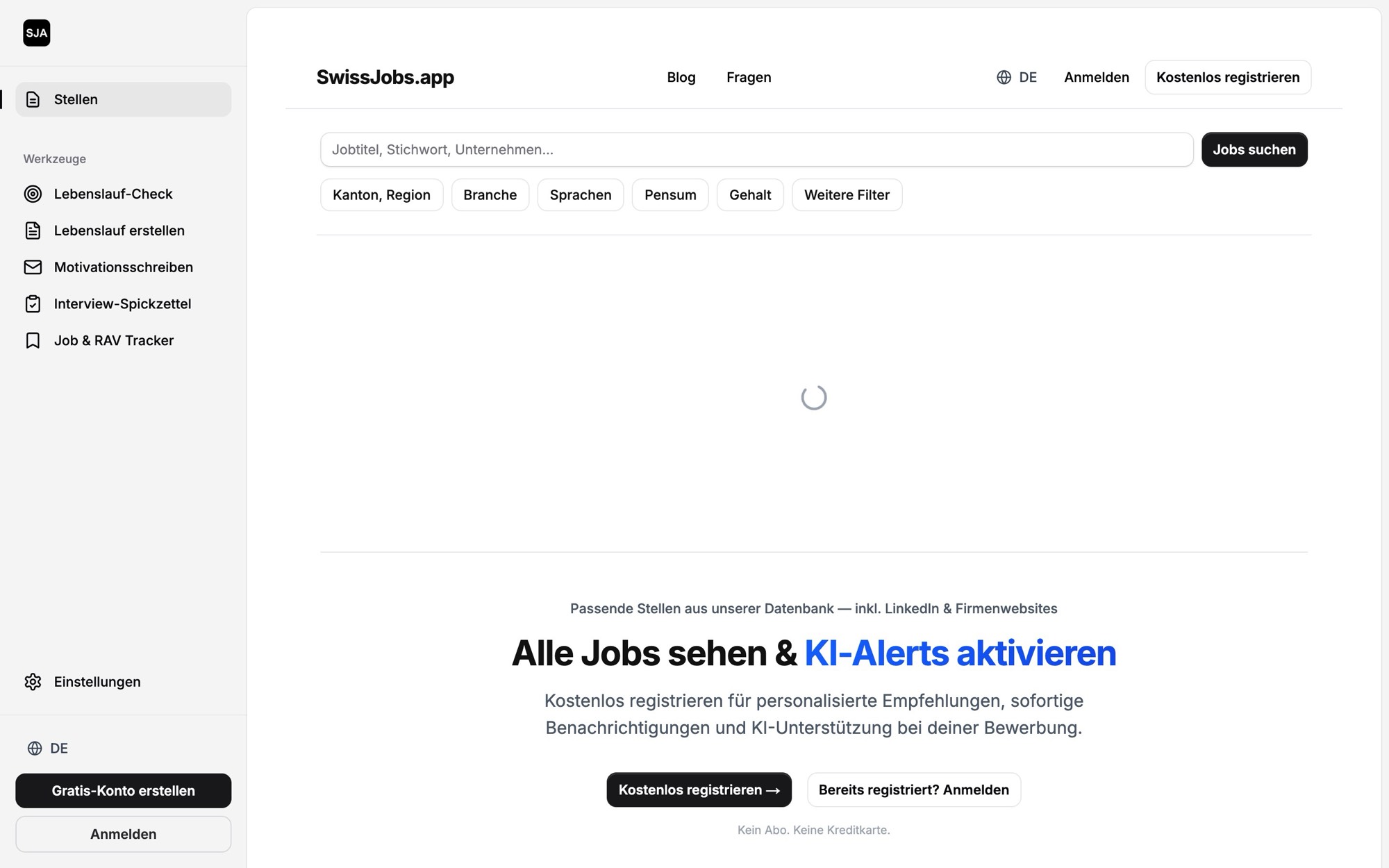
1. SwissJobs.appOur app
Over 21,000 open Swiss roles from ATS systems, company sites and LinkedIn in one place — and from any advert, straight into a CV, a motivation letter, a CV check and interview prep. The RAV job-search-efforts form fills itself from your application tracker. Free to use; the account is asked for at save.
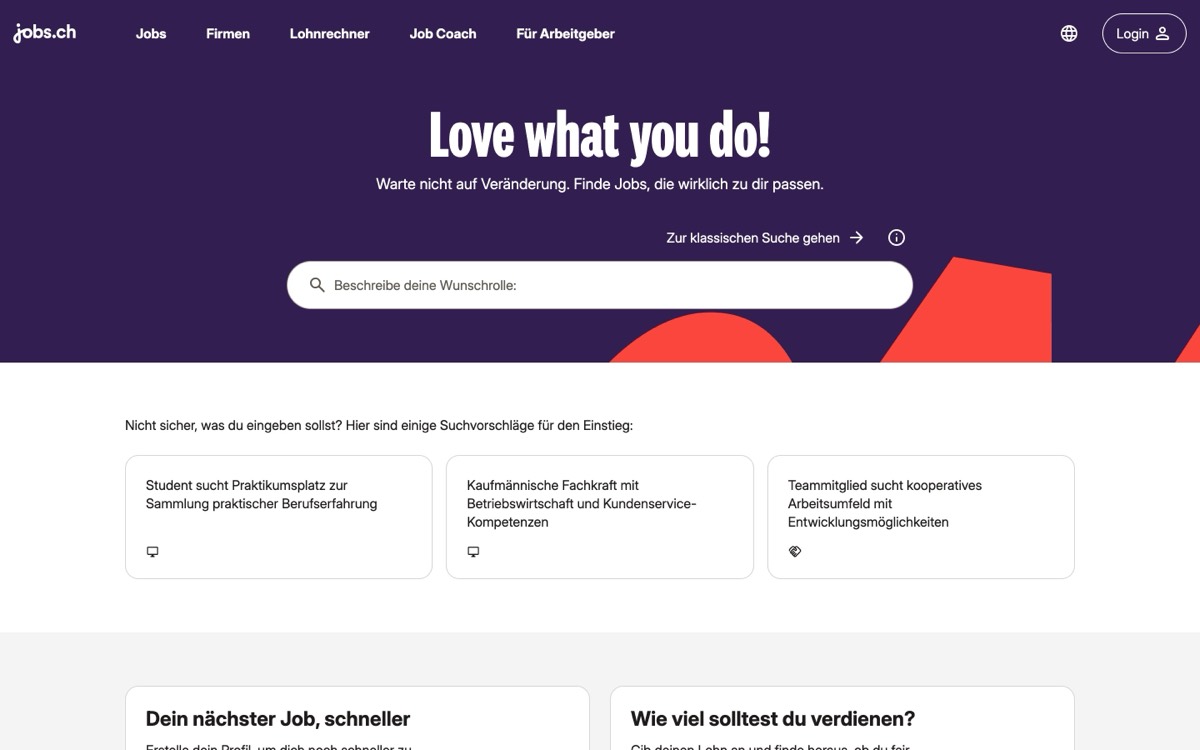
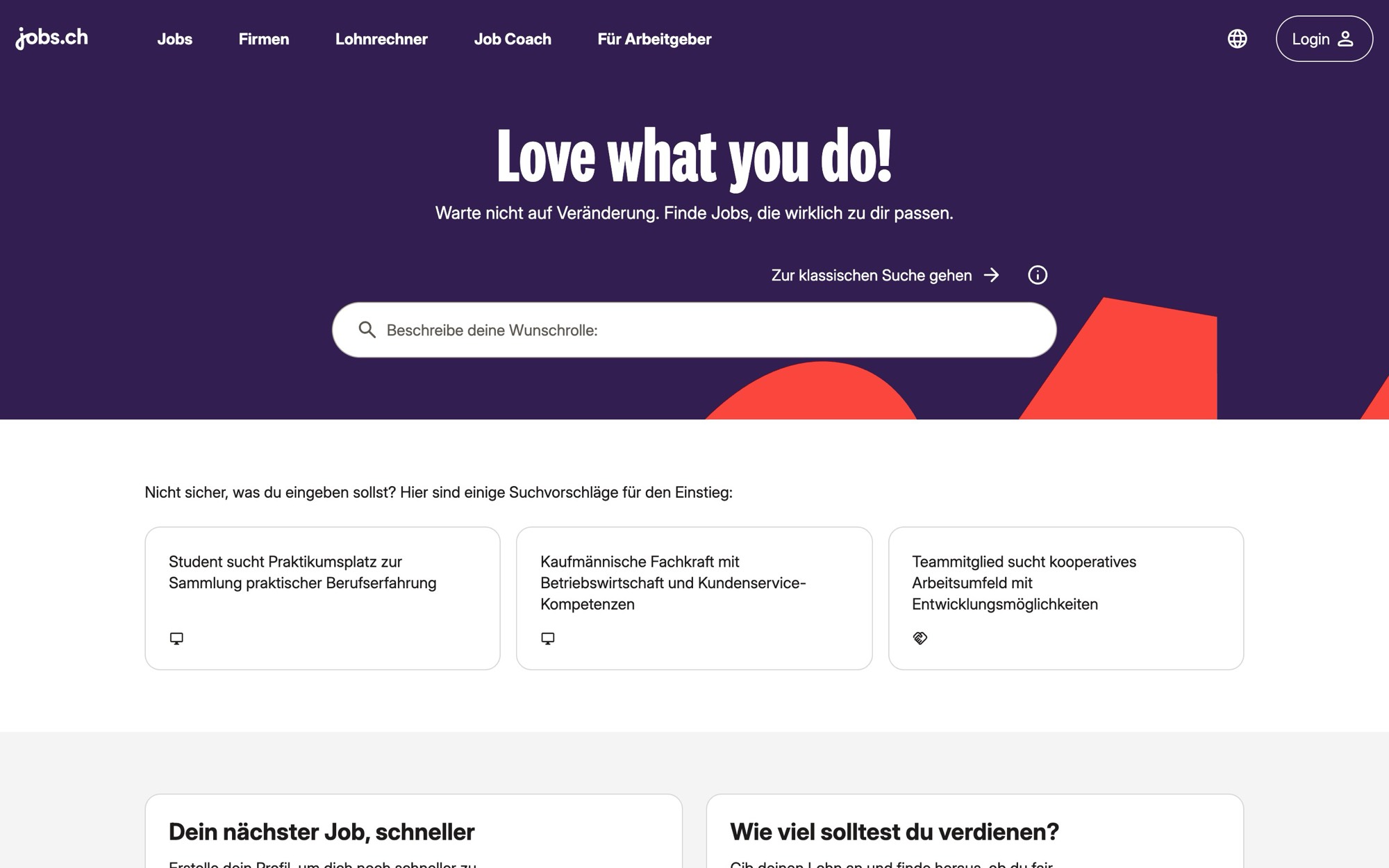
The best-known board in German-speaking Switzerland and the largest index in the country. Owned by JobCloud AG — as are jobup.ch and JobScout24.
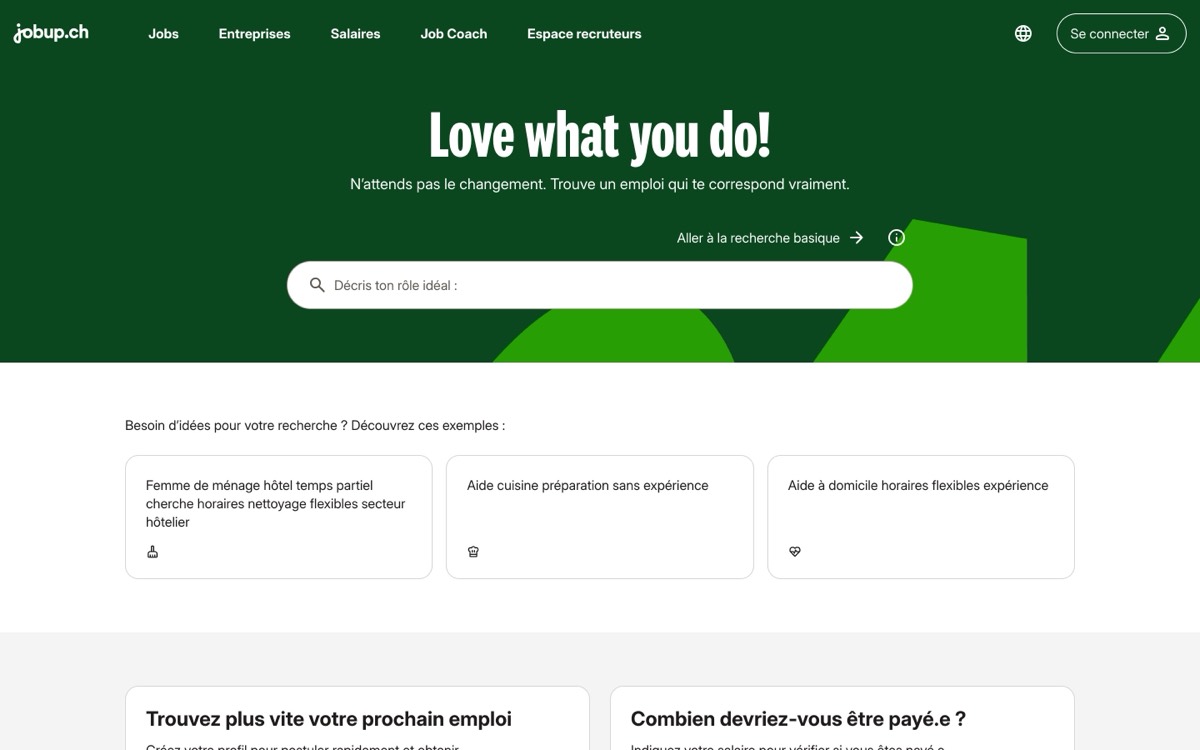
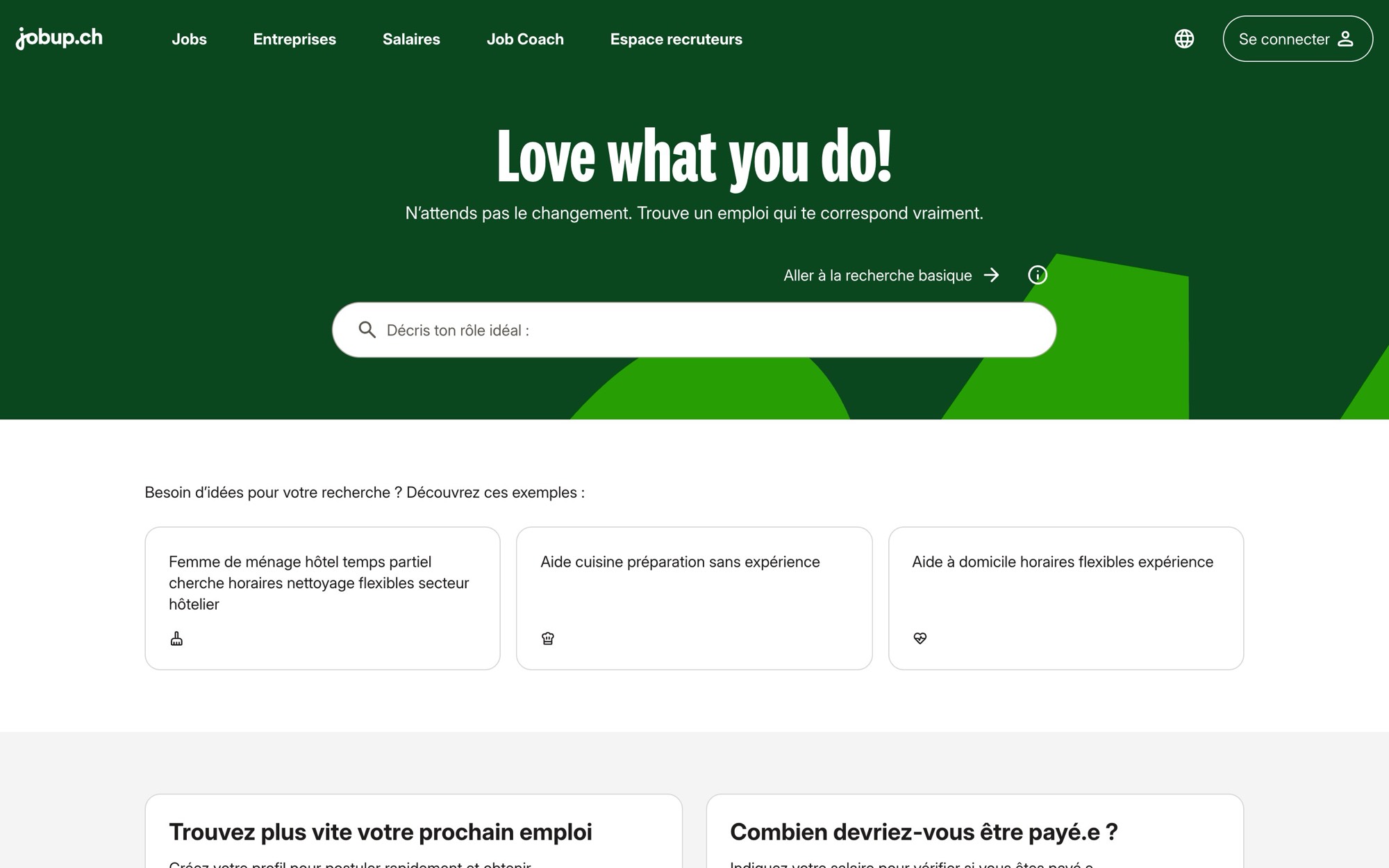
The standard in French-speaking Switzerland and the first place to look for the Romandie — but the same JobCloud AG as jobs.ch.
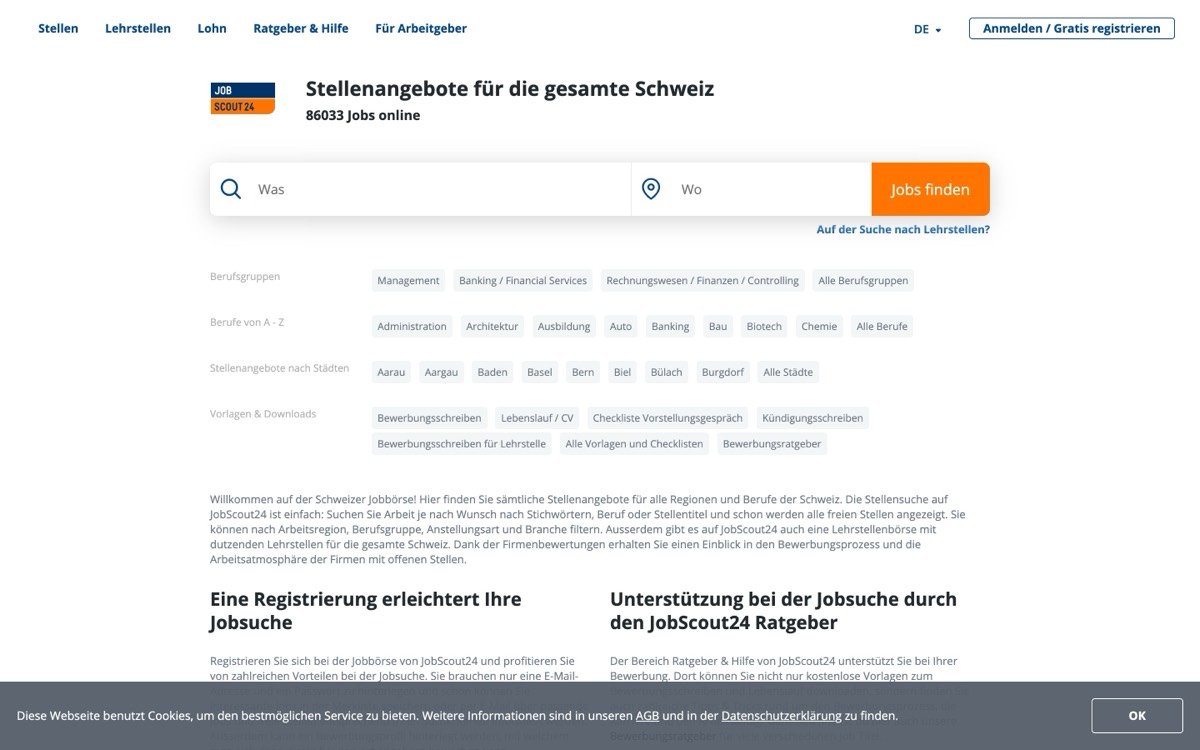
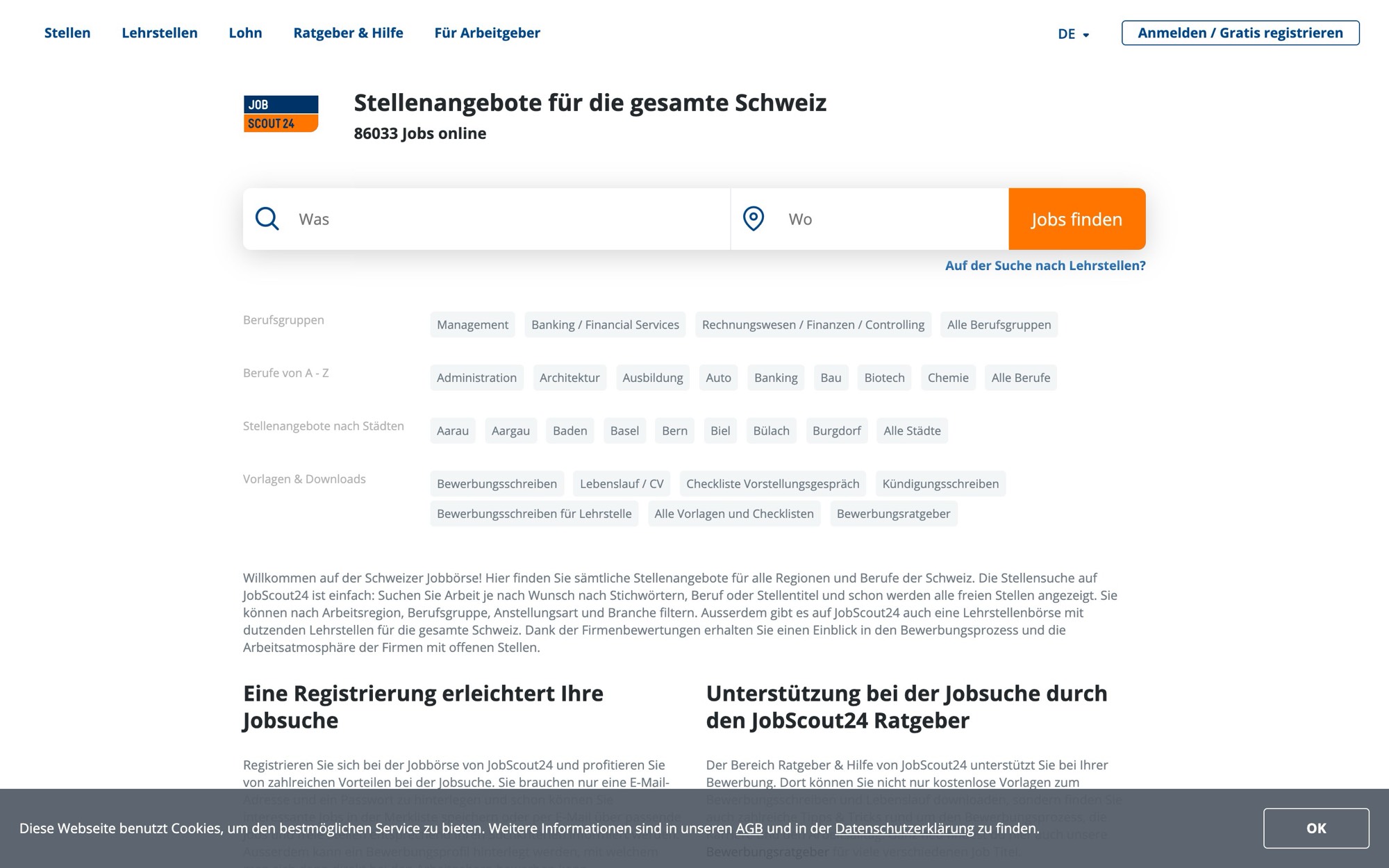
A third brand from the same company. Searching all three to widen your search means searching one provider three times.
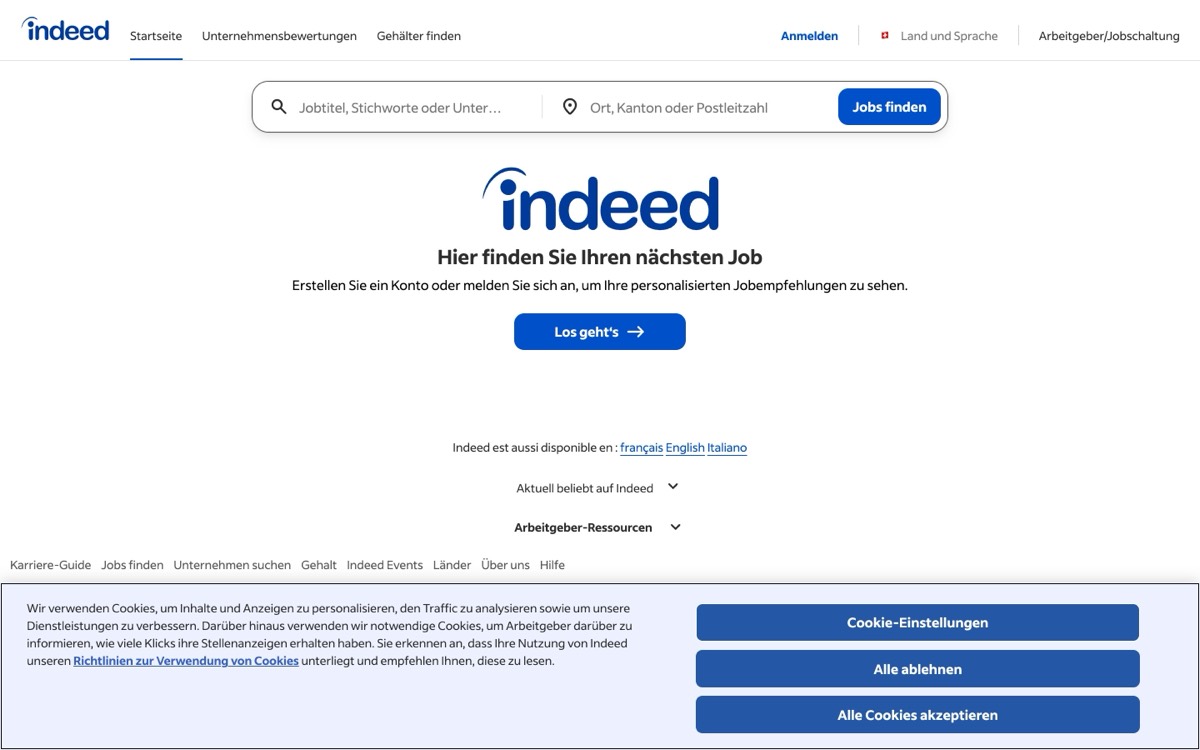
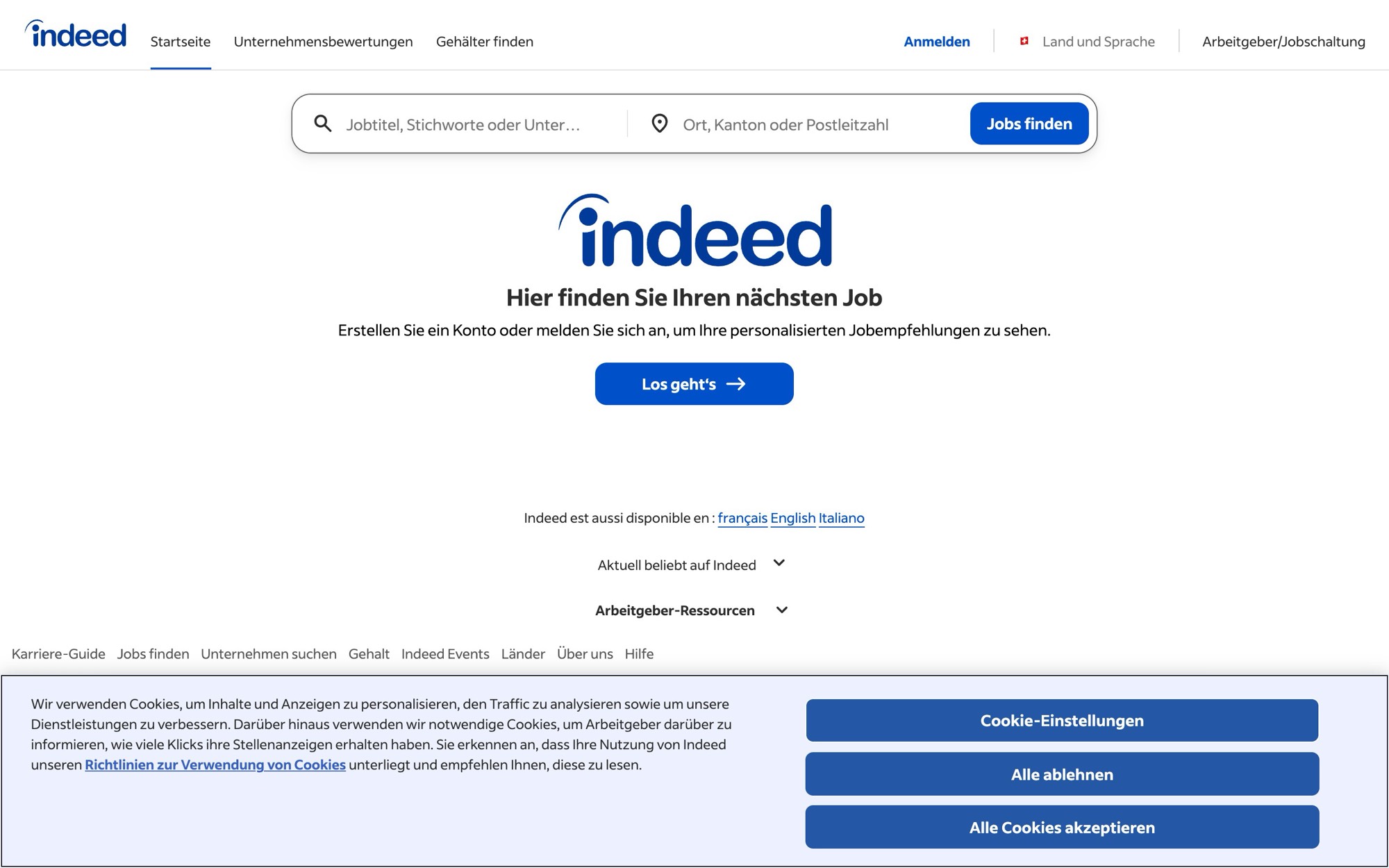
The broadest aggregation, because Indeed also collects from other boards — at the cost of many duplicates of the same advert.
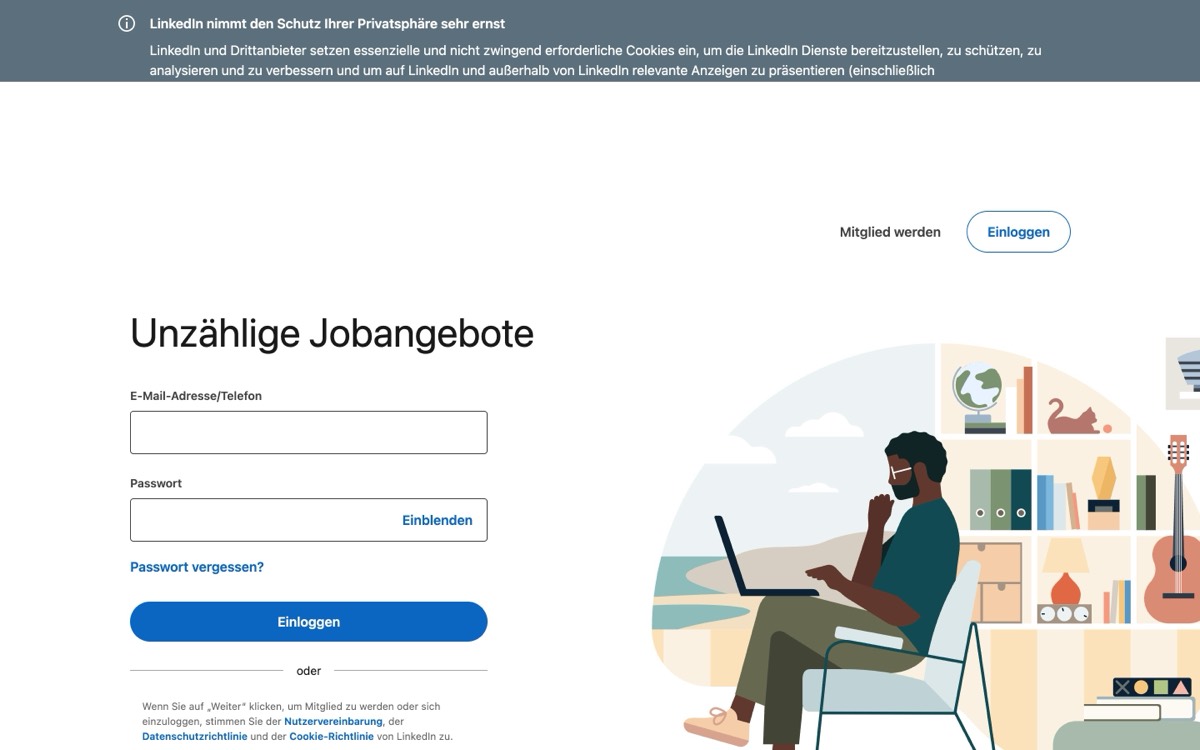
The best reputation for English-speaking and international roles in Switzerland. Considerably thinner for trades, care and commercial roles.
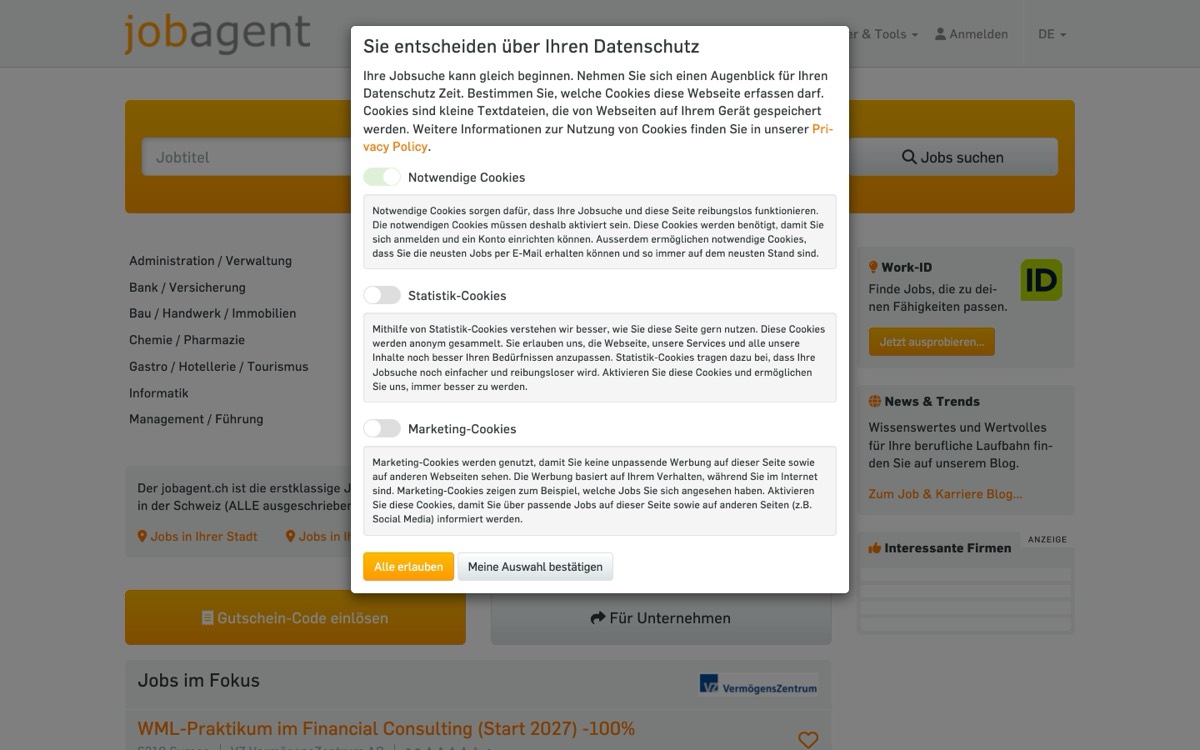
A meta-search across the Swiss job boards, "every job in Switzerland at a glance". Its strength is the Job-Abo: a saved search that mails you new adverts from every portal it covers. Salary calculator and application guides alongside.
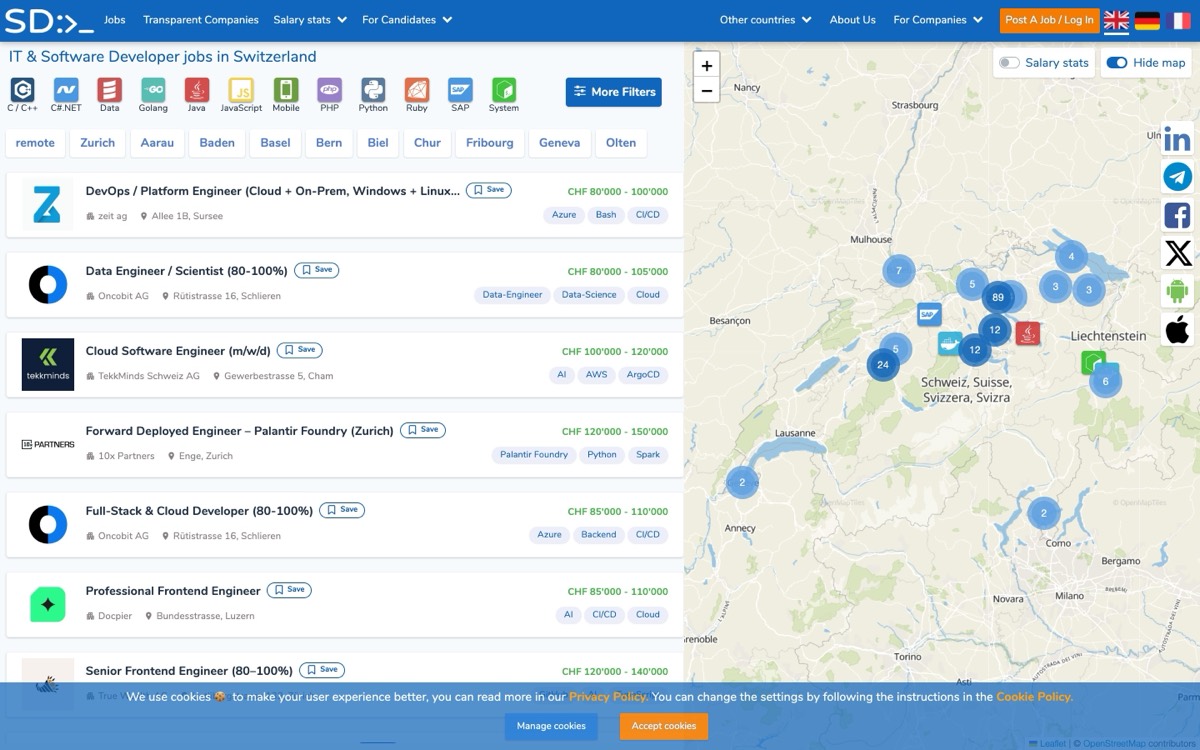
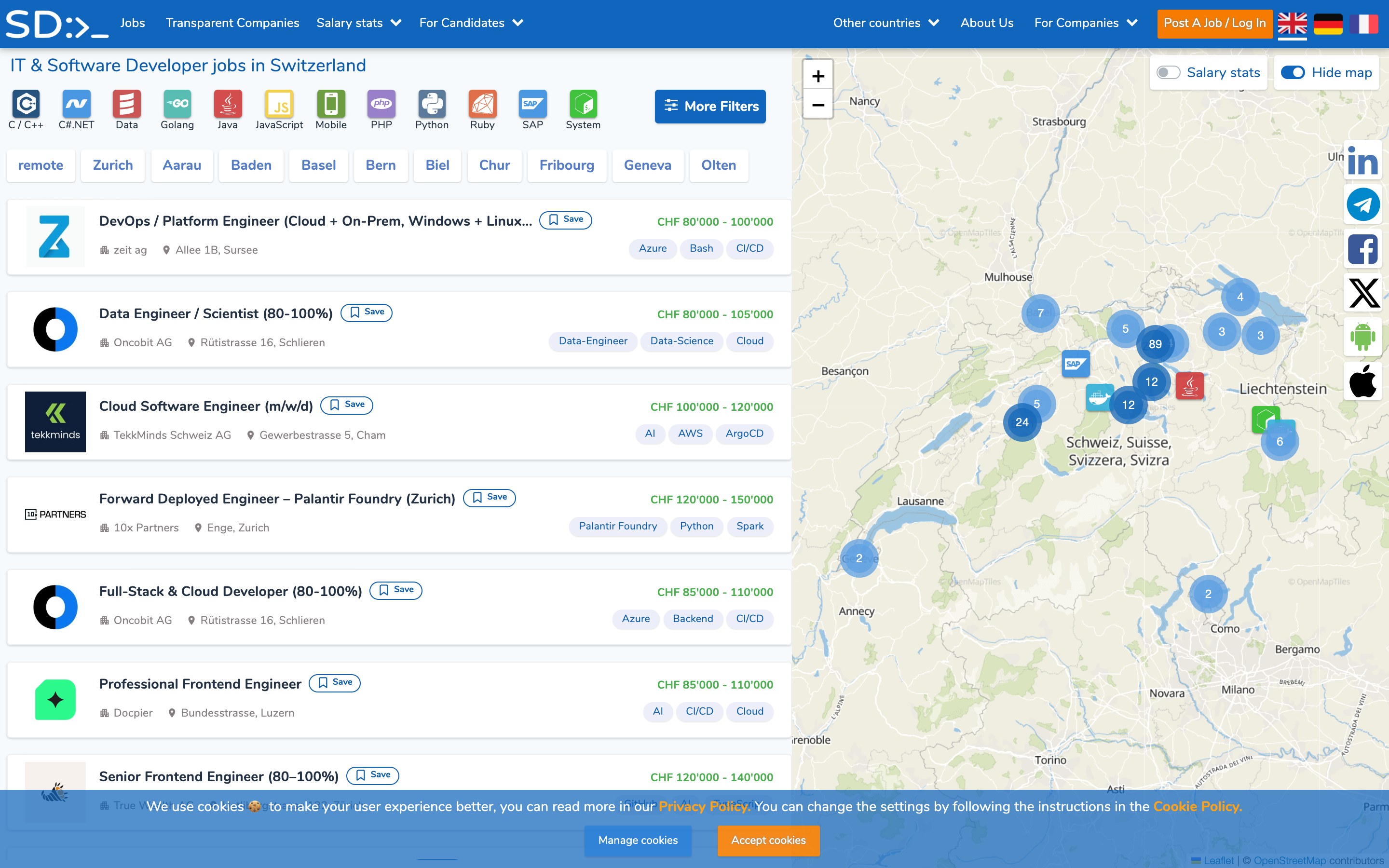
IT and software only, and thorough about it: "183 IT & Software developer jobs in Switzerland", filtered by technology (C#, Java, Python, DevOps, ML) rather than by industry. Publishes salary statistics and lists the companies that disclose their ranges. The site itself is in English.
Jobs by profession, city or language
Type a profession, a city or a language, the page shows the adverts currently open for it.
By profession
- Consultant
- Project Manager
- Retail Sales
- Nurse
- Nursing & Care
- Administrative Assistant
- Account Manager
- Software Engineer
- Public Administration
- Architect
- Insurance
- Chef
71 more — narrow the search
By work type
Here is the size behind that. On 24 August 2026 Job-Room's public job search held just over seventy-five thousand adverts published within the previous sixty days, and roughly a third of them, 32.2 per cent, were less than a week old. No private Swiss job board comes close to that volume, ours included.
The decisive point, though, is legal rather than numerical. Since 1 January 2020 employers must notify the RAV of vacancies in occupations with a nationwide unemployment rate of at least 5 per cent. Only five working days after publication in the protected area may the vacancy be advertised anywhere else, and SECO states plainly that this blocking period cannot be shortened or circumvented. Those are precisely the adverts no alternative can show you: they exist there and nowhere else, visible only to people registered with an RAV and enrolled on the portal.
The rest of this answer is countable: what the publicly visible listings consist of, who actually supplies them, where the portal is clearly ahead of any private site, where a second source adds something — and what we cannot do.
Share by language of the 8280 vacancies posted on Job-Room in the three days to 24 August 2026, counted through the portal's public job search. The interface is available in four languages; the adverts are effectively in one.
- Blocking period: a notifiable vacancy may only be advertised elsewhere five working days after it is published in the area reserved for jobseekers registered with an RAV. The period starts the working day after publication, and SECO states it cannot be shortened or circumvented.
- Breaching the registration requirement is punishable under Art. 117a of the Foreign Nationals and Integration Act by a fine of up to CHF 40'000, or CHF 20'000 where the breach is negligent. Cantons monitor compliance and must file a criminal complaint.
- Scale on 24 August 2026: just over seventy-five thousand publicly visible adverts from a sixty-day window; 32.2 per cent posted in the last seven days, 84.5 per cent in the last thirty.
- Regional spread on Job-Room: Zurich 22.0 per cent, Bern 13.1 per cent, Aargau 10.5 per cent. The six French-speaking cantons together account for 10.1 per cent and Ticino for 0.5 per cent — the interface comes in four languages, the supply of adverts does not.
- Language of the adverts: of the eight thousand-odd vacancies posted on Job-Room in the three days to 24 August 2026, 90.4 per cent are written in German, 8.2 per cent in French, 1.1 per cent in English and 0.3 per cent in Italian. Among our own adverts where the language is identified, 56.2 per cent are German and 26.7 per cent English.
- Who fills Job-Room: for 27.9 per cent of those new adverts the application lands on jobs.ch and for 10.1 per cent on jobup.ch — 38.0 per cent between the two JobCloud brands. A single recruitment agency accounted for 21.2 per cent of all new adverts, spread across 427 municipalities under 233 distinct job titles.
- Concentration: Job-Room's twenty largest advertisers supplied 45.2 per cent of the new adverts in those three days, while 63.0 per cent of advertisers posted exactly one. 18.7 per cent of adverts share a word-for-word title with another advert from the same three days.
- Overlap with our own index: not one of the application destinations that dominate Job-Room appears in it. The two sets share 118 destinations, most of them applicant systems rather than the same vacancies.
- Search engines cannot see Job-Room: the portal's robots.txt blocks the job-search path outright, and the page serves no text without JavaScript. An advert there cannot be found through Google or quoted by an assistant.
Who to choose
With Job-Room it ends at the advert. With us it starts there: the same posting produces the CV, the motivation letter, the check against it, and the entry in your RAV record.
Choose Job-Room if
Job-Room — the official channel the RAV point you to — what is recorded there counts.
Choose SwissJobs.app if
Pick the job directly — We run the job index ourselves. The advert text is already loaded, and everything else is written against exactly that text — no searching, no copying, no pasting.
Four tools, not one — CV, motivation letter for the same advert, a CV check against that advert, and interview preparation — one account, the same data.
The RAV sheet — Your job-search efforts are filled from your application tracker and printed as the official SECO form. No other tool in this comparison has it.
Word export, no watermark — PDF and DOCX, both clean. Many tools hand you a text file on the free plan, or stamp a watermark on the document.
Start without an account — The tools open without signing up. The account is asked for to save and from the second document — the first download needs none.
Feature comparison
| Feature | SwissJobs.app | Job-Room |
|---|---|---|
| Swiss job listings | Yes | Yes |
| All 26 cantons | Yes | not stated |
| Search without an account | Yes | not stated |
| Job alerts by email | Yes | not stated |
| AI match against your profile | Yes | No |
| Build a CV straight from the advert | Yes | No |
| Motivation letter for the advert | Yes | No |
| CV check against that advert | Yes | No |
| Application tracker | Yes | No |
| RAV job-search-efforts form (SECO) | Yes | No |
| Low-competition listings surfaced | Yes | not stated |
| Free to use | Yes | not stated |
| Interface languages | DE / EN / FR / IT | not stated |
| Built in Switzerland | Yes | not stated |
As of 4 September 2026. "not stated" means it could not be read on their own site — not "does not exist". Our rows come from the code (lib/stripe/trialConfig.ts) and from walking the live flow, not from marketing copy.
Pricing side by side
| What you pay | SwissJobs.app | Job-Room |
|---|---|---|
| Job searchThe search is not part of our subscription. What is paid for is the tools that come after it. | Free — search, filters, job alerts and the application tracker cost nothing | Free for jobseekers |
| Monthly price | CHF 15 — all six tools, one subscription | not stated |
| Yearly price | CHF 95 a year (= CHF 7.92 a month) — the same six tools | not stated |
| Free trialOur seven days are the full product, not a limited preview. | 7 days, full access, cancel any time | not stated |
| What works without payingWe print the limit, because that is the number a comparison usually leaves out. | Tools open without an account; free account: 5 documents/day, 10 per rolling week | not stated |
| Currency | CHF | not stated |
| BillingWatch for four-week billing periods anywhere: that is 13 charges a year, not 12. | Calendar month, cancel any time | not stated |
As of 4 September 2026. "not stated" means it could not be read on their own site — not "does not exist". Our rows come from the code (lib/stripe/trialConfig.ts) and from walking the live flow, not from marketing copy.
Why there is no alternative for anyone registered with an RAV
The Swiss job registration requirement has applied since 1 July 2018 and in its present form since 1 January 2020: employers must notify the responsible RAV of vacancies in occupations whose nationwide unemployment rate reaches at least 5 per cent before advertising them publicly. Which occupations those are is fixed by a list published each autumn for the following year, keyed to the five-digit code of the Swiss occupational classification. The legal basis is Art. 121a of the Federal Constitution, Art. 21a and 117a of the Foreign Nationals and Integration Act, and Art. 53a ff., 58a and 63 of the Employment Services Ordinance.
The blocking period follows from that notification, and it is the whole reason this question has to be answered differently from a question about any private site. A notified vacancy may only be advertised elsewhere five working days after it appears in the protected area. The period begins on the working day after publication, and SECO's own wording is unambiguous: it cannot be shortened or circumvented. Anyone who is not registered and enrolled sees nothing of those vacancies during that week — not with us, not on jobs.ch, nowhere.
Access is deliberately narrow. Only someone registered as a jobseeker with an RAV can enrol; enrolment runs through the unemployment insurance identity system and requires an AGOV login, the AHV social security number and the eight-digit personal number issued by the RAV. After that the e-services open up: online submission of the claim for unemployment benefit, of the insured person's monthly declaration and of the record of personal job-search efforts, plus document upload, job alerts and watchlists.
The second half of the obligation runs through the same channel. SECO's guide for insured persons states that job-search activity must be evidenced to the RAV monthly, as a rule in the form of proper applications to concrete vacancies, with speculative applications counting only as a supplement. Where someone does not make sufficient personal effort to find suitable work, entitlement is suspended temporarily — between 1 and 60 days depending on fault. At the first interview, which takes place within fifteen days of registering, proof of job-search efforts is one of the documents to bring.
So we will put the consequence as plainly as it is meant: an application tracker, a watchlist or a search box on a private site is a convenience, not a substitute for that route. What binds is what the RAV requires and the channel through which it accepts the record. For the insured person's monthly declaration this is even written down: only the corresponding e-service or the paper form issued by the unemployment fund may be used.
This page therefore explains the rule rather than advising you what to do about it. If a detail of your own case is unclear — which efforts count, how many, in what form — the answer comes from your RAV or your unemployment fund, not from a comparison page.
What the public part of Job-Room contains
Alongside the protected area there is an ordinary public job search, and it is large. On 24 August 2026 it held just over seventy-five thousand adverts from the previous sixty days. It is fresh, too: 32.2 per cent were less than a week old, 53.6 per cent less than a fortnight, and 84.5 per cent no older than a month. If choice alone is what you are after, there is more here than on any private site — arbeit.swiss describes the portal on its own registration page as Switzerland's largest job platform, and the figure bears that out.
Regionally, though, the distribution is lopsided. Zurich accounts for 22.0 per cent of the adverts, Bern 13.1 and Aargau 10.5. The six French-speaking cantons together reach 10.1 per cent and Ticino 0.5. For comparison: assigning our own adverts to cantons with the same municipality table — it is drawn from Job-Room's own location data and matches 88.5 per cent of our adverts — puts French-speaking Switzerland at 20.5 per cent and Ticino at 1.0. The gap between the two sets is therefore enormous in Zurich and small in Geneva or Lugano.
The same pattern shows in language. Of the eight thousand-odd vacancies posted in the three days to 24 August 2026, 90.4 per cent are written in German, 8.2 per cent in French, 1.1 per cent in English and 0.3 per cent in Italian, while the interface itself is offered in all four. For someone in Zug or Basel looking for an English-language role, that is the practical difference that matters most: 26.7 per cent of our adverts whose language is identified are in English, against roughly one per cent on Job-Room.
How you apply is revealing as well. 7.0 per cent of the new adverts carry no external link at all and 5.0 per cent give only an email address. That is the part of the supply private boards rarely hold: small employers who notify the RAV of a vacancy without ever having built a careers page. 88.4 per cent of the roles are permanent, 31.1 per cent are open below full time, and 58.7 per cent are additionally forwarded to the European EURES portal.
Who actually supplies Job-Room
One detail qualifies the headline number without disputing it: a substantial share of the listings does not come from employers directly but from private job boards and recruitment agencies publishing through the portal's interface. For 27.9 per cent of the new adverts in those three days the application route leads to jobs.ch and for 10.1 per cent to jobup.ch — 38.0 per cent ending up at the two JobCloud brands. Use Job-Room as your alternative to jobs.ch and a good part of what you see is the same stock.
With one supplier it is starker still. A healthcare recruitment agency posted 21.2 per cent of all new adverts across those three days, better than one in five. Behind them sit 233 distinct job titles spread over 427 municipalities; the same medical specialist title appears close to two hundred times with the place name changed. That is not an insinuation but something anyone can count through the portal's public job search, and it explains why a results list there often looks more uniform than the headline total suggests.
Across all advertisers, the twenty largest supplied 45.2 per cent of the new vacancies while 63.0 per cent of advertisers posted exactly one, and 18.7 per cent of adverts share a word-for-word title with another advert from the same three days. Job-Room is not a register curated by hand at an agency desk; it is a collection point fed by very different sources, from hospitals through the big commercial boards to temporary staffing firms.
Fairness requires the same measurement on our side, and it goes against us. Over a comparable three-day window our twenty largest advertisers account for 47.3 per cent of new adverts and a single supplier for 28.5 per cent. Our own index is the more concentrated of the two, not the less. Only on word-for-word duplicate titles do we come out lower, at 14.1 per cent against 18.7.
Where Job-Room is clearly ahead
First on volume, and that is not arguable. Second on price: for jobseekers the portal is free, permanently and without a subscription. With us the trial stops after seven days; the subscription then runs at CHF 15.- monthly or CHF 95.- annually. For searching alone that is unnecessary — it only pays off if you take the application documents out of it as well.
Third on everything connected to the RAV. The portal is where registration for placement, the claim for unemployment benefit, the insured person's monthly declaration and the record of job-search efforts all come together. No private tool has access to those procedures, and none should pretend otherwise.
Fourth on the channel back to employers. When a company notifies a vacancy, the responsible RAV sends it details of jobseekers with matching files within three working days, or reports that there are none. Someone registered can therefore be put forward without having applied at all — a mechanism no private board offers. Add the EURES forwarding switched on for 58.7 per cent of new adverts, and well over a hundred RAV offices working from a nationwide vacancy database.
One disadvantage is self-imposed and concerns visibility: the portal's robots.txt blocks the job-search path for search engines outright, and without JavaScript the page serves no text at all. A Job-Room advert cannot be found through Google and does not surface in an assistant's answer either. You have to know the portal and go there — obvious for anyone registered with an RAV, and the reason everyone else never encounters this supply.
What a second source adds alongside it
Two indexes are only two indexes if they hold different adverts. That can be tested on the application destination — the address where the application actually arrives. None of the destinations that dominate Job-Room appears in our index at all: the agencies leading there account for not a single one of our adverts. The two sets share 118 destinations, and behind most of those sits the same applicant system rather than the same vacancy. 32.1 per cent of our adverts lead to a destination that also occurs on Job-Room; the other way round it is 18.6 per cent.
In practice that means querying only one of the two shows you a slice. For English-language roles the difference is largest, 26.7 per cent against roughly one. For French-speaking Switzerland it is clear as well, 20.5 against 10.1 per cent. For occupations with high unemployment it runs the other way: there the freshest vacancies are visible for five working days on Job-Room and nowhere else.
The second difference is not in the listings but in what happens after them. Job-Room shows vacancies and accepts forms; it does not write application documents. With us a CV can be built against an advert you have just found without pasting the text anywhere, because the advert is already in the index. What demonstrably works there is small, and we keep it small on purpose: wording carried over from the posting inevitably overlaps a keyword filter more than a catch-all phrase does. No guarantee about any selection stage follows from that, because how a company filters internally is invisible from outside.
Being straight about it: others do this as well. At cvswiss.ch, adapting to a specific posting is in fact the headline feature. What separates us is narrower than an advertisement would put it — there the posting has to be copied into the tool first, here it is already available, the two halves being one product on our side.
Who each option is right for
If you are registered with an RAV, Job-Room is not optional and belongs first in your routine. Enrol, because otherwise the five-working-day information advantage passes you by unused, and settle the question of your job-search record with your RAV rather than with a tool. Everything else, this site included, is a supplement.
If you are searching without an RAV registration, Job-Room is still worth using — free, large and fresh, and part of its supply is advertised nowhere else, particularly among small employers without a careers page of their own. Expect it to be heavily German-language and heavily German-speaking-Switzerland, and expect a noticeable share of it to have arrived there via jobs.ch and jobup.ch.
Add SwissJobs.app if you are searching in English, if you are searching in French-speaking Switzerland or Ticino, or if you want a dossier shaped to each advert instead of one standard document. Querying both sources in parallel costs nothing and together covers considerably more of the market than either alone.
And the case where we are expressly not the answer deserves repeating at the end, because it is the one where a mistake is expensive: notifiable vacancies in the protected area, registration for placement and the record of job-search efforts run through the RAV and Job-Room. We are useful next to that, not instead of it.
The Job-Room figures come from the portal's public job search, queried on 24 August 2026: the overall total from its result counts per canton and per time window, the composition from a complete count of all eight thousand-odd adverts posted in the three days to that date. Adverts inside the protected area are by definition not included. The legal statements come from arbeit.swiss and from SECO's guide for insured persons, read directly rather than recalled. Our own figures are shares of the adverts live on 24 August 2026; we do not publish absolute index sizes. The canton assignment for our adverts uses Job-Room's own municipality table, covers 88.5 per cent of our adverts and is an approximation, not official statistics.
Sources
- arbeit.swiss — FAQ on the job registration requirement (blocking period, legal basis, penalties)
- arbeit.swiss — Job registration requirement: overview and list of affected occupations
- arbeit.swiss — Registration for jobseekers: conditions and e-services
- arbeit.swiss — Anmeldung und Registrierung: the five-working-day advantage explained
- SECO — Unemployment: a guide for insured persons (2026 edition, German)
- Job-Room — the unemployment insurance job portal
Related questions
What our job index says about the Swiss market
Computed live from our own index, not quoted from a study. Shares only, as of today.
Language the advert is written in
- Deutsch
- 60%
- English
- 23%
- Français
- 13%
- Italiano
- 3%
Of adverts that state a language requirement, the share asking for
- Deutsch
- 70%
- English
- 43%
- Français
- 21%
- Italiano
- 3%
19% posted in the last 7 days · Largest markets: Zürich 18% · Bern 10% · Genève 5% · Basel 5%