The Swiss hidden job market is real. It's 2,112 jobs, and most of them are on Workday.
I pulled the inventory at 08:20 this morning: 18,984 live Swiss postings. Then I went looking for the thing everybody talks about and nobody counts — the hidden job market.
Honestly, I expected to find nothing. "Hidden job market" is mostly a phrase used to sell networking coaching, usually attached to a claim that 70 or 80 percent of jobs are never advertised. That number has been recycled since the 1970s and I've never once been shown the study behind it. So my going-in position was that the whole thing is folklore.
What I found is smaller than the myth and a lot more useful. 2,112 of those 18,984 postings — 11.1%, about one in nine — are advertised. Publicly. In full. On a page you could open right now. They just never reach the boards most people search, because they only exist on the employer's own applicant tracking system: Workday, Greenhouse, Ashby, Lever. That's the hidden job market. It isn't secret. It's badly distributed. And badly distributed is something you can actually do something about.
Short version
- What is the hidden job market in Switzerland?
- It isn't unadvertised jobs — it's jobs advertised somewhere almost nobody looks. Of the 18,984 postings live on our platform on 12 August 2026, 2,112 (11.1%) exist only on a company's own applicant tracking system: Workday, Greenhouse, Ashby, Lever or BambooHR. They're completely public. They're just not on the big boards, so the only people who see them are the ones who thought to check that specific employer's careers page in that specific fortnight.
- How many Swiss jobs are only on the company's own careers page?
- 2,112 of 18,984 live postings, or 11.1%. They come from 384 employers — and 285 of those employers appear nowhere else in our inventory, which includes LinkedIn and a long list of Swiss career sites. Those 285 account for 1,438 of the 2,112 postings. So for roughly two thirds of this pool, the company's own careers page is the only place the job exists as far as we can see.
- Are hidden job market jobs really less competitive?
- Probably — and "probably" is the honest word, so I'm going to use it. I can't count applicants: only 6 of our 18,984 postings carry an applicant number at all. What I can count is distribution, and these jobs sit on one channel instead of four or five. Fewer channels means fewer people ever saw the advert. That's a reasonable inference from the data, not a measurement of it, and anyone quoting you a precise figure for how much easier they are is making it up.
- Do I need German for these jobs?
- Usually not, and that's the single most useful thing in this article if you're international. Of the 2,048 postings in this pool whose advert text we could parse, 1,801 (87.9%) state English and only 440 (21.5%) state German. Across the rest of the inventory it's the opposite: 71.6% German, 34.7% English. 88.6% of these adverts are written in English in the first place. If you've spent three months bouncing off German-language postings, this is the part of the market that was never the problem.
- How do I find jobs that aren't on the job boards?
- Two routes. Manually: write down 30 to 50 employers you'd genuinely work for, find each careers page, and check it every couple of weeks — most will sit on a Workday or Greenhouse subdomain you can bookmark once and reuse forever. Or use a feed that already crawls them; ours is at /lowcompetition and it's these postings plus our rare-find pool. Either way, the real work is building the company list. The searching is the easy part.
Working on your CV right now? ATS CV checker: free, against a real Swiss job ad
See what a Swiss recruiter checks first
Upload your CV and get a score against a specific job ad in about 30 seconds — language levels, work permit, photo, how your achievements are phrased.
ATS CV checker, freeSo what is the "hidden job market", really?
It's not unadvertised jobs — it's the 2,112 live Swiss postings, 11.1% of 18,984, that exist only on a company's own applicant tracking system where the big boards never index them.
The folklore version says most jobs are filled through networks before they're ever posted. I don't buy the big version of it. Every time I've chased that 80% figure it dissolves into a citation of a citation of a book from decades ago, and nobody involved ever had access to a national inventory of live postings.
The version I can actually measure is duller, and better. A company buys Workday or Greenhouse. Their openings go live on their own board — something like companyname.wd3.myworkdayjobs.com or boards.greenhouse.io/companyname. Then somebody in HR decides whether to also pay to syndicate onto the Swiss boards, or push it to LinkedIn, or just leave it. A lot of them just leave it.
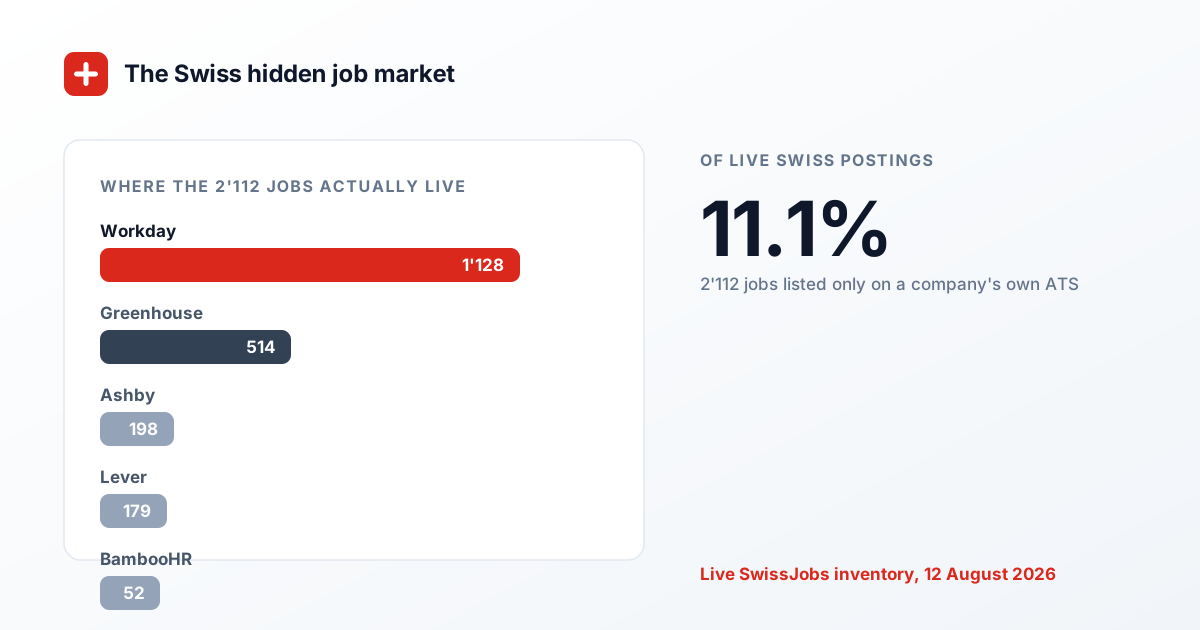
This morning that comes to 2,112 postings. Workday is over half of it on its own — 1,128 postings, 53.4% of the pool. Greenhouse has 514 (24.3%), Ashby 198, Lever 179, BambooHR 52, and 41 sit on self-hosted or one-off systems. Four vendors and you've covered 95% of the hidden Swiss job market. That's the whole secret.
One precision point, because the whole article rests on it. When I say "only", I mean only within our inventory — 18,984 published postings gathered from LinkedIn and a long list of Swiss career sites. I can't see the entire internet, and I'm not going to claim these postings appear literally nowhere else. What I can say is that we crawl a lot of this market every day, and these 2,112 turned up in exactly one place.
Live SwissJobs inventory, 12 August 2026. Base: the 2,112 of 18,984 published postings that appear only on an employer's own applicant tracking system, grouped by the ATS vendor hosting the application page.
Write a custom CV for every job you apply to
Most people send the same CV everywhere. The AI editor rewrites yours per application — Swiss format, the right language, in about a minute.
CV maker & resume builder: tailor it to this jobWho's actually hiding? Not who you'd guess
384 employers, 285 of which appear nowhere else in our 18,984-posting inventory — and the single biggest contributor is a running-shoe company.
I half expected this pool to be a handful of banks. It's two completely different populations wearing the same clothes.
The first is large internationals with a Workday tenant and no particular need for job boards. Roche has 78 postings in here. PwC 70. Vontobel 51, Julius Bär 48, Swisscom 39, Thermo Fisher 32. These are companies whose brand does the distribution for them — they assume you'll come to their careers page, and enough people do that the assumption holds. The largest single contributor isn't a bank at all: On, the running-shoe company, with 251 postings. One employer, 11.9% of the entire hidden market.
The second population is the interesting one. 238 of the 384 employers have just one or two postings in here. 600 of the postings come from employers with five or fewer. These are small tech and biotech companies on Ashby or Lever — Proton has 28, and then there's a long tail of names most people in Switzerland have never heard, each quietly hiring two or three people.
And here's the number that actually matters: 285 of those 384 employers don't appear anywhere else in our inventory. Not on LinkedIn, not on the Swiss boards we crawl. Between them they account for 1,438 of the 2,112 postings — 68.1%. So a bit over two thirds of this pool comes from companies that, from a job seeker's point of view, are effectively invisible unless you already knew their name.
Which reframes the advice you usually hear. "Network your way into the hidden job market" is doing a lot of work in that sentence. What you actually need is duller: a list of company names. Once you have the name, the jobs are right there, public, with an apply button.
See what a Swiss recruiter checks first
Upload your CV and get a score against a specific job ad in about 30 seconds — language levels, work permit, photo, how your achievements are phrased.
ATS CV checker, freeWhat kind of jobs are these?
Engineering, finance and marketing, skewed hard towards senior: 31.9% of this pool carries a senior, lead, head or director title against 8.8% everywhere else — and there's almost nothing here for trades, care or apprenticeships.
Let me start with the disappointing half, because I'd rather you know in the first paragraph whether to keep reading.
If you're a Pflegefachfrau, an electrician, a Lastwagenchauffeur or a Verkäuferin, this pool is not for you. Healthcare and care roles are 1.9% of it against 6.1% of everything else. Trades and logistics: 1.4% against 4.7%. Retail and hospitality: 3.4% against 5.9%. Apprenticeships basically don't exist here — 35 postings, against 712 in the rest of the inventory. The employers who buy Workday and Ashby are not the employers hiring your local Lehrstelle, and no amount of clever searching changes that.
Now the other half. Engineering and IT is 23.4% of this pool against 14.9% of the rest. Finance and legal 8.2% against 3.5% — more than double. Sales and marketing 8.8% against 6.2%. And the seniority skew is the sharpest split in the whole dataset: 673 of the 2,112 postings, 31.9%, have senior, lead, head, director, principal or staff in the title. In the rest of the inventory that figure is 8.8%.
That last one surprised me and then it didn't. Think about who a company decides to advertise widely for. Volume roles, where you need forty applicants and you'll take the fifth-best. Senior roles are the opposite: you want six good ones, you'd rather they arrived through your own channels, and paying to syndicate a Head of Something advert mostly buys you noise to filter. So the senior stuff quietly stays home on the company's own board.
If you're mid-career or above in tech, finance or commercial roles, that ratio is the argument for spending an hour building a company list. Three and a half times the senior density, in the one channel most people never open.
Live SwissJobs inventory, 12 August 2026. Share of the 2,112 ATS-only postings against the 16,872 other published postings, classified by keywords in the job title in four languages. Titles that match nothing land in an "other" bucket of roughly half of each side, so read the comparison, not the absolute level.
Are they really less competitive? What I can and can't prove
I can prove these jobs sit on one distribution channel instead of several; I can't prove how many people applied, because only 6 of our 18,984 postings carry an applicant count.
This is the part where most articles on this topic quietly start making things up, so let me draw the line clearly.
We do have an applicant-count signal. When our crawler picks up a LinkedIn Easy Apply posting with fewer than 30 applicants, we flag it as a rare find and route it to our low-competition feed. Useful mechanism. But right now exactly 6 live postings carry that flag. Six. That's not a dataset, that's an anecdote with a schema. I'm not going to build an article on it and I'm certainly not going to put it in a chart.
So the applicant-count claim is out. What's left is distribution, and distribution I can count precisely: 2,112 postings on exactly one channel, 1,438 of them from employers that show up nowhere else we look.
From there it's inference, and I'll label it as such. Two mechanisms make me think competition really is thinner here. First, reach — an advert nobody indexed is an advert most job seekers never saw, and applications come from people who saw the advert. Second, friction. Applying through Workday means an account, a parsed CV, a form with fourteen fields and a question about your notice period. LinkedIn Easy Apply takes twenty seconds. Friction filters volume ruthlessly, which is annoying when you're the one filling in the form and excellent when you consider who else didn't bother.
And the counter-argument, because it's real. These jobs are in English, in Zurich, at companies with international brands. That means they compete in a global applicant pool, not a Swiss one — a Greenhouse advert at a well-known company can pull applications from three continents. So "less competitive" isn't a blanket property of this pool. It's strongest for the 238 employers nobody's heard of, and weakest for the big names everyone already checks. Roche's careers page is not a secret.
My honest summary: fewer people see these, more of the ones who do are serious, and the small unknown employers in the tail are where the actual edge is. I'd rather give you that than a made-up percentage.
It's in Zurich, and it's in English
52.0% of this pool's located postings are in Zurich against 18.7% of everything else, and 88.6% of the adverts are written in English.
The geography is lopsided in a way I didn't expect to be quite this extreme. Of the 1,608 postings in this pool with a canton we could identify, 836 are in Zurich. 52.0%. In the rest of the inventory Zurich is 18.7%. Geneva is second at 11.2% (against 8.6%), and Zug punches well above its weight at 5.8% against 2.9% — which, if you know what sits in Zug, is not exactly a shock.
Everywhere else loses out. Bern is 4.6% of this pool against 9.7% of the rest. Aargau 1.6% against 6.6%. Lucerne 1.3% against 7.7%. St. Gallen 1.6% against 4.0%. Ticino 0.8% against 2.3%. If you're job hunting outside the Zurich–Zug–Geneva triangle, the hidden job market is a much smaller opportunity for you, and I think that's worth saying plainly rather than burying.
Language is the other half of the story, and it's the sharpest number in the article. 88.6% of these adverts are written in English, against 19.3% of the rest of the inventory. Of the 2,048 postings here whose text we could parse for requirements, 1,801 (87.9%) name English and only 440 (21.5%) name German. Across the rest of the market: 71.6% German, 34.7% English. French appears in 4.3% of this pool against 22.2% elsewhere. In Zurich specifically, 750 of the 836 postings — 89.7% — are advertised in English.
Is that a bias in my data? Partly, and it's worth naming: companies that buy Workday and Ashby are disproportionately international, so of course they advertise in English. But that's the finding, not a distortion to correct for. This pool is where the internationally-run part of the Swiss economy hires, and it's the most accessible slice of this market for anyone without German.
Which cuts both ways again. If you're a German-speaking Swiss job seeker, this is the corner of your own market you're least likely to stumble into — not because you're excluded (only a fifth of these ask for German at all) but because you'd need to be applying in English, to companies you may never have heard of, on platforms your usual search never touches.
Live SwissJobs inventory, 12 August 2026. Base: the 1,608 ATS-only postings and 9,150 other postings where a canton could be identified from the stated location. Postings with no resolvable canton are excluded from both sides.
How to actually find them — and what your CV needs to survive
Build a list of employers rather than searching for jobs, bookmark their ATS page, and send a single-column CV in the advert's language, because these applications are read by a parser before they're read by a person.
The method is boring and it works. Spend one evening writing down 30 to 50 employers you would genuinely take a job at — from your industry, from Handelszeitung lists, from the client lists of companies you've worked with, from wherever. Then find each one's careers page. Most of them will resolve to a subdomain you can bookmark once: companyname.wd3.myworkdayjobs.com, boards.greenhouse.io/companyname, jobs.ashbyhq.com/companyname. Check them every two weeks. That's it. That's the technique people charge money to teach.
If you'd rather not do that by hand, our low-competition feed at /lowcompetition already crawls them — it's built from exactly this pool plus the rare-find postings I mentioned earlier. I'm obviously not neutral about which of those two options you pick, so take the manual method seriously too; it works fine and it costs you an evening.
Now the part people get wrong once they've found the jobs. An ATS application is parsed before it's read. Workday and Greenhouse pull your PDF apart into fields — name, employer, dates, title — and a human sees the reconstruction, not your layout. So: one column, no sidebar, no skills bar chart, no text inside images, real headings, months and years on every role. All the design that makes a CV look considered is exactly what turns into scrambled fields on the other side.
Write it in English for this pool. 88.6% of these adverts are in English, and an English CV is the default expectation here in a way it simply isn't for a German-language Stelleninserat. Keep the language block anyway, with honest levels — a fifth of these do ask for German, and "German B1, in a B2 course" is a far better answer than silence.
Two more things that matter more here than elsewhere. State your permit and location in one line near your name, because these employers hire internationally and genuinely don't know whether you need sponsorship — 'Zurich · EU citizen · available from 1 October' resolves it in eleven words. And match the seniority language of the advert: if a third of this pool is senior, lead and head roles, the CV has to make the scope obvious in the first third of page one — team size, budget, number of markets, whatever your version of scope is.
If you want to know whether a parser and a hurried human can both find those facts in your CV, that's the thing our CV check does. Paste the posting, upload the CV, and it tells you what a Swiss first screen can't locate. Takes less time than one Workday form.
What I'd actually use for this
Four links. Three of them are ours and I'll say so each time.
- SwissJobs — low-competition feedour tool
Ours. This is the pool the whole article is about: postings crawled straight from employers' own applicant tracking systems, plus the rare finds with confirmed low applicant counts. If you don't want to build a company list by hand, start here.
SwissJobs — low-competition feed SwissJobs CV Check our tool
Ours, free. Run your CV against one specific posting. It checks the things a Swiss screen checks in the first thirty seconds — location, permit, availability, language levels against what the advert asked for — which matters double when a parser reads you first.
Try it free- SwissJobsour tool
Ours. The 18,984 live Swiss postings every number above came out of. Useful for the other 88.9% of the market, and for reading ten adverts in your field before you rewrite anything.
SwissJobs - LinkedIn
Not ours. Bad at showing you these jobs — that's the entire point of this article — but genuinely good for the step before: finding which companies in your field exist in Switzerland at all. Build the list there, then go to their careers page directly.
Visit site
So the hidden job market is real, and it's 11.1%, not 80%. It isn't a network you have to be born into. It's four ATS vendors, 384 employers, and the fact that nobody bookmarks a careers page.
The number I'll re-run in a quarter is 285 — the employers posting nowhere but their own site. If that keeps growing, then the practical skill in a Swiss job hunt is shifting away from searching and towards knowing which companies exist, which is a very different thing to be good at. And if it shrinks, it'll be because the boards got cheaper, not because the market got more honest.
The tools compared
We checked 16 Swiss and international application tools on their own pages — prices, free tiers, and what is actually included.