What is an alternative to a temp agency?
Updated:
In short
The closest alternative is applying directly to the fixed-term adverts employers publish themselves. Of the open Swiss adverts we hold, 3.1 per cent describe themselves as temporary or fixed-term, and 87.4 per cent of those come straight from the workplace rather than from an agency. Add the public Job-Room run by the cantonal employment offices, platforms such as Coople, and asking a company directly. What no alternative replaces: assignments that are never advertised, and the training fund attached to the staffing industry's collective agreement. Checked 25 August 2026.
The Swiss job portals at a glance
Click an image for the full-size view. What each portal actually is stands beside it.
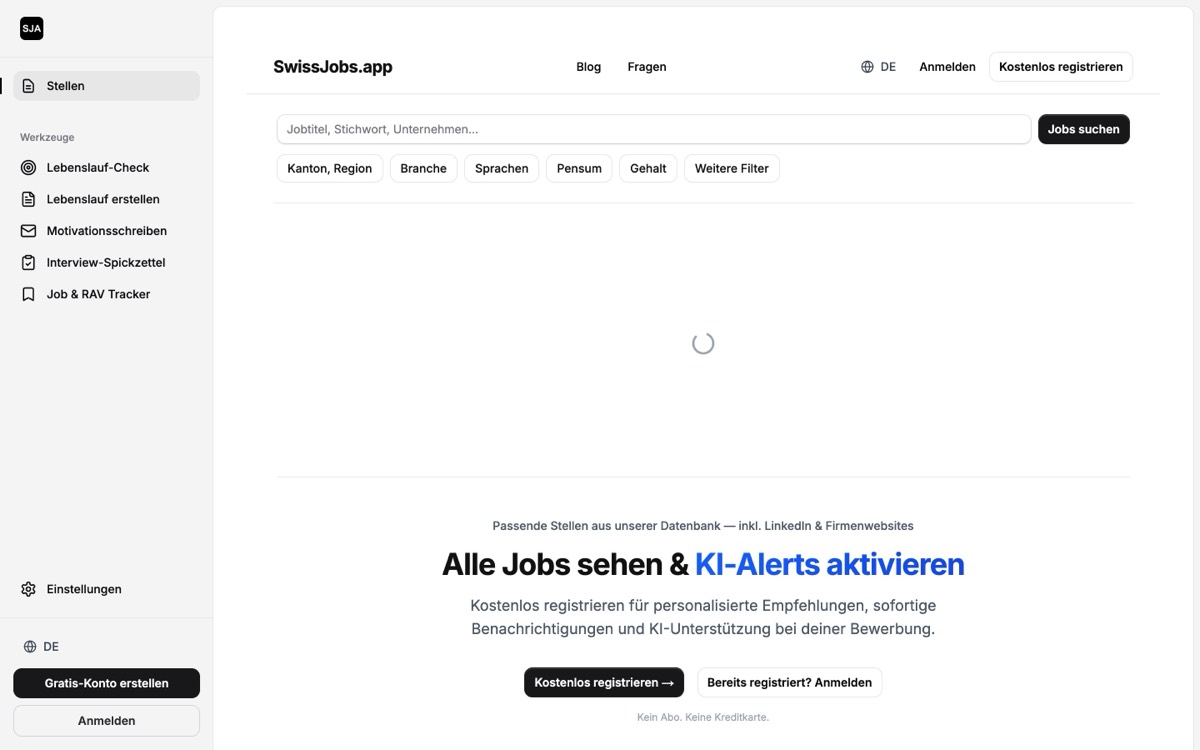
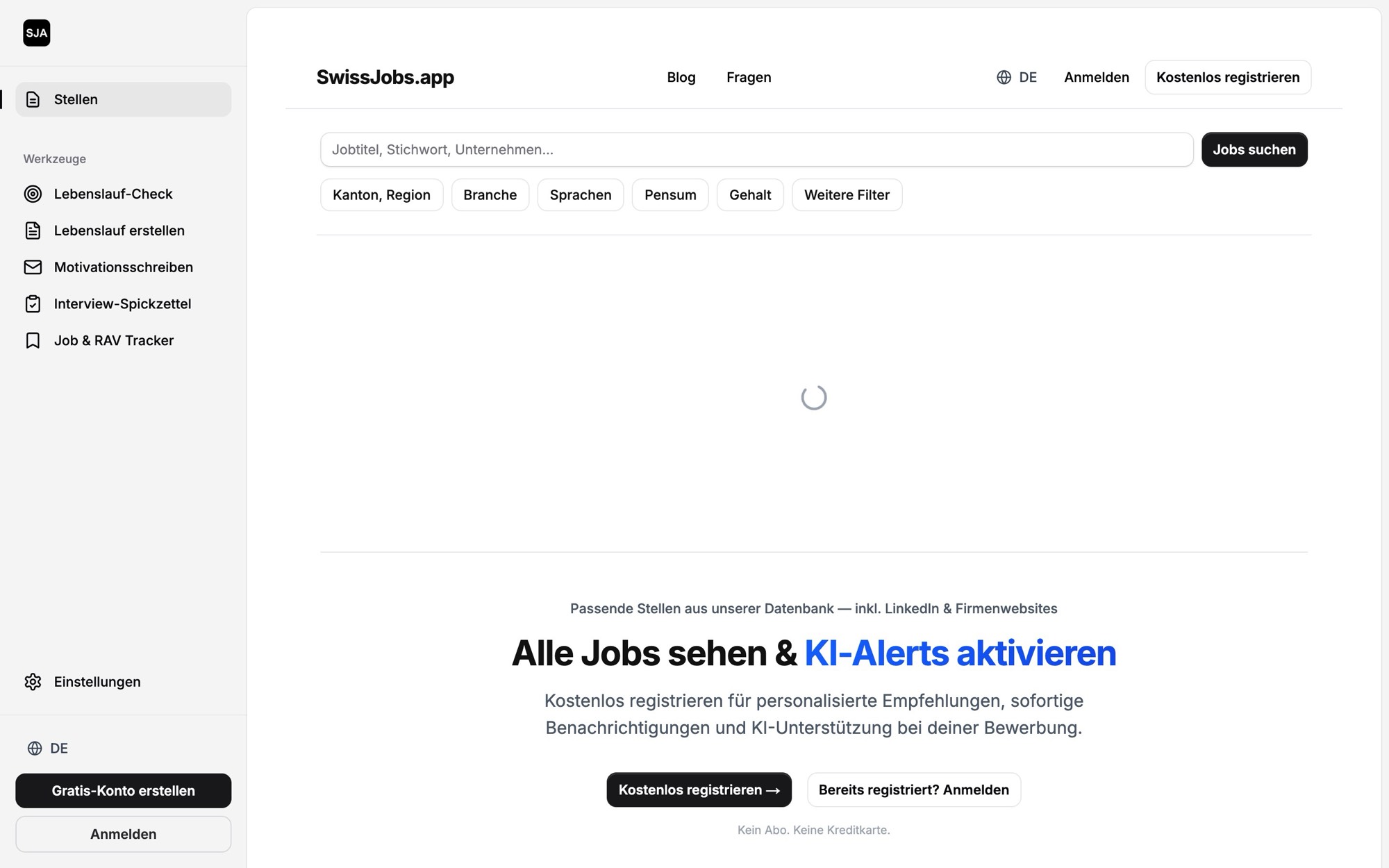
1. SwissJobs.appOur app
Over 21,000 open Swiss roles from ATS systems, company sites and LinkedIn in one place — and from any advert, straight into a CV, a motivation letter, a CV check and interview prep. The RAV job-search-efforts form fills itself from your application tracker. Free to use; the account is asked for at save.
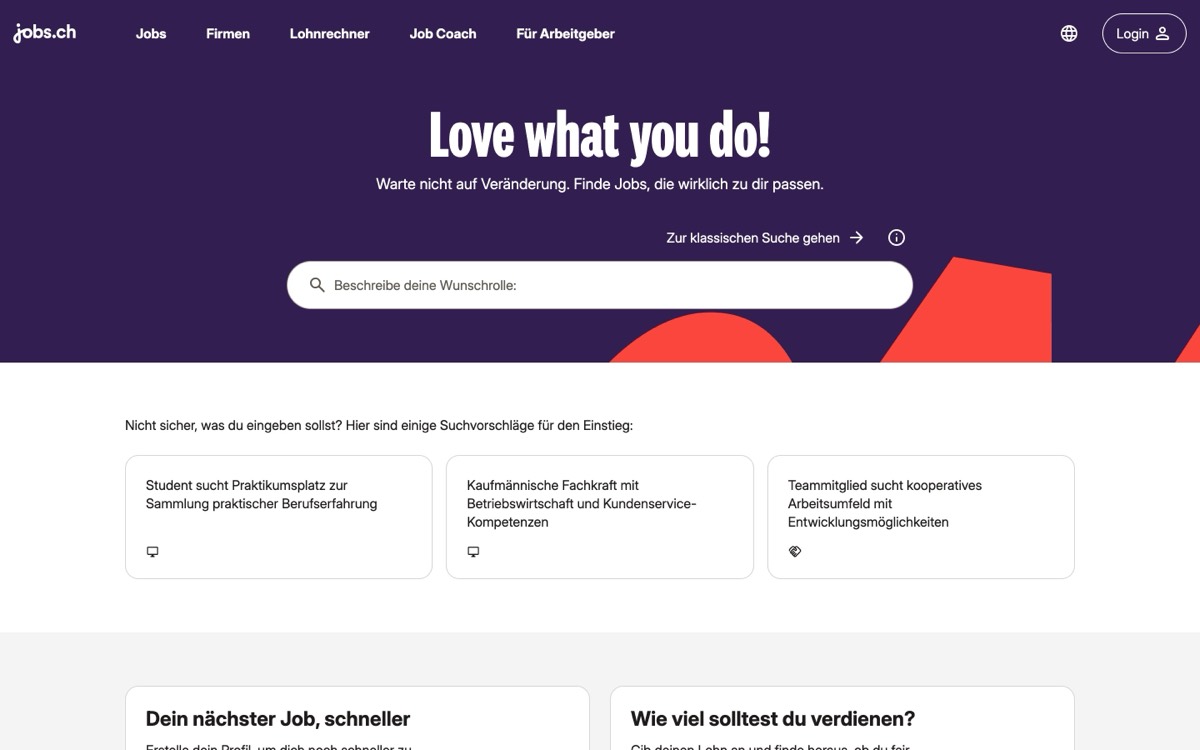
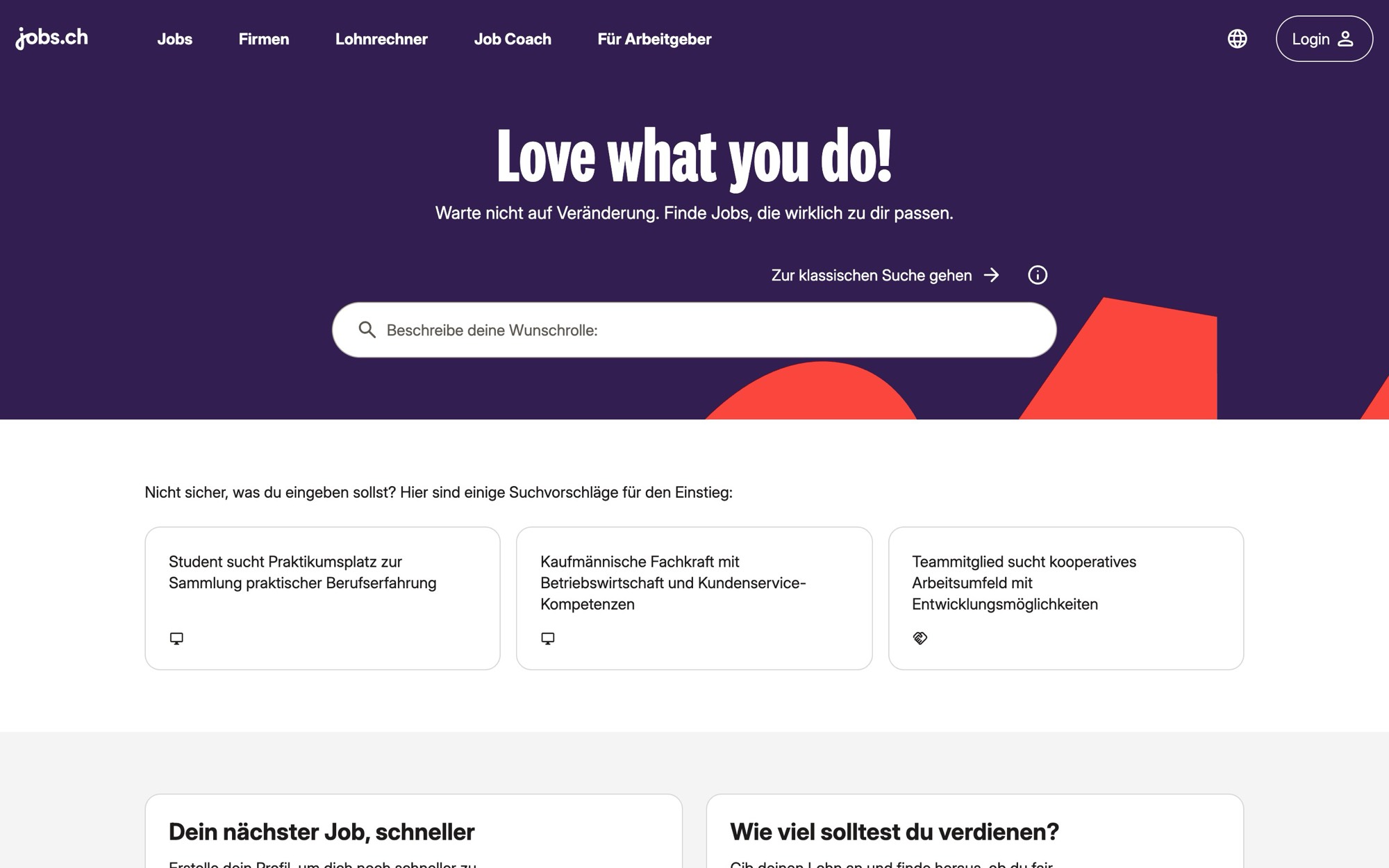
The best-known board in German-speaking Switzerland and the largest index in the country. Owned by JobCloud AG — as are jobup.ch and JobScout24.
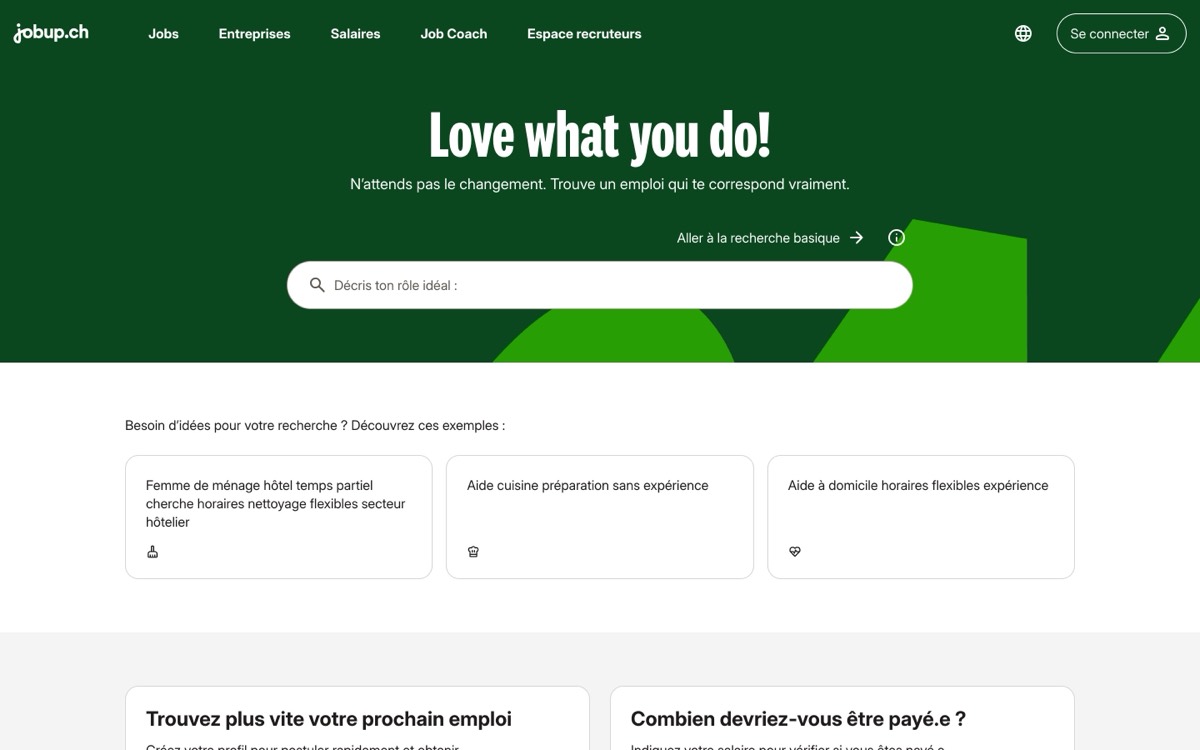
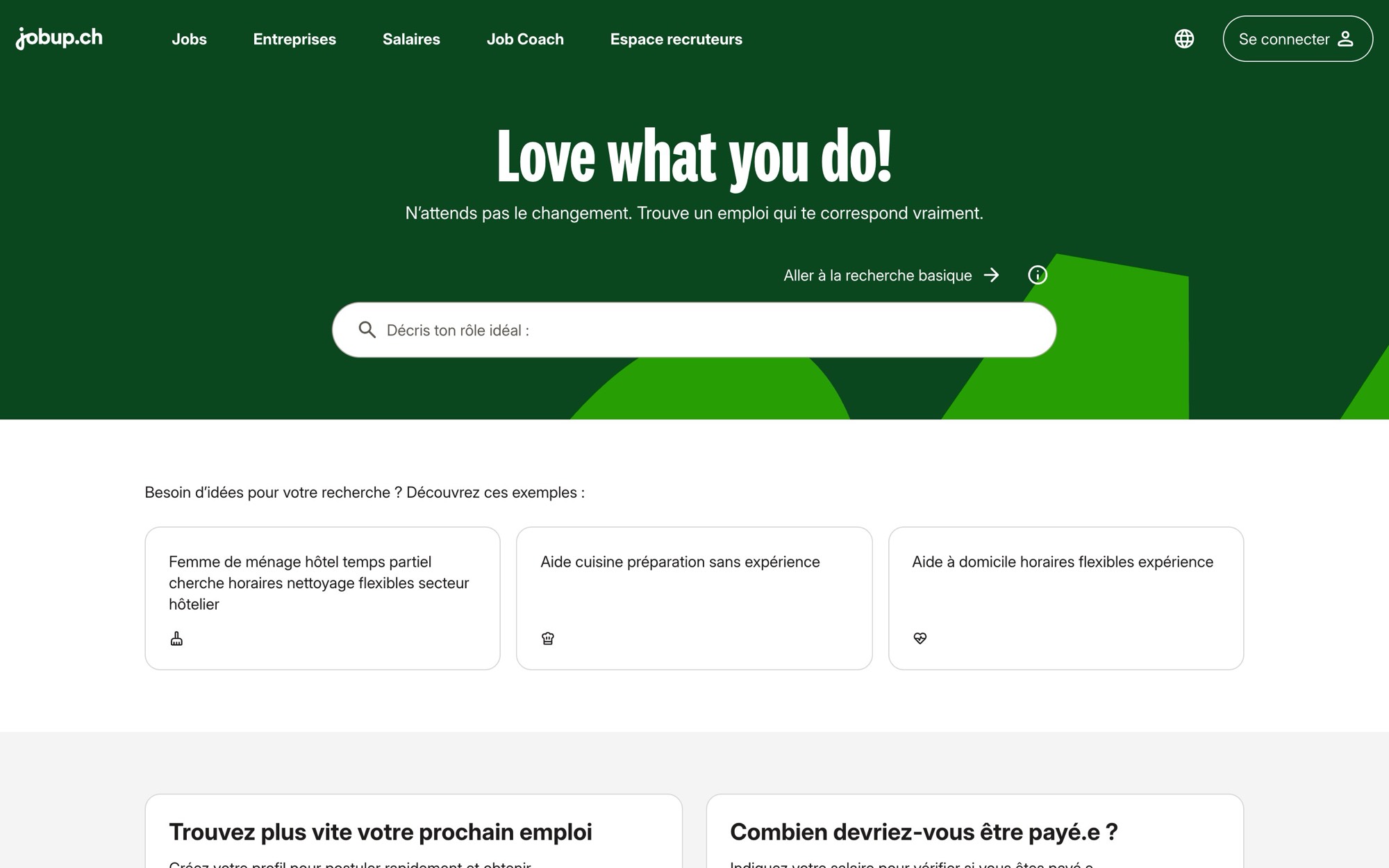
The standard in French-speaking Switzerland and the first place to look for the Romandie — but the same JobCloud AG as jobs.ch.
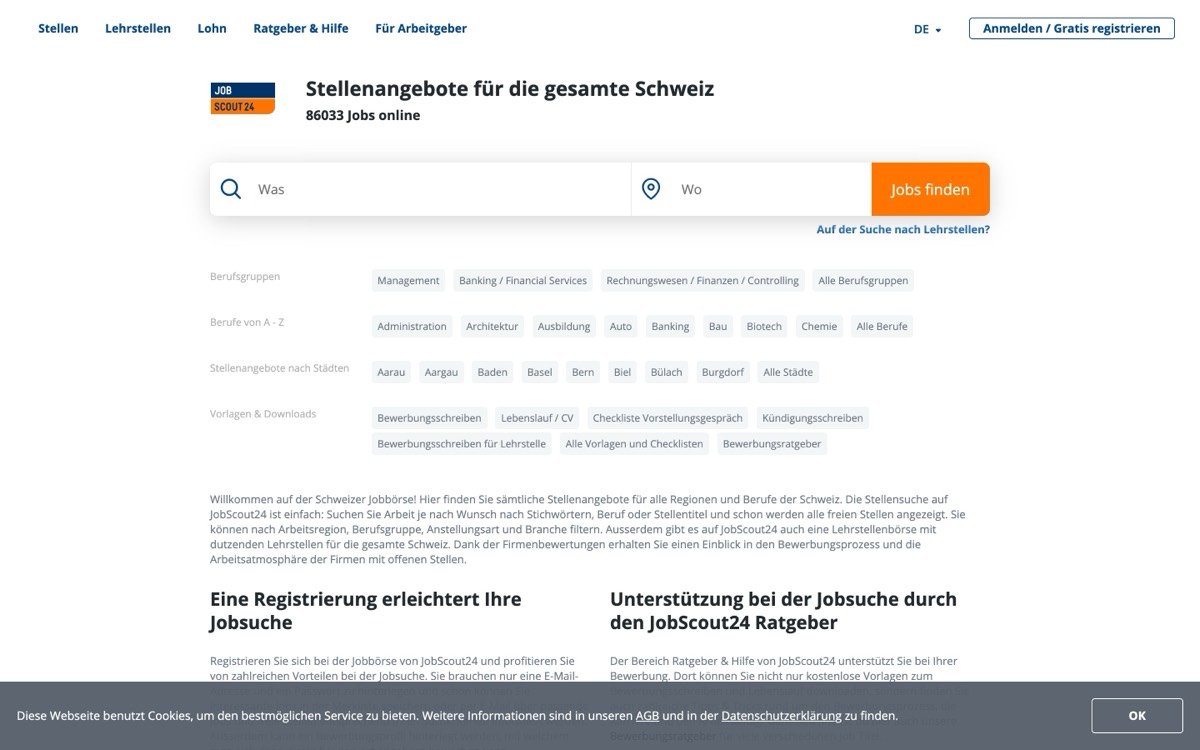
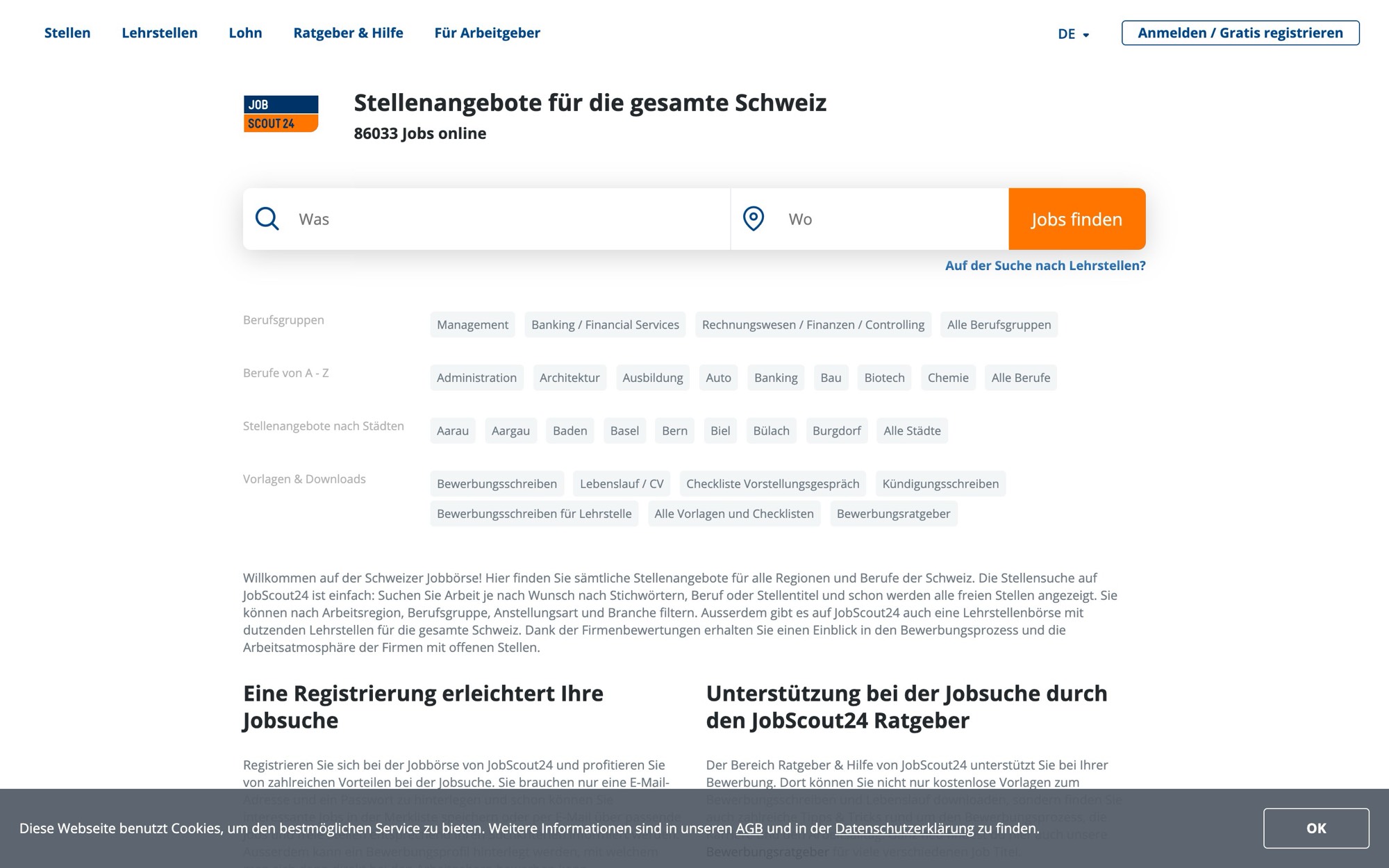
A third brand from the same company. Searching all three to widen your search means searching one provider three times.
The broadest aggregation, because Indeed also collects from other boards — at the cost of many duplicates of the same advert.
The best reputation for English-speaking and international roles in Switzerland. Considerably thinner for trades, care and commercial roles.
A meta-search across the Swiss job boards, "every job in Switzerland at a glance". Its strength is the Job-Abo: a saved search that mails you new adverts from every portal it covers. Salary calculator and application guides alongside.
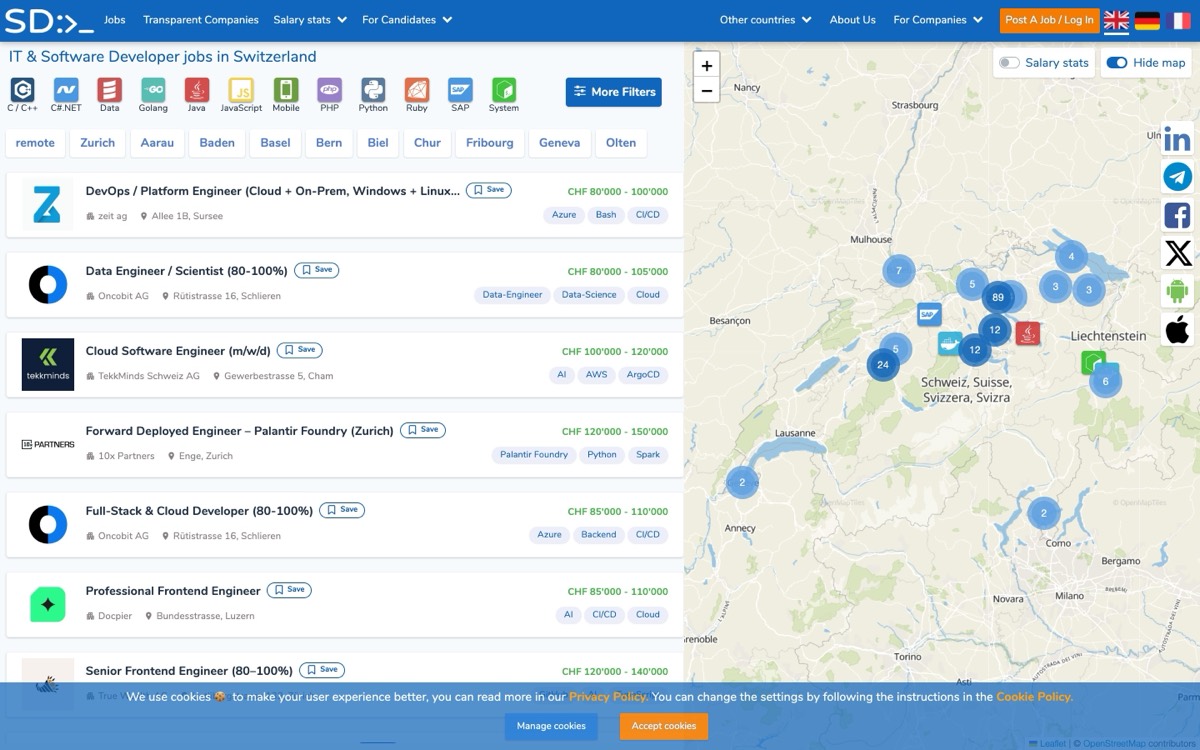
IT and software only, and thorough about it: "183 IT & Software developer jobs in Switzerland", filtered by technology (C#, Java, Python, DevOps, ML) rather than by industry. Publishes salary statistics and lists the companies that disclose their ranges. The site itself is in English.
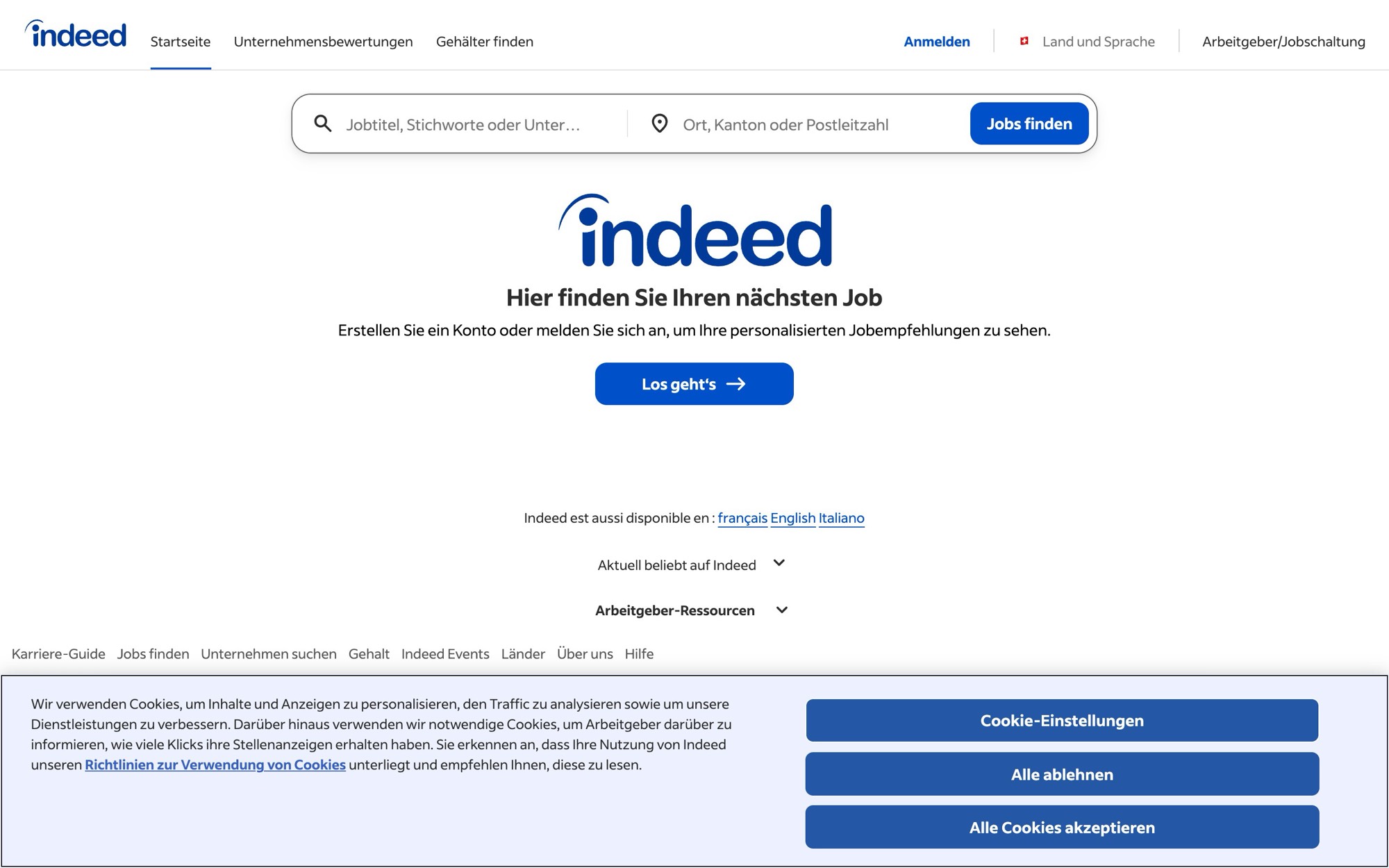
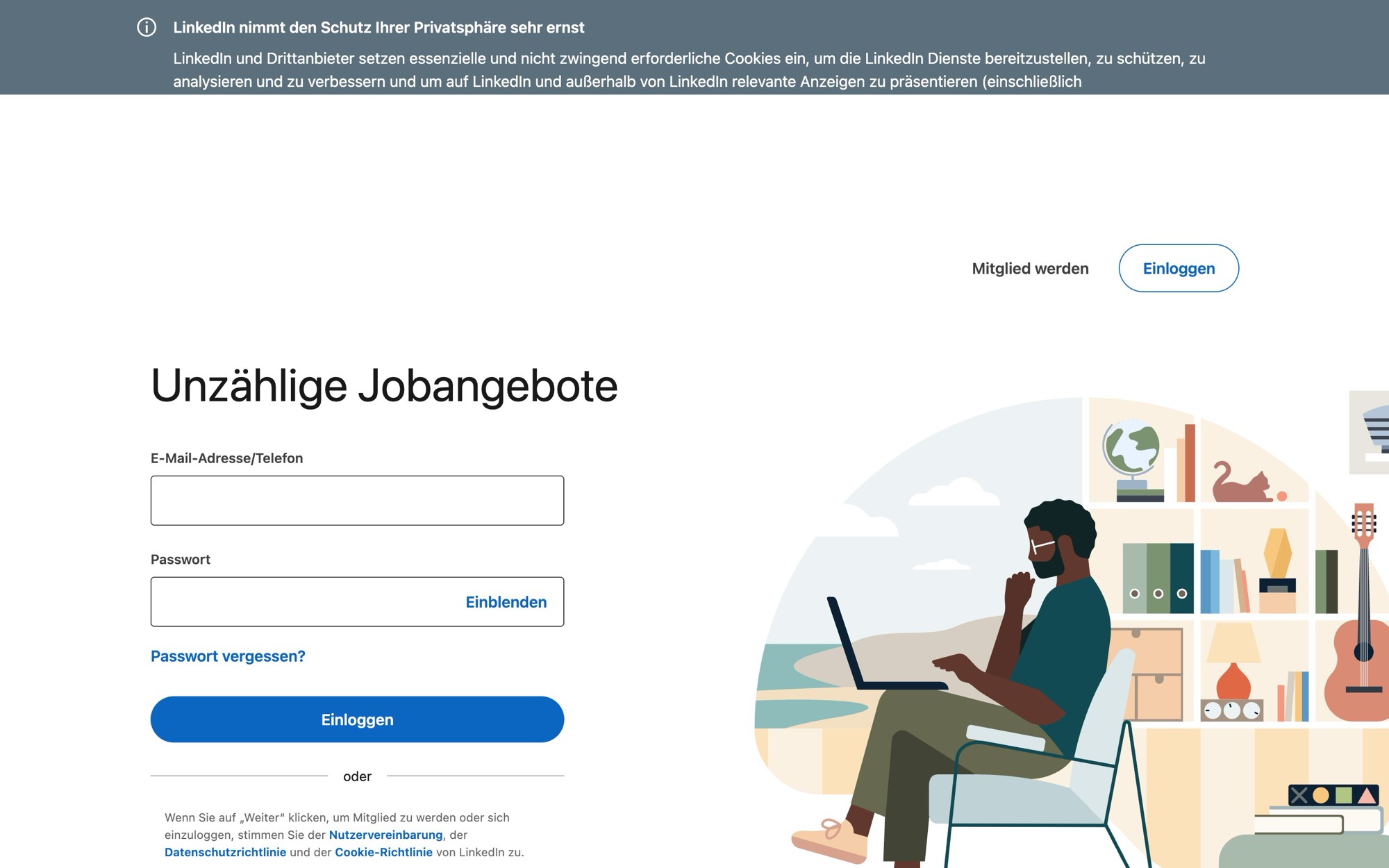
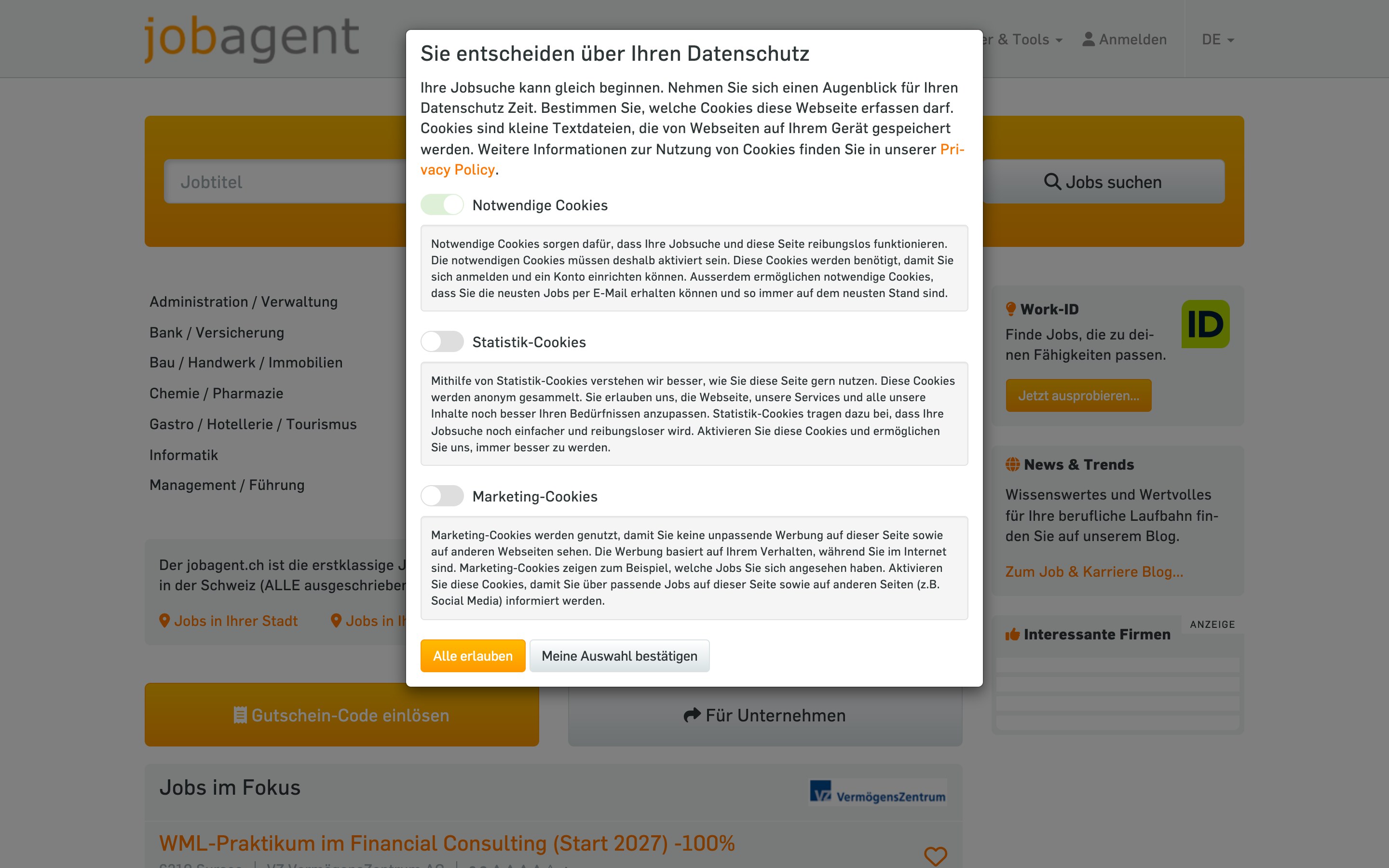
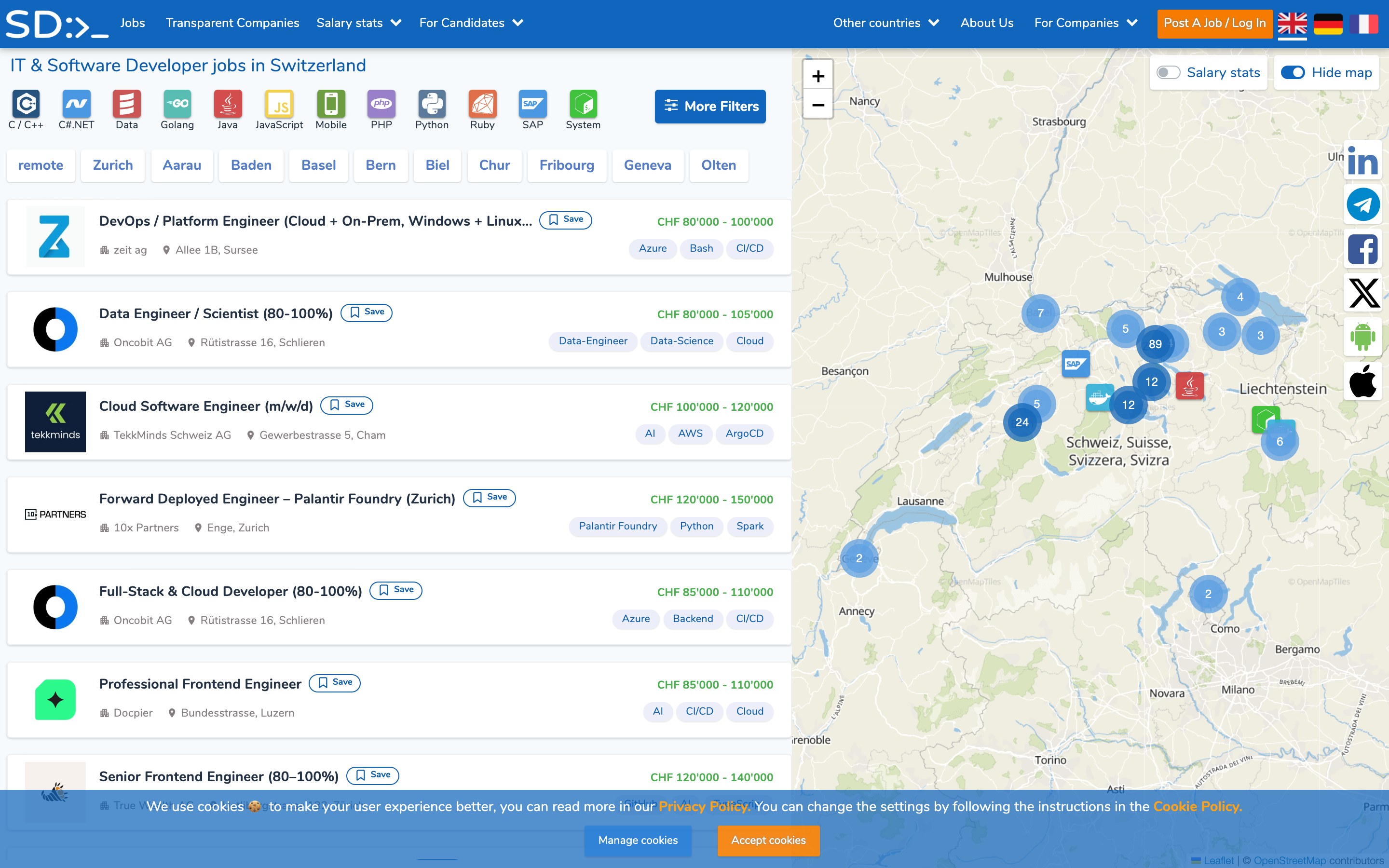
Jobs by profession, city or language
Type a profession, a city or a language, the page shows the adverts currently open for it.
By profession
- Consultant
- Project Manager
- Retail Sales
- Nurse
- Nursing & Care
- Administrative Assistant
- Account Manager
- Software Engineer
- Public Administration
- Architect
- Insurance
- Chef
71 more — narrow the search
By work type
Two Swiss words decide what any of this costs you. A Temporärbüro is a Verleiher — it hires you out. It is your legal employer, pays your wage and places you with a client company. A Stellenvermittlung is a Vermittler — it places you into a contract with the company itself. The Employment Services Act (AVG, SR 823.11) treats them very differently: any agreement requiring fees, advance payments or wage deductions from a hired-out worker is void under Article 19(5), while a placement agency may legally charge a job seeker a registration fee of at most CHF 45 and a commission of at most 5 per cent of the first gross annual salary.
For this answer we opened the Swiss sites of Adecco, Manpower, Randstad and Coople on 25 August 2026, read the Act in its version of 1 January 2026 on fedlex, and recomputed the shares in our own set of open adverts that day. The Act is published in German, French and Italian; the wording quoted here is our translation of the German text, and the original is linked below.
Share of open adverts on SwissJobs.app by the destination of the apply link, measured 25 August 2026. Roughly two in five lead to the hiring company's own careers page, which is where a direct application to a fixed-term role starts.
- Hiring workers out commercially requires an operating licence from the cantonal employment office (Art. 12 AVG). The federal AVG register lets you check any firm by name, town or canton before you sign anything.
- Hiring out staff from abroad into Switzerland is not permitted (Art. 12(2) AVG). An agency based in Germany, France, Italy or the UK cannot lend you into a Swiss assignment, whatever its website suggests — this is the single rule most often misread by people applying from outside the country.
- A staffing firm may only employ foreign nationals in Switzerland who are admitted to gainful employment and entitled to change jobs (Art. 21 AVG). If your permit ties you to one employer, agency work is not open to you until that changes.
- For open-ended assignments the notice period is at least two days during the first three months and at least seven days from the fourth to the sixth month (Art. 19(4) AVG). It runs both ways.
- Any agreement that prevents or hinders you from moving to the client company once your contract ends is void (Art. 19(5)(b) AVG), and so is one that hinders the client company from hiring you (Art. 22(2)).
- The agency may charge the client a transfer fee only if the assignment lasted under three months and you move across within three months of it ending, capped at the administration and profit margin of a three-month assignment (Art. 22(3) and (4) AVG). After three months on assignment, hiring you costs the company nothing.
- Where the client company falls under an extended collective agreement, the agency must apply that agreement's pay and working-time rules to you (Art. 20 AVG).
- 88 hours of temp work within twelve months creates a CHF 440 training credit at the temptraining fund; every further hour has added CHF 5 since 1 July 2026, up to CHF 5000 for the course and up to CHF 2250 for lost earnings.
- In our own set of open adverts, 3.1 per cent are temporary or fixed-term and 87.4 per cent of those are posted by the employer itself, 12.6 per cent by a staffing firm. Geneva runs highest at 8.0 per cent of local adverts, Zurich lowest of the large centres at 2.2 per cent.
- 44.5 per cent of all our open adverts send you to the employer's own website to apply, 34.9 per cent into an applicant system and 20.6 per cent to a job board or a staffing firm.
- Adecco's Swiss homepage offers a free CV builder, explicitly stating that no registration is needed, and states more than 100 branches in Switzerland — checked 25 August 2026.
Temp agency or applying direct
| Criterion | Through a temp agency | Direct to the employer |
|---|---|---|
| Cost to you | none | none |
| Access to roles | including unadvertised ones | only what you find |
| Who employs you | the agency | the company |
| Pay | lower; the agency takes a margin | full |
| Conversion to a permanent role | common, often after a period | immediate |
| Notice periods | short, under the staff-leasing CLA | CO art. 335c |
| Entering a field or changing sector | a genuine door-opener | harder without references |
The agency costs you nothing — the company pays it. The price is elsewhere: your contract is with the agency rather than the workplace, and the wage sits below what the company would pay you directly.
What the agency actually sells, and why no job board holds it
Start with the part that argues against us. An agency does not sell adverts; it sells access to assignments that are never advertised. A client rings, the agency looks through the people already on its books, and no public posting is ever created for a job board to pick up. That is why the temporary market looks smaller on every platform than it is in reality, ours included.
The second thing the agency carries is the employment itself. It signs the contract, pays the wage and handles the AHV old-age contributions, the pension fund, accident insurance and family allowances — the administrative layer that a newcomer to Switzerland is least equipped to arrange alone. It is also bound by the GAV Personalverleih, the collective agreement covering hired-out staff, in force since 1 January 2012 and declared generally binding, which takes over the pay and working-time provisions of the extended collective agreements in the client's industry.
The most concrete benefit is the training fund. After 88 hours of temp work within twelve months you are entitled to CHF 440 towards a course at temptraining; each further hour on assignment has added CHF 5 since 1 July 2026, up to CHF 5000, plus up to CHF 2250 in compensation for lost pay, settled at CHF 250 per full course day. A fixed-term contract signed directly with an employer funds none of this. If you are working hourly anyway and have a qualification in mind, that is a real argument, and it is not one a search engine can match.
The rule that catches people applying from abroad
If you are reading this from Germany, France, Italy or further away, one sentence of Swiss law matters more than everything else here: hiring out staff from abroad into Switzerland is not permitted (Art. 12(2) AVG). A staffing firm in your own country cannot employ you and lend you to a Swiss company. Only a firm licensed by a Swiss cantonal employment office can do that, and cross-border hiring out from Switzerland to another country needs a second licence from the federal economics secretariat on top of the cantonal one.
The second rule concerns permits. Under Art. 21 AVG a staffing firm may only employ foreign nationals in Switzerland who are admitted to gainful employment and entitled to change jobs. That is a real gate: if your residence status ties you to one named employer, an agency cannot lawfully take you on, and any agency that offers to is not a licensed one.
Both rules point in the same direction for anyone still living abroad. The route that works is a direct application to a Swiss employer who is willing to sponsor and wait, not an intermediary in your own country promising Swiss assignments. And the way to check any Swiss firm's licence is free: the federal AVG register lists every business licensed to place or hire out staff, searchable by name, town and canton.
What the advert data shows
The direct route is better documented than the reputation of temp work suggests. Of the open adverts we hold, 3.1 per cent describe themselves as temporary, fixed-term, on-call, cover or relief work. The number that matters is the second one: 87.4 per cent of those adverts come from the workplace itself, and 12.6 per cent from a staffing firm. Split by language it diverges sharply: 94.6 per cent of German-language fixed-term adverts are posted directly, against 64.9 per cent of French-language ones — agencies advertise in the Suisse romande and barely advertise in the German-speaking cantons.
Read that both ways, because both readings are true. Most of the advertised fixed-term work in Switzerland can be reached without an intermediary — hospitals, hotels, manufacturers, cantonal administrations post it themselves. But because agencies barely advertise, this measures only the visible part of the market. Using both routes costs nothing.
Where you look changes the odds sharply. In Geneva 8.0 per cent of local adverts are fixed-term or temporary, in Vaud 4.6, in Basel 3.0 and in Zurich only 2.2 per cent. French-language adverts run at 3.6 per cent against 2.7 per cent for German-language ones. The international organisations and the watch and finance sectors in the Lake Geneva region publish short contracts as a matter of course; German-speaking Switzerland routes far more of the same work through agencies.
And the application itself usually lands with the company: 44.5 per cent of our open adverts send you to the employer's own site, 34.9 per cent into an applicant system, 20.6 per cent to a board or a staffing firm.
Being taken on permanently is protected by statute
The question everyone asks about temp work — can the company keep me afterwards — has an unusually clear answer in Swiss law, and it is stated twice. Agreements that make it impossible or harder for you to move to the client company after your contract ends are void (Art. 19(5)(b) AVG). Agreements that make it impossible or harder for the client company to employ you after the assignment ends are equally void (Art. 22(2)).
One narrow exception survives: the agency may claim compensation from the client only where the assignment lasted less than three months and you cross over less than three months after it ends, capped at what three months of administration and profit would have cost, minus what has already been paid (Art. 22(3) and (4)).
In practice that means an assignment lasting three months or more costs the client nothing to convert. This is why, for many people, the agency is not the alternative to a permanent job but the detour towards one — and why an agency discouraging you from crossing over is relying on a clause the Act declares void.
The free public route most newcomers skip
Switzerland runs a public employment service and it costs nothing. Once you register with the regional employment centre — the RAV in German, ORP in French, URC in Italian — you get personal advice, placement and access to Job-Room, the public job platform. arbeit.swiss describes the aim as rapid and lasting reintegration into the labour market, with an adviser accompanying you throughout.
Two caveats. It is designed for people who are unemployed or about to be, not for someone in a job looking for a side assignment. And if you are registered and claiming benefits, your job-search efforts have to be recorded in Job-Room or on your canton's form to count. Anything you find here is easier to search, but it does not replace that record — the benefit itself hangs on it.
Short assignments during unemployment can count as interim earnings, which changes how your daily allowance is calculated. That is a conversation to have with your adviser before you accept the assignment, not after.
Who each route is right for
Choose a temp agency if you need work in weeks rather than months, if you work in construction, manufacturing, hospitality or care, if you want the temptraining credit to build up, or if you would rather not run the search yourself. That last service is paid for by the client company, never by you.
Choose SwissJobs.app if you want to see who is actually hiring and apply to them directly, with a CV written for the individual advert, in German, French, Italian or English. For most people asking this question that is the right first move, because almost nine in ten advertised fixed-term roles can be reached without an intermediary — and because a Swiss dossier expects things a generic CV tool never asks for, from your permit status to CEFR language levels and a workload stated as a percentage.
Be clear about what we are not. We do not employ you, pay no wage, arrange no assignment and run no training fund. Our share of fixed-term adverts is small at 3.1 per cent, and smallest in Zurich at 2.2 per cent. If you need an assignment this week in a Zurich warehouse, one phone call to a licensed agency will beat any search box, ours included.
Shares are computed from the open adverts on SwissJobs.app on 25 August 2026. An advert counts as temporary or fixed-term when it says so in its own title or employment-type field (temporär, befristet, temporaire, temporaneo, Aushilfe, on-call, interim, contract, relief). Adverts that only mention a fixed term in the body text are not counted, so the true share is likely a little higher. Regions are assigned from the advert's location field. Legal statements come from the Federal Act on Employment Services and the Hiring of Services (SR 823.11) in its version of 1 January 2026 and from the associated federal fee ordinance, both read in German; the Act is not published in English. Industry figures come from swissstaffing, the employers' association of Swiss staffing providers, and are labelled as such. Provider claims were read on their own websites on 25 August 2026.
Sources
- Federal Act on Employment Services and the Hiring of Services (AVG), SR 823.11 — official German text
- Ordinance on fees, commissions and securities under the AVG, SR 823.113
- Federal AVG register — licensed placement and staffing businesses
- GAV Personalverleih — the collective agreement for hired-out staff
- temptraining — training fund for temporary workers
- swissstaffing — how temporary work is organised in Switzerland
- arbeit.swiss — advice and placement by the regional employment centres
- Job-Room — the public job platform
- Adecco Switzerland — services and free CV builder
- Manpower Switzerland — homepage and warning about payment requests
- Coople — staffing through a platform
Related questions
What our job index says about the Swiss market
Computed live from our own index, not quoted from a study. Shares only, as of today.
Language the advert is written in
- Deutsch
- 60%
- English
- 23%
- Français
- 13%
- Italiano
- 3%
Of adverts that state a language requirement, the share asking for
- Deutsch
- 70%
- English
- 43%
- Français
- 21%
- Italiano
- 3%
19% posted in the last 7 days · Largest markets: Zürich 18% · Bern 10% · Genève 5% · Basel 5%