What is an alternative to Xing for job hunting in Switzerland?
Updated:
In short
The closest alternative to Xing for job hunting in Switzerland is SwissJobs.app: Swiss adverts you can search without an account, filtered by canton and by Pensum — the workload stated as a percentage — in all four national languages. Xing's interface exists in German and English only; xing.com/fr and xing.com/it both land on the English page. Xing stays stronger where it comes from: Germany and Austria, and as a network where you get found instead of searching. It also shows a salary range on most adverts and says whether the employer gave it or Xing estimated it. We show none. As of 25 August 2026.
The Swiss job portals at a glance
Click an image for the full-size view. What each portal actually is stands beside it.
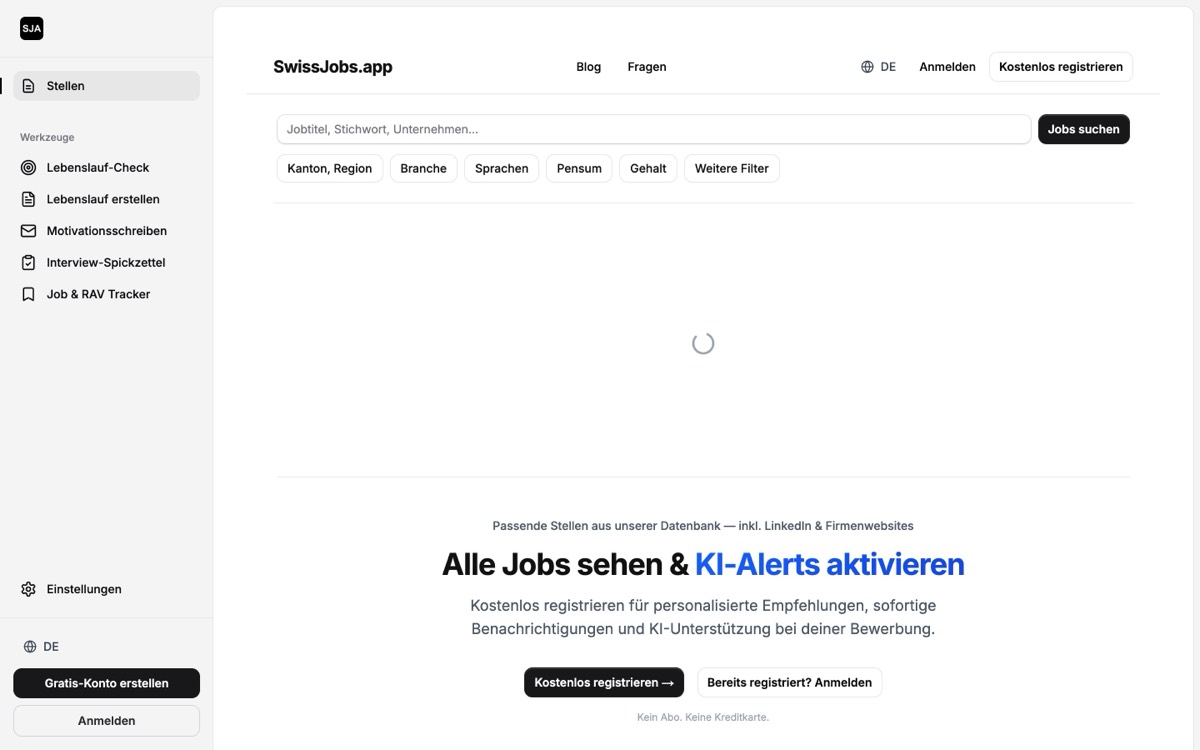
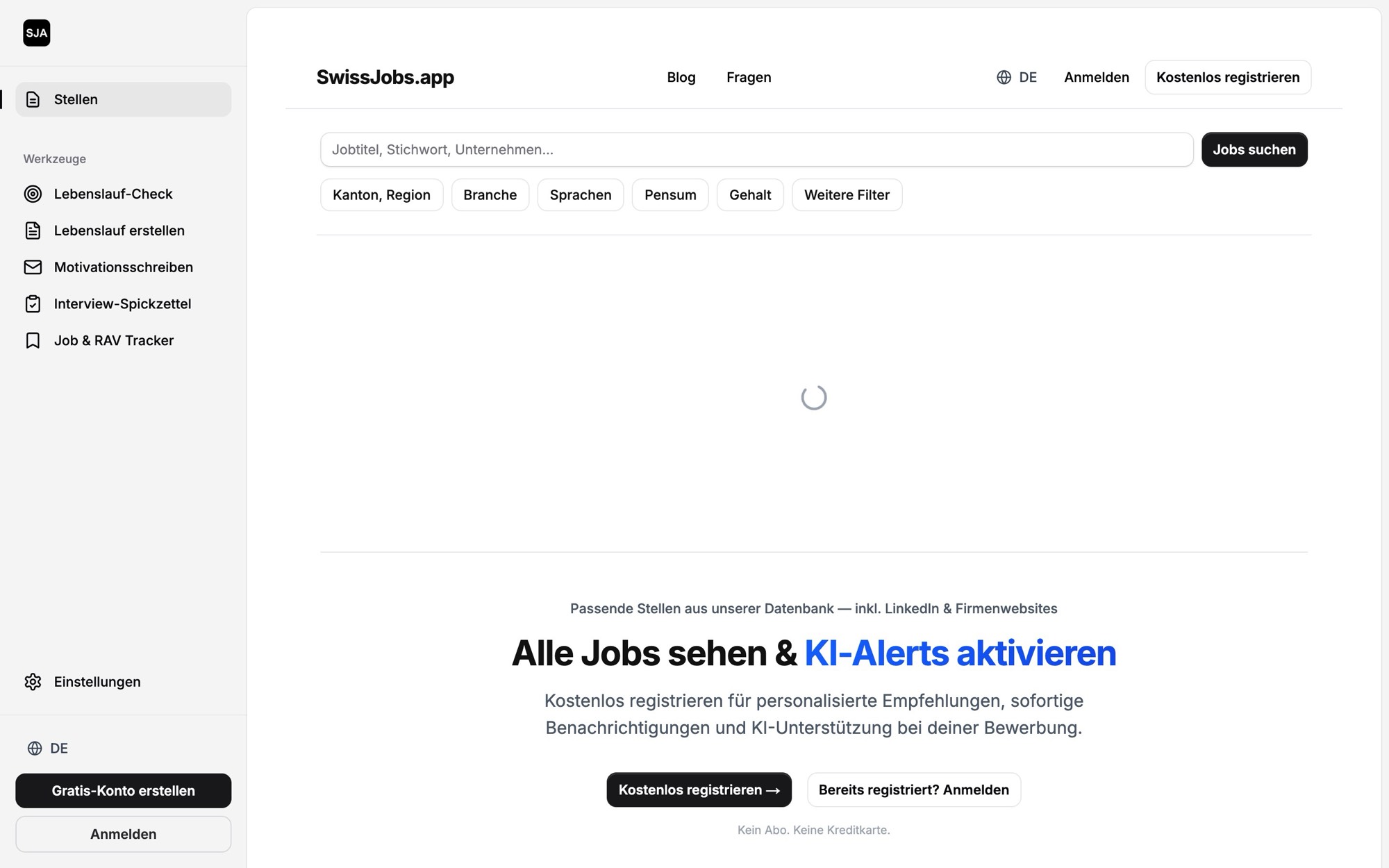
1. SwissJobs.appOur app
Over 21,000 open Swiss roles from ATS systems, company sites and LinkedIn in one place — and from any advert, straight into a CV, a motivation letter, a CV check and interview prep. The RAV job-search-efforts form fills itself from your application tracker. Free to use; the account is asked for at save.
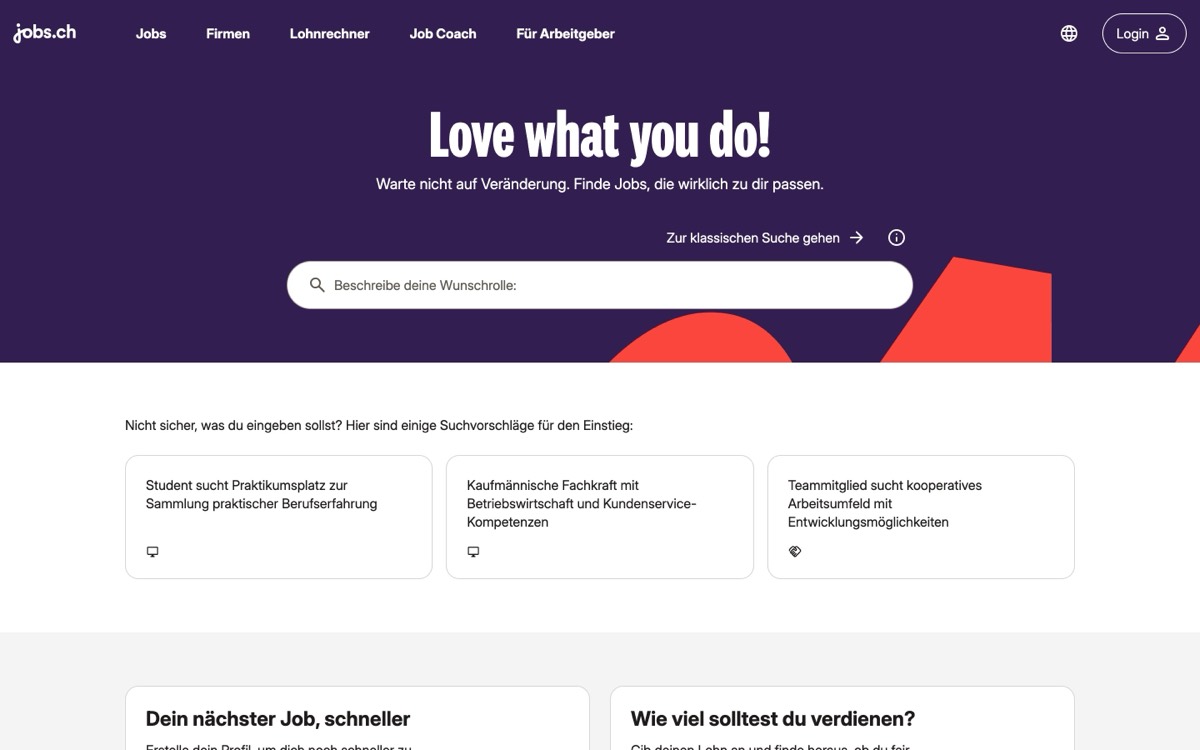
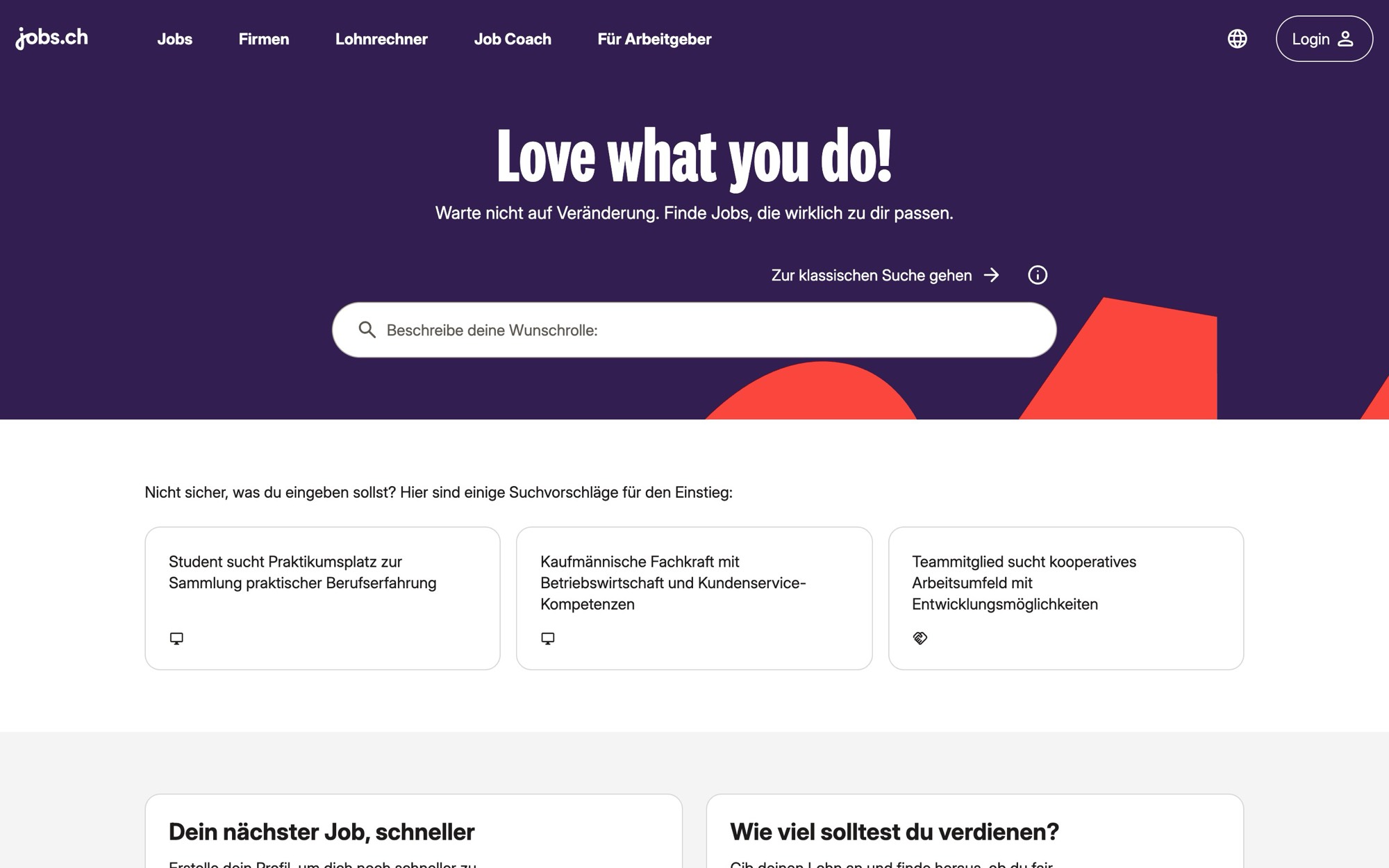
The best-known board in German-speaking Switzerland and the largest index in the country. Owned by JobCloud AG — as are jobup.ch and JobScout24.
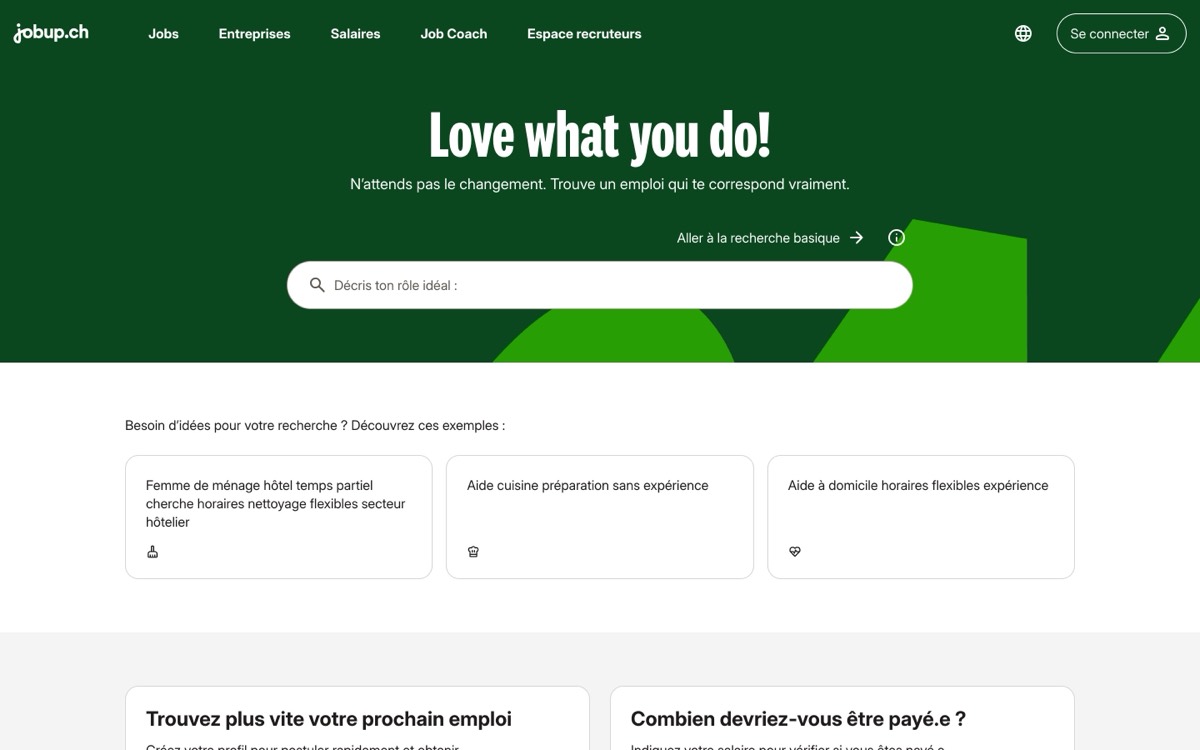
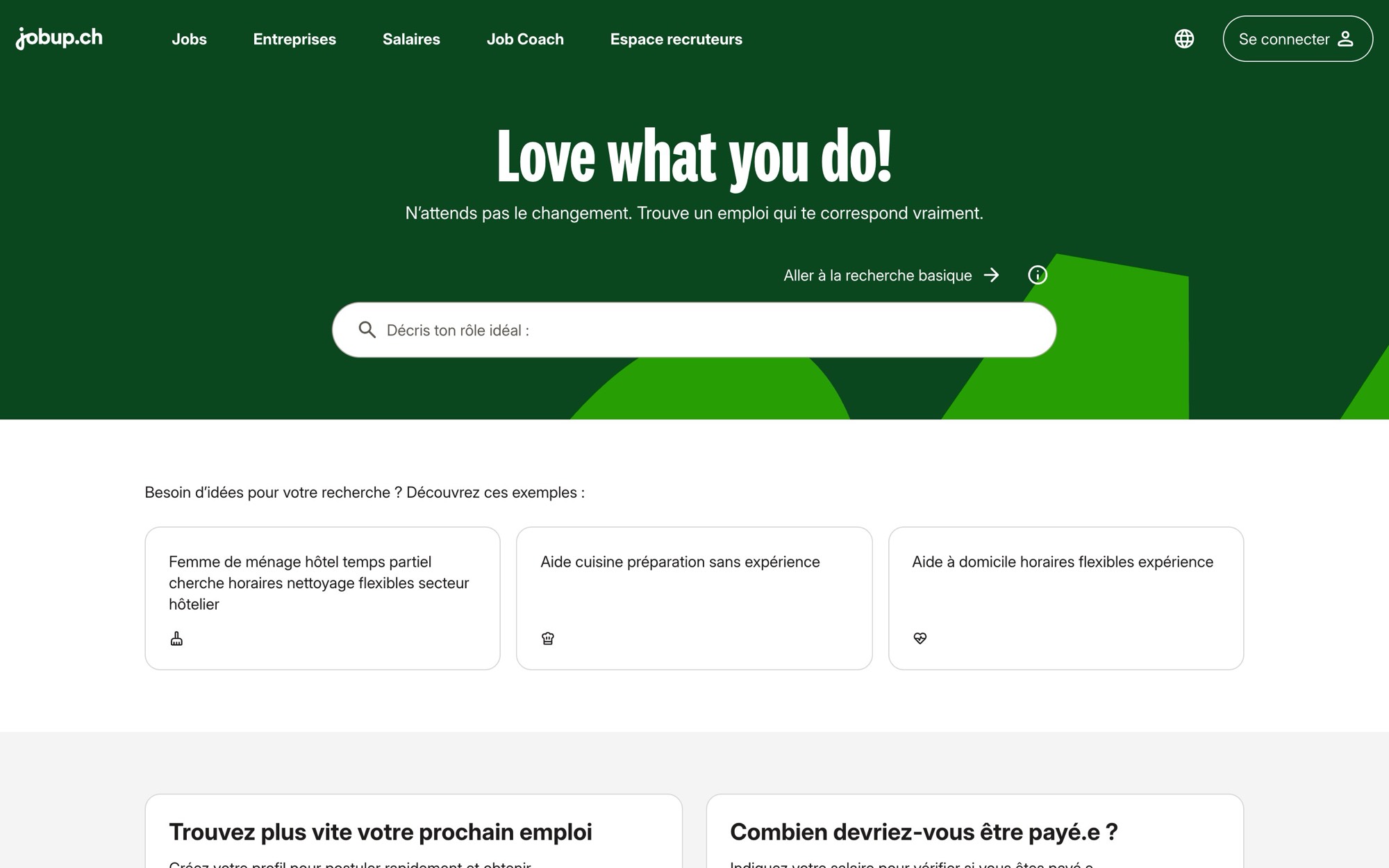
The standard in French-speaking Switzerland and the first place to look for the Romandie — but the same JobCloud AG as jobs.ch.
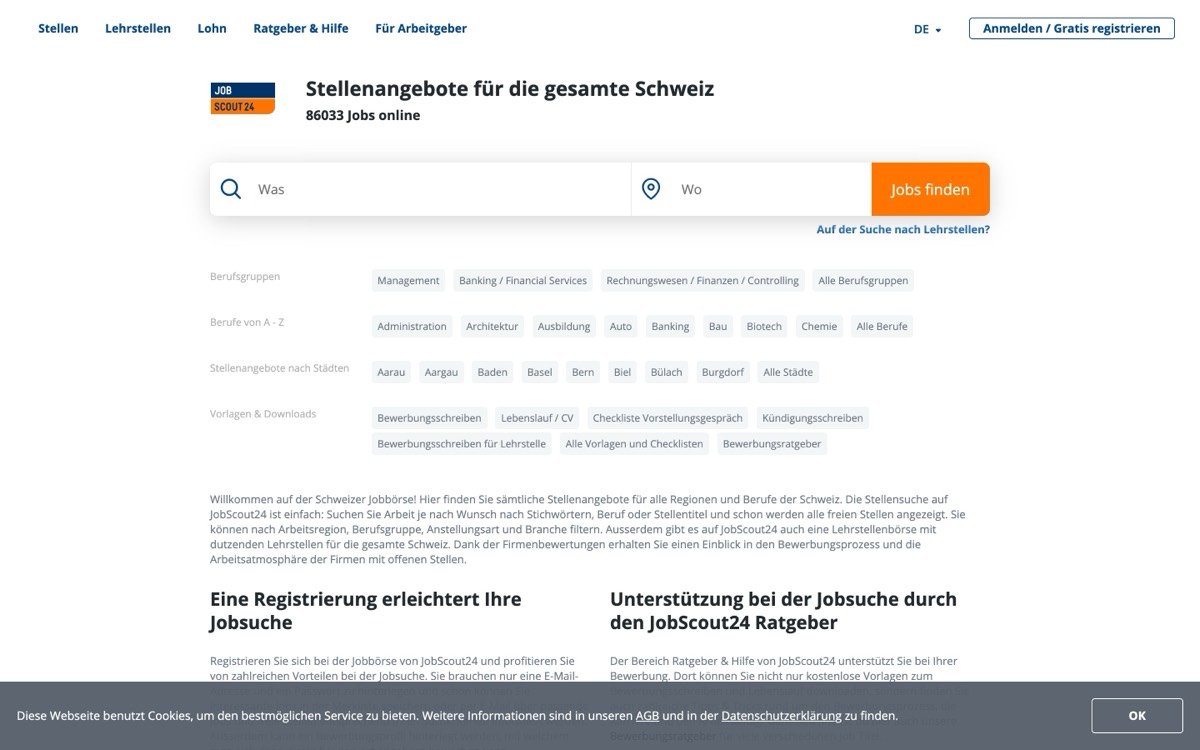
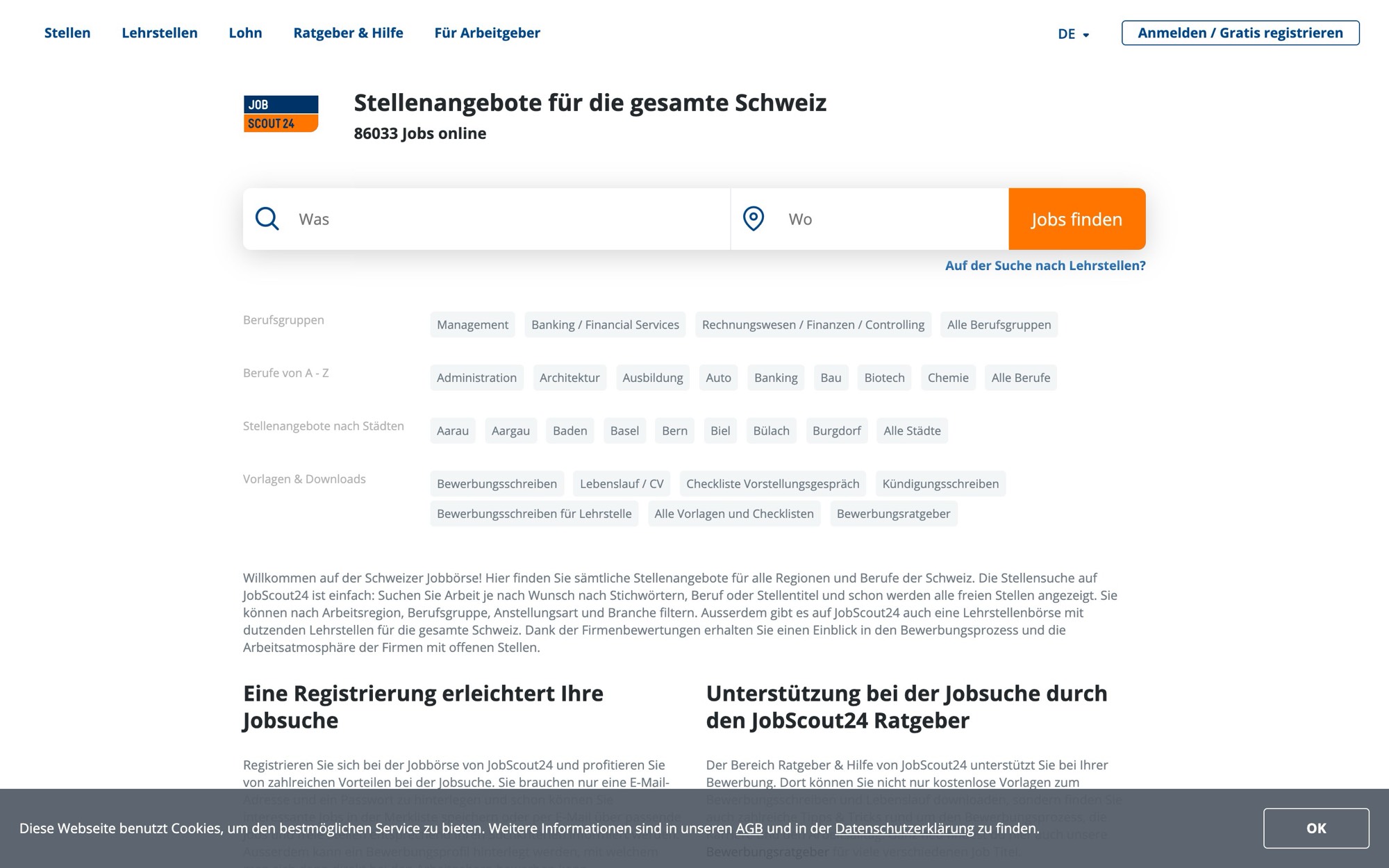
A third brand from the same company. Searching all three to widen your search means searching one provider three times.
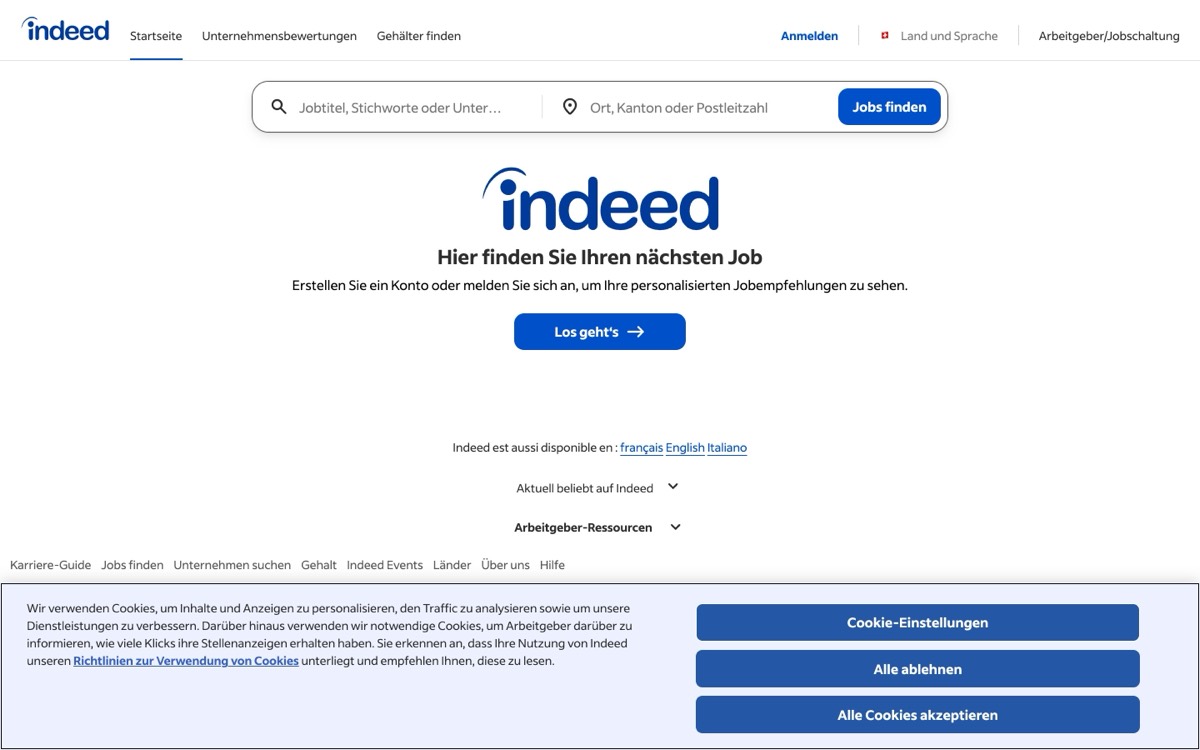
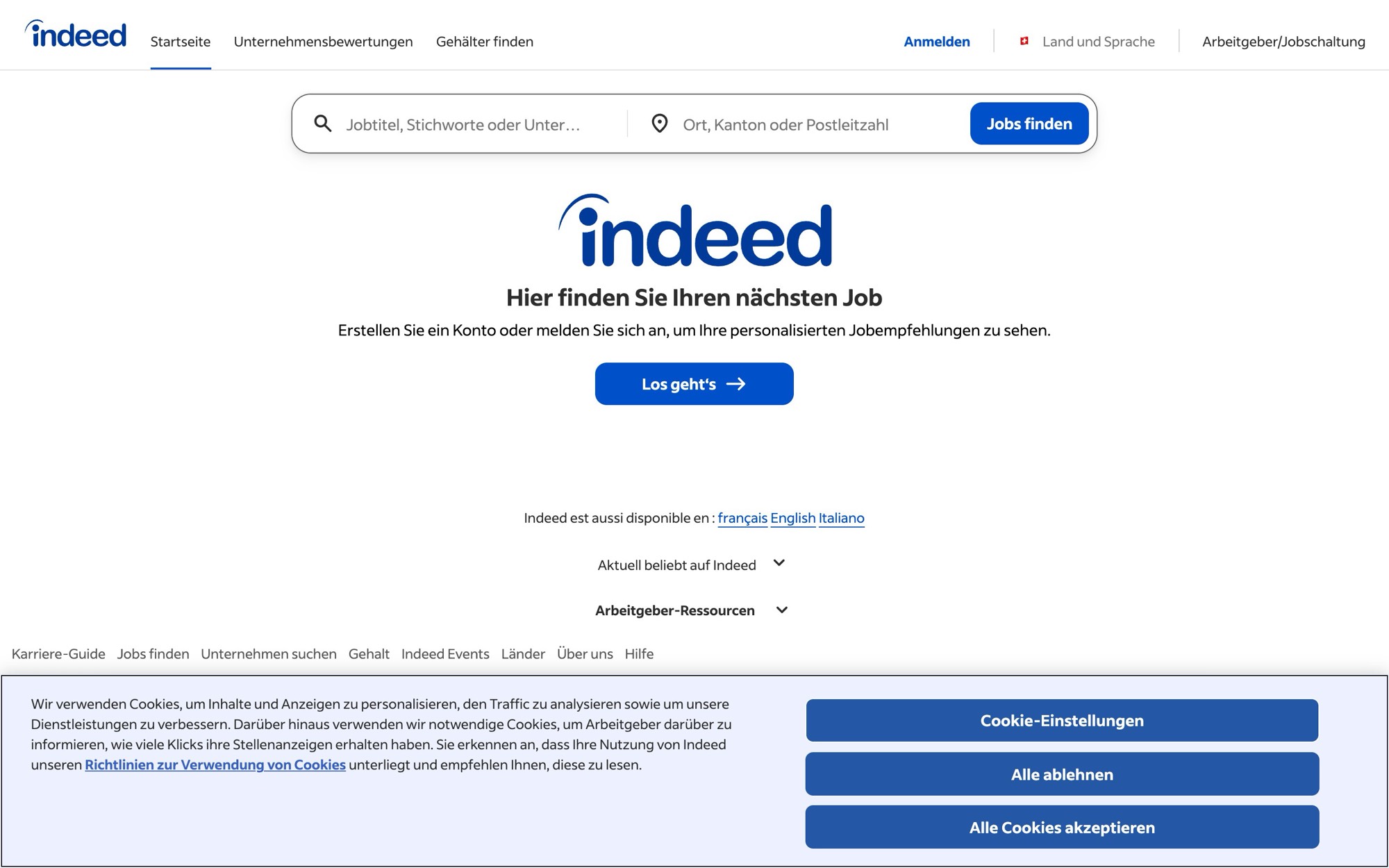
The broadest aggregation, because Indeed also collects from other boards — at the cost of many duplicates of the same advert.
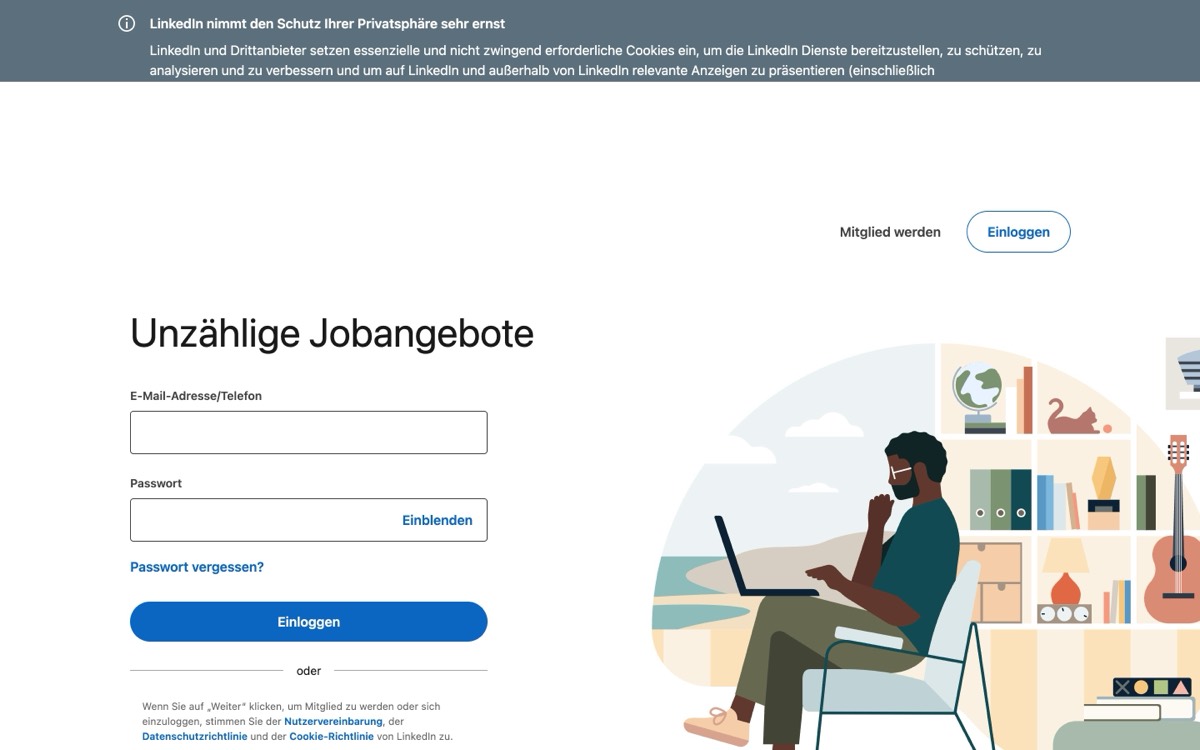
The best reputation for English-speaking and international roles in Switzerland. Considerably thinner for trades, care and commercial roles.
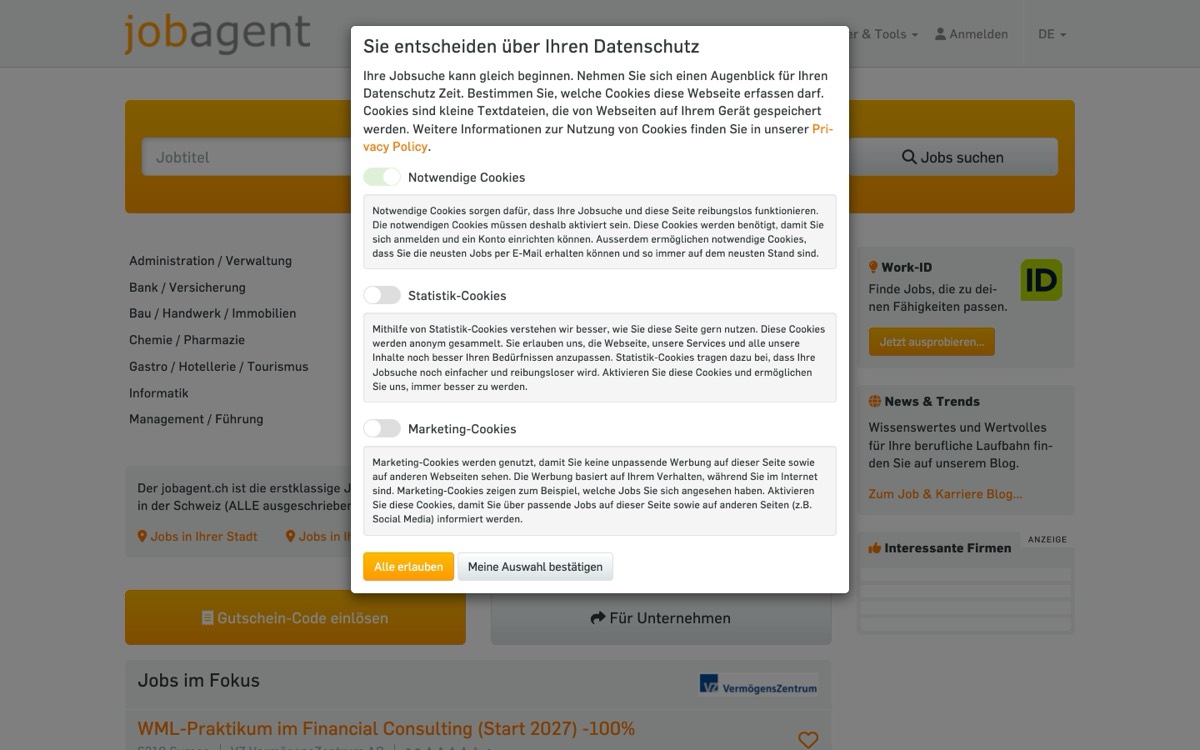
A meta-search across the Swiss job boards, "every job in Switzerland at a glance". Its strength is the Job-Abo: a saved search that mails you new adverts from every portal it covers. Salary calculator and application guides alongside.
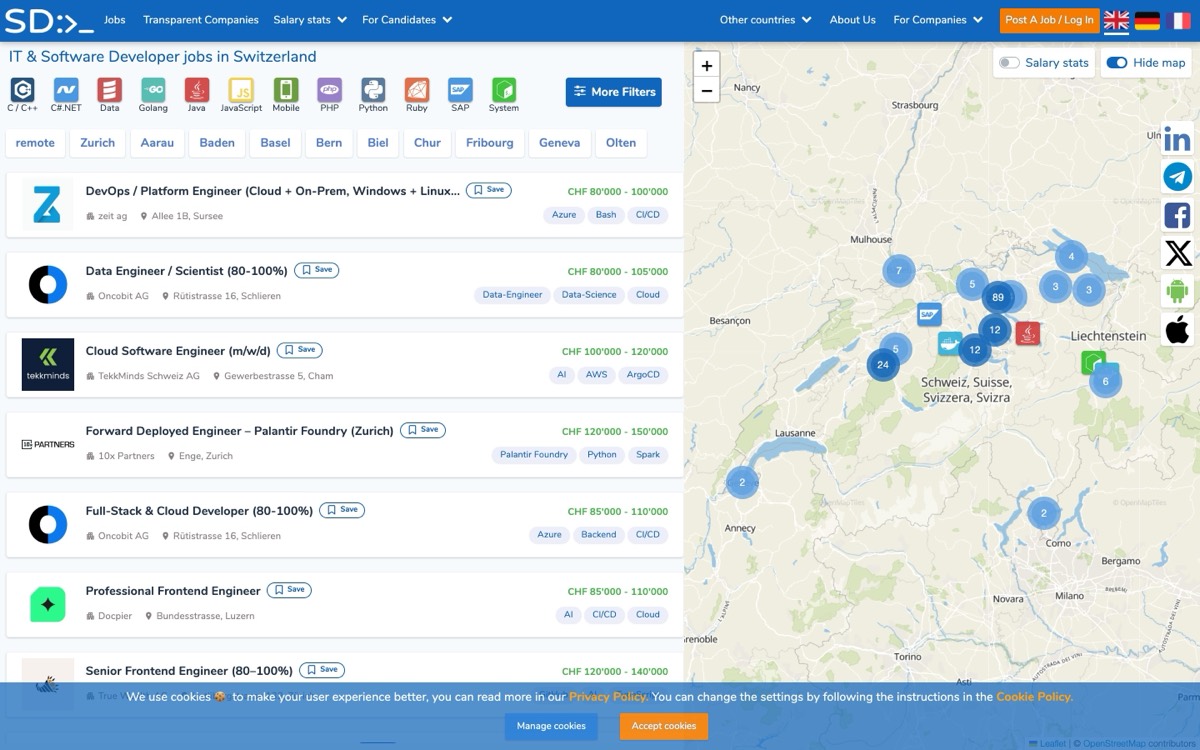
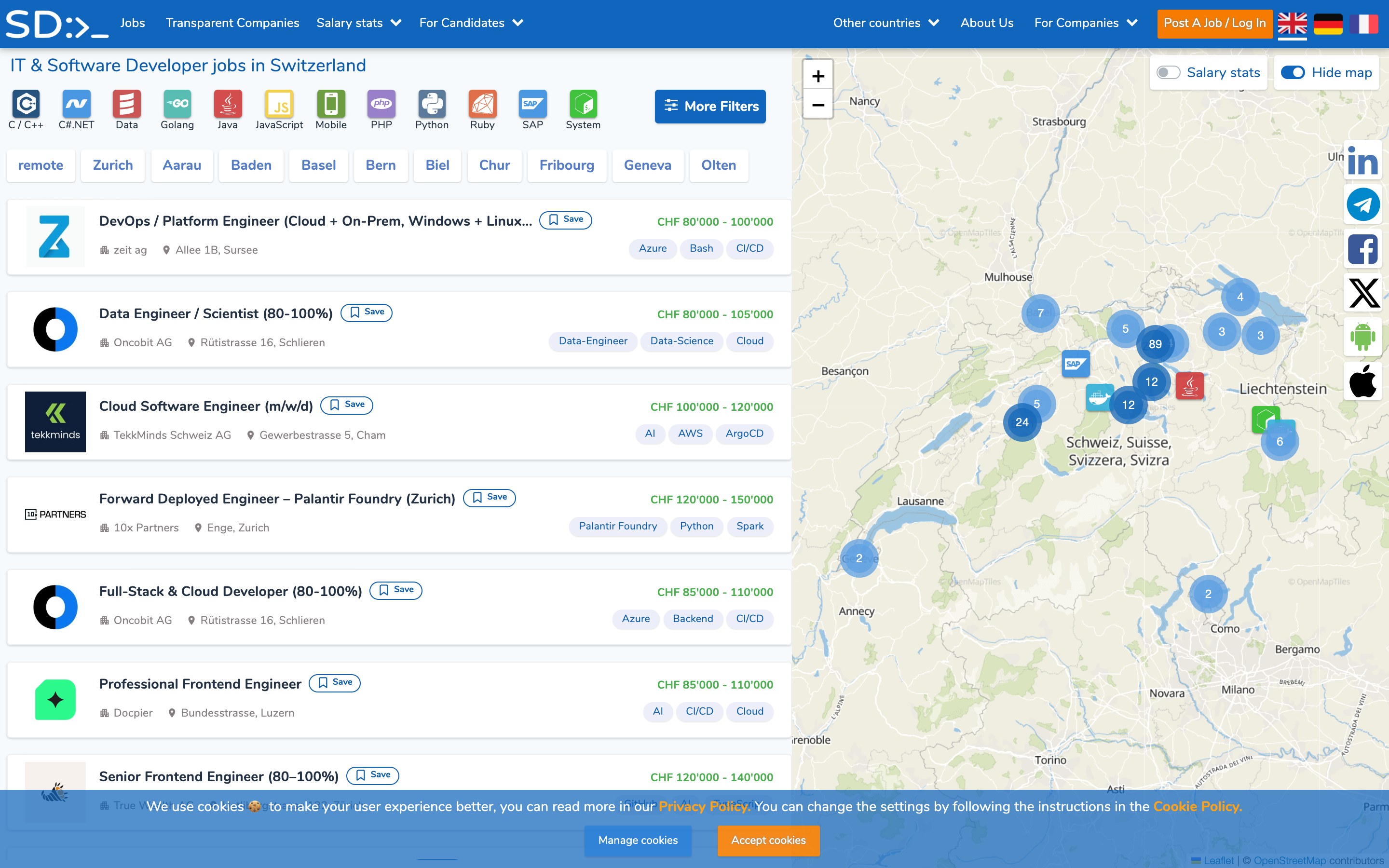
IT and software only, and thorough about it: "183 IT & Software developer jobs in Switzerland", filtered by technology (C#, Java, Python, DevOps, ML) rather than by industry. Publishes salary statistics and lists the companies that disclose their ranges. The site itself is in English.
Jobs by profession, city or language
Type a profession, a city or a language, the page shows the adverts currently open for it.
By profession
- Consultant
- Project Manager
- Retail Sales
- Nurse
- Nursing & Care
- Administrative Assistant
- Account Manager
- Software Engineer
- Public Administration
- Architect
- Insurance
- Chef
71 more — narrow the search
By work type
Xing is the German-speaking world's professional network, run by New Work SE in Hamburg. Plenty of people in Switzerland hold a profile there, usually because they worked in Germany first, and Swiss adverts genuinely do appear on it. The question is whether it is the right instrument for a Swiss search — and that turns out to be answerable from Xing's own pages rather than from opinion.
On 25 August 2026 we opened seven of Xing's Swiss job pages without signing in — the country page plus Zurich, Basel, Bern, Geneva, Lausanne and Lugano — along with three individual adverts, the CV editor and the legal notice, and wrote down what they said. Below is what came back, measured against shares from our own index of live Swiss adverts.
Share of the adverts whose canton can be determined (70.5 per cent of the stock open on SwissJobs.app on 25 August 2026). Xing offers no canton filter, only a twenty-kilometre radius around a city.
- xing.com/fr and xing.com/it both land on xing.com/en — Xing's interface exists in German and English, not in French or Italian (read 25 August 2026).
- The salary filter on the page whose chip reads «Standort: Schweiz» is set in euros: «Gehalt: 0 € – EUR 200'000».
- Of roughly a hundred salary ranges across seven Swiss Xing pages, fourteen were in euros — including EUR 72'000 to EUR 78'000 for a production job in Köniz, tagged as the employer's own figure.
- Xing labels every range as estimated or employer-supplied — «91.000 CHF – 124.000 CHF (von XING geschätzt)». We show no salary on an advert at all.
- An advert titled «Projektleiter mit Französischkenntnissen im 20-60% Pensum» was filed in Xing's own field as «Art der Beschäftigung: Vollzeit».
- «More than 999» was returned by the country page, Zurich, Basel and Bern alike — a display ceiling, not a count. Lausanne returned 33; Geneva and Lugano printed a figure with no location filter applied.
- Geneva's result list opened with a vacancy in Illingen in the German Saarland, and carried another in Frankfurt am Main.
- There is no canton filter; Xing's geography is a twenty-kilometre circle around a city, and around Basel that circle lies substantially in Germany and France.
- In our index 27.7 per cent of locatable adverts are in the Romandie and 1.8 per cent in Ticino; 13.3 per cent are written in French and 2.2 per cent in Italian.
- 21.9 per cent of our adverts carry a percentage in the title and 12.7 per cent a range such as «80 – 100 %» — a full-time/part-time toggle cannot carry that.
- What Xing Premium costs cannot be seen without an account: xing.com/premium redirects to login.xing.com.
Who to choose
With Xing it ends at the advert. With us it starts there: the same posting produces the CV, the motivation letter, the check against it, and the entry in your RAV record.
Choose Xing if
Xing — rooted in the German-speaking market, for DACH contacts and companies that maintain a profile there.
Choose SwissJobs.app if
Pick the job directly — We run the job index ourselves. The advert text is already loaded, and everything else is written against exactly that text — no searching, no copying, no pasting.
Four tools, not one — CV, motivation letter for the same advert, a CV check against that advert, and interview preparation — one account, the same data.
The RAV sheet — Your job-search efforts are filled from your application tracker and printed as the official SECO form. No other tool in this comparison has it.
Word export, no watermark — PDF and DOCX, both clean. Many tools hand you a text file on the free plan, or stamp a watermark on the document.
Start without an account — The tools open without signing up. The account is asked for to save and from the second document — the first download needs none.
Feature comparison
| Feature | SwissJobs.app | |
|---|---|---|
| Swiss job listings | Yes | Yes |
| All 26 cantons | Yes | not stated |
| Search without an account | Yes | not stated |
| Job alerts by email | Yes | not stated |
| AI match against your profile | Yes | No |
| Build a CV straight from the advert | Yes | No |
| Motivation letter for the advert | Yes | No |
| CV check against that advert | Yes | No |
| Application tracker | Yes | No |
| RAV job-search-efforts form (SECO) | Yes | No |
| Low-competition listings surfaced | Yes | not stated |
| Free to use | Yes | not stated |
| Interface languages | DE / EN / FR / IT | not stated |
| Built in Switzerland | Yes | not stated |
As of 4 September 2026. "not stated" means it could not be read on their own site — not "does not exist". Our rows come from the code (lib/stripe/trialConfig.ts) and from walking the live flow, not from marketing copy.
Pricing side by side
| What you pay | SwissJobs.app | |
|---|---|---|
| Job searchThe search is not part of our subscription. What is paid for is the tools that come after it. | Free — search, filters, job alerts and the application tracker cost nothing | Free for jobseekers |
| Monthly price | CHF 15 — all six tools, one subscription | not stated |
| Yearly price | CHF 95 a year (= CHF 7.92 a month) — the same six tools | not stated |
| Free trialOur seven days are the full product, not a limited preview. | 7 days, full access, cancel any time | not stated |
| What works without payingWe print the limit, because that is the number a comparison usually leaves out. | Tools open without an account; free account: 5 documents/day, 10 per rolling week | not stated |
| Currency | CHF | not stated |
| BillingWatch for four-week billing periods anywhere: that is 13 charges a year, not 12. | Calendar month, cancel any time | not stated |
As of 4 September 2026. "not stated" means it could not be read on their own site — not "does not exist". Our rows come from the code (lib/stripe/trialConfig.ts) and from walking the live flow, not from marketing copy.
What Xing's Swiss pages actually say
The page xing.com/jobs/schweiz reports «Mehr als 999 Schweiz Jobs» — more than 999 — with the filter chip set to «Standort: Schweiz». The Zurich page reports the same figure. So does Basel, and so does Bern. When one city returns the same number as the whole country, that number is a display ceiling rather than a count, and nothing about the size of the Swiss stock can be read out of it.
West and south of there it gets stranger. The Lausanne page returned 33 adverts with the chip «Lausanne (20 km)» properly set — a figure you can actually read. Geneva reported 337 and Lugano 758, but on neither page was any location filter applied at all, and the result lists showed it: Geneva's opened with an inside-sales role in Illingen, in the German Saarland, and carried another in Frankfurt am Main, while Lugano's ran through Lucerne, Konstanz, Lausanne, Geneva and Sulgen in Thurgau after its first hit. The number above the list does not always describe the place in the page title.
The filters are quickly listed because there are few: date posted (last 24 hours, last week, last month), workplace (fully remote, partly remote, on site), employment type (part-time, full-time, self-employed, student, seasonal, casual, voluntary), six career levels, and a salary slider. There is no canton filter. Xing's geography is a twenty-kilometre circle around a city — and a twenty-kilometre circle around Basel sits substantially in Germany and in France. A canton is not a disc around a railway station, and commute, tax rate and school district all follow cantonal lines, not radial ones.
What a subscription costs is not visible without an account: xing.com/premium and xing.com/purchase/premium both redirect to login.xing.com. The legal notice lists two memberships, Premium and ProJobs. Searching and creating a profile are free.
The Swiss page that prices Switzerland in euros
The sharpest finding sits at the bottom of the Swiss page, in the filter block. The salary slider there is set to «Gehalt: 0 € – EUR 200'000». Not on the German home page — on the page whose own chip reads «Standort: Schweiz». Use that slider and you are filtering Swiss jobs against a euro threshold, in a country that pays in francs.
It carries through into the result cards. Across the seven Swiss pages — roughly a hundred and forty cards — about a hundred showed a salary range, and fourteen of those were denominated in euros. A production job in Köniz, whose own text names the Bern-Liebefeld site, showed a range of EUR 72'000 to EUR 78'000. A sales lead in Bern showed EUR 100'000 to EUR 120'000. Both were tagged «Unternehmensangabe» — the employer's own figure — so Xing had not converted anything; it passed through what it was given.
Credit where it is due, because this is a real advantage over us. Xing labels the provenance of every range it prints. A Zurich project-lead role carried «91.000 CHF – 124.000 CHF (von XING geschätzt)», estimated by Xing, while the Bern role was marked as the company's own statement. Very few job boards separate estimate from disclosure that plainly, and we do not do it at all — we show no salary on an advert. If you want a pay range before you click, Xing serves you better than we do.
The catch is what a Swiss annual figure leaves unsaid. Whether it means twelve or thirteen monthly payments is rarely stated; the 13. Monatslohn, a thirteenth salary paid out yearly, is widespread in Switzerland without being universal, and it moves an annual number by roughly eight per cent. Anyone commuting in from across a border is also taxed at source — Quellensteuer — rather than through a home-country payroll. A range printed in euros looks like an answer to all of that and is not one.
Full-time or part-time, when Switzerland counts in per cent
One Winterthur advert carried the title «Projektleiter mit Französischkenntnissen im 20-60% Pensum» — a project lead at a workload of twenty to sixty per cent. In Xing's own structured field underneath it read: «Art der Beschäftigung: Vollzeit», employment type full-time. A second, a Zurich project lead with «(80 - 100%)» in its title, said the same. Across the seven pages roughly one card in seven was tagged part-time and almost all the rest full-time. Not one card carried a percentage in Xing's field; the percentage was always in the title, meaning in the text the employer wrote.
That matters because the Pensum is the actual unit of Swiss employment. In our index, 21.9 per cent of adverts carry a percentage in the title itself. 12.7 per cent state a range there, like «80 – 100 %», and 5.3 per cent name a workload below a hundred per cent. A range is an invitation to negotiate rather than an evasion — it says the workload is still open. A toggle that knows only full-time and part-time cannot express that; it discards precisely the number an applicant needs before deciding whether to apply.
A small item in Xing's own menu points the same way, and an English-speaking reader arriving from Germany would not notice it: «Mini-jobs», offered as a category on the English home page too. That is a German employment form with its own contribution rules. Switzerland has no equivalent, and the word appears in fewer than one advert in a thousand in our index. Small workloads here are advertised as a percentage — «Verkauf 20 – 40 %» — not as a mini-job.
Four language regions, two languages in the menu
Xing runs its interface in German and in English. Requesting xing.com/fr or xing.com/it lands you on xing.com/en in both cases. The home page is marked up as a German-language document with no alternate-language declarations for search engines, and the language picker in the footer offers «Deutsch». Even the English version stays half German: the employer cards are still printed in German, and «Mini-jobs» sits in the category list.
The adverts underneath are multilingual; the interface above them is not. The Lugano page carried an Italian-language advert for a security role in the Luganese, labelled «Teilzeit» beside it. The Lausanne page carried French-language trade roles — «Monteur en ventilation (H/F)», «Menuisier-Ébéniste» — labelled «Vollzeit». Someone searching in French does not type into a German search box, and someone searching in Italian is not looking for «Teilzeit».
How much of the country that writes off can be put in figures. In our index the canton is determinable for 70.5 per cent of adverts; of those, 27.7 per cent sit in the Romandie — Geneva, Vaud, Valais, Neuchâtel, Fribourg, Jura — and 1.8 per cent in Ticino. Among adverts whose language can be identified cleanly, 13.3 per cent are written in French and 2.2 per cent in Italian. That is not a fringe; it is a good quarter of the market.
And in Switzerland the language an advert is written in is not a formality — it is the first filter on who applies at all. That is why we run all four languages as their own interface rather than as a translation layer over a German one.
Where Xing is genuinely the better tool
In Germany and Austria. Xing puts its stock at «Over 1 million jobs to choose from» and advertises a good quarter-million employers. On 25 August 2026 its home page showed sixteen employer cards: Deutsche Post, Deutsche Bahn, dm, Siemens, Amazon, IKEA, Ottobock, BMW, Porsche, AOK, SAP, REWE, BASF, Kaufland, ROSSMANN and one recruitment agency. All sixteen are German names. That is not a weakness — it is the audience. If your search covers Germany, if you might move back, or if you are keeping both sides of a border open, Xing is the right place and we are the wrong one.
The network. On Xing you can be found without searching: create a profile, record your job preferences, and according to Xing more than twenty thousand recruiters are looking through profiles there. We have no network, no profiles and no feed, and it is not something a job board can build. For moving quietly out of a job you still hold, a profile beats any result list.
The application tools. Xing runs a free CV builder at xing.com/lebenslauf with templates and a PDF download, plus a cover-letter editor that, by its own description, takes «Deine Details und die Job-Beschreibung» — your details and the job description — and writes the letter. So Xing does tailor a cover letter to a specific advert, if you paste the advert in. We therefore make no claim that per-advert tailoring is ours alone; the Swiss tool cvswiss.ch leads its own feature page with exactly that. Our difference is narrower and checkable: the advert is already here, because we run the job search and the CV in one place. Nothing gets pasted.
And freshness, so the arithmetic stays honest. Several cards on the Swiss pages read «Vor 3 Stunden» or «Vor 8 Stunden», and roughly a third were marked «Externes Job-Angebot. Von einem Partner.» — an external listing from a partner, much of it staffing agencies feeding continuously. In our index the median advert is 23 days old and 31 per cent are at most a fortnight old. If you want the very newest entries, Xing has fresher material than we do.
Finally the cross-border question, which also goes Xing's way. The Köniz advert explicitly courted commuters from Lörrach, Weil am Rhein, Rheinfelden, Bad Säckingen, Waldshut-Tiengen, Singen and Konstanz. If you live on the German side and intend to stay there, Xing's German centre of gravity puts both labour markets in one list, which no Swiss-only board will do.
What a Swiss application expects that a German tool has no field for
If you are reading this in English you are most likely either already working in Switzerland or preparing to move here, and the useful part is less the portal comparison than the list of Swiss conventions a German-market tool does not model. The Arbeitszeugnis — the written employer reference every Swiss employee receives on leaving — is not on that list, because Germany issues one too.
What does differ: the Pensum, stated as a percentage, which belongs in the CV as well as in the advert. The Bewilligung line — anyone without a Swiss passport names their permit category, B, C, or G for cross-border commuters — which is an ordinary line here rather than a delicate one. Language levels given as A1 to C2 rather than «fluent». A photograph, which German guidance discourages and Swiss practice still expects. Two pages rather than one, and a Bewerbungsdossier that includes the references rather than a standalone resume. And the vocabulary: Lohn not Gehalt, Ferien not Urlaub, and the RAV — the cantonal unemployment office — where a German reader would think of the Agentur für Arbeit.
None of it is large on its own. Together these lines decide whether a dossier reads as local, and none of these fields exists in a tool built for the German market.
Who should use what
Xing, if your search area includes Germany or Austria, if you live near a border and want both sides in one list, if you would rather be found than search, or if you want a pay range before you click. Its free CV builder is a decent tool too, if a clean PDF is all you need.
LinkedIn, if your field is international or you work in English — that is where the English-language part of the Swiss market is densest. Our comparison is at swissjobs.app/questions/alternative-to-linkedin-jobs-switzerland.
jobs.ch, if it matters to you that the employer recognises the portal; jobup.ch for a search in French-speaking Switzerland. Our overview of the Swiss boards is at swissjobs.app/vergleich/beste-jobboersen-schweiz.
Job-Room, the public employment service's portal, if you are registered with an RAV. Job-search efforts are evidenced to the RAV through its own channel whatever portal you found the vacancy on, and your adviser will tell you which form your canton requires. No private portal, ours included, replaces that record.
SwissJobs.app, if you are applying in Switzerland and want to filter by canton and by Pensum, if you search in French or Italian, if you want to start without an account — and if you want a dossier cut to each advert without pasting the posting anywhere. Use Xing instead if Germany is part of your search area, or if a profile that gets found is worth more to you than a canton filter.
Xing was read without an account on 25 August 2026 at www.xing.com: the home page in German and in English, the job pages for Switzerland, Zurich, Basel, Bern, Geneva, Lausanne and Lugano, three individual Swiss adverts, the CV editor and the legal notice. Quotations are Xing's own wording; the cards counted are those visible on the first page without signing in, not Xing's whole stock. Our own figures come from the advert index that stood open on SwissJobs.app the same day. Canton is derived from place and region text and could be determined for 70.5 per cent of adverts; advert language is detected automatically and is unambiguous for 74.1 per cent; age counts from the publication date. Only shares are published, and they shift from day to day.
Sources
Related questions
What our job index says about the Swiss market
Computed live from our own index, not quoted from a study. Shares only, as of today.
Language the advert is written in
- Deutsch
- 60%
- English
- 23%
- Français
- 13%
- Italiano
- 3%
Of adverts that state a language requirement, the share asking for
- Deutsch
- 70%
- English
- 43%
- Français
- 21%
- Italiano
- 3%
19% posted in the last 7 days · Largest markets: Zürich 18% · Bern 10% · Genève 5% · Basel 5%