Where do I find admin and office jobs in Switzerland — and why does searching in English find so few of them?
Updated:
In short
Admin and office roles are one of the larger slices of the Swiss market — just under 5% of the open adverts we capture — but they are the hardest slice to reach in English. Among those that state a language requirement, only 5.8% accept English on its own, against 19.9% across the rest of the market, and 45.4% ask for two or more languages against 26.7%. German appears in 86.5% of the requirements, French in 32.8%. Search in the local language, by department rather than by profession.
The Swiss job portals at a glance
Click an image for the full-size view. What each portal actually is stands beside it.
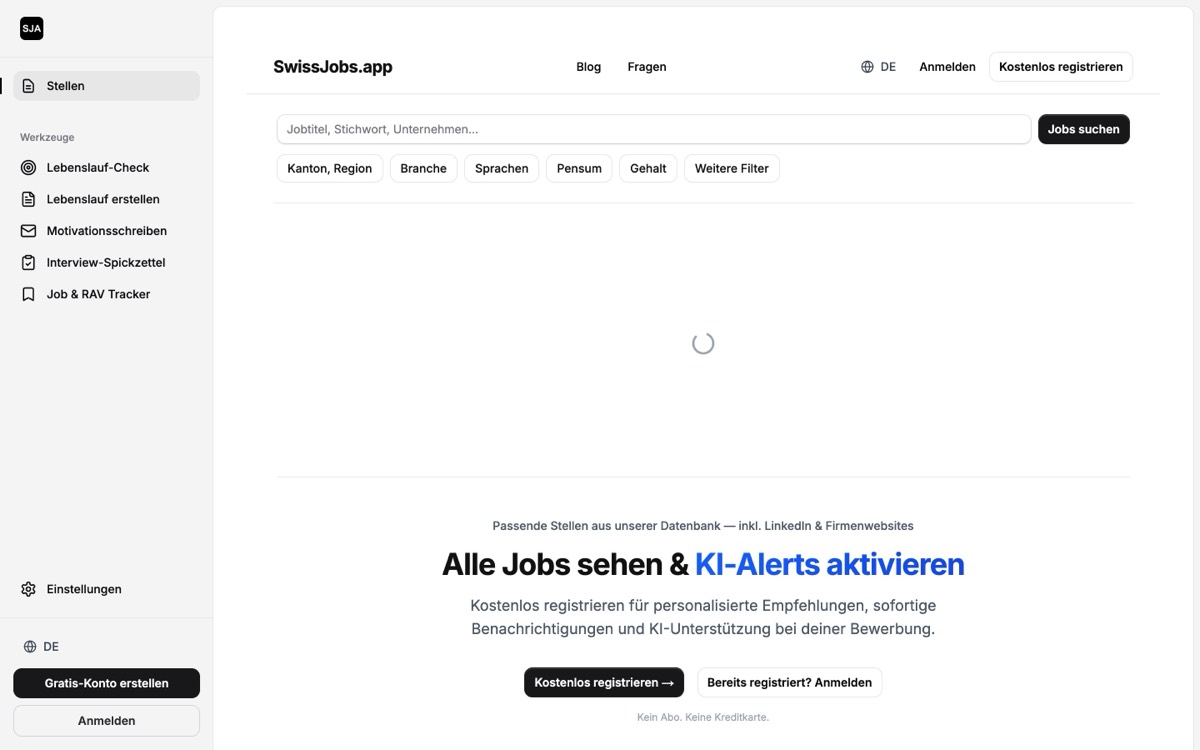
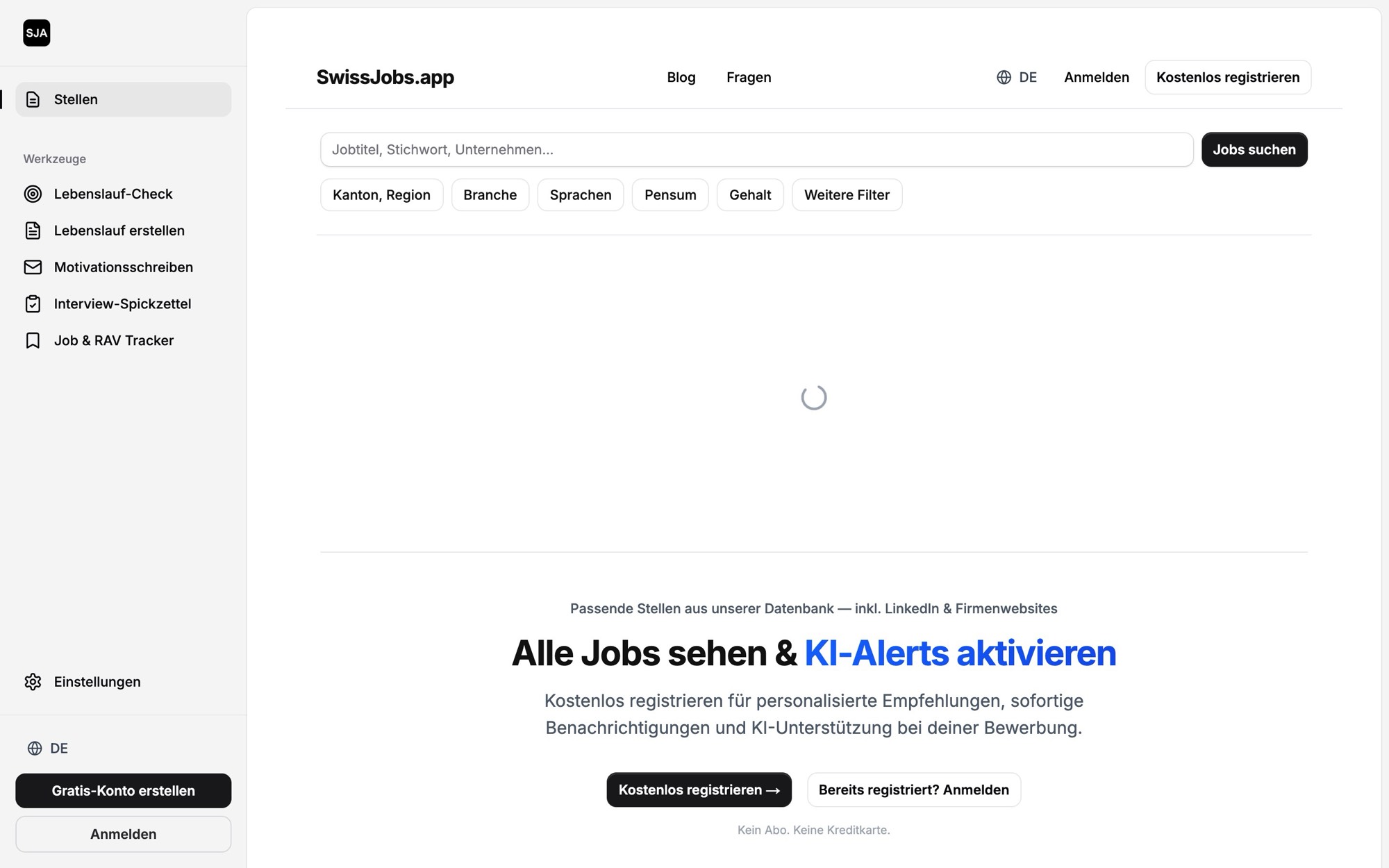
1. SwissJobs.appOur app
Over 21,000 open Swiss roles from ATS systems, company sites and LinkedIn in one place — and from any advert, straight into a CV, a motivation letter, a CV check and interview prep. The RAV job-search-efforts form fills itself from your application tracker. Free to use; the account is asked for at save.
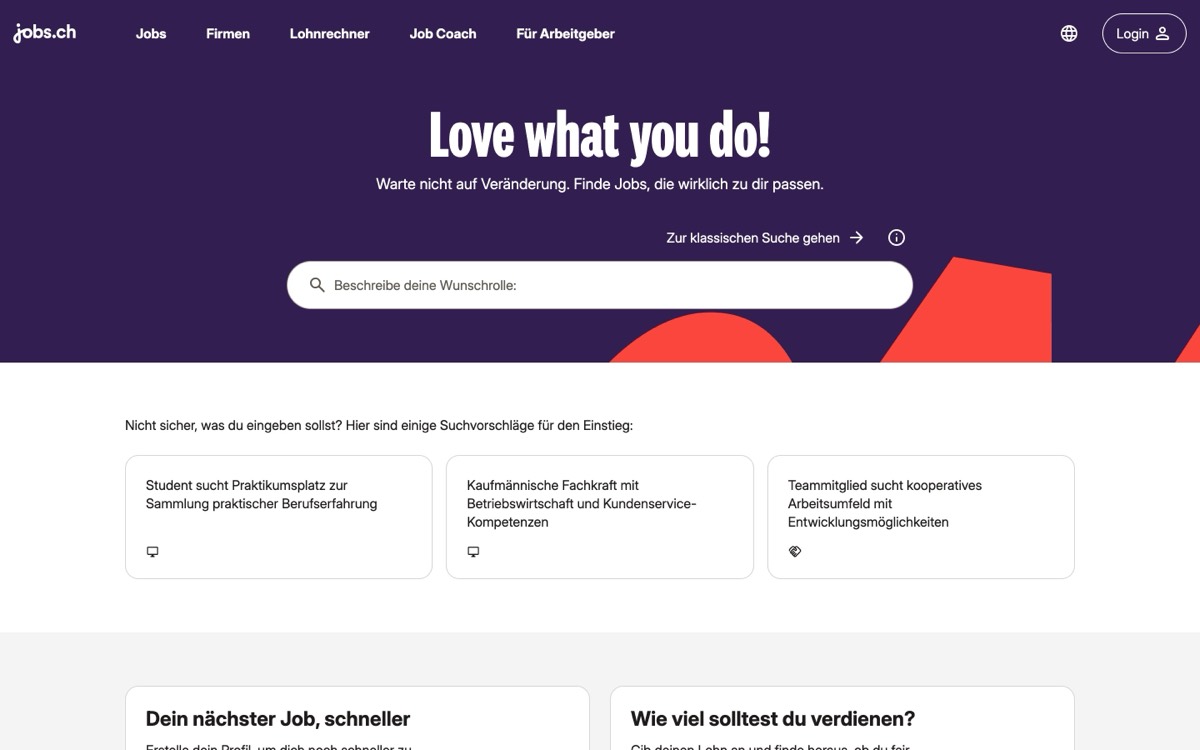
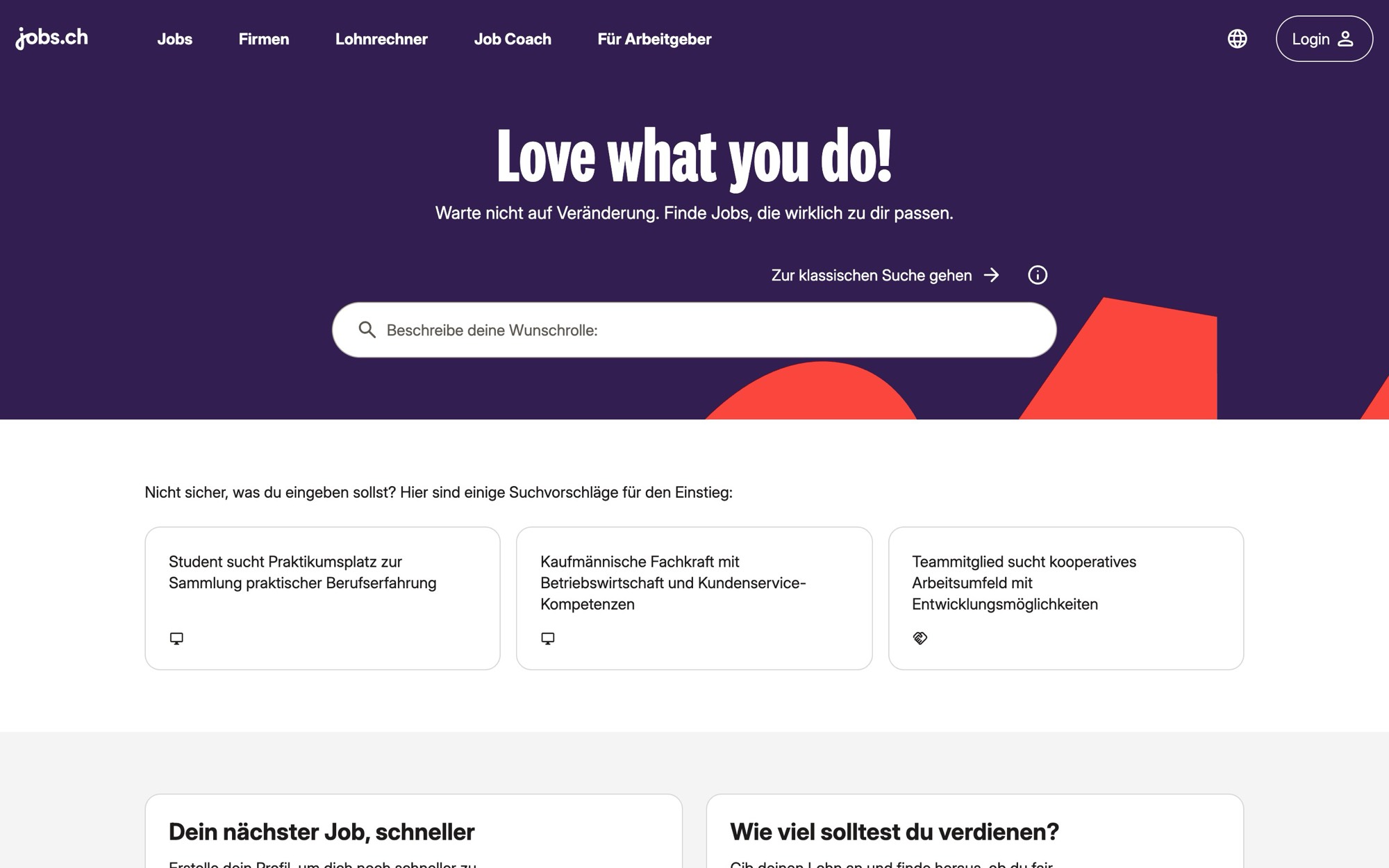
The best-known board in German-speaking Switzerland and the largest index in the country. Owned by JobCloud AG — as are jobup.ch and JobScout24.
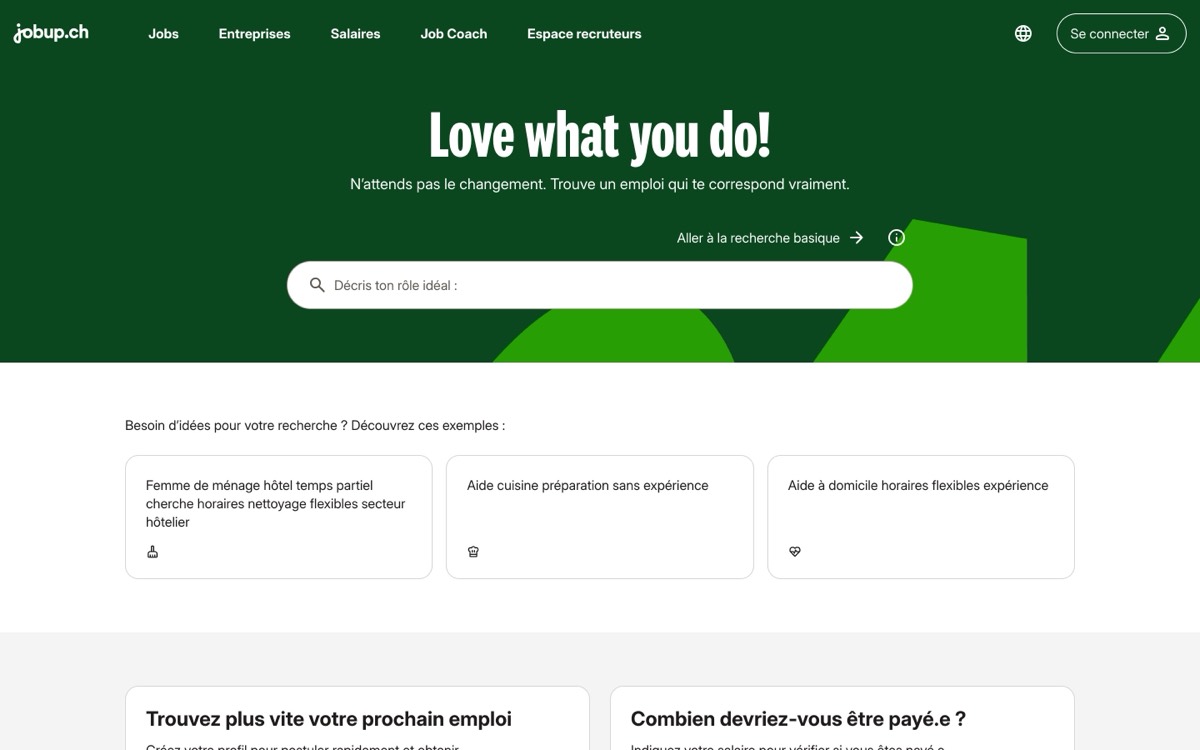
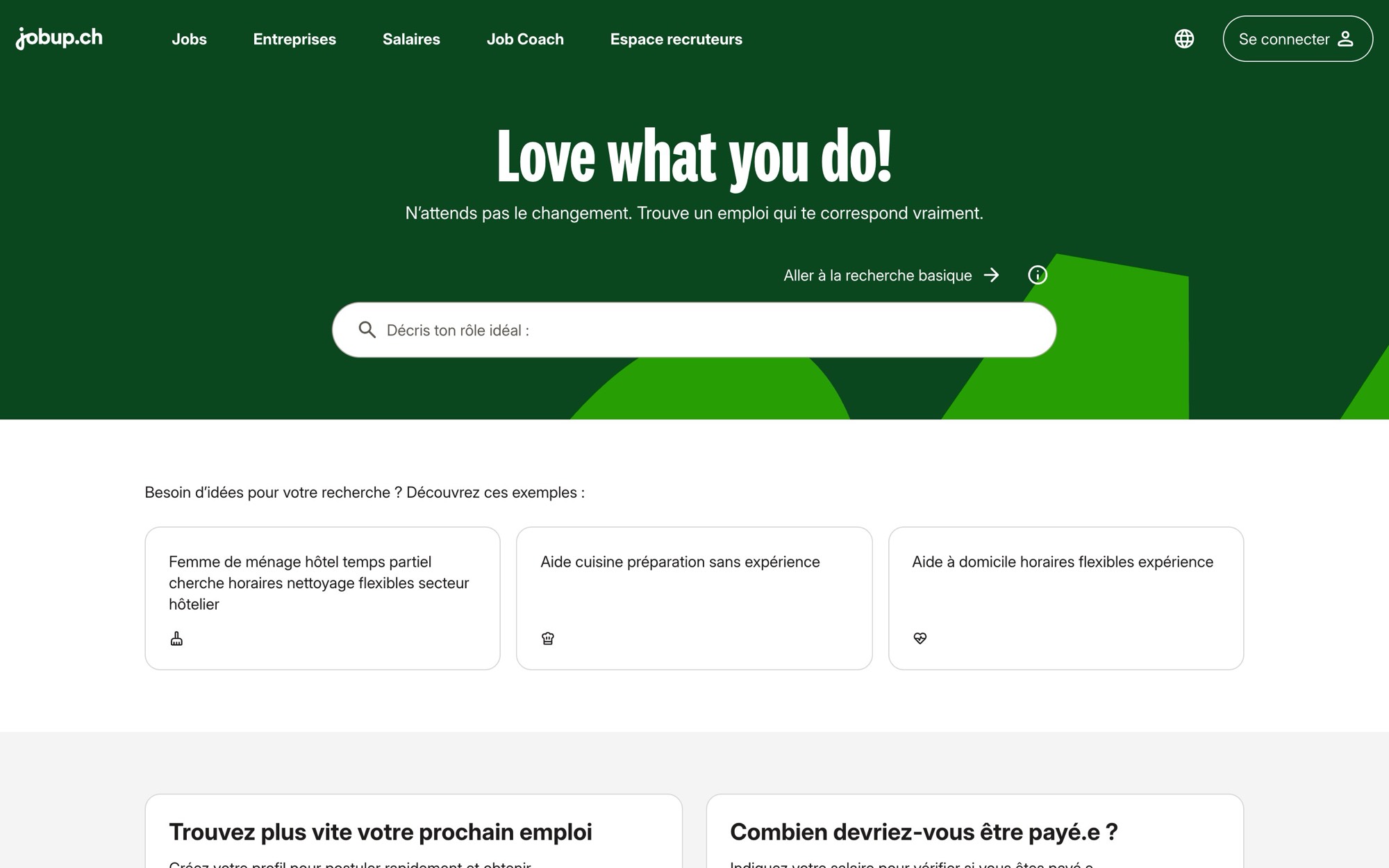
The standard in French-speaking Switzerland and the first place to look for the Romandie — but the same JobCloud AG as jobs.ch.
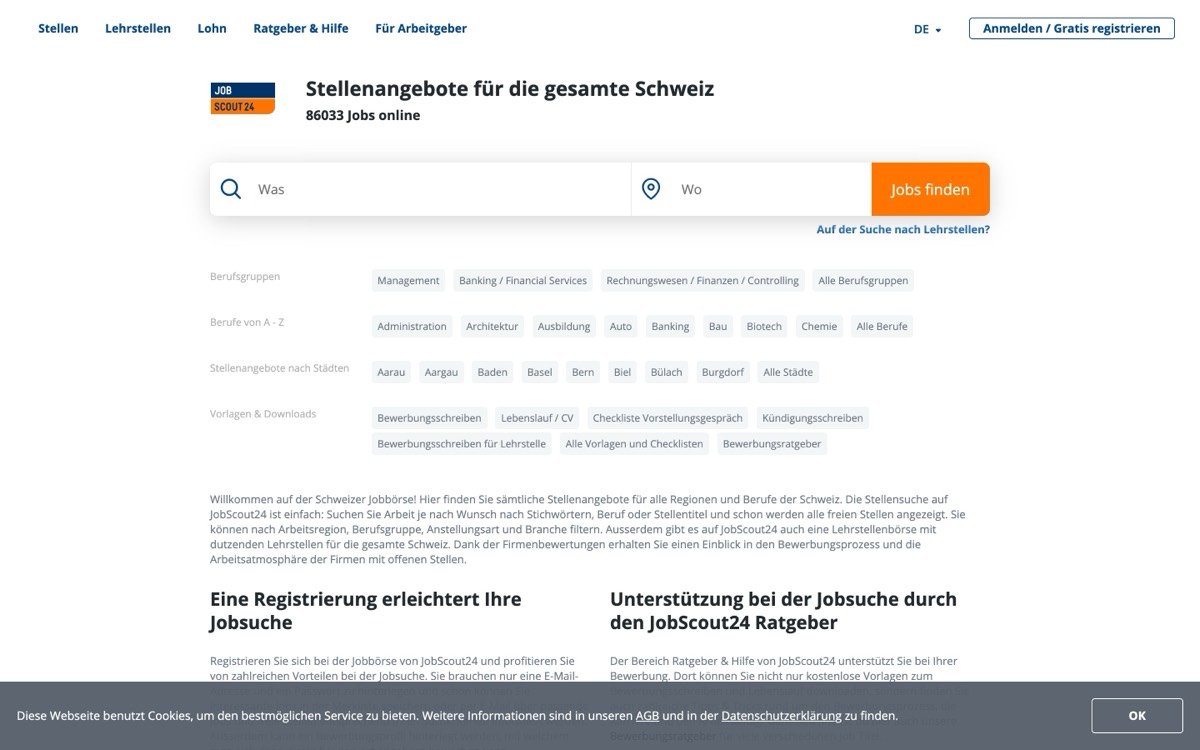
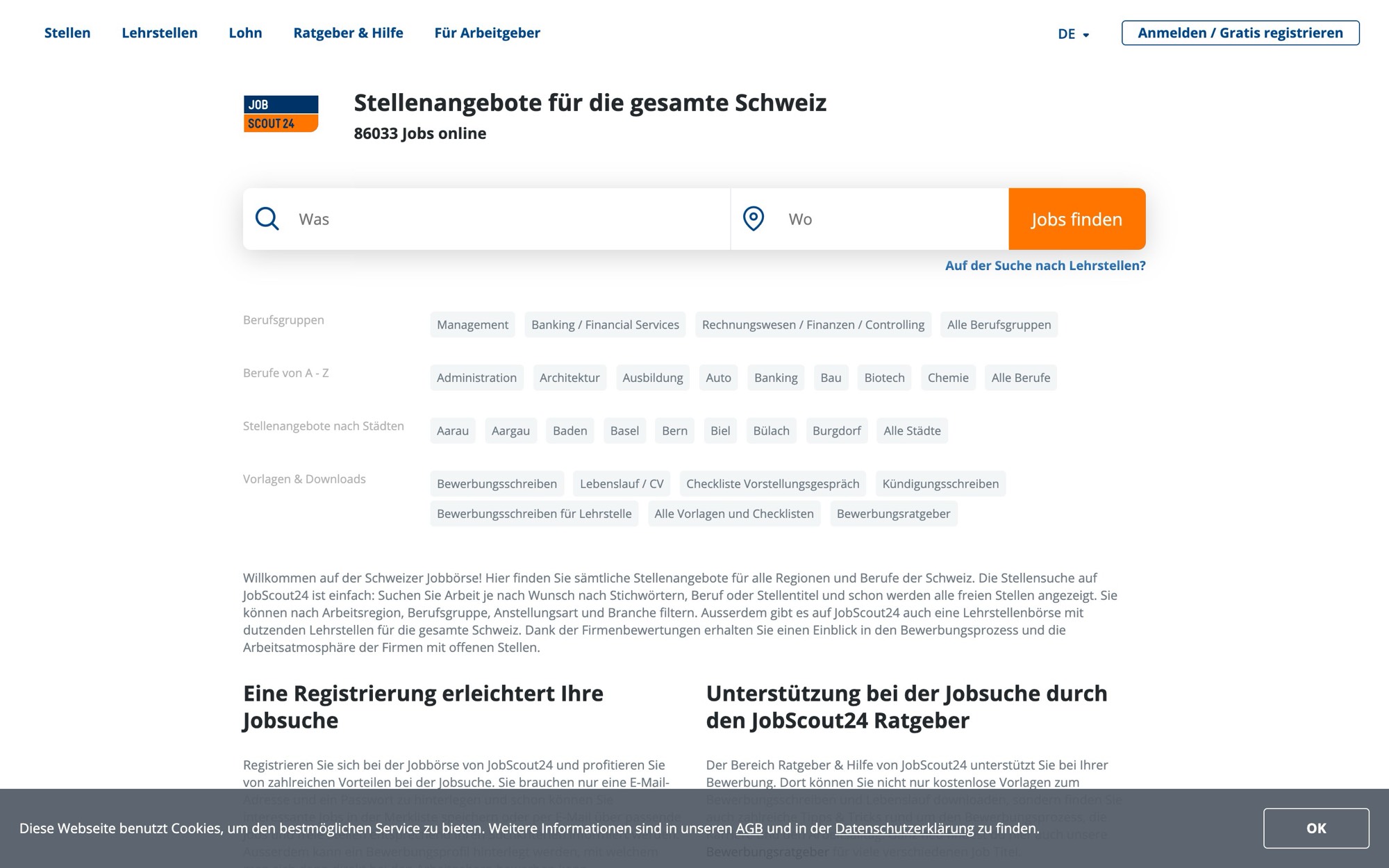
A third brand from the same company. Searching all three to widen your search means searching one provider three times.
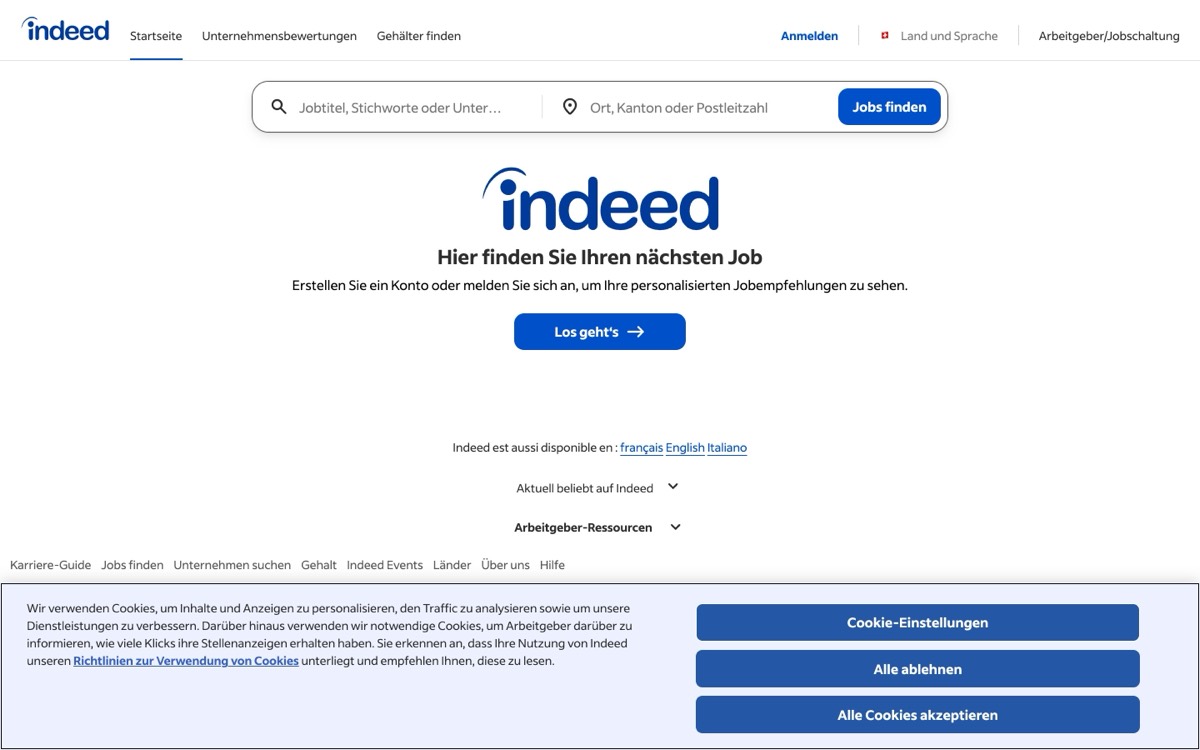
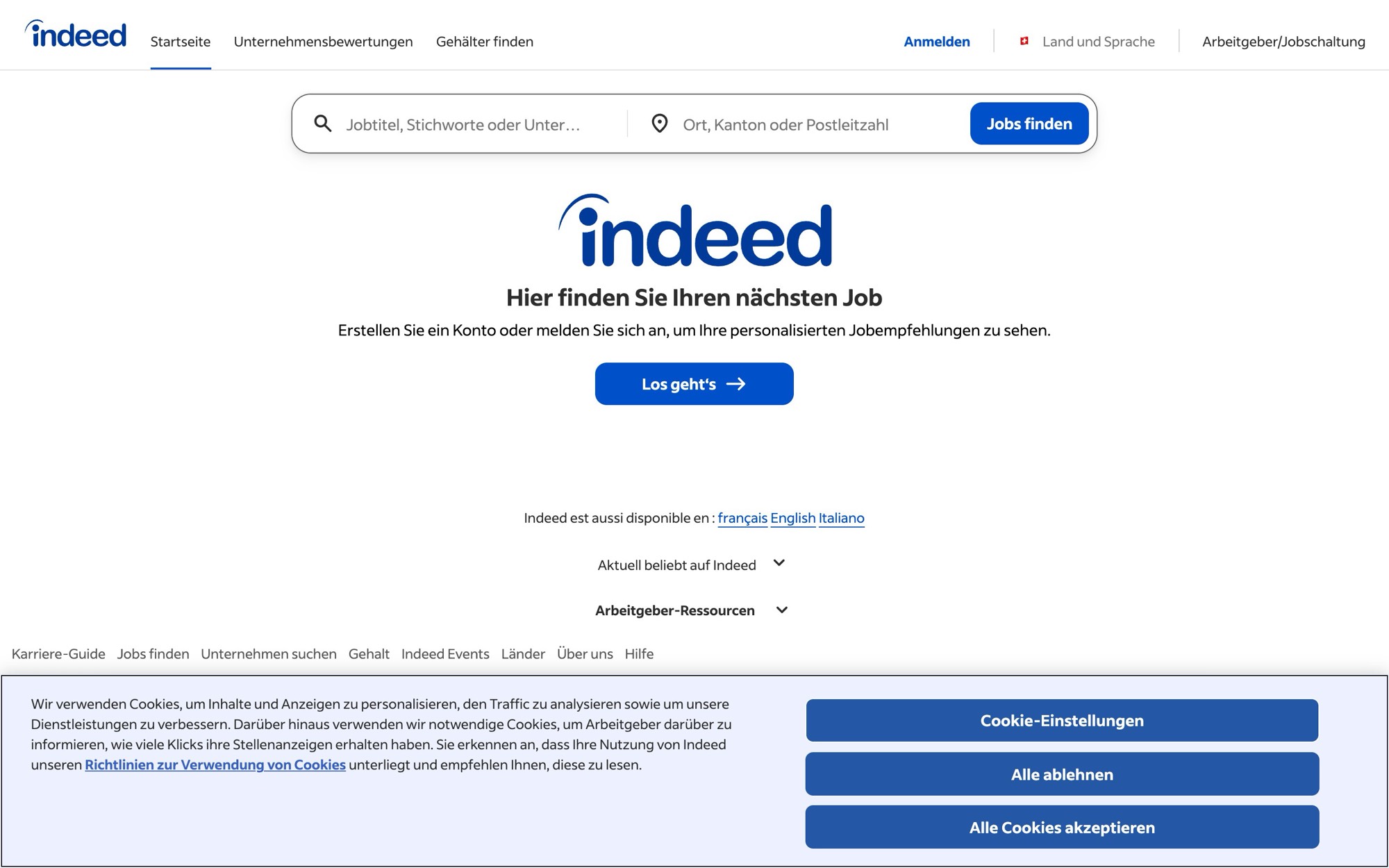
The broadest aggregation, because Indeed also collects from other boards — at the cost of many duplicates of the same advert.
The best reputation for English-speaking and international roles in Switzerland. Considerably thinner for trades, care and commercial roles.
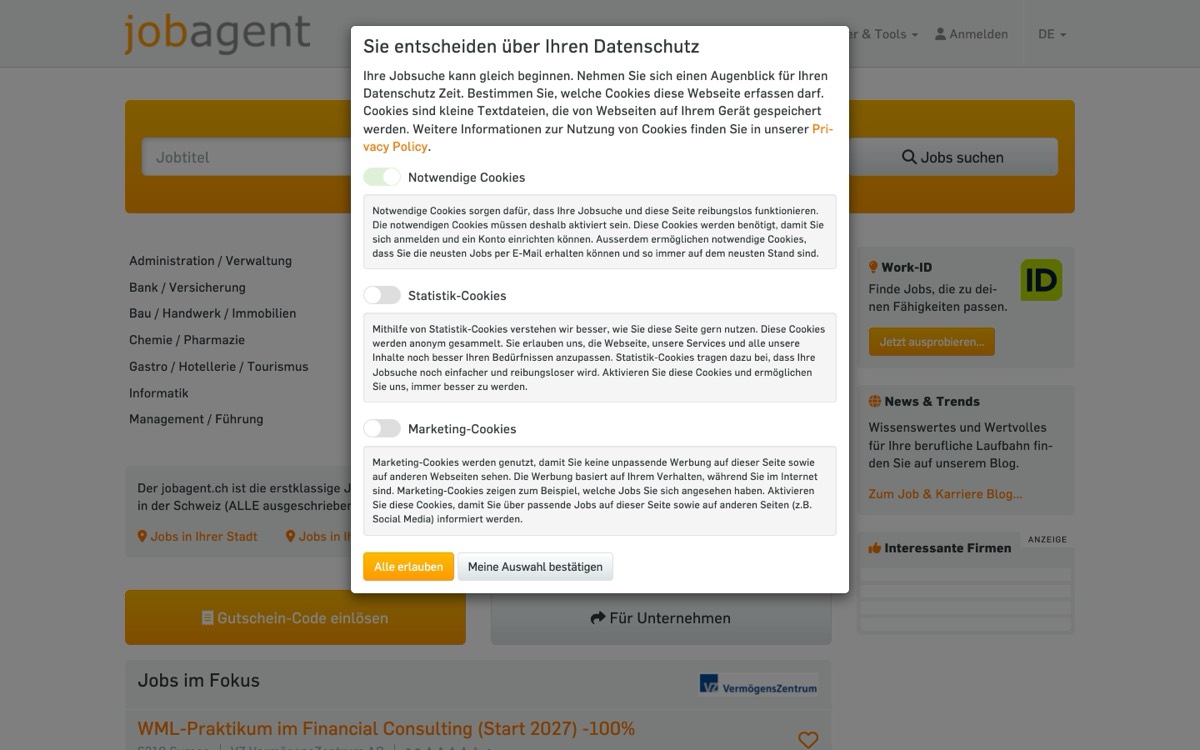
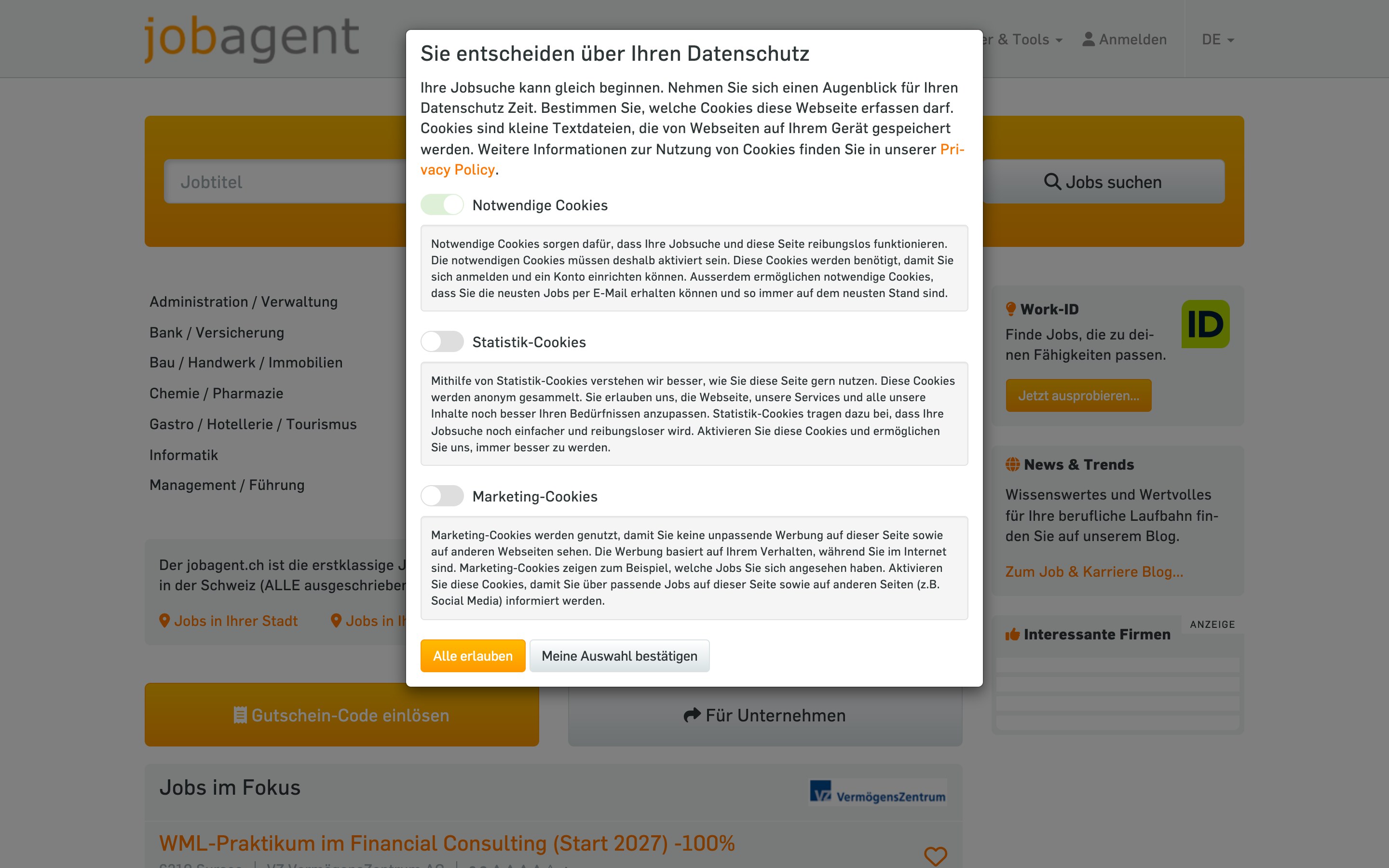
A meta-search across the Swiss job boards, "every job in Switzerland at a glance". Its strength is the Job-Abo: a saved search that mails you new adverts from every portal it covers. Salary calculator and application guides alongside.
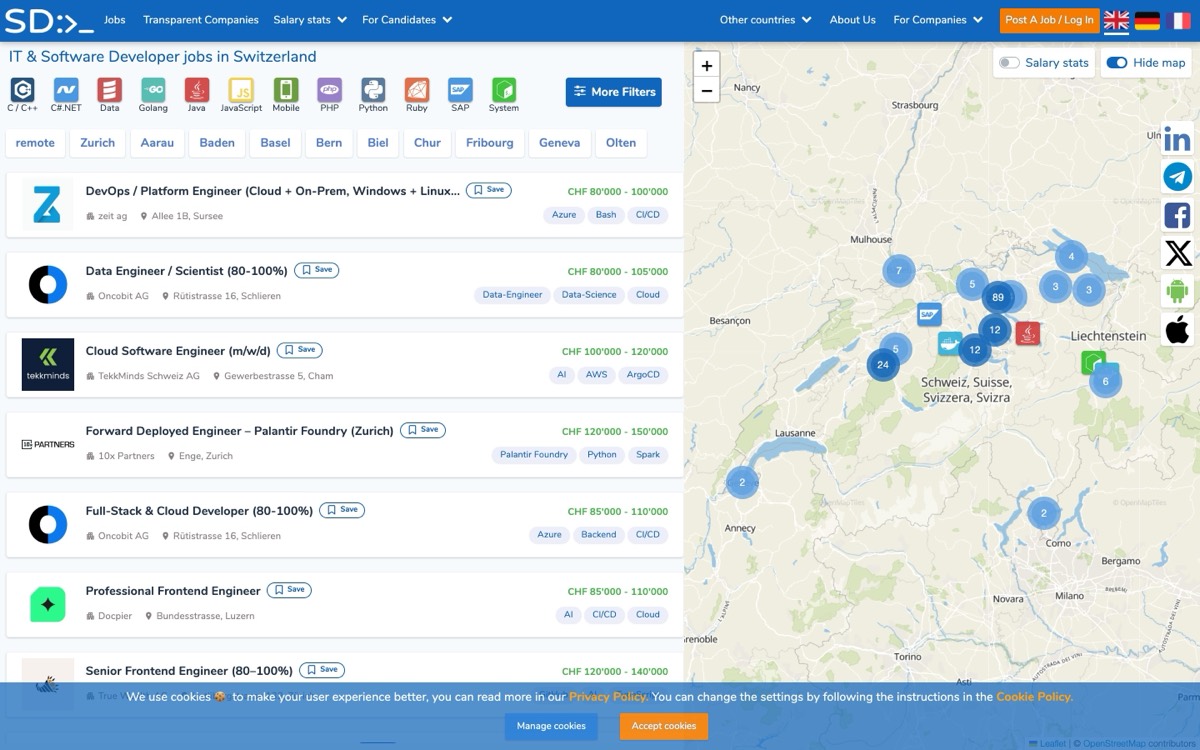
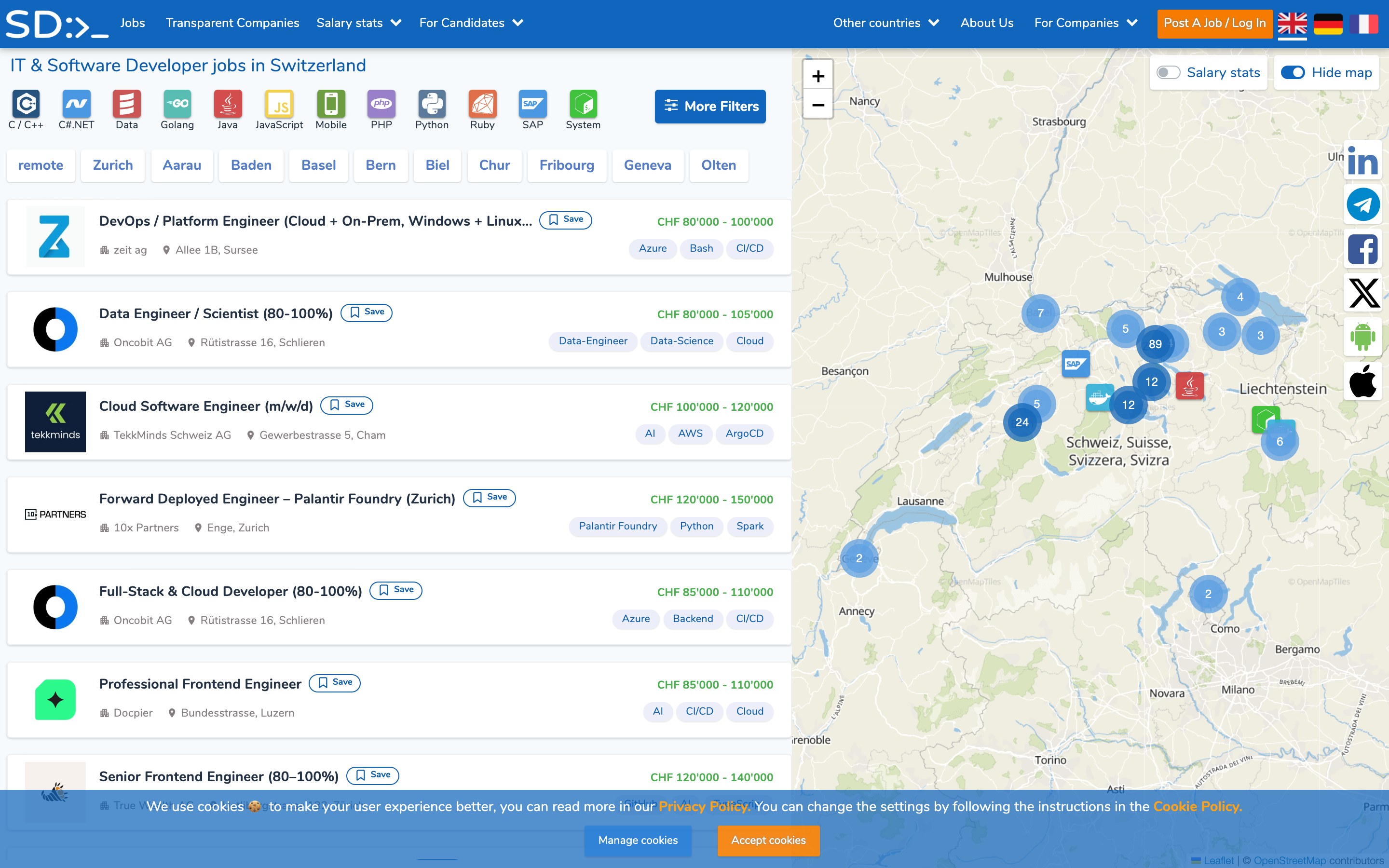
IT and software only, and thorough about it: "183 IT & Software developer jobs in Switzerland", filtered by technology (C#, Java, Python, DevOps, ML) rather than by industry. Publishes salary statistics and lists the companies that disclose their ranges. The site itself is in English.
Jobs by profession, city or language
Type a profession, a city or a language, the page shows the adverts currently open for it.
By profession
- Consultant
- Project Manager
- Retail Sales
- Nurse
- Nursing & Care
- Administrative Assistant
- Account Manager
- Software Engineer
- Public Administration
- Architect
- Insurance
- Chef
71 more — narrow the search
By work type
The naming problem is the second obstacle. The German term for this field, kaufmännisch, appears in only 10% of the titles; with KV, Kauffrau and Kaufmann added it reaches 15.3%. The workhorse word is Sachbearbeiter — literally case handler — at 21.7%, and not one advert carrying it stops there. Every one names a department behind it: Export, Treuhand, Rechnungswesen, Innendienst, Debitoren. The six title words most people try first reach 65.1% of the field; it takes the full fifteen in the chart below to reach 97.5%.
The employers are many rather than few. Strip out the 22% of adverts posted under an agency's name — against 11.6% in the rest of the market — and the largest single employer accounts for 2.9% of the field, the ten largest for 18.3%, and 68% of employers have exactly one advert open. There is no shortlist of career pages to subscribe to here. Coverage comes from the right search words, repeated weekly.
Share of the captured Swiss office and admin adverts whose title carries each word. A title can carry several, so the values do not sum to a hundred. All fifteen together reach 97.5% of the field — they are effectively what the field is — while the six words most people try first reach 65.1%. Running analysis of the open Swiss adverts we capture, August 2026.
- Only 5.8% of office adverts stating a language requirement accept English alone, against 19.9% in the rest of the market. Where English is asked for, a third of the mentions are at conversational level only, against 10.6% elsewhere.
- 45.4% of these adverts ask for two or more languages and 16.1% for three or more, against 26.7% and 6.3% in the rest of the market. The most valuable pairing is German with French, named in 11.4% of them.
- The word kaufmännisch appears in 10% of the field's titles. Sachbearbeiter reaches 21.7%, Administration 17.6% and accounting words 15.8%. The six words most people try first reach 65.1% together; the full fifteen reach 97.5%.
- 22% of the field is posted under an agency or staffing name rather than the employer's, against 11.6% elsewhere; one intermediary alone accounts for 15% of all office adverts we capture.
- Among adverts posted by employers directly, 68% of those employers have exactly one office role open. Public bodies account for 13.6% of that group, hospitals and clinics 8.3%, insurers 5.9%, banks 2.6%.
- The field turns over faster than the market: median advert age 17 days against 19, and only 20.2% older than two months against 27.2%. A weekly repeat of the same search beats a monthly one.
English is an addition here, almost never a substitute
If you arrived in Switzerland with English and are looking for office work, this is the number that should shape your plan: among the office and admin adverts that state a language requirement at all, 5.8% accept English on its own. Across the rest of the market that figure is 19.9%. German is named in 86.5% of these requirements against 67.2% elsewhere, French in 32.8% against 19.6%, English in 35.2% against 41.8% and Italian in 6.3% against 3.8%.
The level asked for tells you the same thing from another angle. Where German is required, 89.4% of the mentions are at professional or native level. Where English is required, only 63.8% are — and 34.7% ask for conversational English only, against 10.6% in the rest of the market. English in a Swiss back office is the language you use for a supplier in Rotterdam, not the language the job runs in. Italian tips further still: 47.9% of its mentions are conversational and 33.3% professional.
This is not a formality that a good CV can talk its way past. Office work in Switzerland is correspondence — with customers, suppliers, insurers, cantonal offices, the pension fund. That correspondence is in German, French or Italian, it is written rather than spoken, and it is read by people who will notice. A B1 that carries a conversation will not carry a claims letter. If your German or French is not yet at working level, the honest sequence is language first, applications second, and in the meantime the English-friendly openings are in IT, research, pharma and internationally run corporate functions rather than here.
There is one genuine exception worth knowing. Of the office adverts whose drafting language we detect, 11.8% are written in English, and those behave differently: 43.3% of them still ask for German, but 51.1% ask for two or more languages, which means roughly half do not. They cluster in internationally staffed employers — group finance, shared service centres, order management for export businesses. Searching in English will surface exactly this subset. It is a real segment; it is just a tenth of the field, not the field.
The title is a compound — search the second half
Swiss office adverts are named after the department, not the profession. The German umbrella term for the field, kaufmännisch, appears in 10% of the titles; adding KV, Kauffrau and Kaufmann brings it to 15.3%. Typing the name of the field therefore misses roughly six adverts in seven.
What the titles actually carry is a function word plus a department. Sachbearbeiter — the closest English equivalent is case handler or clerk — leads at 21.7%, and of every advert carrying it, not one stops at the bare word. Behind it stands Verkaufsinnendienst, Export, Immobilienbewirtschaftung, Treuhand, Rechnungswesen, Auftragsabwicklung, Seefracht, BVG, Quellensteuer. The department is the half that searches, and it recurs in adverts whose first half is something else entirely: Mitarbeiterin Innendienst, Fachspezialist Lohnbuchhaltung, Teamleiter Rechnungswesen.
It helps to know what the departments mean, because several have no tidy English equivalent. Innendienst is internal or inside sales — quoting, order entry, customer follow-up from a desk. Treuhand is the Swiss fiduciary trade: bookkeeping, payroll and tax filing done for client companies, and one of the largest employers of office staff in the country. Auftragsabwicklung is order processing. Debitoren and Kreditoren are accounts receivable and payable. BVG is occupational pension administration, Quellensteuer is withholding tax for foreign employees, and Vorsorge covers pension and insurance products.
Practically: build your search from the department you have worked in, in the local language, and add the function word second. If you have done accounts payable, search Kreditoren and Buchhaltung. If you have done export documentation, search Export, Zoll and Spedition. If you have worked in insurance claims, search Schadenbearbeitung, Leistungen and Vorsorge. And if you are starting out with no department yet, work down the fifteen words in the chart — the six most obvious ones alone cover 65.1% of what is there, the full fifteen 97.5%.
No shortlist of employers to watch
At first glance the field looks concentrated: the ten largest posters carry 30.3% of all office adverts. That is an artefact of one poster. A single intermediary — a recruitment platform, not an employer — carries 15% of the field on its own, and 22% of the adverts overall are posted under the name of an agency, a recruitment consultancy or a temporary-staffing firm, against 11.6% in the rest of the market.
Remove those and look only at adverts posted by the employer itself, and the picture inverts. The largest single employer then carries 2.9%, the ten largest 18.3% and the twenty-five largest 27.9% — and 68% of the employers in this field have exactly one office role open. The median employer here has one advert. This is the flattest distribution we measure in a large occupational field, and it is the exact opposite of nursing, where two dozen institutions carry two thirds of the supply.
Where repeat posting does occur, it comes from four corners. Of the adverts posted directly by employers, 13.6% come from a canton, a city or a federal office — the public sector is the largest identifiable block in this field. 8.3% come from hospitals, clinics and care homes, where patient administration, medical secretarial work and billing are office jobs. 5.9% come from insurers, 2.6% from banks and 1.6% from fiduciary and property-management firms. Names in our index include the Canton of Fribourg, Luzerner Kantonsspital, Die Mobiliar, Helvetia, Spitalzentrum Biel, Wincasa, the AMAG Group, Aargauische Kantonalbank, the Canton of Bern and Insel Gruppe.
So the career-page strategy that works well in healthcare barely works here. To reach the same coverage you would have to follow hundreds of employers. What works instead is a small number of broad keyword searches, saved and repeated, plus two or three exceptions for the standing recruiters in your region — typically the cantonal administration, the cantonal hospital and the insurers. And on every advert carrying an agency name, ask which company the role is actually at before you apply: that is more than a fifth of the list.
One advert in eight is an apprenticeship
11.7% of the adverts in this field are not jobs at all but training places — Lehrstelle, Lernende, apprentissage. In the rest of the market the figure is 3.3%. That is the largest training share we measure in any occupational field, and it reflects a real feature of the Swiss system: the commercial apprenticeship is the country's broadest entry route into office work, and it is the most common qualification track at upper-secondary level.
The titles are unusually explicit about it. 78.1% of these training adverts name the EFZ, the federal certificate of competence; 5.5% name its French equivalent, the CFC; 0.8% name the shorter EBA. 44.5% name 2027 as the start date, 2.3% name 2026, and 53.1% leave the year out. An apprenticeship advert in this field routinely sits in the same result list as jobs starting next week, more than a year before it begins.
The sector usually sits in the title too: 15.6% of these training adverts name an insurer or an insurance general agency, 10.2% the services-and-administration specialism, 7% fiduciary or property, 6.3% a bank. If you are looking for a job and not a training place, filter this eighth of the list out deliberately, or your results fill with 2027 start dates. If you are looking for a training place, search the word plus the sector rather than the word alone.
There is a less obvious use for this block if you are a career changer or returning to work. An employer that runs commercial apprenticeships has a vocational training team, a structured induction and processes designed around teaching someone the work. Those are the same employers most likely to look seriously at an adult applicant without a matching Swiss qualification — even when the role you apply for is not the apprenticeship.
Geographically the flattest field in the country
Office work is spread more evenly across Switzerland than the market as a whole. Among adverts with a canton recorded, Zurich carries 17.9% of this field against 24.3% of the rest of the market. Bern carries 11.8% against 8.8%, Fribourg 9.7% against 5.2%, Lucerne 9% against 6.8%, Aargau 8.2% against 5.7%, St Gallen 4.6% against 3.5%, Zug 4.4% against 3.1% and Thurgau 3.1% against 1.9%. Geneva (6.4% against 9%), Vaud (5.1% against 8.8%) and Basel-Stadt (4.4% against 6.9%) are under-represented.
One caveat, larger than for the other figures here: a canton is cleanly recorded on 35.6% of the office adverts and 41.9% of the rest, so the ranking holds but the decimals are softer than they look. The direction matches what the field is, though. Every administration, hospital, contractor and garage in every district needs accounts, reception and order processing. This work follows the population, not the corporate headquarters.
That has a concrete consequence for an international job seeker. In fields that cluster in Zurich, Geneva and Zug, a long commute is often the price of the opportunity. Here it is not. If you have settled in a smaller canton because the rent is affordable, the office market around you is denser than it feels — but it only becomes visible once you search with department words in the local language instead of the name of the profession in English.
The bilingual belt from Biel through Fribourg to the Lower Valais deserves a special mention, because it is where the field's most valuable language combination pays. Of the office adverts written in French, 58.7% also require German and 67.9% require at least two languages. If you have both, extend your search deliberately across the language boundary rather than staying inside your own — the pairing is scarce enough that it is worth more than an extra year of experience in many of these roles.
Fresher than the market — so change your rhythm, not your CV
These adverts stay online for less time than the market average. The median office advert is 17 days old against 19, and the gap widens at the top: the upper quartile sits at 45 days against 65. Only 20.2% are older than two months against 27.2%, and 12.5% older than three against 16.2%. Roles get filled and the list renews itself.
That inverts the tactic that works in healthcare, where an old advert usually means a post nobody has been able to fill. Here an office advert that has been up for three months is more likely to be a forgotten page than an opportunity, and an application in week one is worth more than a polished application in week four. So repeat the search weekly rather than monthly, and do sort by date — in a field with this renewal rate, unlike in slower ones, the top of a date-sorted list is genuinely where the live roles are.
The workload percentage sits in the title unusually often: 32.5% of these adverts name a percentage, against 21.5% in the rest of the market. The most common form is the range 80–100%, in 11.2% of the field, then a flat 100% in 8.9%, 80% in 2.7% and 60% in 2.3%. A single figure below 100% — a genuine part-time offer — appears in 10.3% of titles against 5.1% elsewhere. If you want part-time, your odds here are better than average, but you have to read the number in the title rather than trust a filter.
In order, then. First, search the department you have worked in, in German, French or Italian, not the English name of the profession. Second, treat your language combination as a search criterion in its own right, especially if it includes German and French. Third, decide consciously whether apprenticeship adverts belong in your results. Fourth, save the search and repeat it weekly, because this field renews faster than most. Fifth, for every advert carrying an agency name, establish which employer the role is with before you apply.
Shares from our running analysis of the open Swiss job adverts we capture, August 2026. An advert counts as office or admin here when its title names a clerical, administrative, secretarial, accounting, reception or customer-service function; clinical, technical, IT-administration, retail and hospitality roles with similar wording are excluded. Concentration measures are computed on equal-sized subsamples so that sample size does not distort the comparison, and the employer figures are additionally computed with intermediaries removed, as labelled. Language requirements are counted only for adverts that state one. Cantonal shares cover the 35.6% of the field with a canton recorded. We publish shares, never absolute stock figures. Because the field is delimited by title vocabulary, the fifteen words cover it highly by construction; what is informative is the gap between the six most obvious words and the full fifteen.
Sources
Related questions
What our job index says about the Swiss market
Computed live from our own index, not quoted from a study. Shares only, as of today.
Language the advert is written in
- Deutsch
- 60%
- English
- 23%
- Français
- 13%
- Italiano
- 3%
Of adverts that state a language requirement, the share asking for
- Deutsch
- 70%
- English
- 43%
- Français
- 21%
- Italiano
- 3%
19% posted in the last 7 days · Largest markets: Zürich 18% · Bern 10% · Genève 5% · Basel 5%