Job board vs applying directly — which gets you hired faster in Switzerland?
Updated:
In short
Neither is faster in itself — with one exception written into Swiss law. In occupations where national unemployment is at least five per cent, a vacancy must first sit for five working days in the protected area of Job-Room, the public employment service portal, before it may be advertised anywhere else. Jobseekers registered with an RAV therefore see it first. In 2026 that covers 10.8 per cent of the working population. Everywhere else, what decides speed is not the channel but how old the advert already is when you find it: the median open advert in our index is 21 days old.
The Swiss job portals at a glance
Click an image for the full-size view. What each portal actually is stands beside it.
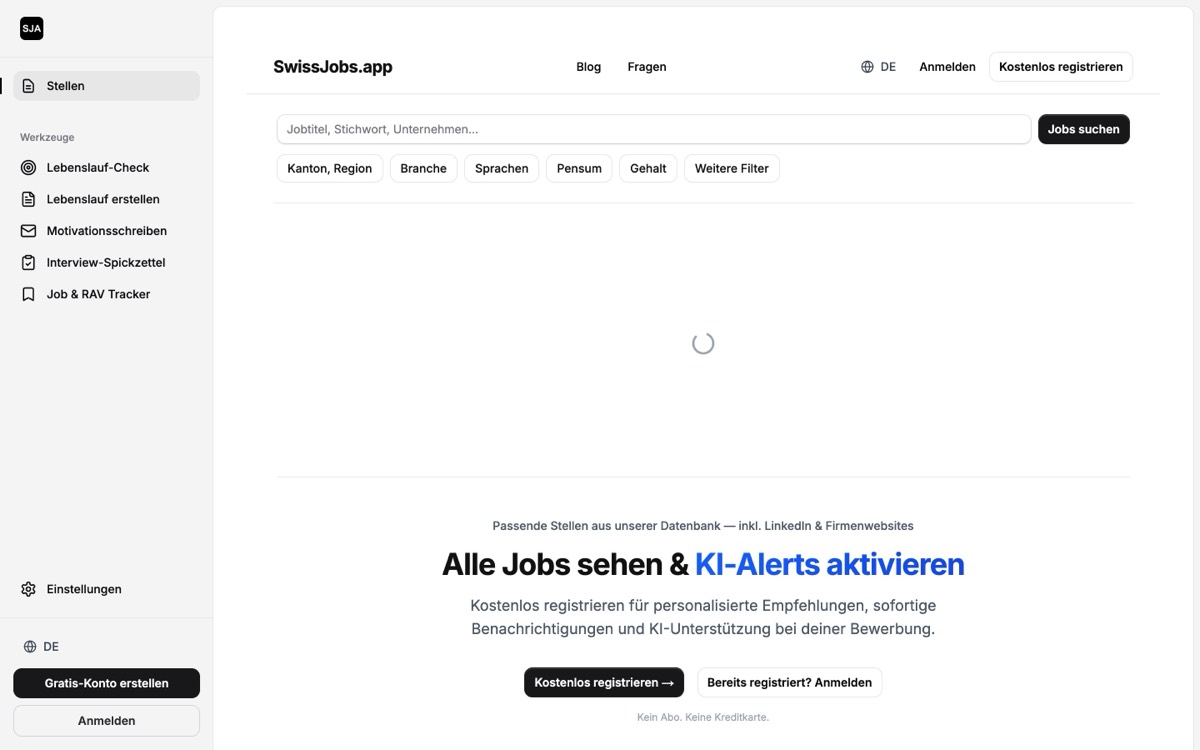
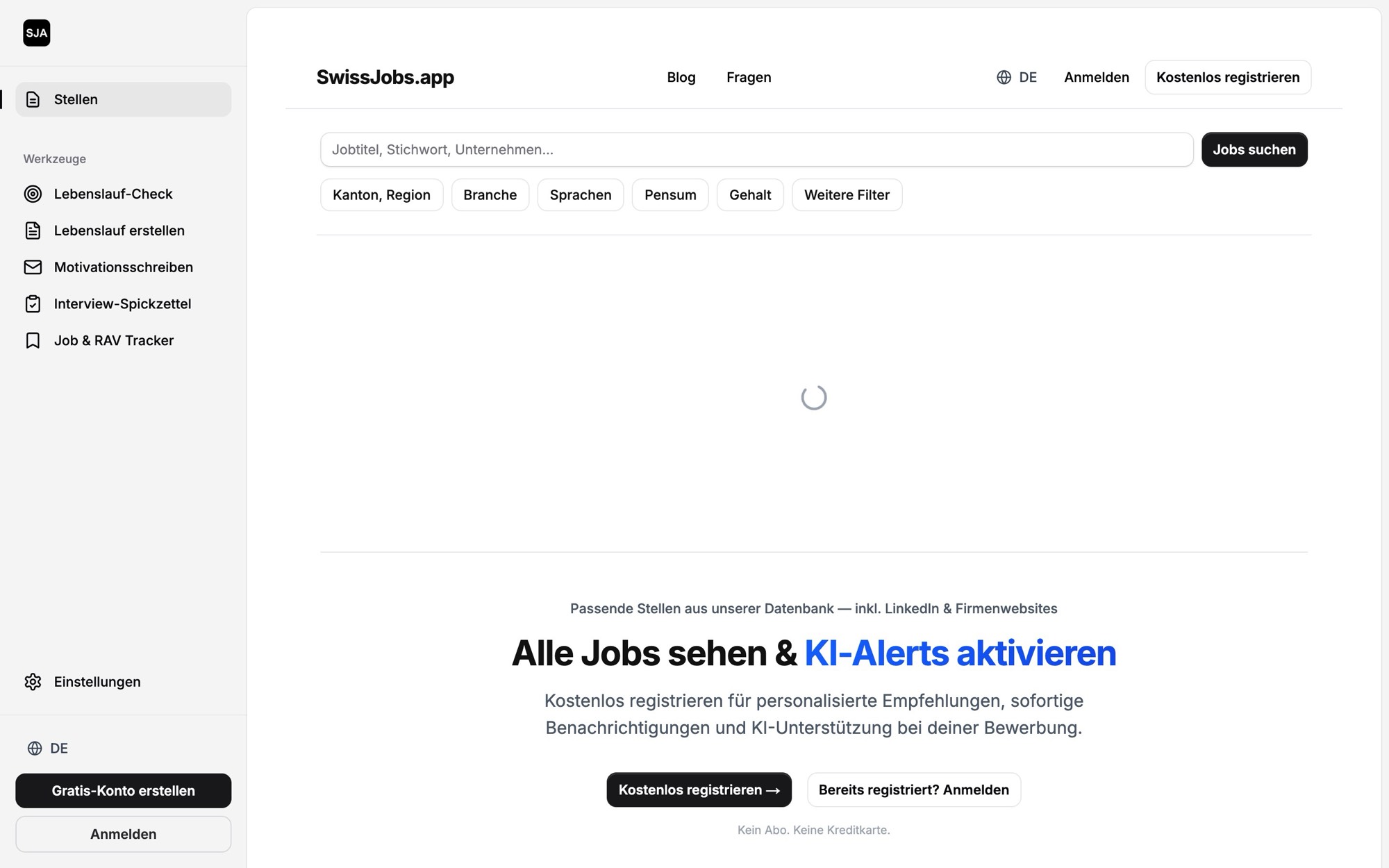
1. SwissJobs.appOur app
Over 21,000 open Swiss roles from ATS systems, company sites and LinkedIn in one place — and from any advert, straight into a CV, a motivation letter, a CV check and interview prep. The RAV job-search-efforts form fills itself from your application tracker. Free to use; the account is asked for at save.
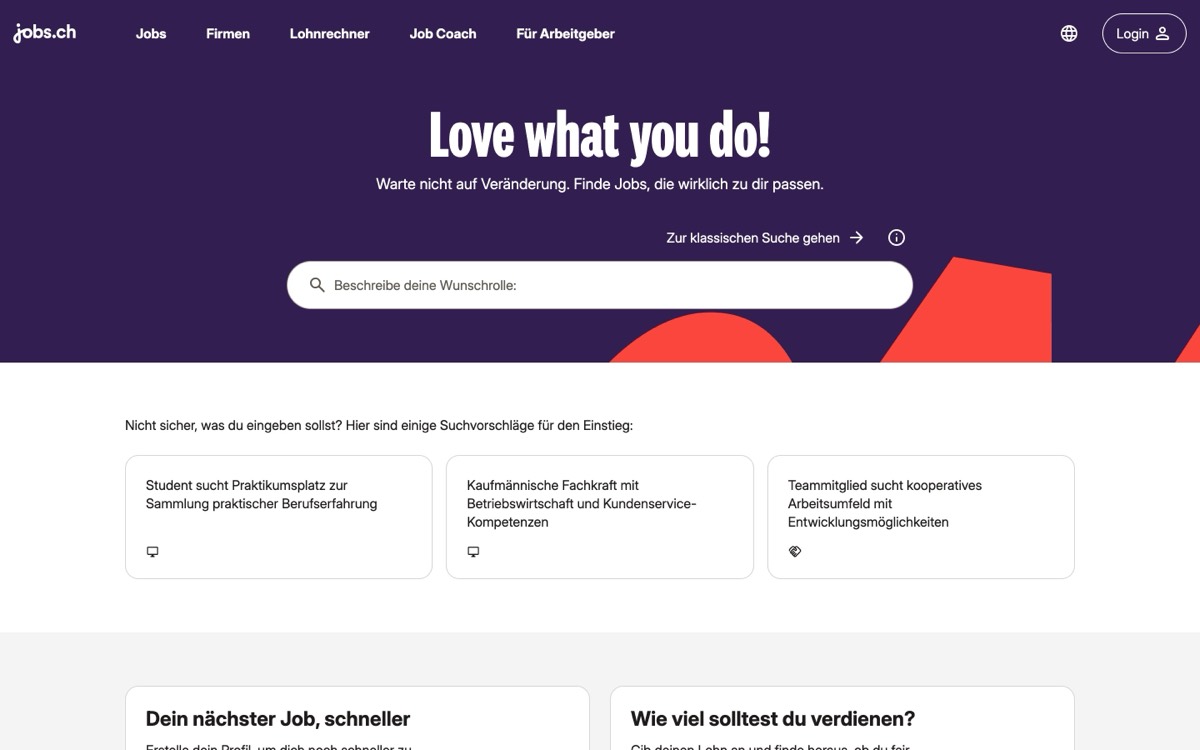
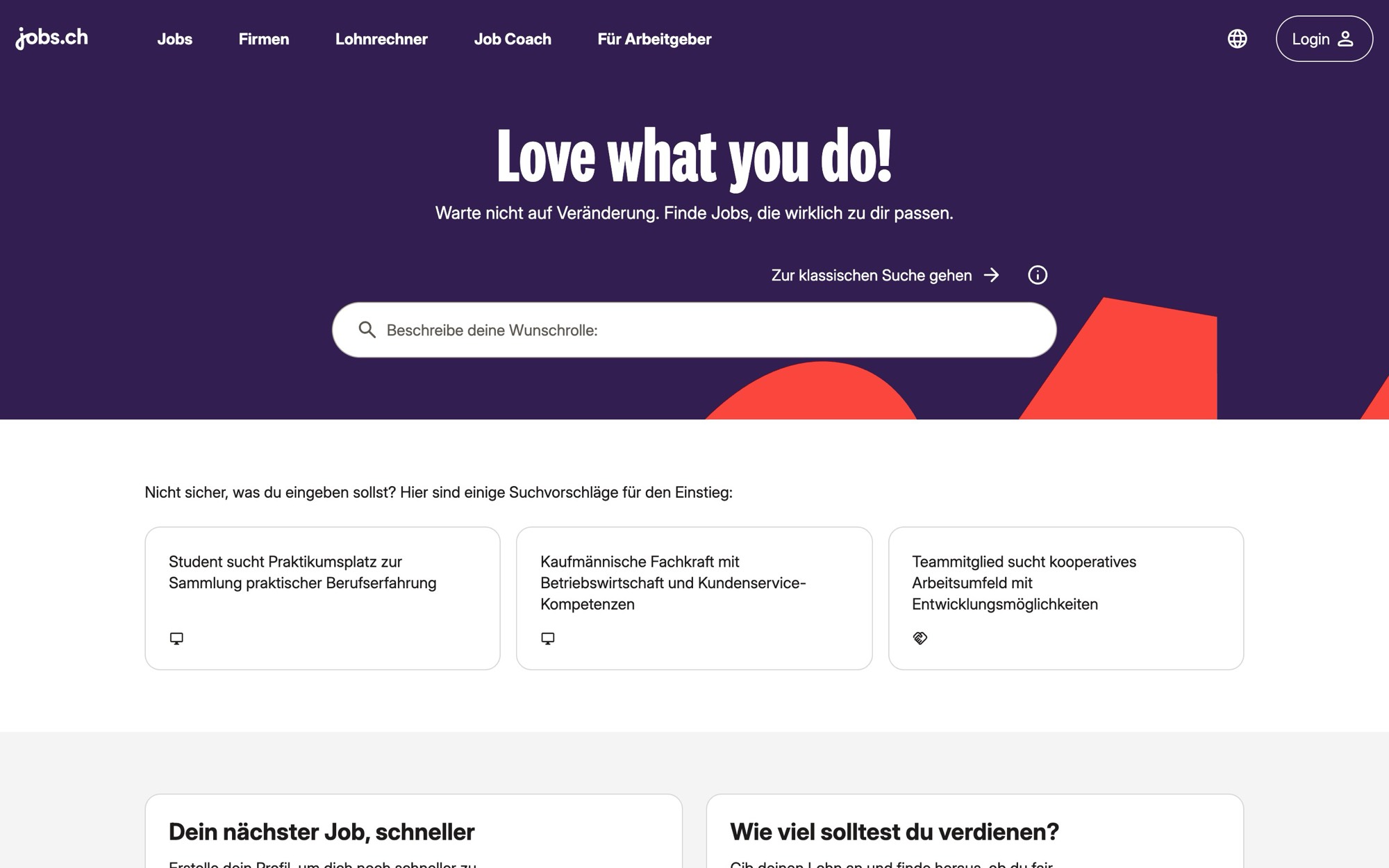
The best-known board in German-speaking Switzerland and the largest index in the country. Owned by JobCloud AG — as are jobup.ch and JobScout24.
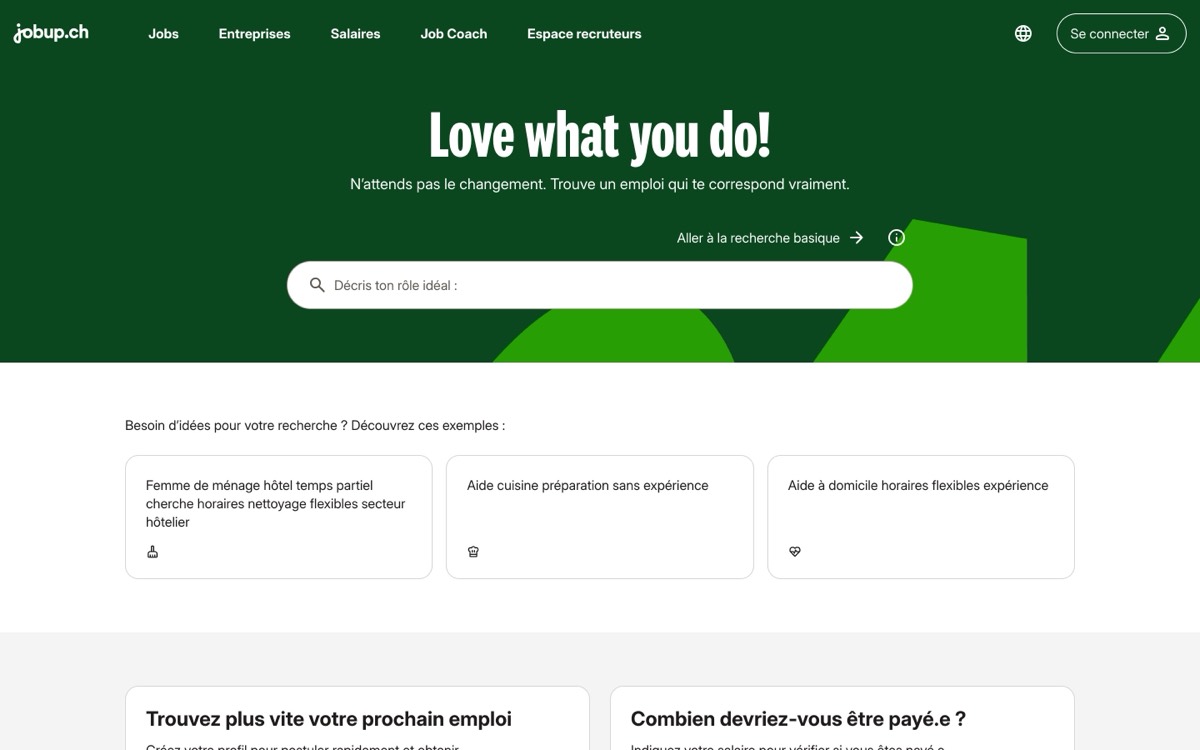
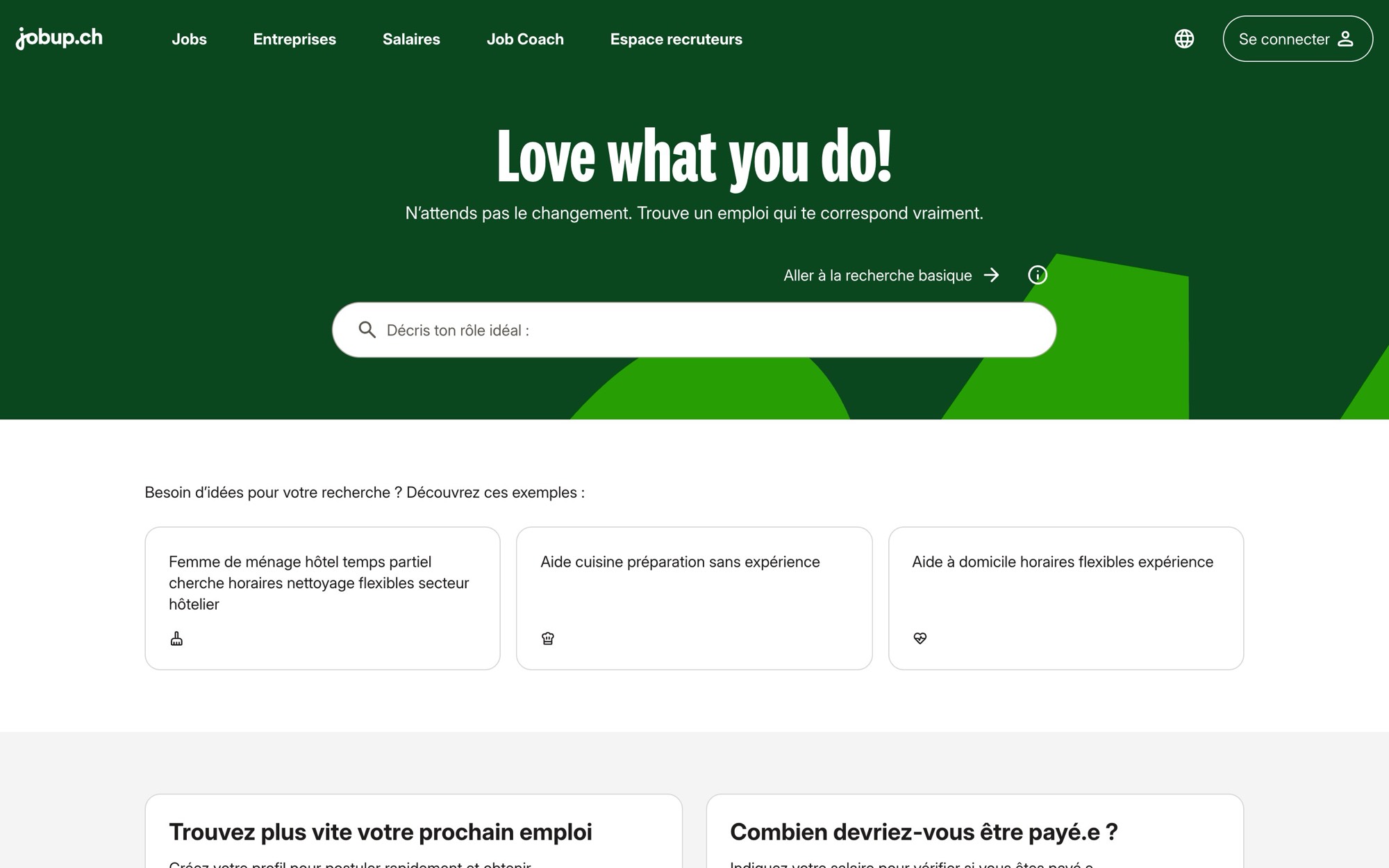
The standard in French-speaking Switzerland and the first place to look for the Romandie — but the same JobCloud AG as jobs.ch.
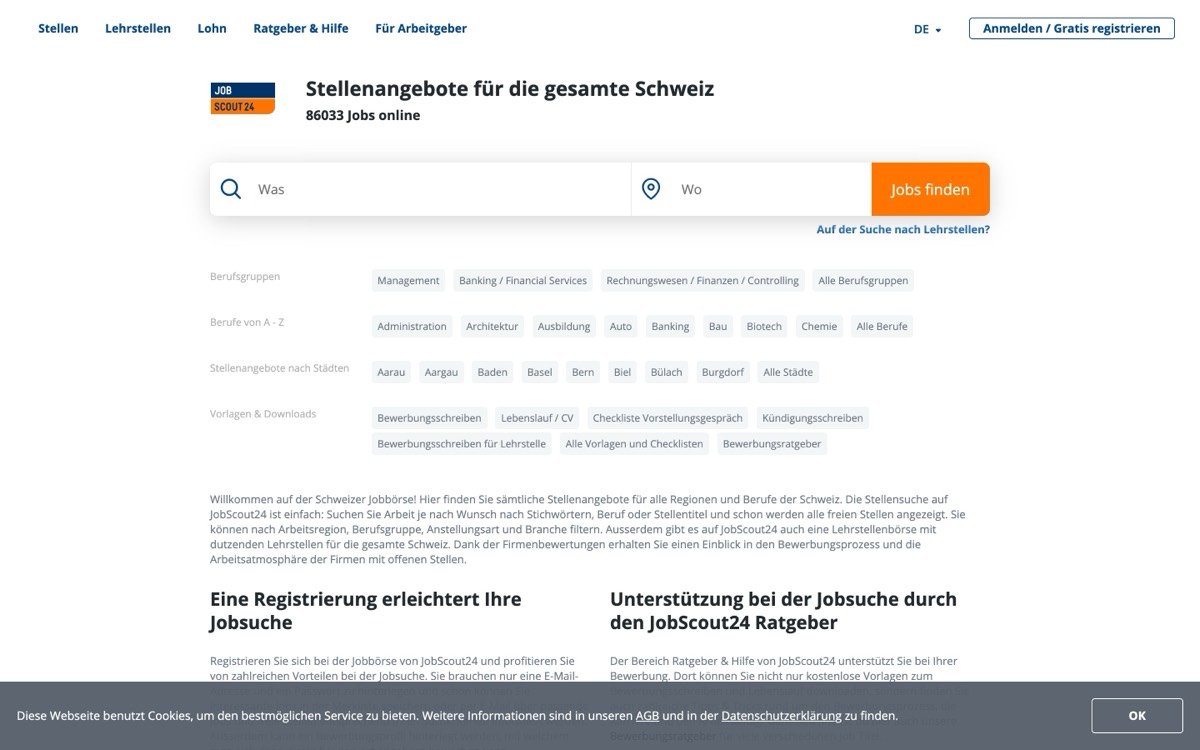
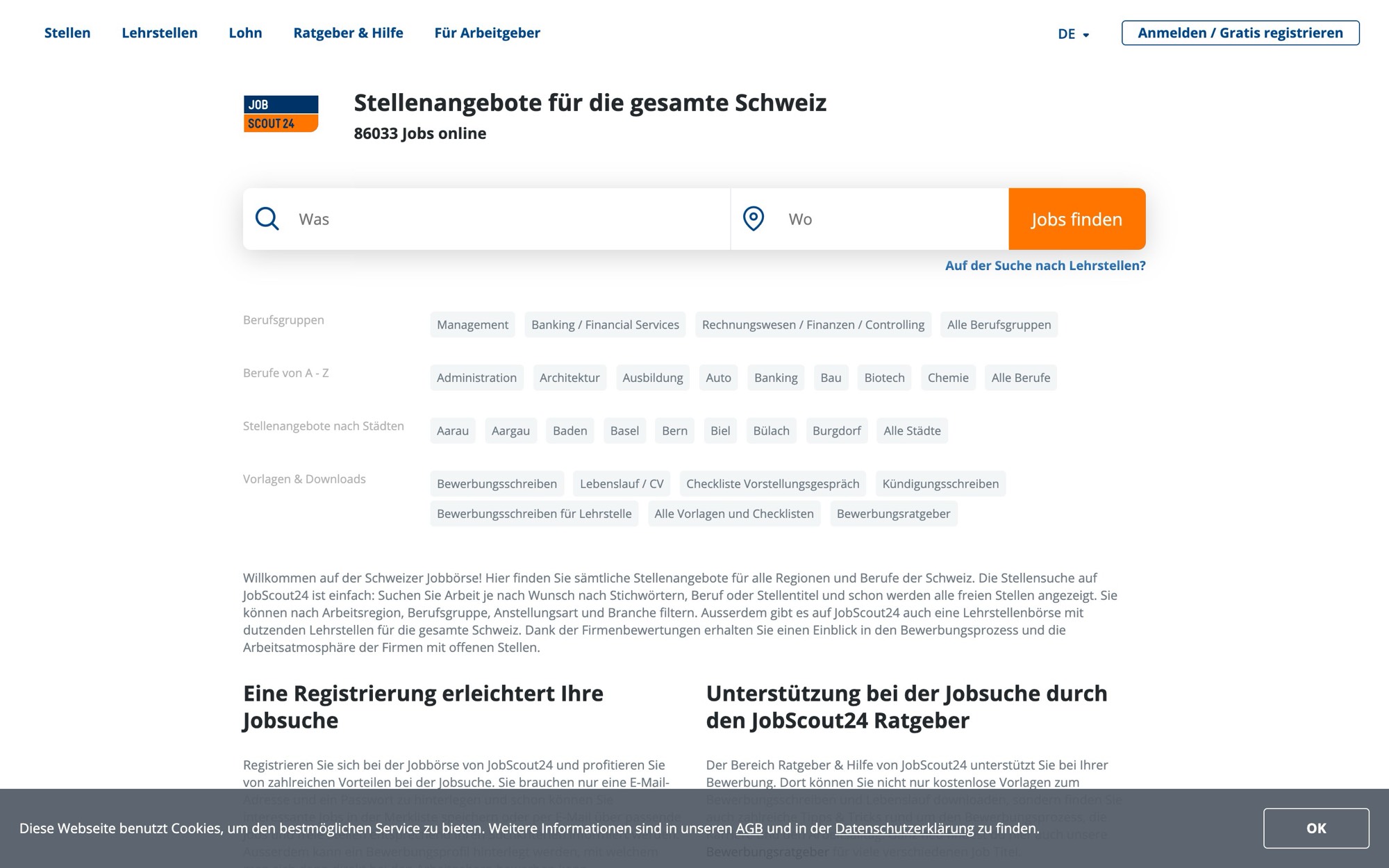
A third brand from the same company. Searching all three to widen your search means searching one provider three times.
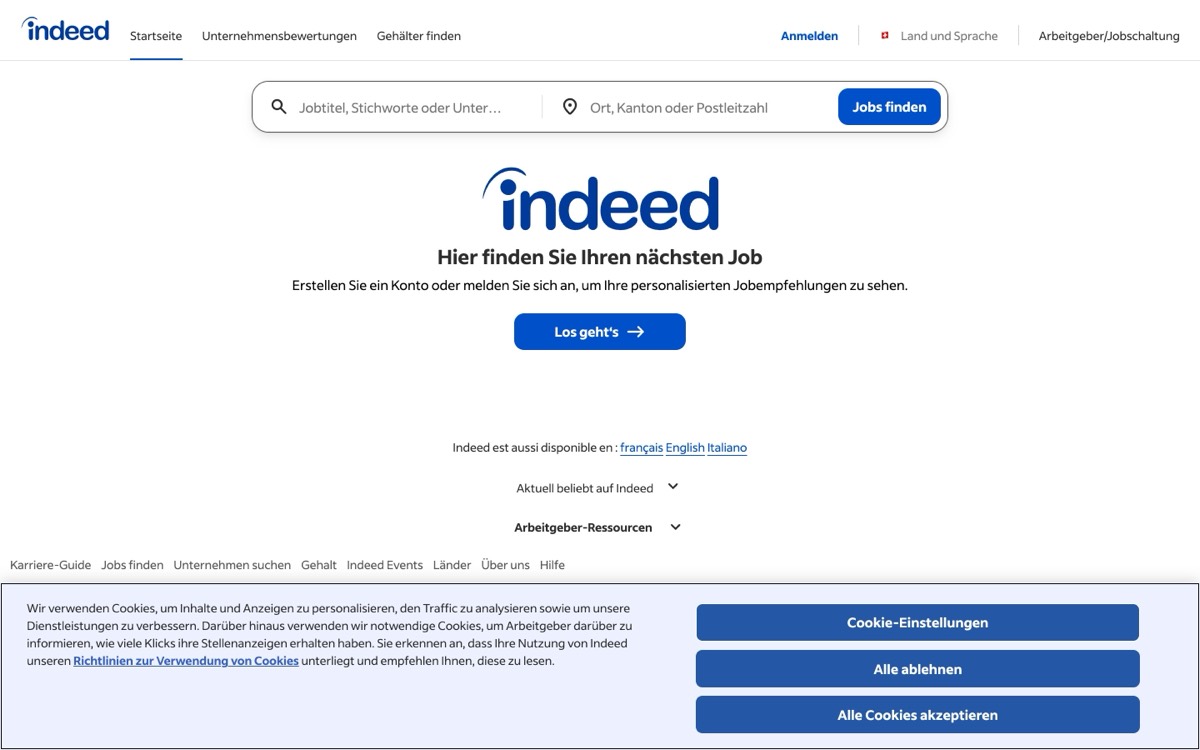
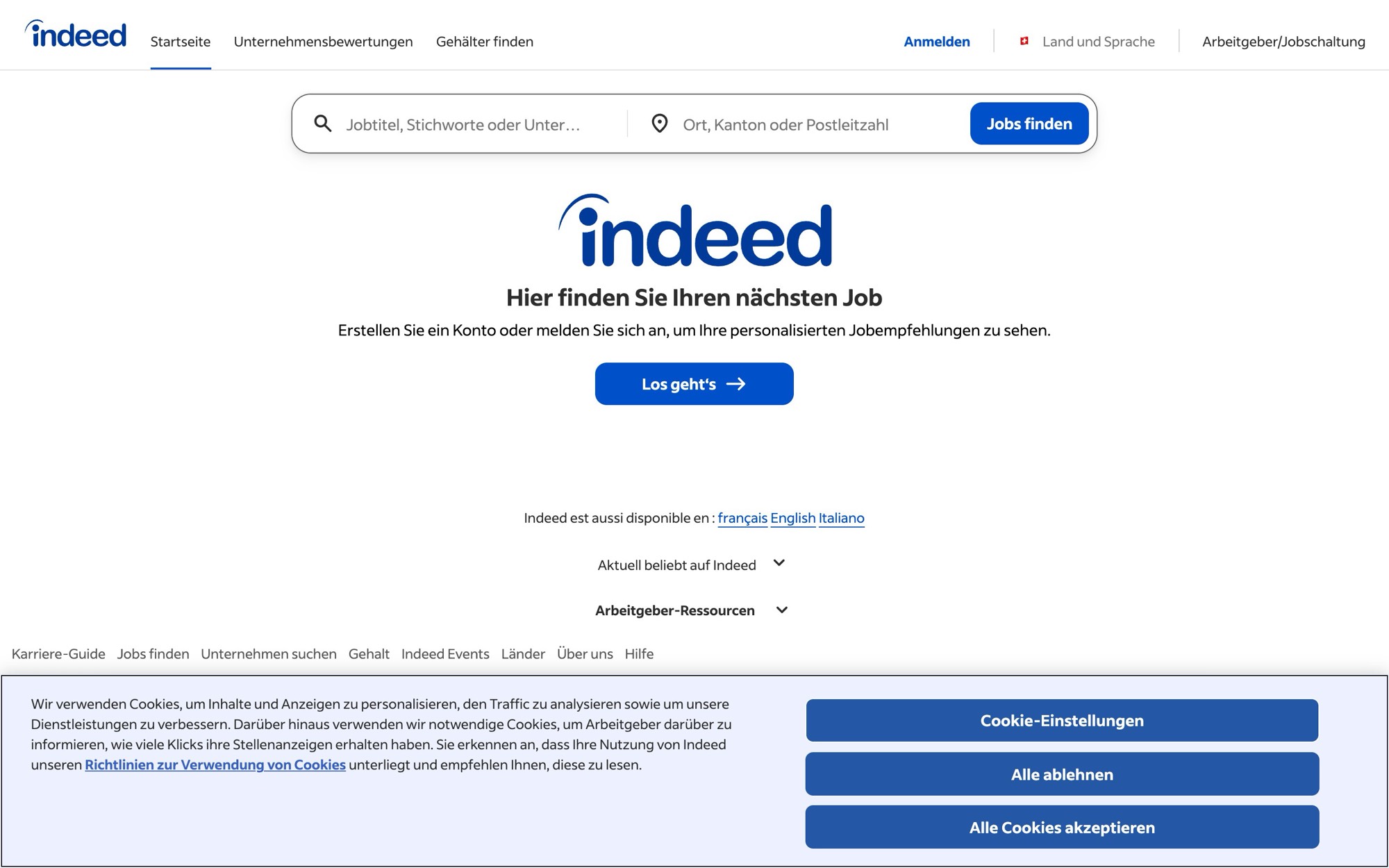
The broadest aggregation, because Indeed also collects from other boards — at the cost of many duplicates of the same advert.
The best reputation for English-speaking and international roles in Switzerland. Considerably thinner for trades, care and commercial roles.
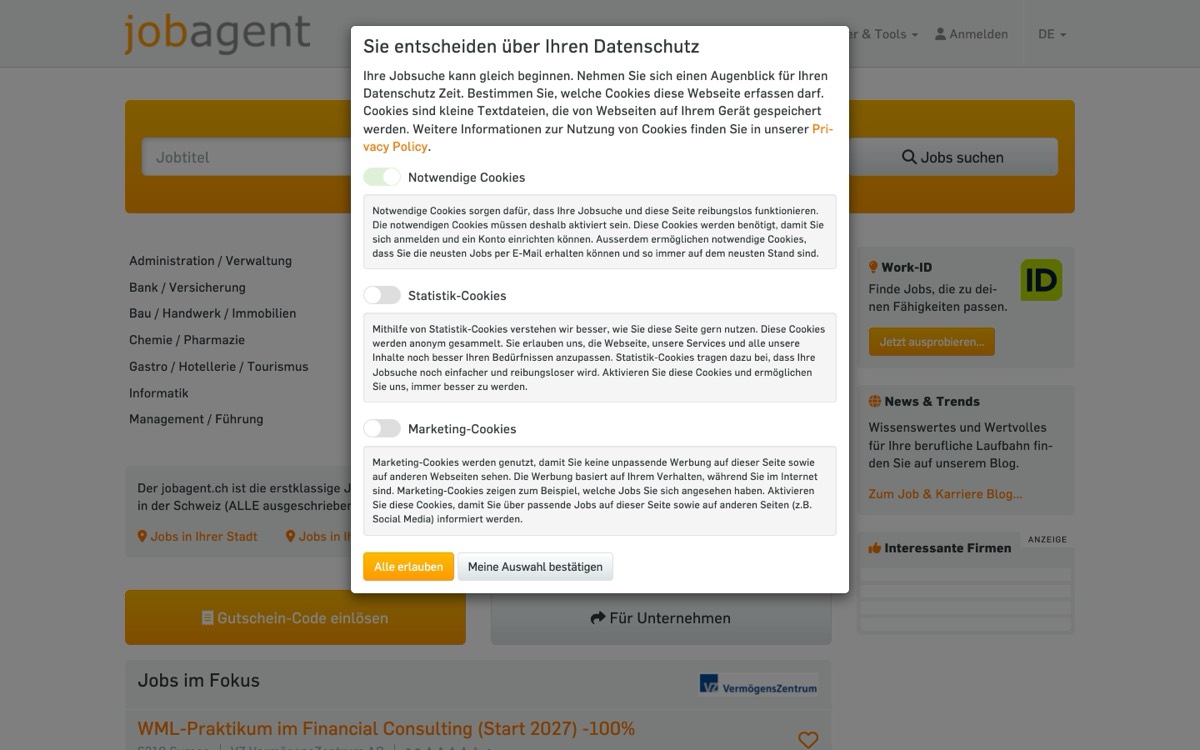
A meta-search across the Swiss job boards, "every job in Switzerland at a glance". Its strength is the Job-Abo: a saved search that mails you new adverts from every portal it covers. Salary calculator and application guides alongside.
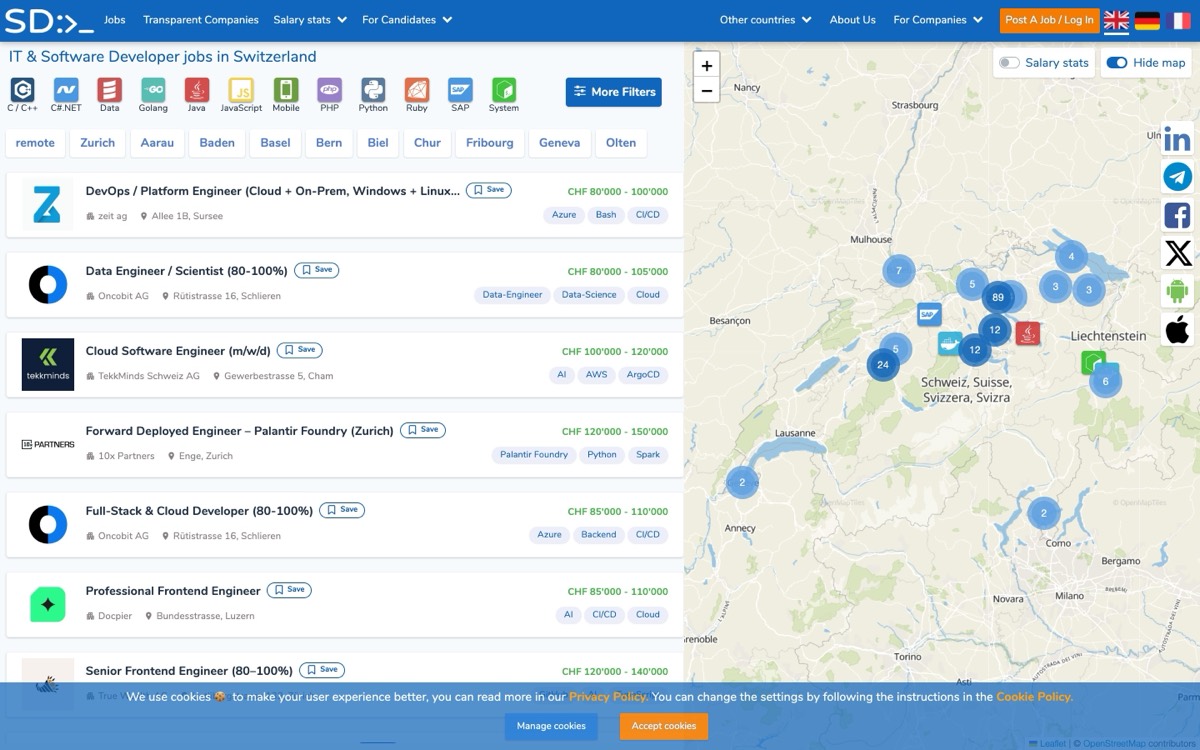
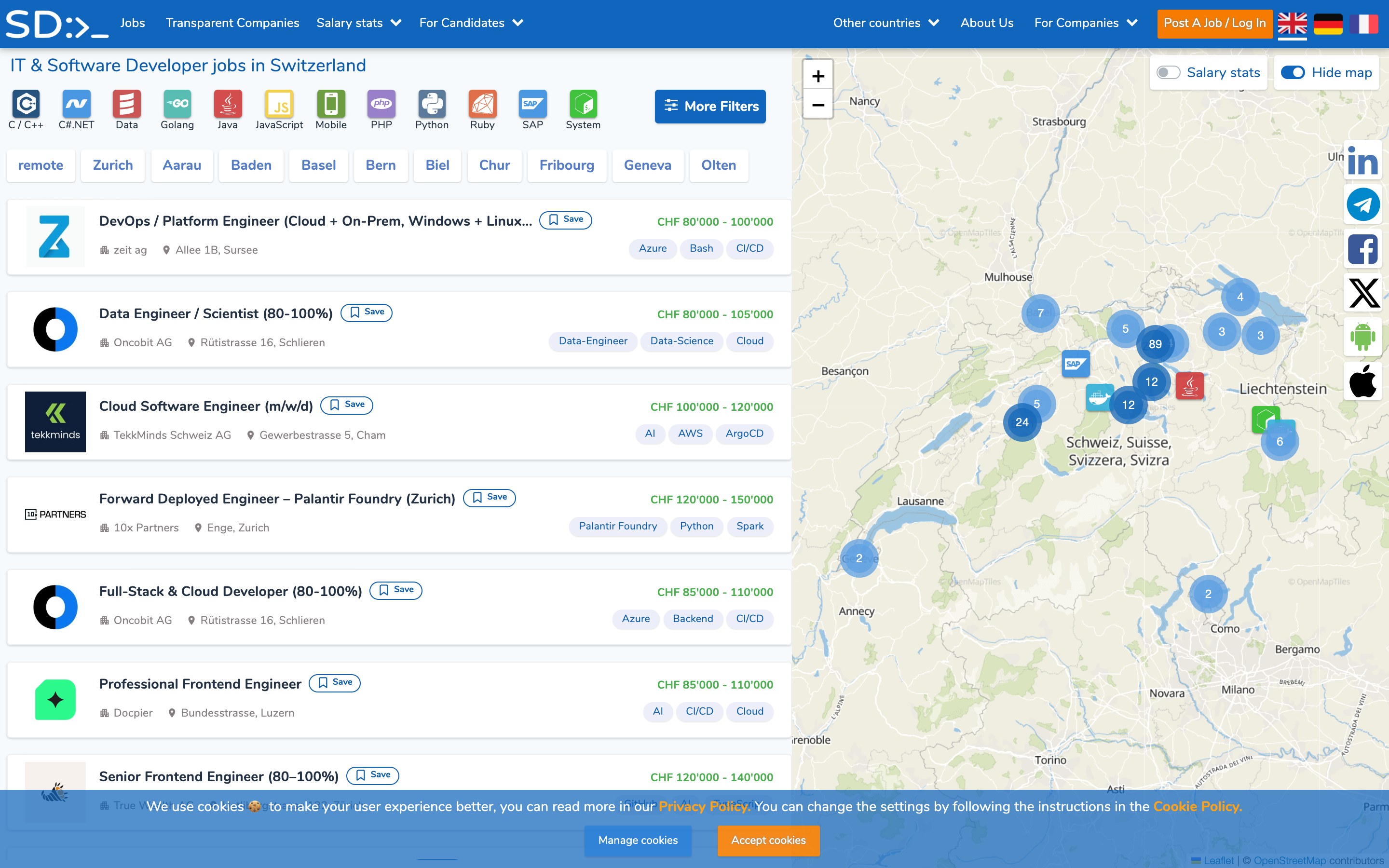
IT and software only, and thorough about it: "183 IT & Software developer jobs in Switzerland", filtered by technology (C#, Java, Python, DevOps, ML) rather than by industry. Publishes salary statistics and lists the companies that disclose their ranges. The site itself is in English.
Jobs by profession, city or language
Type a profession, a city or a language, the page shows the adverts currently open for it.
By profession
- Consultant
- Project Manager
- Retail Sales
- Nurse
- Nursing & Care
- Administrative Assistant
- Account Manager
- Software Engineer
- Public Administration
- Architect
- Insurance
- Chef
71 more — narrow the search
By work type
The rest of the answer is less comfortable. For an advertised job, both routes end in the same process. The board is the layer where you see the vacancy; the decision happens inside the employer, at the employer's pace. Whether you open the form from the board or from the company's career page moves your application by minutes, not days.
Applying directly with no advert is a different thing again: not fast, but open-ended. You face no field of competitors — and no deadline either. Just under half the employers in our index have exactly one open advert, and in any given week only about one employer in five posts anything at all.
Share of currently open adverts on SwissJobs.app by days since publication, as at 24 August 2026. It measures the age of open adverts, not how long they stay open.
- The five-working-day head start exists only in registration-liable occupations, and only for people registered as jobseekers with an RAV.
- In 2026, 10.8 per cent of the working population is in those occupations, up from 6.5 per cent in 2025; cooks and cleaning staff were added on 1 January 2026.
- Within three working days the RAV sends the employer matching candidate files — before the advert is public anywhere.
- The median open advert is 21 days old and roughly one in six is older than 90 days; the employer's process outlasts any channel choice.
- Only about one open advert in eight is less than a week old, so seeing a vacancy early buys more time than the route you apply through.
Through a job board or straight to the company
| Criterion | Via a job board | Direct to the employer |
|---|---|---|
| What you reach | every published vacancy | unadvertised roles as well |
| Speed | immediate; 21.9% are new within 7 days | slower, reply uncertain |
| Competition per role | high — everyone sees the same list | low to none |
| Effort per application | low | high — research required |
| Hit rate | low but predictable | high when the timing is right |
| Counts for the RAV | yes | yes, speculative applications too |
| When to use which | as the weekly baseline | on top, for target employers |
Both work, but not at the same speed. Our index shows 21.9% of adverts went up in the last seven days — so the board is the faster route to what is NEW, and the direct approach the better route to what has not been advertised yet.
Two different questions hide in one word
"Applying directly" means one of two things, and they behave completely differently in time. Either you saw an advert and use the employer's own career page instead of the board's apply button — or you write to a company that has advertised nothing at all.
In the first case there is no speed difference worth deciding on. Same vacancy, same inbox, same person reading it in the same order. What differs is how much typing the form demands, not when the answer arrives. A board is visibility, not a queue you can jump.
In the second case everything changes, in both directions. Nobody is competing with you, but no clock is running either. There is no date by which anyone inside the company has to answer you, because there is no post to fill that carries a date.
And then there is the Swiss rule that has no equivalent in most countries people move here from — the one that actually puts a number on "faster".
The five working days that only exist here
Since 1 January 2020, in the words of SECO, "employers have been legally required to register vacancies in occupations where the national unemployment rate is at least 5% with the regional employment centre (RAV)". The vacancy "has to be posted in the protected area of the unemployment insurance online portal Job Room for five working days before it can be advertised elsewhere (blocking period)". The rule follows the 2014 vote on immigration and the implementation of Article 121a of the Federal Constitution; arbeit.swiss names Article 21a of the Foreign Nationals and Integration Act and Article 53a ff. of the Recruitment Ordinance as its legal basis.
The scope moved sharply this year. In 2025, 6.5 per cent of the working population was employed in registration-liable occupations; in 2026 it is 10.8 per cent. Newly liable since 1 January 2026 are cooks, and cleaning staff and auxiliaries in offices, hotels and other establishments — each with an unemployment rate of 5.3 per cent. The largest liable occupation is again construction labourers. The list is republished every autumn for the following year, and the only criterion is the twelve-month average unemployment rate of that occupation type.
The period is longer than "five days" sounds. It starts the working day after the vacancy goes up, and weekends and public holidays do not count. The official example: published Tuesday 31 July 2018, blocking period expiring Wednesday 8 August, external advertising possible Thursday 9 August — five working days became nine calendar days, because 1 August is a national holiday.
The employer is not idle in the meantime. Within three working days of publication in the protected portal, the RAV sends the employer the files of suitable candidates or reports that there are none, and that transmission expressly does not shorten the blocking period. The employer then has to tell the RAV whom it considered suitable and invited, and whether the post is still open. In these occupations, in other words, the first applications are on the desk before the advert is visible in public at all.
Two limits keep the picture honest. Not every job is liable: the requirement falls away for engagements of at most 14 calendar days, for internal moves after at least six months in the company, and where the post is filled by someone registered as a jobseeker with an RAV. And the head start exists only for registered people. arbeit.swiss puts the condition like this: "In principle anyone entitled to sojourn and to work in Switzerland can register as a jobseeker with a regional employment centre RAV." If you are applying from abroad, that door is closed to you and the market starts for you when the advert goes public. Whether registration is possible in an individual case — cross-border commuters in particular — is a question for the responsible RAV.
What the blocking period does to a speculative application
This is where applying directly gets uncomfortably concrete. Asked whether an employer may draw on an existing candidate pool during the blocking period, arbeit.swiss answers that only once the period has expired "can existing candidates be employed" — candidates "not registered as jobseekers with the RAV" who "previously sent a speculative application or replied to a standard job advert".
That inverts the usual expectation. In a registration-liable occupation, already being in the company's pool buys you nothing in time: the employer is not allowed to fill the post with you until the five working days have passed — unless you are yourself registered with an RAV, in which case the reporting requirement does not apply at all. And the period cannot be shortened; SECO states plainly that it "cannot be shortened or circumvented", not even for an urgent start date.
Outside those occupations none of this applies, and a speculative application is legally unremarkable — a question of probability rather than of speed.
The employer's clock, measured
We looked at how old the currently open adverts in our index are, counted from their publication date. The median is 21 days. A quarter of open adverts are older than 67 days, roughly one in six older than 90 days, and only 13.2 per cent are less than a week old.
That distribution is the real answer to "which is faster". Seconds separate the board's apply button from the career page. Weeks separate a process decided in a fortnight from one whose advert has been standing for three months. The spread between employers is orders of magnitude larger than the spread between channels.
The same shows in where the apply button leads. Adverts whose application runs into an applicant tracking system are a median 32 days old; those that stay on a board or with an agency, 11 days; those pointing at the company's own site, 25 days. Read those with care — they measure the age of open adverts rather than their lifespan, and boards refresh their listings differently from company portals. As a direction of travel they still hold: the employer running its own applicant system usually runs the longer process too.
For planning, that means expecting a process in weeks rather than a reply in days, and continuing to apply meanwhile. Waiting on one very well-targeted application costs exactly the time you hoped to save on the channel.
When applying directly really is faster
There are cases where the direct route does save days, and they share one pattern: the need already exists, the advert does not yet.
The first is the employer that is currently in motion. In any given week, only about one employer in five in our index publishes a new advert at all. Writing to a company that has just posted several roles reaches an HR team that is recruiting anyway — a very different situation from writing to a firm whose last vacancy was a year ago.
The second is the large employer. About 81 per cent of all open adverts sit with employers that have five or more vacancies open at once, while just under half of all employers have exactly one. Where hiring runs continuously, an unsolicited application more often lands in a process that is already under way.
The third is the phone call to the contact person named in the advert — not as an application, but as a question about timing. An advert that has been online for two months may already be at final interviews. Two minutes on the phone decide whether the half hour for a tailored dossier is still worth spending.
The reverse also holds. Where a vacancy is advertised and a procedure is prescribed, going around that procedure is not a shortcut. In Switzerland it usually ends with a polite pointer back to the form, only later.
What actually saves days
See it early. Because only about one open advert in eight is less than a week old, the moment you notice a vacancy is the biggest lever you personally control. The publication date is normally on the advert; reading it before investing an hour is part of searching.
Have the dossier ready before you need it. A Swiss application expects Arbeitszeugnisse — the employer references every previous job produces — and the missing interim reference from an employer two jobs ago is the most common self-inflicted delay. Requesting one takes longer than any channel decision.
Answer the permit question in advance. If you do not hold a Swiss passport, stating your permit or your entitlement to one in the CV saves a whole round of queries. The same applies to cross-border commuters and the G permit. And note the format expectation while you are at it: this is a CV of about two pages with a photo and dates, not a one-page US-style resume.
Finally, correct the expectation itself. In most cases "which channel is faster" is the wrong question. The channel decides minutes, the employer's process decides weeks — and in registration-liable occupations a statutory period decides who gets to see the vacancy first at all.
Figures on advert age, turnover and distribution come from our own running analysis of the Swiss job adverts we index, as at 24 August 2026. Age is counted from the publication date of currently open adverts, which does not measure how long an advert stays open overall. We publish shares, never absolute index figures. The job-registration-requirement statements come from arbeit.swiss (SECO), read on 24 August 2026.
Sources
Related questions
What our job index says about the Swiss market
Computed live from our own index, not quoted from a study. Shares only, as of today.
Language the advert is written in
- Deutsch
- 60%
- English
- 23%
- Français
- 13%
- Italiano
- 3%
Of adverts that state a language requirement, the share asking for
- Deutsch
- 70%
- English
- 43%
- Français
- 21%
- Italiano
- 3%
19% posted in the last 7 days · Largest markets: Zürich 18% · Bern 10% · Genève 5% · Basel 5%