LinkedIn vs Swiss job boards — where should you search?
Updated:
In short
Both, and how you split them is the real answer. LinkedIn is worth your time when your audience is there: English-language, international and senior roles. A Swiss job board is worth it when your occupation is described in Pensum (workload in per cent), canton and national language. On 24 August 2026 we counted sixty public LinkedIn results for each of eight Swiss occupations: nearly every care and kitchen advert still carried LinkedIn's «Be among the first 25 applicants» line, while no product-manager advert did — those showed 27 to over 200 applicants. Checked 24 August 2026.
Who to choose
With Linkedin Oder Schweizer Jobboerse it ends at the advert. With us it starts there: the same posting produces the CV, the motivation letter, the check against it, and the entry in your RAV record.
Choose LinkedIn if
LinkedIn — English-language and international roles, and the route through people, recruiters actively search for profiles there.
Network instead of a form — the profile is the application, "Open to work" signals availability to recruiters, and some roles appear nowhere else.
Management and international — strongest at international employers and senior roles, thin in trades, care and retail.
Choose LinkedIn Jobs if
Network instead of a form — the profile is the application, "Open to work" signals availability to recruiters, and some roles appear nowhere else.
Management and international — strongest at international employers and senior roles, thin in trades, care and retail.
Choose SwissJobs.app if
Pick the job directly — We run the job index ourselves. The advert text is already loaded, and everything else is written against exactly that text — no searching, no copying, no pasting.
Four tools, not one — CV, motivation letter for the same advert, a CV check against that advert, and interview preparation — one account, the same data.
The RAV sheet — Your job-search efforts are filled from your application tracker and printed as the official SECO form. No other tool in this comparison has it.
Word export, no watermark — PDF and DOCX, both clean. Many tools hand you a text file on the free plan, or stamp a watermark on the document.
Start without an account — The tools open without signing up. The account is asked for to save and from the second document — the first download needs none.
The Swiss job portals at a glance
Click an image for the full-size view. What each portal actually is stands beside it.
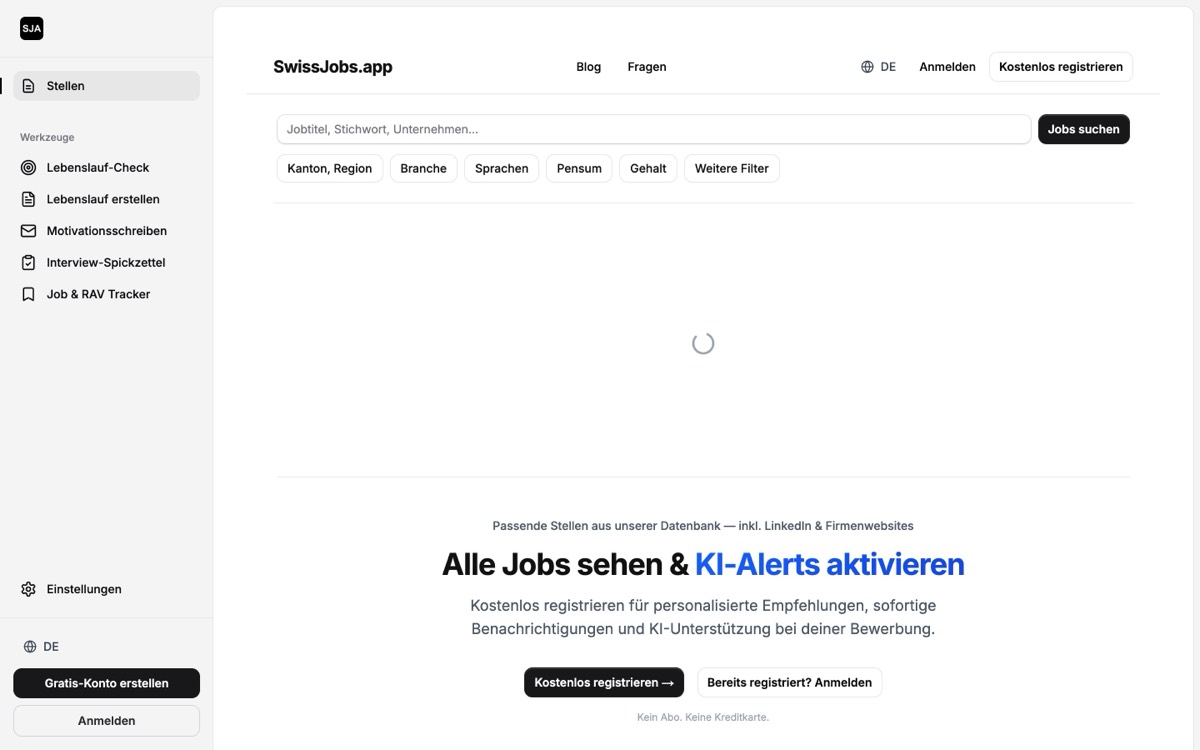
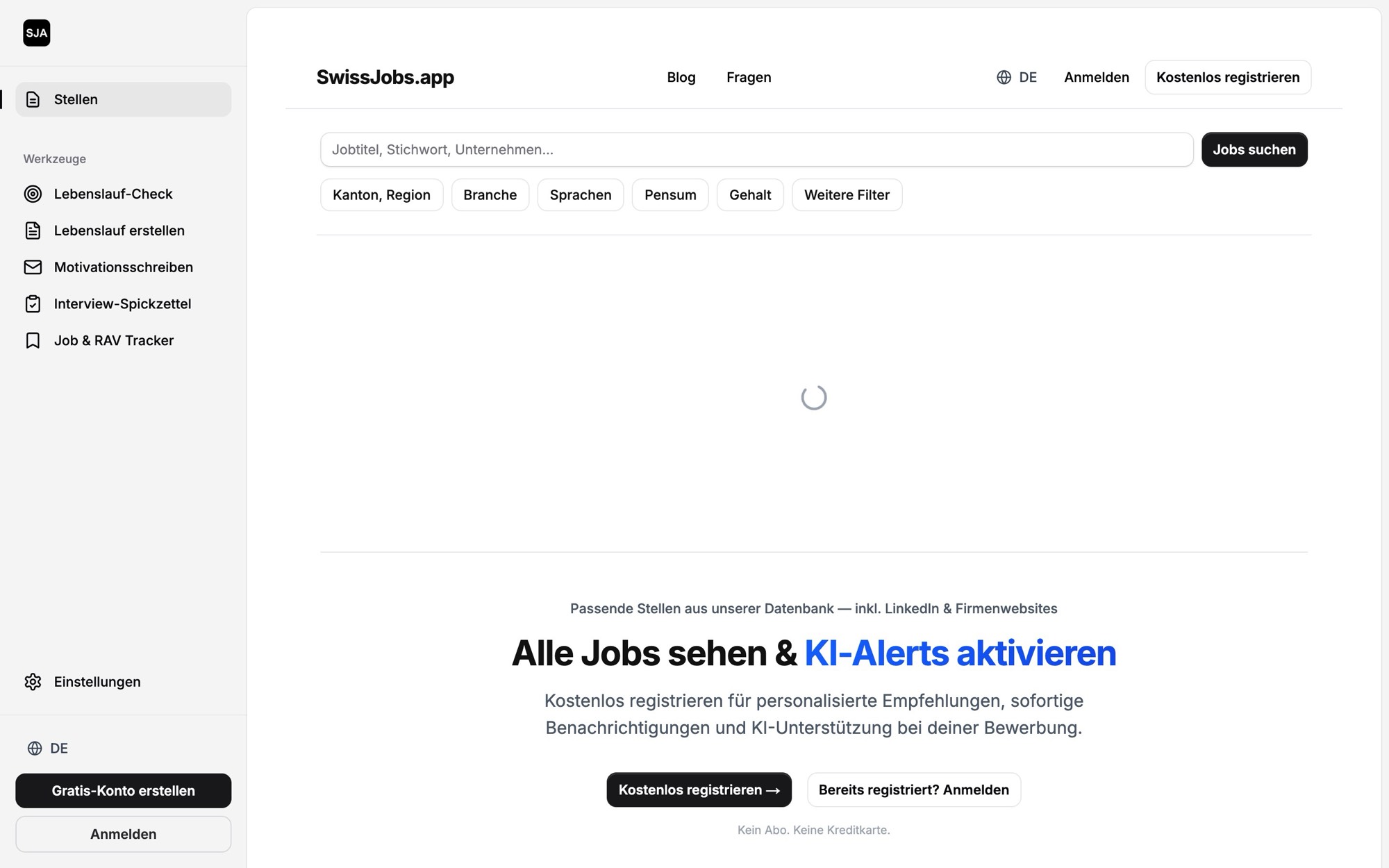
1. SwissJobs.appOur app
Over 21,000 open Swiss roles from ATS systems, company sites and LinkedIn in one place — and from any advert, straight into a CV, a motivation letter, a CV check and interview prep. The RAV job-search-efforts form fills itself from your application tracker. Free to use; the account is asked for at save.
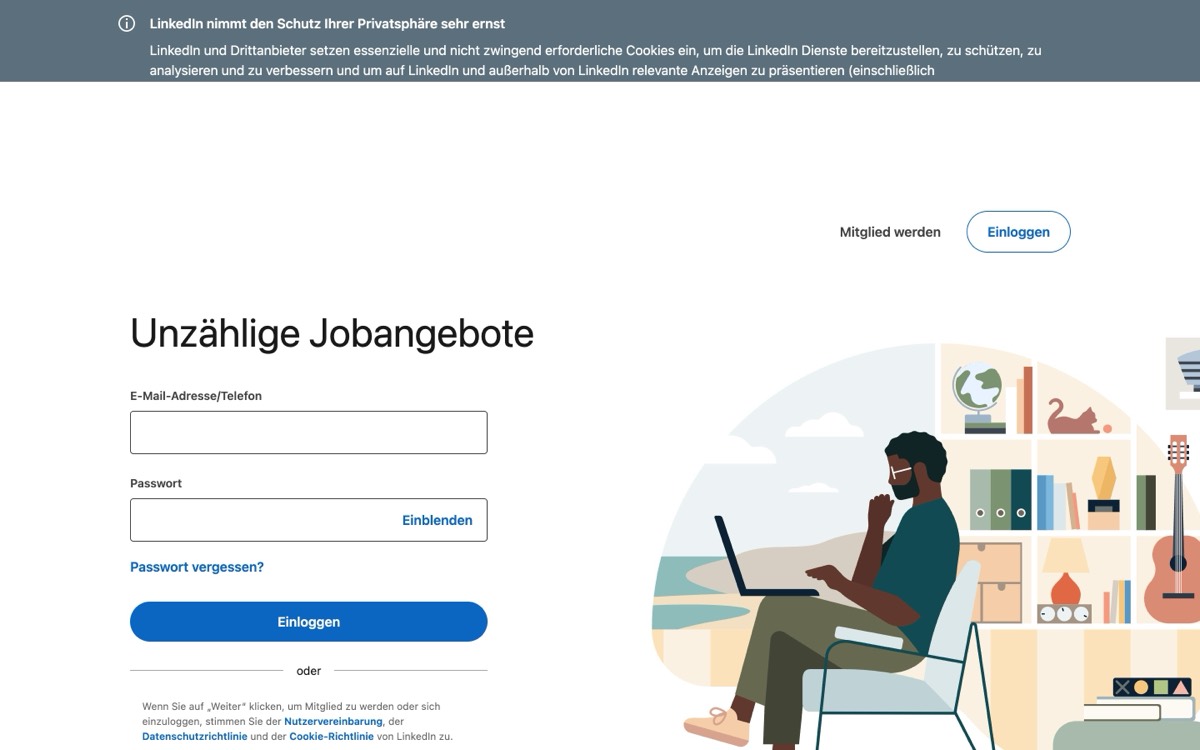
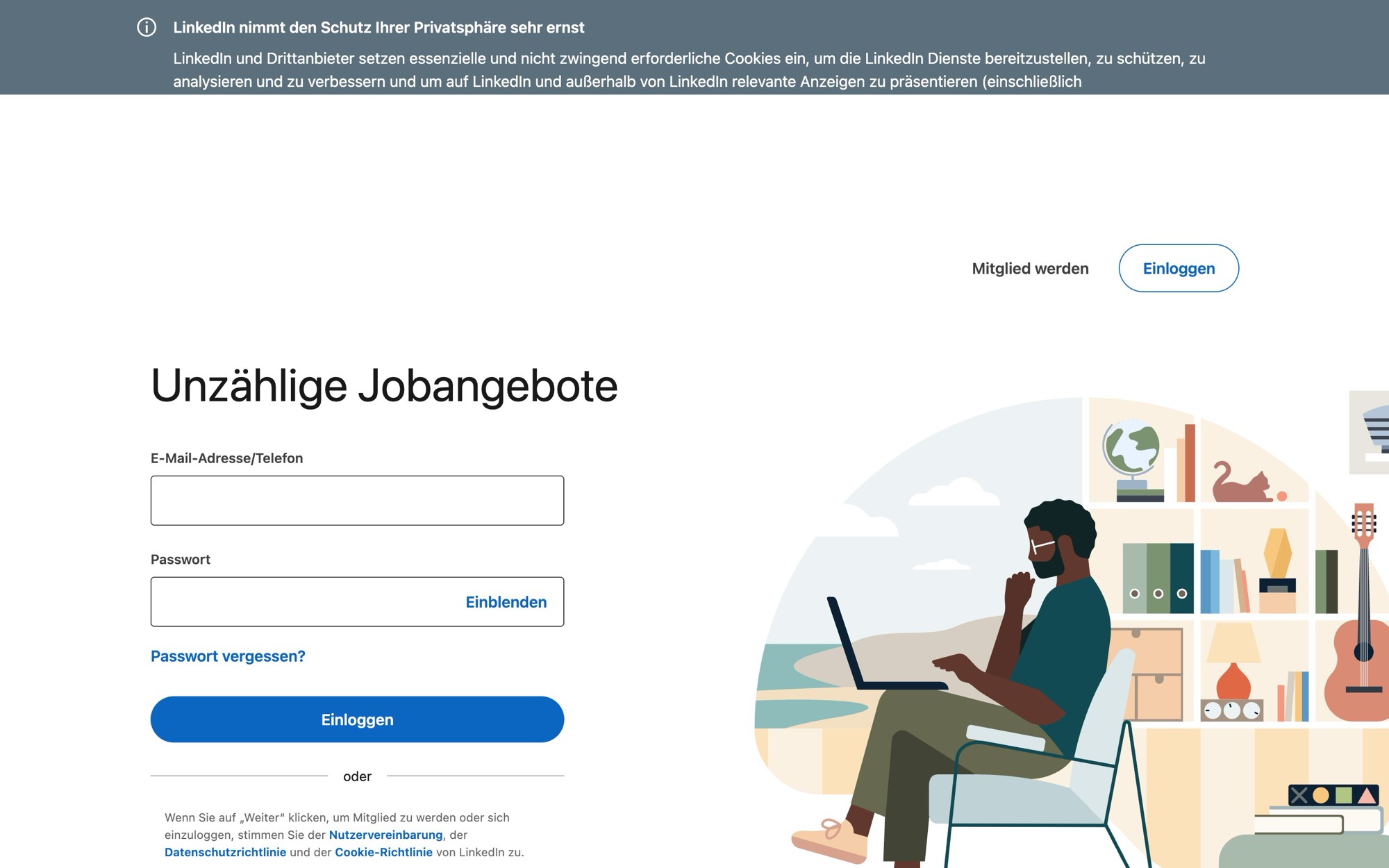
The best reputation for English-speaking and international roles in Switzerland. Considerably thinner for trades, care and commercial roles.
The question is usually asked as a platform question, and it is really an occupation question. Swiss adverts for almost every field sit on LinkedIn, including nursing, kitchens, retail and the trades. What differs enormously between fields is not the supply of adverts but the audience — how many people actually see and answer the same posting there.
So what follows is a count rather than an opinion. Eight occupations, the first public Swiss LinkedIn result list for each with sixty hits, six individual adverts opened in four of those occupations, and the totals the Swiss portals reported for the same keywords on the same day. All of it visible without an account, all of it repeatable.
Sixty results per occupation from the public Swiss LinkedIn result lists, counted without an account on 24 August 2026. A low value means heavy competition; a high value means light competition — and little audience.
- Counted on 24 August 2026: eight occupations, the first public Swiss LinkedIn result list for each, sixty hits per list, all visible without an account.
- Share of results still flagged «Be among the first 25 applicants»: nursing 96.7 %, chef 95 %, electrician 85 %, bookkeeping 73.3 %, sales advice 70 %, back office 63.3 %, product manager 25 %, software engineer 23.3 %.
- Six adverts opened per occupation: nursing and kitchens six of six under 25 applicants; product management 27, 53, 119, 174 and twice «Over 200 applicants».
- «Employment type: Full-time» appeared on adverts whose own title reads «80 - 100%» — LinkedIn has no Pensum field.
- On several chef and nursing adverts LinkedIn's «Seniority level» read «Management».
- Freshness by occupation: 41.7 % of chef results were at most a week old, while 45 % of electrician results were over a month old and 26.7 % over three months.
- Totals are not comparable: «Koch» LinkedIn 807 against jobs.ch 879; «Sachbearbeiter» LinkedIn over seven thousand against jobs.ch 764.
- In our own stock, 51.9 % of nursing titles carry the workload percentage and 50.4 % a Swiss qualification marker, against 8.7 % across all occupations.
- arbeit.swiss explicitly advises combining channels and states that many vacancies are filled through personal contacts.
Feature comparison
| Feature | SwissJobs.app | |
|---|---|---|
| Swiss job listings | Yes | Yes |
| All 26 cantons | Yes | not stated |
| Search without an account | Yes | not stated |
| Job alerts by email | Yes | not stated |
| AI match against your profile | Yes | No |
| Build a CV straight from the advert | Yes | No |
| Motivation letter for the advert | Yes | No |
| CV check against that advert | Yes | No |
| Application tracker | Yes | No |
| RAV job-search-efforts form (SECO) | Yes | No |
| Low-competition listings surfaced | Yes | not stated |
| Free to use | Yes | not stated |
| Interface languages | DE / EN / FR / IT | not stated |
| Built in Switzerland | Yes | not stated |
As of 4 September 2026. "not stated" means it could not be read on their own site — not "does not exist". Our rows come from the code (lib/stripe/trialConfig.ts) and from walking the live flow, not from marketing copy.
Pricing side by side
| What you pay | SwissJobs.app | |
|---|---|---|
| Job searchThe search is not part of our subscription. What is paid for is the tools that come after it. | Free — search, filters, job alerts and the application tracker cost nothing | Free for jobseekers |
| Monthly price | CHF 15 — all six tools, one subscription | not stated |
| Yearly price | CHF 95 a year (= CHF 7.92 a month) — the same six tools | not stated |
| Free trialOur seven days are the full product, not a limited preview. | 7 days, full access, cancel any time | not stated |
| What works without payingWe print the limit, because that is the number a comparison usually leaves out. | Tools open without an account; free account: 5 documents/day, 10 per rolling week | not stated |
| Currency | CHF | not stated |
| BillingWatch for four-week billing periods anywhere: that is 13 charges a year, not 12. | Calendar month, cancel any time | not stated |
As of 4 September 2026. "not stated" means it could not be read on their own site — not "does not exist". Our rows come from the code (lib/stripe/trialConfig.ts) and from walking the live flow, not from marketing copy.
Competition per advert differs by a multiple
LinkedIn flags adverts that have had few applications so far, and on the advert page it spells the threshold out: «Be among the first 25 applicants.» Once that threshold is passed it names the number openly — «67 applicants», «Over 200 applicants». That makes competition per vacancy something you can count without logging in.
On the lists of 24 August 2026, that flag appeared on 96.7 per cent of the nursing results, 95 per cent of the chef results and 85 per cent of the electrician results. For software engineers it was 23.3 per cent and for product managers 25 per cent. Bookkeeping (73.3), sales advice (70) and back-office administration (63.3) sat in between. The ranking follows the line between an occupation advertised in German with a workload percentage and one advertised in English with a job title.
We then opened six individual adverts in four of those occupations. In nursing and in kitchens, six out of six still showed the under-25 line. In software engineering the pages showed 25, 43, 67 and 91 applicants, plus one «Over 200 applicants». In product management not a single advert was below the threshold: 27, 53, 119 and 174 applicants, and twice «Over 200 applicants».
Both readings of that are true and belong together. For a nurse, the low number means fewer rivals per advert — a reason to look there. For the employer, the same number means the advert is finding almost no audience on LinkedIn, which is why the same vacancy is also posted on a Swiss portal, in the trade press and on the company's own careers page. Search only on LinkedIn in those occupations and you are seeing a slice, not the market.
The Pensum shows what each set of fields was built for
The Pensum is the Swiss base unit: a job is not full-time or part-time, it is 60, 80 or 100 per cent, and very often a band such as «80 – 100 %». In our own stock of Swiss adverts, that percentage is already in the title for 51.9 per cent of nursing vacancies, 37.8 per cent of back-office roles and 25.7 per cent of logistics roles.
LinkedIn has no field for it. On every advert page we opened, the «Employment type» line read «Full-time» — including on adverts whose own title says «80 - 100%». The percentage survives only in the wording the employer wrote, not in the platform's structure, so narrowing by workload means reading titles. The Swiss portals have a filter for exactly this: the English interface of jobs.ch lists «Published since · Workload · Occupational field · Contract type · Language · Position», and jobup.ch carries the same workload filter for French-speaking Switzerland.
The same mismatch shows in seniority. LinkedIn keeps a «Seniority level» field, and on several chef and nursing adverts it read «Management». That is not malice; it is a globally uniform category that fits an occupation built on a federal apprenticeship badly. Those Swiss qualification markers are everywhere in this half of the market: 50.4 per cent of nursing titles carry an HF, EFZ, FaGe, «dipl.» or «eidg.», and 30.4 per cent of construction and trade titles do, against 8.7 per cent across all occupations.
One practical trap for anyone searching in English: typing the country name into the public search box is not enough. On the same day, the public search URL with the location set to «Schweiz» returned a headline reading «More than a thousand jobs for Pflegefachfrau in United States of America». Read the line above the list before you read the list.
Freshness is a property of the list, not of the platform
We counted the date lines on the same eight lists. Among the chef results, 41.7 per cent were at most a week old, and among the bookkeeping results 40 per cent — genuinely fresh. Among the electrician results, 45 per cent carried a date more than a month old and 26.7 per cent one more than three months old. Among the product-manager results, nothing was older than three months.
For searching, that makes the date line the most important column on a LinkedIn card. An advert that has been sitting in the list for four months is either long filled or a standing advert from a staffing agency. The Swiss portals have a «published since» filter for this; on LinkedIn you do it by eye.
And the headline totals on the two sides are not comparable, even when they sit side by side. For «Koch» (chef) LinkedIn reported 807 jobs in Switzerland that day and jobs.ch 879 — close. For «Sachbearbeiter» (back office) LinkedIn reported over seven thousand and jobs.ch 764. For «Elektroinstallateur» it ran the other way: LinkedIn over a thousand, jobs.ch a little over two thousand. Both sides match loosely and round their figures, and they are not counting the same thing. Treat the big number above the list as decoration and judge the first page instead.
What LinkedIn does that no job board can
The honest advantage is not in searching but in the opposite direction. On LinkedIn you can be found without searching, and you can look around discreetly while still employed. A job board does not know you; it only knows your query.
That direction is officially recommended here too. The public employment service writes on arbeit.swiss: «Make use of various channels and combine different search strategies» — naming networking, online portals such as Job-Room, newspaper listings and company websites — and adds that «a lot of job vacancies are filled in this way», meaning through personal contacts. That is a fair description of what a network does and a result list does not.
The second area where LinkedIn leads is the English-language part of the market, which is real but narrower than it looks. In our stock, 66.3 per cent of adverts for management, consulting and product roles are written in English, and not one of those titles carries a Swiss qualification marker. Retail runs the other way: 94.4 per cent German, 1.6 per cent English. Two labour markets in one country, and LinkedIn serves one of them far better than the other.
If you are moving to Switzerland, three conventions matter more than the choice of platform. Salary is quoted in CHF and often as thirteen monthly payments; workload is a percentage rather than a job title; and language ability is stated as a CEFR level (B2, C1), not as «fluent». A LinkedIn profile has no field for any of it — the Swiss application dossier does.
If you are registered with an RAV
Then a third address joins the list, and it is not optional: Job-Room, the portal of the public employment service. Your job-search efforts are evidenced to your RAV (the regional employment centre) regardless of which portal you found the vacancy on. No private tool, ours included, replaces that record — at most it prepares it. What counts and in which form is what your RAV tells you, and practice differs from canton to canton.
In practice: search wherever you like. Record it where the RAV requires.
Who should search where
LinkedIn, if your role is English-language or international, if you are looking at corporate employers in Zug, Geneva, Zurich or Basel, if you would rather be found than search — and if a discreet move out of a current job matters to you. Expect more rivals per advert there; in our count the numbers ran into three figures.
A Swiss job board, if your occupation has a Pensum, a canton and a federal qualification: nursing, kitchens, retail, the trades, back office, logistics. That is where the filters are and where the audience is. jobs.ch for German-speaking Switzerland, jobup.ch west of the Sarine — both belong to the same company, so expect a large overlap; ostjob.ch for the east, plus whatever portal your own trade uses.
And in both cases: the employer's own careers page. That is not a platform question — it is where most Swiss applications are actually submitted.
SwissJobs.app is one of those Swiss boards: search without an account, filter by canton and Pensum, and tailor a CV to a single advert. If contacts and professional visibility matter more to you than the result list, LinkedIn is the better tool and that is where your effort belongs.
LinkedIn figures were read without an account on 24 August 2026 from the public Swiss result lists for eight keywords (sixty hits on the first page each) and from six individual advert pages in four of those occupations; the quoted wording is LinkedIn's own. The lists change during the day, so this is a snapshot of what was public that day and not a statement about the platform's whole inventory. Swiss portal totals come from their own public search pages the same day. Our own values are shares of the adverts open on SwissJobs.app on 24 August 2026; occupation groups were formed from title wording and age counts from the publication date. Only shares are published.
Search Swiss vacancies by canton and workload
Jobs by profession, city or language
Type a profession, a city or a language, the page shows the adverts currently open for it.
By profession
- Consultant
- Project Manager
- Retail Sales
- Nurse
- Nursing & Care
- Administrative Assistant
- Account Manager
- Software Engineer
- Public Administration
- Architect
- Insurance
- Chef
71 more — narrow the search
By work type
Sources
- LinkedIn — public Swiss job list (example: Pflegefachfrau)
- LinkedIn job search Switzerland
- arbeit.swiss — tips on applying: combine channels, many vacancies filled through contacts
- Job-Room — portal of the Swiss public employment service
- jobs.ch — public job search with a Pensum filter
- jobup.ch — job search for French-speaking Switzerland
Related questions
What our job index says about the Swiss market
Computed live from our own index, not quoted from a study. Shares only, as of today.
Language the advert is written in
- Deutsch
- 60%
- English
- 23%
- Français
- 13%
- Italiano
- 3%
Of adverts that state a language requirement, the share asking for
- Deutsch
- 70%
- English
- 43%
- Français
- 21%
- Italiano
- 3%
19% posted in the last 7 days · Largest markets: Zürich 18% · Bern 10% · Genève 5% · Basel 5%