SwissJobs.app or Indeed — which is better for a Swiss job search?
Updated:
In short
Indeed shows far more Swiss listings than we do: on 4 September 2026 the page title of its Swiss search read about a hundred and thirty-seven thousand open jobs. Little of it is recent. Set Indeed’s own date filter to the last seven days and about thirteen thousand remain — roughly one listing in ten. In our index, 20.8 per cent of adverts are a week old or less. Indeed is the address for maximum coverage; SwissJobs.app is for fewer, fresher adverts with the CV, the letter and the Swiss paperwork attached to each one. Updated 4 September 2026.
Who to choose
On Indeed the search ends at the listing. With us it starts there: the same advert produces the CV, the motivation letter, the check against that advert and the line in the Swiss unemployment-office record.
Choose Indeed Switzerland if
Indeed Switzerland — the broadest aggregation, it also finds adverts that sit only on company sites.
The broadest aggregation — Indeed also collects from other boards and from company sites, the largest result set, at the cost of duplicates of the same advert.
One search box — a keyword and a place are enough; there is no language filter and no Swiss-specific field.
Choose SwissJobs.app if
The advert is already inside the generator — We run the job index ourselves. In the CV generator you search for the posting, pick it, and the document is written against that exact text — no switching sites, no copying, no pasting.
Four tools instead of one result list — CV, motivation letter for the same advert, a check of your CV against that advert, and interview preparation — one account, one set of facts.
Freshness rather than volume — 20.8 per cent of our adverts are a week old or less, against roughly 9.5 per cent on Indeed by its own date filter. We have fewer listings, but you scroll past less dead stock.
The language requirement is on the listing — 67.1 per cent of our adverts state which language they need before you open them. In a four-language country that is often the question that decides whether you can apply at all.
Swiss paperwork built in — The permit line (B, C or G), CEFR language levels, workload as a percentage, the photo convention, the two-page norm — and the official SECO job-search-efforts form filled from your application tracker.
The Swiss job portals at a glance
Click an image for the full-size view. What each portal actually is stands beside it.
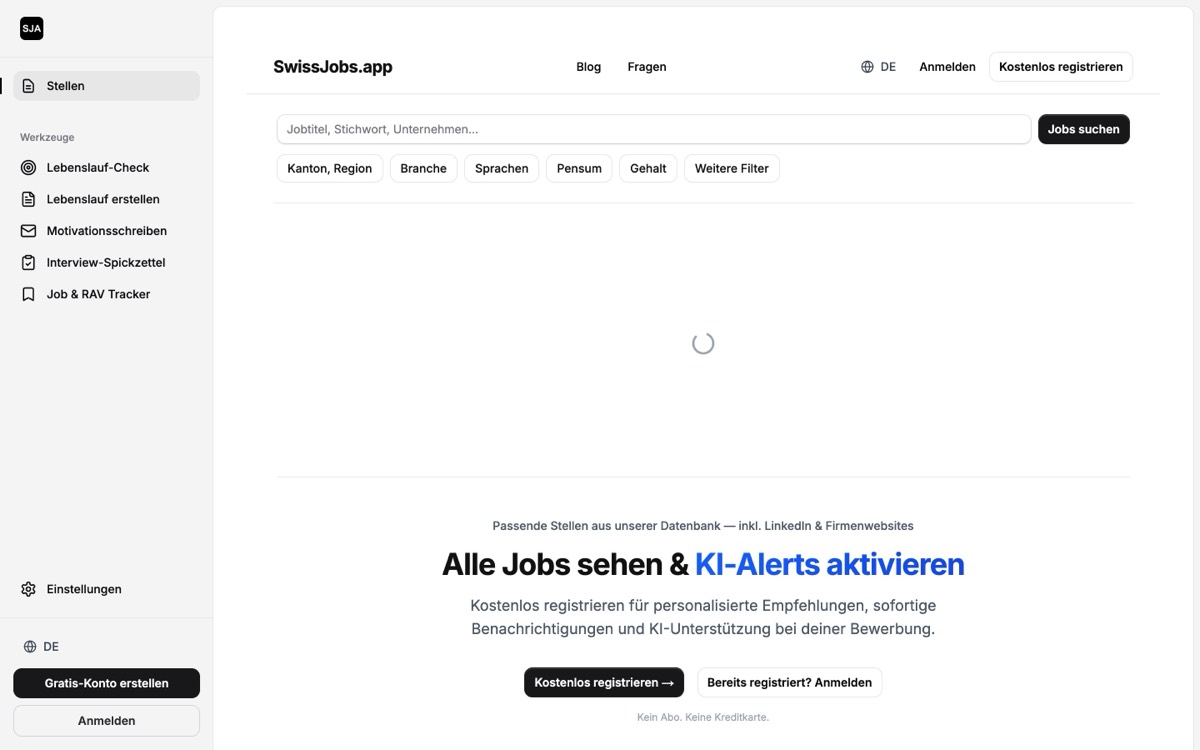
1. SwissJobs.appOur app
Over 21,000 open Swiss roles from ATS systems, company sites and LinkedIn in one place — and from any advert, straight into a CV, a motivation letter, a CV check and interview prep. The RAV job-search-efforts form fills itself from your application tracker. Free to use; the account is asked for at save.
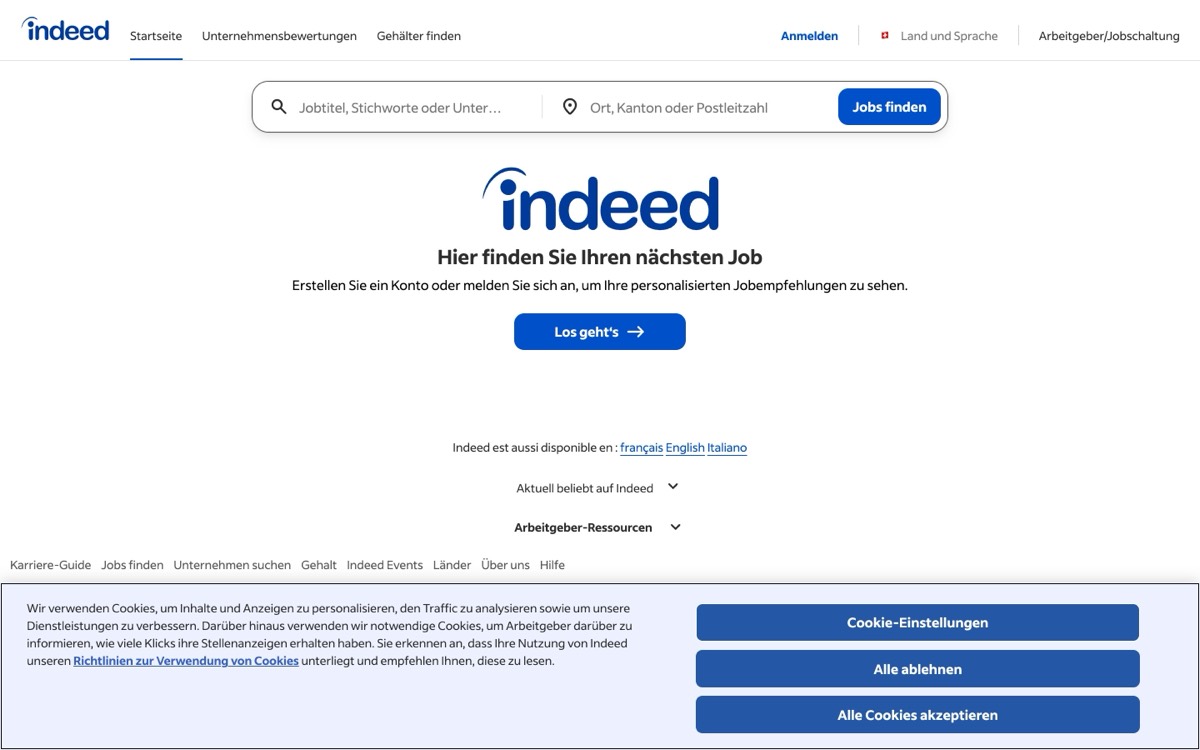
The broadest aggregation, because Indeed also collects from other boards — at the cost of many duplicates of the same advert.
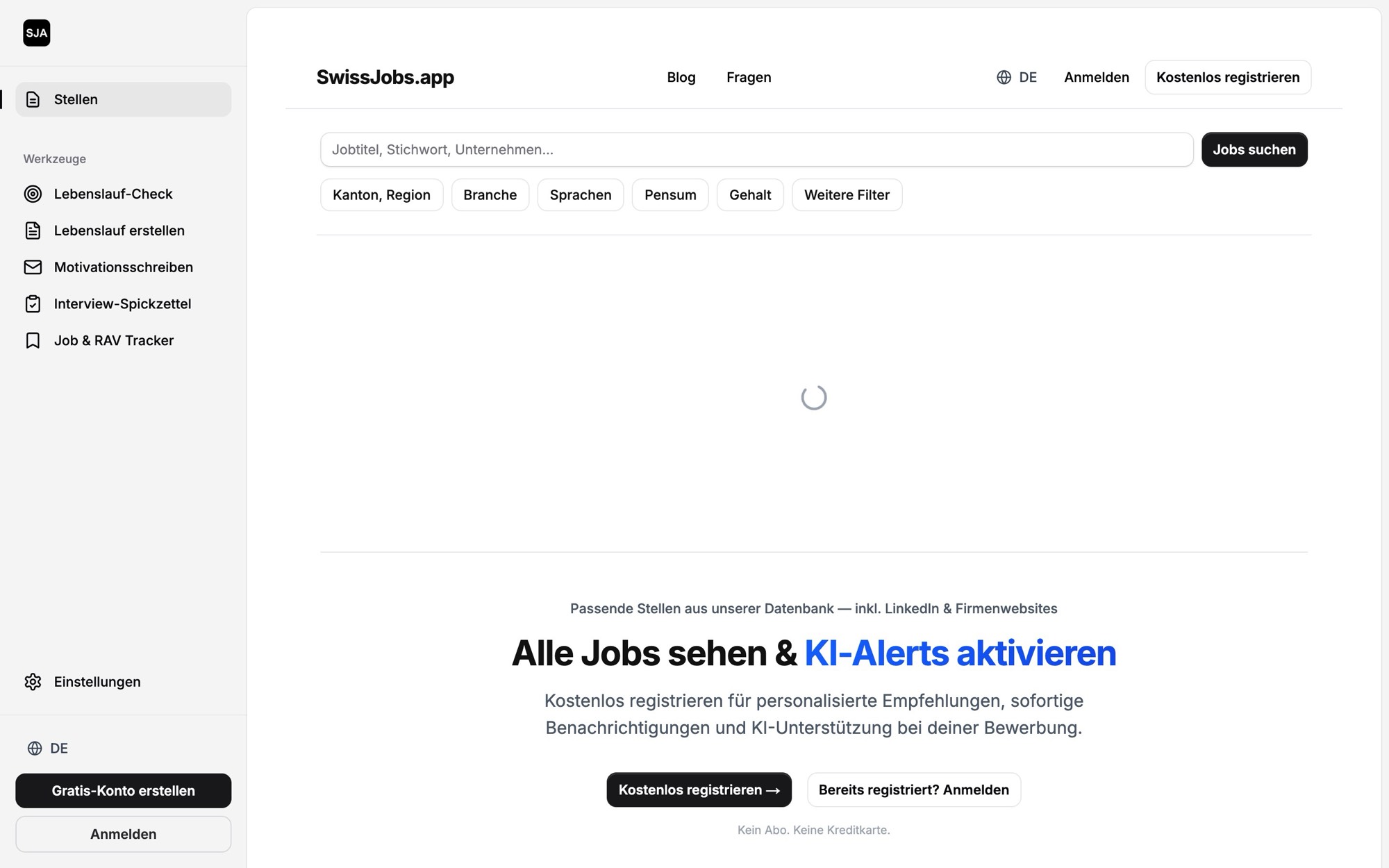
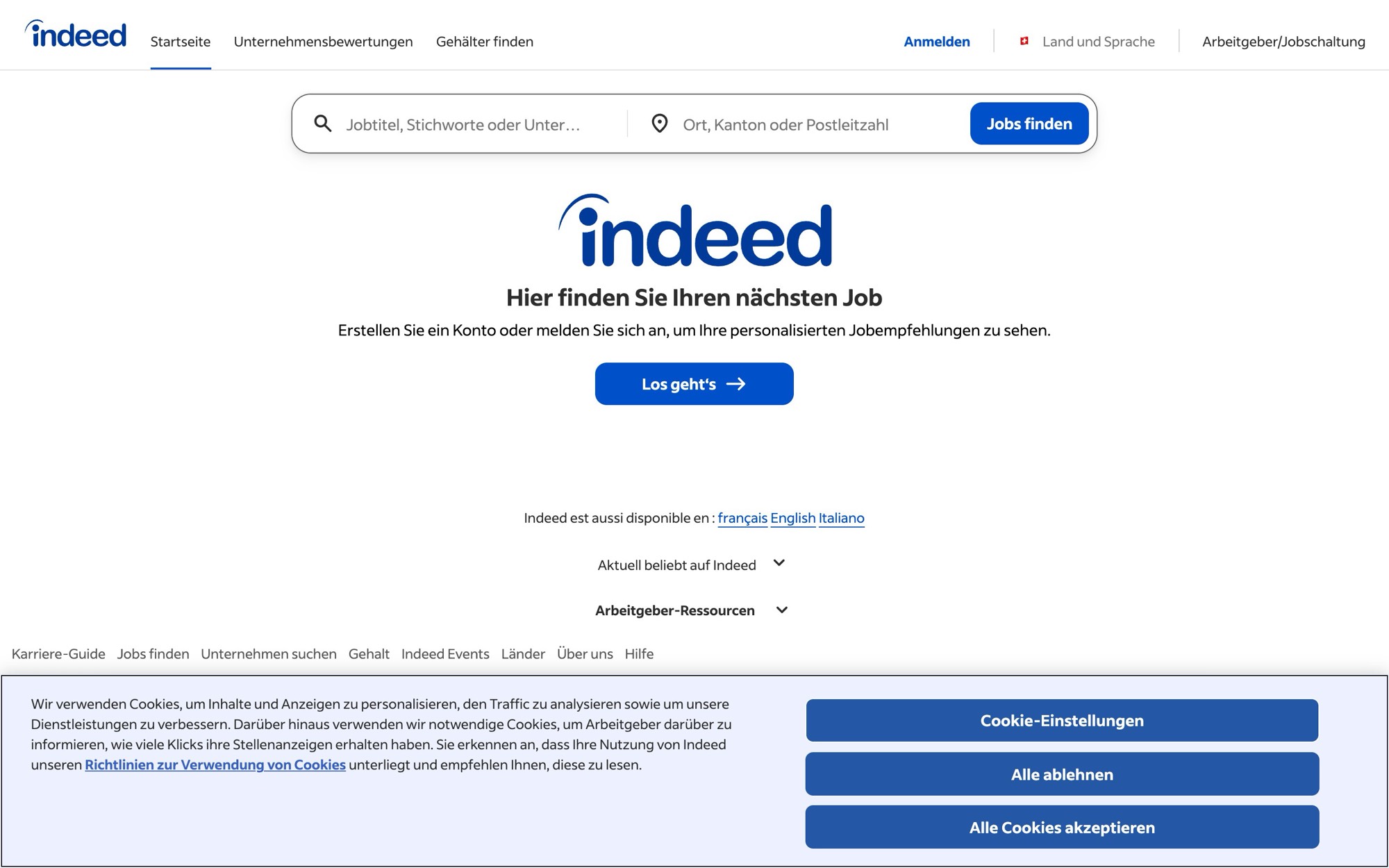
Both halves of that are checkable without taking our word for it. Indeed prints its counts in the page title of its own search, and the number changes when you pick a period under «Date» in the left-hand column. Our figures come from the index our own search served in the same hour.
If you are job-hunting in Switzerland from abroad, or you moved here recently, there is a second difference that matters more than either number — and it is not about size at all. It is about which language a job advert is written in, and neither platform makes that obvious in the same way.
Language detected automatically from the advert text, across the adverts open on SwissJobs.app on 4 September 2026. «Not classified» is stated rather than distributed, because guessing it would be inventing data.
- Indeed Switzerland, 4 September 2026, from the page title of its own nationwide search: about a hundred and thirty-seven thousand open jobs.
- With Indeed’s date filter set to seven days: about thirteen thousand, or 9.5 per cent of the stock. Three days: about seven thousand (5.1 per cent). Last 24 hours: about two thousand (1.5 per cent).
- The same calculation on our index, taken the same hour: 20.8 per cent of adverts are seven days old or less, 12.0 per cent three days or less, 3.1 per cent from the last 24 hours.
- In absolute numbers Indeed still wins even on fresh adverts — about thirteen thousand against a fraction of that with us. The share flips; the volume does not.
- Indeed rounds what it displays, so treat these shares as orders of magnitude, not decimals.
- The interface language does not filter the language of the jobs: the German-language Swiss search returned Italian adverts from Ticino and French adverts from Valais among its first results.
- In our index, 20.9 per cent of adverts are written in English, 41.3 per cent in German, 10.9 per cent in French and 1.7 per cent in Italian; a further 24.1 per cent could not be classified reliably.
- 67.1 per cent of our adverts state at least one required language and 20.7 per cent of all adverts ask for two or more — German is named in 44.1 per cent of adverts, English in 30.3 per cent, French in 14.9 per cent, Italian in 2.5 per cent.
- What else rides on a listing with us: a short summary on 91.4 per cent, the employment type on 84.1 per cent, an employer logo on 69.9 per cent — and on 100 per cent a direct link to where the application actually goes.
- Our own weak spot, from the same calculation: 19.6 per cent of our adverts share an employer and a title with at least one other entry, and the ten largest employers account for 16.4 per cent of the index.
Feature comparison
| Feature | SwissJobs.app | Indeed Switzerland | Indeed |
|---|---|---|---|
| Swiss job listings | Yes | Yes | not stated |
| Open jobs, as the site itself statesIndeed’s own page title on 4 September 2026, rounded. We publish shares of our index, never its absolute size. | not published as an absolute | about 137,000 for the whole country | not stated |
| Share of adverts from the last 7 daysComputed from Indeed’s own date filter (about 13,000 of about 137,000). | 20.8% | about 9.5% | not stated |
| Share of adverts from the last 3 days | 12.0% | about 5.1% | not stated |
| Share of adverts from the last 24 hours | 3.1% | about 1.5% | not stated |
| Date filter in the search | Yes — sort by date | Yes — «Date» filter | not stated |
| Workload (Pensum) filter | Yes | Yes | not stated |
| Employment-type filter | Yes | Yes | not stated |
| Remote-work filter | Yes | Yes | not stated |
| Search without an account | Yes | Yes | not stated |
| Email job alerts | Yes | Yes | not stated |
| Company reviewsA genuine Indeed advantage: former employees’ reviews exist there and not with us. | No | Yes | not stated |
| Salary section | Salary pages sourced from official statistics | Yes — «Find salaries» | not stated |
| Be found by employersSecond genuine advantage. We never show you to an employer. | No | Yes — searchable profile CV | not stated |
| Required language shown on the individual advertIndeed’s filter column has a «Language» entry; the individual result card carried no language information. | On 67.1% of adverts | not stated | not stated |
| Short summary of the advert in the list | On 91.4% of adverts | Excerpt from the advert text | not stated |
| CV tool | Yes — full generator and editor | Yes — profile CV, free | not stated |
| Generate a CV against one specific advert | Yes — in about a minute | No | not stated |
| Pick the advert from the site’s own index inside the generator | Yes | No | not stated |
| AI prompt that rewrites the document on instruction | Yes | No | not stated |
| Edit every line by hand | Yes | Yes — in the profile CV | not stated |
| Motivation letter for the same advert | Yes | No | not stated |
| CV check against that advert | Yes | No | not stated |
| Interview preparation | Yes | No | not stated |
| Application tracker | Yes | Saved jobs and application history in the account | not stated |
| RAV job-search-efforts form | Yes — the official SECO form ALV 716.007, filled from the tracker, in DE/FR/IT | No | not stated |
| PDF and Word export without a watermark | Yes, both | Profile CV as PDF | not stated |
| CV design variationsVariations on one Swiss format, freely combined — not 54 separate designs. | 54 (2 layouts x 3 fonts x 9 accent colours) | not stated | not stated |
| Swiss conventions in the document | Permit line, CEFR levels A1–C2, workload in per cent, photo, two-page norm | not stated | not stated |
| Interface in German, French, Italian and English | Yes, four separate language versions | Yes, via the country and language switcher | not stated |
| Built in Switzerland | Yes | No — global provider with a Swiss country site | not stated |
Indeed values read on ch.indeed.com on 4 September 2026. Where a value was not on the pages we checked, the cell says «not stated» rather than «No».
Prices side by side
| Item | SwissJobs.app | Indeed Switzerland | Indeed |
|---|---|---|---|
| Job searchIndeed costs job seekers nothing. That is a real argument and the first line an honest pricing table has to print. | Free | Free | not stated |
| Monthly price for the application tools | CHF 15 — all six tools, one subscription | not applicable — no paid tier for job seekers | not stated |
| Yearly price | CHF 95 a year (= CHF 7.92 a month) — the same six tools | not applicable | not stated |
| Free trialOur seven days are the complete product, not a limited preview. | 7 days, full access | not applicable | not stated |
| What works without payingWe print our own ceiling, because that is the number a comparison usually leaves out. | Search and tools open without an account; a free account allows 5 documents a day and 10 per rolling week | Search, alerts and applying; an account for saved items | not stated |
| Currency and billingWatch for four-week billing periods at any provider: that is 13 charges a year, not 12. | CHF, calendar month, cancel any time | not applicable | not stated |
| Who pays for the platformNot an accusation — it is the difference that explains the order of a result list. | The job seeker, if they want the tools. Posting is free with us and placement cannot be bought. | Employers, through sponsored adverts billed per click | not stated |
What Indeed Switzerland actually showed on 4 September 2026
We opened the Swiss Indeed search in an ordinary browser that day and wrote down what was there. The nationwide search with no keyword reports about a hundred and thirty-seven thousand open jobs in its page title. The filter column offers remote work, distance, employment type, language, workload, education level, industry and date. The header carries the home link, company reviews, salaries and the employer section, with a country-and-language switcher set to «Switzerland (German)».
Then we repeated the same request four times and changed nothing but the date filter. Last 14 days: about seventeen thousand. Last seven days: about thirteen thousand. Last three days: about seven thousand. Last 24 hours: about two thousand. All four numbers come from Indeed’s own page title, and all four are rounded by Indeed — the order of magnitude holds, the decimal place does not.
Two observations from the result list itself, both worth knowing before you rely on it. First, the German-language interface does not restrict the adverts to German: among the first results were an Italian-language posting from Riazzino in Ticino and two French-language ones from Verbier in Valais. Second, the same Swiss Post job in Verbier appeared twice in a row, once under «Die Schweizerische Post AG» and once under «La Poste Suisse». An aggregator collects what it finds, and one employer can arrive under several names.
Worth saying in fairness: the filter is labelled «Pensum», the Swiss word for workload as a percentage, not a translated «part-time level». A global platform that uses the local term has done more localisation work than its reputation suggests.
The one calculation Indeed’s own date filter makes possible
A date filter is a gift to anyone comparing two job boards. It does not measure what a platform says about itself. It measures what the stock actually contains, and it measures it the same way on both sides: what share of the listings on offer is less than a week old?
On Indeed that is about 9.5 per cent — thirteen thousand out of a hundred and thirty-seven thousand. In our index it is 20.8 per cent, a little over double. At three days: 5.1 per cent against 12.0 per cent. At 24 hours: 1.5 per cent against 3.1 per cent. The ratio holds across all three windows, which is a good sign that it is not the artefact of a single measurement.
Be careful what you take from that. It does not mean Indeed has fewer fresh jobs — counted in listings, Indeed has considerably more of them than we do, and that stays true. It describes density: on Indeed roughly one listing in ten is from the past week, with us roughly one in five. If you work through a list until your patience runs out, you pass more current adverts per screen with us.
And a limitation on our own side, because someone else would find it otherwise: our index has a gap between eight and thirteen days old, where almost nothing sits. Our fourteen-day figure of 21.6 per cent is therefore understated and no use for any comparison. The three-day and seven-day figures are unaffected, and those are the ones quoted above.
The language of the interface is not the language of the job
This is the difference that matters most if you are arriving, and it is invisible in any listing count. Switzerland has four language regions, and the language an advert is written in usually decides who may apply. Switching a job site to English changes the buttons. It does not change the adverts.
In our index, 41.3 per cent of adverts are written in German, 20.9 per cent in English, 10.9 per cent in French and 1.7 per cent in Italian; for 24.1 per cent the language could not be determined reliably, and the small remainder is spread across other languages. That English fifth is the single most useful number for someone relocating: an advert written in English almost always means English is a working language of the team, which is a much stronger signal than a company website in English.
The requirement stated inside the advert is the other half. 67.1 per cent of our adverts name at least one required language, and 20.7 per cent of all adverts ask for two or more. German appears in 44.1 per cent of adverts, English in 30.3 per cent, French in 14.9 per cent, Italian in 2.5 per cent. We show that on the listing, before you open it. It is read out of the advert text automatically, so it is an estimate rather than the employer’s own wording — but an estimate you can see beats a question you have to answer by reading every posting.
On Indeed’s result cards we found no equivalent. There is a «Language» entry in the filter column, and adverts in three languages came back on a German-language search — so the information exists somewhere in their system, but the card does not carry it.
What a Swiss application asks for that a global form does not
A Swiss dossier is not an American resume with different spelling. It expects Arbeitszeugnisse — the written employer references every Swiss job leaves behind, which candidates attach to the application. A photo is conventional here rather than discouraged. Language ability is given as a CEFR level — B2 or C1 — rather than as «fluent», and the workload appears as a Pensum, a percentage of a full working week; an advert reading «80–100%» is completely normal rather than a part-time exception. Two pages is the norm, not a failure of concision.
If you are not a Swiss or EU/EFTA citizen, one line does more work than any other: your permit status. A B, C or G permit, or the fact that you already hold the right to work, belongs near the top of the CV, because it is the first thing an HR department checks. No global CV form has a field for it.
This is where a tool that only lists jobs stops being enough. We generate the document against the advert you picked, with those Swiss elements built into the format — and then let you change every line by hand or by instruction. What we will not claim is that this gets you through an employer’s filter. What happens inside an employer’s screening step is visible to nobody — not to the candidate and not to a tool. All that can be shown is the mechanics: if a screen looks for the words in the posting, a document containing those words is likelier to be picked up than one all-purpose CV sent everywhere.
Where Indeed is the better answer
Reach. A basic posting on Indeed costs an employer nothing, which opens the list to businesses for whom a paid slot on a Swiss portal is simply out of budget — the dental practice, the country hotel, the four-person workshop. If your search term is rare, your profession small or your region away from the centres, Indeed’s hit count is hard to beat, and more results beats a better share when the alternative is no results.
Regionally that is measurable. In canton Ticino, Indeed listed about a thousand open jobs on 4 September, 200 of them from the last seven days. Ticino adverts make up 1.4 per cent of our index and the median Ticino advert with us is 56 days old — our worst figure of any sizeable canton. In canton Geneva, Indeed showed about three thousand and 600 from the last week; we hold 7.3 per cent of our index there at a median age of 31 days. For a search restricted to Ticino, Indeed is the better tool, and our freshness arithmetic does not change that.
Two features we simply do not have. Company reviews are one. The searchable stored CV is the other — if you would rather be approached than search, Indeed gives you a channel we do not offer and do not intend to.
And Indeed costs a job seeker nothing at all. Our search is free too, but our application tools cost CHF 15 a month after the trial. If you only want to read adverts and write everything yourself, Indeed never asks you for money.
Our own weak spots, so you do not have to go looking
We held a duplicated listing against Indeed above. We have the same problem: 19.6 per cent of our adverts share an employer and a title with at least one other entry. Some of those are genuine multi-location postings of the same role; some are duplicates. Anyone criticising an aggregator for this owes their own number beside it.
The index is unevenly weighted. The ten largest employers carry 16.4 per cent of all adverts and the single largest 6.0 per cent. In the other direction, 45.2 per cent of the employers in our index have exactly one advert. And 0.5 per cent of adverts are more than a year old; the median advert is about 30 days old and a quarter of the index is older than 78 days.
Geographically we are thin where it costs the most: Ticino 1.4 per cent, Vaud 5.5 per cent, Geneva 7.3 per cent of the index. Among the larger cantons our stock is freshest in Bern (median 23 days, 33.2 per cent from the last week), Aargau (25 days) and Zurich (29 days), and oldest in Ticino (56 days), Lucerne (46 days) and Vaud (43 days).
Who should use which
Use Indeed if you want the largest possible number of results, if you are searching a small region or a rare profession, if you want to read company reviews, if you would rather be found than search — or if you are searching in Ticino. In all of those cases Indeed is the honest recommendation, and it costs you nothing.
Use SwissJobs.app if you are actually applying rather than browsing: if your time is short and you would rather scroll past less dead stock, if you need to know whether a role requires German before you open the advert, and if the listing you found should turn straight into a dossier written for it rather than one CV sent everywhere.
Using both is not a contradiction — searching is free on either side and the two stocks only partly overlap. If you are registered with an RAV, the public employment service’s own portal, Job-Room, belongs in the rotation as well. And the record of your job-search efforts only counts once it is filed with your RAV; our form helps you fill it in, it does not replace the filing.
Indeed figures read on ch.indeed.com in an ordinary browser on 4 September 2026: the home page, the nationwide search with no keyword, the same search with the date filter set to 14, 7, 3 and 1 day, and the cantons of Ticino and Geneva. Every Indeed number comes from the page title of that search and is rounded by Indeed. Our own figures come from the adverts open on SwissJobs.app on 4 September 2026: age from the posting date, cantons resolved from the location text (about a third of adverts name no resolvable place), advert language and language requirements read automatically out of the advert text and therefore an estimate. All our figures are shares of the index rather than absolute counts, and they change daily.
Search Swiss jobs and tailor your CV to the advert you pick
Jobs by profession, city or language
Type a profession, a city or a language, the page shows the adverts currently open for it.
By profession
- Consultant
- Project Manager
- Retail Sales
- Nurse
- Nursing & Care
- Administrative Assistant
- Account Manager
- Software Engineer
- Public Administration
- Architect
- Insurance
- Chef
71 more — narrow the search
By work type
Sources
Related questions
What our job index says about the Swiss market
Computed live from our own index, not quoted from a study. Shares only, as of today.
Language the advert is written in
- Deutsch
- 60%
- English
- 23%
- Français
- 13%
- Italiano
- 3%
Of adverts that state a language requirement, the share asking for
- Deutsch
- 70%
- English
- 43%
- Français
- 21%
- Italiano
- 3%
19% posted in the last 7 days · Largest markets: Zürich 18% · Bern 10% · Genève 5% · Basel 5%