Temp agency or applying directly — which leads to a permanent job faster?
Updated:
In short
These are answers to two different questions. A Swiss temp agency — a Temporärbüro, legally a Personalverleih or staff-leasing firm — is usually faster to a first pay cheque, because it fills from people it already employs instead of opening a selection process. It is not automatically faster to a permanent contract: Swiss law sets no maximum length for an assignment and no point at which one must turn into permanent employment. The one hard date is at three months, and it works in your favour. As of 28 August 2026.
The Swiss job portals at a glance
Click an image for the full-size view. What each portal actually is stands beside it.
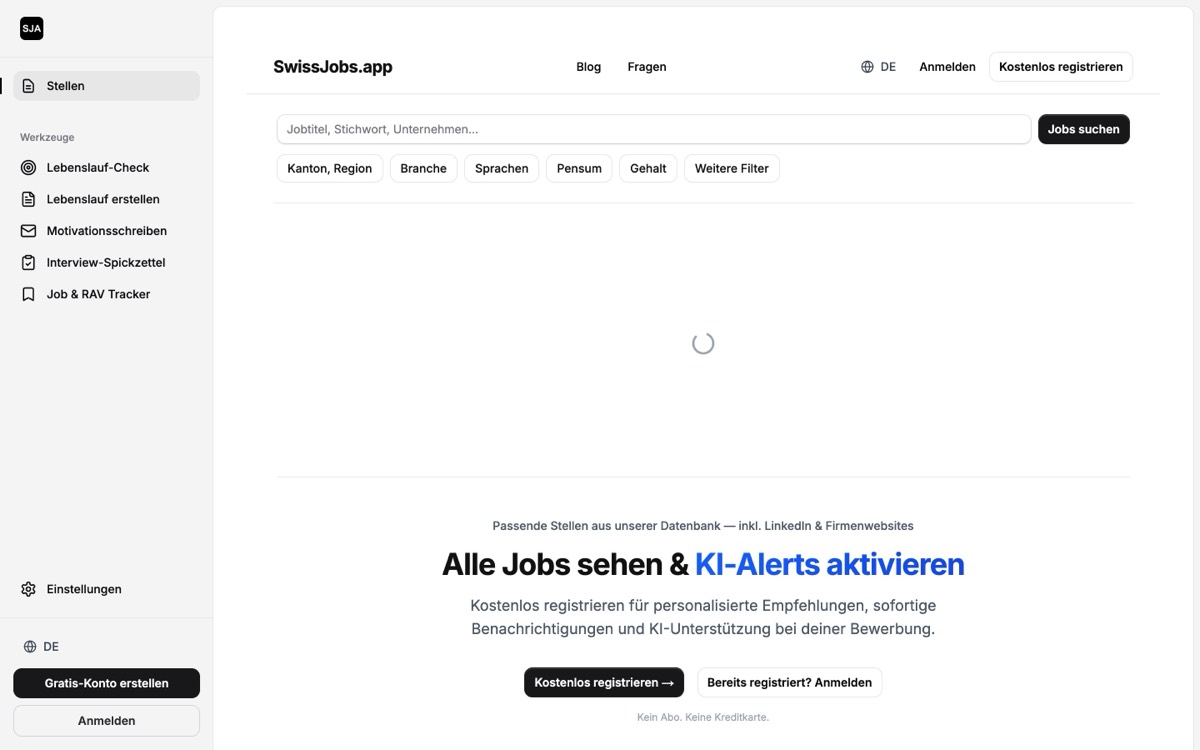
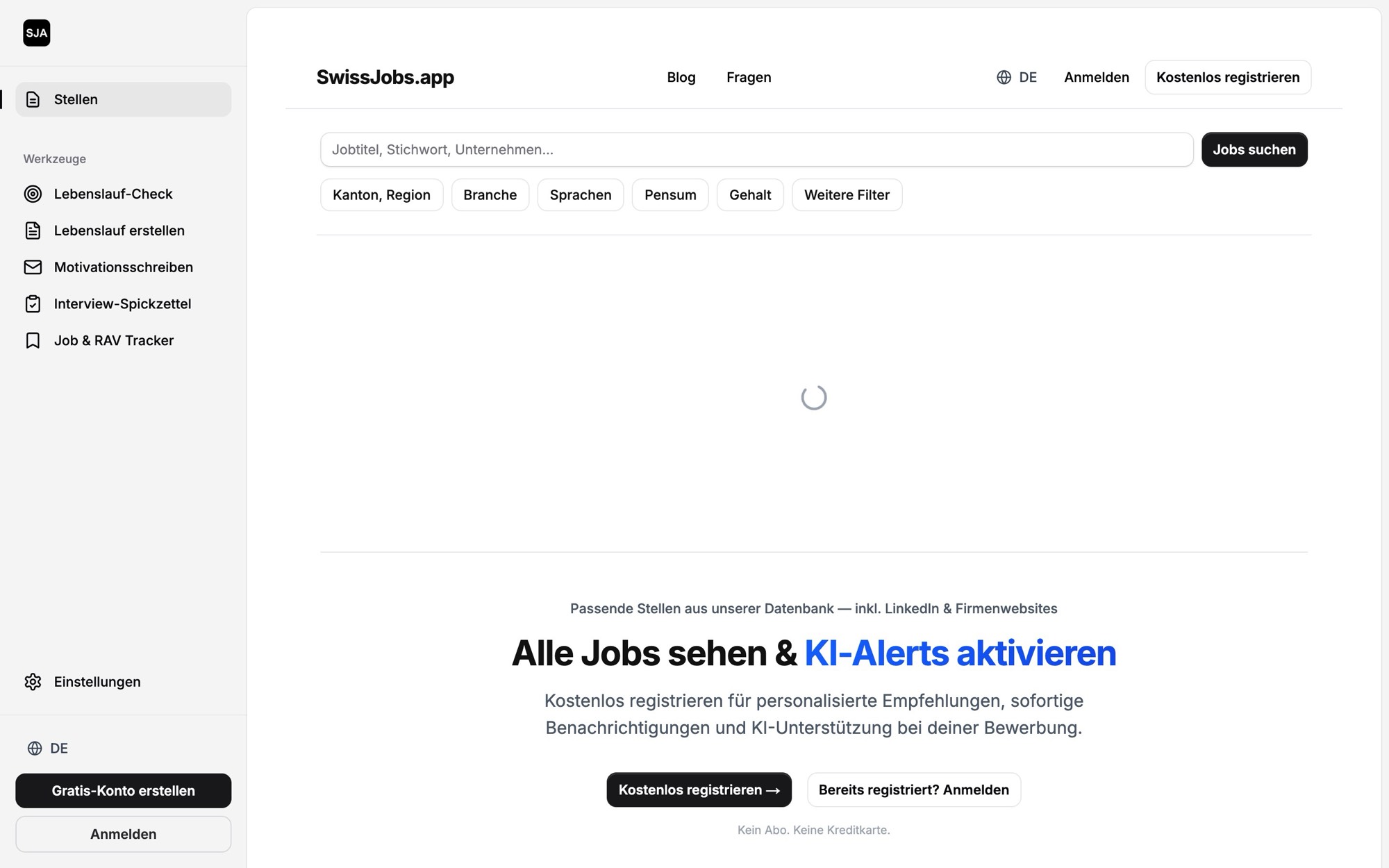
1. SwissJobs.appOur app
Over 21,000 open Swiss roles from ATS systems, company sites and LinkedIn in one place — and from any advert, straight into a CV, a motivation letter, a CV check and interview prep. The RAV job-search-efforts form fills itself from your application tracker. Free to use; the account is asked for at save.
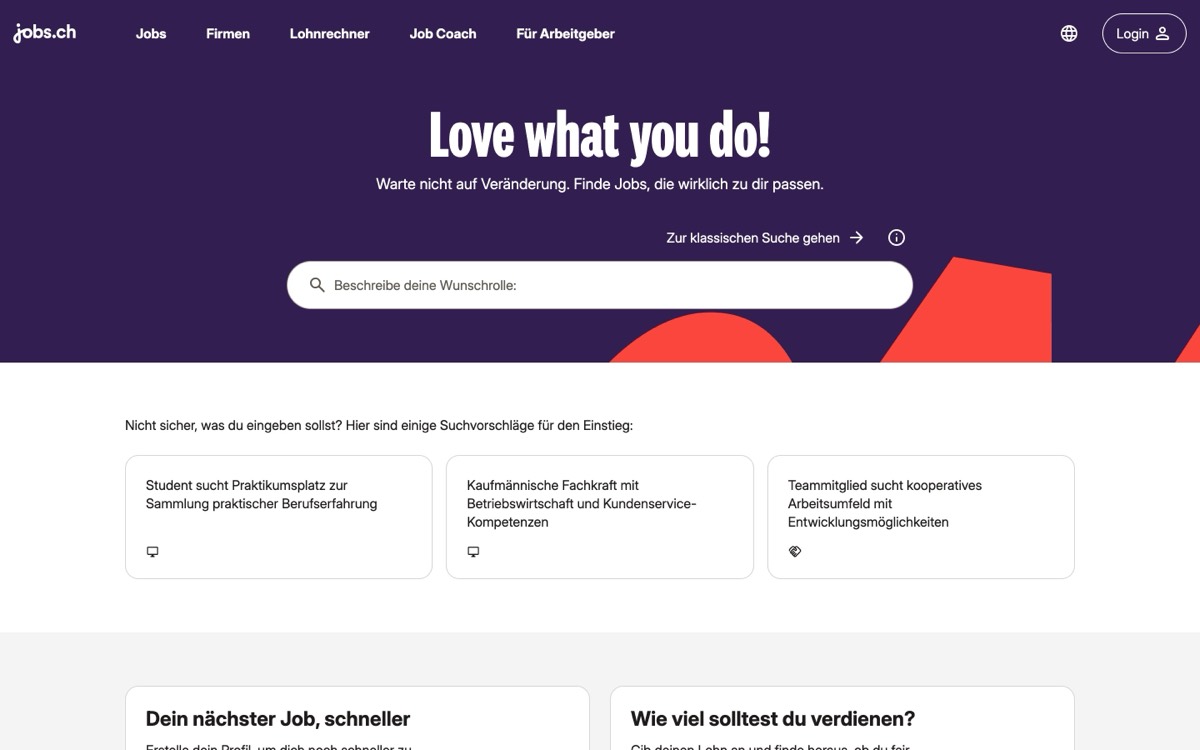
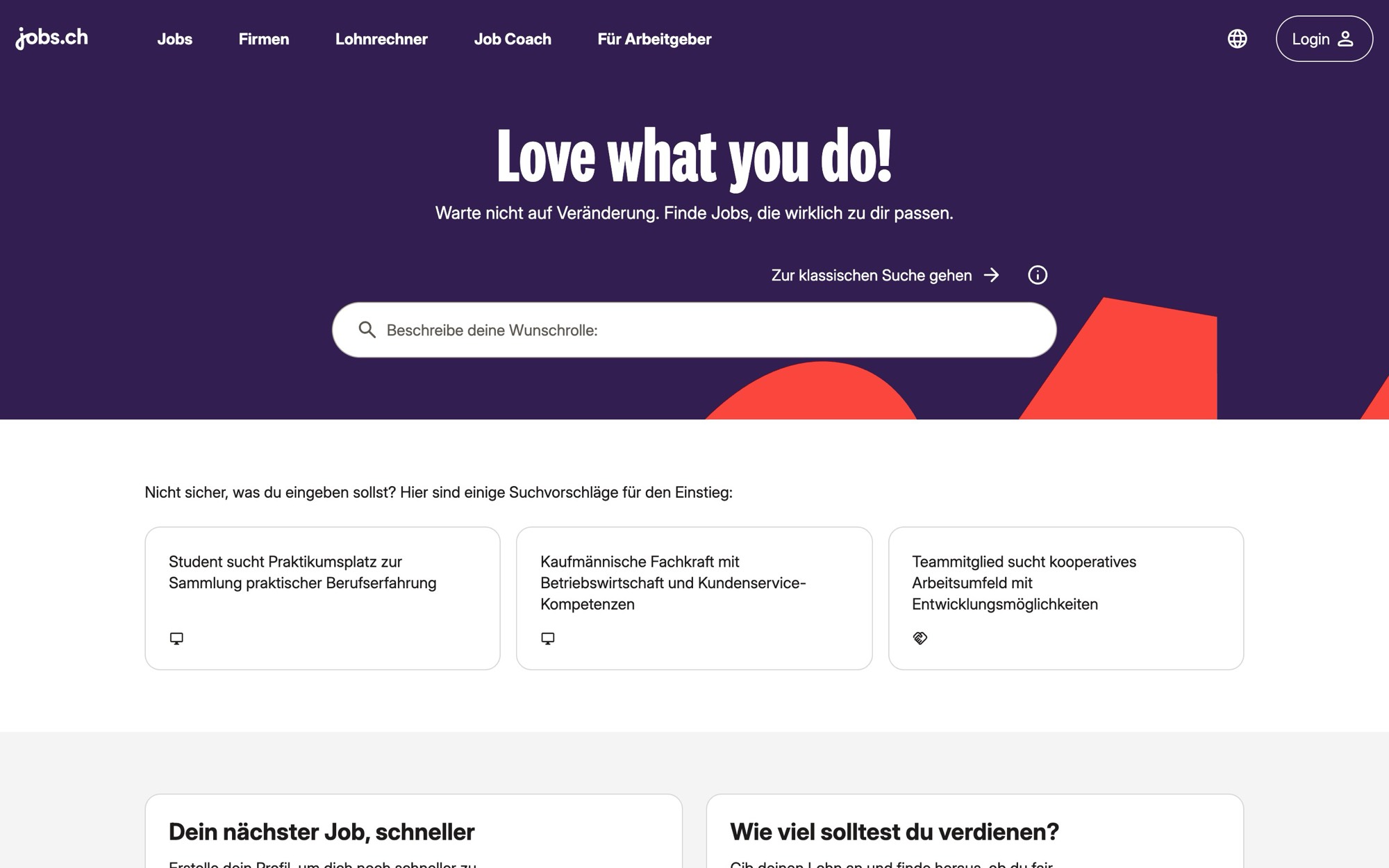
The best-known board in German-speaking Switzerland and the largest index in the country. Owned by JobCloud AG — as are jobup.ch and JobScout24.
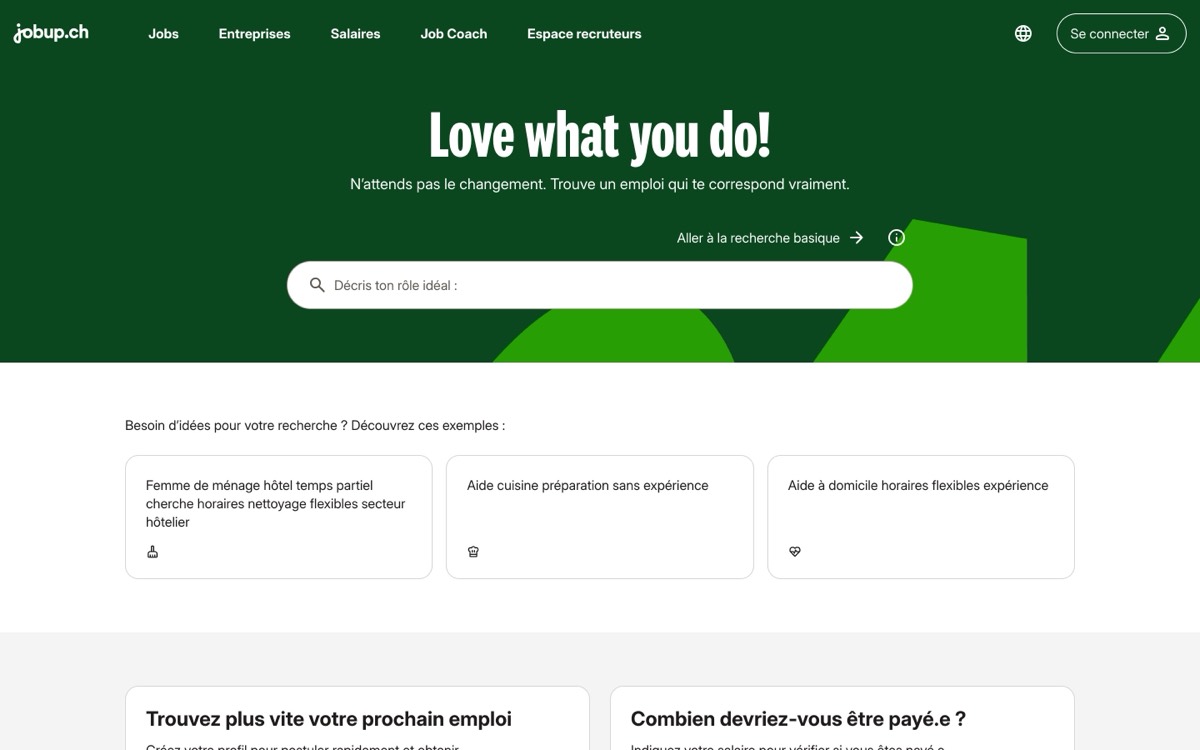
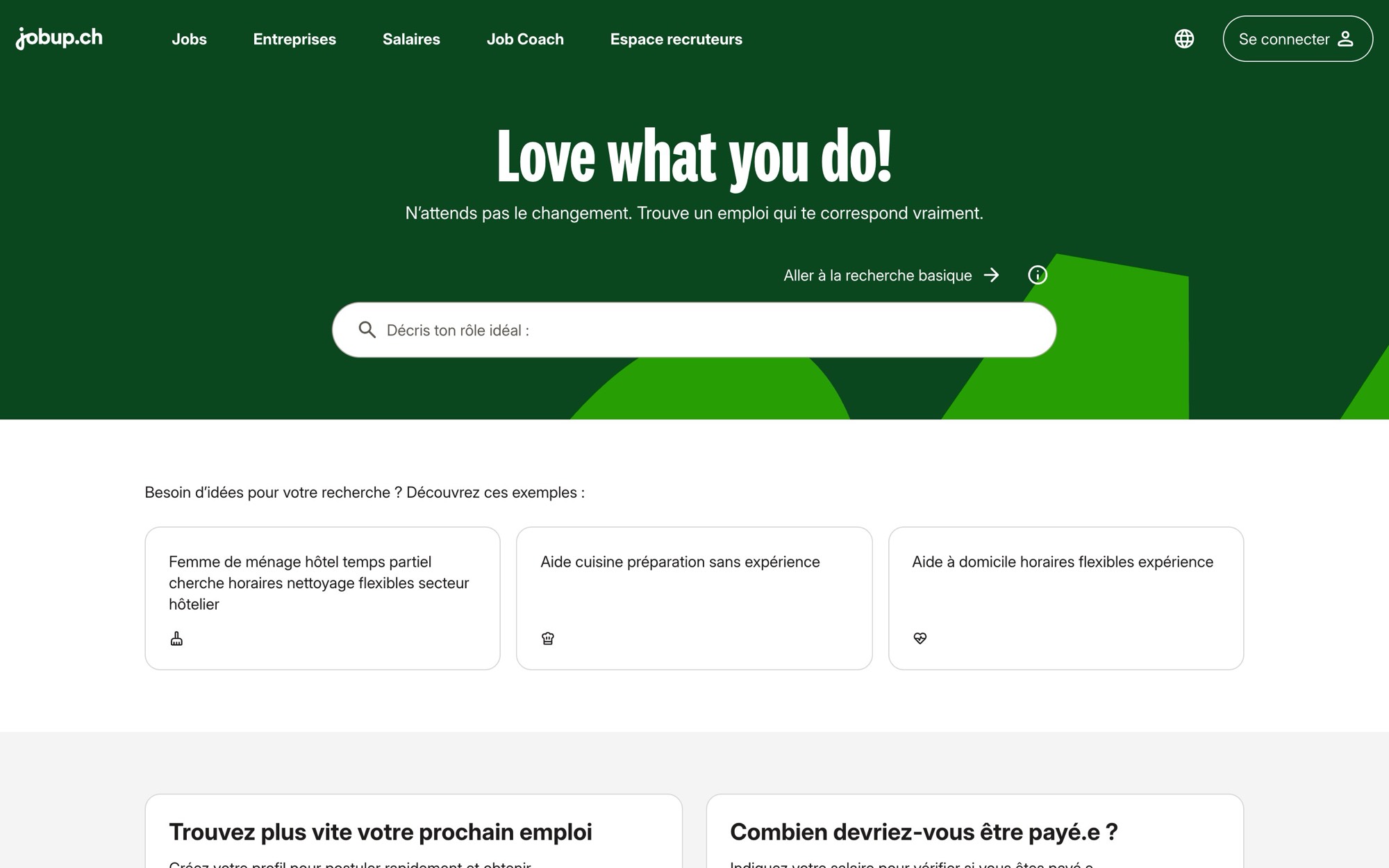
The standard in French-speaking Switzerland and the first place to look for the Romandie — but the same JobCloud AG as jobs.ch.
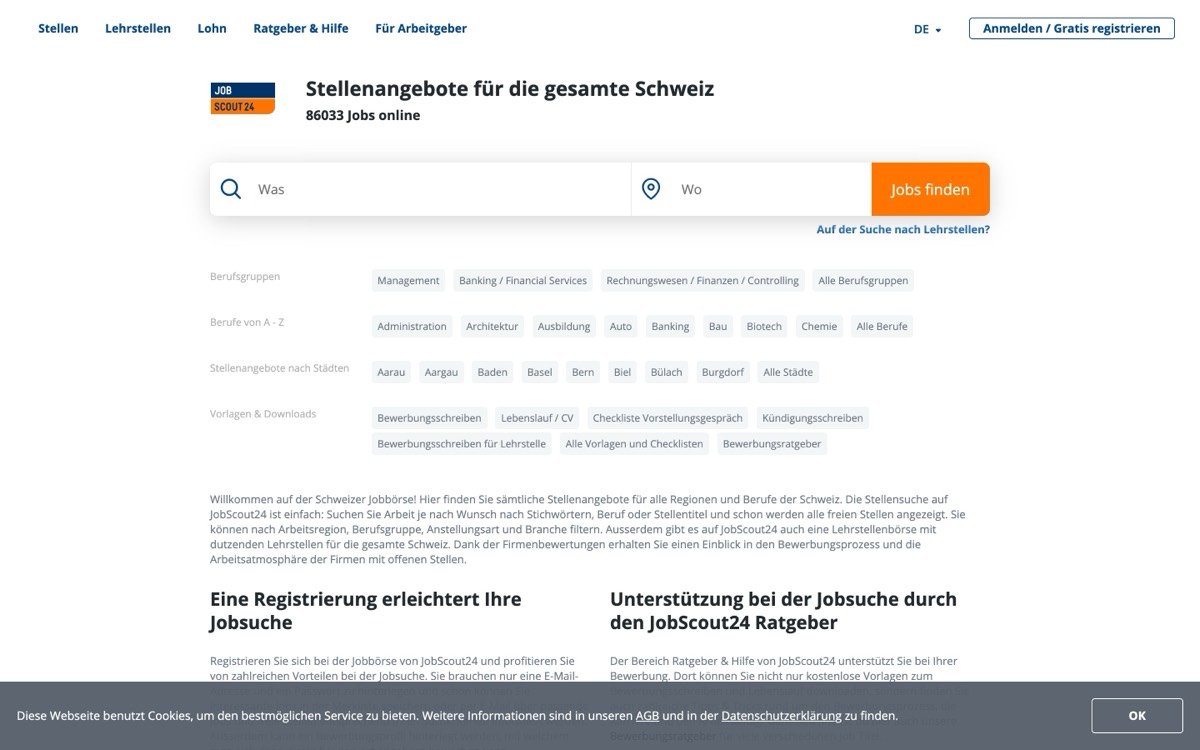
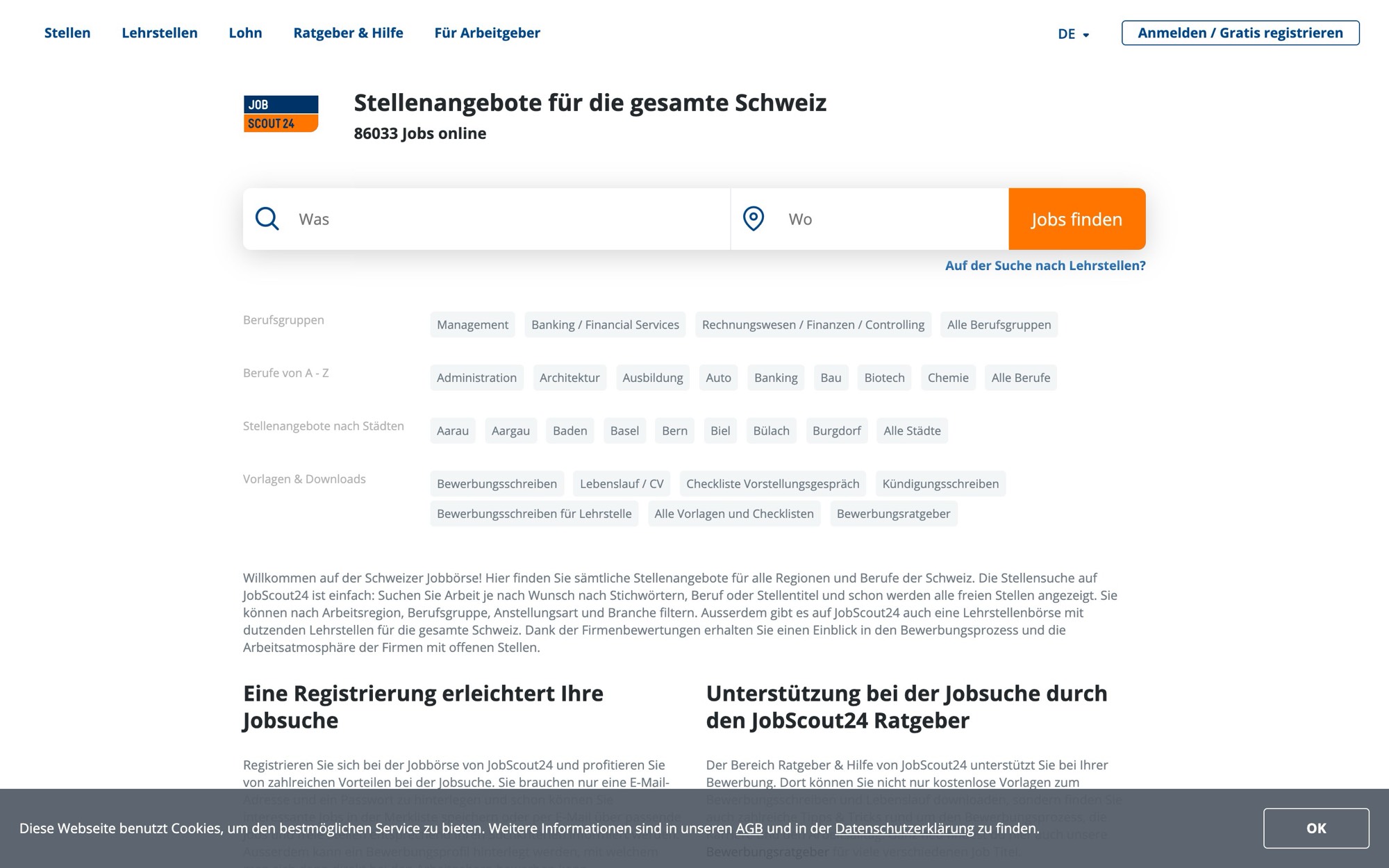
A third brand from the same company. Searching all three to widen your search means searching one provider three times.
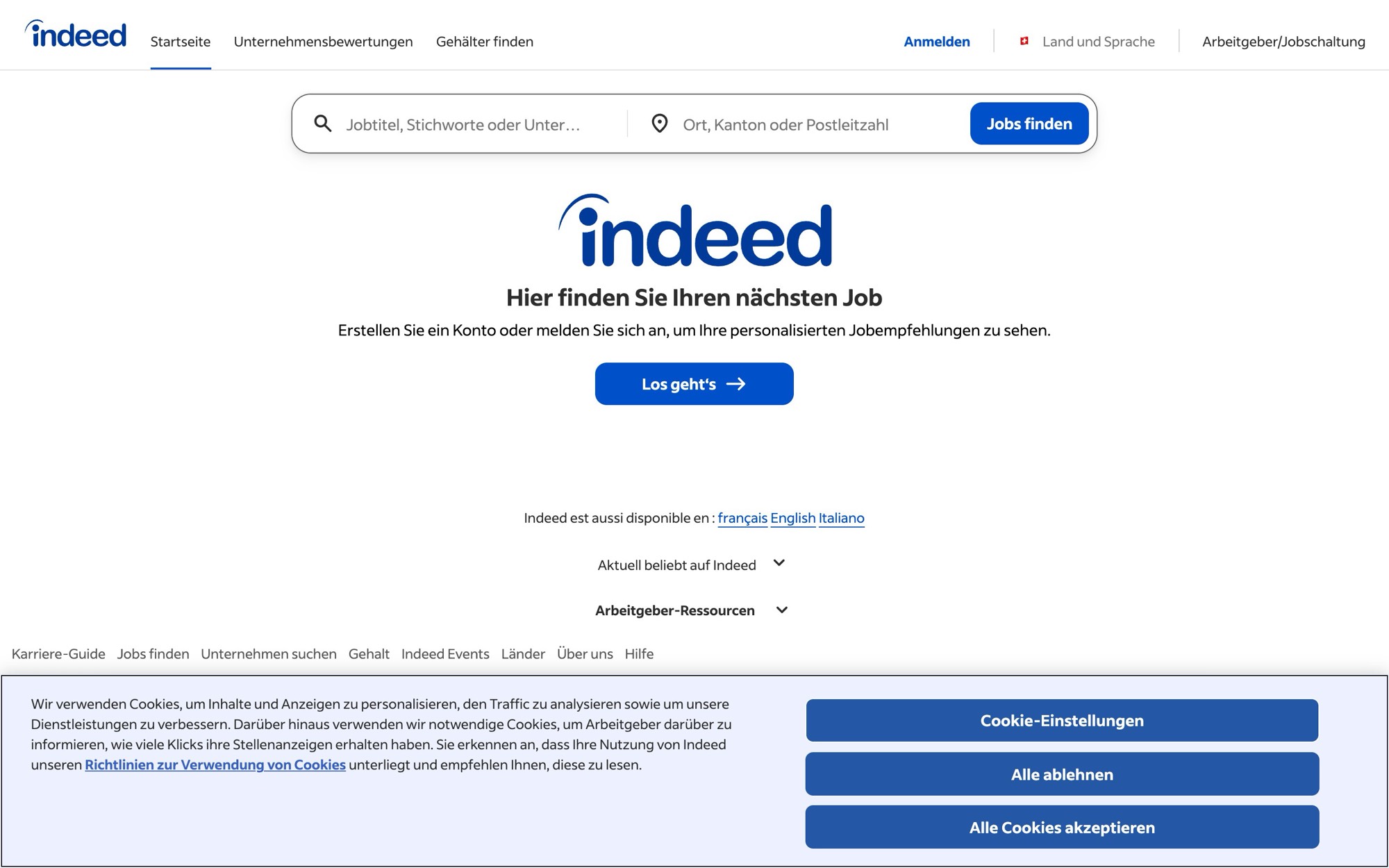
The broadest aggregation, because Indeed also collects from other boards — at the cost of many duplicates of the same advert.
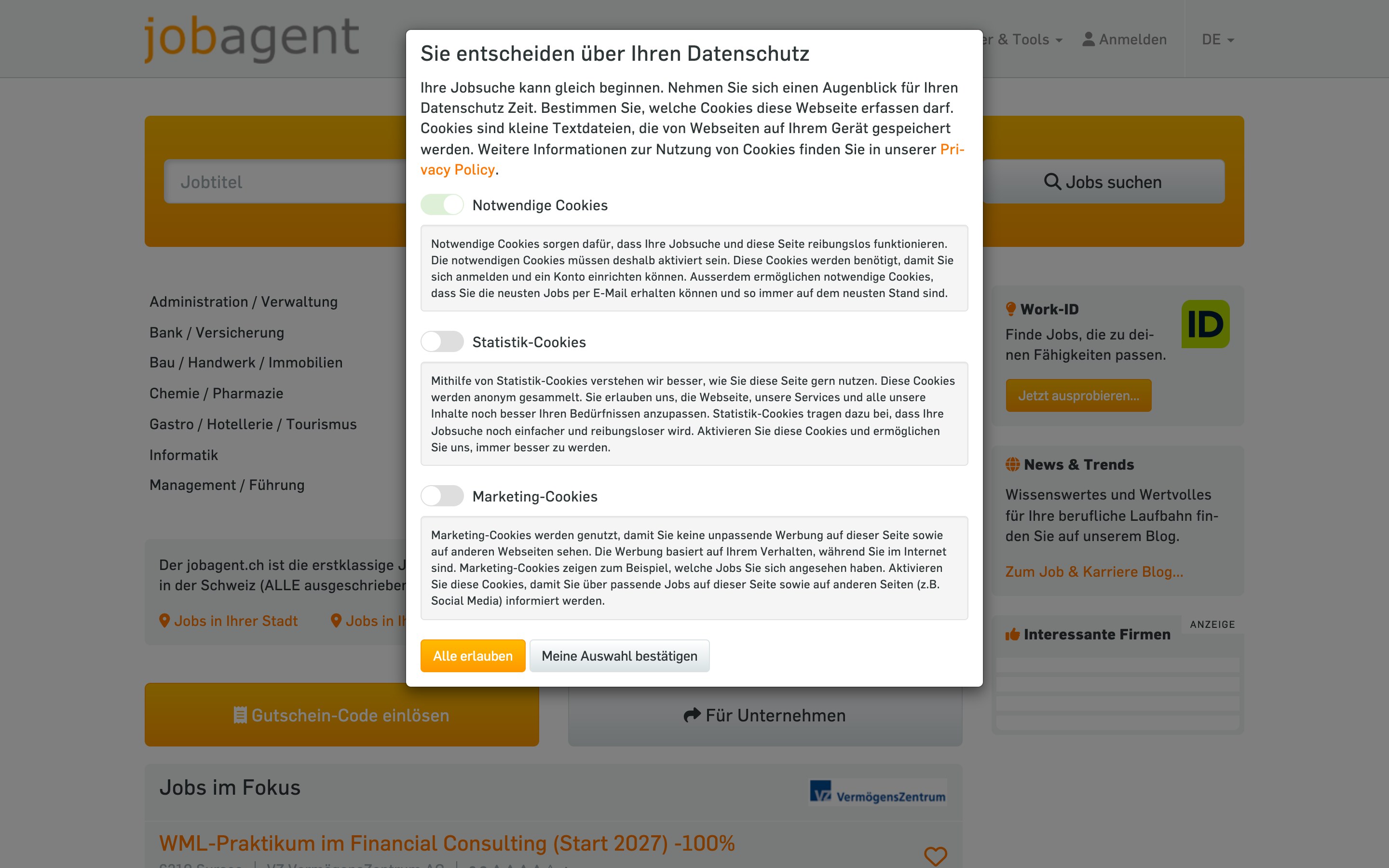
The best reputation for English-speaking and international roles in Switzerland. Considerably thinner for trades, care and commercial roles.
A meta-search across the Swiss job boards, "every job in Switzerland at a glance". Its strength is the Job-Abo: a saved search that mails you new adverts from every portal it covers. Salary calculator and application guides alongside.
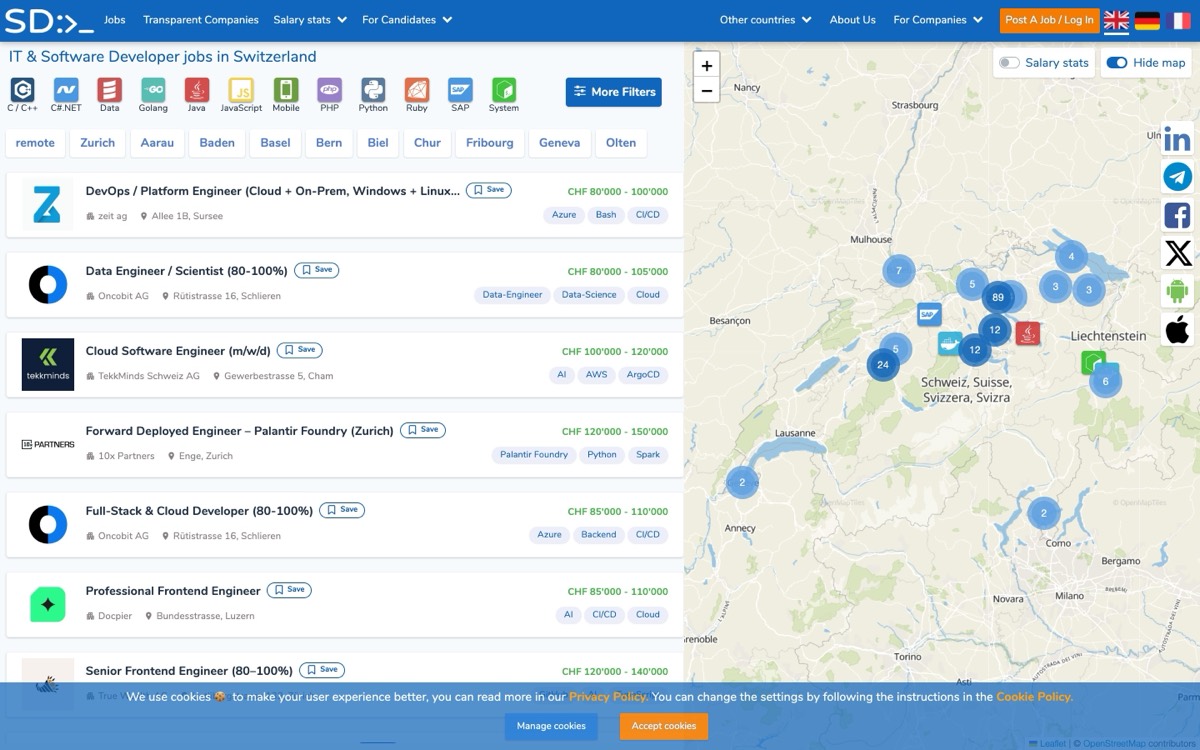
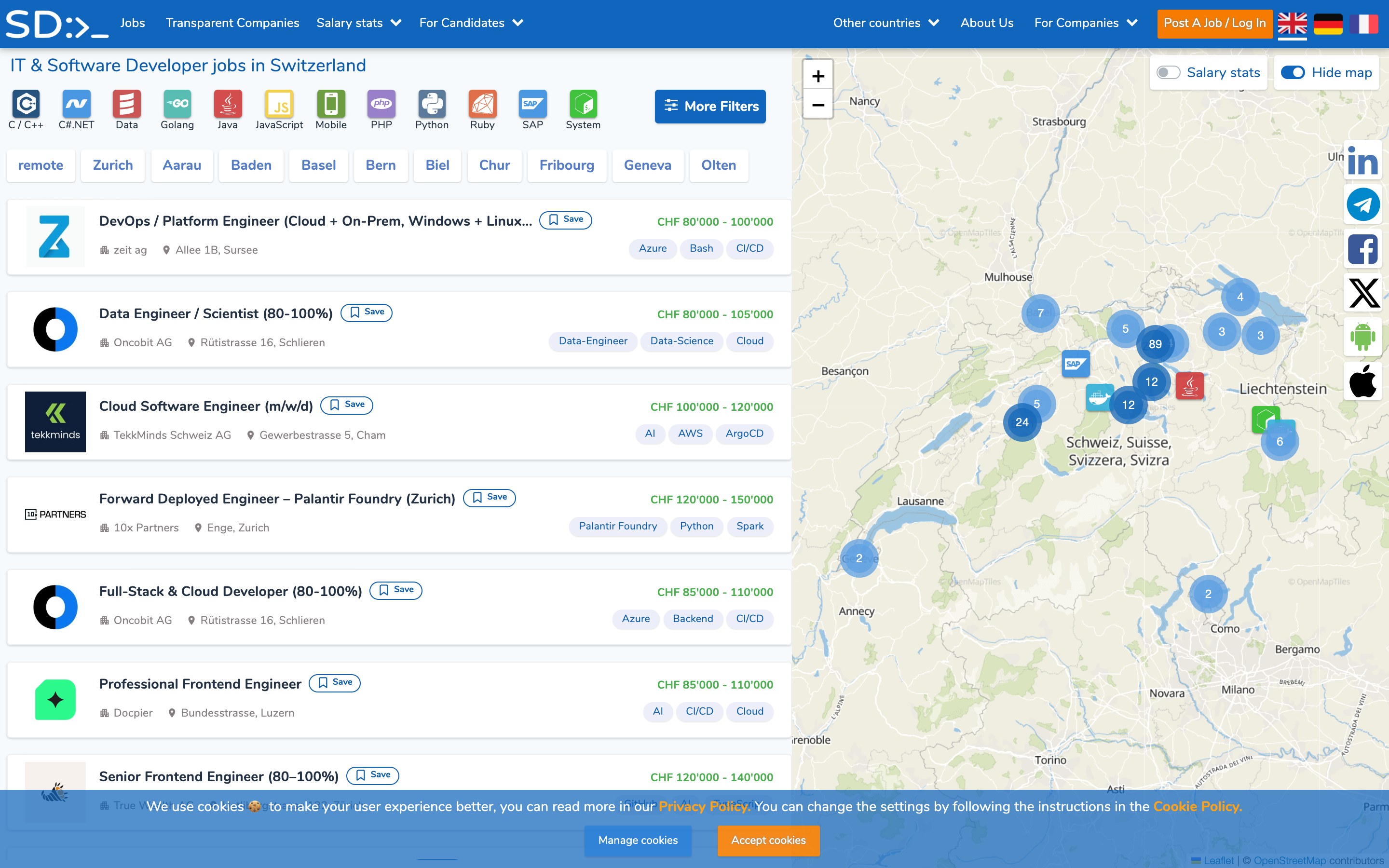
IT and software only, and thorough about it: "183 IT & Software developer jobs in Switzerland", filtered by technology (C#, Java, Python, DevOps, ML) rather than by industry. Publishes salary statistics and lists the companies that disclose their ranges. The site itself is in English.
Jobs by profession, city or language
Type a profession, a city or a language, the page shows the adverts currently open for it.
By profession
- Consultant
- Project Manager
- Retail Sales
- Nurse
- Nursing & Care
- Administrative Assistant
- Account Manager
- Software Engineer
- Public Administration
- Architect
- Insurance
- Chef
71 more — narrow the search
By work type
If you are searching in English, there is something you should know before you weigh the two routes: you can barely see the agency channel. Of the English-language adverts we carry, 0,8 per cent come from a staffing or placement firm. In German-language adverts it is 10,6 per cent, in French 16,0 per cent and in Italian 39,3 per cent. The channel does not shrink because you search in English — it disappears from your screen.
The three-month date comes from article 22 paragraph 3 of the Employment Services Act (Arbeitsvermittlungsgesetz, AVG). An agency may claim a fee from the company you were placed with only if the assignment lasted less than three months and you move across less than three months after it ended, and even then the amount is capped. Past three months, hiring you costs that company nothing extra. Nothing comparable exists on the direct-application route, because there is no third party to pay off.
Share of the open adverts on SwissJobs.app whose poster is a staff-leasing or placement company, calculated on 28 August 2026 from keywords in the job title. In retail and hospitality, employers advertise almost everything themselves.
- Notice periods during an assignment are short and cut both ways: two days' minimum notice applies for the first three months and seven days' from month four through month six (art. 19 para. 4 AVG), rising to one month from month seven under the staff-leasing collective agreement (GAV Personalverleih).
- Agreements that prevent or hinder your move to the company you were placed with are void, as are agreements charging you fees or withholding part of your wage (art. 19 para. 5 AVG). Registering with an agency is free for the candidate; the client company pays.
- The agency route barely exists in some occupations. Staffing firms account for 28,4 per cent of the adverts we carry in IT and engineering, but 3,3 per cent in retail and hospitality — and 0,0 per cent of apprenticeships and internships.
- Swiss law sets no maximum assignment length. Germany's AÜG caps an assignment to the same client at 18 consecutive months; Italy's rules convert a fixed-term arrangement to open-ended after 24 months; France caps most missions at 18 months and pays a 10 per cent end-of-mission indemnity. Switzerland has none of these.
- The industry association swissstaffing published in 2019 that one in two temporary workers looking for a permanent job had found one within 24 months of starting their first assignment. Two years is a long answer to a question about speed.
- An agency must hold a cantonal licence, plus a federal one if it places people across the border. The federal register of licensed firms lists over seven thousand of them and is public — worth a look before you sign anything.
Temp agency or applying direct
| Criterion | Through a temp agency | Direct to the employer |
|---|---|---|
| Cost to you | none | none |
| Access to roles | including unadvertised ones | only what you find |
| Who employs you | the agency | the company |
| Pay | lower; the agency takes a margin | full |
| Conversion to a permanent role | common, often after a period | immediate |
| Notice periods | short, under the staff-leasing CLA | CO art. 335c |
| Entering a field or changing sector | a genuine door-opener | harder without references |
The agency costs you nothing — the company pays it. The price is elsewhere: your contract is with the agency rather than the workplace, and the wage sits below what the company would pay you directly.
Two clocks, not one
The confusion in this question comes from running two measurements together. The first clock measures how long until you are earning again. The second measures how long until you hold an open-ended contract. The agency wins the first clearly. On the second it has no reliable advantage, and treating a promise about the first as a promise about the second is the mistake the whole industry benefits from.
On the first clock the evidence is one-sided. An economic report written by Swiss Economics for swissstaffing in 2025, on the use of temporary staff in hospitals, quotes the sector's own selling point: in an emergency a suitable candidate is sometimes organised within six hours. The same report notes that filling a vacancy with a permanent hire normally takes something between three and twelve months.
Our own adverts show the same rhythm from the other side. Among the adverts posted by staffing and placement firms, 54,6 per cent had appeared within the two weeks before our last data refresh, against 15,8 per cent of those posted by employers themselves; 11,3 per cent were older than three months, against 22,1 per cent. The leasing market turns over faster, and you can see it in what it publishes.
One honest caveat belongs here. A young advert is not the same as a quickly filled job. Among agency adverts, 31,0 per cent sit in a group where the same poster has advertised the same job title more than once, against 19,4 per cent for employers. Part of that freshness is rotation — the same role reposted, and a pool of applications built for the next phone call.
What the evidence says about the crossover
Two Swiss organisations publish numbers on whether temporary work leads to permanent work, and they want opposite conclusions, which is exactly why you should read both. swissstaffing, the staffing providers' association, reported in 2019 from a gfs-zürich survey that one in two temporary workers who were looking for a permanent job had found one within 24 months of starting their first assignment.
The Swiss Trade Union Federation published its counter-reading in May 2019. Its dossier on temporary work goes through the international research on the stepping-stone effect and concludes that the effect is not empirically established; a lock-in effect, where long spells of temporary work make the transition harder rather than easier, is at least as well supported. It also records that spells got longer: for most people one to six months in 2010, six to eighteen months by 2014.
The association's most recent survey, carried out by gfs-zürich among roughly five thousand temporary workers in October and November 2024, adds a third fact that neither side disputes: 61 per cent of respondents were working temporarily for the first time, and most had a single assignment. For a lot of people temporary work really is temporary — a transition, not a career track.
So the fair summary is that nobody can tell you the agency route reaches a permanent contract faster. What can be said is narrower and still useful: it puts you inside a company that then knows you, and that company may hire you without paying anyone once three months have passed.
The deadlines that decide the difference
Speed has a price, and it is written into the same rules. For assignments of indefinite length, article 19 paragraph 4 AVG lets either side walk away on two days' notice for the first three months, and on seven days' notice through months four to six. From month seven the collective agreement for the sector sets one month. What gets you into work quickly also gets you out of it quickly, in both directions.
Your cover follows a calendar too. Under the staff-leasing collective agreement there is no public-holiday compensation during the first thirteen weeks of a fixed-term assignment — 1 August excepted — and 3,2 per cent from the fourteenth working week. Sickness benefit runs for 60 days rather than 720 if the assignment is limited to thirteen weeks or less, and the same threshold governs occupational pension cover. Several assignments with the same agency within twelve months are added together.
In exchange, the collective agreement sets a wage floor that ordinary permanent employment does not have. The 2026 base rates are CHF 25.86 an hour for skilled workers in standard-wage regions and CHF 27.62 in high-wage regions — the Bern agglomeration, the Arc Lémanique and the cantons of Basel-Stadt, Basel-Landschaft, Geneva and Zurich. Unskilled rates are CHF 21.22 and CHF 22.39, with Geneva at CHF 22.70 and Ticino at CHF 18.92. Holiday pay is 8,33 per cent, or 10,6 per cent for workers under 20 and over 50, and the 13th month's salary comes on top.
The direct route has none of those dates. It has a probation period set in your contract and, after that, the notice periods of the Code of Obligations. That is the real trade between the two: speed of entry against security of tenure.
If you are moving to Switzerland
Assumptions imported from elsewhere fail here, and the failure is always in the same direction: people expect a legal moment that forces a decision. Germany's staff-leasing act states that an agency may not assign the same worker to the same client for more than 18 consecutive months. Italy's official labour portal explains that time on fixed-term supply contracts counts towards a 24-month ceiling, beyond which the contract converts to open-ended. France caps most missions at 18 months including renewals and pays an end-of-mission indemnity of at least 10 per cent of gross pay.
Switzerland has no equivalent to any of those. There is no ceiling, no automatic conversion and no end-of-assignment indemnity. You can tell this from what the trade union federation is asking for: a six-month limit, after which the worker would gain a claim to permanent employment. Nobody campaigns for a rule that already exists.
What Switzerland does protect is the crossover itself. Clauses that make it harder for you to join the client company after the assignment are void, and so are clauses making it harder for the client to hire you (art. 19 para. 5 letter b and art. 22 para. 2 AVG). An agency that tells you it is not allowed to let you go permanent is relying on an agreement the law declares void.
One thing the agency route does not solve is the permit. Article 21 AVG lets an agency employ a foreign national here only if that person is already admitted to the labour market and free to change employer. If you hold neither a permit nor a claim to one, going through an agency does not create it — and the Bewilligung line belongs in your CV either way.
Which route exists in your occupation
For many jobs this question has only one answer available, because one of the two routes barely operates there. We separated our open adverts by whether the poster is a staffing or placement firm or the employer itself. Those firms are 1,2 per cent of the posters we carry but 12,1 per cent of the adverts, and about two thirds of those adverts come from a single provider.
By field the spread is wide. Staffing firms account for 28,4 per cent of adverts in IT and engineering, 19,8 per cent in construction, industry and logistics, and 16,2 per cent in commercial and office roles. In health and care it is 7,9 per cent, and in retail and hospitality 3,3 per cent — there, employers advertise nearly everything themselves.
Two more differences are absolute rather than gradual. Apprenticeships and internships make up 4,4 per cent of employer adverts and 0,0 per cent of agency ones. Part-time work is advertised roughly twice as often by employers, 6,0 per cent against 2,7 per cent. If you need a Pensum below 100 per cent — the Swiss way of stating workload as a percentage — the direct route is where those roles are.
And then there is the language effect from the top of this page. Searching in English hides the channel almost entirely, at 0,8 per cent of English-language adverts. If you are open to working in German, French or Italian, part of what changes is not only which jobs you can do but which recruiting channel becomes visible to you at all.
Who should take which route
Take the agency if the first clock is the one that matters: you need income within weeks, you work in construction, industry, logistics, engineering or IT, you are new to a region and have no Swiss references yet, or you want to see a company from the inside before committing. The fact that hiring you costs the company nothing after three months is a legitimate thing to raise in conversation.
Apply directly if the second clock matters more: you have an income and time, you want an apprenticeship, an internship or a part-time Pensum, you are aiming at retail, hospitality, education or public administration, or you have one particular employer in mind. In those cases the detour through an agency does not shorten the road; it leads away from it.
For most people it is not either-or. Registering with a licensed agency is free and does not stop you applying on your own. Whether a firm holds a licence is public information in the federal register. And if you are registered with an RAV, ask your adviser before an assignment starts how it will be counted and how to record your job-search efforts — those records are what your benefit depends on, and only your own RAV can answer for your canton.
If you want to run the direct route yourself, the adverts employers publish are on our site, sorted by canton, language and workload, with the name of whoever posted them. That is the only role we play in this question: neither a search box nor an advert can employ you.
The shares for posters, fields, advert age and language come from our own analysis of the open Swiss job adverts on SwissJobs.app, calculated on 28 August 2026. Posters counted as staffing or placement firms were checked by hand, so the figure is a lower bound. Advert age is measured from the publication date to our last data refresh and does not measure how long an advert stays open; the very newest adverts are under-represented. We publish shares, never absolute stock figures. The legal points come from the Employment Services Act as in force on 1 January 2026 on fedlex, and the deadlines and wage floors from the GAV Personalverleih 2024–2027, January 2026 edition, all read on 28 August 2026.
Sources
- Federal Act on Employment Services and the Hiring of Services (AVG), SR 823.11 — art. 19 and 22 (German)
- SECO — private employment services and staff leasing (German)
- Federal register of licensed placement and staff-leasing companies
- GAV Personalverleih 2024–2027 — notice periods, base wages and insurance thresholds
- swissstaffing — Temporary Workers in Switzerland 2024, survey by gfs-zürich
- swissstaffing — press release on the gfs-zürich survey and the move into permanent employment
- Swiss Trade Union Federation — Dossier No. 133 on temporary work in Switzerland (May 2019)
- Germany, Arbeitnehmerüberlassungsgesetz § 1 — maximum assignment length
- Italy, Cliclavoro (Ministry of Labour) — somministrazione di lavoro and the 24-month ceiling
- France, Code du travail numérique — maximum length of a mission d'intérim
- France, Code du travail numérique — end-of-mission indemnity (10 %)
Related questions
What our job index says about the Swiss market
Computed live from our own index, not quoted from a study. Shares only, as of today.
Language the advert is written in
- Deutsch
- 60%
- English
- 23%
- Français
- 13%
- Italiano
- 3%
Of adverts that state a language requirement, the share asking for
- Deutsch
- 70%
- English
- 43%
- Français
- 21%
- Italiano
- 3%
19% posted in the last 7 days · Largest markets: Zürich 18% · Bern 10% · Genève 5% · Basel 5%